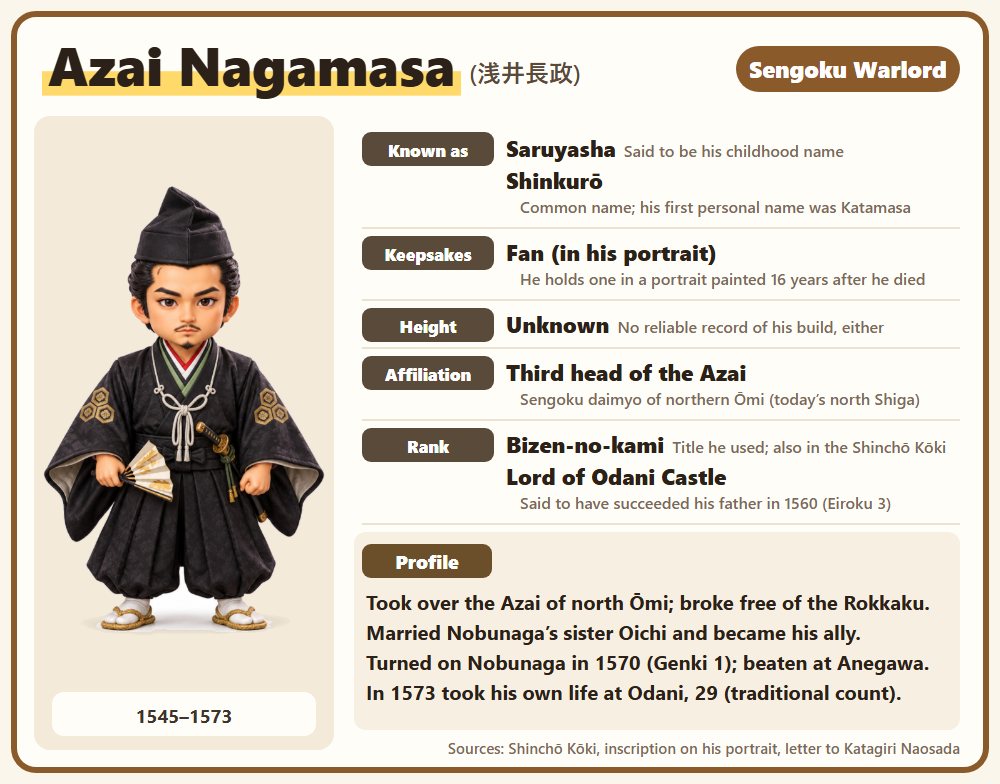
Azai Nagamasa (1545–1573) was a Sengoku-period daimyo (regional lord) who ruled northern Ōmi Province (today's northern Shiga Prefecture). He was the third head of the Azai family, based at Odani Castle (Nagahama, Shiga Prefecture), and he allied himself with Oda Nobunaga by marrying Nobunaga's sister, Oichi. In 1570, however, he broke with Nobunaga and became his enemy, and in 1573 Nobunaga attacked him and he took his own life at Odani Castle.
His three daughters with Oichi, Chacha, Hatsu and Gō, survived him. Chacha and Gō had children, linking Nagamasa's descendants to the Toyotomi family and the Tokugawa shoguns. This article covers Nagamasa's death, his son Manpukumaru, why he turned against Nobunaga and his relationship with Oichi, keeping apart what the records of his time show, what later books say, and what remains unknown.
Western years are given with Japanese lunisolar months and days. The full Western dates given for events in 1570 and 1573 use the Julian calendar; modern dates use the Gregorian calendar. Ages use the traditional Japanese count, in which a person was counted as one at birth and gained a year at the start of each new year in the Japanese calendar.
Key points are tagged: [Fact] confirmed by records from the time, [Widely accepted] a view widely accepted by researchers, [Debated] accounts, interpretations or ways of counting differ, [Unknown] not established from the sources we checked, [Legend] stories found in later records or traditions, [Folk belief] popular claims with little evidence, and [Drama fiction] scenes created for dramas.

I am Uesugi Kenshin. Today's subject is a warrior who was Nobunaga's brother-in-law, yet chose to fight him.

I'm Date Masamune! Azai Nagamasa was Oichi's first husband, right?

Exactly. Why did he end up fighting Nobunaga, and how did he die? Let us follow the records.
The Short Answers
- What did he do? He was the third head of the Azai, the daimyo family of northern Ōmi. He allied with Nobunaga by marrying his sister Oichi, turned against him in 1570, and took his own life at Odani Castle in 1573, which ended the Azai as a daimyo family
[Fact](more) - How did he die? Besieged by Nobunaga at Odani Castle, he killed himself inside the castle at 29 by the traditional count. Records differ on whether he died on the 28th day of the 8th month or the 1st day of the 9th month
[Debated](more) - Who was Manpukumaru? A boy said to have been Nagamasa's heir. He was found after the castle fell and executed at the age of 10 by the traditional count
[Fact: Shinchō Kōki](more) - Why did he betray Nobunaga? The records from his time that we checked do not establish why he broke with Nobunaga, and historians' views differ
[Debated](more) - His relationship with Oichi? It is thought to have been a political marriage to ally with Nobunaga
[Widely accepted]. They had three daughters, Chacha, Hatsu and Gō[Fact](more)
Three Things We Learn by Comparing the Sources
- When exactly did he die? A table comparing the Shinchō Kōki, a letter issued by Nagamasa, and the inscription on his portrait shows why there are two dates (more)
- The "broken promise" story: the famous claim that Nobunaga broke a promise not to attack the Asakura, traced to an Edo-period war tale and read in the original (more)
- The skull cup: what the Shinchō Kōki actually says about the heads of Nagamasa and his allies at Nobunaga's New Year feast, and what it does not say (more)
Jump to the part you want to read:
- Who was Azai Nagamasa? What did he do?
- How did Azai Nagamasa die? The siege of Odani Castle
- Who was Manpukumaru? Nagamasa's children
- Nagamasa and Oichi: their marriage
- Why did Nagamasa turn against Nobunaga?
- What was the Battle of Anegawa?
- Was Nagamasa handsome? Portrait, height and personality
- Where is Odani Castle? Ruins, grave and related places
- Azai Nagamasa's life: a timeline
- Did Nobunaga really make a cup from his skull?
- Azai Nagamasa's descendants and family tree
- FAQ
Who Was Azai Nagamasa? What Did He Do?
In a single sentence, Azai Nagamasa was "Oichi's first husband, a daimyo of northern Ōmi who allied with Nobunaga, later opposed him, and died when Odani Castle fell".
| Item | Details | Reliability |
| Name | Azai Nagamasa. His childhood name was Saruyasha. He first called himself Katamasa and later changed it to Nagamasa. His common name was Shinkurō, and he used the title Bizen-no-kami | [Widely accepted] |
| Born | 1545 (Tenbun 14), a year worked back from his age at death | [Widely accepted] |
| Family | Grandfather Azai Sukemasa; father Azai Hisamasa; mother Ono-dono, a daughter of 井口経元 | Father: [Fact] / Mother: [Widely accepted] |
| Base | Odani Castle (today's Nagahama, Shiga Prefecture) | [Fact] |
| Territory | Northern Ōmi (today's northern Shiga Prefecture) | [Fact] |
| Wife | Oichi, usually described as the younger sister of Oda Nobunaga | Marriage: [Fact: Shinchō Kōki] / Relationship: [Widely accepted] |
| Children | Daughters Chacha (Yodo-dono), Hatsu (Jōkōin) and Gō (Sūgen-in); a son, Manpukumaru, and others | Daughters: [Fact] / Son: see the Manpukumaru section |
| Died | 1573 (Tenshō 1), on the 28th day of the 8th month or the 1st day of the 9th month, by his own hand at Odani Castle | [Debated] |
| Age at death | 29 by the traditional count | [Widely accepted] |
| Grave | Tokushōji temple (Nagahama, Shiga Prefecture), which has the graves of the three generations of the Azai | [Fact] |
Assuming the generally accepted birth year of 1545, he would have been 27 or 28 at his death in modern age reckoning, depending on his birthday, which is unknown.
Three Things He Did
- 1. He led the Azai family while still young: The Azai had been subordinate to the Rokkaku, the daimyo of southern Ōmi, and the "Kata" in his first name Katamasa is said to have come from Rokkaku Yoshikata. In his teens Nagamasa broke with the Rokkaku and is said to have defeated their army at the Battle of Norada (today's Hikone) in 1560 (Eiroku 3). That year he succeeded his father as head of the family
[Widely accepted] - 2. He married Nobunaga's sister and allied with him: By marrying Oichi, he became one of Nobunaga's "relatives"
[Fact: Shinchō Kōki]. When Nobunaga marched on Kyoto in 1568, Nagamasa is said to have attacked the Rokkaku as his ally[Widely accepted] - 3. He fought Nobunaga and was destroyed at Odani Castle: In 1570 (Genki 1) he broke with Nobunaga and became his enemy, and after his defeat at the Battle of Anegawa he went on fighting for more than three years. In 1573 (Tenshō 1) Odani Castle fell and Nagamasa took his own life
[Fact: Shinchō Kōki]
Although the Azai daimyo house fell, Nagamasa's descendants through Chacha and Gō connected him to the Toyotomi, the Tokugawa shoguns and even the imperial family (see the descendants section).
His Father, Azai Hisamasa
Nagamasa's father, Azai Hisamasa, was the second head of the Azai. He protected the family in northern Ōmi while deferring to the Rokkaku of southern Ōmi [Widely accepted]. In 1560 he is said to have handed the headship to Nagamasa, then 16 by the traditional count, and retired [Widely accepted].
Even after retiring, Hisamasa stayed at Odani Castle and fought Nobunaga together with Nagamasa. On the night of the 27th day of the 8th month of 1573, after Hideyoshi seized the Kyōgokumaru enclosure in the middle of the castle, Hisamasa killed himself, before Nagamasa did [Fact: Shinchō Kōki]. He is said to have been in the enclosure called Komaru [Widely accepted].
The stories that "Hisamasa opposed the alliance with Nobunaga" or "gathered the retainers and forced Nagamasa to side with the Asakura" come from war tales written in the Edo period (1603–1868) and cannot be confirmed from records of the time [Legend]. In April 2026, the discovery of a letter from Hisamasa to a retainer, missing for about 100 years, was announced and drew attention (see the Odani Castle section).
Is It "Azai" or "Asai"?
The name 浅井 is usually read "Azai." In Nagahama, the family's home area, it is still read "Azai," and a dictionary from the Muromachi period also writes it "Aza-i." On the other hand, some scholars argue from old place-name readings that "Asai" is correct, so views differ [Debated]. This article uses "Azai." In English books you will see both spellings.
Note that Asano Nagamasa, a retainer of Toyotomi Hideyoshi with a very similar name, is a completely different person.
What Was the Azai Family Crest?
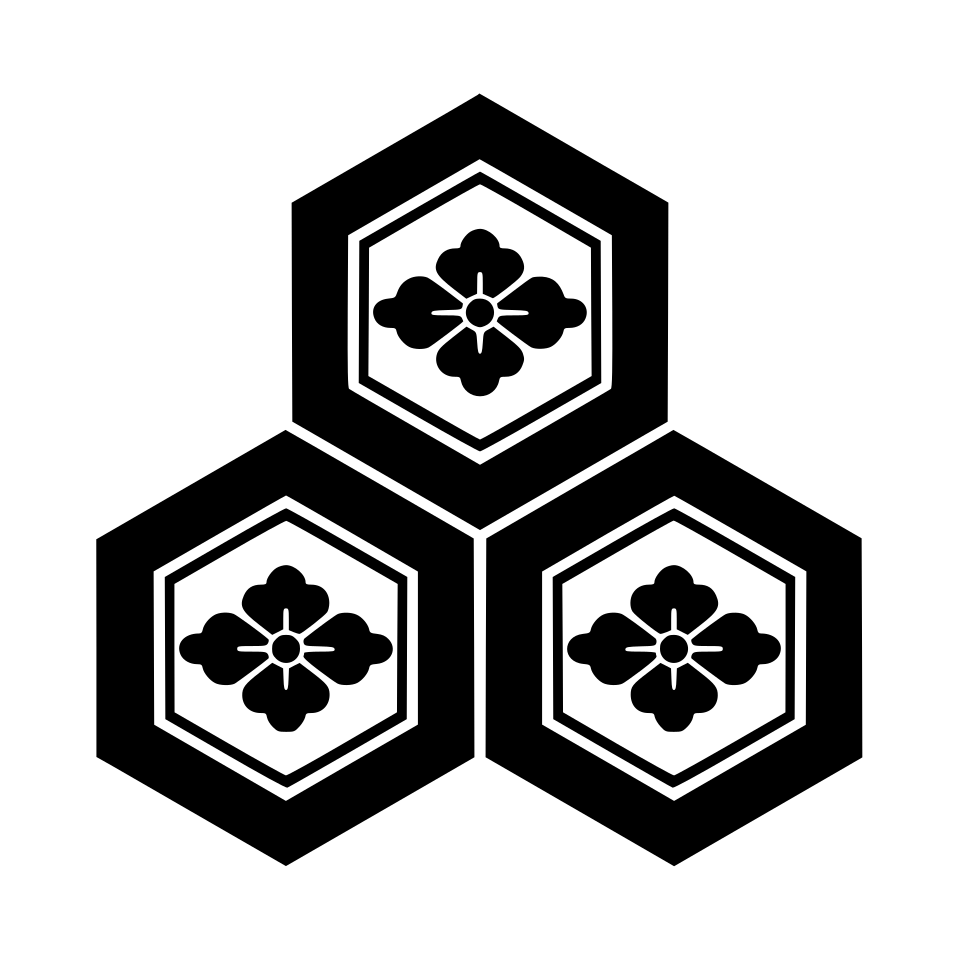
Image: Mitsumori kikkō ni hanabishi. Wikimedia Commons (created by Gameposo, vectorized by Marnanel, CC BY-SA 4.0)
The crest known as the Azai family crest is mitsumori kikkō ni hanabishi: three stacked hexagons shaped like a tortoise shell (kikkō), each with a four-petaled flower (hanabishi) inside [Widely accepted]. A crest of three stacked hexagons also appears on the robe in Nagamasa's portrait, painted in 1589 (see the portrait section).
However, the portrait of his father Hisamasa, kept at the same temple, Jimyō-in, is said to show a crest of a different shape. Since the Azai may have used other crests as well, we cannot say that this was their only crest.

He took over the family young and broke free of a powerful overlord!
Indeed. But the man he allied with next was none other than Nobunaga. From there, his fate took a dramatic turn.
How Did Azai Nagamasa Die? The Siege of Odani Castle
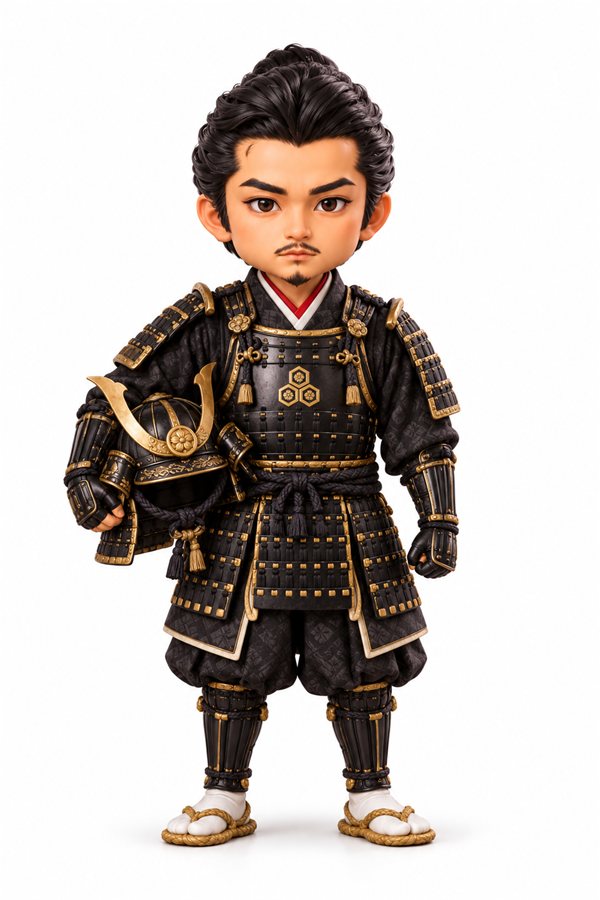
Image: Azai Nagamasa in armor
Azai Nagamasa took his own life inside Odani Castle in 1573 (Tenshō 1), when Oda Nobunaga besieged his home castle [Fact: Shinchō Kōki]. He was 29 by the traditional count. He took his own life during the siege, not from illness; his death is generally described as seppuku (ritual suicide).
There are two dates for his death: the 28th day of the 8th month and the 1st day of the 9th month (September 24 or September 26, 1573, in the Julian calendar) [Debated]. We explain below, record by record, why there are two dates.
How the Siege Unfolded
The fall of Odani Castle is described in detail in the Shinchō Kōki by Ōta Gyūichi, who served Nobunaga. The Shinchō Kōki is a chronicle of Nobunaga that Gyūichi compiled later from what he had seen and heard, and it is one of the most important records for this period.
| Date in 1573 (Tenshō 1) | Event |
| 8th month, 8th day | Atsuji Sadayuki, who held Yamamotoyama Castle for the Azai, goes over to Nobunaga. Nobunaga sets out that night |
| 8th month, 10th day | Nobunaga camps on Mt. Yamada north of Odani Castle, blocking the road from Echizen (today's Fukui Prefecture) |
| Night of the 13th onward | The army of Asakura Yoshikage, which had come to help the Azai, begins to withdraw. Nobunaga pursues it and crushes the Asakura army at Tonezaka |
| Around the 20th | With Nobunaga advancing into Echizen, Asakura Yoshikage kills himself, and the Asakura family is destroyed (the date follows encyclopedias and similar references) |
| 8th month, 26th day | Nobunaga returns to Mt. Toragozen in front of Odani Castle |
| Night of the 27th | Hashiba (later Toyotomi) Hideyoshi seizes the Kyōgokumaru in the middle of the castle, cutting off the enclosure where Nagamasa's father Hisamasa was (said to be the Komaru) from Nagamasa's side. Hisamasa kills himself |
| The next day (the 28th, by the Shinchō Kōki's account) | Nobunaga climbs to the Kyōgokumaru and forces Nagamasa and his retainer Akao Kiyotsuna to kill themselves |
The table follows the account in book 6 of the Shinchō Kōki (only the date of Asakura Yoshikage's death comes from encyclopedias and similar references) [Fact: Shinchō Kōki]. The Shinchō Kōki calls Hisamasa's position simply "Hisamasa's castle"; the name "Komaru" comes from later records and notes on Edo-period maps. As for the date of Nagamasa's death, other records disagree (see below). With the Asakura, the family the Azai relied on, destroyed first, and the castle split in two, Odani Castle could no longer hold out.
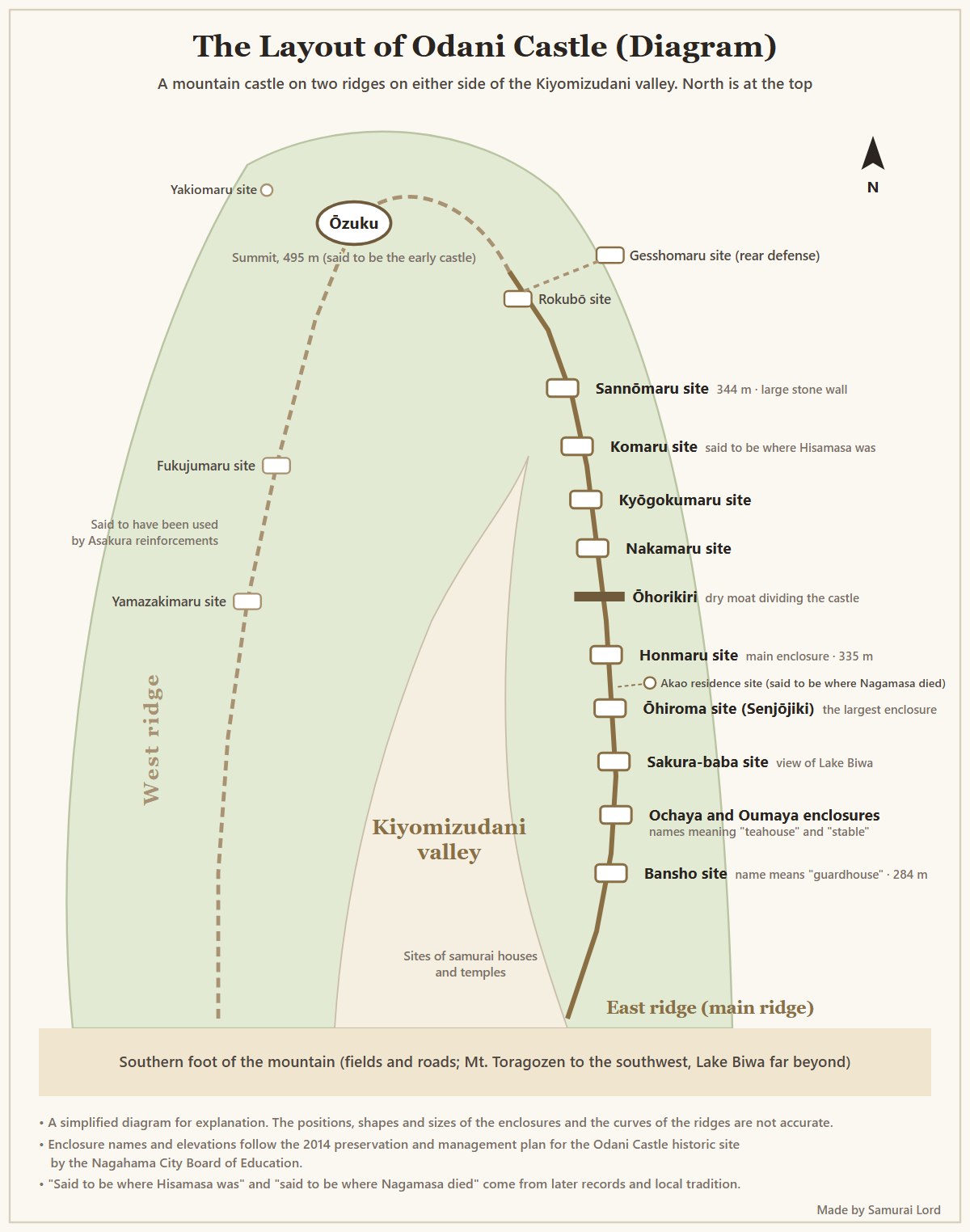
Image: Diagram of Odani Castle (made by Samurai Lord; positions and shapes are not exact). Tap or click to enlarge
Odani Castle was a mountain castle with a row of flat terraces, called kuruwa (enclosures), along the ridge. By taking the Kyōgokumaru in the middle, Hideyoshi was able to corner Hisamasa, north of it, and Nagamasa, south of it, separately.
Source Box ①: Nagamasa's End in the Shinchō Kōki
Source
Ōta Gyūichi, Shinchō Kōki, book 6 (8th month of Tenshō 1, 1573)
Original (excerpt)
「翌日又 信長京極つふらへ御あかり候て 浅井備前 赤生美作生害させ」
Translation
The next day Nobunaga again climbed to the Kyōgokumaru and had Azai Bizen-no-kami (Nagamasa) and Akao Mimasaka-no-kami (Kiyotsuna) take their own lives.
Notes
"Kyōgoku tsubura" means the Kyōgokumaru, and "shōgai sase" means forced them to kill themselves. The Shinchō Kōki does not name the place where Nagamasa died or describe the scene in detail
Did He Die on the 28th Day of the 8th Month or the 1st Day of the 9th Month?
According to the Shinchō Kōki, Hisamasa killed himself on the night of the 27th day of the 8th month, and Nagamasa "the next day," which makes it the 28th day of the 8th month. On the other hand, some records give the 1st day of the 9th month.
| Record | What it says | Which date it supports |
| Shinchō Kōki, book 6 | Nagamasa was forced to kill himself "the next day" after the night of the 27th, when Hisamasa died | The 28th day of the 8th month |
| A letter of commendation to Katagiri Naosada | A letter (kanjō) praising the service of his retainer Katagiri Naosada, dated "the 29th day of the 8th month of Genki 4." It still survives | Does not fit the 28th (he would still have been alive on the 29th) |
| The inscription on the portrait "Azai Nagamasa" | "He died on the 1st day of the 9th month of Tenshō 1." Written above the portrait in 1589 (Tenshō 17), sixteen years after his death, for his seventeenth memorial observance | The 1st day of the 9th month |
| Asai Sandaiki (an Edo-period war chronicle of three generations of the Azai) | He died on the 1st day of the 9th month | The 1st day of the 9th month |
The 8th month of Tenshō 1 had only 29 days, so the day after the 29th day of the 8th month was the 1st day of the 9th month. If we accept the letter as one Nagamasa issued that year, it does not fit his death on the 28th. The letter alone, however, does not prove that he died on the 1st day of the 9th month. It is the portrait inscription and the Asai Sandaiki that clearly give that date. For this reason, this article presents both dates [Debated].
The letter is dated with the old era name, "Genki 4," rather than the new era name "Tenshō," adopted in the 7th month of that year. Its recipient, Katagiri Naosada, was the father of Katagiri Katsumoto, who later served as a senior retainer of Toyotomi Hideyori.
Source Box ②: "The 1st Day of the 9th Month" on Nagamasa's Portrait
Source
The inscription (san) on the portrait "Azai Nagamasa" (Jimyō-in, Mt. Kōya)
Original (excerpt)
「天正元癸酉九月朔、罹于兵燹矣。後十七年、有人命工画其肖像」
Translation
On the 1st day of the 9th month of Tenshō 1 (1573, the cyclical year mizunoto-tori), he lost his life in the warfare. In the seventeenth year, counting the year of his death as the first, someone commissioned a painter to portray him.
Notes
"Saku" means the first day of the month. In the past, the year of death was counted as the first year, so "the 17th year" means 16 years later by the modern count. The inscription was written by 錬甫宗純, who had served as head priest of Nanzenji temple in Kyoto, and is dated the 12th month of Tenshō 17 (1589). It shows that a text written 16 years after Nagamasa's death gives "the 1st day of the 9th month"
Where Did He Die?
The Shinchō Kōki says Nagamasa killed himself together with his retainer Akao Kiyotsuna but does not name the place [Fact: Shinchō Kōki]. In the Edo-period Asai Sandaiki, Nagamasa went into Akao Kiyotsuna's residence inside the castle and killed himself there [Legend: Asai Sandaiki].
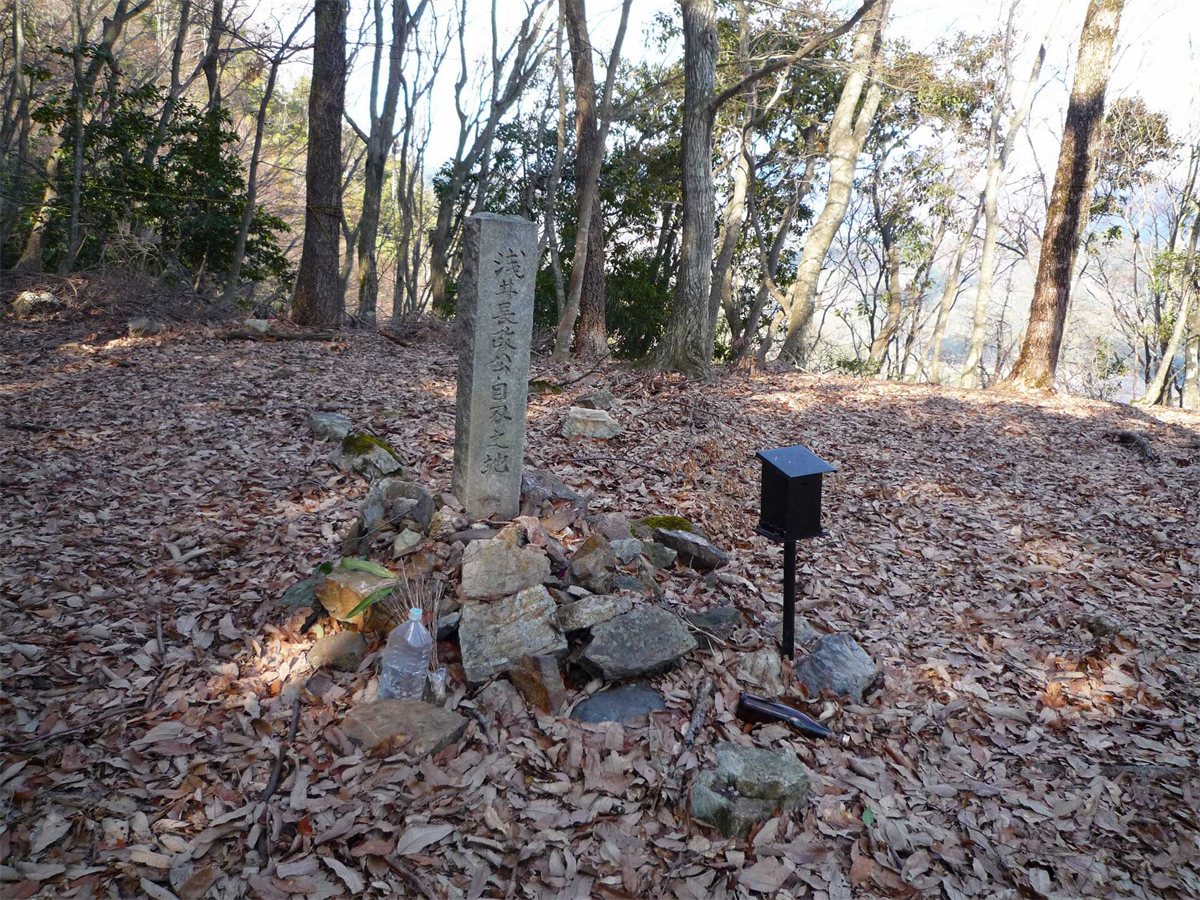
Image: The monument "Azai Nagamasa-kō Jijin no Chi" ("the place where Lord Azai Nagamasa took his life") at the Odani Castle ruins (Nagahama, Shiga Prefecture). It stands at the spot said to be the Akao residence site and marks a traditional location; the place has not been confirmed by records of the time. Wikimedia Commons (photo: Heartoftheworld, CC BY-SA 3.0)
Who Acted as His Second (Kaishaku)?
Kaishaku is the act of beheading a person committing seppuku to shorten their suffering. In the records from his time that we checked, we found no account identifying Nagamasa's second [Unknown].
- Asai Sandaiki (an Edo-period war tale): says that Azai Hyūga-no-kami, a member of the family, acted as his second and then killed himself
[Legend] - In the case of his father Hisamasa: the Shinchō Kōki records that the dancer Tsurumatsu-dayū acted as Hisamasa's second and then cut his own belly
[Fact: Shinchō Kōki] - Did Oichi act as his second? A scene in NHK's 2026 historical drama Toyotomi Kyōdai! shows Oichi performing kaishaku for Nagamasa, but we found no support for this scene in the historical sources we checked; it is a dramatization
[Drama fiction]
What Happened to Oichi and the Three Daughters?
Oichi and her three daughters left the castle before it fell and were taken in by the Oda family [Widely accepted]. How they left the castle is told in later books, and the details are unknown [Legend]. For their life afterward, see our article on Oichi.
What Happened to His Head?
The heads of Nagamasa and Hisamasa were sent to Kyoto and put on public display [Fact: Shinchō Kōki]. Furthermore, the Shinchō Kōki records that at a New Year feast the following year, they were brought out at Nobunaga's drinking party, treated as hakudami, together with the head of Asakura Yoshikage. We look at this story in the skull section.
Who Was Manpukumaru? His End, His Mother, and Nagamasa's Children
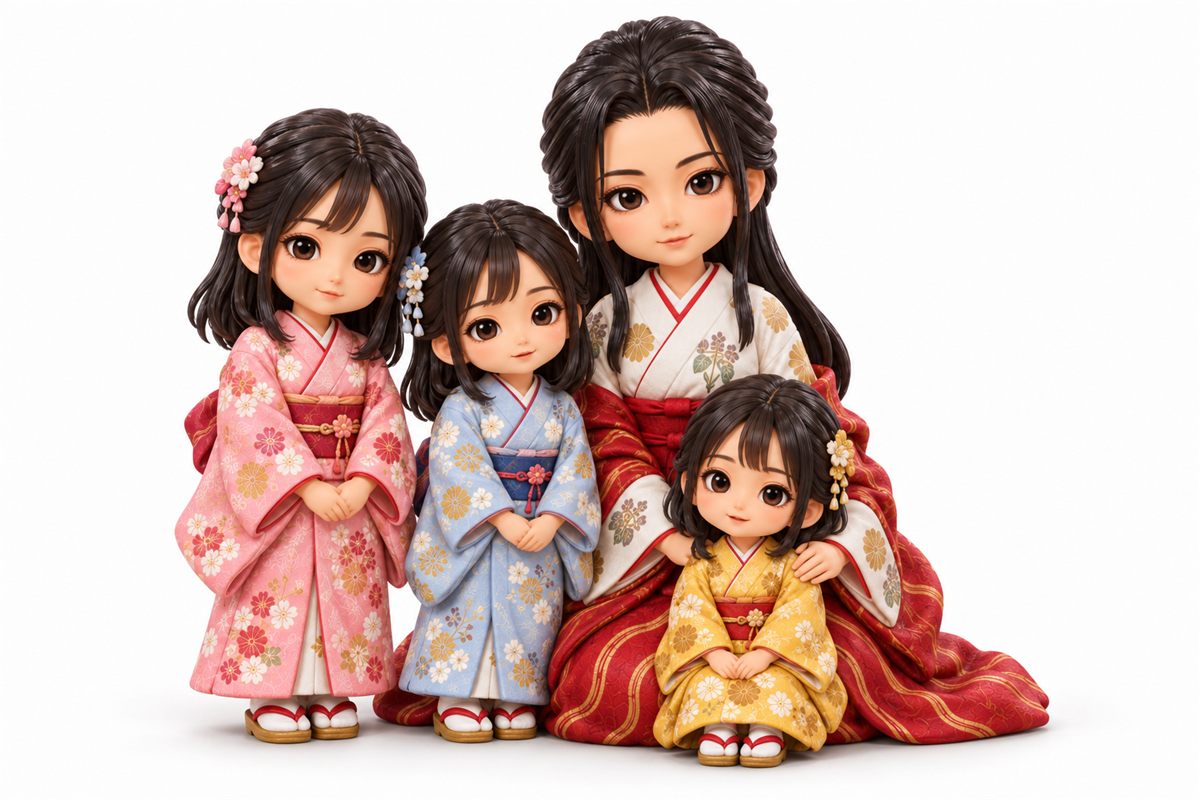
Image: Oichi and her three daughters
Manpukumaru was a boy said to have been Azai Nagamasa's heir. After Odani Castle fell he was found and executed at the age of 10 by the traditional count [Fact: Shinchō Kōki]. Working back from that age, he was born around 1564 (Eiroku 7).
However, the Shinchō Kōki says only "the 10-year-old heir of Azai Bizen-no-kami" and does not give his name. The name "Manpukumaru" comes from the Edo-period Asai Sandaiki and similar books.
Source Box ③: Nagamasa's Heir in the Shinchō Kōki
Source
Ōta Gyūichi, Shinchō Kōki, book 6 (Tenshō 1, 1573)
Original (excerpt)
「浅井備前十歳之嫡男御座候を尋出し関か原と云所に張付に懸させられ」
Translation
Azai Bizen-no-kami (Nagamasa) had a 10-year-old heir; he was searched out and crucified at a place called Sekigahara.
Notes
Haritsuke, translated here as crucifixion, was a Japanese form of execution in which the condemned person was tied to a wooden frame and killed with spears. The Shinchō Kōki says that by this Nobunaga "cleared away his long-held resentment." It does not give the boy's name or where he had been hiding
How Did Manpukumaru Die? Crucifixion or Impalement?
Records describe Manpukumaru's end differently. Let us compare the Shinchō Kōki, close to his time, with the Edo-period Asai Sandaiki.
| Point | Shinchō Kōki (record by Ōta Gyūichi, who served Nobunaga) | Asai Sandaiki (Edo-period war tale) |
| Name | Not given ("the 10-year-old heir") | Manpukumaru |
| How he was found | Says only that he was "searched out" | He had fled with retainers toward Tsuruga in Echizen but was handed over to Hideyoshi at Kinomoto (Nagahama) |
| His end | Crucified at Sekigahara (today's Sekigahara, Gifu Prefecture) | Impaled on Nobunaga's orders |
| Date | Not given | Says he arrived at Kinomoto on the 3rd day of the 9th month (the date of execution is unclear) |
What can be confirmed is the Shinchō Kōki's statement that he was "crucified at Sekigahara" [Fact: Shinchō Kōki]. The impalement and the story of Hideyoshi taking him at Kinomoto come from Edo-period books [Legend: Asai Sandaiki]. We found no record that confirms the date of his execution [Unknown].
Only 10 years old... That's just cruel.
In the age of war, the heir of a defeated house was hunted down as someone who might one day take revenge. It is harsh, but that was the reality of war in this era.
Who Was Manpukumaru's Mother? Was He Oichi's Son?
His mother is unknown [Unknown]. Some stories make him Oichi's son, but in the sources we checked we found no reliable identification of his mother, and researchers note that no source shows his mother was Oichi.
If Oichi married Nagamasa at the end of 1567 or the beginning of 1568, as many encyclopedias say, then Manpukumaru, born around 1564, does not fit the picture of a son born after their marriage. The dates alone, however, do not establish who his mother was. Some researchers, however, think the marriage took place earlier, in which case he may have been her son [Debated].
Nagamasa's Other Sons
Nagamasa is said to have had other sons as well, but none of them can be confirmed from records of his time.
- Manjumaru: a boy born in the 5th month of 1573 is said to have been entrusted to Fukudenji temple in Ōmi (Maibara, Shiga Prefecture) and later to have become a monk named 正芸
[Legend] - Azai Iyori: some genealogies make him Nagamasa's son, and he is said to have served the Toyotomi and others
[Legend]
The Asai Sandaiki says that Nagamasa had "five children, three of them daughters and two of them sons" [Legend].
His Three Daughters (the Azai Sisters)
His three daughters with Oichi later became known as the "three Azai sisters," and each played an important role at the end of the Sengoku period.
| Name | Born | Marriage and later life |
| Chacha (Yodo-dono) | Around 1569 [Debated] | Became a consort of Toyotomi Hideyoshi and bore his heir, Hideyori. She died with Hideyori at the siege of Osaka |
| Hatsu (Jōkōin) | Around 1570 [Debated] | Wife of Kyōgoku Takatsugu. During the siege of Osaka she was involved in talks between the Toyotomi and Tokugawa sides |
| Gō (Sūgen-in) | 1573 | In her third marriage she became the wife of Tokugawa Hidetada, the second shogun, and bore the third shogun, Iemitsu |
That the three were the daughters of Oichi and Nagamasa is certain [Fact]. Their birth years are worked back from later records. For their later lives, see "Oichi's Three Daughters" in our article on Oichi.
Nagamasa and Oichi: Their Marriage
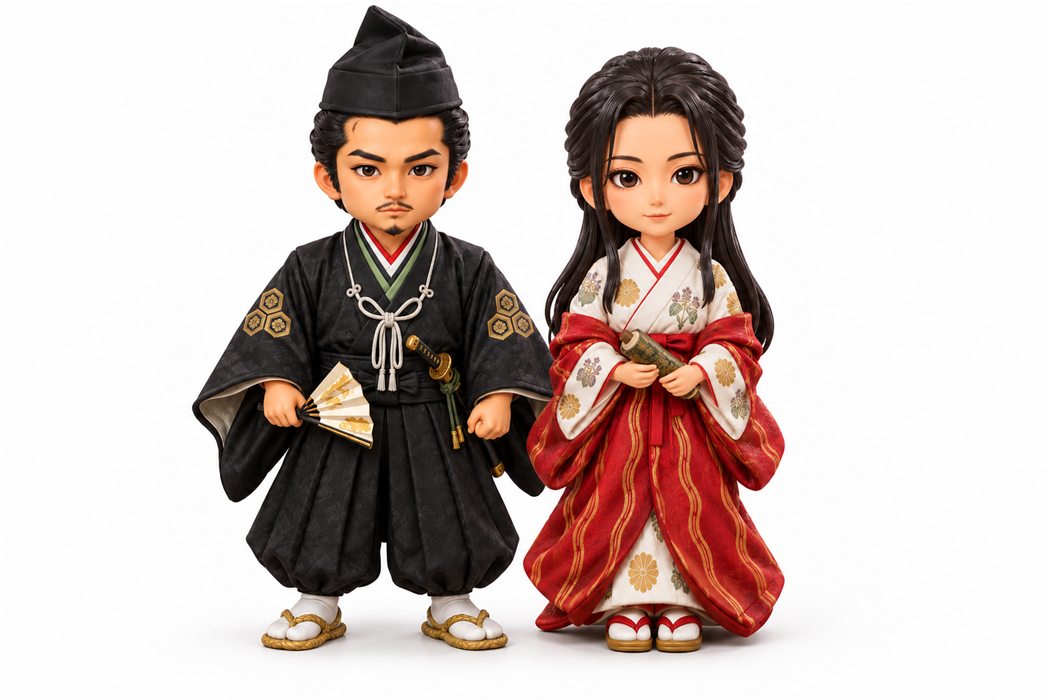
Image: Azai Nagamasa and Oichi
The marriage of Nagamasa and Oichi was a political marriage to ally the Azai and Oda families [Widely accepted]. If it took place around 1567–68, as is often said, Nobunaga had taken Mino (today's Gifu Prefecture) and was preparing to march on Kyoto, and keeping the Azai of northern Ōmi, who lay along the way, on his side was important to him.
The Shinchō Kōki records that in 1570 (Genki 1) Nobunaga regarded the Azai as "clearly relatives" [Fact: Shinchō Kōki]. So it is certain that they were married by 1570 at the latest.
When Did They Marry, and How Far Apart Were Their Ages?
When they married is not clear [Debated]. Many encyclopedias today give the end of 1567 or the beginning of 1568, but some researchers think it was earlier, around 1559 to 1563.
If Nagamasa was born in 1545 and Oichi in 1547, the age difference was two years. Both birth years, however, are worked back from later records [Widely accepted].
Were They a Loving Couple?
Because they had three daughters, they are often described as "a loving couple." However, in the records from the time that we checked, we found nothing that directly tells us their feelings or how they got along [Unknown].
The famous story that, when Nobunaga and Nagamasa became enemies, Oichi warned Nobunaga by sending him a bag of red beans tied at both ends is also found in Edo-period books [Legend]. For the story from Oichi's side, see "First Marriage: Azai Nagamasa" in our article on Oichi.
We can't know how they really felt... but it's touching that their daughter later held memorial services for her father.
True. We will look at the portrait story in a later section.
Why Did Azai Nagamasa Turn Against Nobunaga? Kanegasaki and the Theories

Image: Oda Nobunaga
In the records from his time that we checked, we found nothing that establishes why Nagamasa broke with Nobunaga. Historians' views also differ, and no single reason can be stated with certainty [Debated]. Let us start with the Battle of Kanegasaki, where the betrayal happened.
What Was the Battle of Kanegasaki (the Kanegasaki Retreat)?
In the 4th month of 1570 (Genki 1), Nobunaga invaded Tsuruga (Tsuruga, Fukui Prefecture) to attack Asakura Yoshikage of Echizen (today's Fukui Prefecture), and took Tezutsuyama and Kanegasaki castles [Fact: Shinchō Kōki]. Then word arrived that Azai Nagamasa had turned against him.
The Azai's northern Ōmi lay right beside the roads leading from Tsuruga back to Kyoto and Gifu. With Nagamasa as an enemy, Nobunaga would be caught between the Asakura in front and the Azai behind. Leaving Kinoshita Tōkichirō (later Toyotomi Hideyoshi) at Kanegasaki Castle, Nobunaga withdrew to Kyoto on the 30th day of the 4th month by a mountain road through Kutsuki in Ōmi [Fact: Shinchō Kōki]. This retreat is known as "the Kanegasaki retreat" (Kanegasaki no nokiguchi).
Who besides Hideyoshi stayed behind to fight, and how they fought, differ from record to record [Debated].
Two years earlier, in the 12th month of 1568, Nagamasa and his father Hisamasa had jointly issued a sworn pledge (kishōmon) to the Kutsuki family, who now helped Nobunaga retreat. The document survives today in the National Archives of Japan [Fact]. The Kutsuki, who had ties to the Azai, sided with Nobunaga this time.
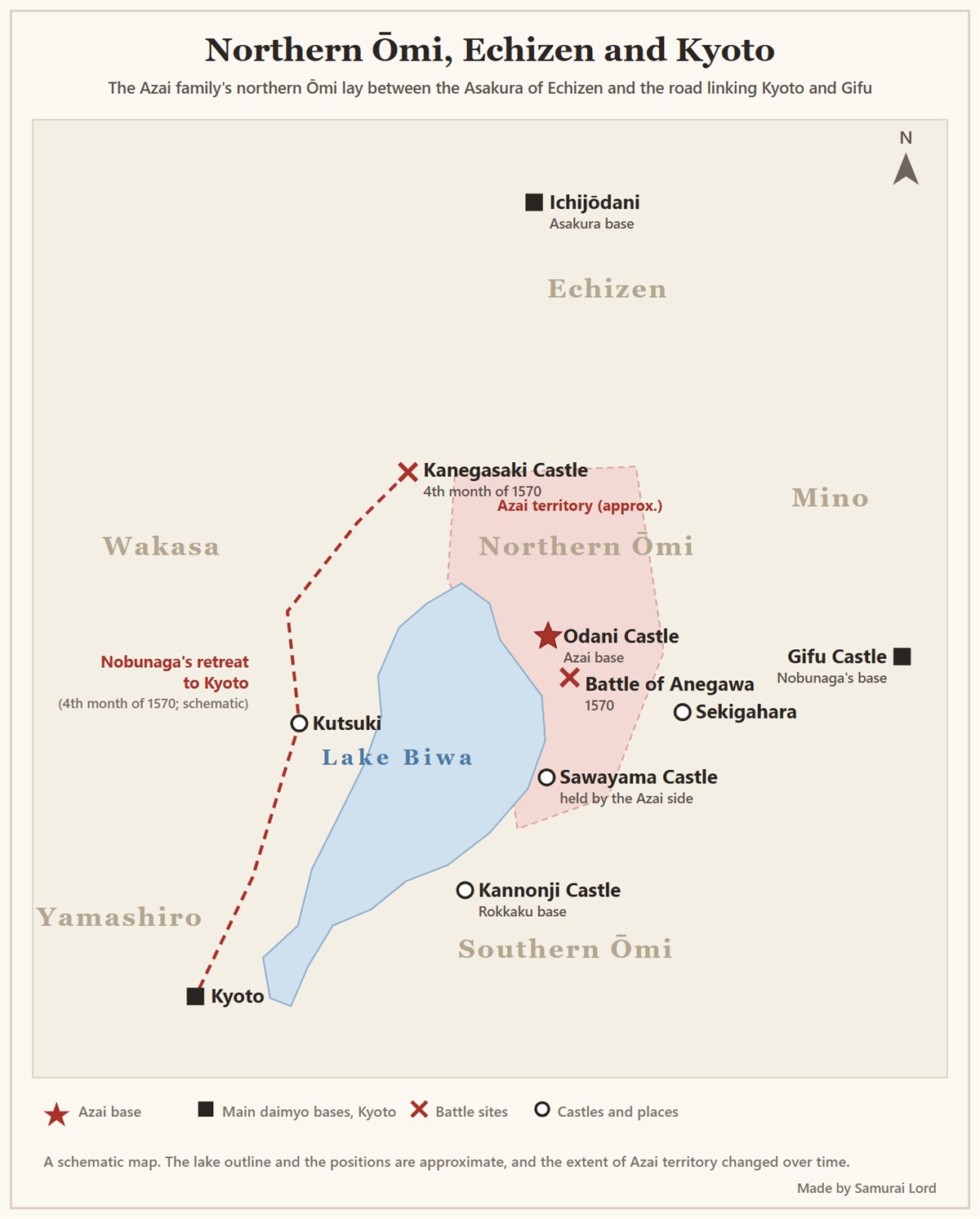
Image: Northern Ōmi, Echizen and Kyoto (a schematic map made by Samurai Lord). Tap or click to enlarge
Source Box ④: "The Azai Betrayal" in the Shinchō Kōki
Source
Ōta Gyūichi, Shinchō Kōki, book 3 (4th month of Genki 1, 1570)
Original (excerpt)
「浅井者歴然為御縁者之上剰江北一円に被仰付之間不足不可有之条可為虚説と思食候処従方々事実之注進候」
Translation
Since the Azai were clearly his relatives, and moreover he had entrusted them with all of northern Ōmi, they could have no grievance; so he thought it must be a false report. But reports came in from all sides that it was true.
Notes
This shows that Nobunaga could not believe Nagamasa's betrayal at first. On the other hand, why Nagamasa turned against him is not written here either
Why Did He Do It? Historians' Theories
The following theories have been put forward [Debated]:
| Theory | The idea | Main proponents |
| Old ties with the Asakura | He could not abandon the Asakura, with whom the family had been linked since his grandfather's time | The traditional explanation in encyclopedias and similar works; some research questions whether the Azai and Asakura were really old allies |
| Subordinate to the Asakura | The Azai were closer to being subordinate to the Asakura than an equal ally | 長谷川裕子 |
| Discontent over rewards | After the war with the Rokkaku, the Azai were not rewarded enough, and the retainers' discontent led them away from Nobunaga | Owada Tetsuo |
| Fear of Nobunaga | Surrounded by Nobunaga's retainers, he feared he would be attacked next | Kuroda Motoki |
| A clash of systems | The Azai way, supported by retainers and local communities, did not fit Nobunaga's way of doing things | Miyajima Keiichi |
All of these are historians' interpretations, and we found no record that settles the question. Several reasons may have combined.
Edo-period war tales also say that he broke with Nobunaga at the invitation of the shogun, Ashikaga Yoshiaki. However, we found no record from his time confirming this as the reason for his break in the 4th month of 1570 [Legend].
Is the "Promise Not to Attack the Asakura" Story True?
You often see the claim that "Nobunaga had promised Nagamasa not to attack the Asakura, and was betrayed because he broke that promise." But this story comes from the Asai Sandaiki, written in the Edo period.
Source Box ⑤: The "Written Pledge" in the Asai Sandaiki (an Example from a Later Book)
Source
Asai Sandaiki, book 13 (a war tale said to have been compiled by a monk of a temple in Ōmi in the late 17th century, in the Edo period)
Original (excerpt)
「越前の国の儀は浅井か指図にまかすへきと堅く誓紙をかゝるれと」
Translation
Although Nobunaga had solemnly pledged in writing that matters concerning the province of Echizen would be left to the Azai's direction...
Notes
These words are given as a line spoken by his father Hisamasa. The content is "matters concerning Echizen would be left to the Azai's direction," and the words themselves do not say "the Asakura will not be attacked." The Asai Sandaiki is considered a book with many fictional passages, and this promise cannot be confirmed from records of the time
In other words, the idea that "he betrayed Nobunaga because the promise was broken" is a story that spread from Edo-period books [Legend]. The story that "his father Hisamasa and the retainers overruled Nagamasa" also comes mainly from such war tales [Legend].
So even the famous stories often come from Edo-period books!
Nagamasa's true feelings cannot be found in the records we have. That is exactly why so many theories arose.
What Was the Battle of Anegawa? Location and Outcome
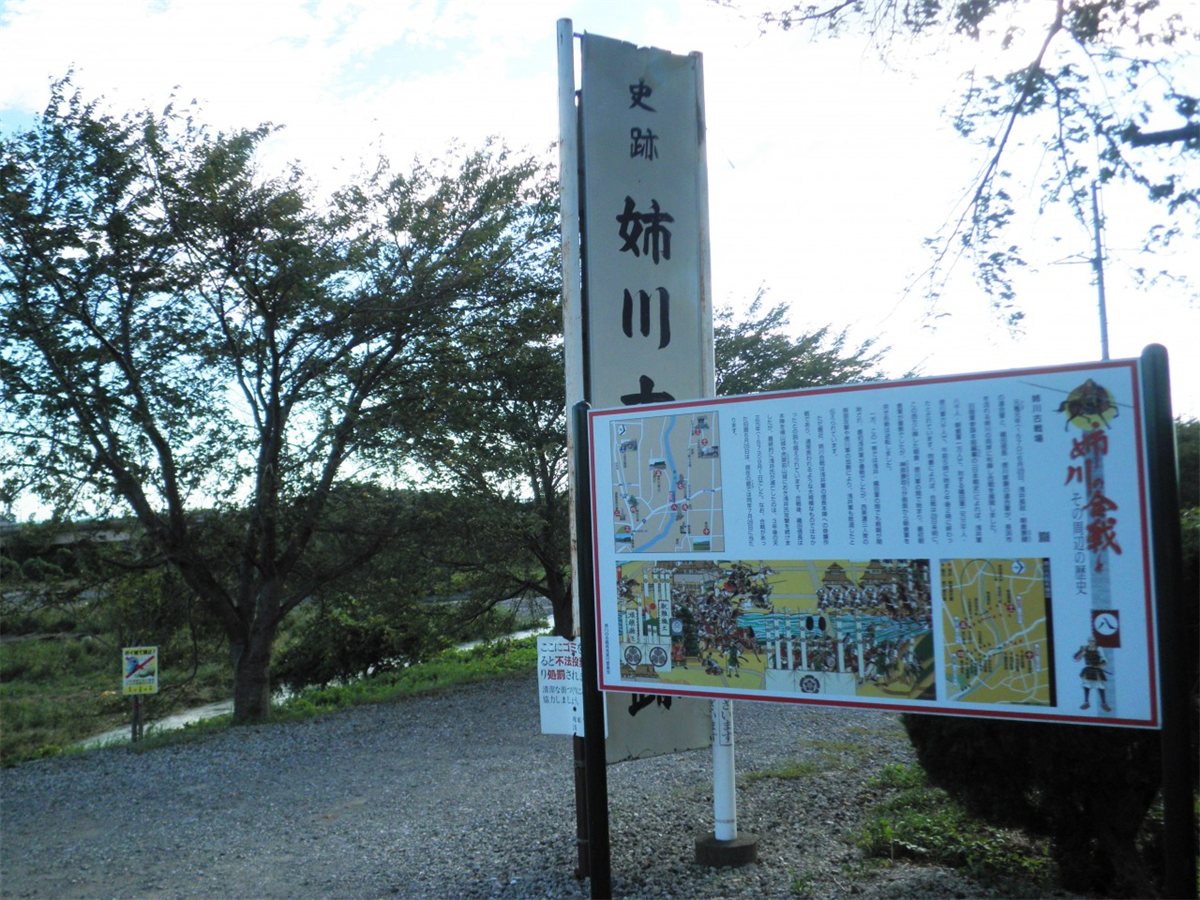
Image: The Anegawa battlefield (Nagahama, Shiga Prefecture). Wikimedia Commons (photo: 立花左近, CC BY-SA 3.0)
The Battle of Anegawa was fought on the 28th day of the 6th month of 1570 (Genki 1; July 30, 1570, in the Julian calendar) on the banks of the Ane River in Ōmi (today's Nagahama, Shiga Prefecture) between the armies of Oda Nobunaga and Tokugawa Ieyasu and the armies of Azai Nagamasa and the Asakura. It ended in a victory for the Oda and Tokugawa [Fact: Shinchō Kōki].
Where Was It?
The battlefield lies around the Ane River, which flows south of Odani Castle, in what are today the Nomura and Mita areas of Nagahama, where a monument to the battlefield stands. The Azai and Asakura armies faced the Ane River and camped in two places, Nomura and Mitamura [Fact: Shinchō Kōki]. The Azai army is thought to have been at Nomura and the Asakura army at Mitamura [Widely accepted].
For the location, see the map in the section on his betrayal above.
Who Fought Whom, and How Many Troops?
- The Oda and Tokugawa armies: Nobunaga and the army of his ally Ieyasu. Ieyasu fought on the western side, toward Mitamura
[Fact: Shinchō Kōki] - The Azai and Asakura armies: the Shinchō Kōki gives the Asakura army as about 8,000 and the Azai army as about 5,000
[Fact: Shinchō Kōki]
The size of the Oda and Tokugawa armies varies greatly between records and is unclear [Debated]. For Ieyasu, see our article on Tokugawa Ieyasu.
What Was the Outcome?
The Oda and Tokugawa armies won. The Shinchō Kōki says they took the heads of more than 1,100 leading men of the Azai and Asakura side (this is not a count of all the dead on both sides). Some other records give several thousand, so the number of dead is unclear [Debated].
The Azai retainer Endō Naotsune was killed in this battle. One manuscript of the Shinchō Kōki says that he was killed by Takenaka Kyūsaku, the younger brother of Takenaka Hanbei [Fact: Shinchō Kōki]. For Hanbei, see our article on Takenaka Hanbei.
The story of the Azai retainer Isono Kazumasa breaking through the Oda army's lines one after another, the "breakthrough of eleven ranks," is a tradition found in the Asai Sandaiki [Legend].
Defeat Did Not Mean Immediate Destruction
Even after the defeat at Anegawa, the Azai were not destroyed at once. Nagamasa joined forces with the Asakura and others, and went on fighting Nobunaga from Odani Castle for more than three years [Fact].
- 6th month of 1570 (Genki 1): Nobunaga placed Hideyoshi at Yokoyama Castle, south of Odani Castle, to watch the Azai
[Fact: Shinchō Kōki] - 2nd month of 1571 (Genki 2): the retainer Isono Kazumasa, who held Sawayama Castle (Hikone), handed the castle over to Nobunaga
[Fact: Shinchō Kōki] - 7th month of 1572 (Genki 3): Nobunaga built a fort on Mt. Toragozen, right in front of Odani Castle, and had Hideyoshi hold it
[Fact: Shinchō Kōki] - 8th month of 1573 (Tenshō 1): the retainer Atsuji Sadayuki went over to Nobunaga, and Odani Castle fell
[Fact: Shinchō Kōki]
Rather than storming the castle all at once, Nobunaga gradually drew the Azai retainers to his side and steadily tightened his grip on Odani Castle.
Was Azai Nagamasa Handsome? Portrait, Height and Personality
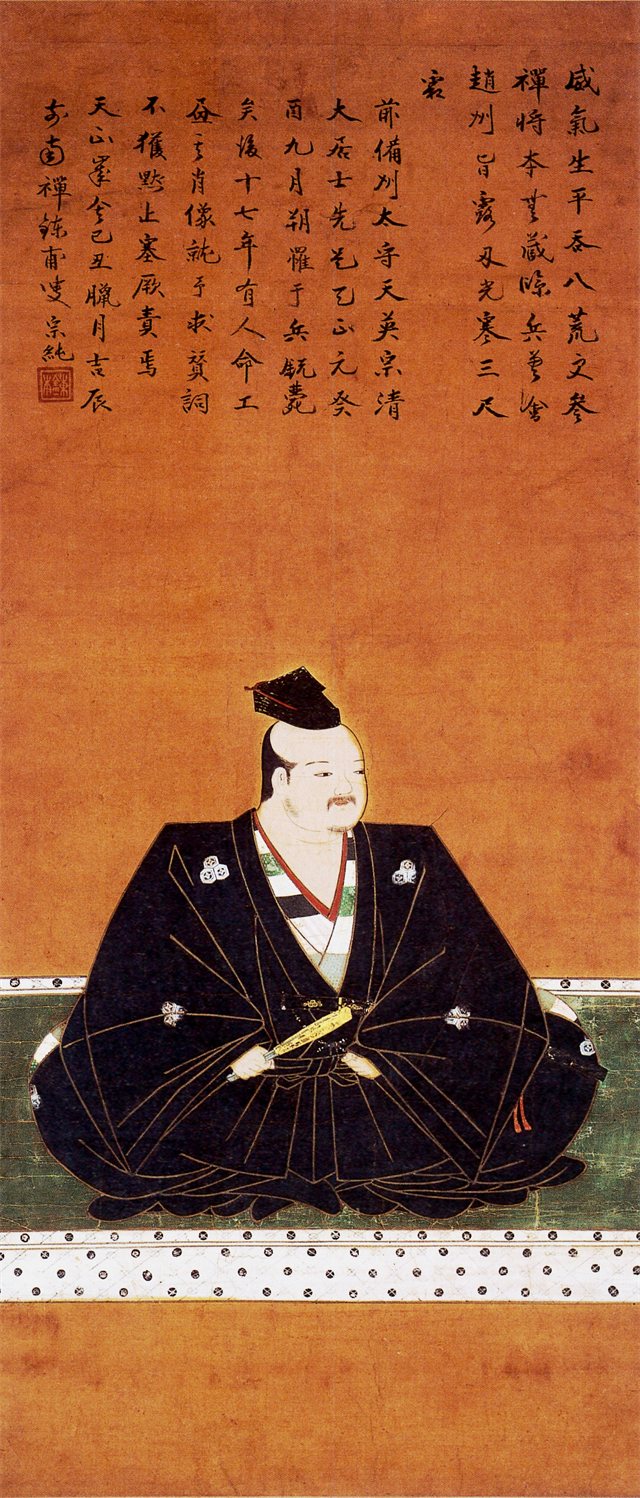
Image: "Azai Nagamasa" (Jimyō-in, Mt. Kōya; Important Cultural Property). Wikimedia Commons (public domain)
In games and TV dramas, Nagamasa is often shown as a dashing, handsome young warrior. However, in the records from his time that we checked, we found no description of his looks, so whether he was really handsome is unknown [Unknown].
The Surviving Portrait Was Painted 16 Years After His Death
The best-known picture of Nagamasa is the portrait "Azai Nagamasa" kept at Jimyō-in temple on Mt. Kōya (Kōya, Wakayama Prefecture). It is designated an Important Cultural Property of Japan [Fact].
- When it was painted: 1589 (Tenshō 17), the year of his seventeenth memorial observance (counting the year of his death as the first, that is, 16 years after his death), as the inscription states
[Fact] - Who had it painted: the inscription says only "someone." It is thought to have been Chacha, the eldest daughter of Nagamasa and Oichi
[Widely accepted] - His appearance: he sits holding a fan, wearing a small eboshi cap and black clothing
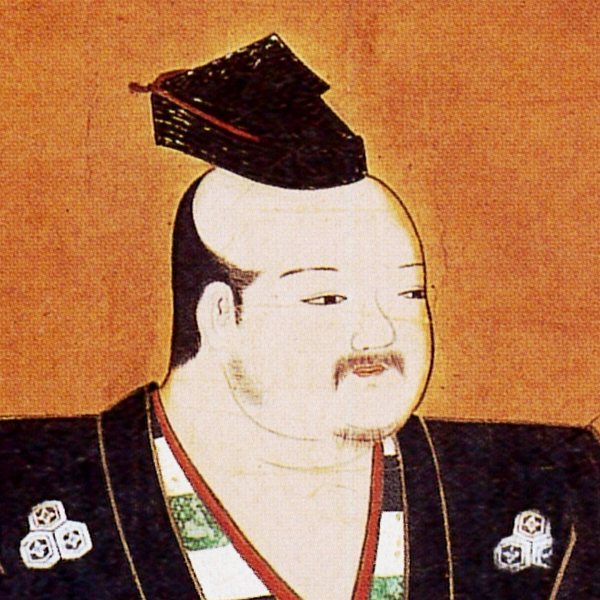
Image: Detail of the face in "Azai Nagamasa." A crest of three stacked hexagons can be seen on the sleeve. Wikimedia Commons (public domain)
The portrait shows Nagamasa with a full, rounded face. But since it was painted 16 years after his death, we cannot tell how faithfully it shows his real face. Nor can we decide from this portrait whether he was overweight.
Where Does the Handsome Image Come From?
In today's games and dramas, Nagamasa is often drawn as a dashing figure, a warrior who met a tragic end while still young. In Edo-period ukiyo-e prints, too, he was depicted as a valiant warrior.
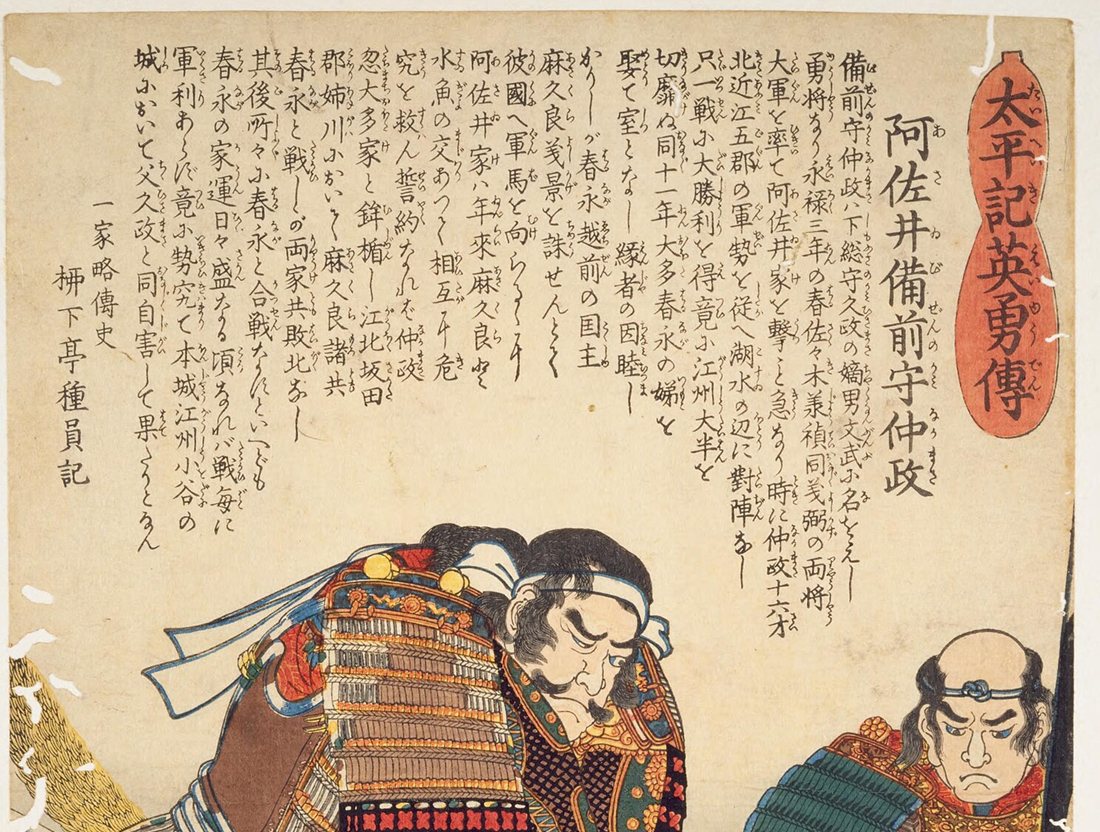
Image: Part of Utagawa Kuniyoshi's print of Asai Bizen-no-kami Nakamasa (Azai Nagamasa) from the series Taiheiki Eiyūden (late Edo period). Collection of the National Diet Library. Wikimedia Commons (public domain)
In this print his name is written with slightly altered characters, "Asai Bizen-no-kami Nakamasa." In the Edo period, artists often depicted Sengoku warlords with the characters of their names changed.
How Tall Was He?
We found no reliable record of Nagamasa's height [Unknown]. In the records from his time that we checked, we also found no reliable description of his build.
What Was He Like? Clues to His Character
Few records tell us directly about Nagamasa's character. One clue is the letter of commendation dated the 29th day of the 8th month mentioned above. According to researchers, it praises and thanks his retainer Katagiri Naosada, who fought with him to the end, just before the castle fell. Such a letter could also serve as proof of a retainer's merit if he went on to serve another lord.
The historian Ōta Hiroshi also points out that the heads of the Azai acted as "mediators," settling disputes within their domain according to established custom.
On the other hand, the image of Nagamasa as "loyal" and "warm-hearted" spread from later war tales and stories [Legend].
Nagamasa looks gentler in his portrait than I expected.
The portrait is thought to have been commissioned by Chacha in memory of her father. Knowing that, it looks a little different, does it not?
Where Is Odani Castle? The Ruins, His Grave and Related Places
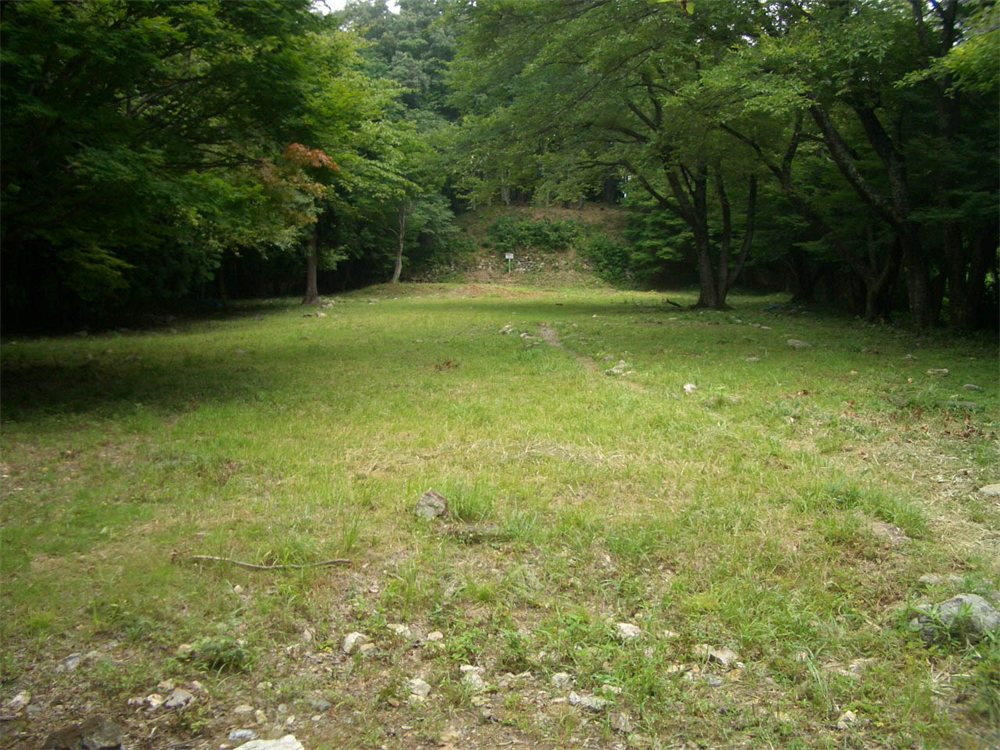
Image: The Senjōjiki at the Odani Castle ruins (Nagahama, Shiga Prefecture). Wikimedia Commons (photo: ブレイズマン, public domain)
Odani Castle was a mountain castle on Mt. Odani in Ibe, Kohoku-chō, Nagahama, Shiga Prefecture. It is thought to have been built by Nagamasa's grandfather Sukemasa [Widely accepted], and it served as the base of three generations of the Azai: Sukemasa, Hisamasa and Nagamasa [Fact]. It is said to have been built in the Daiei era (early 1520s), with theories giving around 1524 or 1525 [Debated].
The site is a national historic site, "Odani Castle Ruins" (designated in 1937, with the Kiyomizudani area at the foot of the mountain added in 1995) [Fact]. It is also on the list of "Japan's 100 Great Castles" and is known as a leading example of a castle built on a mountain.
What Was the Castle Like?
Odani Castle had a row of enclosures along the mountain ridge, including the Honmaru, Nakamaru, Kyōgokumaru, Komaru and Sannōmaru, and its highest point, Ōzuku, is about 495 meters above sea level [Fact]. In the Kiyomizudani valley at the foot of the mountain stood the residences of the Azai and their retainers [Fact]. For the layout of the enclosures, see the diagram in the section on his death.
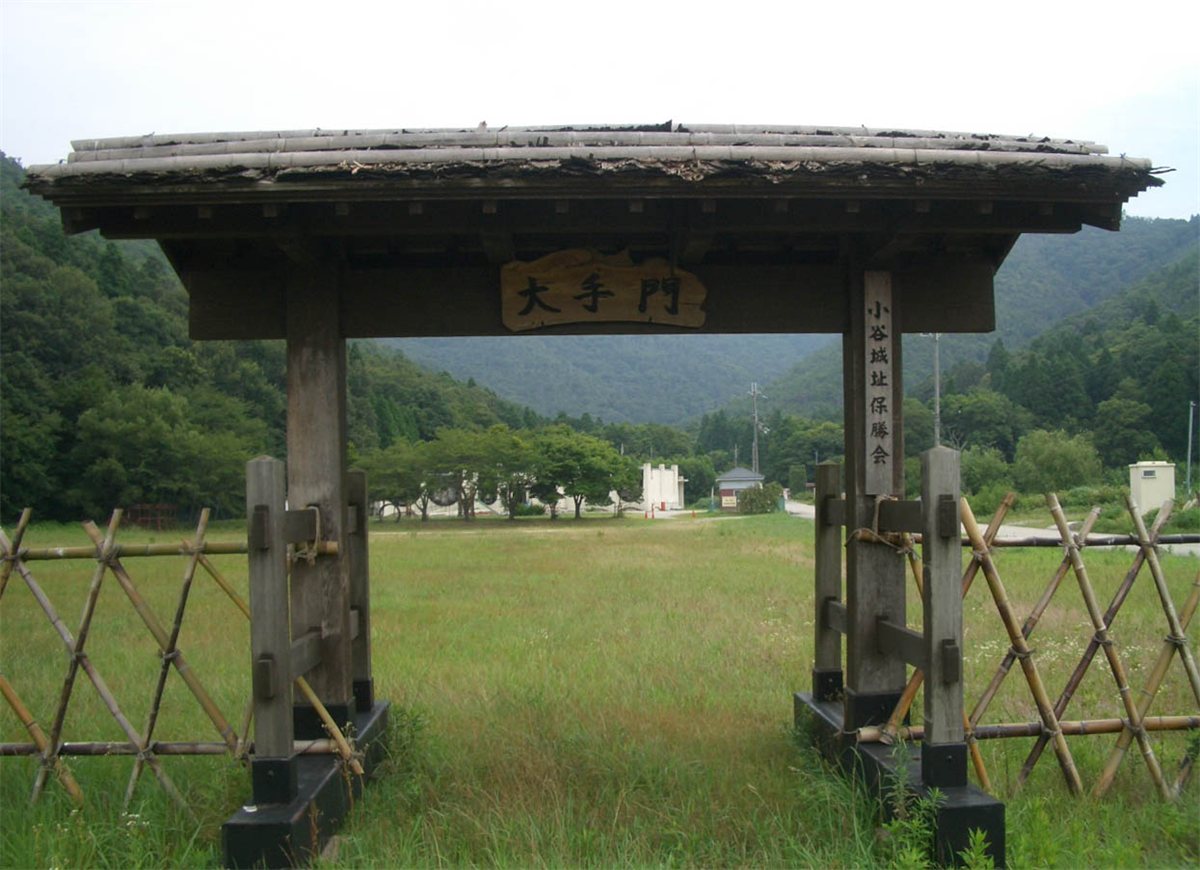
Image: The Ōtemon gate at the foot of the Odani Castle ruins (Nagahama, Shiga Prefecture). Wikimedia Commons (photo: ブレイズマン, public domain)
After Odani Castle fell, northern Ōmi was given to Hideyoshi. Hideyoshi stayed at Odani Castle for a while, then renamed Imahama, on the shore of Lake Biwa, "Nagahama" and built a new castle there, after which Odani Castle is said to have fallen out of use [Widely accepted].
A Letter from Hisamasa, Announced in 2026
On April 21, 2026, Nagahama City announced the rediscovery of a letter from Nagamasa's father Hisamasa to a retainer, whose whereabouts had been unknown for about a century. It was discovered in September 2025 in a merchant family's house that the city had been asked to survey, and it orders the retainer to take part in ishibiki, hauling stones for the stone walls of Odani Castle. The letter had been printed in the 『東浅井郡志』 (history of Higashiazai District) in 1927, but its whereabouts had since been unknown. The new study also found that in that book the character for "stone" had been misread as another character.
Nagahama City thinks the Azai may have strengthened the stone walls in preparation for an attack by Nobunaga's army. The find clearly shows that the Azai had stones hauled for the walls of Odani Castle.
Visiting the Odani Castle Ruins
At the foot of the Odani Castle ruins is the Odani Castle Sengoku Historical Museum (Odani Gujō-chō, Nagahama), where you can learn about the Azai and Odani Castle. Because it is a mountain castle, reaching the area of the Honmaru means climbing a mountain path.
Azai Nagamasa's Grave and Related Places
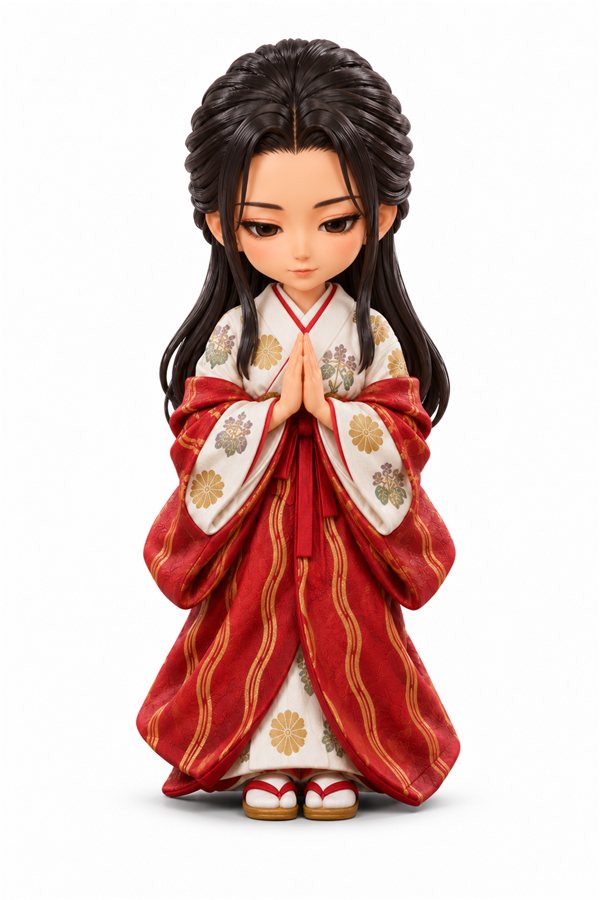
Image: Oichi praying for the repose of her family
| Place | What it is | Address today |
| Tokushōji | The Azai family temple, with the graves of three generations of the Azai: Sukemasa, Hisamasa and Nagamasa | Hirakata-chō, Nagahama, Shiga Prefecture |
| Odani Castle ruins | The Azai base, with the "Azai Nagamasa-kō Jijin no Chi" monument and the residence sites in Kiyomizudani | Ibe, Kohoku-chō, Nagahama, Shiga Prefecture |
| Yōgenin | A temple built in 1594 (Bunroku 3) at the request of his eldest daughter Chacha to Hideyoshi, to hold memorial services for her father Nagamasa and others. The temple's name comes from Nagamasa's Buddhist posthumous name | Higashiyama Ward, Kyoto |
| Jimyō-in | A temple that keeps the portraits of Nagamasa and Oichi and of his father Hisamasa (all Important Cultural Properties) | Kōya, Wakayama Prefecture (Mt. Kōya) |
| Jissaiin | A temple where Oichi and her daughters are said to have been sheltered before Odani Castle fell [Legend] | Hiratsuka-chō, Nagahama, Shiga Prefecture |
Yōgenin later burned down, and in 1621 (Genna 7) it was rebuilt by his third daughter, Gō.
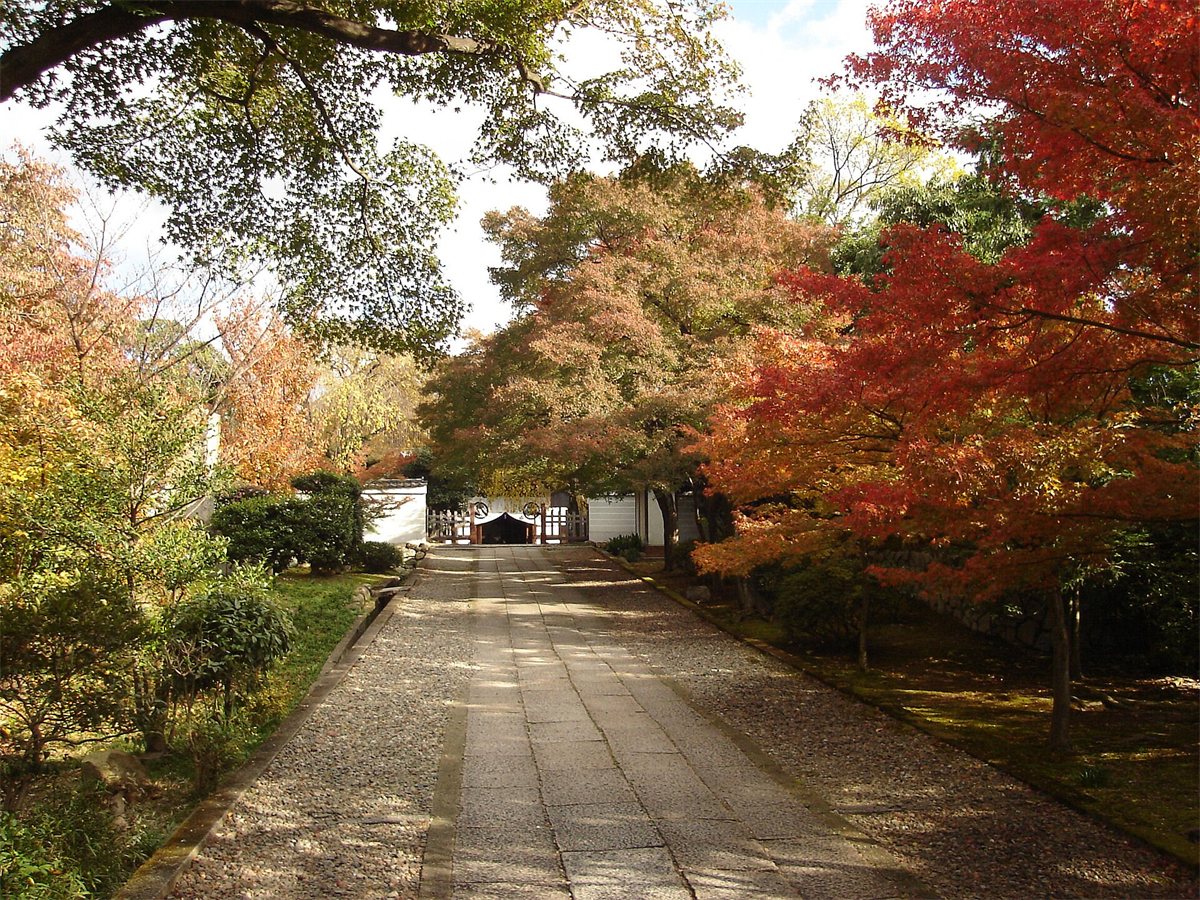
Image: The approach to Yōgenin (Higashiyama Ward, Kyoto). Wikimedia Commons (photo: PlusMinus, CC BY-SA 3.0)
His daughters built a temple for their father!
Daughters who lost their father when they were small went on to honor his memory.
Azai Nagamasa's Life: A Timeline
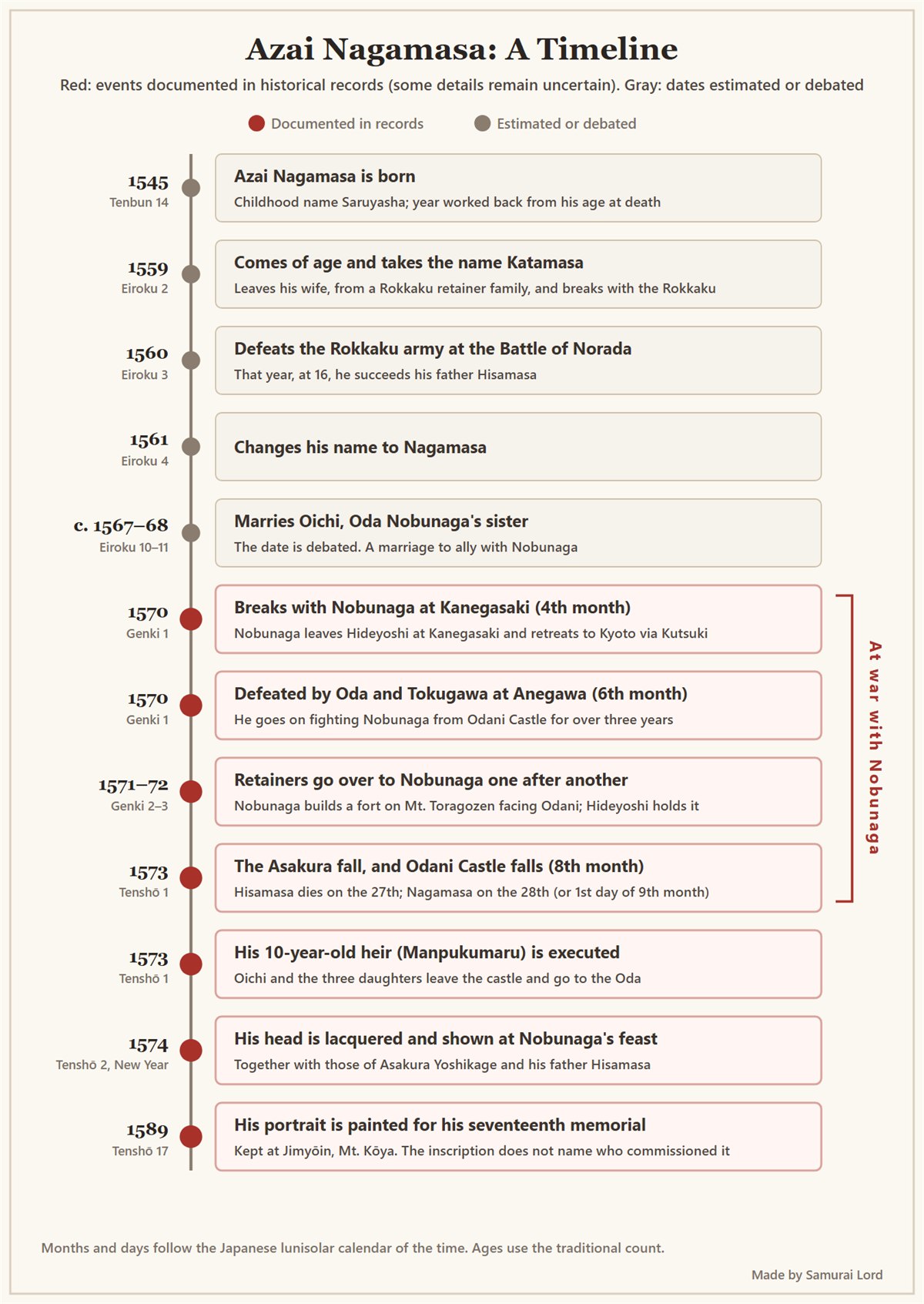
Image: Timeline of Azai Nagamasa (made by Samurai Lord). Tap or click to enlarge
| Year | Age (traditional count) | Event |
| Daiei era (early 1520s) | ― | His grandfather Sukemasa builds Odani Castle [Debated] |
| 1545 (Tenbun 14) | 1 | Nagamasa is born; his childhood name is Saruyasha [Widely accepted] |
| 1559 (Eiroku 2) | 15 | Comes of age (genpuku) and takes the name Katamasa. He leaves his wife, the daughter of a senior Rokkaku retainer, and breaks with the Rokkaku [Widely accepted] |
| 1560 (Eiroku 3) | 16 | Defeats the Rokkaku army at the Battle of Norada and succeeds his father Hisamasa as head of the family [Widely accepted] |
| 1561 (Eiroku 4) | 17 | Changes his name to Nagamasa [Widely accepted] |
| Around 1567–68 (end of Eiroku 10 to beginning of Eiroku 11) | 23–24 | Marries Oichi (the date is debated) [Debated] |
| 1568 (Eiroku 11) | 24 | Nobunaga marches on Kyoto; Nagamasa also attacks the Rokkaku [Widely accepted] |
| 1570 (Genki 1) | 26 | In the 4th month, breaks with Nobunaga at Kanegasaki. On the 28th day of the 6th month, is defeated at the Battle of Anegawa [Fact] |
| 1571–72 (Genki 2–3) | 27–28 | Retainers go over to Nobunaga one after another. Nobunaga builds a fort on Mt. Toragozen [Fact] |
| 1573 (Tenshō 1) | 29 | In the 8th month the Asakura are destroyed. On the 27th day of the 8th month his father Hisamasa kills himself [Fact]. On the 28th day of the 8th month or the 1st day of the 9th month, Nagamasa kills himself [Debated]. His heir (Manpukumaru) is executed [Fact]. His third daughter Gō is born this year [Widely accepted] |
| 1574 (Tenshō 2) | ― | At New Year, the heads of Nagamasa and others are made into hakudami and brought out at Nobunaga's drinking party [Fact] |
| 1589 (Tenshō 17) | ― | His seventeenth memorial observance. The portrait "Azai Nagamasa" at Jimyō-in is painted [Fact] |
| 1594 (Bunroku 3) | ― | Chacha builds Yōgenin in Kyoto [Widely accepted] |
Hideyoshi and the Azai
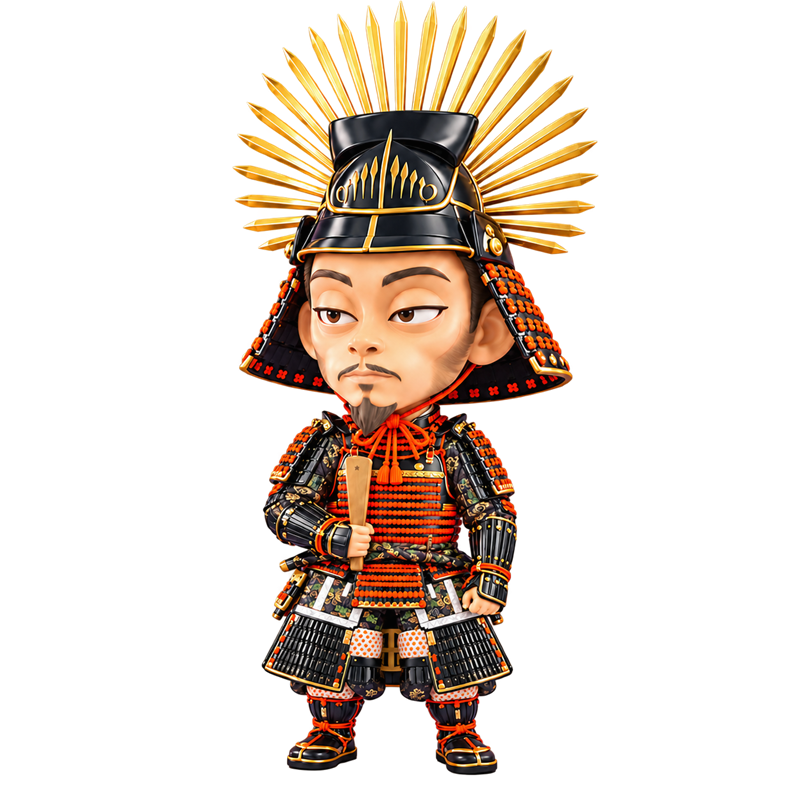
Image: Toyotomi Hideyoshi
Hashiba Hideyoshi, later known as Toyotomi Hideyoshi, repeatedly played important roles in Nobunaga's campaigns against the Azai [Fact: Shinchō Kōki].
- 1570: left behind at Kanegasaki Castle. After the Battle of Anegawa, put in charge of defending Yokoyama Castle
- 1572: holds the fort on Mt. Toragozen, right in front of Odani Castle
- 1573: takes the Kyōgokumaru, cutting Hisamasa off from Nagamasa. After the castle falls, he receives the former Azai lands in northern Ōmi from Nobunaga
It was here in northern Ōmi that Hideyoshi first became a daimyo with his own castle. Later he took Nagamasa's eldest daughter, Chacha, as his consort [Fact]. For Hideyoshi, see our article on Toyotomi Hideyoshi.
Did Nobunaga Really Make a Cup from His Skull? What Became of the Heads

Image: Oda Nobunaga
You may have heard that "Nobunaga made drinking cups from the skulls of Nagamasa and the others and drank sake from them." However, what the Shinchō Kōki records is only that at New Year in 1574 (Tenshō 2), the heads of Asakura Yoshikage, Azai Hisamasa and Azai Nagamasa were made into hakudami and brought out at a drinking party [Fact: Shinchō Kōki]. It does not say that they were made into cups and drunk from [Folk belief].
Source Box ⑥: Hakudami in the Shinchō Kōki
Source
Ōta Gyūichi, Shinchō Kōki, book 7 (1st day of the 1st month of Tenshō 2, 1574, at Gifu)
Original (excerpt)
「已上三ツ薄濃にして公卿に居置御肴に出され候て御酒宴」
Translation
These three (the heads of Asakura Yoshikage, Azai Hisamasa and Azai Nagamasa) were made into hakudami, set on serving stands and brought out as sakana for the drinking party.
Notes
This took place at a New Year drinking party attended only by Nobunaga's close retainers, after the guests from Kyoto and other provinces had left. Sakana means something served at a drinking party; here it can be read as meaning they were put on display
What Is Hakudami?
Hakudami is often explained as a head (skull) coated with lacquer and colored with gold powder or the like.
What the Records Say, and What They Don't
| Story | Shinchō Kōki | Asai Sandaiki (Edo period) | Our assessment |
| The heads were made into hakudami | Recorded | Says they were "lacquered red" | [Fact] |
| They were brought out at a drinking party | Recorded (as sakana) | Recorded | [Fact] |
| They were made into cups and drunk from | Not recorded | Not recorded | [Folk belief] |
| The skulls still survive today | ― | ― | [Unknown] |
When and where the "cup" story began to spread is unclear. It is thought to have spread through later novels, dramas and the like.
Why Did Nobunaga Do It?
The sources we checked do not establish Nobunaga's motives, and interpretations differ [Debated]. Some researchers see it as a way of honoring three strong enemies and praying for them; others, noting for example that the Shinchō Kōki describes the execution of Manpukumaru as Nobunaga "clearing away his long-held resentment," see it as an expression of hatred.
Where Are the Skulls Now? Do They Survive?
We found no reliable record of what happened to the heads after the drinking party. Where they are now, or whether they survive at all, is unknown [Unknown].
I was sure the cup story was true...
Even bringing the heads out at a drinking party is shocking to us today. But it is wrong to add things that are not in the records.
Azai Nagamasa's Descendants and Family Tree
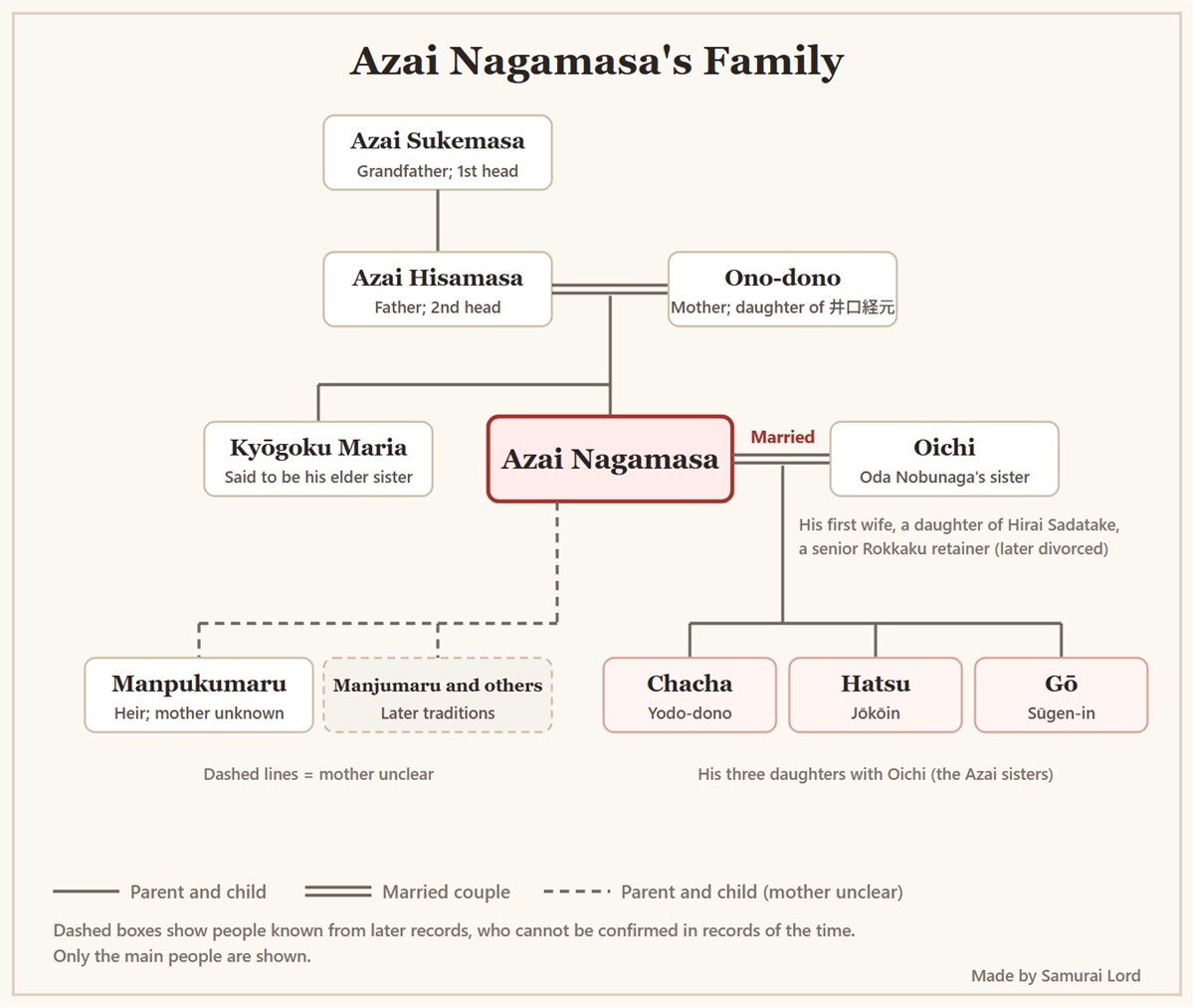
Image: Azai Nagamasa's family (made by Samurai Lord). Tap or click to enlarge
The Azai as a daimyo family were destroyed with the fall of Odani Castle in 1573 [Fact]. His heir Manpukumaru was also executed, and the line that would have succeeded Nagamasa as head of the family is thought to have ended there [Widely accepted].
However, his daughters Chacha and Gō had children, and through Gō's children in particular, Nagamasa's bloodline continued into later times [Fact].
The Bloodlines from His Three Daughters
- Chacha's child: Toyotomi Hideyori. The Toyotomi family was destroyed at the siege of Osaka (1615), but Hideyori's daughter survived and later became a nun (Tenshūni)
[Fact] - Hatsu's children: Hatsu is said to have had no children of her own
[Widely accepted] - Gō's children: the third shogun Tokugawa Iemitsu; Tokugawa Masako (Tōfukumon-in), who became the empress of Emperor Go-Mizunoo; Senhime; Tamahime; Sadako and others
[Fact]
Not only Gō's son Iemitsu, the third shogun, but also Iemitsu's sons Ietsuna (the fourth) and Tsunayoshi (the fifth), Ienobu (the sixth), son of Iemitsu's other son Tsunashige, and Ienobu's son Ietsugu (the seventh) were all descendants of Nagamasa [Fact]. In addition, Empress Meishō, born to Masako, was the first reigning empress in about 860 years, since Empress Shōtoku in the Nara period, and she was Nagamasa's great-granddaughter [Fact].
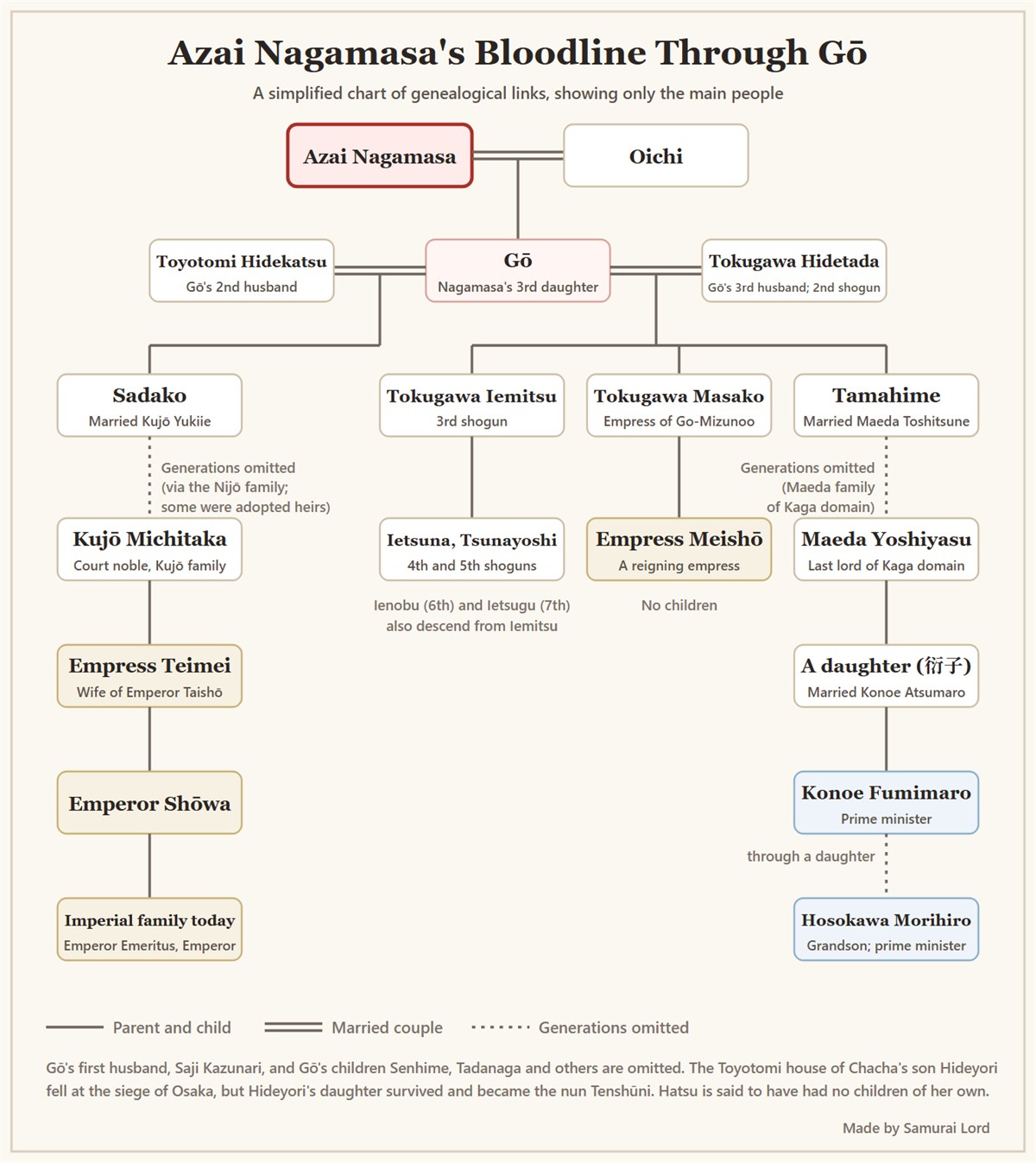
Image: The bloodline from Gō (a simplified chart showing only the main people, made by Samurai Lord). Tap or click to enlarge
Are Prime Ministers Among His Descendants?
On the family trees, Prime Minister Konoe Fumimaro is said to descend from the Maeda family of the Kaga domain, into which Gō's daughter Tamahime married. This is because a daughter of Maeda Yoshiyasu, the last lord of the Kaga domain, married into the Konoe family, and her son was Fumimaro. Furthermore, Fumimaro's grandson was Hosokawa Morihiro, who later also became prime minister.
Both of these follow the family trees of Edo-period daimyo and court noble families.
Is He Connected to Today's Imperial Family?
On the family trees, Sadako, a daughter Gō bore to Toyotomi Hidekatsu, married into the Kujō family of court nobles, and her descendants, through links via daughters and people who moved into the Nijō family, are said to lead to the empress of Emperor Taishō (Empress Teimei). For this reason, it is said that Nagamasa's bloodline connects to today's imperial family.
However, the list of successive heads of the Kujō family does not in itself show the line of blood descent. Some heads succeeded to the family as adopted sons, so the chart above omits the intermediate generations.
Since Empress Meishō had no children, the link to today's imperial family is said to run through this Kujō line. We have not verified every intervening parent–child link in this line.
Are People with the Surname Azai His Descendants?
The surname Azai alone does not establish descent from Nagamasa. Some families claim descent from Manjumaru or Azai Iyori, but we could not verify these lines in the records from his time that we checked [Legend].
Nagamasa's blood flows on into the shogun family and even the imperial family. Amazing!
The family was destroyed, but his daughters carried life forward. That is Nagamasa's other story.
FAQ
Are Azai Nagamasa and Asano Nagamasa the same person?
No, they are completely different people. Asano Nagamasa was a retainer of Toyotomi Hideyoshi and one of his "five commissioners" (go-bugyō). He was the husband of Yaya, the adoptive younger sister of Hideyoshi's wife Nene. Around 1573, when Azai Nagamasa died, he was called Nagayoshi; he changed his name to Nagamasa much later.
How old was Azai Nagamasa when he died?
29 by the traditional count. Assuming the generally accepted birth year of 1545, he would have been 27 or 28 by the modern way of counting, depending on his birthday.
What if Nagamasa had not turned against Nobunaga?
The records cannot answer that question. What the Shinchō Kōki does show is that Nobunaga regarded the Azai as "relatives" and had entrusted northern Ōmi to them. Had Nagamasa not broken with him, he might have survived as a daimyo related to Nobunaga, but that is only speculation.
How do you pronounce Odani Castle?
"Oh-dah-nee." In Japanese it is Odani-jō. It was a mountain castle in today's Nagahama, Shiga Prefecture, and is now a national historic site.
How large was Nagamasa's territory? What was his income in koku?
He ruled mainly northern Ōmi (today's northern Shiga Prefecture), and at one point his power extended as far as the area around Sawayama Castle (Hikone). However, in the records from his time that we checked, we found no figure for the Azai lands in koku (the assessed rice yield of land), and the source behind some figures seen online cannot be confirmed.
Summary: Who Was Azai Nagamasa?
Azai Nagamasa was a daimyo of northern Ōmi who broke free of the Rokkaku while still young and allied with Nobunaga by marrying his sister Oichi, but turned against Nobunaga in 1570 and, after more than three years of fighting, took his own life at Odani Castle in 1573.
Much remains unknown from the records alone, including why he broke with Nobunaga, the exact date of his death and who acted as his second. On the other hand, his daughters survived, and his bloodline reached the Toyotomi, the Tokugawa shoguns and the imperial family.
For his wife, see our article on Oichi; for Nobunaga, whom he fought, our article on Oda Nobunaga; and for Katsuie, who later married Oichi, our article on Shibata Katsuie.
A man who was Nobunaga's own relative, yet chose to fight him. Why, remains a mystery to this day.
Now I want to know more about his daughters Chacha and Gō!
Sources & How This Article Was Written
This article is based mainly on the following records and references:
- Records close to his time: Ōta Gyūichi, Shinchō Kōki (books 3, 6 and 7; available in English as The Chronicle of Lord Nobunaga, translated by J. S. A. Elisonas and J. P. Lamers, Brill, 2011); the inscription on the portrait "Azai Nagamasa" (Jimyō-in, Mt. Kōya); the sworn pledge of Azai Hisamasa and Nagamasa (in the Kutsuki-ke Komonjo, National Archives of Japan)
- Later records: Asai Sandaiki; Asakura Shimatsuki
- Studies and references (in Japanese; titles translated by us): Ōta Hiroshi, "The Sengoku Daimyo Azai Family and the Movements of Its Retainers" (summary of a doctoral dissertation, Meiji University); Frederik Cryns, an article on Nagamasa's letter of commendation to Katagiri Naosada (Gentosha Plus, 2025); Kotobank (Nihon Daihyakka Zensho, Sekai Daihyakka Jiten, Nihon Jinmei Daijiten and others); Nagahama City, preservation and management plan for the Odani Castle historic site; reference case studies of Nagahama City Library; explanations by Jimyō-in and Yōgenin; Kyodo News report (April 21, 2026, on the discovery of Hisamasa's letter)
- Historians' views: for the reasons for his break with Nobunaga (the views of Owada Tetsuo, Kuroda Motoki, Miyajima Keiichi and 長谷川裕子), the date of his marriage, and the mother of Manpukumaru (Fukuda Chizuru and others), we referred to articles and encyclopedia entries that introduce historians' views. On the letter of commendation, studies such as Ogino Minahiko's on "Azai Nagamasa's last letter of commendation" (Komonjo Kenkyū, no. 31) are known
- Images: the portrait "Azai Nagamasa" (Jimyō-in), Utagawa Kuniyoshi's print, and the photos of the Senjōjiki and Ōtemon at the Odani Castle ruins are published on Wikimedia Commons in the public domain. The photos of the "Azai Nagamasa-kō Jijin no Chi" monument (Heartoftheworld, CC BY-SA 3.0), the Anegawa battlefield (立花左近, CC BY-SA 3.0) and Yōgenin (PlusMinus, CC BY-SA 3.0), and the drawing of the Mitsumori kikkō ni hanabishi crest (Gameposo and Marnanel, CC BY-SA 4.0) are also from Wikimedia Commons. The timeline, family charts, castle diagram, map and illustrations are original works by Samurai Lord
What the Labels Mean
[Fact]Confirmed by sources from the time ([Fact: …]names the source)[Widely accepted]A view widely accepted by researchers ([Widely accepted: …]names the source)[Debated]Accounts, interpretations or ways of counting differ[Unknown]Not established from the sources we checked[Legend]Stories found in later records or traditions[Folk belief]Popular claims with little evidence[Drama fiction]Scenes created for dramas
We keep "what a record says" separate from "what actually happened."
This article was written by the Samurai Lord editorial team and is revised as new research and reader feedback come in. If you spot an error, please let us know through our contact form (in Japanese) and we will check and correct it.
Read in Japanese
This article is also available in Japanese: 浅井長政とは?最後や信長を裏切った理由、お市との関係を解説!