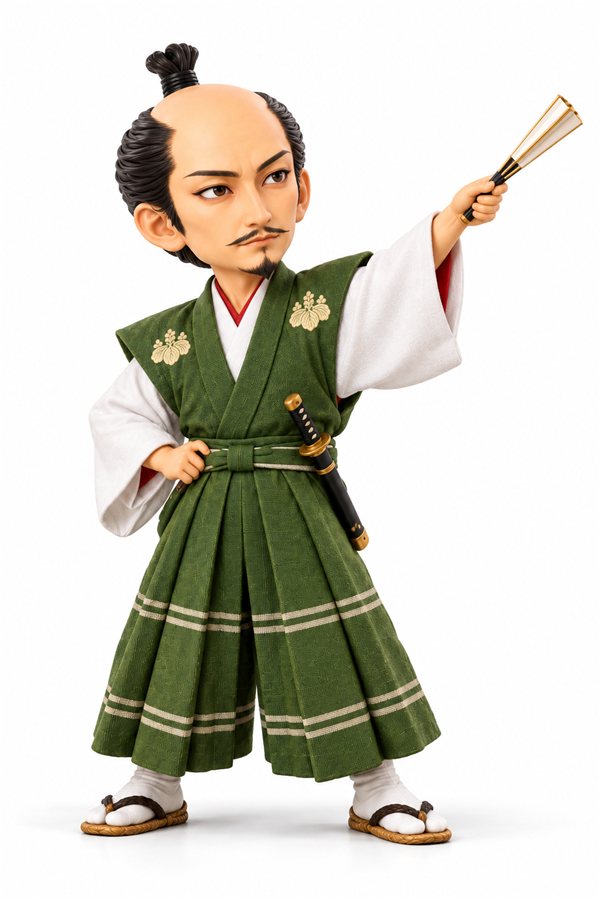
Image: Oda Nobunaga pointing to a castle on a distant mountain
Inabayama Castle was a mountain castle on Mt. Kinka (Kinkazan) in today's Gifu City, Gifu Prefecture. It is the same castle as today's Gifu Castle. In the Sengoku period, three generations of the Saitō family, Dōsan, Yoshitatsu and Tatsuoki, made it their base [Fact].
In 1567 (Eiroku 10), Oda Nobunaga captured the castle and then renamed the town at its foot, Inokuchi, "Gifu" [Widely accepted]. From here, Nobunaga went on to Kyoto and toward the unification of Japan.
This article explains where Inabayama Castle was and how it relates to Gifu Castle, the "Battle of Inabayama Castle" in which Nobunaga took it, Takenaka Hanbei's seizure of the castle, its changing lords, what excavations have revealed, and visiting today.
Historical dates give the Western year with the Japanese era; months and days follow the Japanese lunisolar calendar unless otherwise stated. Modern dates use the Gregorian calendar. Ages use the traditional Japanese count, in which a person was counted as one at birth and gained a year at the start of each new year in the Japanese calendar.
Key points are tagged: [Fact] confirmed by records from the time, [Widely accepted] a view widely accepted by researchers, [Debated] accounts or interpretations differ, [Unknown] not established from the sources we checked, [Legend] stories found in later records or traditions, and [Folk belief] popular claims with little evidence.

I am Uesugi Kenshin. Today's story is about a castle: Inabayama Castle, the key to Mino.

I'm Date Masamune! How do you even attack a castle on top of a mountain?

Not by force alone. What the people around the castle did mattered a great deal.
The Short Answers
- Where is it? On the summit and at the foot of Mt. Kinka (329 m) in Gifu City, Gifu Prefecture (more)
- Is it different from Gifu Castle? No, it is the same castle. It came to be called "Gifu" after Nobunaga took it (more)
- What was the Battle of Inabayama Castle? Nobunaga's capture of the castle from Saitō Tatsuoki in 1567 (Eiroku 10) (more)
- What was Hanbei's seizure? In 1564 (Eiroku 7), Takenaka Hanbei and Andō Morinari briefly took the castle (more)
- Can you visit it now? The keep is closed for renovation and is scheduled to reopen in November 2027 (more)
Three Things We Learn by Comparing the Sources
- How the castle fell in 1567: the steps of Nobunaga's capture as told in the Shinchō Kōki, with a short Japanese excerpt and an English translation (more)
- Did Hanbei take it with just 16 men? What a letter written days after the seizure actually says (more)
- Hideyoshi's famous exploits: which stories are in the records of the time, and which come from later popular books (more)
Jump to the part you want to read:
- What was Inabayama Castle? Where was it, and how is it related to Gifu Castle?
- The Battle of Inabayama Castle: how did Nobunaga take it?
- Takenaka Hanbei's seizure of Inabayama Castle
- Who were the lords of Inabayama Castle?
- Was Inabayama Castle impregnable?
- Why "Gifu"? The origin of the name
- Did the castle have a keep? What excavations show
- Visiting Gifu Castle today: closure and access
- FAQ
The labels such as [Fact] and [Debated] show how certain each point is (their meanings are listed at the end of the article).
What Was Inabayama Castle? Where Was It, and How Is It Related to Gifu Castle?
To give the conclusion first: Inabayama Castle was a mountain castle on Mt. Kinka (formerly called Mt. Inaba) in Gifu City, and the same castle as today's Gifu Castle. It was designated a National Historic Site, the "Gifu Castle Ruins," in 2011 (Heisei 23).
Mt. Kinka is 329 m high, and the whole mountain is made of chert, a very hard rock, with many steep cliffs. The castle consisted of a castle on the mountain and a residence at its western foot. The hard rock and the steep cliffs helped to defend it.
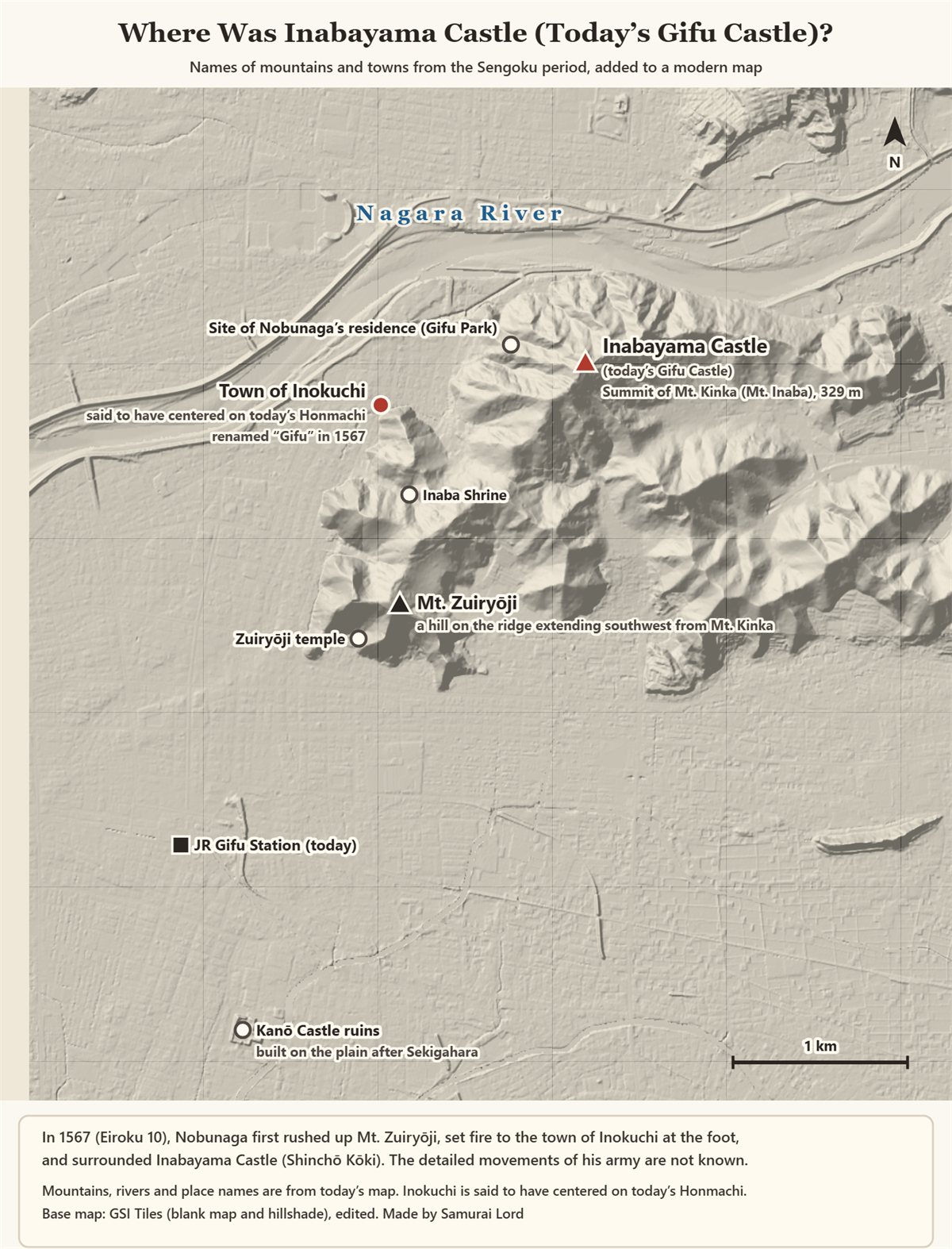
Image: Map of Inabayama Castle (today's Gifu Castle) (made by Samurai Lord on GSI Tiles from the Geospatial Information Authority of Japan). Tap (click) the image to enlarge it
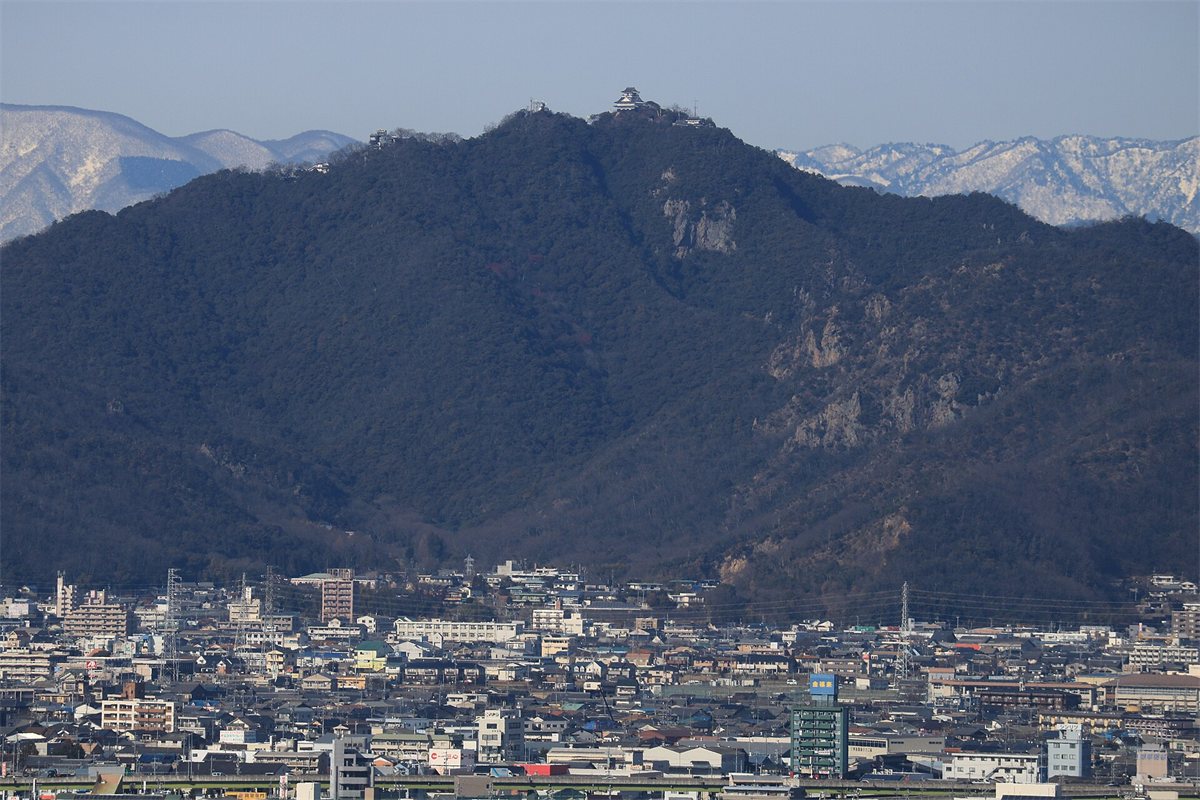
Image: Mt. Kinka and Gifu Castle on its summit, seen from the streets of Gifu. Wikimedia Commons (photo: Alpsdake, CC BY-SA 4.0)
How Is Inabayama Castle Different from Gifu Castle?
Only the name is different: it is the same castle in the same place. When the Saitō family held it in the Sengoku period, it was called by names such as "Inabayama" and "Inokuchi," and after Nobunaga took it in 1567 (Eiroku 10), it came to be called "Gifu." Today it is usually called "Gifu Castle."
Note, however, that what the Shinchō Kōki says is that Nobunaga "renamed the town of Inokuchi Gifu"; it is not a record saying that he "renamed the castle Gifu Castle." The records of the time call both the castle and the town "Gifu" (more).
Also, the white keep standing on the summit today is a reinforced concrete building built in 1956 (Shōwa 31), not a building from the Sengoku period (more).
What We Know and What We Don't
- We know: Inabayama Castle was a mountain castle on Mt. Kinka, and is the same castle as today's Gifu Castle
- We don't know: who first built the castle (more)
The Battle of Inabayama Castle: How Did Nobunaga Take It?
The Battle of Inabayama Castle was Oda Nobunaga of Owari's capture of Inabayama Castle from Saitō Tatsuoki of Mino (Dōsan's grandson) in 1567 (Eiroku 10) [Widely accepted]. (The same name is sometimes used for the battle in which Dōsan defended the castle and drove off the army of Oda Nobuhide, Nobunaga's father. This chapter deals with Nobunaga's capture.)
Nobunaga was the husband of Dōsan's daughter (Nōhime). When Dōsan's son Yoshitatsu died in 1561 (Eiroku 4), Nobunaga invaded Mino at once, but for years he could not get as far as Inabayama Castle (see our article on Saitō Yoshitatsu). The turning point came when senior retainers of Mino decided to go over to Nobunaga's side.
The Capture as Told in the Shinchō Kōki
The Shinchō Kōki, by Nobunaga's retainer Ōta Gyūichi, describes what happened as follows.
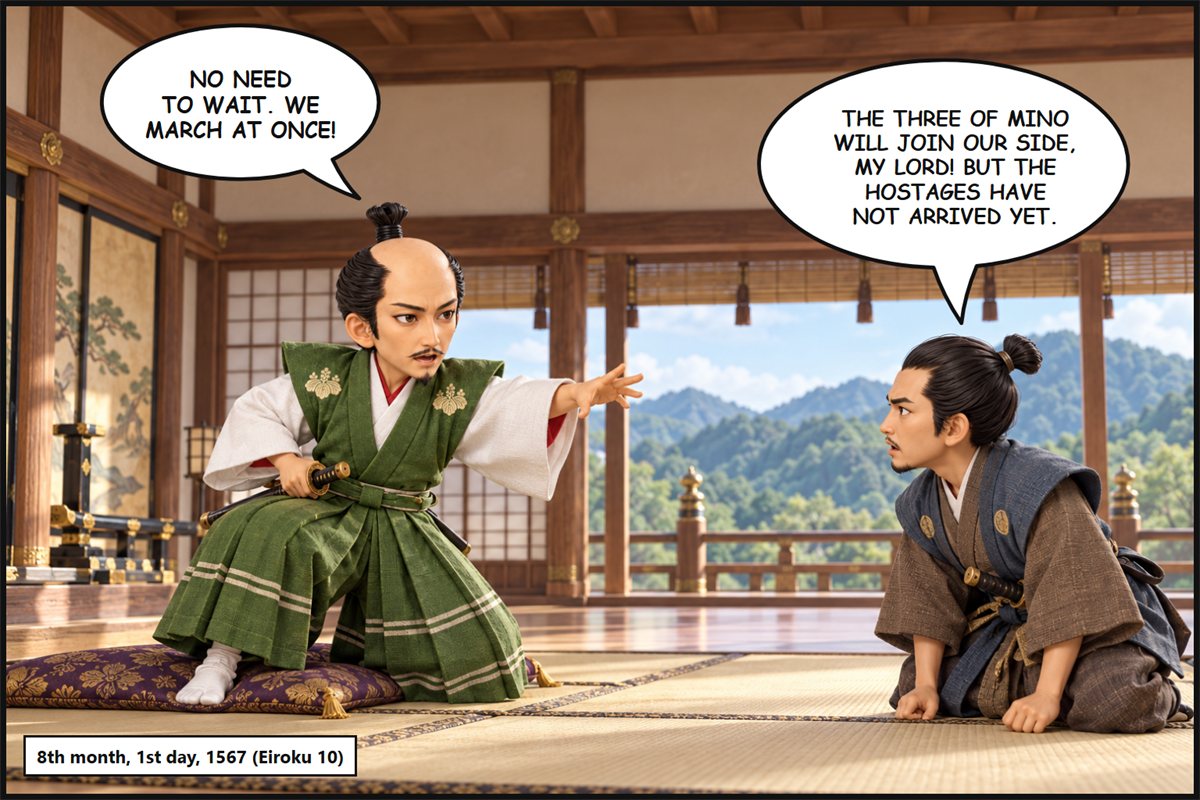
Image: Nobunaga ordering his army out at once on hearing that three senior retainers of Mino will join him
On the 1st day of the 8th month, the "Three of Mino" (Mino Sanninshū), Inaba Ittetsu (Yoshimichi), Ujiie Bokuzen (Naomoto) and Andō Morinari, sent word: "We will join Nobunaga's side, so please accept hostages from us." Nobunaga sent retainers to western Mino to receive the hostages, but before the hostages had even arrived, he set out with his troops and rushed up Mt. Zuiryōji, which is on the same ridge as Mt. Inaba.
Source Box ①: The Capture of Inabayama Castle in the Shinchō Kōki
Source
Ōta Gyūichi, Shinchō Kōki, opening book, the section on the taking of Inabayama (1881 printed edition on Wikisource; available in English as The Chronicle of Lord Nobunaga, translated by J. S. A. Elisonas and J. P. Lamers, Brill, 2011). Gyūichi served Nobunaga; the opening book was compiled in his later years
Quotation (excerpt; spelling adjusted for readability)
「是は如何に、敵か味方かと申す所に、早、町に火をかけ、即時に生か城に成され候」
Translation
While [the defenders] were asking, "What is happening? Friend or foe?", [Nobunaga's forces] had already set fire to the town and at once reduced the castle to a "naked castle."
Explanation
Here, "naked castle" (hadaka-jiro) is understood as a castle left isolated after losing the town below. It does not mean that its walls or defenders had disappeared
What this record tells us, and what it does not
The Shinchō Kōki tells how the defenders were thrown into confusion by Nobunaga's speed. This section, however, gives no year, and we cannot tell the number of troops or the details of where Nobunaga's army camped
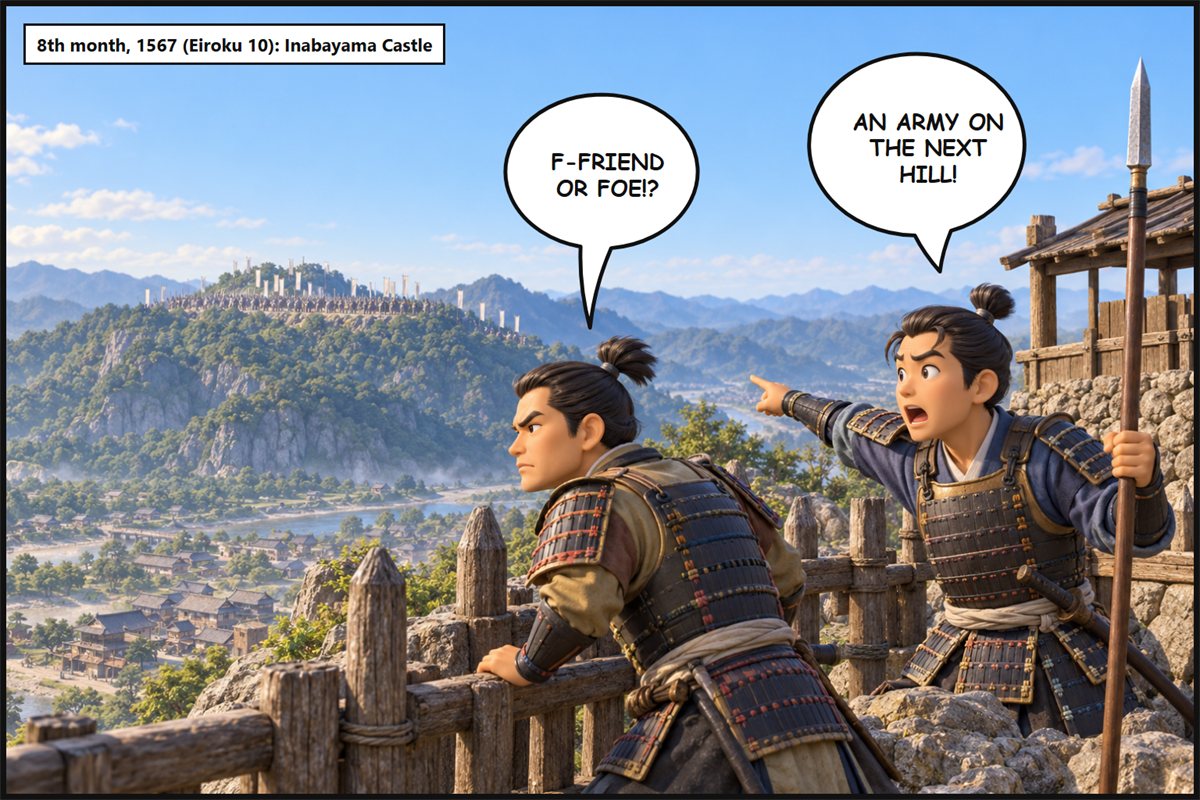
Image: Soldiers of Inabayama Castle, confused by the sight of a great army suddenly appearing on the neighboring hill
The next day, Nobunaga assigned the work and had the castle surrounded with shishigaki (fences made of wood, bamboo and the like). Then, on the 15th day of the 8th month, the defenders gave up, and Tatsuoki withdrew by boat to Nagashima in Ise (today's Kuwana, Mie Prefecture). Nobunaga gained the main seat of power in Mino, and named the town of Inokuchi "Gifu."
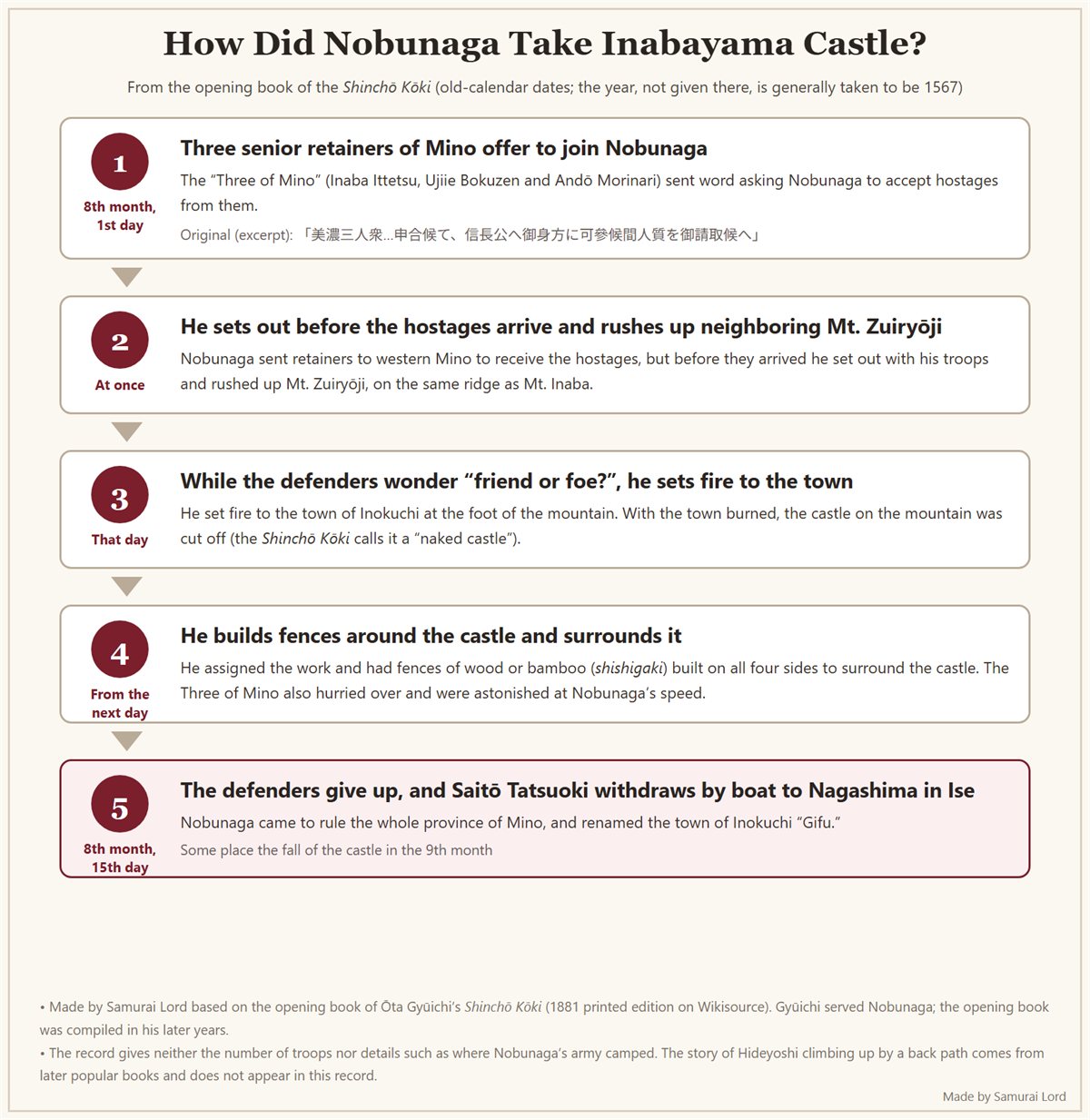
Image: How Nobunaga took Inabayama Castle (made by Samurai Lord based on the Shinchō Kōki). Tap (click) the image to enlarge it
With its town burned and fences all around it, the castle was cut off on its mountain. The senior retainers going over to Nobunaga, Nobunaga's swift seizure of the town below, and the encirclement all came together, and the castle fell.
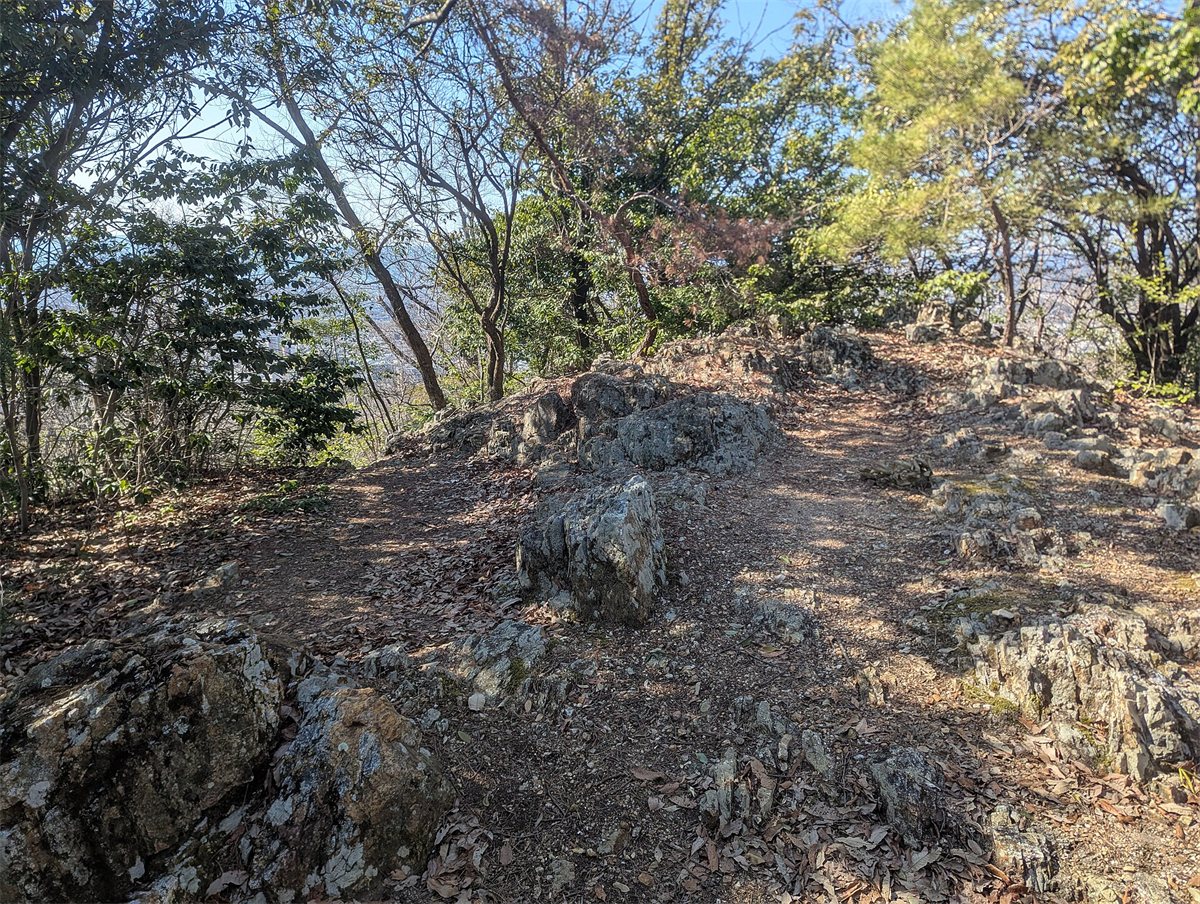
Image: The summit of Mt. Zuiryōji, which Nobunaga's army rushed up (known today as the site of tombs from the Yayoi period). Wikimedia Commons (photo: 大野一将, CC0)
When Was the Battle of Inabayama Castle? 1567 or 1564?
This section of the Shinchō Kōki gives no year. However, an entry for the following year says, "since he had taken the great province of Mino last year," and from the 9th month of the same year onward many documents appear in which Nobunaga guaranteed lands to temples, shrines and people of Mino and forbade violence there. For these reasons, 1567 (Eiroku 10) is the accepted date today [Widely accepted].
As for the month and day, the Shinchō Kōki's date for Tatsuoki's withdrawal, the 15th day of the 8th month, is widely used, but there is also a theory that it was in the 9th month [Debated]. Some Edo-period books give 1564 (Eiroku 7), but this is not supported by current research. 1564 is the year in which Takenaka Hanbei briefly seized the castle (more).
Did Hideyoshi Play a Part? Sunomata Castle and the Secret Path
Stories of the exploits of Kinoshita Tōkichirō (the later Toyotomi Hideyoshi) in the capture of Inabayama Castle are famous. But the section of the Shinchō Kōki on the capture does not mention anything Hideyoshi did. What exactly he did there cannot be confirmed.
| Well-known story | Source | Certainty |
| Hideyoshi climbed up a narrow path at the back of the castle with a few men | Edo-period popular books such as the Ehon Taikōki | [Legend] |
| Horio Mosuke (later Horio Yoshiharu) guided him along the back path | Same as above | [Legend] |
| A gourd was used as a signal, and became Hideyoshi's later standard of a "thousand gourds" | Same as above | [Legend] |
| Hideyoshi built a castle at Sunomata in one night (the "one-night castle of Sunomata") | The Ehon Taikōki, and the Bukō Yawa, which came to light in the Shōwa era (a book whose origins and reliability are debated) | [Legend] |
| Nobunaga had a fort built at Sunomata | The Shinchō Kōki (entry for 1561, Eiroku 4) | In the record |
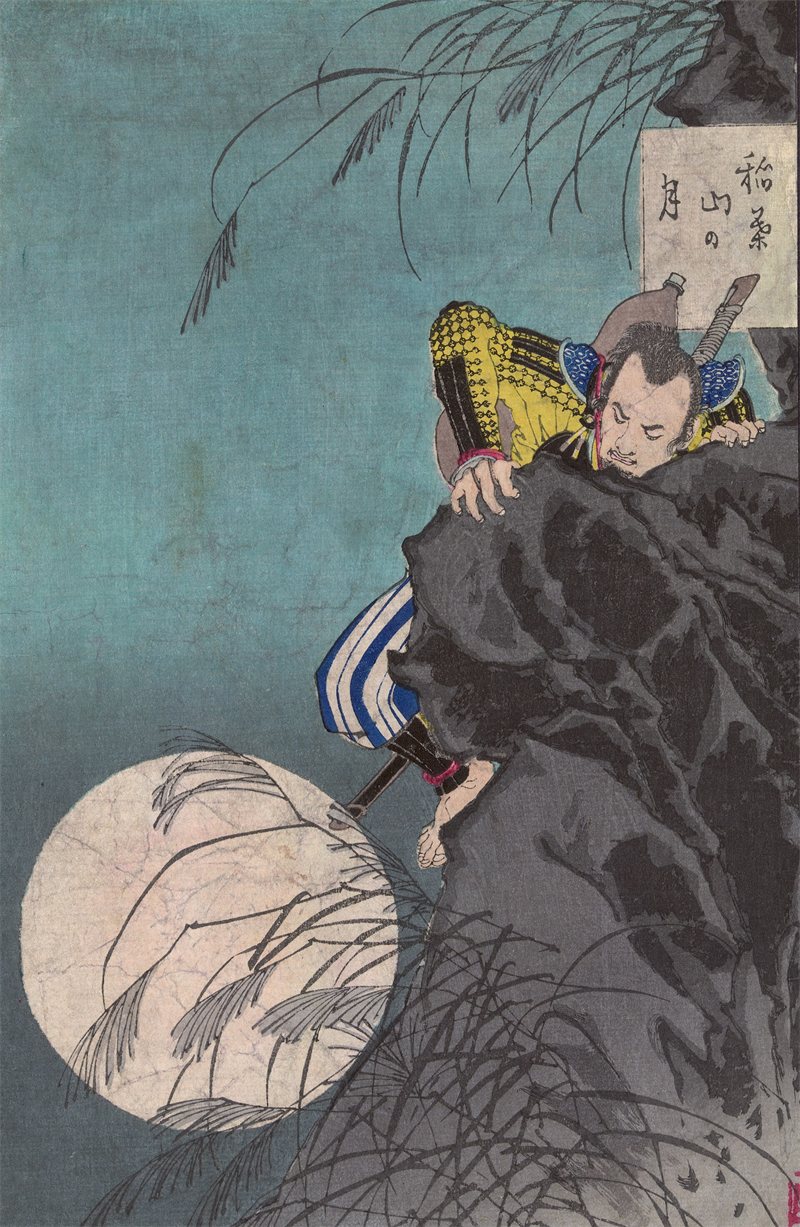
Image: Tsukioka Yoshitoshi's woodblock print "The Moon over Inabayama," from One Hundred Aspects of the Moon, showing the legendary scene of Hideyoshi climbing the cliffs of Mt. Inaba. Wikimedia Commons (Library of Congress; public domain)
That something is not in the Shinchō Kōki does not mean Hideyoshi took no part in the fighting. But the stories of the back path and the gourd are best read as tales that later generations enjoyed telling.
What We Know and What We Don't
- We know: the course of the capture as told in the Shinchō Kōki (the Three of Mino went over to Nobunaga, who climbed Mt. Zuiryōji, burned the town and surrounded the castle), and that Nobunaga took Mino around 1567 (Eiroku 10)
- We don't know: the exact date (8th or 9th month); the number of troops; what exactly Hideyoshi did
Takenaka Hanbei's Seizure of Inabayama Castle
Hanbei's seizure was the event of the 6th day of the 2nd month of 1564 (Eiroku 7), when Takenaka Hanbei, a retainer of Tatsuoki, and his father-in-law Andō Morinari took Inabayama Castle [Widely accepted]. Tatsuoki left the castle, and it is thought to have returned to his control within about half a year. It took place three years before Nobunaga captured the castle, and is a separate event from Nobunaga's capture.
The event is confirmed by a letter dated the 11th day of the 2nd month, written by Kaisen Jōki, a Zen monk of the time.
Source Box ②: The Letter of Kaisen Jōki
Source
A letter from Kaisen Jōki to a monk of Zenshōji temple, dated the 11th day of the 2nd month (copied in 『明叔録』; we follow the text printed in 『美濃国稲葉郡志』, 1915). The letter gives no year
Quotation (excerpt; characters modernized)
「金華山城、菩提城主竹中遠州子半兵衛、去六日白昼奪取、与伊賀守両人而一国領之」
Translation
Hanbei, the son of Takenaka Enshū, lord of Bodai Castle, seized Kinkazan Castle in broad daylight on the 6th. Together with Iga-no-kami, he now rules the province.
Explanation
Here, "Enshū" refers to Hanbei's father, who used the title Tōtōmi-no-kami, and "Iga-no-kami" refers to Andō Morinari. These titles do not mean that they governed those provinces. Kinkazan Castle refers to Inabayama Castle
What this record tells us, and what it does not
The letter goes on to say that six men, including Saitō Hida-no-kami, were killed in the seizure, that Tatsuoki and his followers left the castle without fighting, and that the whole province was in great turmoil. It does not say how many men Hanbei and his side entered the castle with
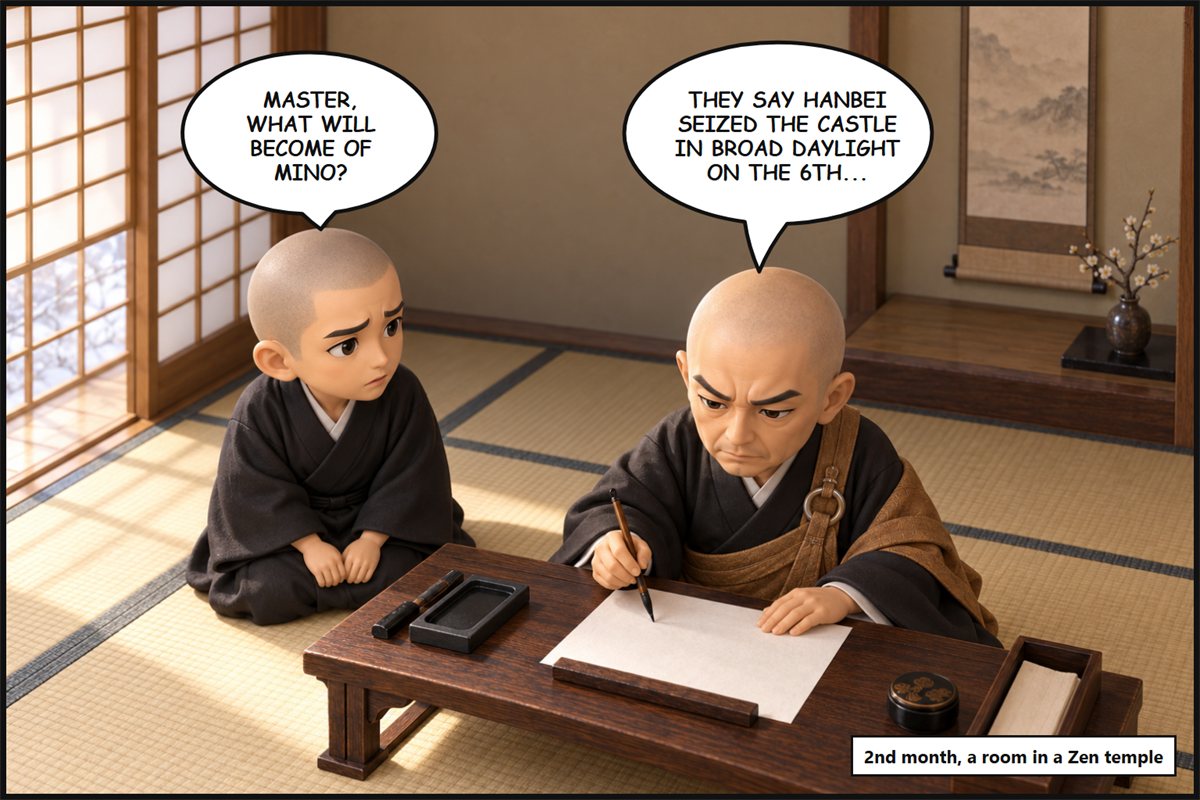
Image: Kaisen writing a letter about the seizure of Inabayama Castle
Did Hanbei Really Take It with 16 Men?
The story that "Hanbei seized the castle with only about sixteen men" is well known. But this is a story told in later war chronicles and similar books [Legend]. The letter of the time does not tell us how many men took part.
The "six men" in Kaisen's letter are those killed on the castle's side. And the phrase "together with Iga-no-kami, he now rules the province" describes Hanbei and Andō Morinari as the two leaders; it does not tell us how many attackers took part. The event was led by Hanbei and Andō Morinari. How many took part, and exactly how they did it, cannot be learned from this letter.
| Point of comparison | The seizure of 1564 | Nobunaga's capture of 1567 |
| Who | Takenaka Hanbei and Andō Morinari (Tatsuoki's own retainers) | Oda Nobunaga (a daimyo from outside Mino) |
| Outcome | Tatsuoki left the castle, but it is thought to have returned to his control within about half a year | Tatsuoki withdrew to Nagashima in Ise, and Mino became Nobunaga's |
| Records that confirm it | Kaisen Jōki's letter (written at the time) | The Shinchō Kōki and others |
For why Hanbei seized the castle and what he did afterward, see our article on Takenaka Hanbei.
What We Know and What We Don't
- We know: Hanbei and Andō Morinari seized Inabayama Castle, and Tatsuoki left it
- We don't know: how many men entered the castle; the real reason for the seizure
Who Were the Lords of Inabayama Castle? From Saitō Dōsan to Oda Hidenobu
Who Built Inabayama Castle?
It is said that Nikaidō Yukimasa, an official of the Kamakura shogunate, first built a castle here at the beginning of the Kamakura period (the Kennin era, 1201–04) [Legend]. This, however, is a story found in Edo-period books, and Gifu City's plan for the historic site says that "the specific historical sources on which it is based are not clear."
The castle is thought to have been used in earnest from the time of Saitō Dōsan and his father, Nagai Shinzaemon-no-jō, in the Sengoku period [Widely accepted]. An announcement in 2025 (Reiwa 7) also reported stone walls on the mountain that, judging from how they were built, are thought to date from Dōsan's time.
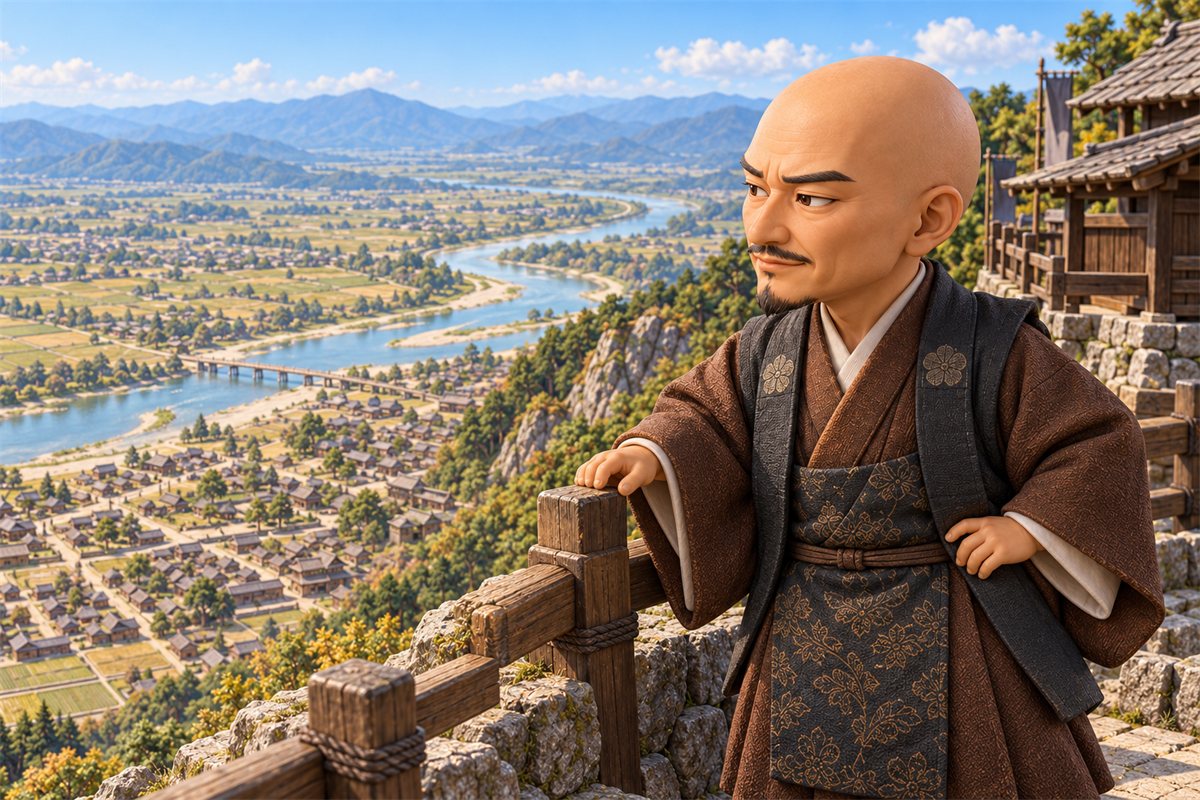
Image: Saitō Dōsan looking down on the castle town from the summit of Mt. Inaba
The Lords of the Castle
The lord of Inabayama Castle (Gifu Castle) changed many times between the Sengoku period and the Battle of Sekigahara. The main lords were as follows.
| Lord | Period (approx.) | Who was he? |
| Nikaidō Yukimasa | Beginning of the Kamakura period | Said to have first built a castle here [Legend] |
| Saitō Dōsan (and his father, Nagai Shinzaemon-no-jō) | 1530s–around 1554 | Said to have developed the castle and the town of Inokuchi (article on Saitō Dōsan) |
| Saitō Yoshitatsu | Around 1554–1561 | Dōsan's eldest son, who defeated his father and ruled Mino (article on Saitō Yoshitatsu) |
| Saitō Tatsuoki | 1561–1567 | Yoshitatsu's son, said to have succeeded at 14 by the traditional count [Widely accepted] |
| Oda Nobunaga | 1567–1575 | Took Mino and used it as his base to go to Kyoto. Moved to Azuchi in 1576 (article on Oda Nobunaga) |
| Oda Nobutada | 1575–1582 | Nobunaga's eldest son. Died in the Honnō-ji Incident |
| Oda Nobutaka | 1582–1583 | Nobunaga's third son. Opposed Hideyoshi and surrendered |
| Ikeda Motosuke | 1583–1584 | Eldest son of Ikeda Tsuneoki. Died at the Battle of Komaki and Nagakute |
| Ikeda Terumasa | 1584 or 1585 – 1590 or 1591 | Motosuke's younger brother, later lord of Himeji Castle |
| Toyotomi Hidekatsu | 1591–1592 | Hideyoshi's nephew |
| Oda Hidenobu | 1592–1600 | Nobunaga's grandson (once called Sanbōshi). The last lord |
The year a lord took over can differ by about a year between sources (even Gifu City's own materials differ on when Ikeda Terumasa arrived and left). In 1575 (Tenshō 3), Nobunaga handed headship of the family and Gifu Castle to his son Nobutada, and the following year moved to Azuchi Castle.
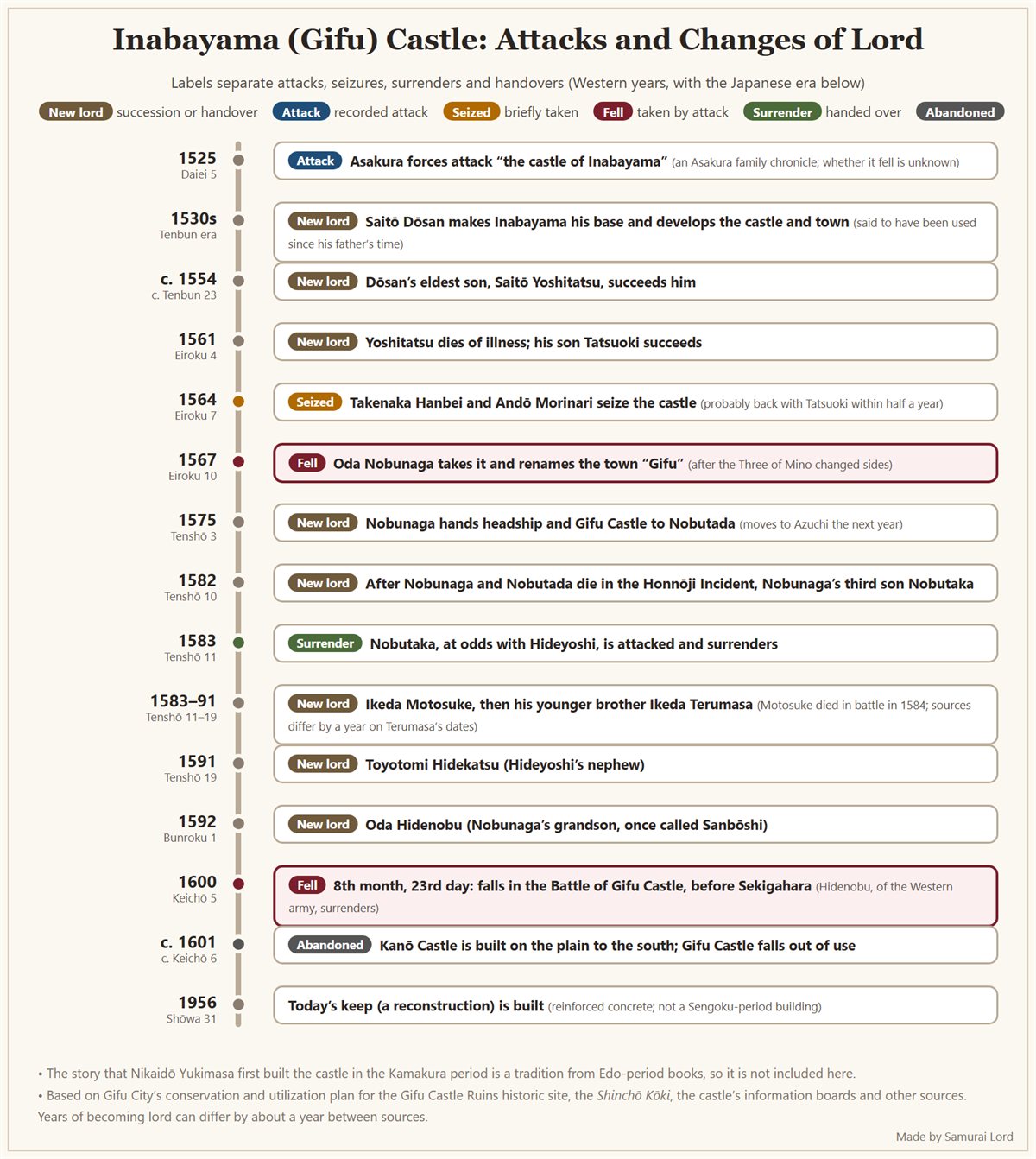
Image: Attacks on Inabayama Castle and Gifu Castle and its changes of lord (made by Samurai Lord based on Gifu City's plan for the historic site, the Shinchō Kōki and other sources). Tap (click) the image to enlarge it
The Battle of Gifu Castle and the End of the Castle
In 1600 (Keichō 5), just before the Battle of Sekigahara, the lord of the castle, Oda Hidenobu, who had sided with the Western army, was attacked by the Eastern army. On the 23rd day of the 8th month, Gifu Castle fell to an attack by Ikeda Terumasa, a former lord of the castle, Fukushima Masanori and others, and Hidenobu surrendered [Fact]. This is called the "Battle of Gifu Castle."
After the Battle of Sekigahara, Kanō Castle was built on the plain to the south, and Gifu Castle fell out of use (around 1601) [Widely accepted]. The buildings and stones of Gifu Castle are said to have been used to build Kanō Castle, and there is also a story that its keep was moved to Kanō Castle [Legend].
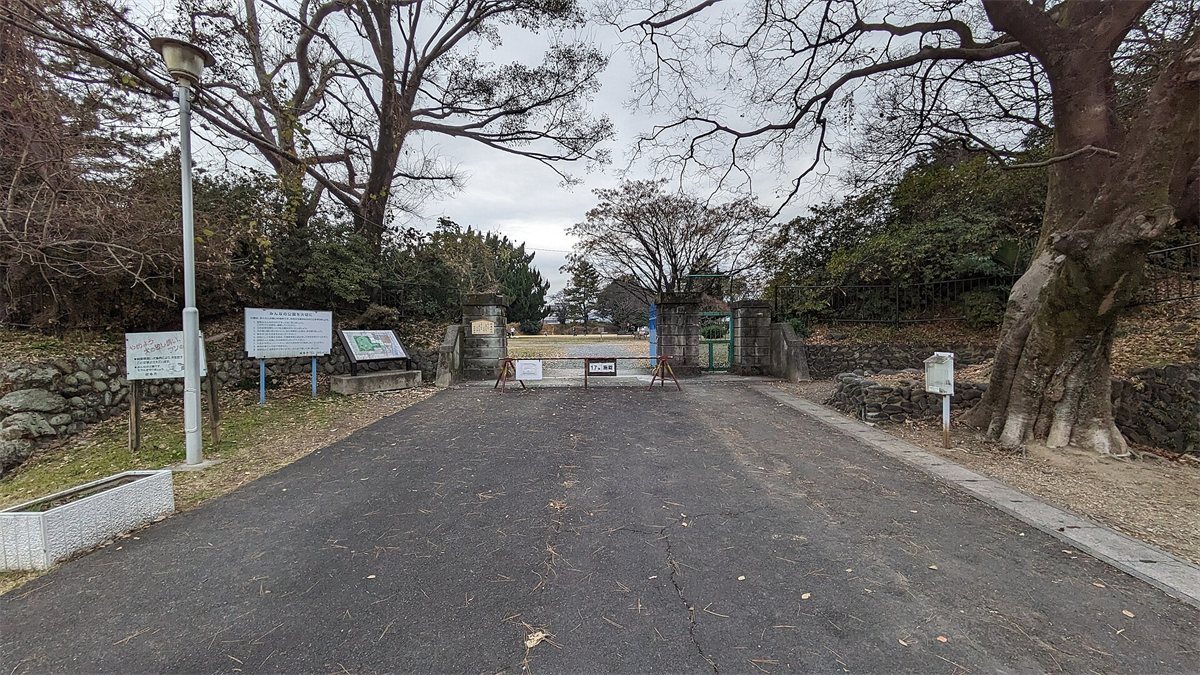
Image: The ruins of Kanō Castle, built to replace Gifu Castle (Kanō Marunouchi, Gifu City). Wikimedia Commons (photo: 先従隗始, CC0)
Was Inabayama Castle Impregnable? Its Defenses and Why It Fell
Inabayama Castle is often called "impregnable" (hard to attack and hard to take). Mt. Kinka is indeed a mountain of hard rock with many cliffs, terrain well suited to defense. However, we did not find this description in the records from the time checked for this article.
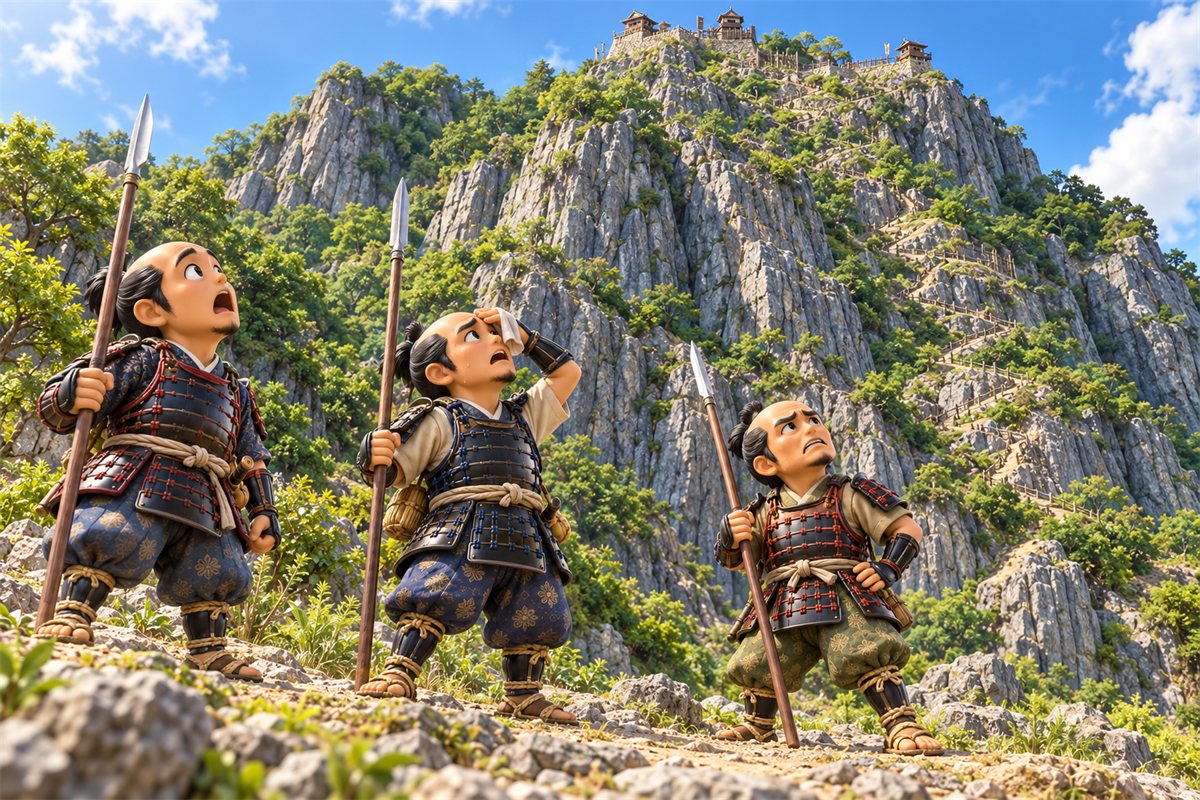
Image: Soldiers looking up at a castle on top of a steep, rocky mountain
In fact, the castle was attacked or taken many times. It was seized by Hanbei and his men in 1564 (Eiroku 7), captured by Nobunaga in 1567 (Eiroku 10), and fell in a single day in 1600 (Keichō 5). Each time, the circumstances were different.
- 1564: a surprise seizure by retainers inside the castle
- 1567: senior retainers went over to the enemy, the town below was burned, and the castle was surrounded
- 1583: after Shibata Katsuie's defeat, the lord, Nobutaka, lost his main ally and surrendered the castle
- 1600: it was attacked by a large army after defeats in the surrounding fighting
The steep terrain favored the defenders, but it was not enough on its own to hold the castle. When retainers' loyalty slipped away or the surrounding battles were lost, the castle on the mountain was left isolated.
So a steep mountain alone can't protect a castle. The town below and the retainers mattered too!
Why "Gifu"? The Origin of the Name
The Shinchō Kōki says that after taking Inabayama Castle, Nobunaga "this time renamed the place called Inokuchi, and named it Gifu." It does not say, however, who came up with the name.
A well-known story says that the Zen monk Takugen Sōon of Owari offered three names, "Kizan," "Kiyō" and "Gifu," and Nobunaga chose "Gifu". The name is said to come from the ancient Chinese story of Mount Qi (岐山, "Kizan" in Japanese), associated with King Wen and the rise of the Zhou dynasty. This, however, is a story found in Edo-period books [Legend].
The manga panel below is a scene based on this tradition [Legend].
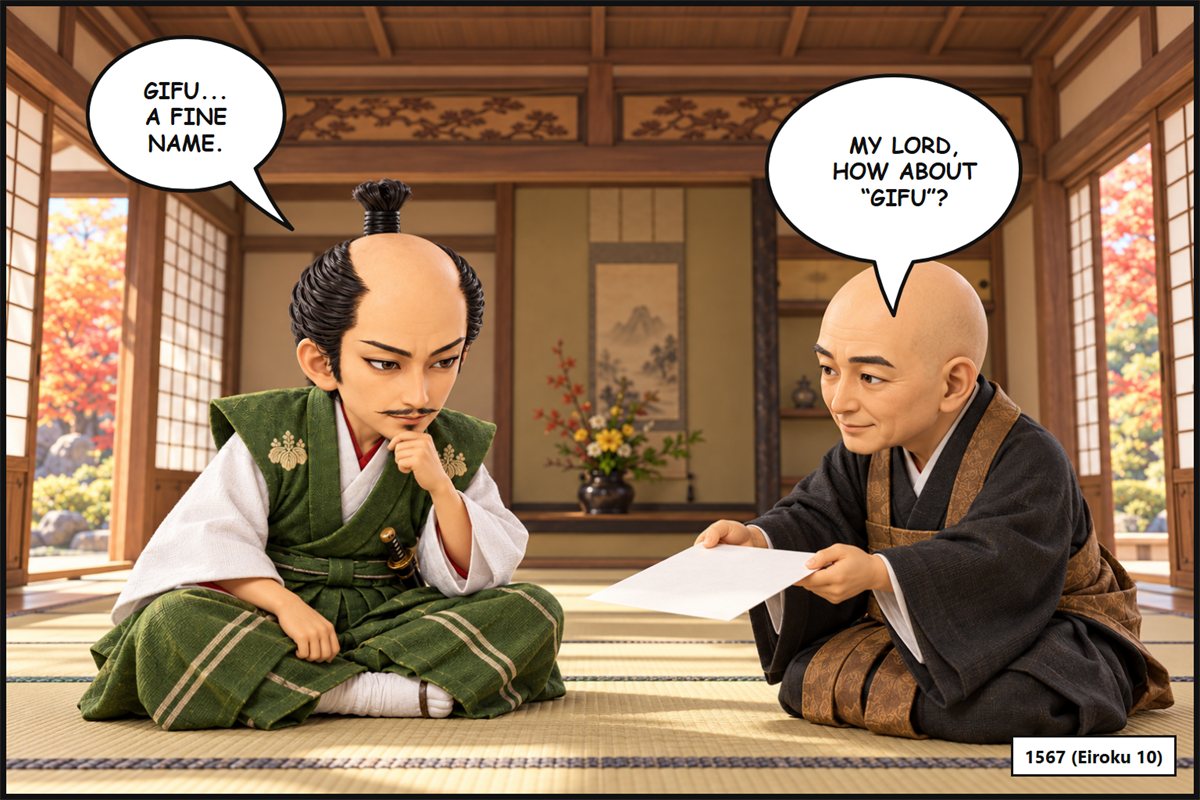
Image: Takugen suggesting a new name for the town to Nobunaga
On the other hand, it is known that names such as "Gifu," "Kiyō" and "Kizan" were already used before Nobunaga's time by Zen monks of Mino, as elegant names for this place in their poems and writings [Widely accepted]. Nobunaga is thought to have made a name known among the Zen monks into the town's official name.
The Names of Inabayama Castle in the Sources
Inabayama Castle was called by various names depending on the period and the writer. Note that the names did not simply change one after another; names of the mountain, the castle and the town are mixed together.
| Name | Name of what? | Where it appears |
| 稲場山ノ城 (Inabayama Castle) | The castle | 『朝倉家伝記』, an Asakura family chronicle describing events of 1525 (Daiei 5) |
| Inabayama | The mountain and the castle | Shinchō Kōki (Inabayama, Dōsan's residence) |
| Inokuchi | The town (the castle's mountain was called "Mt. Inokuchi") | Shinchō Kōki |
| 因幡山 (Inabayama, written with different characters) | The mountain (its master = the lord of the castle) | Genjo Ōnenki, the record of a monk of Daigoji temple in Kyoto (1561) |
| Kinkazan Castle | The castle | Kaisen Jōki's letter of the 11th day of the 2nd month (no year is given, but it is thought to date from 1564) |
| Gifu | The town and the castle | Shinchō Kōki (Inokuchi renamed in 1567) |
It was also in 1567 (Eiroku 10), the year he took Inabayama Castle, that Nobunaga began using his seal reading "Tenka Fubu" [Fact]. The vermilion seal stamped on documents granting land in Mino to his retainers is regarded as the earliest example of Nobunaga's vermilion-seal documents.
What We Know and What We Don't
- We know: Nobunaga renamed Inokuchi "Gifu"; "Gifu" was a name already found in the poems and writings of Zen monks before that
- We don't know: who came up with the name (the story of Takugen is a tradition)
Did Inabayama Castle Have a Keep? What Excavations Show
What Gifu Castle looked like in Nobunaga's time is becoming clearer from the records of visitors and from excavations.
Gifu Castle as Seen by Luís Fróis
In 1569 (Eiroku 12), the Portuguese missionary Luís Fróis visited Nobunaga in Gifu and described what he saw in a letter [Fact]. Fróis called the residence at the foot of the mountain a "palace" and described its beauty in detail.
According to Gifu City's introduction, Fróis was also invited to the castle on the mountain and served a meal in a splendid room. On this occasion, Nobunaga himself carried in the tray of food to entertain him. When Fróis gratefully raised the tray above his head, Nobunaga told him to "hold it level so as not to spill the soup," Fróis writes.
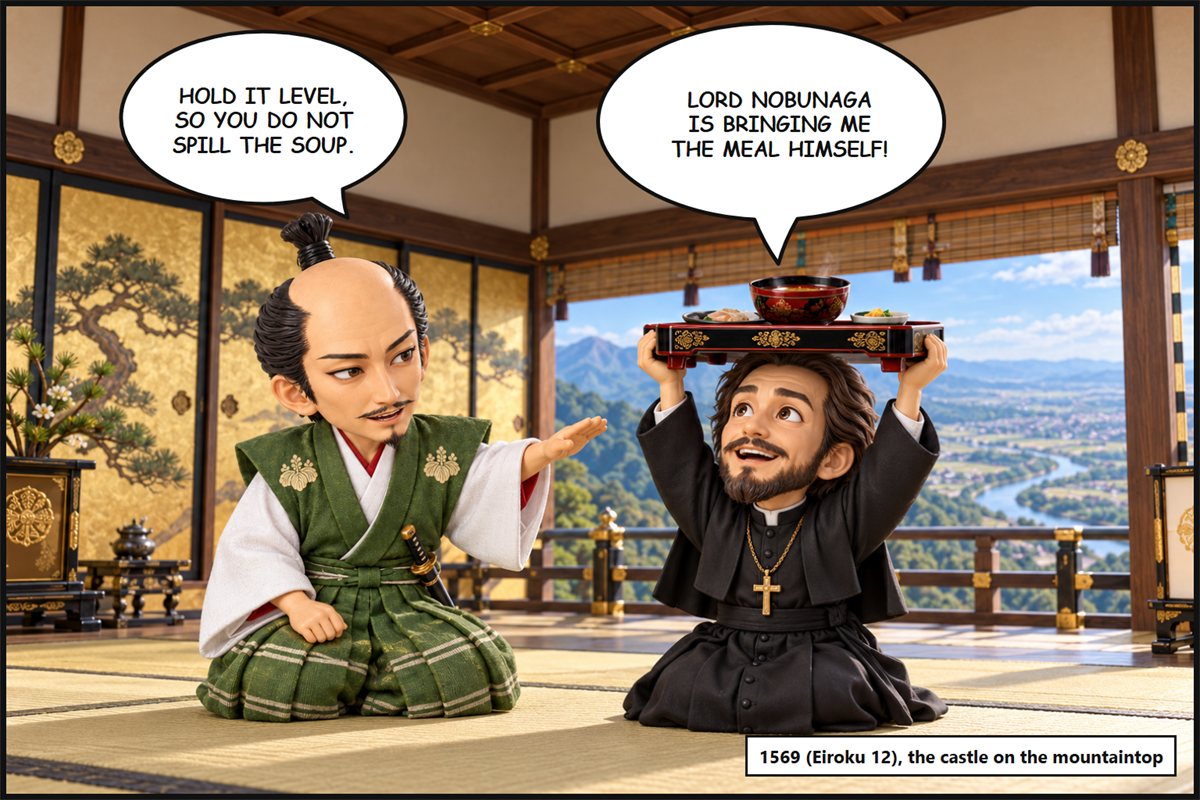
Image: Nobunaga carrying a meal tray to entertain Fróis in a room on the mountain
The court noble Yamashina Tokitsugu, who visited Gifu in the same year, also wrote in his diary that the view from the mountain was "a steep landscape beyond words."
What Excavations Have Found
Excavations by Gifu City have gradually revealed what the castle looked like in Nobunaga's time.
- The residence at the foot: a passage lined with large stones, flat terraces rising in many levels, and the remains of a garden where a waterfall poured down from the rocks
- Gold-leaf decorated roof tiles: roof tiles with gold leaf on parts of their designs, such as chrysanthemums, were found at the site of the residence at the foot (a Gifu City cultural property)
- Stone walls on the mountain: stone walls from Nobunaga's time, and stone walls thought to date from Dōsan's time, have been found
- The keep base: in fiscal 2019 (Reiwa 1), stone walls of a keep base (tenshudai) thought to date from Nobunaga's time were identified for the first time, to the west of today's keep
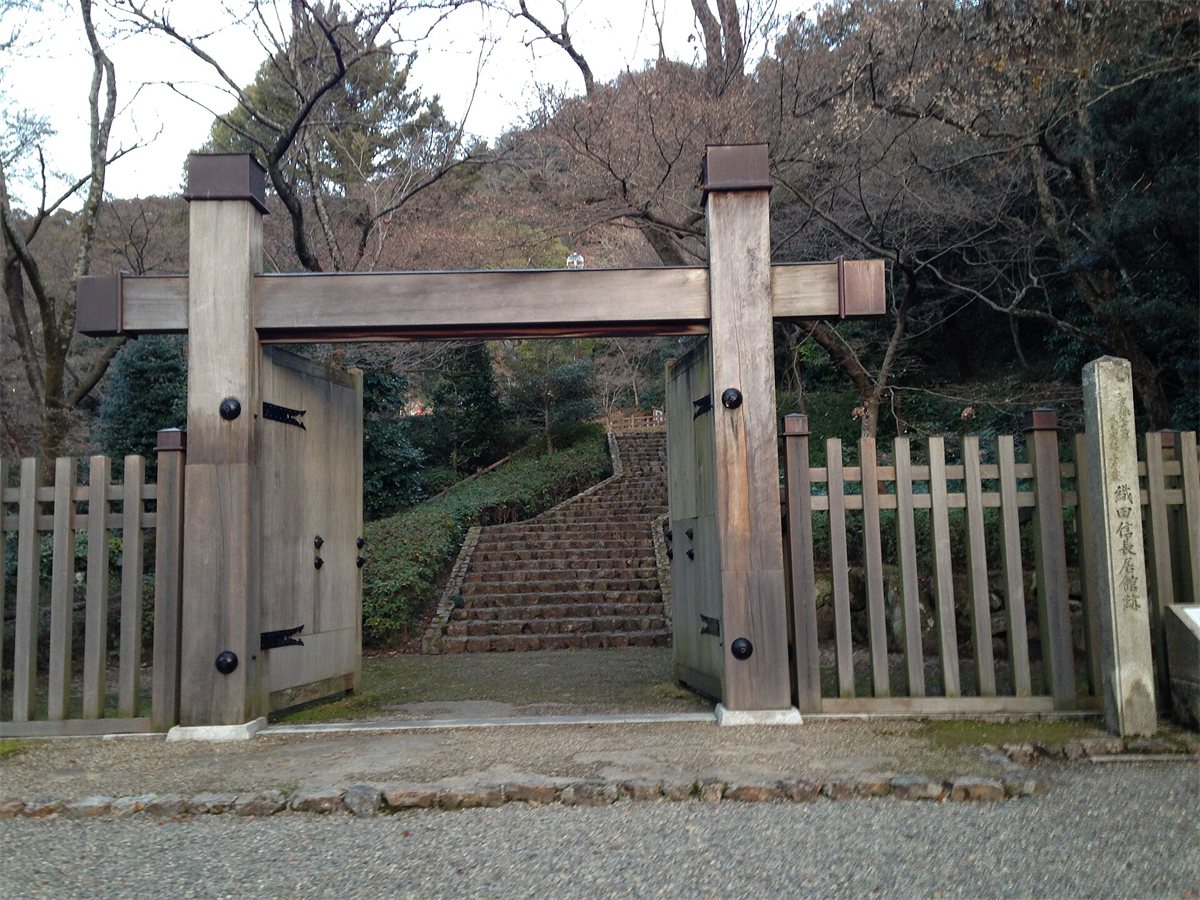
Image: The site of Nobunaga's residence at the foot of the mountain (Gifu Park). Wikimedia Commons (photo: そらみみ, CC BY-SA 3.0)
Was There a Keep?
From the excavation results, it is thought very likely that a keep base and tile-roofed buildings were built in Nobunaga's time [Widely accepted]. A letter written by Fukushima Masanori at the time of the Battle of Gifu Castle in 1600 (Keichō 5) also mentions a "keep" (天主). However, what that keep looked like and how many stories it had are not known [Unknown].
What We Know and What We Don't
- We know: Nobunaga built a splendid residence at the foot of the mountain and also had a castle with stone walls on the mountain
- We don't know: the shape and height of the keep in Nobunaga's time
Visiting Gifu Castle Today: Closure and Access
Today's keep of Gifu Castle is a reconstructed keep of reinforced concrete built in 1956 (Shōwa 31) (three exterior tiers, four floors inside), after the first modern reconstructed keep, built in 1910 (Meiji 43), burned down in 1943 (Shōwa 18). It is not an exact reproduction of the castle as it was. Gifu Castle is also on the list of "Japan's 100 Great Castles."
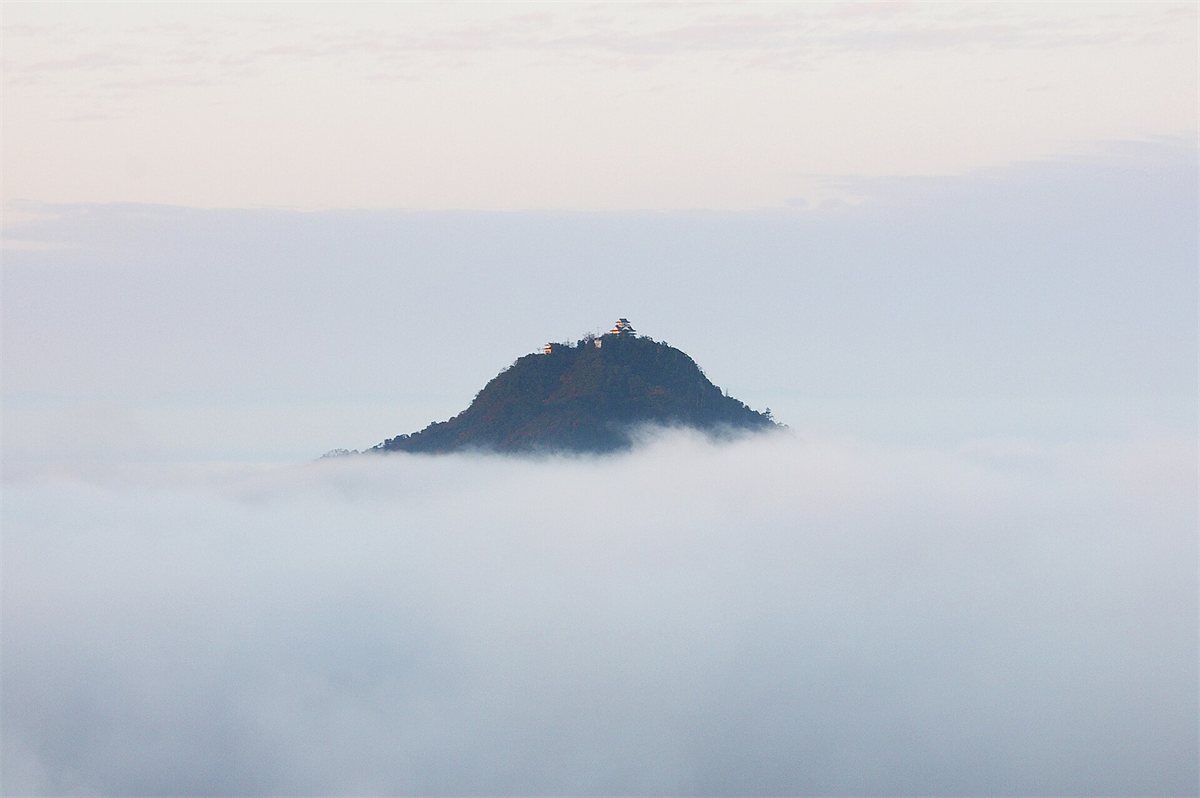
Image: Gifu Castle floating above a sea of clouds (before the closure for renovation). Wikimedia Commons (photo: Gifu City, CC BY 4.0)
The Keep Is Closed for Renovation (as of October 2026)
| Facility | Current situation |
| Keep | Closed for renovation work. Scheduled to reopen in November 2027. According to Gifu City, the keep is to be hidden behind scaffolding and protective sheeting from late August 2026 to mid-April 2027 (the schedule may change as the work progresses) |
| Gifu Castle Museum (Shiryōkan) | Closed (scheduled to reopen with the keep) |
| The path at the summit | The area in front of the keep is closed from November 25, 2025, until the end of September 2027 (planned). The path from the ropeway's summit station up to just before the keep remains open |
| Gifu Kinkazan Ropeway | Scheduled to be suspended for maintenance from December 1 to 28, 2026, and from January 7 to February 16, 2027 |
The visitor information above is based on Gifu City's page on the Gifu Castle keep (in Japanese), updated October 21, 2026. Even while the keep is closed, you can enjoy the view from the Kinkazan observation deck, the site of Nobunaga's residence at the foot of the mountain, and the Gifu City Museum of History.
Getting to Gifu Castle
| How | Route (approx.) |
| Bus | About 15 minutes by Gifu Bus from JR Gifu Station or Meitetsu Gifu Station to the "Gifu Kōen / Gifu-jō" stop (岐阜公園・岐阜城), then about 3 minutes on foot to the ropeway station |
| Ropeway | About 4 minutes on the Gifu Kinkazan Ropeway to the summit station. Normally about 8 minutes on foot from the summit station to the keep (during the renovation, the area in front of the keep is closed) |
| Hiking trails | Routes include the Nanamagari and Hyakumagari trails. During the work, the Meisō-no-Komichi and Hanataka routes end before the summit |
| Car | Use the Gifu Park parking lots (spaces are limited, so the bus is recommended) |
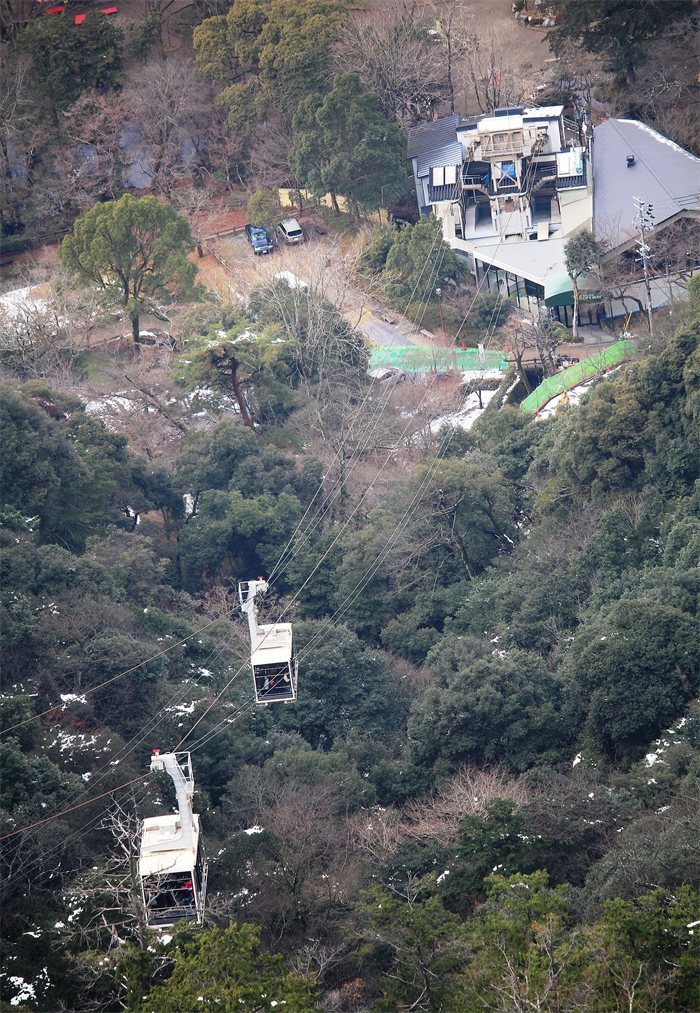
Image: The ropeway passing over the trees of Mt. Kinka. Wikimedia Commons (photo: Alpsdake, CC BY-SA 4.0)
FAQ
How do you read 稲葉山城?
It is read "Inabayama-jō" (Inabayama Castle). Today it is called "Gifu-jō" (Gifu Castle).
Whose castle was Inabayama Castle?
In the Sengoku period, three generations of the Saitō family, Dōsan, Yoshitatsu and Tatsuoki, made it their base, and from 1567 (Eiroku 10) it was Oda Nobunaga's castle (more).
When was the Battle of Inabayama Castle?
1567 (Eiroku 10) is the accepted date today. The Shinchō Kōki gives the 15th day of the 8th month as the day Saitō Tatsuoki left the castle (there is also a theory that it was in the 9th month; more).
Did the one-night castle of Sunomata really exist?
The story of Hideyoshi building a castle at Sunomata in one night comes from the Edo-period popular book Ehon Taikōki and from the Bukō Yawa, which came to light in the Shōwa era. We could not confirm it in the records from the time checked for this article. That Nobunaga had a fort built at Sunomata in 1561 (Eiroku 4) is recorded in the Shinchō Kōki (more).
Why did Takenaka Hanbei give the castle back?
The story that "he did it to admonish his lord Tatsuoki, and gave the castle back once he had achieved his aim" comes from later war chronicles. One interpretation is that pressure from forces supporting Tatsuoki led him to give up the castle. However, much about the details remains unclear (see our article on Takenaka Hanbei).
When was Inabayama Castle abandoned?
After it fell in the Battle of Gifu Castle in 1600 (Keichō 5), and after the Battle of Sekigahara, Kanō Castle was built on the plain to the south, and Gifu Castle fell out of use around 1601 (more).
Summary: What Was Inabayama Castle?
Inabayama Castle was a mountain castle on Mt. Kinka in Gifu City, the same castle as today's Gifu Castle. In the Sengoku period it was the base of Saitō Dōsan, Yoshitatsu and Tatsuoki, and in 1567 (Eiroku 10) Oda Nobunaga captured it and renamed the town of Inokuchi "Gifu."
It was a castle on a steep, rocky mountain, but its master changed many times: Takenaka Hanbei's seizure in 1564 (Eiroku 7), Nobunaga's capture, and the Battle of Gifu Castle in 1600 (Keichō 5). The strength of the castle depended not only on how steep the mountain was, but also on what its retainers and the people around it did.
Today's keep is a Shōwa-era building, but excavations have found stone walls thought to date from Dōsan's time, as well as stone walls and a probable keep base from Nobunaga's time, and the castle of the Sengoku period is gradually coming into view.
For the people involved, see also our articles on Saitō Dōsan, Saitō Yoshitatsu, Takenaka Hanbei, Oda Nobunaga and Nōhime.
Taking a mountain castle is not just a matter of climbing the mountain.

Once it reopens, I want to look down on the Nagara River from the top!
Sources & How This Article Was Written
This article is based mainly on the following records and references:
- Records from the time: the letter of Kaisen Jōki (copied in 『明叔録』; based on the text in 『美濃国稲葉郡志』, 1915); the Genjo Ōnenki; the letter of Luís Fróis and Yamashina Tokitsugu's diary Tokitsugu Kyōki (as introduced in Gifu City's materials); a letter of Fukushima Masanori (as cited in Gifu City's excavation reports)
- Somewhat later and later records: Ōta Gyūichi, Shinchō Kōki, opening book and book 1 (1881 printed edition on Wikisource); 『朝倉家伝記』, Mino no Kuni Shokyūki, Ehon Taikōki, Bukō Yawa and others (as introduced in Gifu City's materials and in research)
- Official materials (in Japanese; titles translated by us): Gifu City, Plan for the Conservation and Use of the Gifu Castle Ruins Historic Site (2021); Gifu City, excavation results for the "Gifu Castle Ruins" historic site (fiscal 2018, 2019 and 2024); Gifu City, "Hospitality at Gifu Castle"; Gifu City, "Gifu Castle Keep (Closed)" (updated October 21, 2026); Gifu Prefecture, "Overview of Gifu Prefecture"; Cultural Heritage Online, "Gold-leaf decorated roof tiles excavated from the Gifu Castle Ruins (site of Oda Nobunaga's residence)"; guides by the Gifu Prefecture Tourism Federation and the Gifu Convention & Visitors Bureau; Japan Castle Foundation, "Japan's 100 Great Castles"
- Encyclopedias: Nihon Daihyakka Zensho, Sekai Daihyakka Jiten and others (Kotobank)
- Map and images: the map uses GSI Tiles from the Geospatial Information Authority of Japan as its base, with place names added by Samurai Lord. The photos of Mt. Kinka and Gifu Castle (Alpsdake, CC BY-SA 4.0), Gifu Castle above the clouds (Gifu City, CC BY 4.0), the ropeway (Alpsdake, CC BY-SA 4.0), the site of Nobunaga's residence (そらみみ, CC BY-SA 3.0), the Kanō Castle ruins (先従隗始, CC0) and the summit of Mt. Zuiryōji (大野一将, CC0), and Tsukioka Yoshitoshi's "The Moon over Inabayama" (public domain), are from Wikimedia Commons. The charts, manga panels and illustrations are original works by Samurai Lord
What the Labels Mean
[Fact]Confirmed by sources from the time ([Fact: …]names the source)[Widely accepted]A view widely accepted by researchers[Debated]Accounts or interpretations differ[Unknown]Not established from the sources we checked[Legend]Stories found in later records or traditions[Folk belief]Popular claims with little evidence
We keep "what a record says" separate from "what actually happened." What is written in records compiled in later times is named in the text by the name of the record, and is not all treated as [Fact]. Translations of the source excerpts in this article are by the Samurai Lord editorial team.
This article was written by the Samurai Lord editorial team and is revised as new research and reader feedback come in. If you spot an error, please let us know through our contact form (in Japanese) and we will check and correct it.
Read in Japanese
This article is also available in Japanese: 稲葉山城はどこ?岐阜城との違いや稲葉山城の戦い・竹中半兵衛の乗っ取りを解説!