Sasaki Kojirō is the swordsman who, according to tradition, fought Miyamoto Musashi on the island of Ganryūjima and lost.
Yet the oldest record calls him only "Ganryū." The full name "Sasaki Kojirō," the age of 18 and the famous "swallow cut" were all added later, in books and novels.
Later sources added names, ages and stories to this sparse account. In this article, we look at what each source actually says, and when it was written.
Japanese months and days refer to the historical lunisolar calendar. Ages in old records usually follow the traditional Japanese count, in which a person was counted as one at birth and gained a year at each New Year.
Key points are tagged: [Fact] confirmed by records from the time ([Fact: …] means the named record says so), [Widely accepted] a view widely accepted by researchers, [Debated] accounts or interpretations differ, [Unknown] not established from the sources we checked, [Legend] stories from later records or local tradition, and [Fiction] details created for novels or plays (details).

I am Uesugi Kenshin. Today's subject is Musashi's great rival, Sasaki Kojirō.

I'm Date Masamune! Kojirō was the young genius with the extra-long sword, right?

That image spread through novels of the 1930s and later. Let us start from the oldest records.
The Short Answers
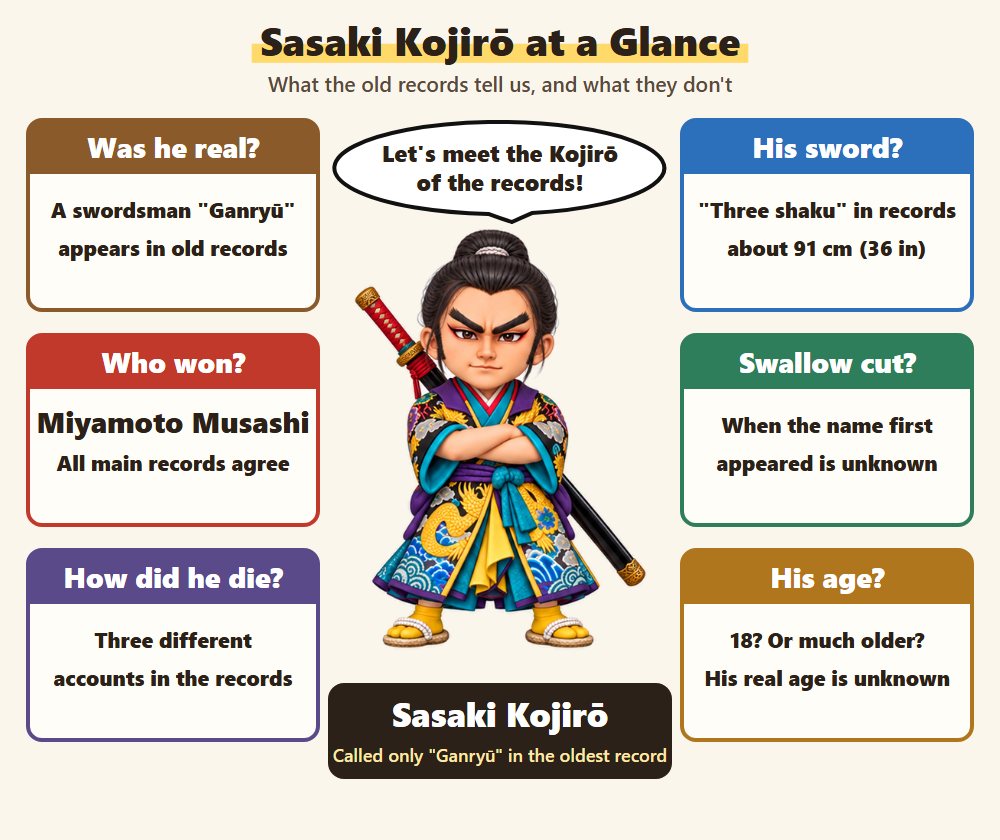
- Was he real? A swordsman called "Ganryū" who fought Musashi appears in early records (more)
- Who won? Miyamoto Musashi. All the main records agree (more)
- How did he die? The records give three different accounts (more)
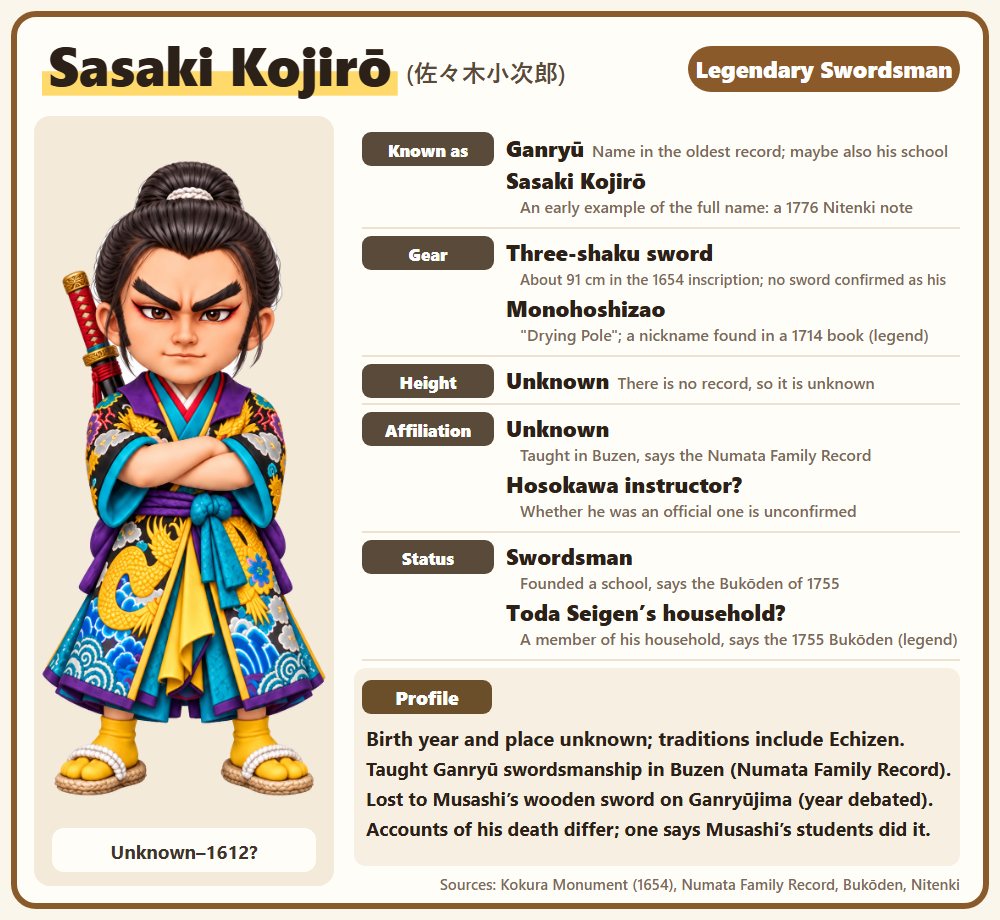
- His sword? "Three shaku" in the records, about 91 cm (36 in) of blade. Later books call it the "Drying Pole" (more)
- The swallow cut? When the name of the technique first appeared has not been established (more)
- His age? One book says 18; others think he was much older (more)
Jump to the part you want to read:
- Who was Sasaki Kojirō? Was he real?
- Musashi vs. Kojirō: who won, and when and where?
- How did Kojirō die? Three different accounts
- How long was the "Drying Pole"? Was it a nodachi?
- Where does the name "Sasaki Kojirō" come from?
- How old was Kojirō? What the two accounts mean by "18"
- Where was Kojirō from, and who was his teacher?
- How Kojirō's image changed, and was he really deaf?
- Where is Ganryūjima, and how do you get there?
- FAQ
Who Was Sasaki Kojirō? Was He Real?
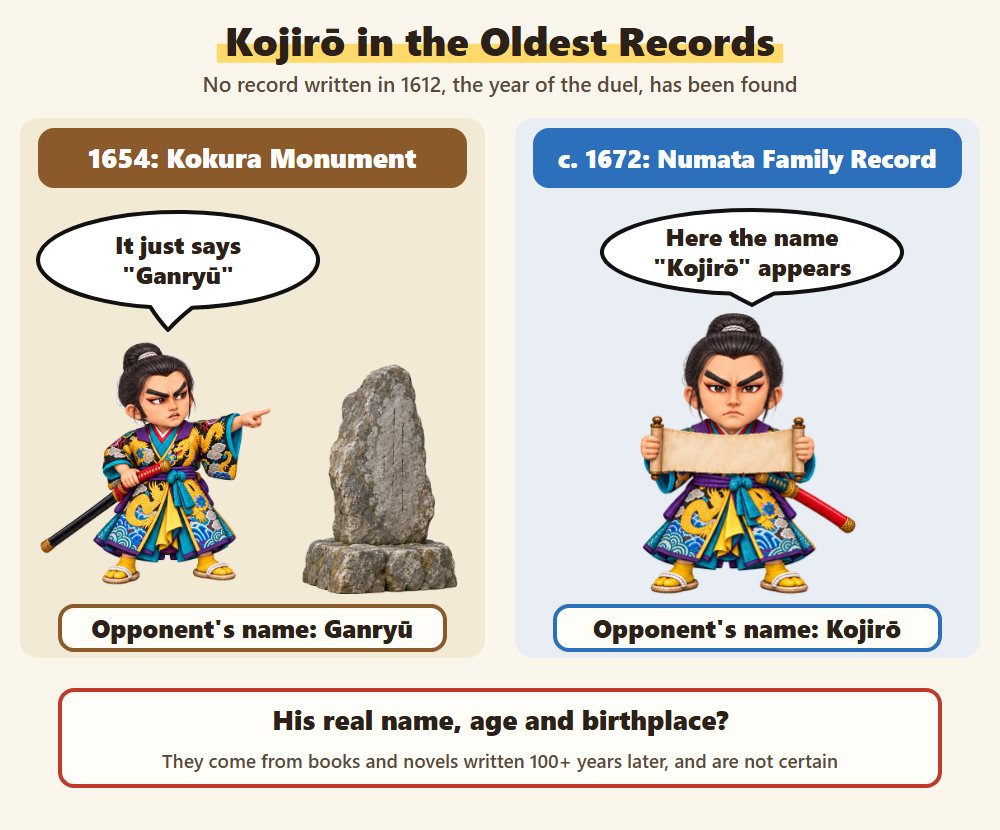
So Kojirō was just a made-up character?
No. Early records tell us that a swordsman really did fight Musashi. What we don't know is his real name and age.
In short, early records show that a swordsman fought Musashi [Widely accepted]. His real name, his age and where he was born, however, are not clear [Unknown].
The oldest record is the Kokura Monument, a stone inscription set up in 1654 by Musashi's adopted son, Miyamoto Iori, on Tamukeyama hill in what is now Kokura Kita Ward, Kitakyushu. It calls Musashi's opponent only "Ganryū" [Fact: Kokura Monument].
The next oldest is the Numata Family Record (Numata-kaki), compiled around 1672 by the Numata family, retainers of the Hosokawa lords. This is where the name "Kojirō" appears. No record written in 1612, the year of the duel, has been found.
From the Sources: The Kokura Monument (1654)
Source
Kokura Monument (Tamukeyama Park, Kokura Kita Ward, Kitakyushu), set up by Miyamoto Iori in 1654. Japanese reading of the inscription
Japanese (excerpts)
「両雄、同時に相会す」「岩流、三尺の白刃を手にして来たり」「武蔵、木刃の一撃を以て之を殺す」「故に俗、舟嶋を改めて岩流嶋と謂ふ」
English
The two heroes met at the same time. Ganryū came holding a naked blade of three shaku (about 91 cm). Musashi killed him with a single blow of a wooden sword. That is why people renamed Funashima (Boat Island) "Ganryū Island."
What it tells us
That Musashi's side said he fought "Ganryū" on Funashima and won with a wooden sword. It says nothing about the opponent's age or birthplace.
| What the early records say | What we cannot confirm |
| Musashi and "Ganryū" fought on Funashima | His real name (was it Sasaki Kojirō?) |
| Ganryū carried a long, real sword | His age |
| Musashi won | His birthplace |
| Ganryū taught swordsmanship in Buzen (Numata Family Record) | Whether he was an official instructor of the Hosokawa clan |
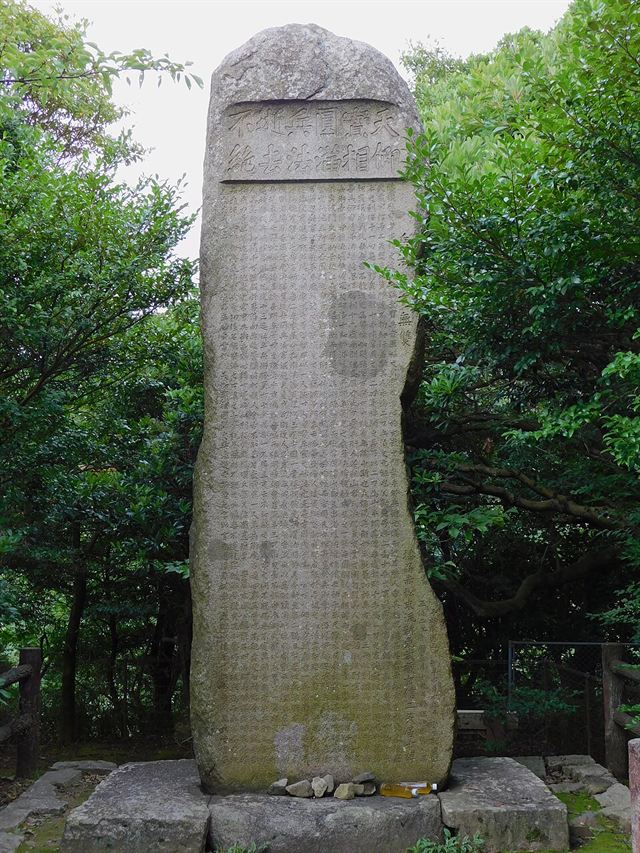
Image: The Kokura Monument (Tamukeyama Park, Kitakyushu). Photo: 速日 (CC BY-SA 4.0 / Wikimedia Commons)
Musashi vs. Kojirō: Who Won, and When and Where?
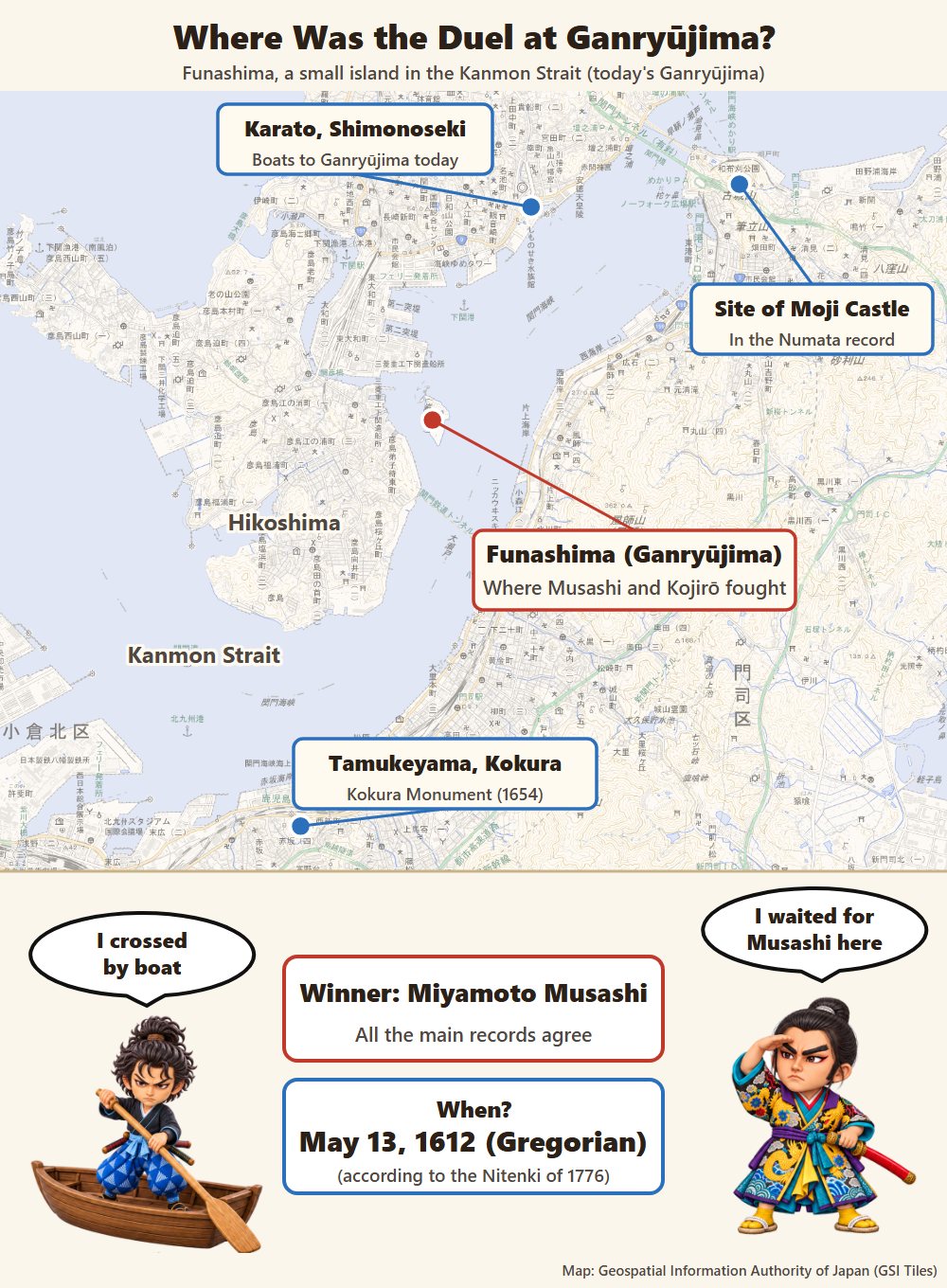
So who won?
In all the main records we compare here, Musashi won. No record says Kojirō won.
Miyamoto Musashi won [Widely accepted]. The duel took place on Funashima, a small island in the Kanmon Strait between Shimonoseki (Yamaguchi Prefecture) and Kitakyushu, later called "Ganryūjima" (Ganryū Island) after the loser.
The date usually given is May 13, 1612, in the Gregorian calendar used internationally today. In Japan's historical calendar, this was the 13th day of the 4th month of Keichō 17. The date comes from the Nitenki, a biography written in 1776, which includes a letter dated the 12th of the 4th month and places the duel on the next day [Legend: Nitenki]. Musashi was 29 by the traditional count (if he was born in 1584).
The year Keichō 17 (1612) already appears in the Bukōden of 1755. The two oldest records, the Kokura Monument and the Numata Family Record, give neither a year nor a date. Other books say 1601, or give Musashi's age in a way that points to 1602 [Debated].
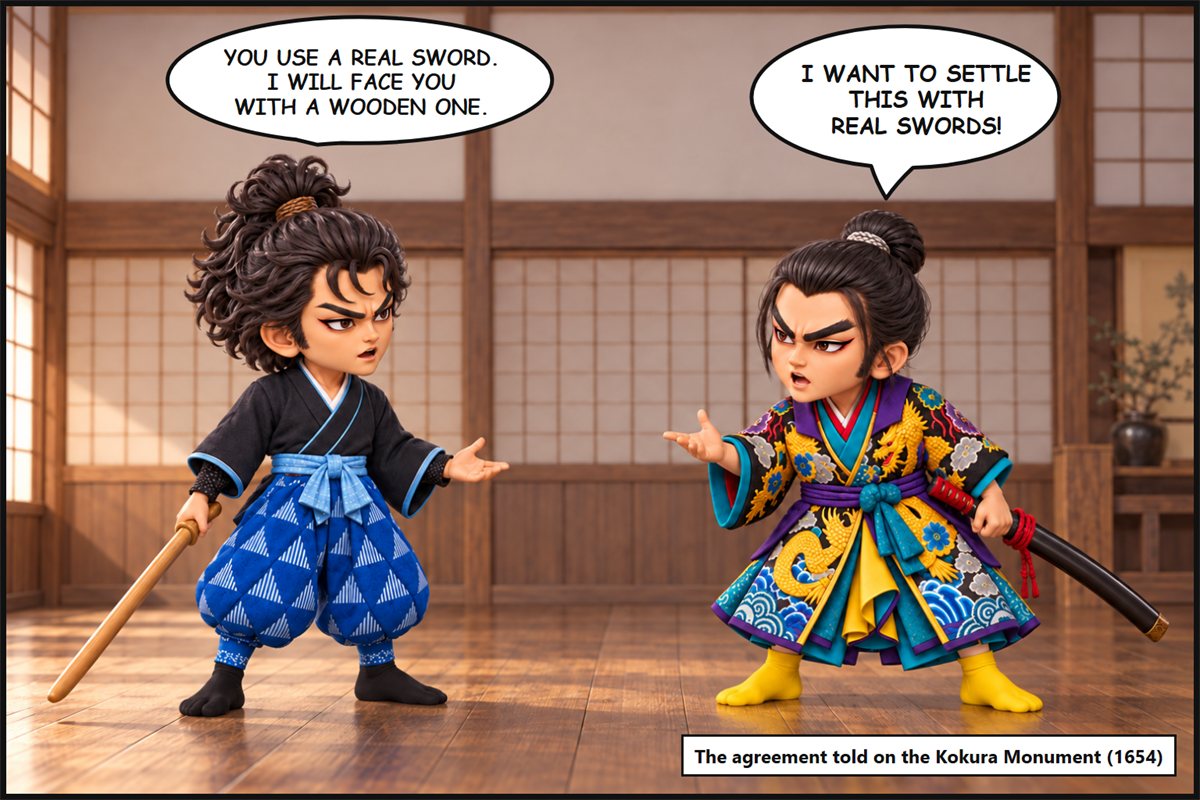
The Kokura Monument says that before the duel, Ganryū asked to settle the match with real swords, and Musashi answered that his opponent could use a real sword while he would use a wooden one. The two firmly agreed [Fact: Kokura Monument].
For what the duel meant in Musashi's life, see our article on Miyamoto Musashi.
Was Musashi Really Late? Where "Kojirō, You Have Lost!" Comes From
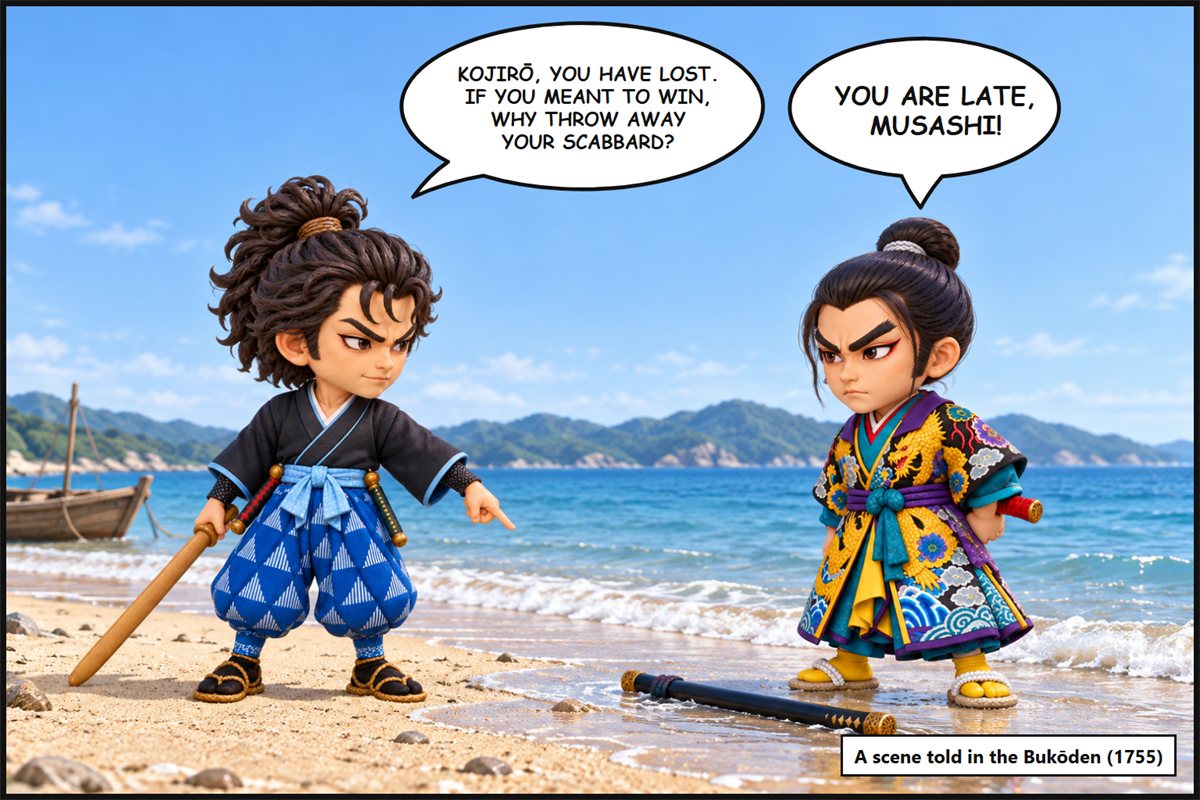
Musashi showed up late on purpose, didn't he?
The story of his lateness appears in a book written more than 140 years after the duel. Whether it was a tactic cannot be confirmed.
Musashi's late arrival and the line "Kojirō, you have lost!" come from the Bukōden of 1755 [Legend: Bukōden], a collection of stories gathered by followers of Musashi's school in Kumamoto.
According to it, Musashi slept until the sun was high and reached the island late. Kojirō said, "You are late," drew his sword and threw the scabbard into the water. Seeing this, Musashi said, "Kojirō, you have lost."
From the Sources: The Bukōden (1755)
Source
Bukōden (1755), from the transcription by the Harima Musashi Research Society
Japanese (excerpts)
「日高ル迄武公鼾睡シ不起」「アヽ汝後レタリ」「小次郎負タリ、勝バ何ゾ其鞘ヲ捨ン」
English
Lord Musashi snored and did not wake until the sun was high. (Kojirō:) "Ah, you are late." (Musashi:) "Kojirō, you have lost. If you meant to win, why would you throw away your scabbard?"
The Kokura Monument of 1654, on the other hand, says the two "met at the same time" and says nothing about lateness. Still, that alone does not prove Musashi was on time [Unknown]. The idea of lateness as Musashi's deliberate strategy was made famous by Yoshikawa Eiji's novel Musashi in the 1930s.
How Did Kojirō Die? Three Different Accounts
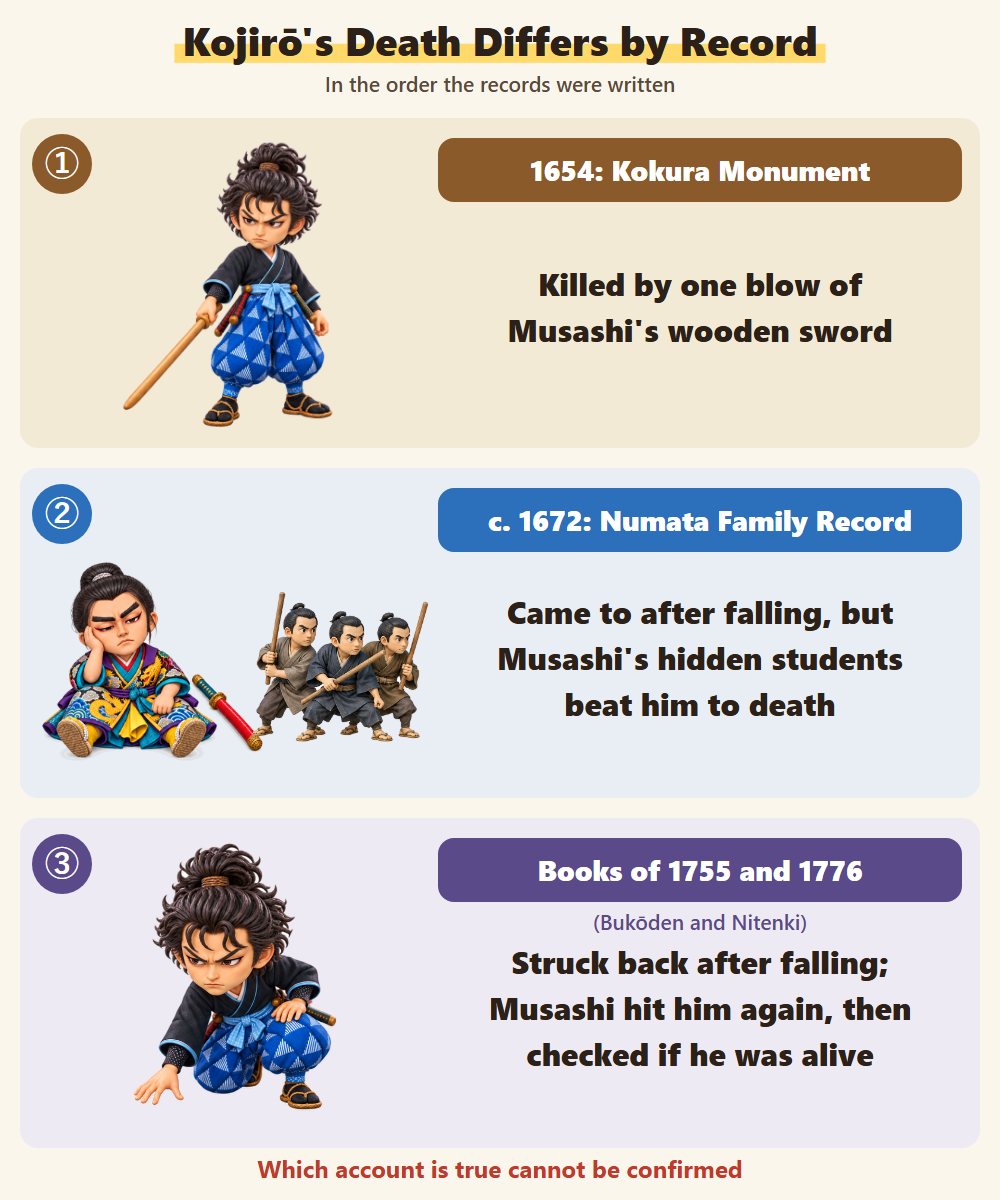
Didn't he die from one blow of Musashi's sword?
There are three stories: killed with one blow, fighting on after he fell, and killed by Musashi's students.
The records describe Kojirō's death in different ways [Debated]. Here are the three main accounts, in the order they were written.
| Record | Written | Kojirō's death |
| Kokura Monument | 1654 | Says he was killed by one blow of Musashi's wooden sword |
| Numata Family Record | around 1672 | He fell and later came to, but Musashi's students, who had been hiding, beat him to death |
| Bukōden and Nitenki | 1755 and 1776 | The fallen Kojirō struck back, Musashi hit him again, and then checked whether he was still alive |
From the Sources: The Numata Family Record (around 1672)
Source
Numata Family Record (around 1672), from the Japanese reading published on the official website of Soeda Town, Fukuoka Prefecture
Japanese (excerpts)
「ひく島後に巌流島と云ふ」「其後に小次郎蘇生致候得共」「彼弟子共参合」「後にて打殺申候」
English
Hiku Island, later called Ganryū Island. ... Afterward, Kojirō revived, but (Musashi's) students gathered and later beat him to death.
According to the Numata Family Record, Kojirō's angry students then set out for the island to kill Musashi. Musashi escaped to Moji (today's Moji Ward, Kitakyushu) and asked Numata Nobumoto, who held Moji Castle, for help [Debated: Numata Family Record].
Nobumoto protected Musashi in the castle and then sent him, guarded by men with guns, to a man named "Munisai" in Bungo Province (today's Ōita Prefecture). Researchers identify Munisai as Musashi's adoptive father.
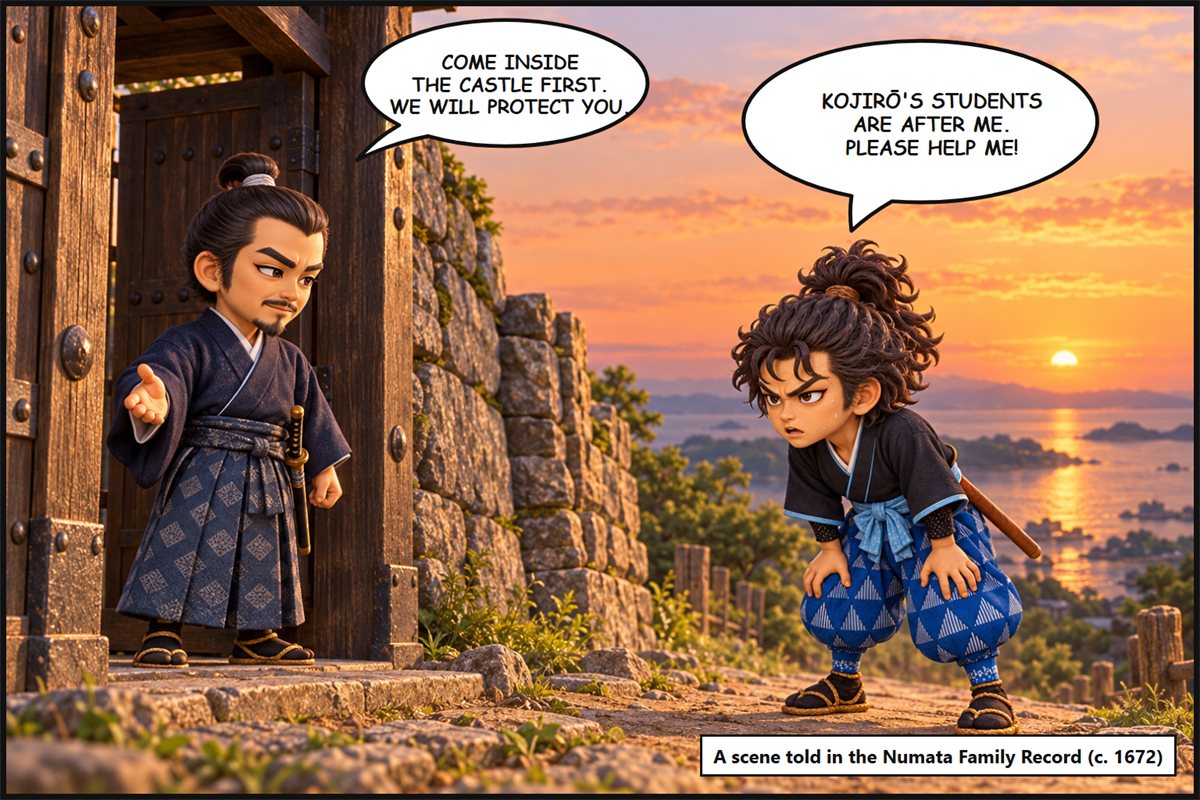
The Numata Family Record was compiled by the Numata family, retainers of the Hosokawa clan, to record the deeds of their ancestors. Yoshimura Toyoo of Kumamoto University considers it a valuable source, partly because of how it describes Munisai in Bungo. Even so, that does not mean every detail of the duel is true.
Note the place name, too. The record calls the site "Hiku Island, later called Ganryū Island." Today, Hikoshima and Funashima (Ganryūjima) are separate islands, so this wording needs care [Unknown].
How Long Was the "Drying Pole"? Was It a Nodachi?
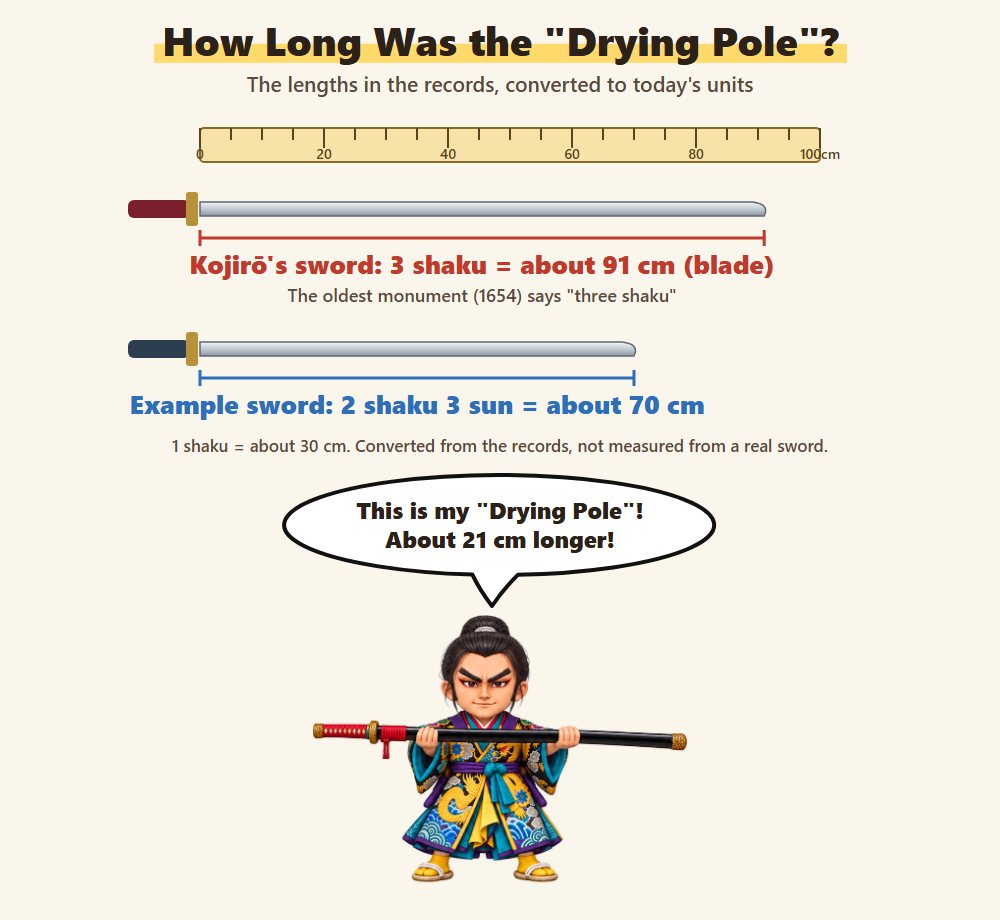
Was that sword really so long?
The monument says "three shaku," about 91 cm today. It does not call the sword a nodachi.
The Kokura Monument describes Ganryū's sword as "three shaku" long [Fact: Kokura Monument]. The shaku is a traditional Japanese unit of length; one shaku is about 30.3 cm, so that is roughly 91 cm (36 in). It works out to about 21 cm longer than an example sword with a blade about 70 cm long (two shaku three sun). The Nitenki of 1776 says "a little over three shaku."
An early example of the nickname Monohoshizao, the "Drying Pole" (a pole for hanging laundry), appears early in the Honchō Bugei Shōden, a collection of martial artists' stories completed in 1714 [Legend: Honchō Bugei Shōden]. The swordsmith also differs from book to book: a note in the Nitenki names Bizen Nagamitsu, while the Kōkai Fūhansō of 1704 names Aoe [Debated]. The Kōkai Fūhansō, however, tells a different version in which the opponent is called "Ueda Sōnyū."
English accounts often describe Kojirō's sword as a nodachi or ōdachi, terms used for large Japanese swords. The sources discussed here give its length as "three shaku" or "a little over three shaku," rather than using those terms. These are recorded dimensions, not measurements of a surviving sword, and no surviving sword has been confirmed as Kojirō's [Unknown].
Was the Swallow Cut (Tsubame Gaeshi) Real?
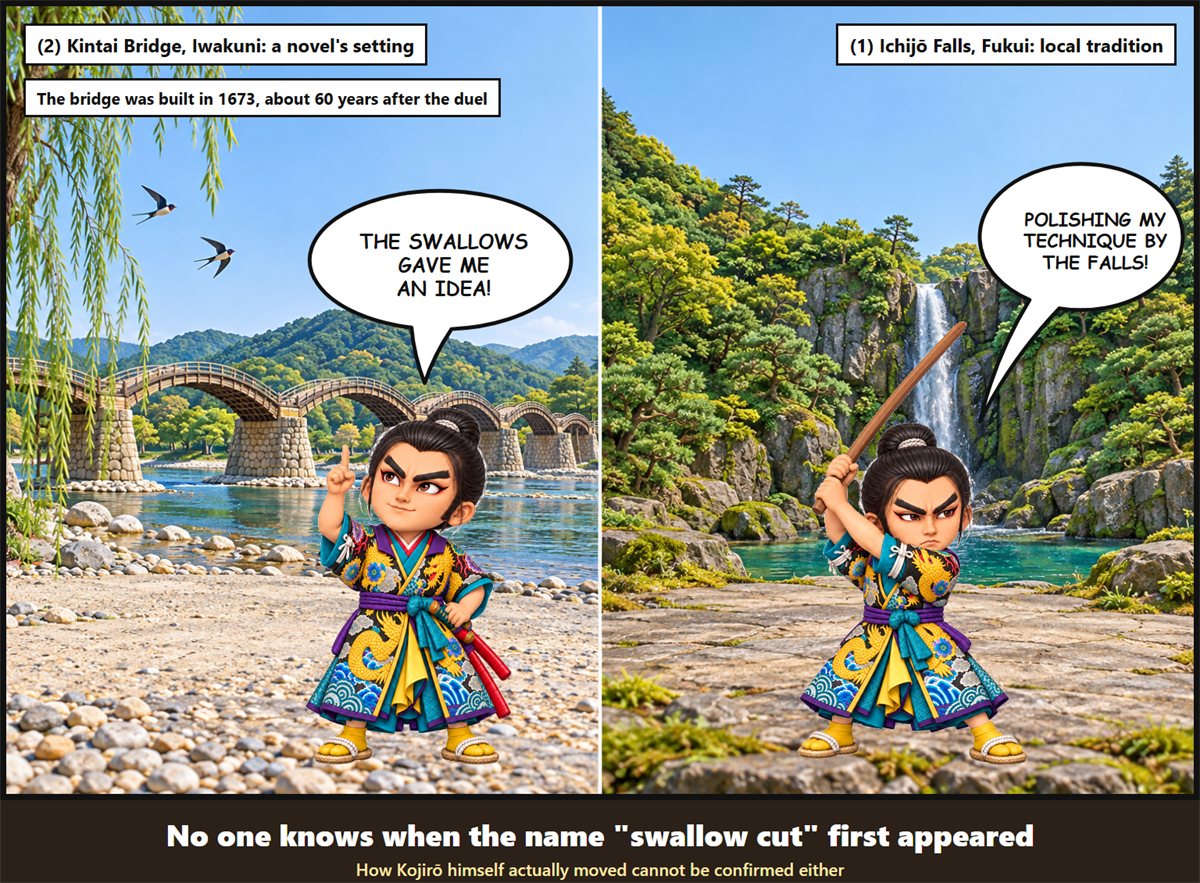
Was the swallow cut a real technique?
We cannot confirm when the name first appeared, or how Kojirō himself performed the technique.
The swallow cut (tsubame gaeshi, "swallow reversal") is famous as Kojirō's signature technique. Yet no one knows when or in which book the name first appeared [Unknown]. How Kojirō's own technique actually worked cannot be confirmed either.
There are two stories about where he developed it. One is a local tradition that he mastered it at Ichijō Falls in Fukui City [Legend]. The other says he got the idea from swallows darting among the willows at the Kintai Bridge in Iwakuni, Yamaguchi Prefecture. That one is a setting from Yoshikawa Eiji's novel [Fiction].
In fact, the Kintai Bridge was first built in 1673, about 60 years after the duel. The Iwakuni City tourism office, too, explains that Kojirō's connection to Iwakuni is Yoshikawa's invention.
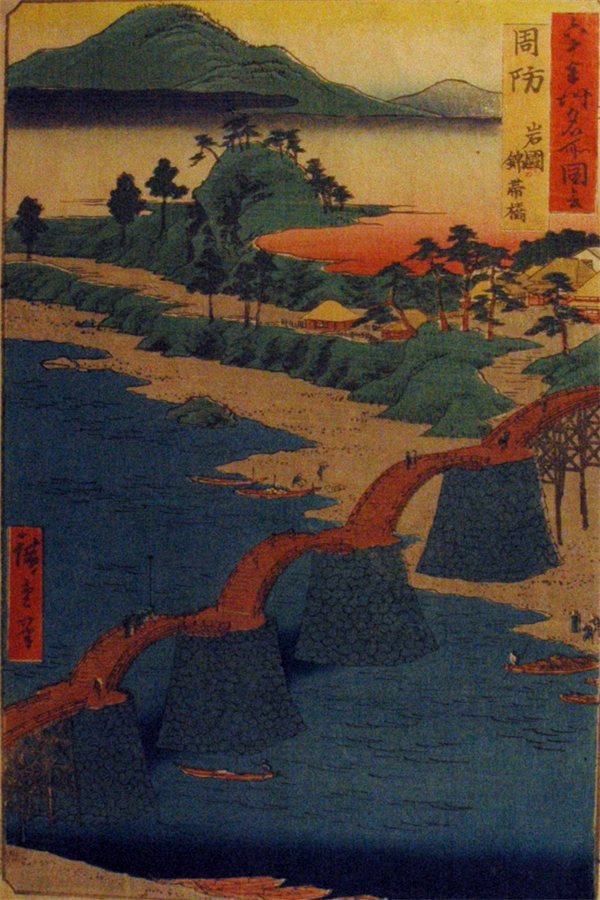
Image: Utagawa Hiroshige, "Iwakuni, Kintai Bridge, Suō Province," from Famous Views of the Sixty-odd Provinces. Public domain (San Diego Museum of Art / Wikimedia Commons)
Where Does the Name "Sasaki Kojirō" Come From? At First, Only "Ganryū"
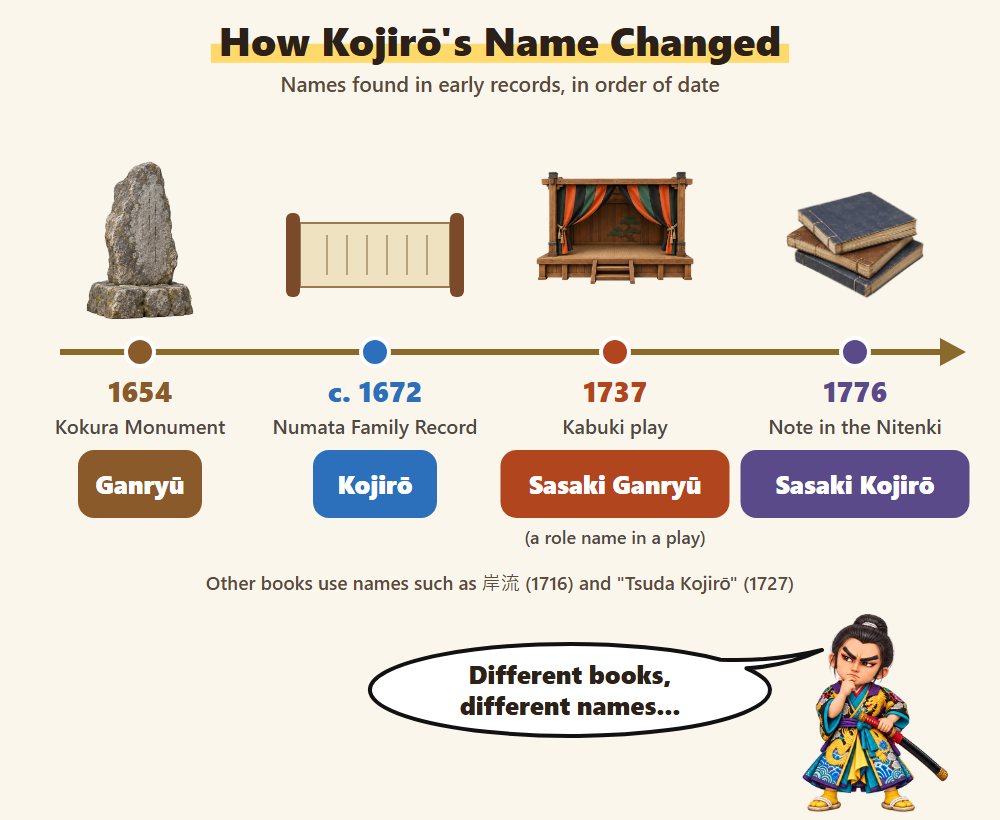
So "Sasaki" may not be his real family name?
We don't know if it was. The name appears in plays and books written more than 100 years after the duel.
Different names appear in sources written at different times. Here are the names found in early records, in order of date.
| Year | Record | Name used |
| 1654 | Kokura Monument | 岩流 (Ganryū) |
| around 1672 | Numata Family Record | 小次郎 (Kojirō) |
| 1716 | Bushō Kanjōki (a collection of anecdotes) | 岸流 (reading not confirmed) |
| 1727 | Tanji Hōkin Hikki (a book of the Niten Ichi school in Fukuoka) | Tsuda Kojirō |
| 1737 | Kabuki play Katakiuchi Ganryūjima | 佐々木巌流 (Sasaki Ganryū, a role name) |
| 1755 | Bukōden | 巌流小次良 (Ganryū Kojirō) |
| 1776 | Nitenki | 岩流小次郎 (Ganryū Kojirō) in the main text; 佐々木小次郎 (Sasaki Kojirō) in a note |
The researcher Uozumi Takashi suggests that the family name "Sasaki" may have spread from "Sasaki Ganryū," a role name in a kabuki play first staged in Osaka in 1737. An early example of the full name "Sasaki Kojirō" is a note added to the text of the Nitenki of 1776.
As for "Ganryū," the Bukōden of 1755 says Kojirō founded his own school at 18 and adopted the name "Ganryū." This could refer to his school or to Kojirō himself. It was later also written with another character for "Gan" (巌), and the island's name, Ganryūjima, comes from it.
How Old Was Kojirō? What the Two Accounts Mean by "18"
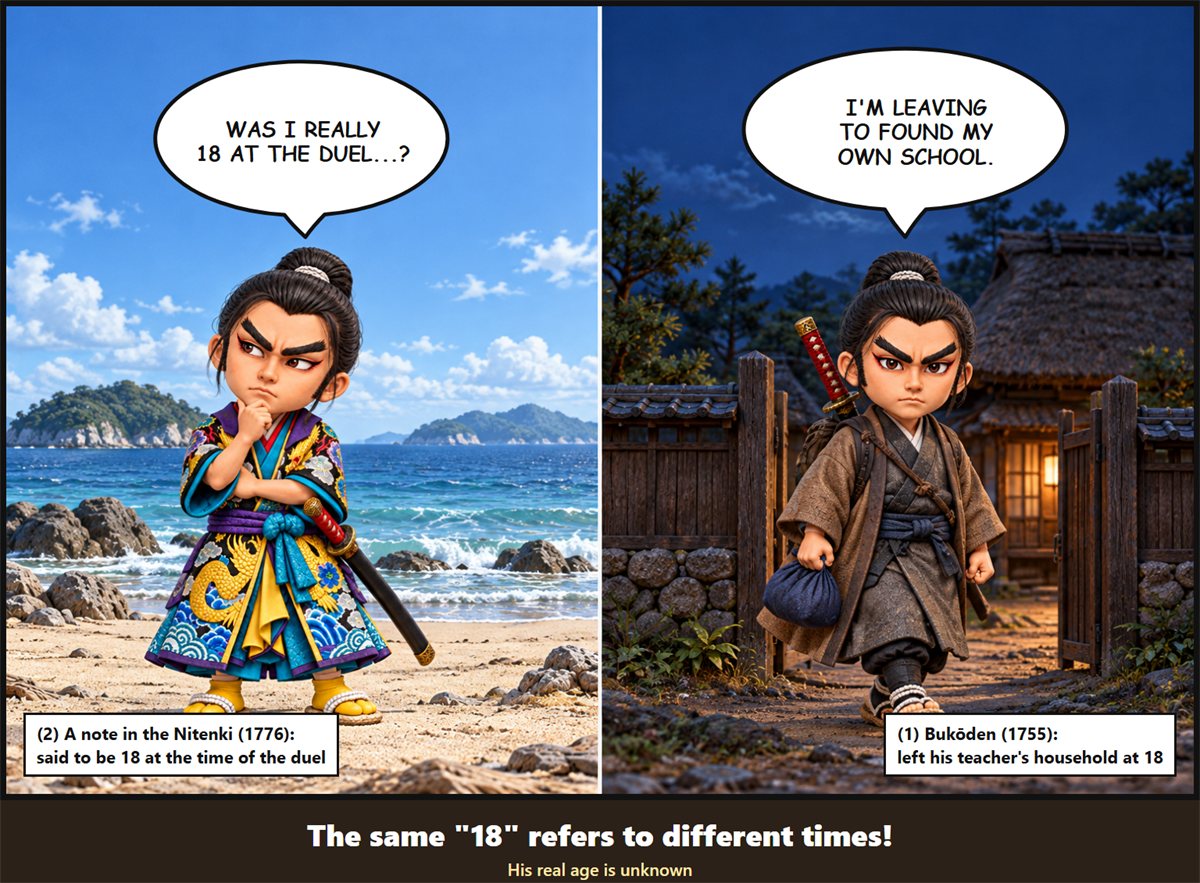
If he was 18, he was younger than Musashi!
His real age is unknown. And even the "18" in the books refers to two different moments.
Kojirō's age is not known [Unknown]. The often-quoted "18" actually has two different meanings.
The Bukōden of 1755 says Kojirō left his teacher's household without permission at 18 and founded his own school. A note in the Nitenki of 1776, on the other hand, passes on a report that he was 18 at the time of the duel. The same number refers to different points in his life.
From the Sources: The Two "18"s
Bukōden (1755)
「十八歳ノ時師ノ前ヲ欠落シ」 = At 18, he left his teacher's household without permission
A note in the Nitenki (1776)
「此時十八歳ノ由ナリ」 = It is said that at this time (the duel) he was 18
His supposed teacher, Toda Seigen, was active around 1560. If Kojirō served as his training partner then, some argue he must have been much older by the duel in 1612 [Debated]. A multilingual guide by the Japan Tourism Agency also mentions that he may have been over 50.
Ages at the time were usually counted in the traditional way, but this note does not say how the age was counted.
Where Was Kojirō From, and Who Was His Teacher?
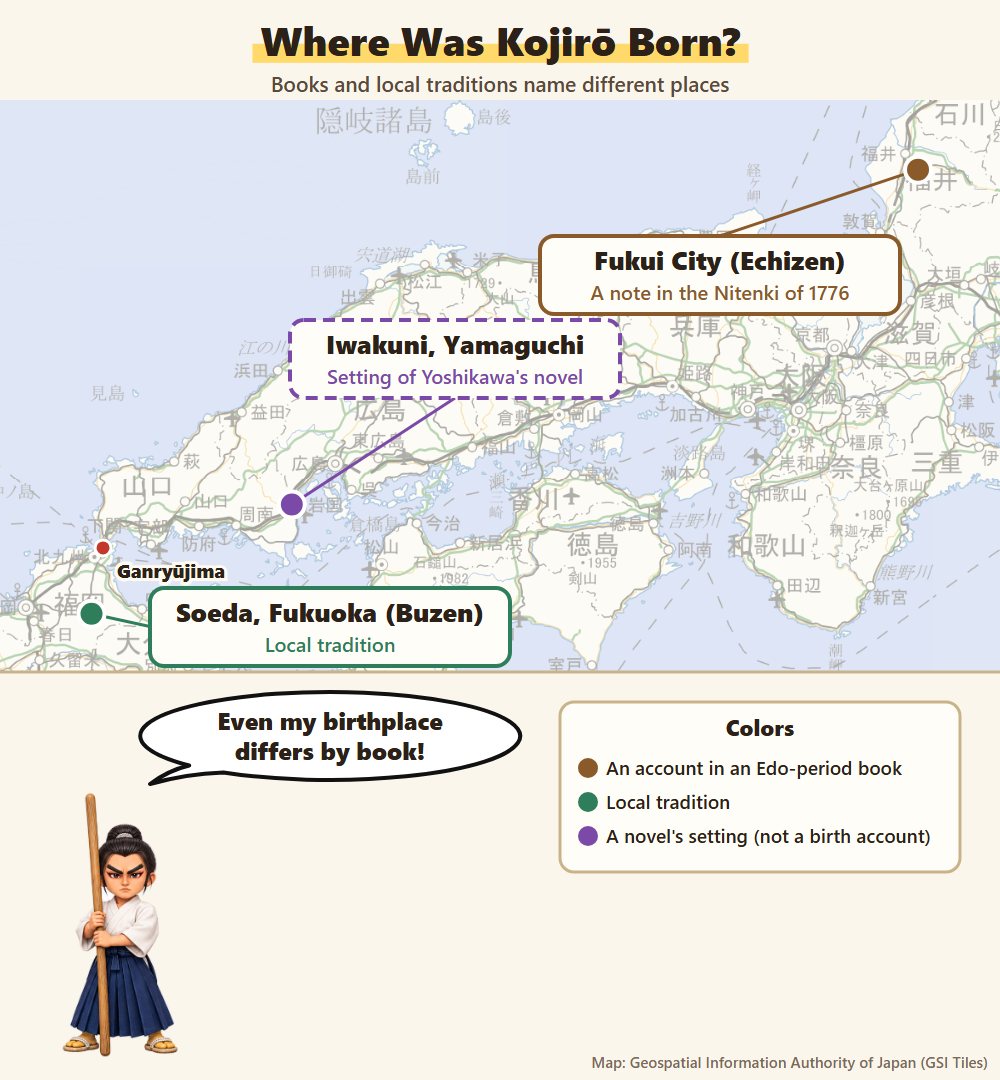
Wasn't Kojirō born in Iwakuni?
Neither his birthplace nor his teacher is certain. Being born in Iwakuni is a setting from a novel.
His birthplace also differs between books and local traditions [Debated].
| Account | Place today | Source |
| Jōkyōji village, Echizen Province (宇坂庄浄教寺村) | Jōkyōji-chō, Fukui City | A note in the Nitenki (1776) [Legend] |
| The Sasaki family of Soeda in Buzen Province | Soeda Town, Fukuoka Prefecture | Local tradition (introduced on the Soeda Town website) [Legend] |
| Iwakuni in Suō Province | Iwakuni City, Yamaguchi Prefecture | A setting in Yoshikawa Eiji's novel [Fiction] |
As for his teacher, the Bukōden of 1755 says Kojirō was a member of the household of the swordsman Toda Seigen [Legend: Bukōden]. It says that from childhood he served as training partner for Seigen, who used a short wooden sword, while Kojirō is described as using a "three-shaku sword" [Legend: Bukōden]. Another account says he studied under Kanemaki Jisai, one of Seigen's students, but this is not certain.
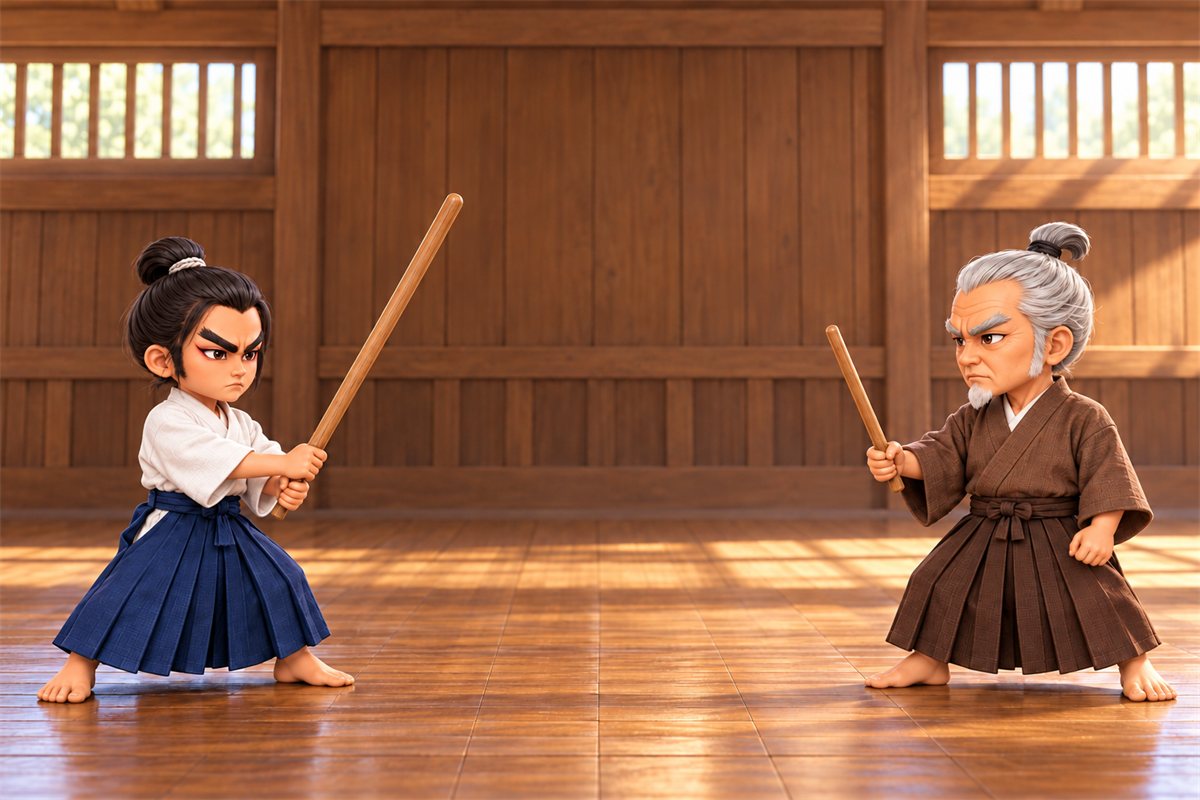
Image: The boy Kojirō as his teacher's training partner (a story told in Edo-period books)
Kojirō is also often said to have been the sword instructor of the Hosokawa clan in northern Kyushu. The Numata Family Record says he taught Ganryū swordsmanship in Buzen Province (today's eastern Fukuoka and northern Ōita prefectures). Whether he was an official instructor of the Hosokawa clan, or when he was appointed, cannot be confirmed [Unknown].
How Kojirō's Image Changed: A Timeline
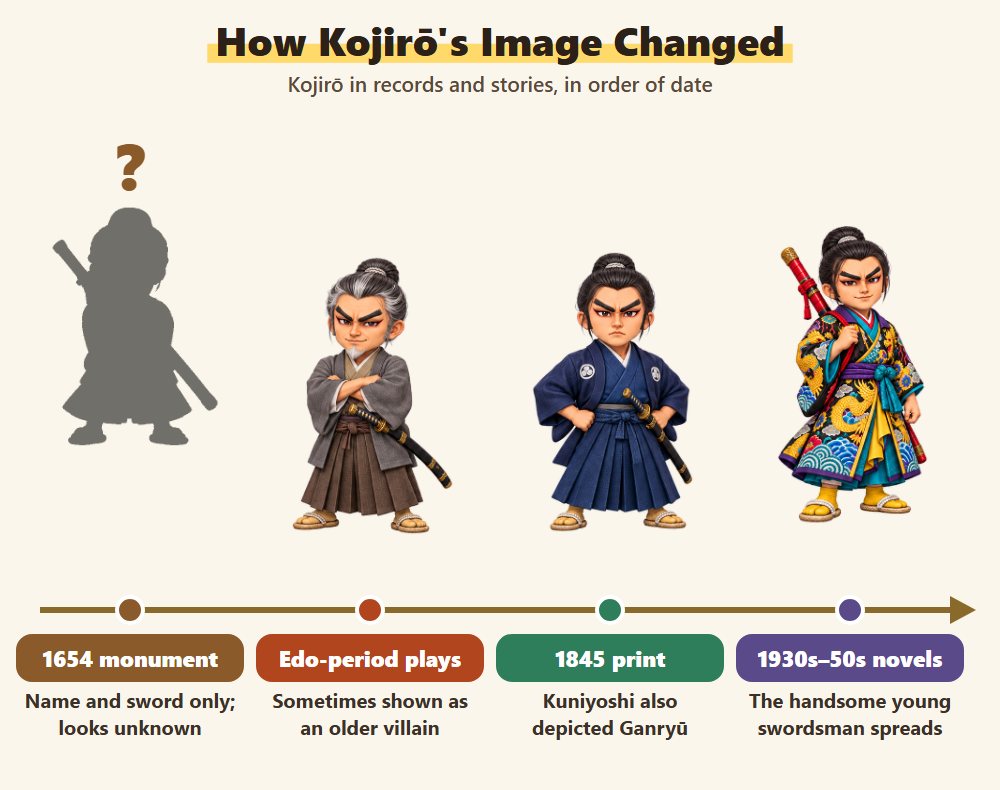
When did the handsome young Kojirō we see today become popular?
Through novels of the 1930s to 1950s. But the idea of a young Kojirō already appears in Edo-period books.
The oldest record, the 1654 monument, mentions the name Ganryū, his sword and his match with Musashi. It tells us nothing about his face or age.
In Edo-period kabuki theater and kōdan (a traditional form of dramatic storytelling), Kojirō (Ganryū) was sometimes portrayed as an older villain [Legend]. In 1845, Utagawa Kuniyoshi also depicted Ganryū in a woodblock print.
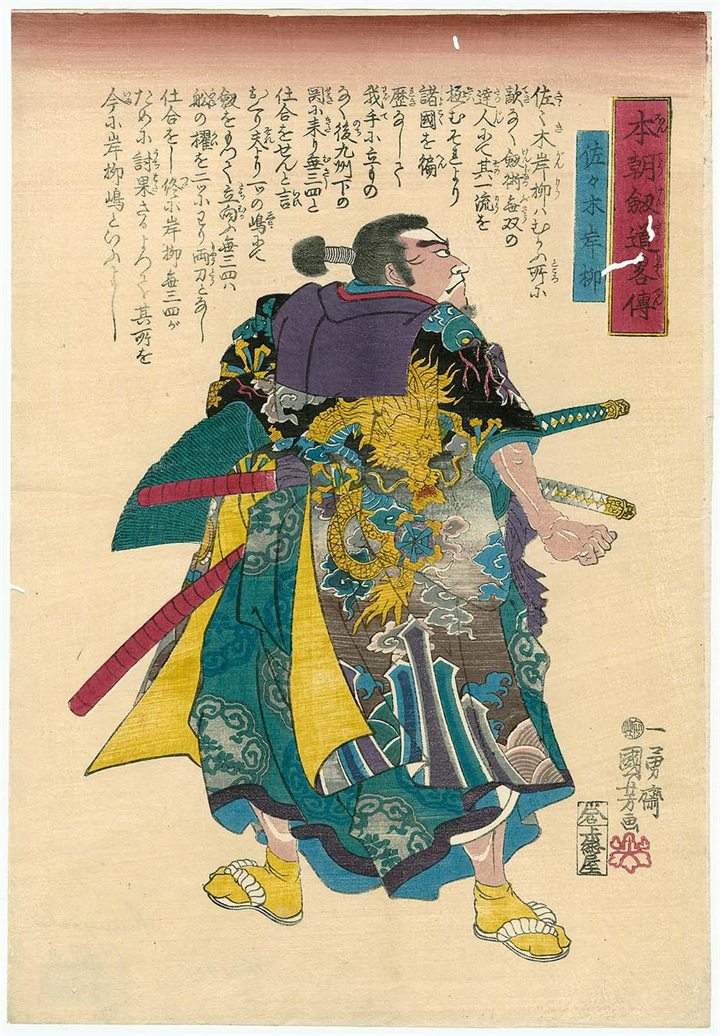
Image: Utagawa Kuniyoshi, Sasaki Ganryū, from the series Honchō Kendō Ryakuden (1845, Museum of Fine Arts, Boston). Public domain (Wikimedia Commons)
Today's image of a handsome young swordsman with a forelock was spread by Yoshikawa Eiji's novel Musashi (serialized in a newspaper from 1935 to 1939) and Murakami Genzō's novel Sasaki Kojirō (published in book form in 1950–51) [Fiction]. Later manga and games have also often portrayed him as a young swordsman.
Here is what the records and works say, in order of date (the right column shows only the main points).
| Year | Record or work | What it says about Kojirō (main points) |
| 1654 | Kokura Monument | Named "Ganryū." Carries a real sword of three shaku and is killed by one blow of Musashi's wooden sword |
| around 1672 | Numata Family Record | Named "Kojirō." Teaches swordsmanship in Buzen. Comes to after falling, then is beaten by Musashi's students |
| 1714 | Honchō Bugei Shōden | Names his long sword the "Drying Pole" |
| 1737 | Kabuki Katakiuchi Ganryūjima | Role name "Sasaki Ganryū" |
| 1755 | Bukōden | Founds his school at 18. Musashi's lateness and "Kojirō, you have lost" |
| 1776 | Nitenki | "Sasaki Kojirō" in a note. Age 18 at the duel, born in Echizen. Duel on the 13th day of the 4th month |
| 1935–39 (newspaper serial) | Yoshikawa Eiji, Musashi | Born in Iwakuni, swallow cut at the Kintai Bridge, a handsome young swordsman (novel's setting) |
| 1950–51 (book form) | Murakami Genzō, Sasaki Kojirō | A novel with Kojirō as the hero |
Was Kojirō Really Deaf? Vagabond vs. History
Was Kojirō deaf in real life?
That is how Vagabond portrays him. His hearing in real life is unknown.
In Vagabond, Inoue Takehiko's manga based on Yoshikawa Eiji's novel Musashi, Kojirō is portrayed as deaf. This is part of the manga's fictional portrayal [Fiction]. We found no reliable historical record of Kojirō's hearing [Unknown].
Record of Ragnarok and the Fate series also feature fictional portrayals of Kojirō. Their character details should not be treated as evidence about the historical swordsman.
Where Is Ganryūjima, and How Do You Get There?
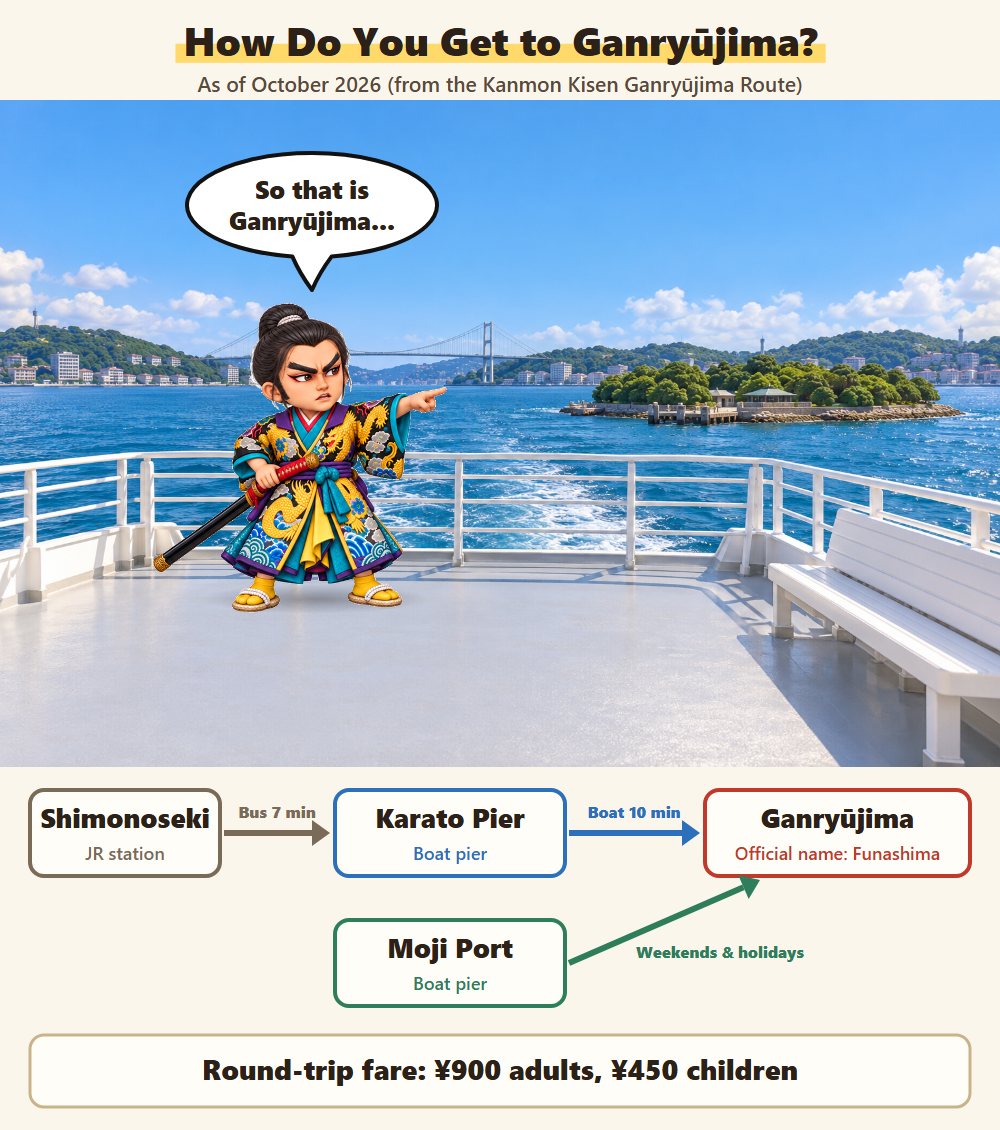
I'd like to visit Ganryūjima!
It is about 10 minutes by boat from Karato in Shimonoseki. The statues of Musashi and Kojirō stand on the island.
Ganryūjima is an uninhabited island in the Kanmon Strait, part of Shimonoseki City, Yamaguchi Prefecture. Its official name is Funashima, and its coastline is about 1.6 km long. People lived on it until 1973.
On the island are the "Monument to Sasaki Ganryū," set up in 1910, statues of Musashi and Kojirō, and a literary monument carved with a passage from Murakami Genzō's novel.
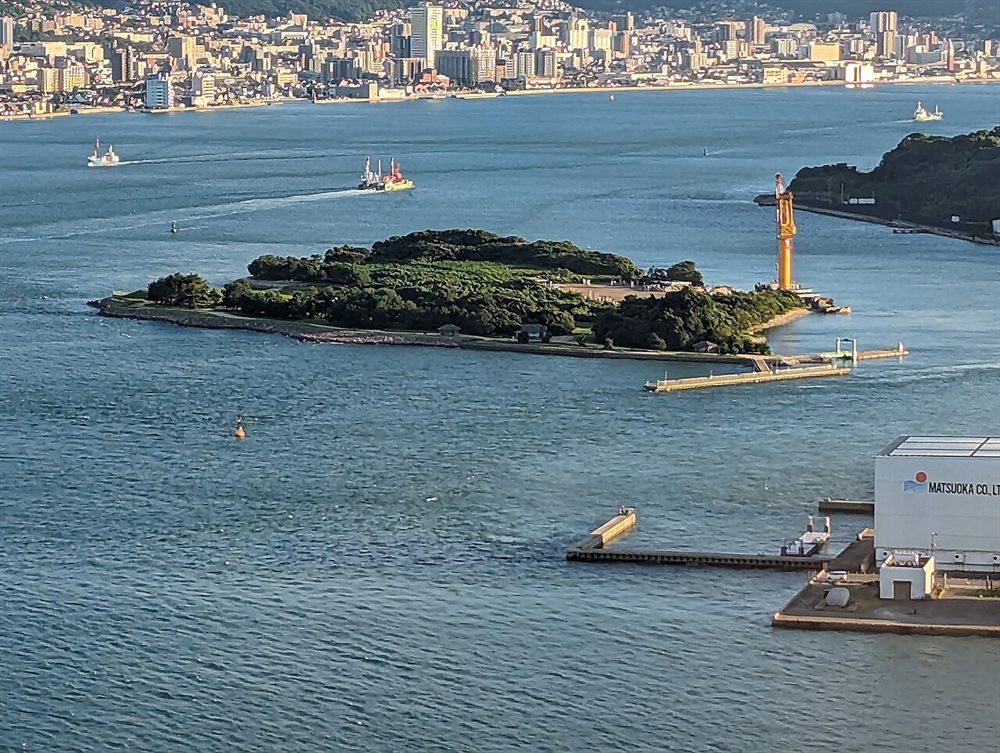
Image: Ganryūjima seen from Kaikyo Yume Tower (Shimonoseki, Yamaguchi Prefecture). Photo: なしはな (CC BY-SA 4.0 / Wikimedia Commons)
Getting there (as of October 2026): Kanmon Kisen boats take about 10 minutes from Karato Pier in Shimonoseki. Boats also run from Moji Port, but only on weekends and national holidays. The round-trip fare is ¥900 for adults and ¥450 for children (Kanmon Kisen, "Ganryūjima Route," in Japanese).
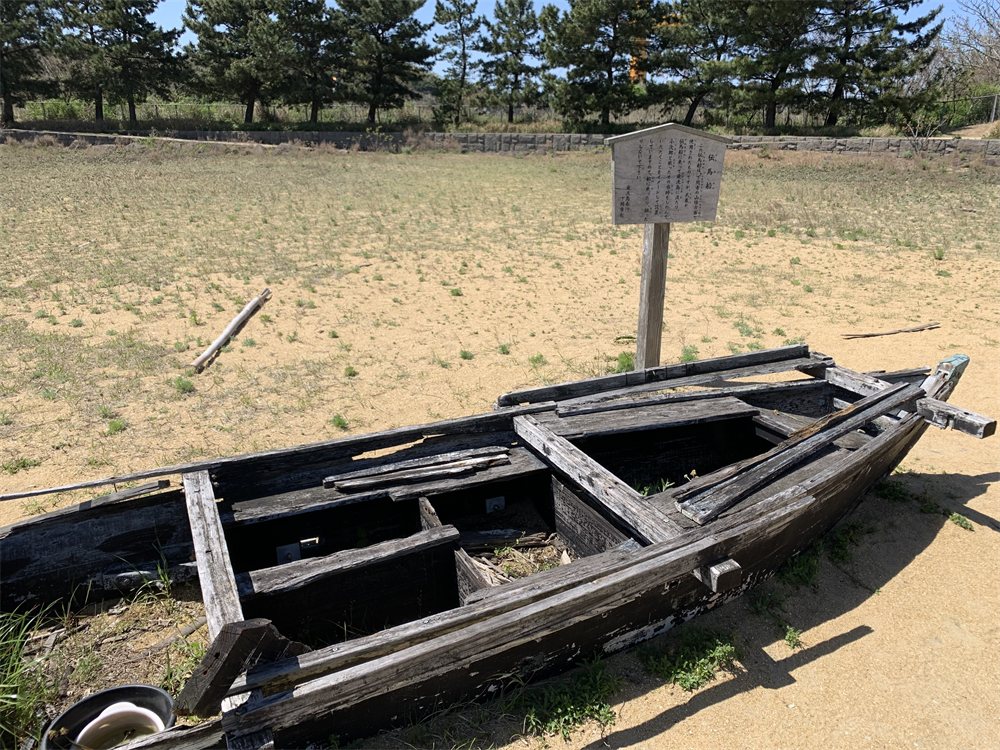
Image: An old wooden boat on Ganryūjima. Photo: ハポニアラ (CC BY 4.0 / Wikimedia Commons)
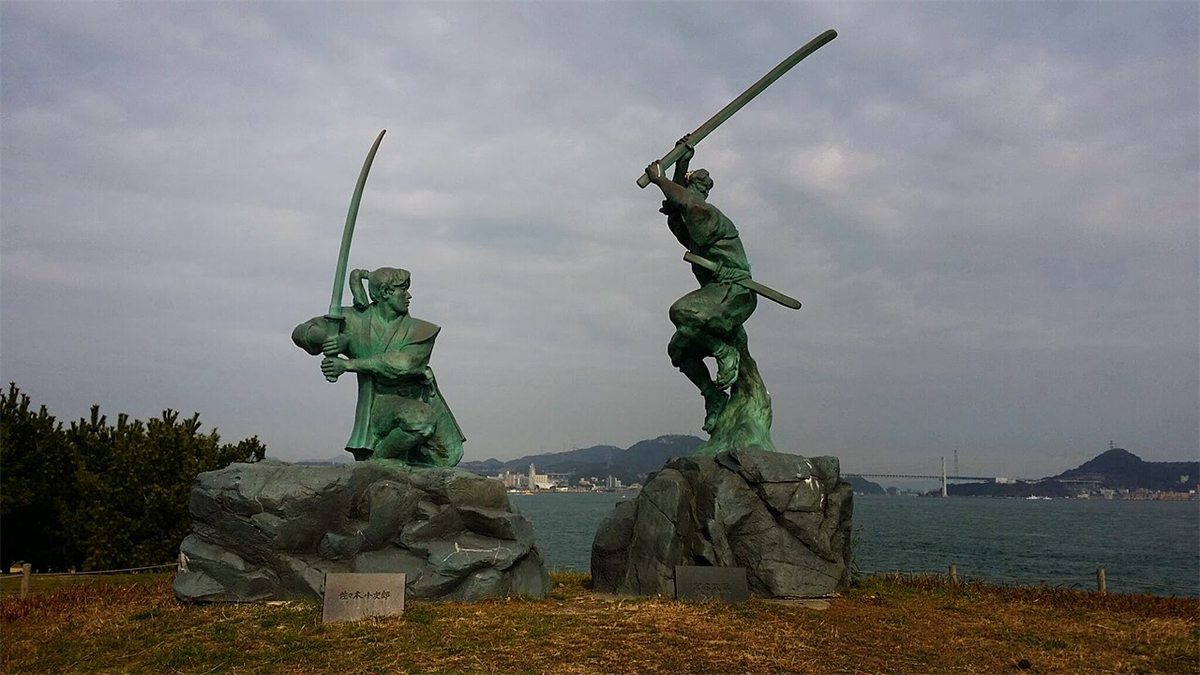
Image: Statues of Musashi and Kojirō on Ganryūjima. Photo: RoninjapanWiki (CC BY-SA 4.0 / Wikimedia Commons)
Where Are Kojirō's Monument and "Grave"?
In Tamukeyama Park, Kokura Kita Ward, Kitakyushu, a "Monument to Sasaki Kojirō" stands near Musashi's Kokura Monument. Kitakyushu City explains that it was rebuilt in 1951.
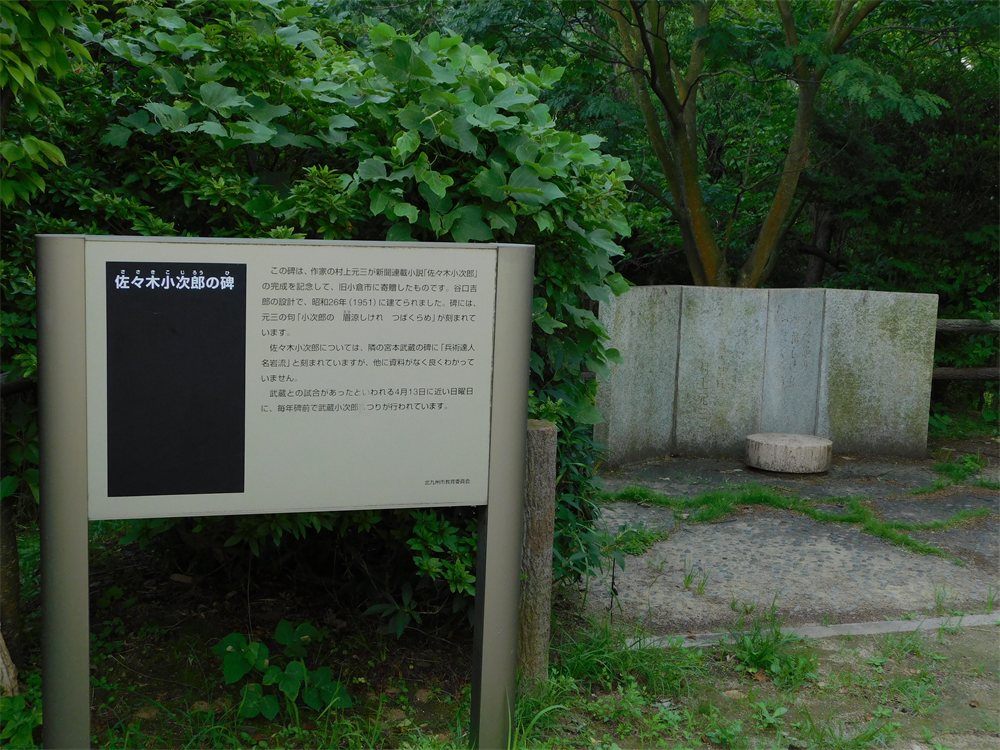
Image: The monument to Sasaki Kojirō and its information board in Tamukeyama Park. Photo: 速日 (CC BY-SA 4.0 / Wikimedia Commons)
In Abu Town, Yamaguchi Prefecture, a gravestone bearing the inscription "佐々木古志らう" (Sasaki Kojirō, written with different characters) is traditionally identified as Kojirō's grave. Local tradition says his wife, Yuki, set it up [Legend]. This tradition alone, however, cannot confirm that it is Kojirō's own grave, or that he had a wife and child.
There are also statues of Kojirō at Ichijō Falls in Fukui City and in Kikko Park in Iwakuni.
FAQ
Did Kojirō fight with two swords?
There is no record that he did. The two-sword fighter was Miyamoto Musashi.
Was Kojirō born in 1585?
His birth year is unknown. A note in the 1776 Nitenki says he was 18 at the duel, while some later interpretations suggest he was much older. These conflicting accounts do not establish 1585, or any other year, as his birth year.
How tall was Kojirō?
There is no record, so it is unknown.
Does Kojirō have descendants?
There is no reliable record. A tradition in Abu Town, Yamaguchi Prefecture, speaks of his wife Yuki, but no source confirms that he had children or descendants.
Did Musashi fight unfairly?
It depends on the record. On the 1654 Kokura Monument, the two fought as agreed, with a real sword against a wooden one. In the Numata Family Record of around 1672, however, Musashi's students were hiding on the island and beat Kojirō to death after he came to.
Did Musashi call Kojirō his greatest opponent?
We found no reliable source for this statement in Musashi's own words. The Book of Five Rings, the book Musashi wrote himself, does not name Kojirō or describe the Ganryūjima duel.
Does Kojirō's Ganryū school still exist?
We could not verify an unbroken line of teaching from Kojirō himself to the present day.
Summary: Who Was Sasaki Kojirō?
Summary
- A swordsman called "Ganryū" who fought Musashi appears on a 1654 monument and in a record of around 1672.
- The name "Sasaki Kojirō," the age of 18 and the story of Musashi's lateness were added in books written more than 100 years later.
- When the name "swallow cut" first appeared has not been established. The Kintai Bridge story is a novel's setting.
- The records describe his death differently. In the Numata family's record, he was killed by Musashi's students.
Kojirō's story gained new details over time. Separate the records from the stories, and he becomes far more interesting.

Now I want to visit Ganryūjima! Next, I'll read about Musashi too!
For Musashi's life, his two-sword style and The Book of Five Rings, see our article on Miyamoto Musashi.
Sources & How This Article Was Written
This article is based mainly on the following records and references:
- Early records: the Kokura Monument (1654); the Numata Family Record (around 1672; Japanese reading from the Soeda Town website, "The Theory That Sasaki Kojirō Was from Soeda, Buzen, Part 2," in Japanese)
- Later books: Honchō Bugei Shōden (1714), Bushō Kanjōki (1716), Tanji Hōkin Hikki (1727), Bukōden (1755) and Nitenki (1776). Quotations from the Bukōden and Nitenki follow the transcriptions by the Harima Musashi Research Society
- Studies (in Japanese): Yoshimura Toyoo, "Another Account of Ganryūjima," Tōkōgen no. 34 (Kumamoto University Library, 2002); Uozumi Takashi, Miyamoto Musashi (Iwanami Shinsho, 2008)
- Public sources (in Japanese; titles translated by us): Kitakyushu City, "Tamukeyama Park"; Yamaguchi Prefecture Tourism Federation, "Ganryūjima"; Kanmon Kisen, "Ganryūjima Route" (checked in October 2026); Iwakuni City Tourism Promotion Division, "Statue of Sasaki Kojirō"; Abu Town, "Grave of Sasaki Kojirō"; Japan Tourism Agency multilingual commentary database, "Ganryūjima"
- Images: the Kokura Monument and the monument to Sasaki Kojirō (速日, CC BY-SA 4.0), Ganryūjima (なしはな, CC BY-SA 4.0), the wooden boat on Ganryūjima (ハポニアラ, CC BY 4.0), the statues of Musashi and Kojirō (RoninjapanWiki, CC BY-SA 4.0), and the prints by Utagawa Hiroshige and Utagawa Kuniyoshi (public domain) are from Wikimedia Commons. The maps are based on GSI Tiles from the Geospatial Information Authority of Japan.
What the Labels Mean
[Fact]Confirmed by sources from the time ([Fact: …]means the named record says so)[Widely accepted]A view widely accepted by researchers[Debated]Accounts or interpretations differ[Unknown]Not established from the sources we checked[Legend]Stories found in later records or local traditions[Fiction]Details created for novels, plays or manga
We keep "what a record says" separate from "what actually happened."
This article was written by the Samurai Lord editorial team and is revised as new research and reader feedback come in. If you spot an error, please let us know through our contact form (in Japanese) and we will check and correct it.
Read in Japanese
This article is also available in Japanese: 佐々木小次郎は何者?巌流島の最期や燕返しの伝承を史料で比べる