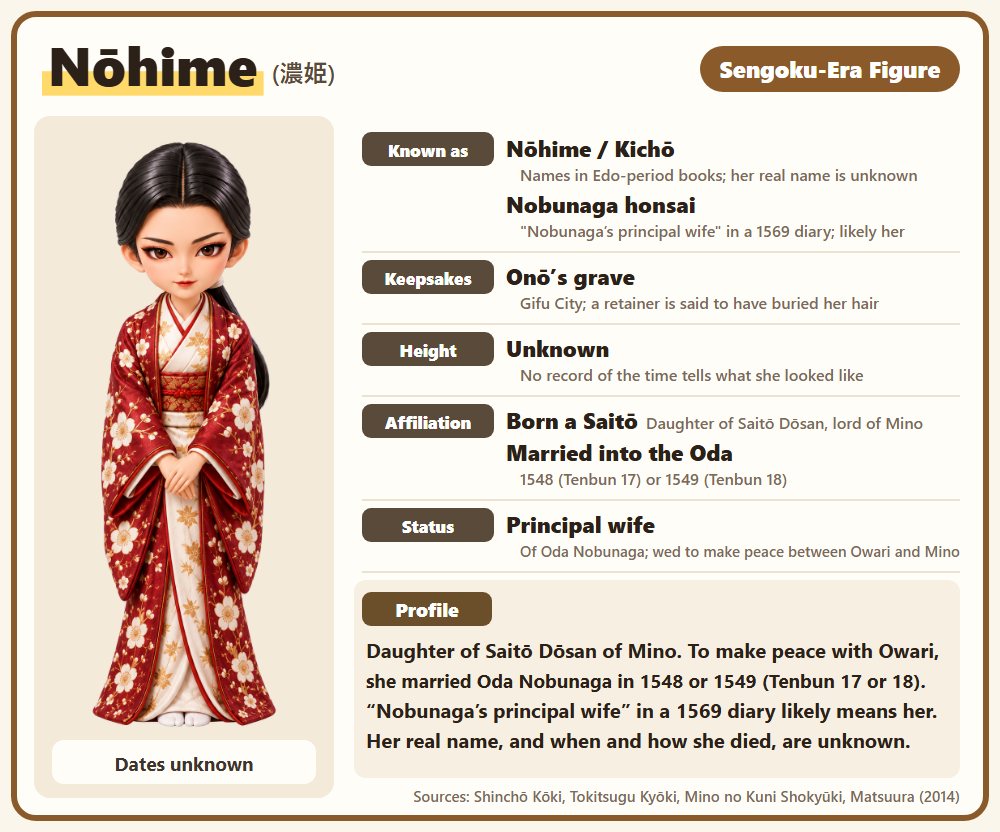
Nōhime was the daughter of Saitō Dōsan, the warlord of Mino Province (today's southern Gifu Prefecture), and became the principal wife of Oda Nobunaga of Owari Province (today's western Aichi Prefecture). She is also known by the name Kichō.
That Dōsan's daughter married Nobunaga is recorded by Nobunaga's own retainer [Fact: Shinchō Kōki]. After that, however, she almost disappears from the records. Her real name is unknown, and so are when, where and how she died [Unknown].
This article traces where the names "Nōhime" and "Kichō" come from and what became of her, checking each story against the date of the record that tells it.
Japanese months and days refer to the historical lunisolar calendar. The Western date given for the Honnō-ji Incident uses the Julian calendar. Ages use the traditional Japanese count, in which a person was counted as one at birth and gained a year at the start of each new year in the Japanese calendar.
Key points are tagged: [Fact] confirmed by records from the time, [Widely accepted] a view widely accepted by researchers, [Debated] accounts, interpretations or ways of counting differ, [Unknown] not established from the sources we checked, [Legend] stories found in later records or traditions, [Folk belief] popular claims with little evidence, and [Drama fiction] scenes created for dramas, novels or films.

I am Uesugi Kenshin. Today's subject is Nobunaga's wife, Nōhime.

I'm Date Masamune! She's the one who fought beside Nobunaga with a naginata at Honnō-ji, right?

A familiar scene from TV dramas. But follow the records, and the story turns out quite different. Let us check it together.
The Short Answers
- How do you say her name? Nōhime ("noh-hee-meh"). Kichō is pronounced "kee-choh" (more)
- Who was her father? Saitō Dōsan, the warlord of Mino
[Fact](more) - Who was her husband? Oda Nobunaga. She was his principal wife
[Fact] - When did she marry? Probably around 1548 or 1549; the exact date is uncertain (more)
- What was her real name? Unknown. Both "Nōhime" and "Kichō" are names found in later books (more)
- How did she die? Unknown. Theories say she died young, died at Honnō-ji, or lived a long life (more)
- Did she have children? We found no record of a child born to her (more)
- Is there a portrait of her? We found no portrait confirmed to show her (more)
- Where is the statue of Nobunaga and Nōhime? In Kiyosu Park, Kiyosu, Aichi Prefecture (more)
Three Things We Learn by Comparing the Sources
- Her names, book by book: a timeline showing when "Nōhime" and "Kichō" appear, from a diary of 1569 to a novel of 1963 (more)
- "Nobunaga's principal wife" in 1569: the diary entry that is the key clue to her later life, presented in Japanese with an English translation (more)
- The women at Honnō-ji: what the Shinchō Kōki actually says about the women around Nobunaga, compared with a Meiji-era print (more)
Jump to the part you want to read:
- Who was Nōhime (Kichō)?
- Nōhime or Kichō? Her real name and where the names come from
- How did Nōhime die? Comparing the theories
- Nōhime and Nobunaga: their marriage and age difference
- Did Nōhime have children?
- Who were Nōhime's parents? Was she Akechi Mitsuhide's cousin?
- Nōhime in novels, TV dramas and films
- Statues, graves and places connected with Nōhime
- FAQ
Who Was Nōhime (Kichō)?
In a single sentence, Nōhime was "the daughter of Saitō Dōsan of Mino, who became Oda Nobunaga's principal wife through a marriage that made peace between Owari and Mino".
In the Sengoku period (the age of warring states, roughly 1467–1590), Nobunaga's father, Oda Nobuhide of Owari, and Saitō Dōsan of Mino fought each other many times. Eventually the two houses made peace, and as a sign of it, a marriage was arranged between Nobunaga and Dōsan's daughter [Fact: Shinchō Kōki]. A marriage like this, arranged to tie two houses together, is called a political marriage.
Source Box ①: Nōhime's Marriage in the Shinchō Kōki
Source
Ōta Gyūichi, Shinchō Kōki, opening book. Gyūichi was a retainer of Nobunaga, and the opening book, which covers Nobunaga's early years, was compiled later (we follow the reading of the Kadokawa Bunko edition as quoted in Matsuura Yoshiki's 2014 paper)
Original
「平手中務才覚にて、織田三郎信長を斎藤山城道三聟に取り結び、道三が息女尾州へ呼び取り候ひき。然る間、何方も静謐なり」
Translation
Through the efforts of Hirate Nakatsukasa (Hirate Masahide, Nobunaga's guardian), a marriage was arranged making Oda Saburō Nobunaga the son-in-law of Saitō Yamashiro Dōsan, and Dōsan's daughter was brought to Owari. As a result, peace prevailed on both sides.
What it tells us, and what it does not
Dōsan's daughter married Nobunaga, and this ended the fighting between Owari and Mino. The record does not give the daughter's name, the date of the marriage or her age at the time
Here is a profile of what is known:
| Item | Details |
| Names | Nōhime, Kichō, Sagiyama-dono and others. All of them appear in later books [Legend] |
| Real name | Unknown [Unknown] |
| Born | Some books say 1535 (Tenbun 4) [Legend: Mino no Kuni Shokyūki] |
| Father | Saitō Dōsan [Fact] |
| Mother | Some books say Omi no Kata, a daughter of the Akechi family [Legend] |
| Husband | Oda Nobunaga (as his principal wife) [Fact] |
| Married | 1548 (Tenbun 17) or 1549 (Tenbun 18) [Debated] |
| Children | We found no record of a child born to her [Unknown] |
| Died / cause of death | Unknown. One theory says she died in 1612 (Keichō 17) [Debated] |
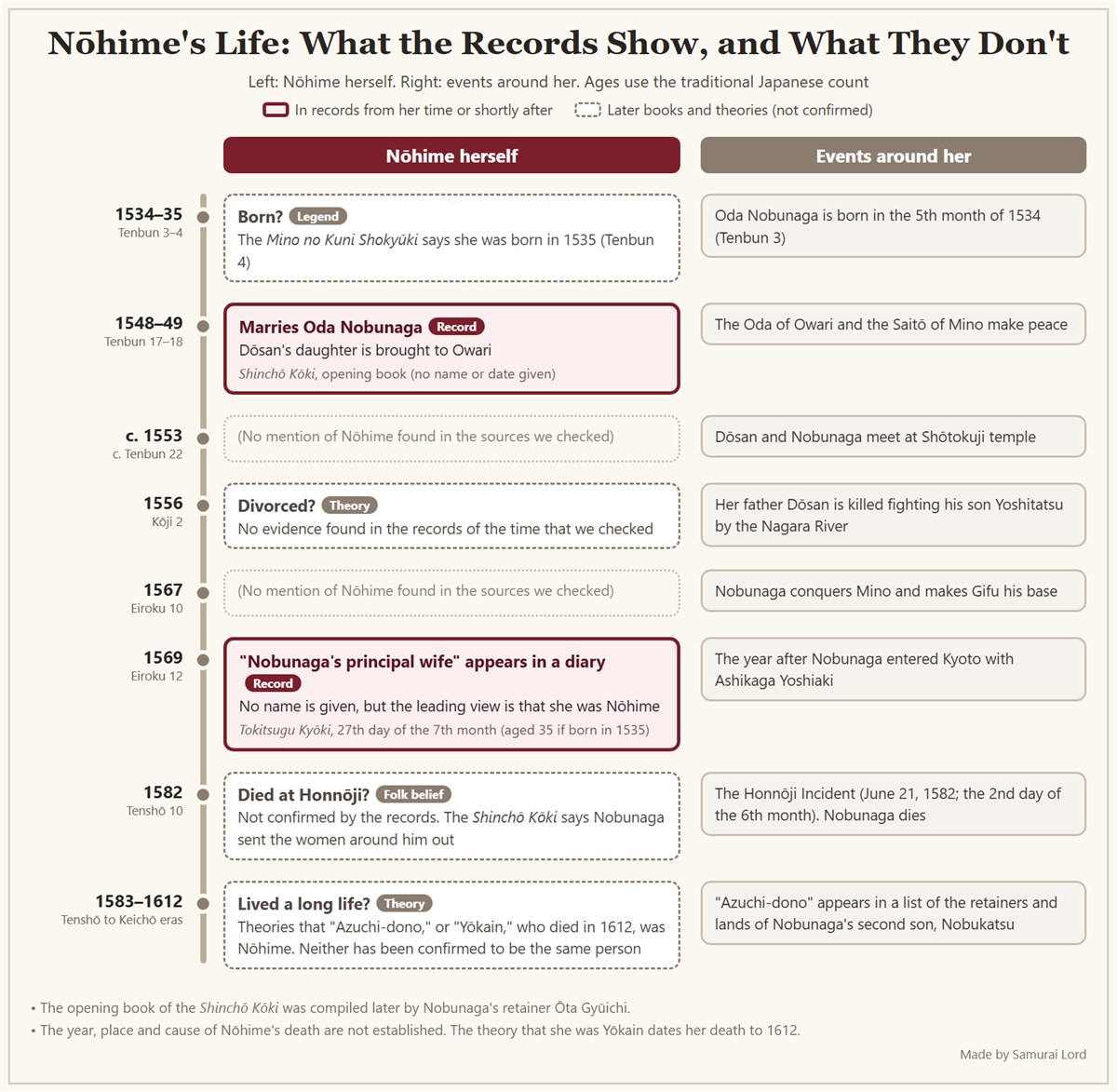
Image: What the records show, and do not show, about Nōhime's life (made by Samurai Lord)
As the chart shows, the main clues that lead to Nōhime herself are the account of the marriage in the Shinchō Kōki and the mention of "Nobunaga's principal wife" in a court noble's diary of 1569. The diary, however, does not give her name (more). Most other stories come from books written in the Edo period (1603–1868) or later, or from local tradition.
We found no portrait confirmed to show her either [Unknown]. There are photos of a picture displayed as "Nōhime" inside Gifu Castle (Gifu City), but we could not confirm who painted it or when. (The keep and museum of Gifu Castle are scheduled to be closed for renovation until the end of October 2027, as of October 20, 2026.)
What We Know / What We Don't Know
- We know: Saitō Dōsan's daughter married Oda Nobunaga to make peace between Owari and Mino
- We don't know: her real name, the year she was born, and what she looked like or what she was like as a person
Nōhime or Kichō? Her Real Name and Where the Names Come From
In short, "Nōhime" and "Kichō" are two names for the same woman. Neither, however, appears in records from her own lifetime. Her real name is unknown [Unknown].
Where the names come from has been studied in detail by Matsuura Yoshiki of the National Institute of Technology, Toyota College, in a 2014 paper on the names "Kichō," "Kochō" and "Kikyō" for Nōhime. Based on that paper, we have arranged the books in which the names appear in order of date.
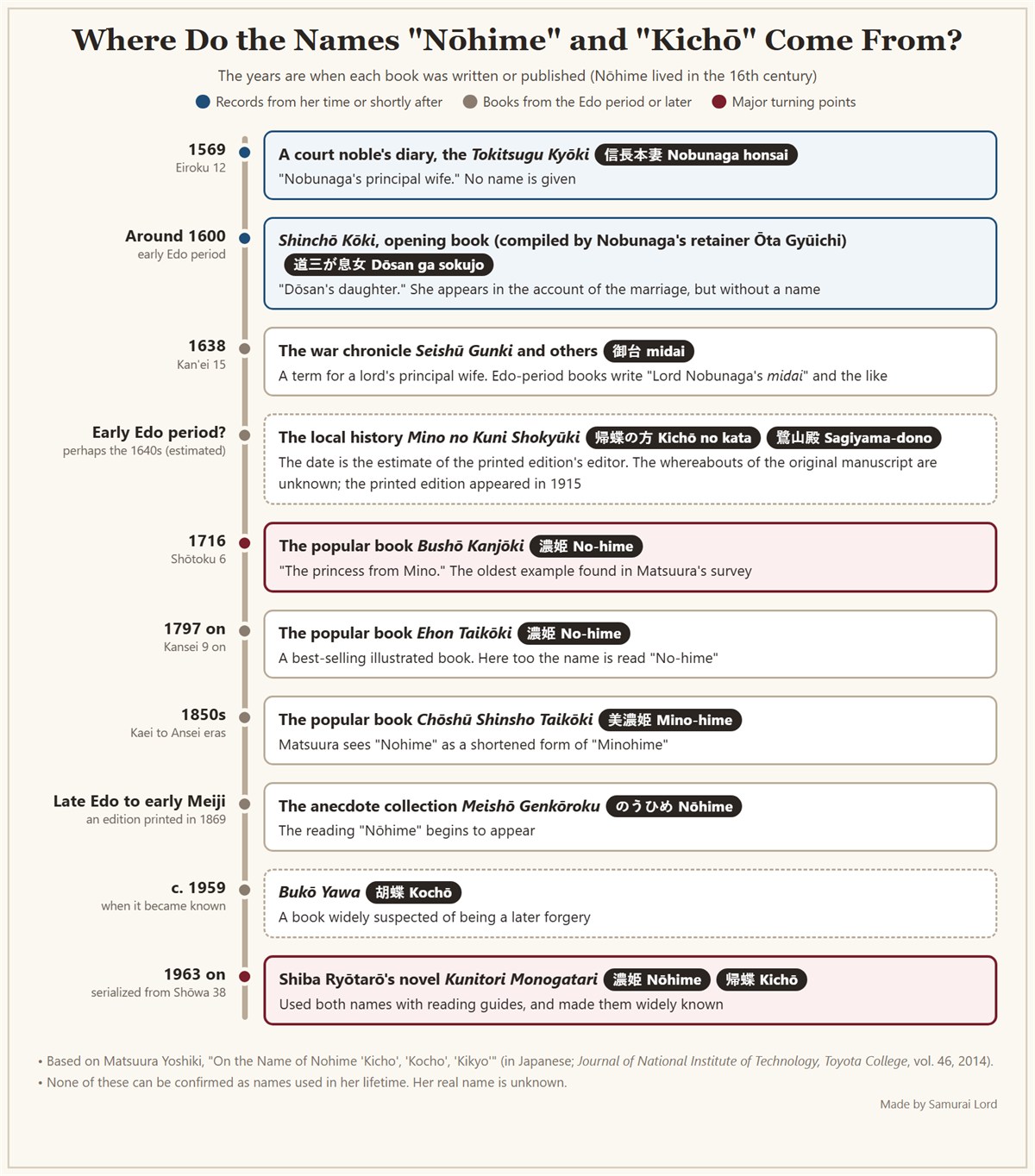
Image: Timeline of the books in which Nōhime's names appear (made by Samurai Lord based on Matsuura Yoshiki's 2014 paper; the years are when each book was written or published)
"Nōhime" Means "the Princess from Mino"
"Nōhime" is a name meaning "the princess who came from Mino" [Legend]. The oldest example found in Matsuura's survey is the popular book Bushō Kanjōki, published in 1716 (Shōtoku 6). The name then appears in the Ehon Taikōki, published from 1797 (Kansei 9).
The reading is interesting. Edo-period books gloss the name as "No-hime," not "Nōhime." Some books from the end of the Edo period write it "Mino-hime," and Matsuura regards "Nohime" as a shortened form of "Minohime." The reading "Nōhime" is found from the Meishō Genkōroku, a collection of anecdotes compiled from the end of the Edo period into the early Meiji era.
"Kichō" Comes from the Mino no Kuni Shokyūki
"Kichō" (written with characters meaning "return" and "butterfly") is a name that appears in the Mino no Kuni Shokyūki, an Edo-period history of Mino [Legend]. Among the old books Matsuura examined, it appears only in this one.
Source Box ②: "Kichō" in the Mino no Kuni Shokyūki
Source
Mino no Kuni Shokyūki (author unknown). The whereabouts of the original manuscript are unknown, and the book is read in a printed edition published in 1915. Its editor, Kurokawa Mamichi, estimated that it was written between the end of the Kan'ei era and the Shōhō era (around the 1640s), but this is not certain. We follow the image of the printed edition shown in Matsuura Yoshiki's 2014 paper
Original (excerpt)
「其後天文十八年二月廿四日、尾州古渡の城主織田上総介信長に嫁す。帰蝶の方といふ。又鷺山殿ともいふ」
Translation
After that, on the 24th day of the 2nd month of Tenbun 18 (1549), she married Oda Kazusa-no-suke Nobunaga, lord of Furuwatari Castle in Owari. She was called Kichō no kata, and also Sagiyama-dono.
Caution
Even on Kurokawa's estimate, the book was compiled some 90 years after the marriage it describes (1549), and the date cannot be confirmed from other records. Her birth year (1535) and her mother's name also come from this book
Another book, the Bukō Yawa, writes her name as "Kochō" ("butterfly"). However, this book only became known in the mid-20th century, and many suspect it of being a later forgery.
Because the characters 帰 (ki) and 胡 (ko) look very similar in cursive handwriting, Matsuura suggests that "Kichō" may originally have been a misreading of "Kochō." Matsuura presents this only as a conjecture, and it has not been confirmed.
The Names Spread Through the Novel Kunitori Monogatari
What made the names "Nōhime" and "Kichō" widely known was Shiba Ryōtarō's novel Kunitori Monogatari (roughly "The Tale of Seizing a Province"), serialized in a magazine from 1963. According to Matsuura, the novel used both names with reading guides, and from there they spread to the general public.
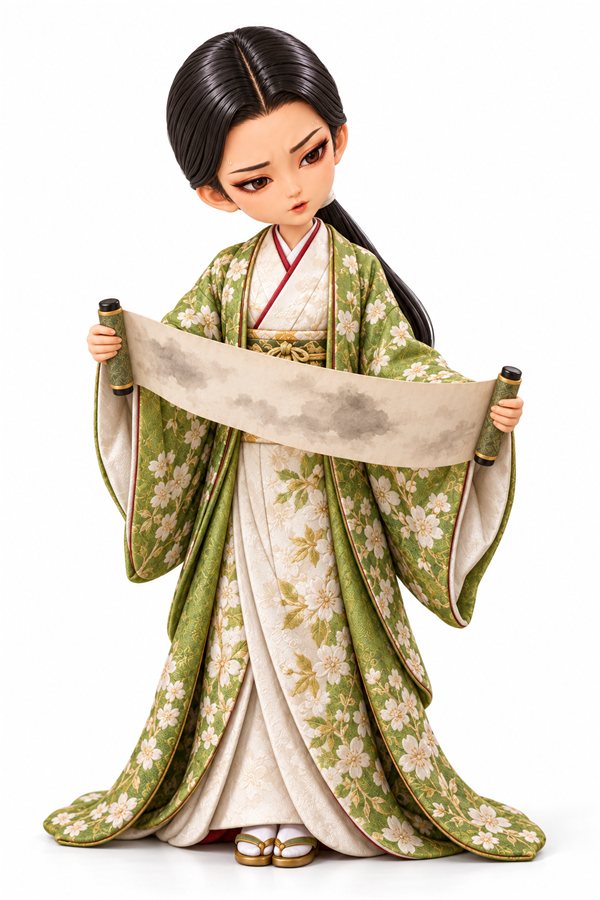
Image: Nōhime peering at a record, wondering what her name was

So she may never have been called "Nōhime" or "Kichō" in her own lifetime!
Just so. Both names come from books written long afterward.
What We Know / What We Don't Know
- We know: "Nōhime" appears in Edo-period popular books, and "Kichō" in the Edo-period Mino no Kuni Shokyūki
- We don't know: her real name, or what the people around her called her in her lifetime
How Did Nōhime Die? Comparing the Theories
In Short: How Nōhime's Life Ended Is Unknown
- When did she die? Unknown. One theory says 1612 (Keichō 17)
[Debated] - What was the cause of death? Under every theory, we found no record giving the cause of her death
[Unknown] - Where? Unknown. The story that she died at Honnō-ji cannot be confirmed from the records
[Folk belief]
There are many theories about Nōhime's end: that she died young, that she was divorced, that she died with Nobunaga at Honnō-ji, or that she lived a long life. An important clue for judging between them is the following diary entry.
The Key Clue: "Nobunaga's Principal Wife" in a Diary of 1569
The Kyoto court noble Yamashina Tokitsugu kept a diary of daily events. In his Tokitsugu Kyōki, the entry for the 27th day of the 7th month of 1569 (Eiroku 12) uses the words "Nobunaga's principal wife" (Nobunaga honsai).
Source Box ③: "Nobunaga's Principal Wife" in the Tokitsugu Kyōki
Source
Yamashina Tokitsugu, Tokitsugu Kyōki, entry for the 27th day of the 7th month of Eiroku 12 (1569). We follow the text from the database of the Historiographical Institute, the University of Tokyo, as quoted in Matsuura Yoshiki's 2014 paper
Original (excerpt)
「故一色義龍後家壷可為所持、可被出之由信長連々被申、一乱之刻被失云々、尚於責乞者可自害云々、然者信長本妻兄弟女子十六人可為自害」
Translation (the ambiguous final clause is paraphrased)
Nobunaga repeatedly demanded that the widow of the late Isshiki Yoshitatsu (Saitō Yoshitatsu) hand over a tea jar she was supposed to have. She said it had been lost in the turmoil of war, and that if he kept pressing her, she would kill herself. The final clause reports that sixteen people would take their own lives in connection with "Nobunaga's principal wife," although its punctuation and the identities of those included are uncertain.
What it tells us, and what it does not
In 1569 there was a woman called "Nobunaga's principal wife." Her name is not given. The meaning of the last part changes depending on how it is punctuated, so exactly who the sixteen people were is unclear
Yoshitatsu was Dōsan's eldest son and Nōhime's brother (Edo-period books say he was her half-brother, with a different mother). In his last years he used the family name Isshiki. Because "Nobunaga's principal wife" appears in an entry about Yoshitatsu's widow, the leading view is that this principal wife was Dōsan's daughter, that is, Nōhime [Widely accepted].
If so, Nōhime was still alive in 1569 (aged 35 by the traditional count, if she was born in 1535) and was still Nobunaga's principal wife. That does not fit the theories that she died young or was divorced before then.
Comparing the Theories About Her End
Here are the main theories, with their evidence and their weak points:
| Theory | Evidence (when written) | Weak points |
She died young [Debated] | She vanishes from the records; a story in the Edo-period Nōyō Shoshi Denki (around 1638) | If the "principal wife" of 1569 was Nōhime, an earlier death does not fit |
She was divorced [Folk belief] | A guess that the marriage lost its purpose after her father Dōsan died in 1556 (Kōji 2) | We found no evidence in records of the time. If the "principal wife" of 1569 was Nōhime, an earlier divorce does not fit |
She died at Honnō-ji [Folk belief] | A Meiji-era woodblock print, a Shōwa-era TV drama, and the local tradition of a hair mound in Gifu City | Not found in the records of the time that we checked. The Shinchō Kōki says Nobunaga sent out the women around him |
She lived on as "Azuchi-dono" [Debated] | "Azuchi-dono" in the Oda Nobukatsu Bugenchō, a list of the retainers and lands of Nobunaga's second son Nobukatsu (Tenshō era) | We found no record saying that Azuchi-dono was Nōhime |
She died in 1612 (the Yōkain theory) [Debated] | "Lord Nobunaga's midai (principal wife)" in a temple register said to have been compiled in or after the mid-18th century | If its reported date is correct, the register was compiled more than 100 years after Yōkain's death. Views differ on whether this was the same woman |
Did She Die Fighting Beside Nobunaga at Honnō-ji?
The scene of Nōhime fighting beside Nobunaga with a naginata (a pole weapon with a curved blade) at Honnō-ji is familiar from TV dramas. But the Shinchō Kōki, which describes the Honnō-ji Incident (June 21, 1582; the 2nd day of the 6th month of Tenshō 10), paints a different picture.
Source Box ④: The Women at Honnō-ji in the Shinchō Kōki
Source
Ōta Gyūichi, Shinchō Kōki, book 15 (the section on the Honnō-ji Incident; we follow the 1881 printed edition on Wikisource)
Original (excerpt)
「是迄御そはに女共付そひて居申候を、女はくるしからす、急罷出よと被仰、追出させられ」
Translation (rendered in context)
Women had been attending him until then, but he said, "You women need not stay. Get out quickly," and had them sent out.
What it tells us, and what it does not
Nobunaga sent away the women who were with him. Their names are not given, so we cannot tell whether Nōhime was among them
After this, Nobunaga went into the inner part of the hall and killed himself [Fact: Shinchō Kōki].
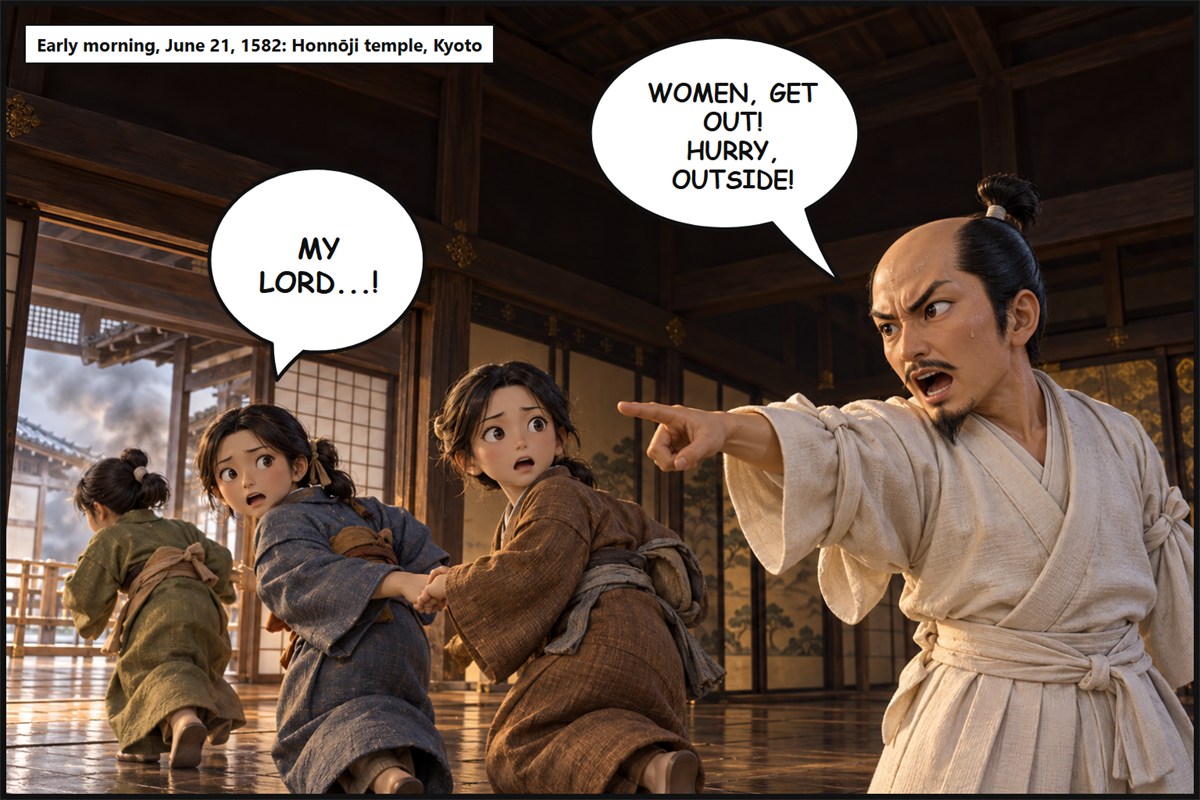
Image: Nobunaga at Honnō-ji, shouting to the women around him to flee
On the other hand, some Meiji-era nishiki-e (multicolored woodblock prints) show a woman swinging a naginata at Honnō-ji.
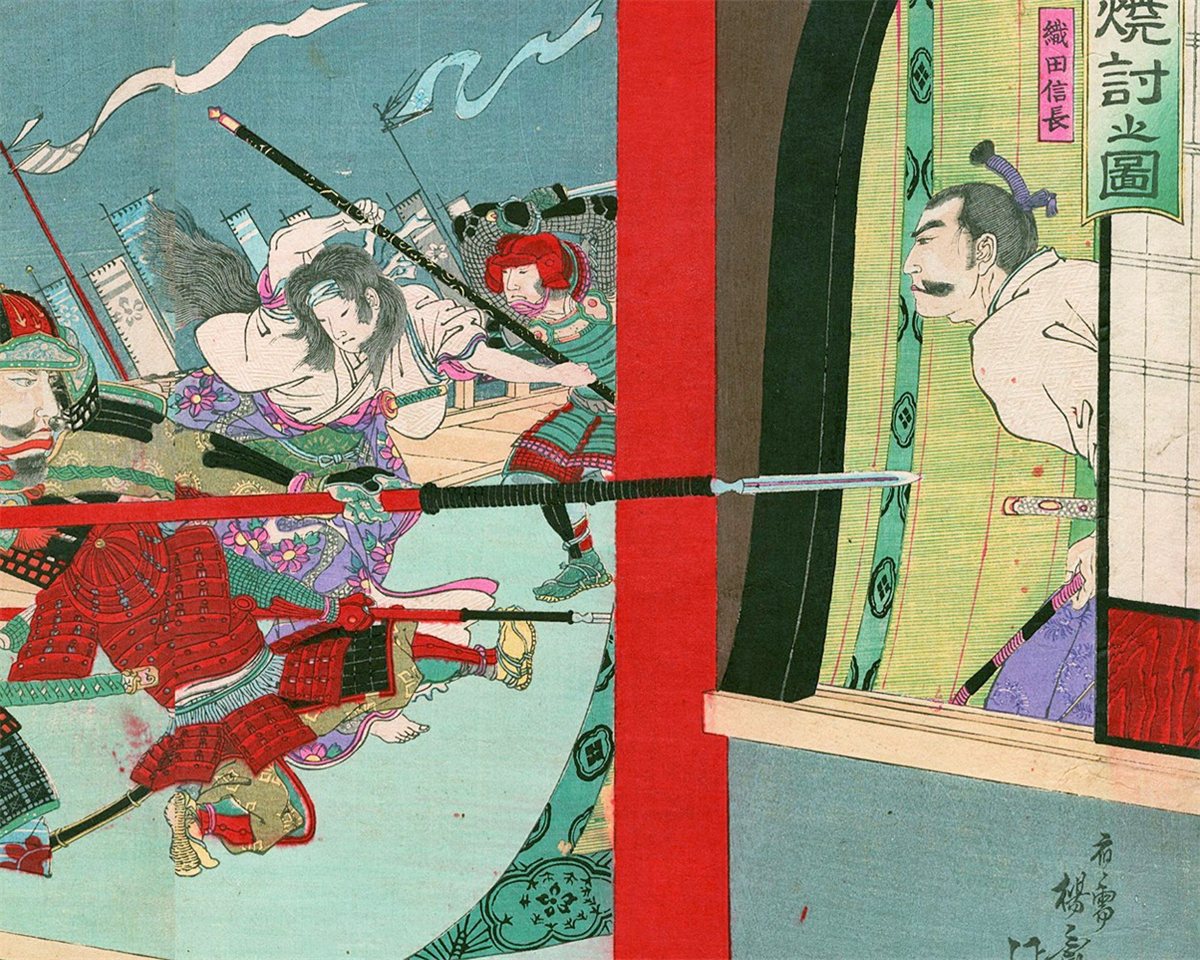
Image: Part of Yōsai Nobukazu, Honnō-ji Yakiuchi no Zu ("The Burning of Honnō-ji," 1896; collection of Nagoya City). In the center a long-haired woman swings a naginata; on the right, Oda Nobunaga looks out from inside a room. The print does not name the woman. Wikimedia Commons (public domain)
The woman in this print is not named, so we cannot say she is Nōhime. A Shōwa-era NHK historical drama does show Nōhime fighting with a naginata at Honnō-ji. But both the print and the drama were made long after the Honnō-ji Incident and are no evidence that Nōhime was there [Folk belief].
In Gifu City there is also "Onō's grave," a hair mound where a retainer who escaped after the Honnō-ji Incident is said to have buried a lock of Nōhime's hair [Legend] (more).
Did She Live On After Honnō-ji? "Azuchi-dono" and "Yōkain"
On the other hand, some theories say that Nōhime lived long after the Honnō-ji Incident [Debated]. There are two clues, and they need to be considered separately.
The first is "Azuchi-dono." A woman called "Azuchi-dono" appears in the Oda Nobukatsu Bugenchō, a register of the retainers and lands of Nobunaga's second son, Oda Nobukatsu. One theory takes her to be one of Nobunaga's wives, named after Azuchi Castle, and identifies her as Nōhime. However, we found no record saying that Azuchi-dono was Nōhime.
The second is "Yōkain." A temple register (『泰巌相公縁会名簿』), said to have been compiled in or after the mid-18th century, is reported to list a woman with the Buddhist name 養華院殿要津妙玄大姉 (Yōkain), who died in the 7th month of 1612 (Keichō 17), as "Lord Nobunaga's midai (principal wife)." (We have not been able to check the original text of the register.) If Yōkain was Nōhime, and if she was born in 1535, she would have lived to 78 by the traditional count.
If the reported compilation date is correct, the register was compiled more than a century after Yōkain's recorded death in 1612, and researchers disagree about whether this woman was Nōhime. Some encyclopedias follow this theory and give her dates as "1535–1612," but neither Azuchi-dono nor Yōkain has been confirmed to be Nōhime.
What Was Her Cause of Death?
Whether she died early or lived long, in the sources we checked, we found no record of what illness or event caused Nōhime's death [Unknown]. Even under the 1612 theory, the only clue is the date of Yōkain's death in the register, and Nōhime's own cause of death remains unknown. Claims that she "died of old age" or "died in Kyoto" are guesses.
What We Know / What We Don't Know
- We know: in 1569 there was a woman called "Nobunaga's principal wife"; at the Honnō-ji Incident, Nobunaga sent out the women around him
- We don't know: when, where and how Nōhime died, or whether she was at Honnō-ji
Nōhime and Nobunaga: Their Marriage and Age Difference
You may come across claims that "Nobunaga doted on Nōhime" or that "they were deeply in love." However, in the records from the time that we checked, we found no description of how close they were as a couple [Unknown]. From those records, we cannot tell whether they got along well or badly.
When Did They Marry, and How Old Were They?
The Shinchō Kōki does not give the year of the marriage. The historian Owada Tetsuo thinks that, since the last battle between the Oda and the Saitō was in 1547 (Tenbun 16), the peace and the marriage probably came the following year, 1548 (Tenbun 17). The Mino no Kuni Shokyūki, on the other hand, gives the 24th day of the 2nd month of Tenbun 18 (1549) [Debated].
Nobunaga was born in the 5th month of 1534 (Tenbun 3), so at the time of the marriage he was 15 or 16 by the traditional count. Nōhime's birth year is uncertain, but if we follow the Mino no Kuni Shokyūki, which says she was born in 1535 (Tenbun 4), she was 14 or 15, and one year younger than Nobunaga.
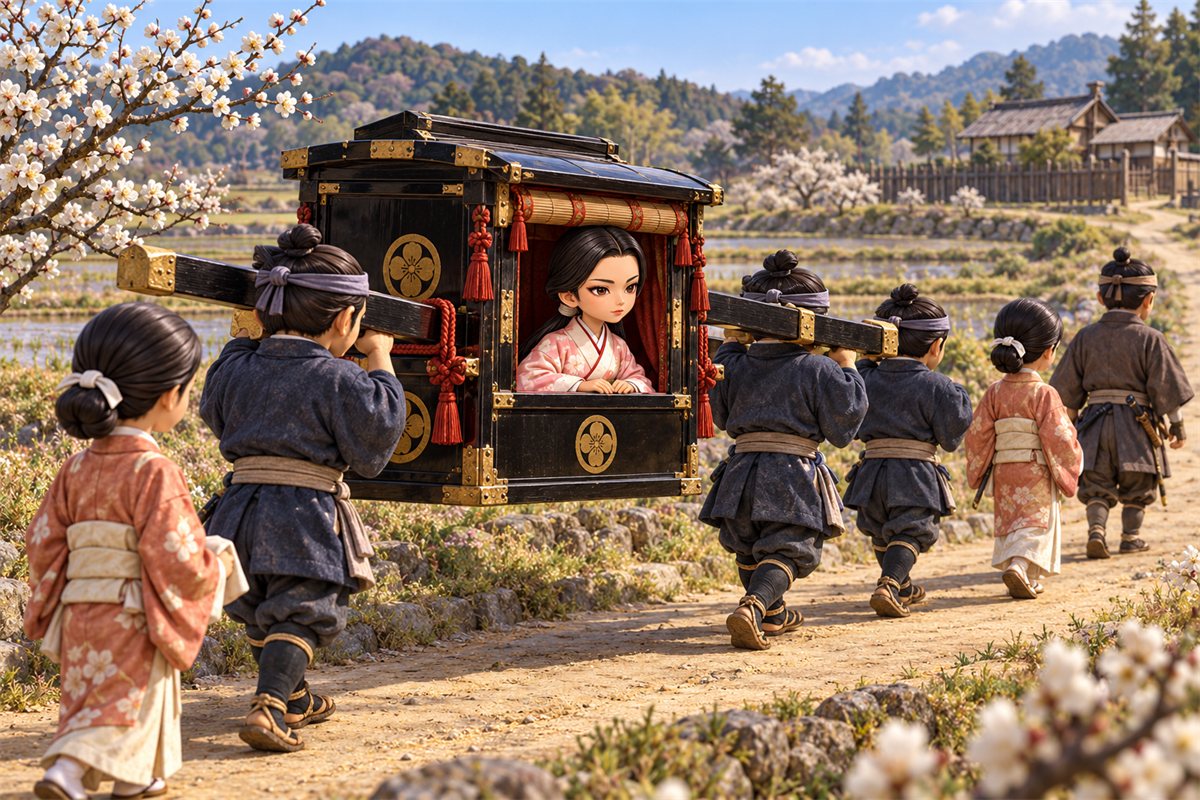
Image: Nōhime on her way from Mino to her marriage in Owari
Was She Married to Someone Else Before Nobunaga?
There is a story that a daughter of Dōsan was married, before Nobunaga, into the Toki family, the hereditary governors (shugo) of Mino, and some take this as Nōhime's first marriage [Debated]. However, it has not been confirmed that this daughter was Nōhime.
Is the Story of Nobunaga Slipping Out at Night True?
The Edo-period popular books Bushō Kanjōki (1716) and Ehon Taikōki tell the following story.
Every night, after Nōhime had fallen asleep, Nobunaga quietly got up and went outside. When she asked why, he confided that Dōsan's senior retainers were plotting to betray and kill Dōsan, and that he was waiting for their signal fire. Nōhime told her father, and Dōsan had those retainers executed. This, it turns out, was exactly Nobunaga's scheme.
It is a clever tale, but it comes from Edo-period popular books and cannot be confirmed from records of the time [Legend].
For Nobunaga's wives and consorts, see also "Who Was Oda Nobunaga's Wife?" in our article on Oda Nobunaga.
What We Know / What We Don't Know
- Likely: she married around 1548 or 1549
- We don't know: how old Nōhime was at the marriage, or what the couple's relationship was like
Did Nōhime Have Children?
In the sources we checked, we found no record that Nōhime gave birth to a child [Unknown].
Some Edo-period books do mention children. The Seishū Gunki (1638) says that Dōsan's daughter, Nobunaga's midai (principal wife), "had no son," and the Mino Meisaiki (1738) says that Nobunaga's principal wife "had no children" [Legend].
Edo-period books also say that Nōhime adopted Nobunaga's eldest son, Nobutada, born to a daughter of the Ikoma family who was one of his secondary wives, and made him the heir [Legend]. Whether she really adopted him, or actually raised him, is unknown.
Some people take the lack of records about children to mean that "the couple did not get along" or that "she was sickly," but the absence of records alone does not support such conclusions.
Most of Nobunaga's children are said to have been born to his secondary wives [Widely accepted]. His eldest son Nobutada was born in 1557 (Kōji 3), and his mother is said to have been a daughter of the Ikoma family [Widely accepted]. For Nobunaga's children, see the family tree in our article on Oda Nobunaga.

Image: Nōhime lost in thought on the veranda of a mansion
What We Know / What We Don't Know
- We know: Edo-period books say she "had no children"
- We don't know: whether Nōhime had any children, or whether she really adopted Nobutada
Who Were Nōhime's Parents? Was She Akechi Mitsuhide's Cousin?
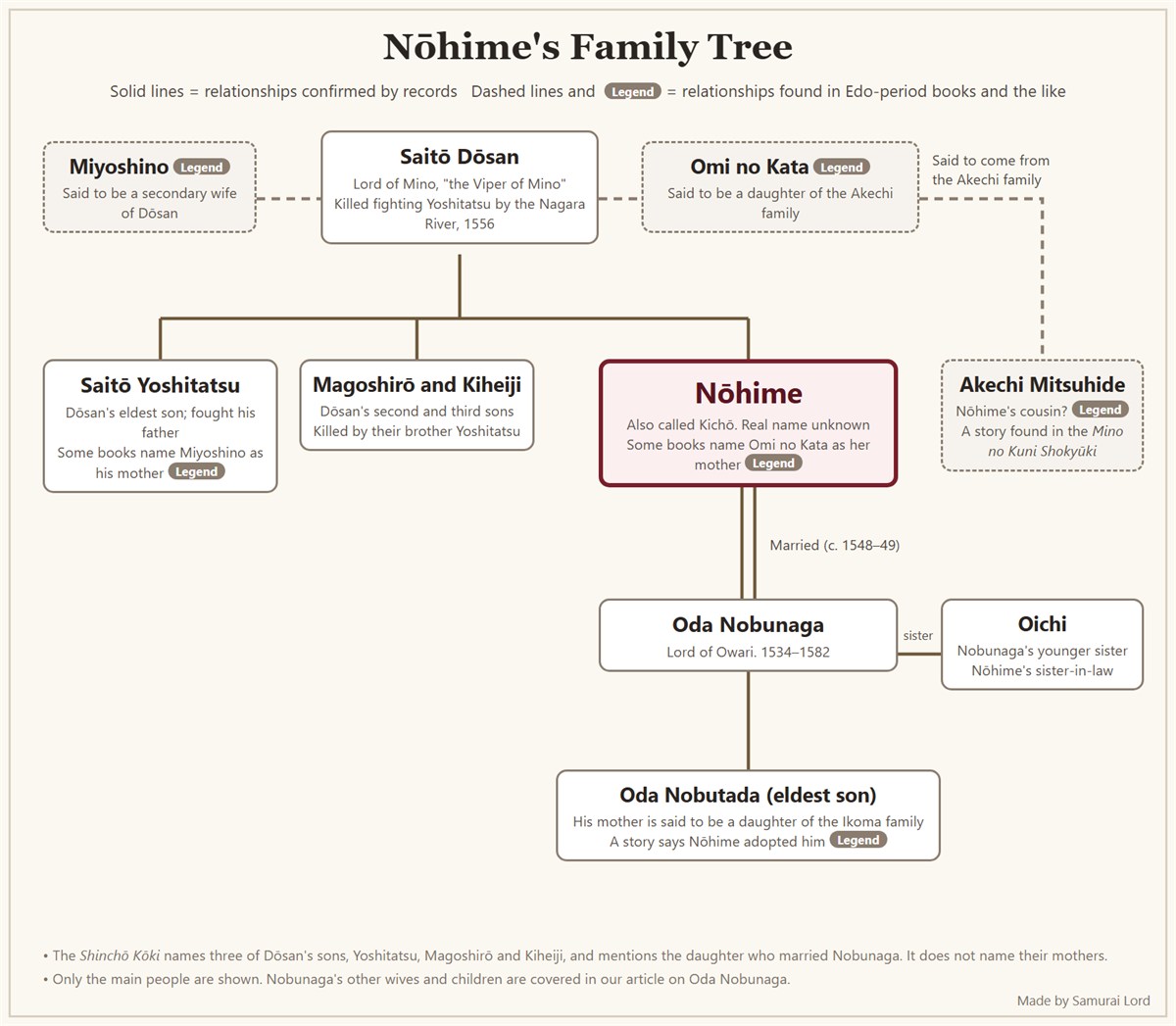
Image: Nōhime's family tree (solid lines show relationships confirmed by records; dashed lines show relationships found in Edo-period books and similar sources. Made by Samurai Lord)
Her Father, Saitō Dōsan, "the Viper of Mino"
Her father, Saitō Dōsan, rose from a family of retainers of the Toki, the governors of Mino, to become the warlord ruling Mino. His cunning earned him the nickname "the Viper of Mino," though the nickname was given in later times.
After marrying his daughter to Nobunaga, Dōsan fell out with his son Yoshitatsu, and in the 4th month of 1556 (Kōji 2) he was killed fighting Yoshitatsu's army by the Nagara River [Fact].
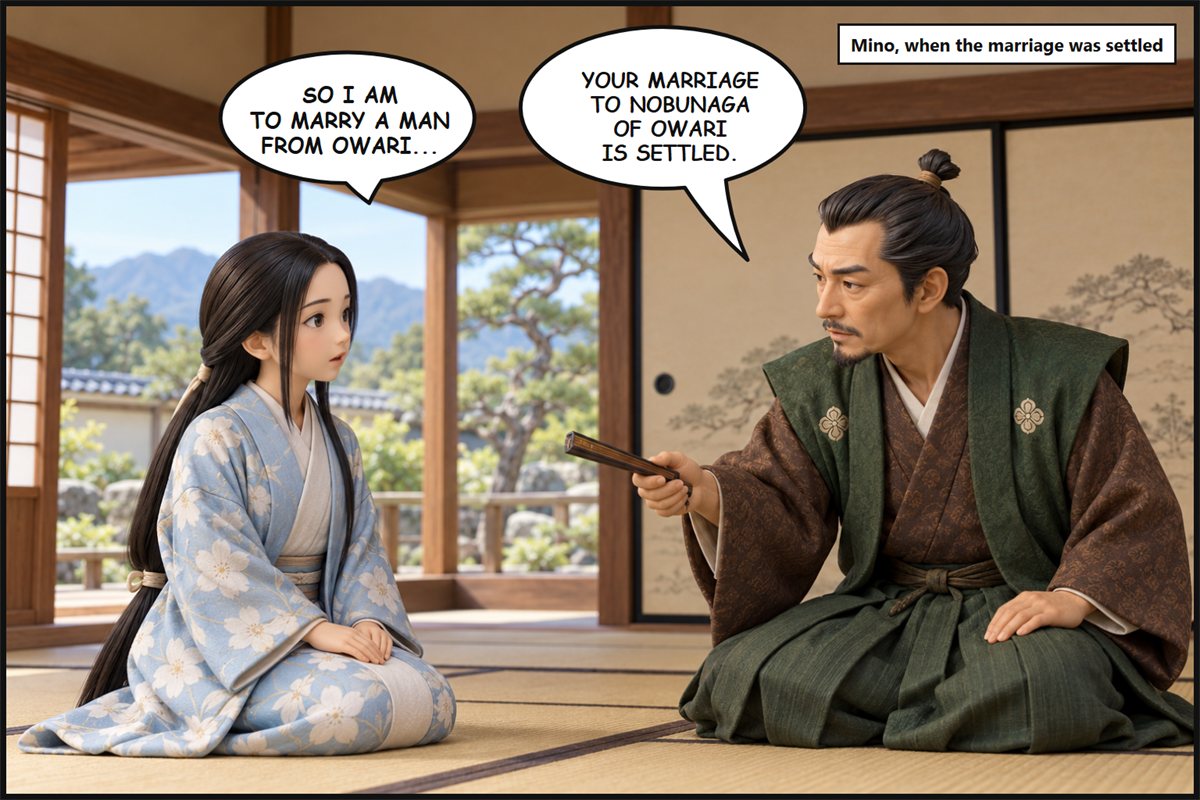
Image: Dōsan telling his daughter Nōhime about the marriage to Nobunaga
Was Her Mother "Omi no Kata"?
The Mino no Kuni Shokyūki says her mother was Omi no Kata, a daughter of the Akechi family [Legend]. The same book names a different woman, Miyoshino, as Yoshitatsu's mother, making Yoshitatsu and Nōhime half-siblings [Legend].
Was She a Cousin of Akechi Mitsuhide?
The Mino no Kuni Shokyūki makes Nōhime a cousin of Akechi Mitsuhide [Legend], on the grounds that her mother, Omi no Kata, came from the Akechi family. Mitsuhide was the general who later turned against Nobunaga at Honnō-ji.
However, we found no other source confirming that they were cousins, and Mitsuhide himself is a man whose birth year and parents are unclear. The idea became widely known through the NHK historical drama Kirin ga Kuru (2020), which presented Kichō as Mitsuhide's cousin. For Mitsuhide, see our article on Akechi Mitsuhide.
Oichi, Her Sister-in-Law
Nōhime was the sister-in-law of Nobunaga's younger sister, Oichi. We found no record of a meeting between the two women in the sources we checked. For Oichi, see our article on Oichi.
What We Know / What We Don't Know
- We know: her father was Saitō Dōsan
- We don't know: who her mother was, or whether she was Akechi Mitsuhide's cousin
Nōhime in Novels, TV Dramas and Films
Nōhime has appeared in many novels, TV dramas and films. Here are some of the main works:
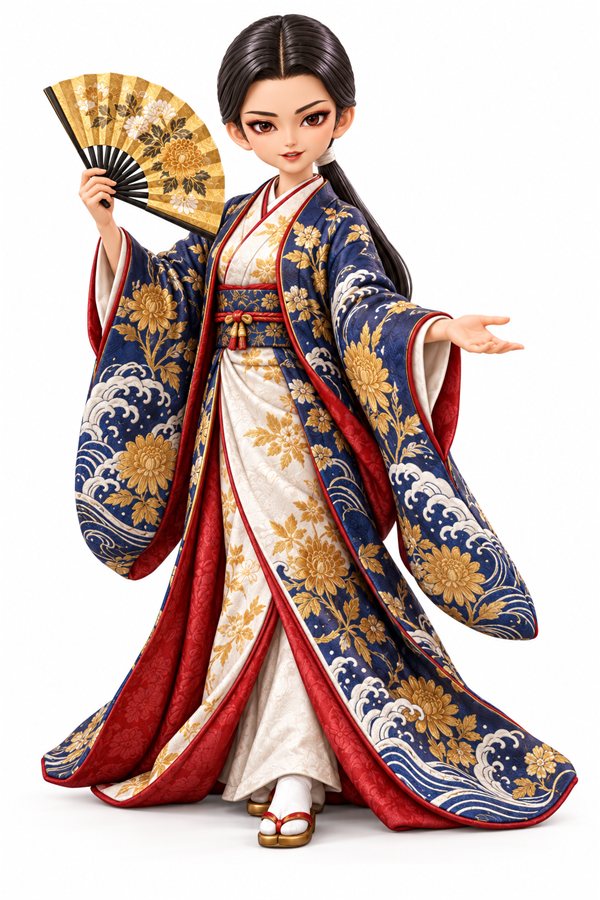
Image: Nōhime introducing the Nōhime of dramas and novels
| Work (year) | How she is portrayed | Difference from history |
| The novel Kunitori Monogatari (serialized from 1963) | Appears under the names "Nōhime" and "Kichō"; the work that spread both names | Her personality and conversations are the novelist's creation [Drama fiction] |
| NHK historical drama Kunitori Monogatari (1973) | Fights with a naginata at the Honnō-ji Incident and dies | We found no record that she was at Honnō-ji [Drama fiction] |
| NHK historical drama Kirin ga Kuru (2020) | Appears as "Kichō," a cousin of Akechi Mitsuhide | The cousin theory comes from an Edo-period book; her exchanges with Mitsuhide are fiction [Drama fiction] |
| The film The Legend & Butterfly (2023) | A film centered on Nobunaga and Nōhime as a married couple | The couple's exchanges are fiction [Drama fiction] |
For NHK's 2026 historical drama Toyotomi Kyōdai! (Toyotomi Brothers!), the chief producer explained in a February 2026 interview that Nōhime (Kichō) would not be shown on screen, so as to bring out Nobunaga's solitude (TV Guide Web, February 14, 2026). This is a decision about how the drama portrays its characters, not a new finding about the historical Nōhime.
What We Know / What We Don't Know
- We know: novels and dramas helped popularize her names and shaped many familiar portrayals of her
- We don't know: what the real Nōhime's personality and conversations were like
Statues, Graves and Places Connected with Nōhime
Places said to be connected with Nōhime are found in Aichi Prefecture, Gifu Prefecture and Kyoto. Some of the connections can be confirmed from records, while others are only local traditions, so we introduce them separately.
The Statues of Nobunaga and Nōhime (Kiyosu Park)
In Kiyosu Park in Kiyosu, Aichi Prefecture, there is a bronze statue of Nobunaga and a statue of Nōhime, who seems to look up at him. Both are modern statues.
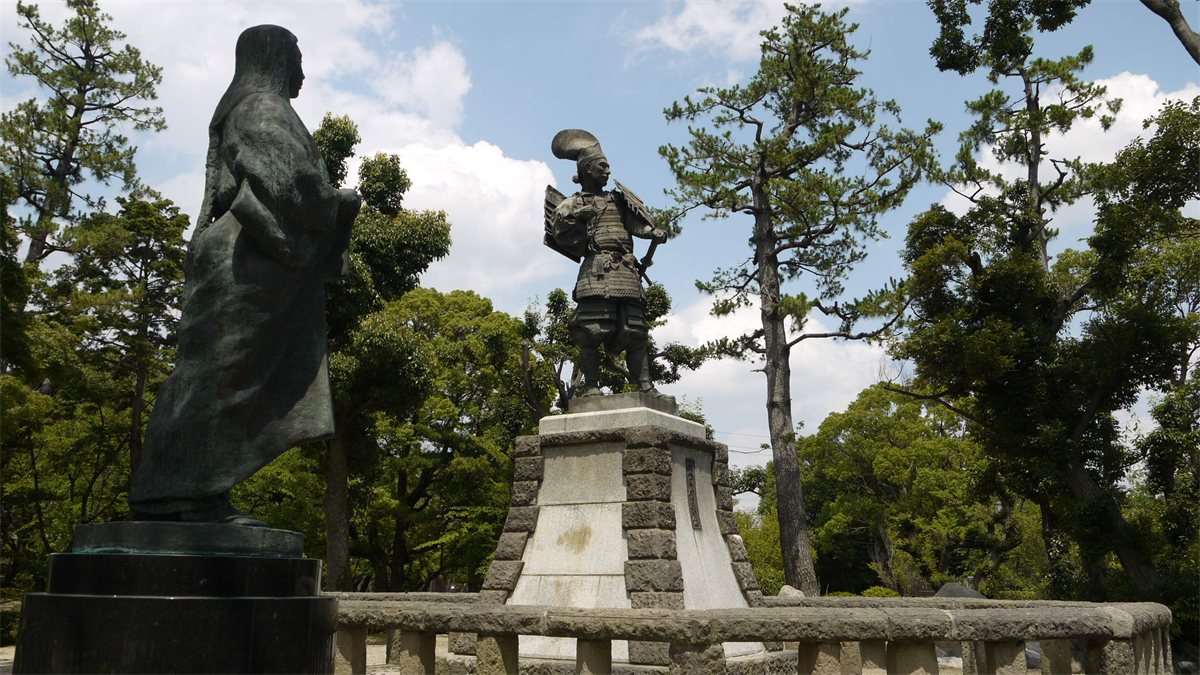
Image: The statues of Nōhime (left) and Oda Nobunaga (right) in Kiyosu Park. Wikimedia Commons (photo: baggio4ever, CC BY 3.0)
Onō's Grave (the Nōhime Hair Mound)
In Fudō-chō, Gifu City, there is "Onō's grave" (the Nōhime hair mound). It is said that after the Honnō-ji Incident a retainer who escaped buried a lock of Nōhime's hair here [Legend]. It was destroyed in the air raid on Gifu in 1945 and rebuilt by local people in 1976. It is not a designated historic site of the nation or the city.
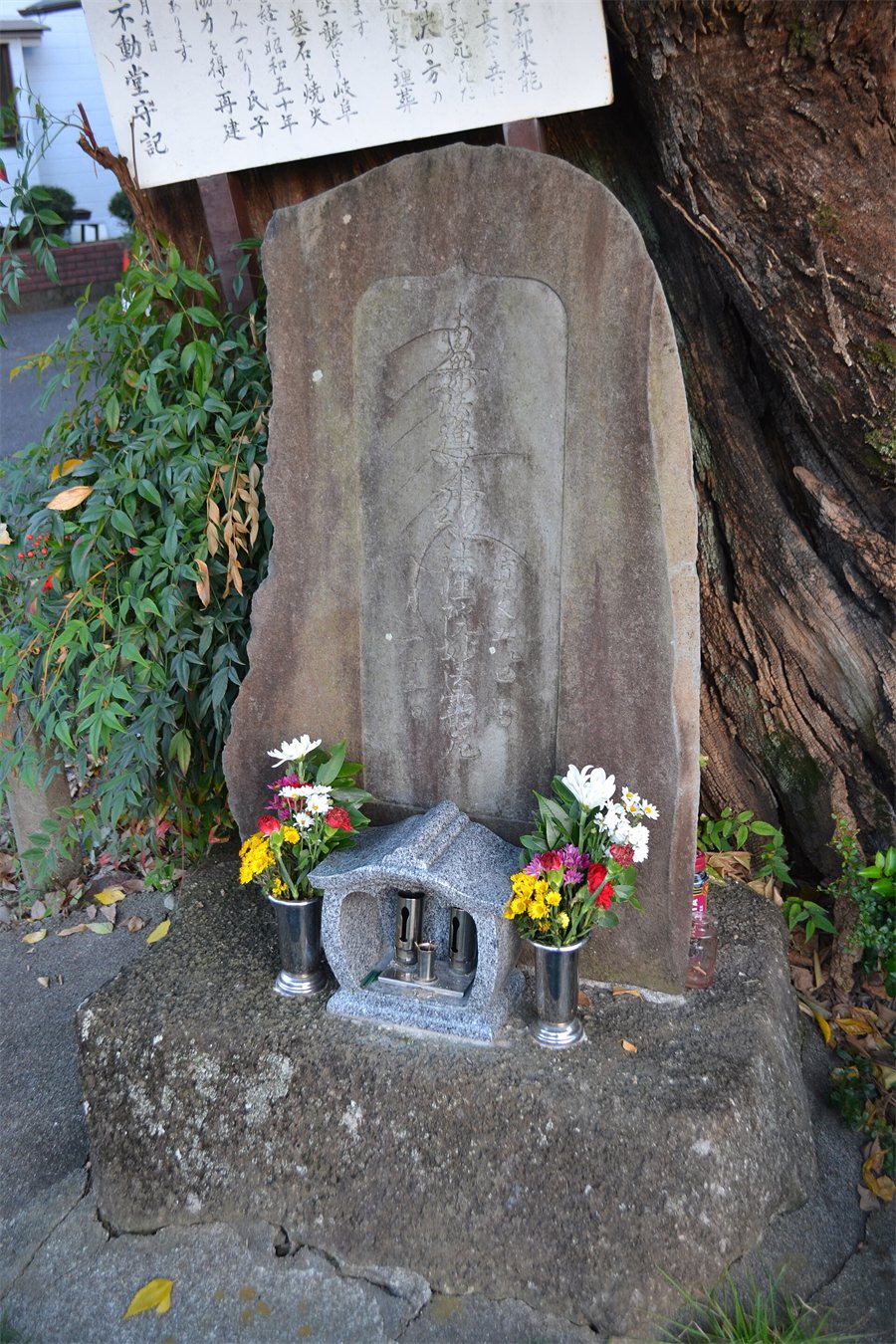
Image: Onō's grave (the Nōhime hair mound) in Fudō-chō, Gifu City. Wikimedia Commons (photo: 先徒隗始, CC0)
Sōkenin at Daitokuji, Kyoto
Sōkenin, a subtemple of Daitokuji in Kita Ward, Kyoto, was founded by Toyotomi Hideyoshi for the first anniversary of Nobunaga's death. It holds graves of the Oda family, and among them is said to be a gorintō (a five-tiered stone memorial tower) for "Yōkain," who died in 1612 and who is identified with Nōhime in the long-life theory [Debated]. The temple is usually closed to the public but can sometimes be visited during special openings.
The Site of Sagiyama Castle and a New Excavation at Its Foot (Gifu City)
Mt. Sagiyama in Gifu City is a small hill said to have held the castle where Dōsan lived in his later years [Legend]. Because the Mino no Kuni Shokyūki calls Nōhime "Sagiyama-dono," it is sometimes described as the place where she grew up, but this cannot be confirmed from the records [Legend].
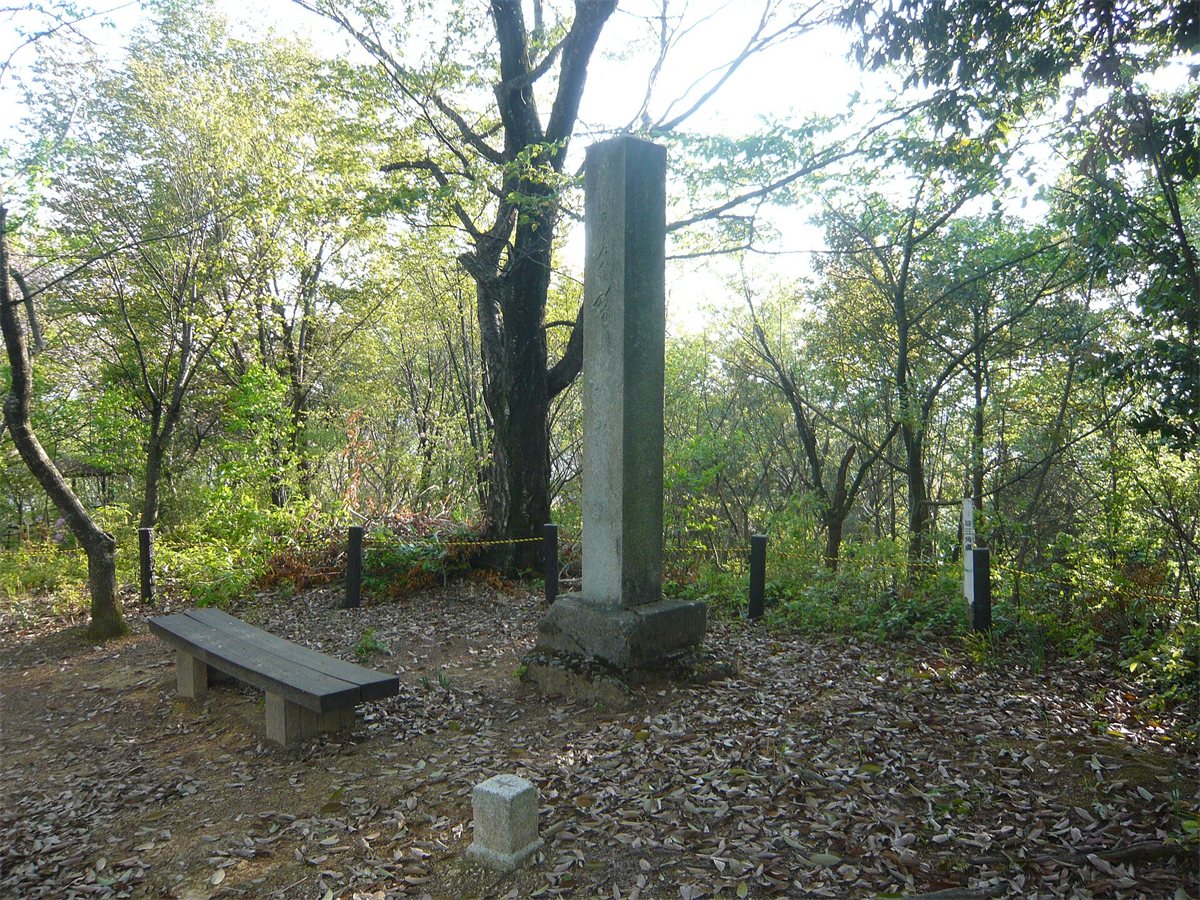
Image: The monument for the site of Sagiyama Castle on the summit of Mt. Sagiyama (Gifu City). Wikimedia Commons (photo: Hide-sp, CC BY-SA 3.0)
The Excavation at the Foot of Mt. Sagiyama, Announced in January 2026
- In an excavation in fiscal 2025, Gifu City found the moat of a Sengoku-period residence at the eastern foot of Mt. Sagiyama, together with an earthen bridge across the moat reinforced with stone walls on both sides (an on-site briefing was held on January 25, 2026)
- The city suggests that it may be the residence that Dōsan prepared for Toki Yorinori, the governor of Mino
- The city's materials say nothing about a connection with Nōhime
Here is a summary of the main places:
| Place | What you can see | Connection with Nōhime |
| Kiyosu Park (Kiyosu, Aichi Prefecture) | Statues of Nobunaga and Nōhime | Modern statues |
| Onō's grave (Fudō-chō, Gifu City) | A hair mound | Said to hold a lock of her hair [Legend] |
| Sōkenin, Daitokuji (Kita Ward, Kyoto) | Graves of the Oda family | Said to include her grave, if the long-life theory is followed [Debated] |
| Site of Sagiyama Castle (Gifu City) | A monument on the summit; the site of a residence at its foot | Linked to her through the name "Sagiyama-dono" [Legend] |
| Gifu Castle (Gifu City) | A reconstructed keep built in 1956 (closed for renovation until the end of October 2027, as scheduled) | The 1569 entry on "Nobunaga's principal wife" dates from when Nobunaga was based at Gifu. We found no record that Nōhime lived there |
FAQ
How do you pronounce Nōhime?
"Noh-hee-meh." In Edo-period books the name was glossed as "No-hime." Kichō is pronounced "kee-choh" (more).
How old was Nōhime when she married?
It is not certain. If she was born in 1535, she was 14 or 15 by the traditional count when she married in 1548 or 1549 (more).
What was the age difference between Nobunaga and Nōhime?
If she was born in 1535, she was one year younger than Nobunaga, who was born in 1534. However, her birth year appears only in an Edo-period book.
Was Nōhime beautiful?
In the records from the time that we checked, we found no description of her appearance, and no portrait confirmed to show her. Novels and dramas often portray her as beautiful or strong-willed, but these traits are not established by the records we checked.
Was Nōhime a real person?
Yes. The Shinchō Kōki records that Dōsan's daughter married Nobunaga
[Fact]. What we do not know is her name and the rest of her life.
Did Dōsan really give Nōhime a dagger?
A famous story says that Dōsan handed her a dagger, saying, "If Nobunaga turns out to be a fool, stab him with this," and that she answered, "This dagger may be the one that stabs you, Father." However, in the sources we checked, we could not find any old record that is the origin of this story
[Folk belief].
Is the Nōhime in video games and anime historically accurate?
Portrayals vary by work. Nōhime was a historical person, but her personality, dialogue and combat scenes in games and anime should not be treated as historical evidence. In the contemporary sources we checked, we found no account of her fighting, and we could not establish that she was at Honnō-ji (more).
Summary: Who Was Nōhime?
Nōhime was the daughter of Saitō Dōsan of Mino and the principal wife of Oda Nobunaga, married to him to make peace between Owari and Mino. Her marriage is a firm fact, recorded in the Shinchō Kōki.
On the other hand, the names "Nōhime" and "Kichō" come from books written in the Edo period or later, and her real name is unknown. How and when she died are also unknown. The entry on "Nobunaga's principal wife" in a diary of 1569 is the most important clue to her life after the marriage.
The image of Nōhime fighting with a naginata at Honnō-ji, familiar from TV dramas, cannot be confirmed from the records of the time.
For related people, see our articles on Oda Nobunaga, Akechi Mitsuhide, Oichi and Toyotomi Hideyoshi.
Precisely because the records are few, it matters to separate what we know from what we don't.
Tracing her names back to their sources was fascinating!
Sources & How This Article Was Written
This article is based mainly on the following records and references:
- A record from her time: Yamashina Tokitsugu, Tokitsugu Kyōki (entry for the 27th day of the 7th month of Eiroku 12; text from the database of the Historiographical Institute, the University of Tokyo, as quoted in Matsuura Yoshiki's paper)
- Later records: Ōta Gyūichi, Shinchō Kōki (the opening book from the Kadokawa Bunko edition as quoted in Matsuura's paper; book 15 and Dōsan's death from the 1881 printed edition on Wikisource; available in English as The Chronicle of Lord Nobunaga, translated by J. S. A. Elisonas and J. P. Lamers, Brill, 2011); Mino no Kuni Shokyūki (Kokushi Sōsho edition, 1915, from the image in Matsuura's paper); Seishū Gunki, Mino Meisaiki, Bushō Kanjōki and Ehon Taikōki (as cited in Matsuura's paper)
- Study (in Japanese): Matsuura Yoshiki, "On the Name of Nohime 'Kicho', 'Kocho', 'Kikyo'" (Journal of National Institute of Technology, Toyota College, vol. 46, 2014; the views of Owada Tetsuo and Kuwata Tadachika are also cited from this paper)
- Public sources (in Japanese; titles translated by us): Gifu City, "Onō's Grave"; Gifu City, "Materials for the On-site Briefing on the Fiscal 2025 Excavation of the Sagiyama Ichiba Site" (2026); Gifu Prefecture Tourism Federation, "Nōhime Hair Mound" and "Site of Sagiyama Castle"
- On the dramas (in Japanese): TV Guide Web, interview with the chief producer of Toyotomi Kyōdai! (February 14, 2026); Yahoo! News Expert, on why Kichō does not appear in Toyotomi Kyōdai! (February 15, 2026); Serai.jp, on Kichō in Kirin ga Kuru (March 21, 2020)
- Images: Yōsai Nobukazu, Honnō-ji Yakiuchi no Zu (collection of Nagoya City, public domain), and the photos of the statues in Kiyosu Park (baggio4ever, CC BY 3.0), Onō's grave (先徒隗始, CC0) and the site of Sagiyama Castle (Hide-sp, CC BY-SA 3.0) are from Wikimedia Commons. The timelines, family tree, manga panels and illustrations are original works by Samurai Lord
What the Labels Mean
[Fact]Confirmed by sources from the time ([Fact: …]names the source)[Widely accepted]A view widely accepted by researchers[Debated]Accounts, interpretations or ways of counting differ[Unknown]Not established from the sources we checked[Legend]Stories found in later records or traditions[Folk belief]Popular claims with little evidence[Drama fiction]Scenes created for dramas, novels or films
We keep "what a record says" separate from "what actually happened."
This article was written by the Samurai Lord editorial team and is revised as new research and reader feedback come in. If you spot an error, please let us know through our contact form (in Japanese) and we will check and correct it.
Read in Japanese
This article is also available in Japanese: 濃姫(帰蝶)とは?最後や死因、子供は?名前の違いや信長との関係を解説!