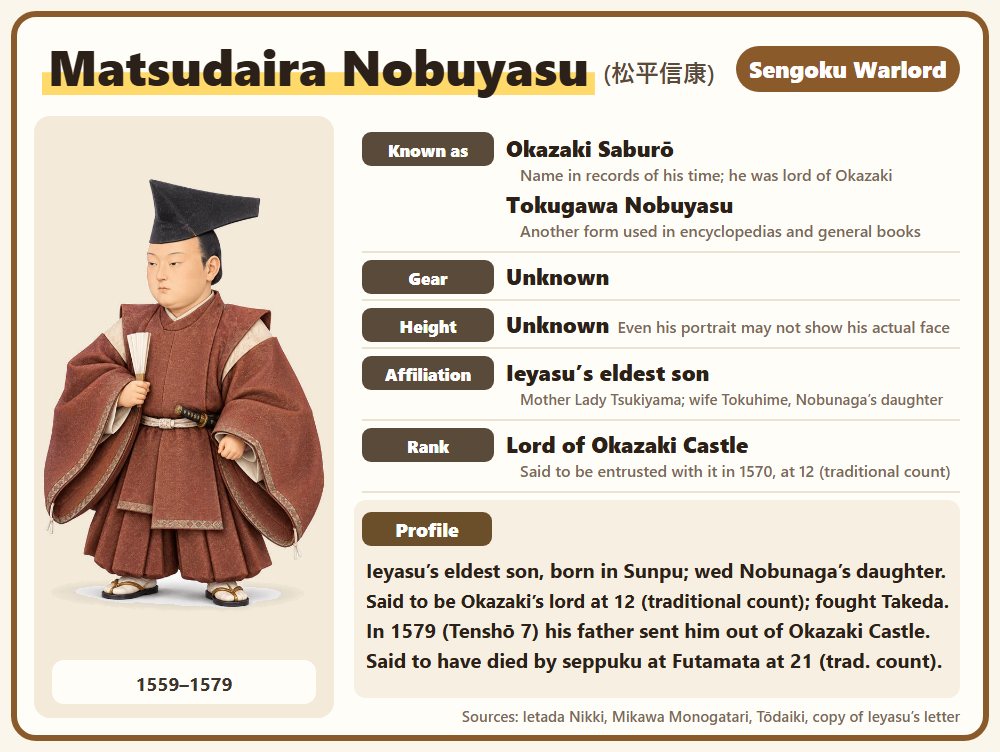
Matsudaira Nobuyasu was the eldest son of Tokugawa Ieyasu. His mother was Lady Tsukiyama. He married Tokuhime, a daughter of Oda Nobunaga, and as lord of Okazaki Castle (in today's Okazaki, Aichi Prefecture) he was called "Okazaki Saburō." He is also known as "Tokugawa Nobuyasu."
In 1579 (Tenshō 7), his father Ieyasu sent him out of Okazaki Castle, and he is said to have committed seppuku (ritual suicide) at Futamata Castle in Tōtōmi (today's Tenryū Ward, Hamamatsu, Shizuoka Prefecture), at 21 by the traditional count. Why this happened is still not clear.
This article explains who Nobuyasu was, why he took his own life, his wife and descendants, "what if he had lived," his end and the story of Hattori Hanzō, and his grave, distinguishing records from his lifetime from later accounts and traditions.
Historical dates give the Western year with the Japanese era; months and days follow the Japanese lunisolar calendar unless otherwise stated. Modern dates use the Gregorian calendar. Ages use the traditional Japanese count, in which a person was counted as one at birth and gained a year at the start of each new year in the Japanese calendar.
Key points are tagged: [Fact] confirmed by records from the time, [Widely accepted] a view widely accepted by researchers, [Debated] accounts or interpretations differ, [Unknown] not established from the sources we checked, [Legend] stories found in later records or traditions, and [Folk belief] popular claims with little evidence.

I am Uesugi Kenshin. Today's story is about Matsudaira Nobuyasu, Ieyasu's eldest son.

I'm Date Masamune! "Matsudaira Nobuyasu" or "Tokugawa Nobuyasu": which one is right?

A good question. Let us answer it, and why he took his own life, one by one, looking at the records.
The Short Answers
- Who was he? Tokugawa Ieyasu's eldest son by Lady Tsukiyama, and lord of Okazaki Castle (more)
- His name? Records from his time call him "Nobuyasu," "Okazaki Saburō" and similar names (Matsudaira or Tokugawa?)
- Why seppuku? The true reason is not clear. One record says Nobunaga ordered it; some historians place greater weight on Ieyasu's own role in the decision (more)
- Wife and children? His wife was Tokuhime, a daughter of Oda Nobunaga. They had two daughters (more)
- His end? He is said to have taken his own life at Futamata Castle in Tōtōmi on the 15th day of the 9th month of 1579 (Tenshō 7), at 21 by the traditional count
[Widely accepted](more) - His grave? His mausoleum is at Seiryūji temple in Tenryū Ward, Hamamatsu, and his head mound is said to be at Wakamiya Hachimangū shrine in Okazaki (more)
Three Things We Learn by Comparing the Sources
- Did Hattori Hanzō weep? A comparison of four records showing how their accounts of the famous "Hanzō who could not do it" differ (more)
- Matsudaira or Tokugawa? What the records of his own time actually call him (more)
- A son guarding his father's retreat: the story in the Mikawa Monogatari of Nobuyasu insisting on guarding the rear, with a short Japanese excerpt and an English translation (more)
Jump to the part you want to read:
- Who was Matsudaira Nobuyasu (Tokugawa Nobuyasu)?
- Why did Nobuyasu commit seppuku? The main theories
- His wife Tokuhime, his children and descendants
- What if Nobuyasu had lived? Hidetada and the succession
- How did Nobuyasu die? Futamata Castle, Hattori Hanzō and Muramasa
- What did he do as lord of Okazaki? Battles with the Takeda and his character
- Where is Nobuyasu's grave?
- FAQ
The labels such as [Fact] and [Debated] show how certain each point is (their meanings are listed at the end of the article).
Who Was Matsudaira Nobuyasu (Tokugawa Nobuyasu)?
In a single sentence, Nobuyasu was "a young warrior who, as Tokugawa Ieyasu's eldest son, was entrusted with Okazaki Castle, and who lost his life in 1579 (Tenshō 7) at 21 by the traditional count".
| Item | Details |
| Name | Matsudaira Nobuyasu (also Tokugawa Nobuyasu) |
| Parents | Father: Tokugawa Ieyasu. Mother: Lady Tsukiyama [Fact] |
| Born | 6th day of the 3rd month of 1559 (Eiroku 2), at Sunpu (today's Shizuoka City) [Widely accepted] |
| Childhood name | Takechiyo (the same as his father Ieyasu's) [Widely accepted] |
| Wife | Tokuhime (also called Gotoku), a daughter of Oda Nobunaga |
| Children | Two daughters: Tokuhime (登久姫; also called Fukuhime) and Kumahime |
| Castle | Okazaki Castle (today's Okazaki, Aichi Prefecture) |
| Died | 1579 (Tenshō 7), at 21 by the traditional count (20 by modern reckoning) |
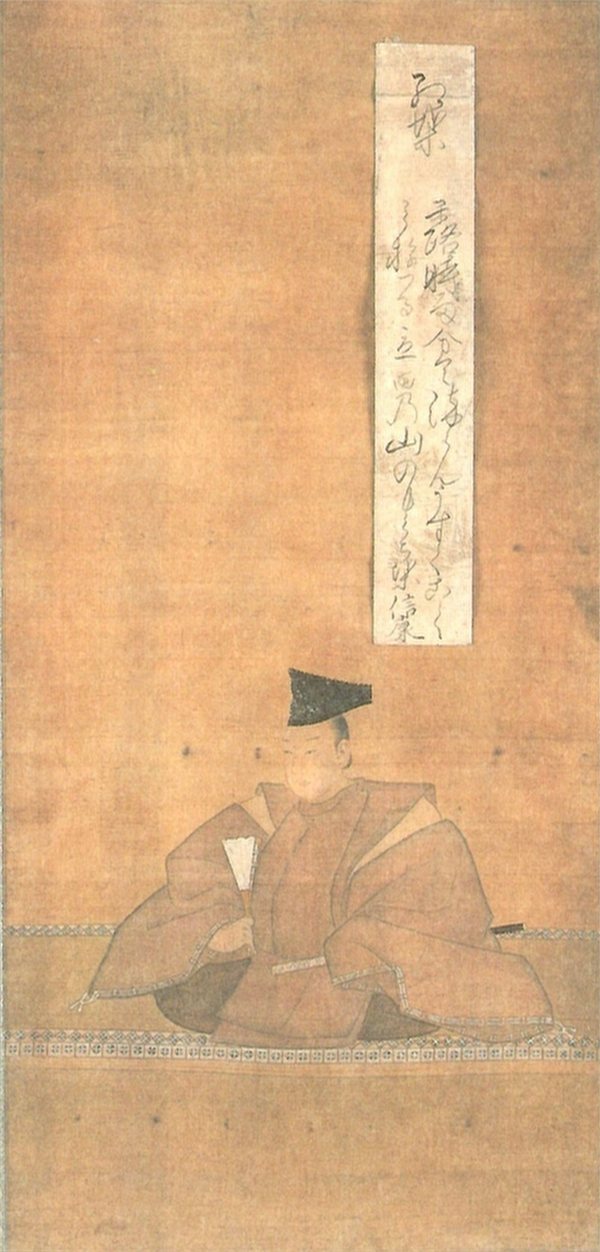
Image: Portrait of Matsudaira Nobuyasu (owned by Shōrenji temple; an Okazaki City cultural property). It was painted in the Edo period by an unknown artist. Wikimedia Commons (photo printed in Shinpen Anjō Shishi 1; public domain)
The best-known portrait of Nobuyasu is the one handed down at Shōrenji temple in Okazaki, which Okazaki City introduces as "said to be his only portrait." It was painted some time after his death, however, and we cannot confirm whether it shows his actual face.
Nobuyasu's Life: A Timeline
| Year | Age | Event |
| 1559 (Eiroku 2) | 1 | Born at Sunpu. His father Ieyasu was then living under the Imagawa family [Widely accepted] |
| Around 1562 (Eiroku 5) | 4 | Ieyasu's retainer Ishikawa Kazumasa is said to have brought Nobuyasu and his mother, Lady Tsukiyama, back from Sunpu to Okazaki [Widely accepted] |
| 1567 (Eiroku 10) | 9 | Marries Tokuhime, a daughter of Oda Nobunaga [Widely accepted] |
| 1570 (Genki 1) | 12 | Said to have come of age; becomes lord of Okazaki Castle after Ieyasu moves to Hamamatsu [Widely accepted] |
| 1575 (Tenshō 3) | 17 | Said to have gone to the Battle of Nagashino with Ieyasu [Widely accepted]. A story tells that in the 9th month, during a retreat from near the Ōi River, he guarded the rear [Legend] |
| 1576 (Tenshō 4) | 18 | His elder daughter, Tokuhime (登久姫), is born [Widely accepted] |
| 1577 (Tenshō 5) | 19 | His younger daughter, Kumahime, is born [Widely accepted] |
| 1579 (Tenshō 7), 4th month | 21 | His younger half-brother Chōmatsu (later Tokugawa Hidetada) is born at Hamamatsu [Widely accepted] |
| 1579 (Tenshō 7), 8th month, 4th day | 21 | Sent out of Okazaki Castle and moved to Ōhama (today's Hekinan, Aichi Prefecture) [Fact: Ietada Nikki] |
| 1579 (Tenshō 7), 9th month, 15th day | 21 | Said to have committed seppuku at Futamata Castle in Tōtōmi [Widely accepted] |
"Matsudaira Nobuyasu" or "Tokugawa Nobuyasu": Which Is Right?
Both names refer to the same person.
Records from his own lifetime call him "Nobuyasu," "Saburō," "Okazaki Saburō" and similar names [Fact]. For example, the Ietada Nikki, the diary of Matsudaira Ietada, a warrior of Ieyasu's family, writes "Nobuyasu," and the Azuchi Nikki, a record by Nobunaga's retainer Ōta Gyūichi, calls him 「三州岡崎三郎殿」 ("Lord Okazaki Saburō of Mikawa"). Among the records from his time that we checked, we found none that calls him "Tokugawa Nobuyasu."
Ieyasu changed his family name from Matsudaira to Tokugawa near the end of Eiroku 9 (the Japanese year that mostly corresponds to 1566). Encyclopedias explain that for some time Ieyasu was the only one to bear the Tokugawa name [Widely accepted]. For this reason, books and papers by historians often call his son "Matsudaira Nobuyasu."
Still, encyclopedias also have entries under "Tokugawa Nobuyasu," and because the name shows at once that he was Ieyasu's eldest son, it is also widely used. "Tokugawa Nobuyasu" is not wrong.
| Name | What kind of name? |
| Takechiyo | His childhood name, the same as his father Ieyasu's |
| Nobuyasu | His name after coming of age. It is often explained that "Nobu" came from Nobunaga and "yasu" from Ieyasu. The Honchō Tsugan (1670), a history compiled for the Edo shogunate, says he received the character "Nobu" because he was Nobunaga's son-in-law (not confirmed in records from his time) |
| Saburō / Okazaki Saburō | Names found in records of his time. "Okazaki" comes from his being lord of Okazaki Castle |
| Jirō Saburō | A name that encyclopedias say he used after coming of age. Ieyasu had also used it at first |
| Matsudaira Nobuyasu | The form most often used in books by historians and in encyclopedias |
| Tokugawa Nobuyasu | A form used in encyclopedia entries, general books and dramas. The Edo-period war chronicle Oda Gunki also writes "Tokugawa Jirō Saburō Nobuyasu" |

So the "Nobu" came from Nobunaga's name!
That is the usual explanation, but it is written in an Edo-period book. It has not yet been confirmed in records from his own time.
Why Did Nobuyasu Commit Seppuku? The Main Theories
To give the conclusion first: the sources do not establish exactly why Nobuyasu was forced to take his own life.
What is certain is that in the 8th month of 1579 (Tenshō 7), Ieyasu came from Hamamatsu to Okazaki and sent Nobuyasu out of Okazaki Castle. The Ietada Nikki records that on the 4th day of the 8th month Nobuyasu moved to Ōhama (today's Hekinan, Aichi Prefecture), and on the 9th to Horie Castle in Tōtōmi (in today's Hamamatsu) [Fact: Ietada Nikki]. He was then moved to Futamata Castle, and is said to have ended his life on the 15th day of the 9th month [Widely accepted].
As for the reason, the Mikawa Monogatari, written in the early Edo period by Ieyasu's retainer Ōkubo Tadataka, says that "his wife Tokuhime complained about Nobuyasu to her father Nobunaga, and Nobunaga demanded that Ieyasu have him commit seppuku" [Legend]. This used to be the standard explanation. In recent years, however, some historians place greater weight on Ieyasu's own role in the decision.
| Theory | What it says | Points to note |
| Nobunaga ordered it | Having heard Tokuhime's complaints, Nobunaga demanded that Ieyasu have Nobuyasu commit seppuku | The story of the Mikawa Monogatari. The Tōdaiki, also from the early Edo period, says Nobunaga replied, "as Ieyasu sees fit" |
| Links with the Takeda | His mother, Lady Tsukiyama, was suspected of secret contact with the enemy Takeda family, and Nobuyasu was drawn into it | Researchers' views differ |
| A split within the Tokugawa family | Ieyasu at Hamamatsu and Nobuyasu at Okazaki came to be at odds, drawing in their retainers | Researchers' views differ |
| His behavior or a troubled marriage | Nobuyasu's behavior, or his relationship with Tokuhime, became a problem | Most of these stories come from Edo-period records. It is hard to believe that a troubled marriage alone led to seppuku |
The records from the time that we examined do not conclusively establish any one of these explanations [Debated]. The views of individual researchers and the original text of the records of the 8th month are explained in detail in "What Was the Tsukiyama Incident, and Why Did It Happen?" in our article on Lady Tsukiyama.
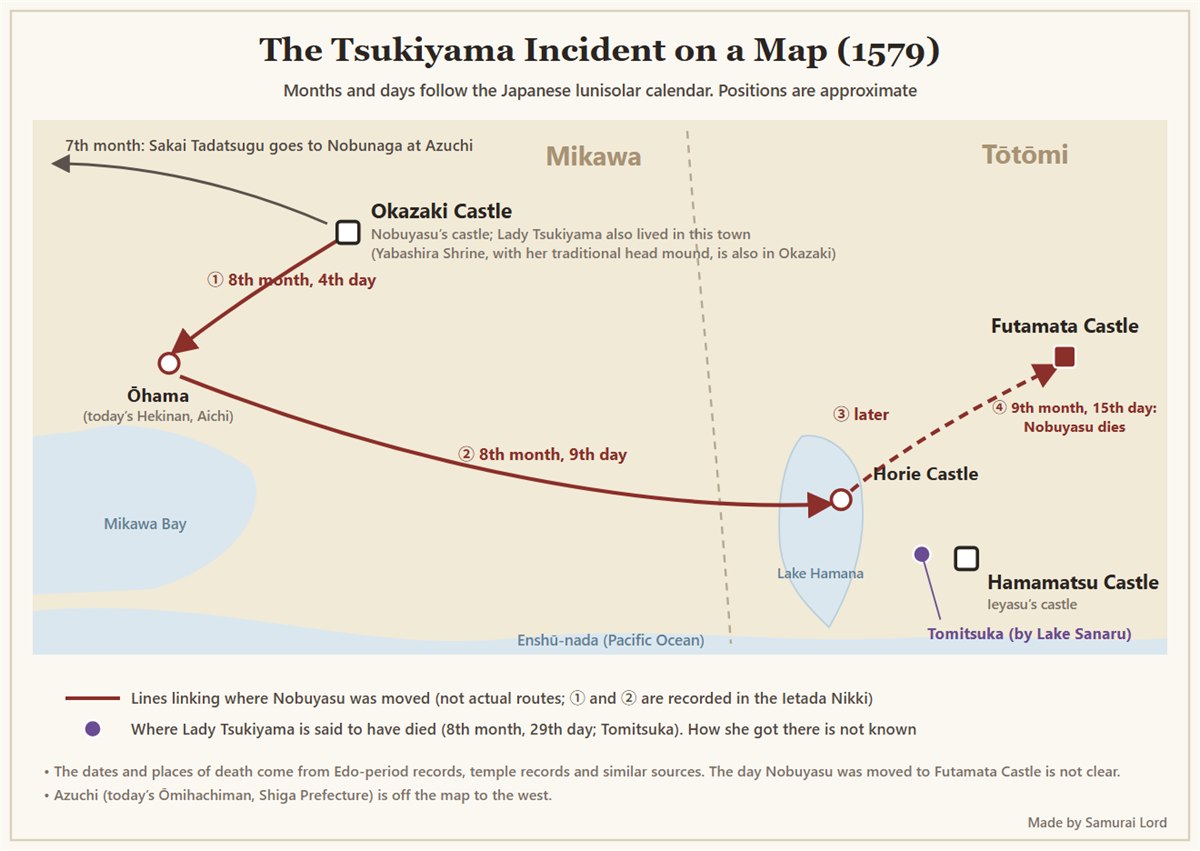
Image: Where Nobuyasu was moved (made by Samurai Lord; positions are approximate). Tap (click) the image to enlarge it
So it wasn't as simple as "a quarrel between husband and wife led to seppuku."
Indeed. His mother, Lady Tsukiyama, also lost her life that same year. Some research links it to a larger problem within the family.
Nobuyasu's Wife Tokuhime, His Children and Descendants
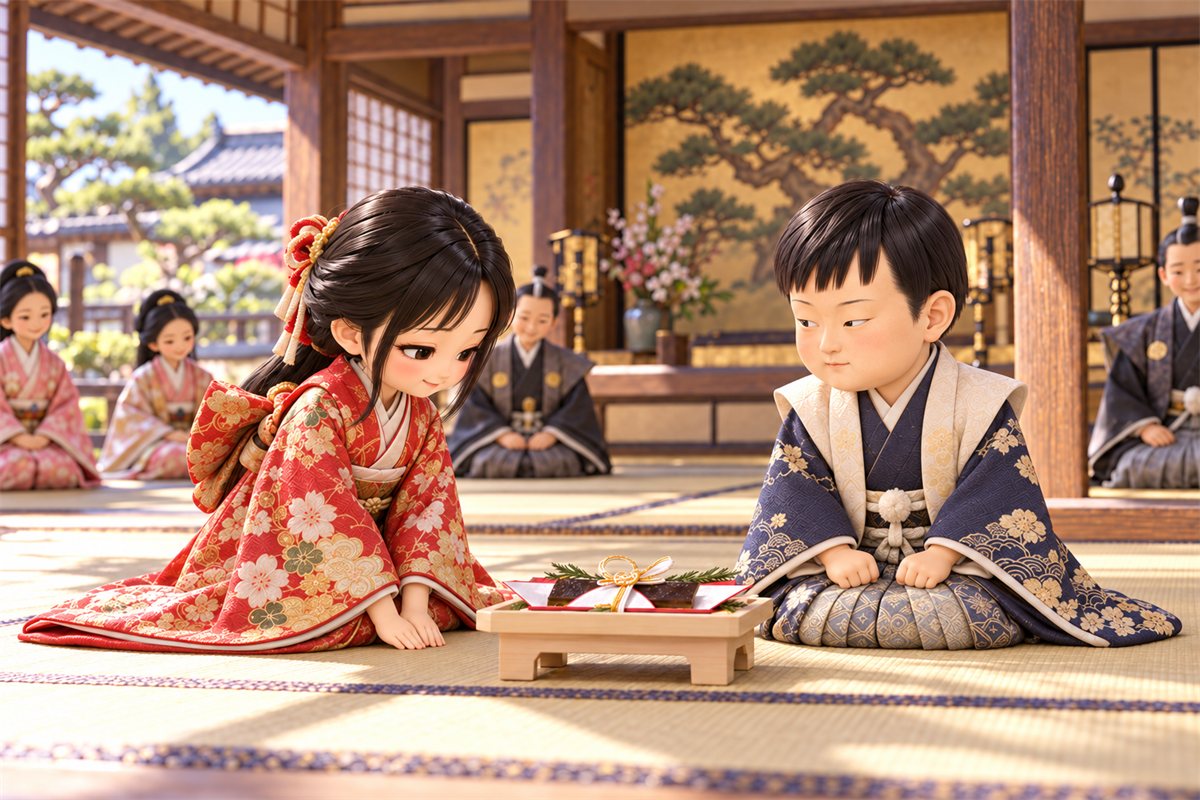
Image: The wedding of the young Nobuyasu and Tokuhime
His Wife, Tokuhime (Gotoku)
Nobuyasu's wife was Tokuhime, a daughter of Oda Nobunaga. She is also called "Gotoku" and "Okazaki-dono." The marriage was meant to strengthen the ties between the Tokugawa and Oda families, and the two are said to have married in 1567 (Eiroku 10), both at 9 by the traditional count [Widely accepted].
The couple had daughters born in 1576 (Tenshō 4) and 1577 (Tenshō 5) [Widely accepted].
As for their relationship, Edo-period records tell that the couple grew apart, and that Tokuhime complained about Nobuyasu to her father Nobunaga [Legend]. How much of this is true, however, is not known.
After Nobuyasu's death, Tokuhime left Okazaki in the 2nd month of 1580 (Tenshō 8), leaving her two daughters behind. She never remarried, and is said to have died in 1636 (Kan'ei 13) at 78 by the traditional count [Widely accepted].
His Two Daughters: Whom Did They Marry?
The name of his elder daughter, 登久姫, is also read "Tokuhime," like her mother's name (徳姫), but it is written with different characters. In this article we write her name with the characters, as "Tokuhime (登久姫)."
| Daughter | Born | Husband | Died |
| Tokuhime 登久姫 (also called Fukuhime) | 1576 (Tenshō 4) | Ogasawara Hidemasa (a warrior of the Ogasawara family of Shinano) | 1607 (Keichō 12) |
| Kumahime (also called 国姫) | 1577 (Tenshō 5) | Honda Tadamasa (eldest son of Honda Tadakatsu; later lord of Himeji) | 1626 (Kan'ei 3) |
The two daughters, who had lost their father, are said to have been raised by their grandfather Ieyasu [Widely accepted]. Each then made a marriage that tied the Tokugawa to a daimyo family [Widely accepted]. Kumahime married Tadamasa, the eldest son of Honda Tadakatsu.
In the next generation, Nobuyasu's granddaughters also married into daimyo families. According to an answer compiled from sources by Okazaki City Central Library, they were as follows [Widely accepted]:
| Granddaughter | Mother | Husband |
| 万姫 (also called 氏姫) | Tokuhime (登久姫) | Hachisuka Yoshishige (lord of Tokushima domain in Awa) |
| 千代姫 | Tokuhime (登久姫) | Hosokawa Tadatoshi (later lord of Kumamoto domain in Higo) |
| 国姫 | Kumahime | Arima Naozumi (lord of Nobeoka domain in Hyūga) |
| 亀姫 | Kumahime | 小笠原忠脩, and later his younger brother Ogasawara Tadazane |
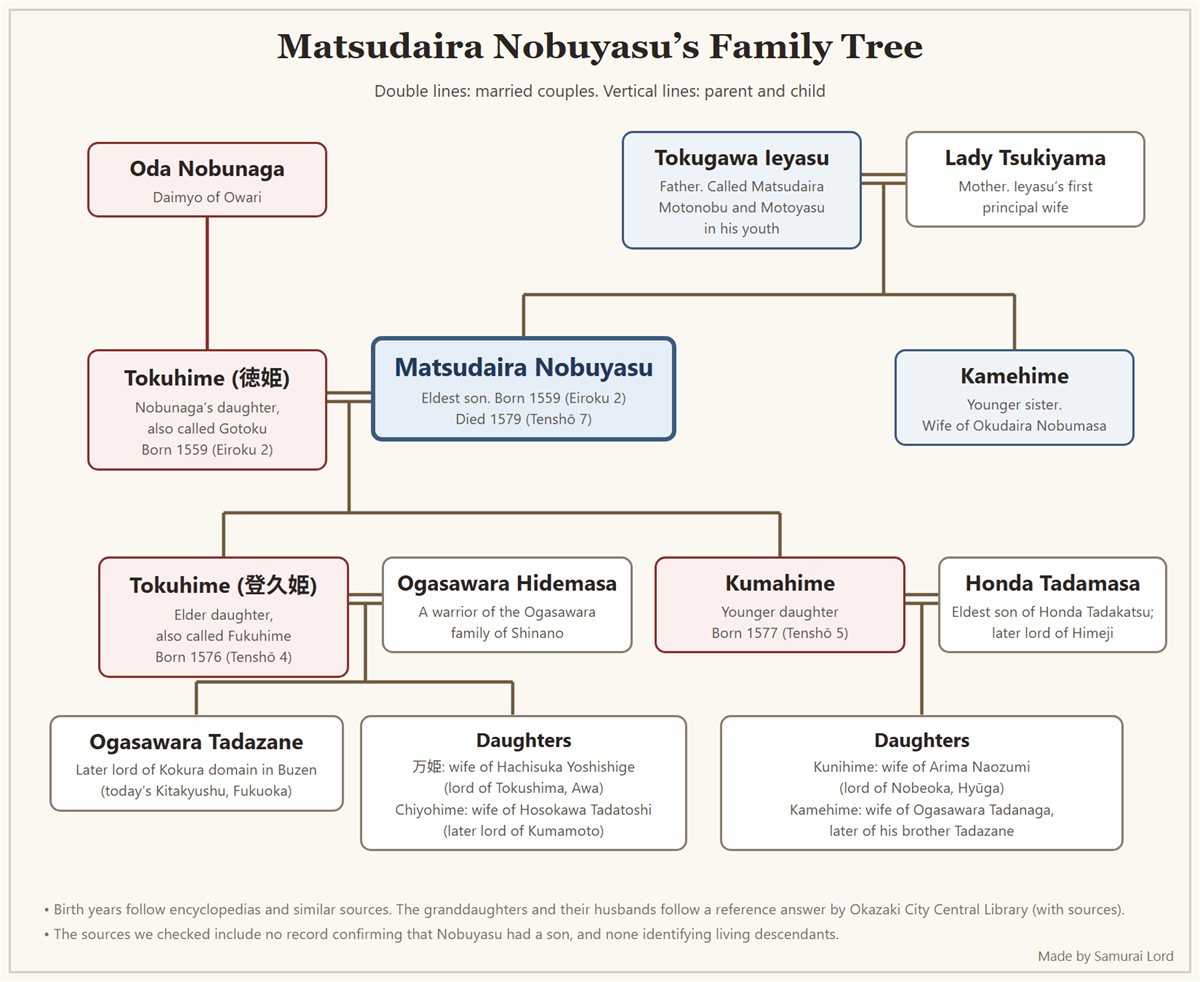
Image: Matsudaira Nobuyasu's family tree (made by Samurai Lord). Tap (click) the image to enlarge it
Does Nobuyasu Have Descendants Today?
In the sources checked for this article, we found no reliable record confirming that Nobuyasu had a son [Unknown].
Through his two daughters, however, his bloodline continued into daimyo families of the Edo period. Ogasawara Tadazane, the son of his elder daughter Tokuhime (登久姫), later became daimyo of Kokura domain in Buzen (today's Kitakyushu, Fukuoka Prefecture), worth 150,000 koku (a measure of rice yield used to rank domains) [Widely accepted]. His granddaughters also married into daimyo families such as the Hachisuka, Hosokawa and Arima.
As for who his descendants are today, the sources we checked do not go so far as to identify living descendants [Unknown].
So the wife of Honda Tadakatsu's son was Nobuyasu's daughter!
Indeed. Ieyasu tied his granddaughters to important retainers and daimyo families.
What If Nobuyasu Had Lived? Hidetada and the Succession
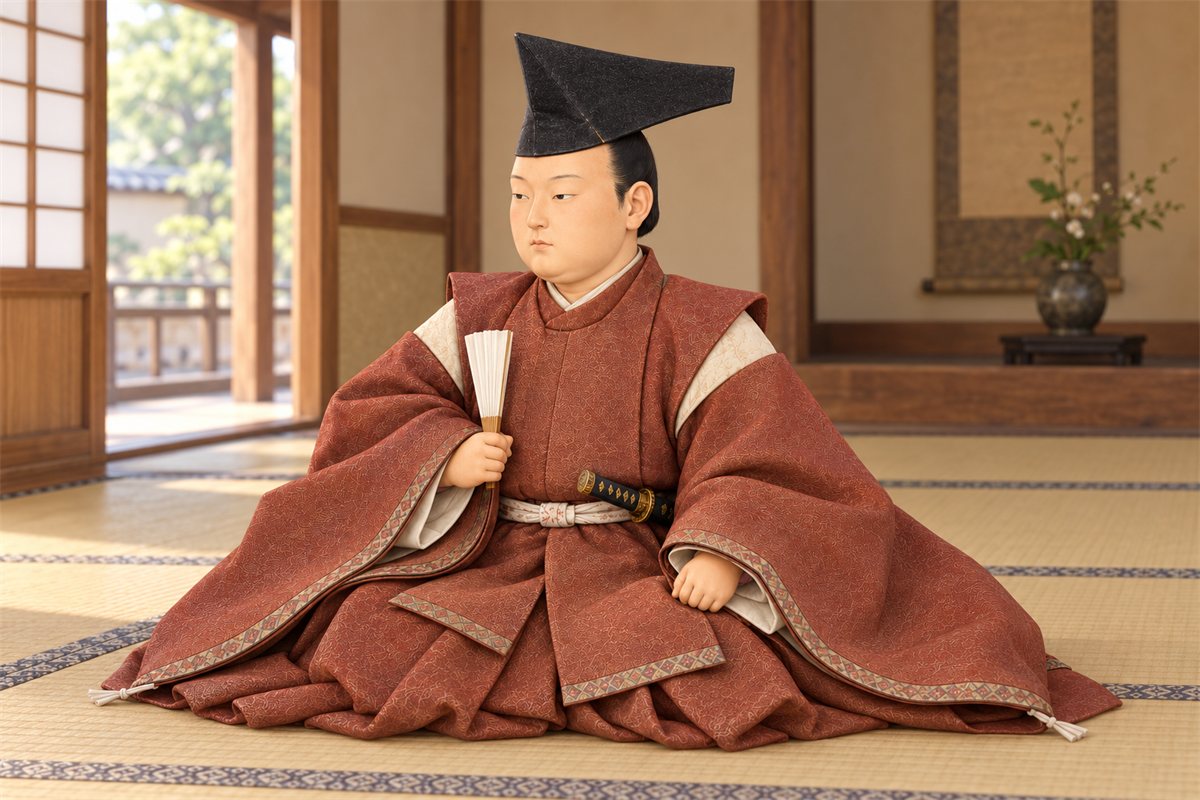
Image: Nobuyasu in a room of Okazaki Castle
As Ieyasu's eldest son, Nobuyasu was regarded as his heir [Widely accepted]. Some explain that "Jirō Saburō," the name he used after coming of age and one that Ieyasu had also used at first, was a name that marked him as the heir [Debated].
Then who succeeded Ieyasu after Nobuyasu died?
| Son | Born | Later life |
| Eldest son: Nobuyasu | 1559 (Eiroku 2) | Died in 1579 (Tenshō 7) |
| Second son: Ogimaru (later Yūki Hideyasu) | 1574 (Tenshō 2) | Adopted by Toyotomi Hideyoshi in 1584 (Tenshō 12); later succeeded to the Yūki family [Widely accepted] |
| Third son: Chōmatsu (later Tokugawa Hidetada) | 4th month of 1579 (Tenshō 7) | Became the heir, and in 1605 (Keichō 10) the second shogun of the Edo shogunate [Widely accepted] |
Hidetada was born about five months before Nobuyasu died. Encyclopedias explain that because his eldest brother Nobuyasu had died and his second brother Hideyasu had been adopted by Hideyoshi, Hidetada naturally came to be the heir [Widely accepted].
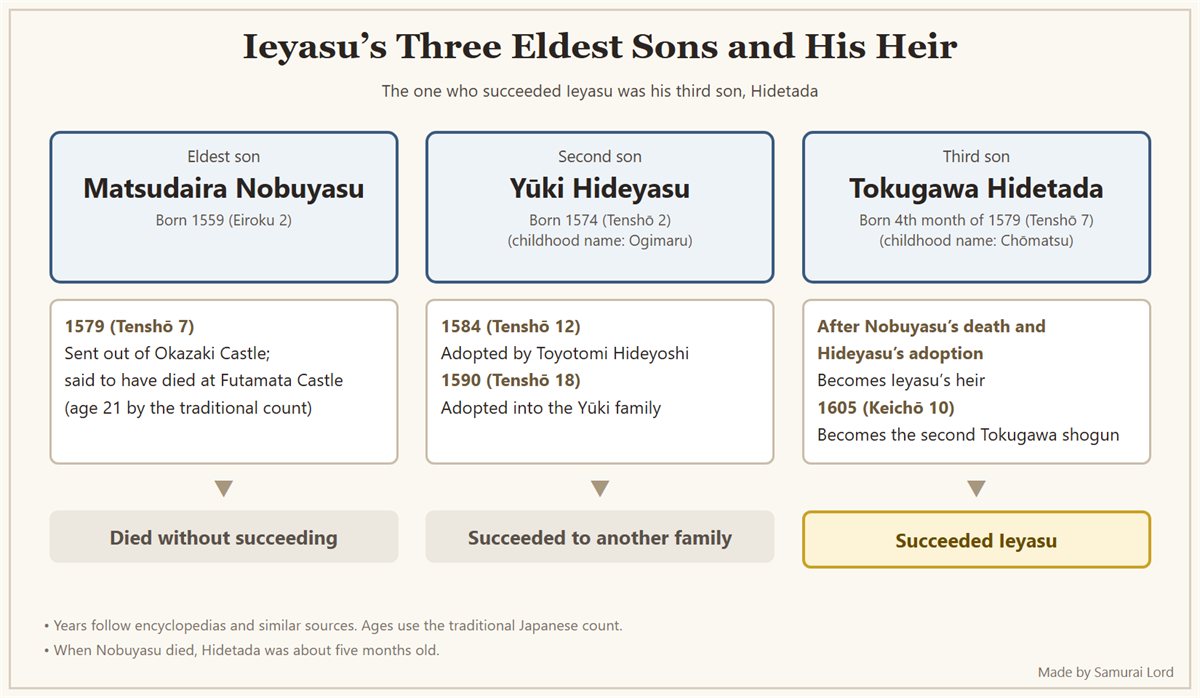
Image: Ieyasu's three eldest sons and his heir (made by Samurai Lord). Tap (click) the image to enlarge it
Had Nobuyasu lived, it is possible that he, as the eldest son, would have succeeded Ieyasu. Whether he would have become shogun, or whether the Tokugawa family would have followed the same path, is a hypothetical question that the records cannot answer.
There is also a story that Ieyasu himself remembered Nobuyasu. The appendix to the Tokugawa Jikki, a history compiled by the Edo shogunate, says that at the time of the Battle of Sekigahara (1600, Keichō 5), Ieyasu muttered to himself, "Ah, how hard this is in my old age. If my son were here, it would not be like this" [Legend]. This story comes from a book compiled more than 200 years after Nobuyasu's death, and it is written as something heard from others.
Note that the "what if he had lived" question is a different matter from the "survival theory" that Nobuyasu actually escaped and lived on. The survival theory is covered in the FAQ.
If Nobuyasu had lived, he might have become the second shogun!
He might have. But that is only a "what if." What the records show is that Hidetada became the heir.
How Did Nobuyasu Die? Futamata Castle, Hattori Hanzō and Muramasa
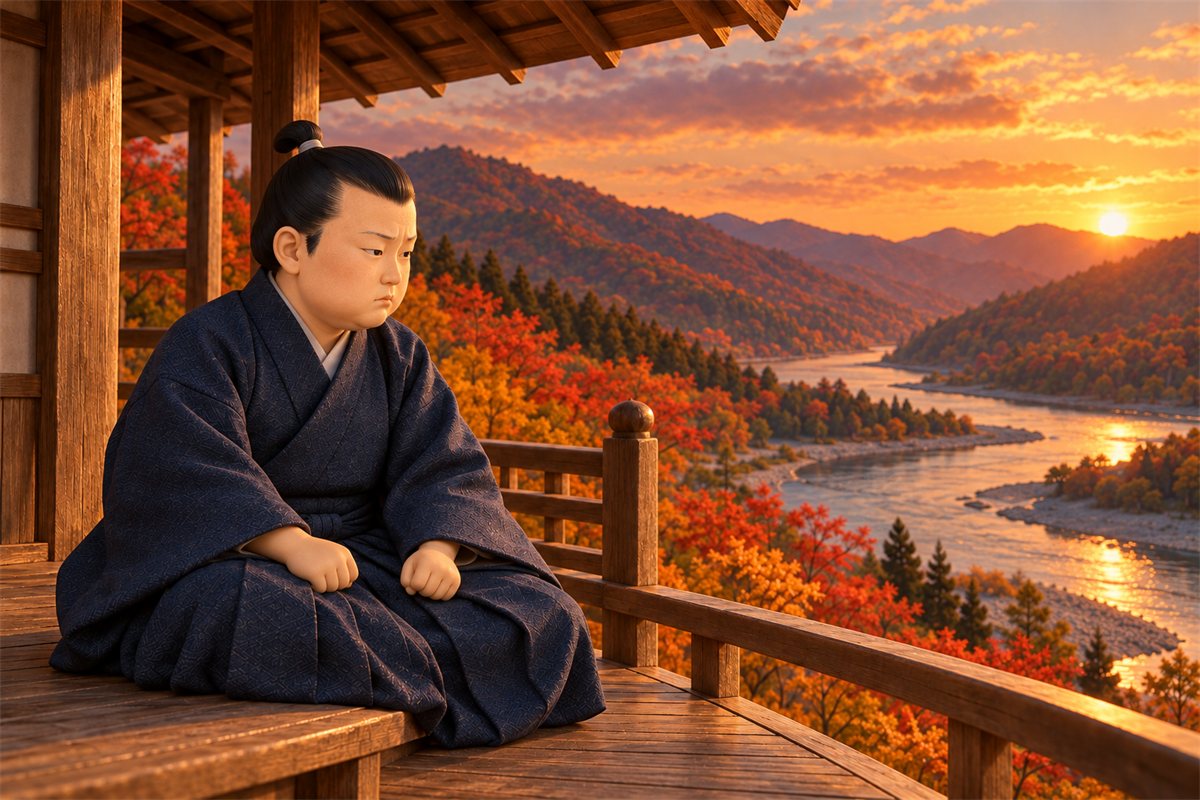
Image: Nobuyasu at Futamata Castle
From Okazaki Castle to Futamata Castle
| Date (1579, Tenshō 7; Japanese calendar) | Event |
| 8th month, 3rd day | Ieyasu comes from Hamamatsu to Okazaki [Fact: Ietada Nikki] |
| 8th month, 4th day | Nobuyasu leaves Okazaki Castle and is moved to Ōhama [Fact: Ietada Nikki] |
| 8th month, 9th day | Nobuyasu is moved from Ōhama to Horie Castle in Tōtōmi [Fact: Ietada Nikki] |
| 8th month, 10th day | Warriors of Mikawa write pledges that they will not secretly contact Nobuyasu [Fact: Ietada Nikki] |
| 8th month, 29th day | His mother, Lady Tsukiyama, is said to have died near Hamamatsu [Widely accepted] |
| Date unknown | Nobuyasu is moved from Horie Castle to Futamata Castle [Widely accepted] |
| 9th month, 15th day | Said to have committed seppuku at Futamata Castle, at 21 by the traditional count [Widely accepted] |
Futamata Castle stood on a hill between the Tenryū and Futamata rivers, and at this time it was held by Ieyasu's retainer Ōkubo Tadayo [Widely accepted].
That Nobuyasu died at Futamata Castle on the 15th day of the 9th month is stated alike by the Tōdaiki of the early Edo period, by temple traditions and by genealogies compiled by the Edo shogunate (the Mikawa Monogatari also gives the 15th, but places it one year off). This date and place are the account widely adopted on the basis of early Edo-period records and similar sources. In this article we label them [Widely accepted], to keep them apart from what can be confirmed in records from the time. The Ietada Nikki, written at the time, has no entry about Nobuyasu's death.
Source Box ①: Nobuyasu's End in the Tōdaiki
Source
Tōdaiki, entry for Tenshō 7 (early Edo period; in Shiseki Zassan, vol. 2, 1911)
Original
「遠州堀江へ移、又二股に移給ふ」「九月十五日、於彼地生害し給」
Translation
(Nobuyasu) moved to Horie in Tōtōmi, and then to Futamata. On the 15th day of the 9th month, he took his own life there.
The Futamata Castle ruins today are a National Historic Site, with stone walls and the base of a keep. These, however, are thought to date from the time of the Horio family, who took over the castle in or after 1590 (Tenshō 18), after Nobuyasu's death, so they differ from the castle as it was in his day.
Who Assisted at His Seppuku? Is the Hattori Hanzō Story True?
The best-known story about Nobuyasu's end is that "Hattori Hanzō was ordered to act as kaishaku, but wept and could not do it." Kaishaku was the role of giving the final assistance during seppuku, so that the person's suffering would not be prolonged.
When we compare the records, however, the books do not agree.
The first thing to know is that two of Ieyasu's retainers whose names are easily confused in this story were both called "Hanzō": Hattori Hanzō Masanari and Watanabe Hanzō Moritsuna, two different people. The appendix to the Tokugawa Jikki, a history compiled by the Edo shogunate, quotes a local song saying, "Hattori Hanzō is Demon Hanzō; Watanabe Hanzō is Spear Hanzō."
| Record (when written) | Who was sent to Futamata Castle | Who acted as kaishaku | The "Hanzō" who could not do it | The Muramasa story |
| Mikawa Monogatari (around 1626, Kan'ei 3) | 天方山城 and Hattori Hanzō | Not stated | Not stated | Not stated |
| Kansei Chōshū Shokafu, entry on Hattori Masanari (around 1812) | Hattori Masanari was involved, together with 天方通綱 | Not stated | Not stated (it says only that he felt that taking part was against his wishes) | Not stated |
| Appendix to the Tokugawa Jikki (first half of the 19th century; citing a work titled 『柏崎物語』) | As witnesses: Watanabe Hanzō Moritsuna and 天方通興 | 天方 | Watanabe Hanzō (his hands shook and he could not take up the sword) | Yes |
| Kaisei Mikawa Gofudoki (1837, Tenpō 8) | 天方通経 and Hattori Hanzō Masanari | 天方 | Hattori Hanzō (broke down in tears and could not act) | Not found in our check |
Note: Names in Japanese characters are given as written in each source; we have not verified how they are read. "Not stated" in the table means that we did not find it in the parts of each book about Nobuyasu's end that we checked. For the Kansei Chōshū Shokafu, the appendix to the Tokugawa Jikki and the Kaisei Mikawa Gofudoki, this includes passages we read through the full-text search of the National Diet Library.
The oldest of these, the Mikawa Monogatari, says only that two men, 天方山城 and Hattori Hanzō, were ordered to go. It does not say who acted as kaishaku, or that Hanzō wept and could not do it.
The story that "Hanzō could not do it, and 天方 acted as kaishaku in his place" appears in a 19th-century history compiled by the shogunate and in books from the later Edo period [Legend]. What is more, the "Hanzō" who could not bring himself to act is Watanabe Hanzō in one book and Hattori Hanzō in another.
The appendix to the Tokugawa Jikki also tells that Ieyasu asked who had made the sword used for the kaishaku, and on learning that it was a Muramasa, ordered that Muramasa swords no longer be worn [Legend].
A line in which Ieyasu says, "Even Demon Hanzō could not strike down his lord's son," is often quoted, but we have not found a source for it in this form [Folk belief].
The Kansei Chōshū Shokafu, a genealogy compiled by the Edo shogunate, also says that Hattori Hanzō Masanari later built a temple to pray for Nobuyasu. This temple is said to have been the origin of today's Sainenji in Shinjuku, Tokyo (see his grave and head mound).
So even a famous story can change from book to book!
Indeed. First, let us see what the earliest of the four accounts in this table says.
What Were His Last Words? Did He Leave a Death Poem?
The Kaisei Mikawa Gofudoki (1837), a book from the later Edo period, says that Nobuyasu's last words were: "I never once thought of siding with Takeda Katsuyori. Please make sure my father knows this" [Legend]. The appendix to the Tokugawa Jikki also says that the two witnesses, weeping, told Ieyasu what Nobuyasu had said at the end, but it does not say what those words were.
In the sources checked for this article, we found no poem that we could reliably identify as Nobuyasu's death poem (a poem left before death) [Unknown]. The portrait at Shōrenji comes with a strip of paper bearing a poem on autumn leaves said to be by Nobuyasu, but we have found no basis for calling it his death poem, and it cannot be confirmed that he wrote it himself.
What Did He Do as Lord of Okazaki? Battles with the Takeda and His Character
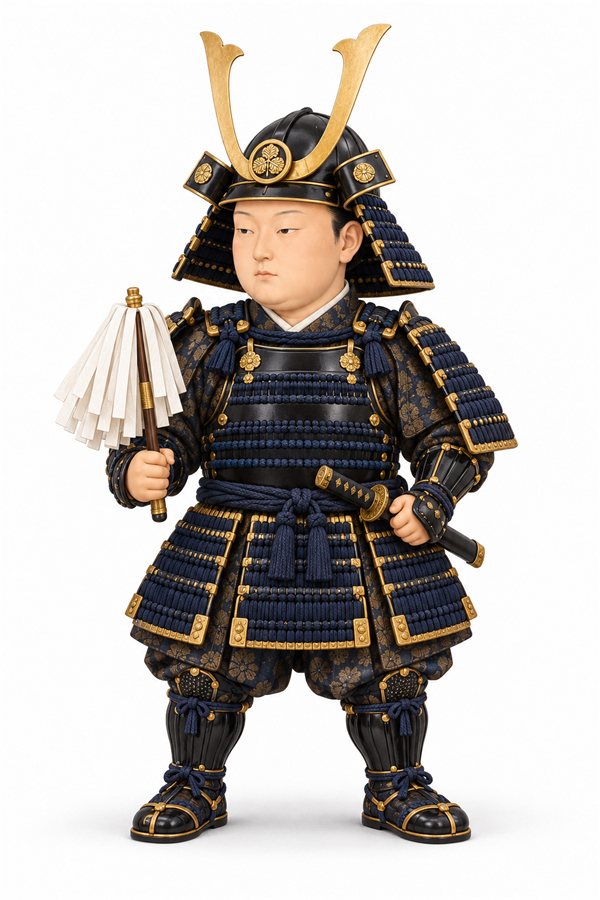
Image: Nobuyasu in armor
Lord of Okazaki Castle at 12
In 1570 (Genki 1), his father Ieyasu moved to Hamamatsu Castle in Tōtōmi, and Nobuyasu, at 12 by the traditional count, was entrusted with Okazaki Castle [Widely accepted]. From then on, Ieyasu lived at Hamamatsu, while Nobuyasu and his mother, Lady Tsukiyama, lived at Okazaki.
The young lord was supported by Hiraiwa Chikayoshi, who had looked after him since childhood, and by senior retainers such as Ishikawa Kazumasa [Widely accepted]. The Mikawa Monogatari tells how Hiraiwa Chikayoshi tried to stop Ieyasu, saying, "If you order him to commit seppuku without careful thought, you will surely regret it" [Legend].
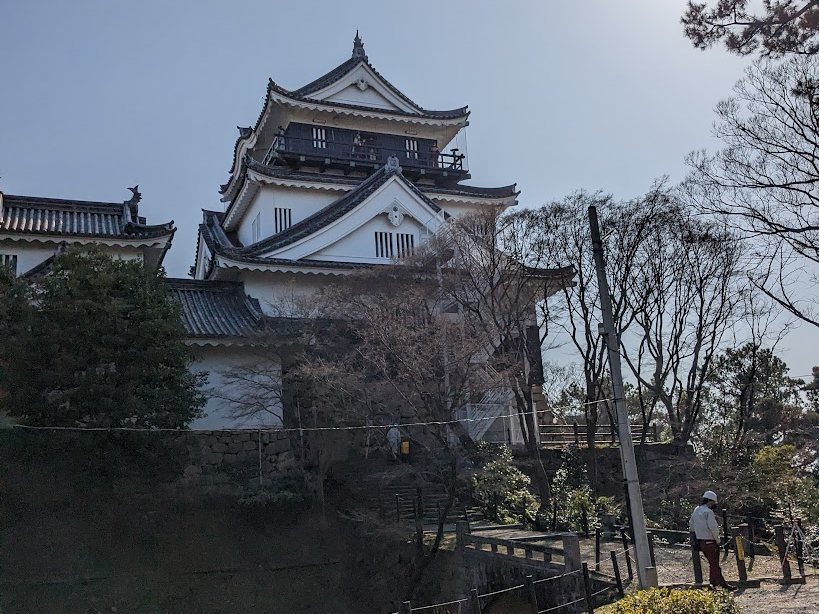
Image: Okazaki Castle (Okazaki, Aichi Prefecture). The present keep was rebuilt in the Shōwa era. Wikimedia Commons (photo: 来島海峡大橋, CC0)
Battles Against the Takeda
Nobuyasu is said to have gone to war against the Takeda family alongside his father. The Mikawa Monogatari says that he took the field with Ieyasu at the Battle of Nagashino in 1575 (Tenshō 3), at 17 by the traditional count [Widely accepted].
The story of the "fighting retreat" (noki-ikusa) in the Mikawa Monogatari appears to date from around the 9th month of the same year [Legend]. According to the Mikawa Monogatari, while Ieyasu and Nobuyasu were attacking Koyama Castle in Tōtōmi (in today's Yoshida, Shizuoka Prefecture), Takeda Katsuyori came to its rescue and part of the Takeda army crossed the Ōi River, so the Tokugawa army lifted the siege and withdrew.
When an army turns its back on the enemy and withdraws, the most dangerous place is the rear. Nobuyasu insisted: "From here on, we must withdraw with the enemy behind us. Father, please go first. How could a son withdraw first and leave his father behind?" Ieyasu told him again and again to withdraw quickly, but Nobuyasu would not go. In the end, the book says, Ieyasu gave way and withdrew first, and Nobuyasu then withdrew calmly after him.
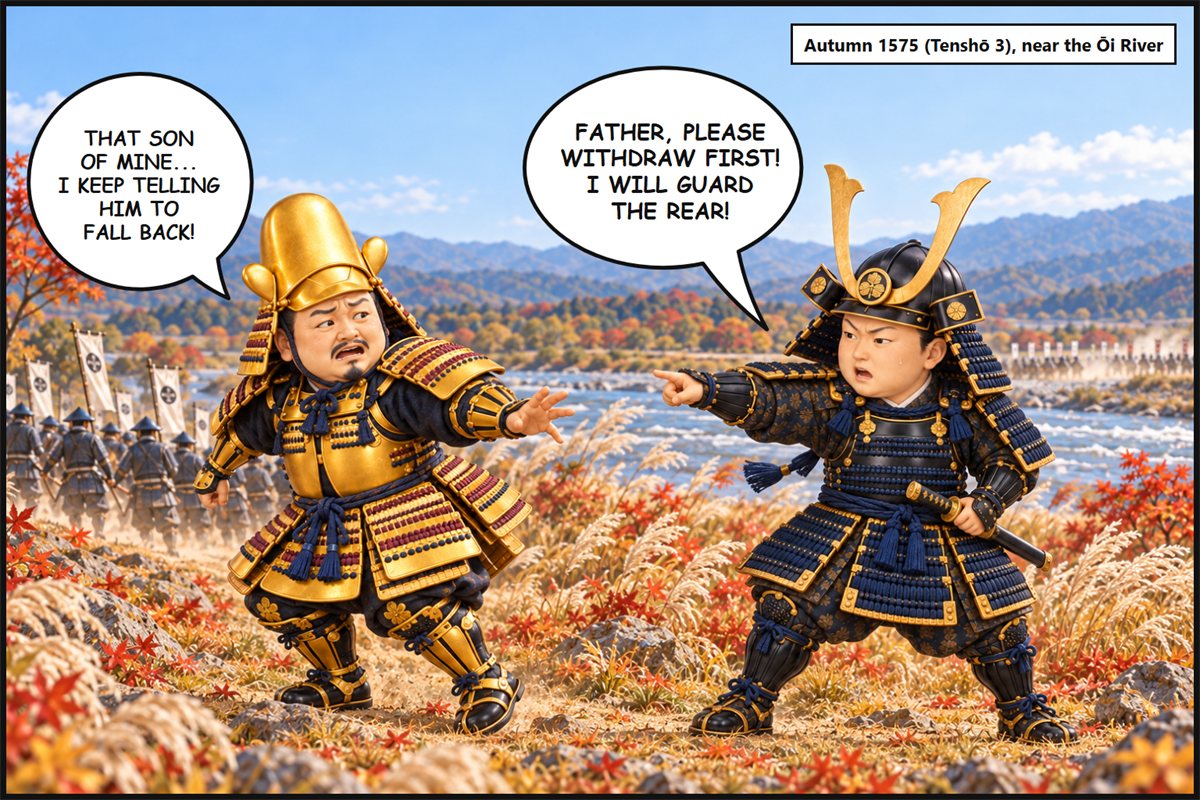
Image: Nobuyasu urging his father Ieyasu to withdraw first (a story told in the Mikawa Monogatari) [Legend]
Source Box ②: The Fighting Retreat in the Mikawa Monogatari
Source
Ōkubo Tadataka, Mikawa Monogatari, last volume (around 1626, Kan'ei 3; Wikisource, from the Kokumin Bunko edition). The Mikawa Monogatari places this story under "Tenshō 5," but from its content it appears to date from the 9th month of 1575 (Tenshō 3) [Widely accepted]
Original (excerpt)
「是寄は敵をあとにして引のき申せば、先上様のかせられ給へ。何方にか親をあとにおき申而、子の身として、先へのく事の御座可有哉」
Translation
From here on, we must withdraw with the enemy behind us. Father, please go first. How could a son withdraw first and leave his father behind?
The Japanese encyclopedia Nihon Daihyakka Zensho also says that in the 9th month of 1575 (Tenshō 3), when the Tokugawa faced Takeda Katsuyori at the Ōi River, Nobuyasu asked for and took on the dangerous duty of shingari (guarding the rear).
What Kind of Person Was Nobuyasu? Violent or Brave?
The records about Nobuyasu's character include both praise and criticism.
| Record | What it says |
| Mikawa Monogatari (early Edo period) | Mourns his death, saying "there will never be another lord like him." Also says that day and night he loved talk of martial deeds, and otherwise cared only for horses and hawks |
| Tōdaiki (early Edo period) | He always disobeyed his father's orders, made light of Nobunaga, and treated his retainers cruelly |
| Matsudaira-ki (early Edo period) | He was very rough and knew no compassion (as introduced by researchers) |
| Ieyasu's letter (a copy, dated the 8th day of the 8th month) | Describes Nobuyasu as "fukakugo," a criticism of his attitude or conduct |
The specific stories of his violent behavior all come from Edo-period records, and we cannot confirm that they really happened [Legend]. The stories of him as a brave and fine warrior also come from Edo-period records.
Historians' views are also divided. Kuroda Motoki thinks that Nobuyasu's bad behavior probably did take place. Honda Takashige thinks that, besides Nobuyasu's character and his discord with Tokuhime, there were moves that seemed linked with those of his mother, Lady Tsukiyama, and that he came under suspicion of rebellion.
So the brave stories and the violent stories mostly come from later times.
Yes. There are records from the time of the incident, such as the copy of Ieyasu's letter, but most of the details come from later times. Do not believe only one side; compare them.
Where Is Nobuyasu's Grave? His Head Mound and Memorials
Places honoring Nobuyasu are found near Futamata Castle, where he died; in Okazaki, where he was lord; and even in Tokyo.
| Place | What is there? | Location |
| Seiryūji | Nobuyasu's mausoleum. He is said to have been buried here. A memorial service is held every year on September 15 in the modern calendar | Futamata-chō, Tenryū Ward, Hamamatsu, Shizuoka Prefecture |
| Wakamiya Hachimangū | A mound said to be Nobuyasu's head mound | Asahi-chō, Okazaki, Aichi Prefecture |
| Sainenji | A memorial pagoda for Nobuyasu (a Shinjuku City historic site). The temple is said to have begun as one built by Hattori Hanzō to pray for Nobuyasu, and Hanzō's grave is also here | Wakaba, Shinjuku, Tokyo |
| Futamata Castle ruins | The site of the castle where Nobuyasu died (a National Historic Site) | Futamata-chō, Tenryū Ward, Hamamatsu, Shizuoka Prefecture |
| Shōrenji | Nobuyasu's portrait (an Okazaki City cultural property) | Yahagi-chō, Okazaki, Aichi Prefecture |
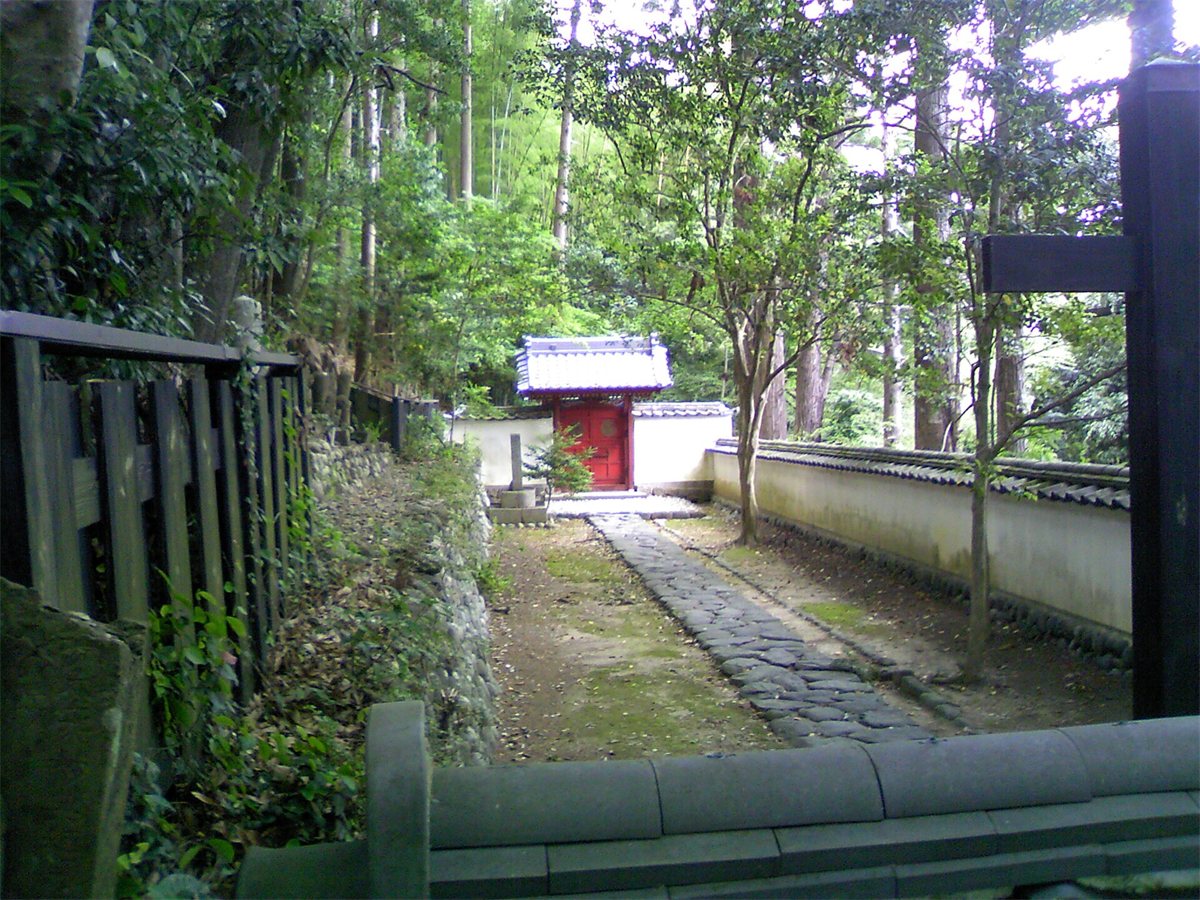
Image: The gate of Nobuyasu's mausoleum at Seiryūji (Tenryū Ward, Hamamatsu). Wikimedia Commons (photo: ホンダ, CC BY-SA 4.0)
Seiryūji is Nobuyasu's bodaiji (the temple that holds memorial services for him). Ieyasu is said to have visited it in 1581 (Tenshō 9) and renamed it "Seiryūji" [Legend]. Nobuyasu's posthumous Buddhist name is written differently in different records, and after this temple he was also called "Seiryūji-dono."
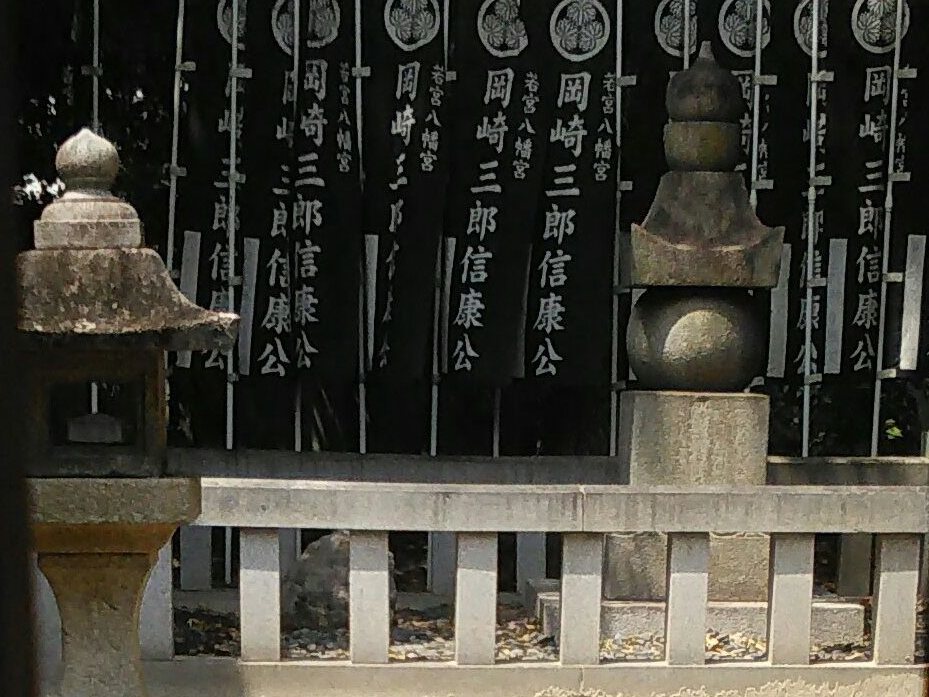
Image: Nobuyasu's head mound at Wakamiya Hachimangū (Okazaki, Aichi Prefecture). Wikimedia Commons (photo: IshizakiA, CC BY-SA 4.0)
At Wakamiya Hachimangū in Okazaki there is a mound said to be where Nobuyasu's head was buried [Legend]. His head is said to have been sent to Nobunaga and later buried at Okazaki.
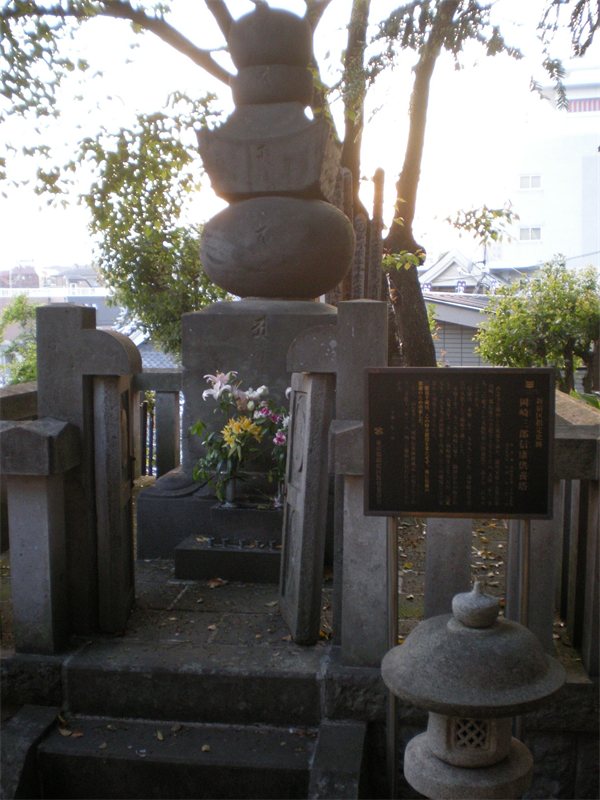
Image: The memorial pagoda for Nobuyasu at Sainenji (Shinjuku, Tokyo). Wikimedia Commons (photo: 故城一片之月, CC BY 3.0)
Sainenji in Yotsuya, Tokyo, is said to have begun as a temple built by Hattori Hanzō Masanari to pray for Nobuyasu [Legend]. Its grounds hold a memorial pagoda for Nobuyasu and Hanzō's grave.
FAQ
How old was Matsudaira Nobuyasu when he died?
He was 21 by the traditional count (20 by modern reckoning). He was born in 1559 (Eiroku 2) and is said to have died on the 15th day of the 9th month of 1579 (Tenshō 7)
[Widely accepted]. Some records, such as the Mikawa Monogatari, give a slightly different year or age.
Is there a theory that Nobuyasu survived?
A tradition that "a stand-in was buried, and Nobuyasu himself escaped into the mountains" was introduced in a book of the Meiji period
[Legend]. But in the sources checked for this article, we found no reliable evidence supporting this tradition.
What was the connection between Hattori Hanzō and Nobuyasu?
The Mikawa Monogatari, written in the early Edo period, names him as one of the men sent to Futamata Castle, where Nobuyasu was held. The story that "Hanzō wept and could not act as kaishaku" appears in later books, and the "Hanzō" in it is Hattori Hanzō in some books and Watanabe Hanzō in others
[Legend]. Hattori Hanzō is said to have later built a temple to pray for Nobuyasu, the origin of today's Sainenji in Shinjuku, Tokyo (more).
Does Nobuyasu's portrait show his real face?
The portrait handed down at Shōrenji in Okazaki is introduced by Okazaki City as "said to be his only portrait." But it was painted in the Edo period, some time after his death, by an unknown artist, and we cannot confirm whether it shows his actual face.
Did Nobuyasu and Tokuhime get along badly?
Edo-period records tell that the couple grew apart, and that Tokuhime complained about Nobuyasu to Nobunaga
[Legend]. But these stories cannot be confirmed in records from the time, and a troubled marriage alone cannot explain Nobuyasu's seppuku (more).
Is the Nobuyasu of TV dramas true to history?
In the NHK historical drama Dōsuru Ieyasu (2023), he appears as a pure-hearted young man who, with his mother Sena (Lady Tsukiyama), seeks a land without war; that plan is the drama's invention. That mother and son lost their lives in the same year agrees with history.
Summary: Who Was Matsudaira Nobuyasu?
Matsudaira Nobuyasu was Tokugawa Ieyasu's eldest son, a young warrior called "Okazaki Saburō" as lord of Okazaki Castle. He is also called "Tokugawa Nobuyasu," but records from his time call him "Nobuyasu," "Okazaki Saburō" and similar names.
In 1579 (Tenshō 7), Ieyasu sent Nobuyasu out of Okazaki Castle, and Nobuyasu is said to have committed seppuku at Futamata Castle on the 15th day of the 9th month, at 21 by the traditional count. It used to be said that Nobunaga ordered it, but some historians place greater weight on Ieyasu's own role in the decision, and the true reason is not known.
He and his wife Tokuhime had two daughters, and through their children his bloodline continued into daimyo families of the Edo period. The stories of Hattori Hanzō and Muramasa are traditions found in later books.
For the people involved, see also our articles on Lady Tsukiyama, Tokugawa Ieyasu, Oda Nobunaga, Honda Tadakatsu and Hattori Hanzō.
What do the records of the time say, and what do the books of later times tell? Separate the two, and the real Nobuyasu comes a little more into view.
Even the Hattori Hanzō story was different in the earliest of these records. That surprised me!
Sources & How This Article Was Written
This article is based mainly on the following records and references:
- Records from the time: Matsudaira Ietada, Ietada Nikki (Bunka Daigaku Shishi Sōsho edition, 1897; National Diet Library Digital Collections); Iwasawa Yoshihiko, "On the Original of the Ietada Nikki" (bulletin of the Historiographical Institute, University of Tokyo, no. 2; in Japanese; the quotation from the Azuchi Nikki also follows this paper)
- Later records: Tōdaiki (in Shiseki Zassan, vol. 2, 1911); Ōkubo Tadataka, Mikawa Monogatari (Wikisource); Hayashi Gahō and others, Honchō Tsugan; Kansei Chōshū Shokafu (entry on Hattori Masanari; National Diet Library Digital Collections); Tōshōgū Gojikki Furoku (the appendix to the Tokugawa Jikki; in Kokushi Taikei, vol. 9, and other editions); Narushima Motonao, Kaisei Mikawa Gofudoki (in Tsūzoku Nihon Zenshi, vol. 10, 1912). Some were read through the National Diet Library's full-text search (NDL Lab)
- Studies and encyclopedias (in Japanese; titles translated by us): Kuroda Motoki, "Why Did Tokugawa Ieyasu Have His Principal Wife and Heir Take Their Own Lives?" (PRESIDENT Online, April 14, 2023); Honda Takashige, "Tokugawa Ieyasu's Decision" (Fujin Kōron.jp, July 2, 2023); Kotobank (Nihon Daihyakka Zensho, Sekai Daihyakka Jiten, Nihon Jinmei Daijiten, Yamakawa Nihonshi Shōjiten and others); Collaborative Reference Database, "The names and death years of the children and granddaughters of Matsudaira Nobuyasu, Tokugawa Ieyasu's eldest son" (Okazaki City Central Library)
- Official materials (in Japanese): Okazaki City, "Portrait of Tokugawa Nobuyasu, color on silk"; Okazaki Tourism Association, "Wakamiya Hachimangū" and "Ieyasu's Children"; Tenryū Ward, Hamamatsu, on the memorial service for Matsudaira Nobuyasu at Seiryūji; Shinjuku City, "People Connected with Shinjuku"; Cultural Heritage Online, "Futamata Castle and Tobayama Castle ruins"
- Images: the portrait (owned by Shōrenji; photo printed in Shinpen Anjō Shishi 1, public domain) and the photos of Okazaki Castle (来島海峡大橋, CC0), the gate of Nobuyasu's mausoleum at Seiryūji (ホンダ, CC BY-SA 4.0), the head mound at Wakamiya Hachimangū (IshizakiA, CC BY-SA 4.0) and the memorial pagoda at Sainenji (故城一片之月, CC BY 3.0) are from Wikimedia Commons. The map, family tree, chart, manga panel and illustrations are original works by Samurai Lord
What the Labels Mean
[Fact]Confirmed by sources from the time ([Fact: …]names the source)[Widely accepted]A view widely accepted by researchers[Debated]Accounts or interpretations differ[Unknown]Not established from the sources we checked[Legend]Stories found in later records or traditions[Folk belief]Popular claims with little evidence
We keep "what a record says" separate from "what actually happened." Translations of the source excerpts in this article are by the Samurai Lord editorial team.
This article was written by the Samurai Lord editorial team and is revised as new research and reader feedback come in. If you spot an error, please let us know through our contact form (in Japanese) and we will check and correct it.
Read in Japanese
This article is also available in Japanese: 松平信康(徳川信康)とは?なぜ切腹?妻や子孫・最期を解説!