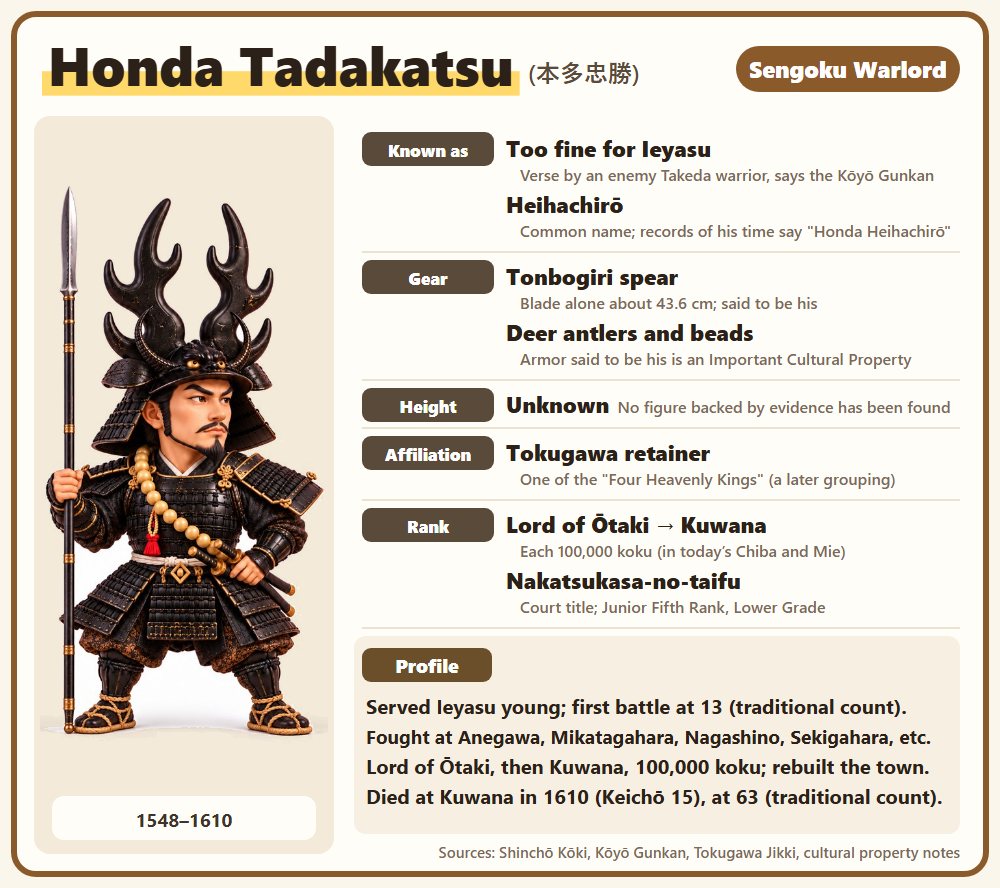
Honda Tadakatsu (1548–1610) was a samurai who served Tokugawa Ieyasu, the future founder of the Tokugawa shogunate, from boyhood. He fought in almost all of Ieyasu's major battles and later became a daimyo (a regional lord), first of Ōtaki in Kazusa (today's Chiba Prefecture) and then of Kuwana in Ise (today's Mie Prefecture). Together with Sakai Tadatsugu, Sakakibara Yasumasa and Ii Naomasa, he is counted among the "Four Heavenly Kings of the Tokugawa."
His deer-antler helmet and huge prayer beads, his famous spear Tonbogiri ("Dragonfly Cutter"), and the claim that he "fought 57 battles and was never wounded" have made him one of the best-known samurai in Japan and abroad. This article answers common questions about his height, death, helmet, family crest and descendants, keeping what records from his time show separate from stories written in later centuries.
Key points are tagged: [Fact] confirmed by records from the time, [Widely accepted] a view widely accepted by researchers, [Debated] accounts, interpretations or ways of counting differ, [Unknown] not established from the sources we checked, [Legend] stories found in later records, and [Folk belief] popular claims with little evidence.

I am Uesugi Kenshin. Today's subject is the warrior famed as the "strongest" of all Ieyasu's retainers.

I'm Date Masamune! He's the one with the deer-antler helmet, right? Was he really never wounded?
The Short Answers
- What did he do? He served Tokugawa Ieyasu from boyhood, fought in his major battles, and became the lord of Ōtaki and then Kuwana. He also acted as Ieyasu's messenger and negotiator (more)
- How tall was he? His real height is not known (more)
- How did he die? The cause is not clear. He died at Kuwana on December 3, 1610, aged 63 by the traditional count. The year before, he is said to have retired because of an eye disease (more)
- Helmet and beads? His real armor survives as an Important Cultural Property of Japan, with large deer antlers on the helmet and huge prayer beads over the shoulder (more)
- Family crest? A standing hollyhock (tachi-aoi), different from the Tokugawa crest of three hollyhock leaves (more)
- Was he really the strongest? Claims like "57 battles without a wound" cannot be confirmed from the records of his own time that we consulted; they are legendary (more)
- Descendants? His eldest son Tadamasa's line ruled the Okazaki domain until the Meiji era. His daughter Komatsu-dono married Sanada Nobuyuki (more)
Three Things We Learn by Comparing the Sources
- A poem from his enemies: the famous verse "Ieyasu has two things too fine for him," read in its original Japanese from the Kōyō Gunkan, with what it does and does not prove (more)
- The real armor, point by point: a labeled photo of the surviving armor, compared with a 17th-century description of his "black deer antlers" (more)
- "57 battles without a wound"? A table identifying sources that record the famous stories, alongside evidence from Tadakatsu's own time (more)
Jump to the part you want to read:
- Who was Honda Tadakatsu? His life and timeline
- How tall was Honda Tadakatsu?
- How did Honda Tadakatsu die?
- His helmet and armor: deer antlers and prayer beads
- What was his family crest?
- Portrait, statues and places to visit
- Was he really the strongest? Checking the legends
- Descendants and family tree
- His spear, Tonbogiri
- Was he related to Honda Masanobu?
Who Was Honda Tadakatsu? His Life and Timeline
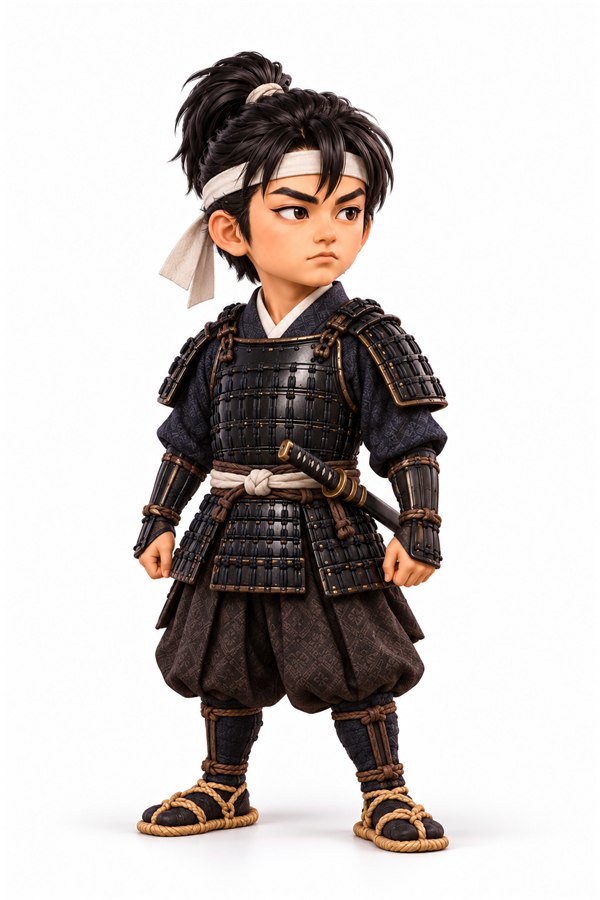
Image: Honda Tadakatsu as a boy
In a single sentence, Honda Tadakatsu was "a retainer who fought and worked at Tokugawa Ieyasu's side from boyhood to the end of his life".
| Item | Details | Reliability |
| Name | Honda Tadakatsu. Commonly called Heihachirō; his childhood name is said to have been Nabenosuke | Common name: [Fact] / childhood name: [Widely accepted] |
| Born | 1548 (Tenbun 17), at Kuramae in Mikawa Province (today's Nishi-Kuramae, Okazaki, Aichi Prefecture) | [Widely accepted] |
| Family | The Honda had long served Ieyasu's family, the Matsudaira. His father, Honda Tadataka, was killed in battle when Tadakatsu was 2 by the traditional count | [Widely accepted] |
| Lord | Tokugawa Ieyasu | [Fact] |
| Court rank and title | Junior Fifth Rank, Lower Grade; Nakatsukasa-no-taifu, an honorary title derived from a senior deputy post in the Ministry of Central Affairs | [Widely accepted] |
| Lands | 1590: Ōtaki in Kazusa (Chiba), 100,000 koku → 1601: Kuwana in Ise (Mie), 100,000 koku | [Widely accepted] |
| Died | December 3, 1610 (the 18th day of the 10th month of Keichō 15), at Kuwana, aged 63 by the traditional count | [Widely accepted] |
| Graves | Jōdoji temple in Kuwana, Ryōgenji temple in Ōtaki, and others | [Widely accepted] |
Western dates use the Julian calendar before October 15, 1582, and the Gregorian calendar after that; Japanese dates refer to the historical lunisolar calendar. All ages in this article use the traditional Japanese count, in which a person was counted as one at birth and gained a year at the start of each new year in the Japanese calendar. A koku was a unit of volume used to express the assessed rice yield of land, and so the size of a lord's domain.
What Did He Do? Three Key Points
- ① He served Ieyasu from boyhood and fought in almost all his major battles: from his first battle at 13 to Anegawa, Mikatagahara, Nagashino, Komaki-Nagakute and Sekigahara, he took part in Ieyasu's great campaigns
[Widely accepted] - ② He became the lord of Ōtaki and then Kuwana: when Ieyasu moved to the Kantō region in 1590, Tadakatsu received Ōtaki in Kazusa (100,000 koku); after Sekigahara, he received Kuwana in Ise (100,000 koku). At Kuwana he is said to have enlarged the castle and rebuilt the castle town (the "Keichō town planning")
[Widely accepted] - ③ He also served as Ieyasu's messenger and negotiator: researchers note surviving documents in which he wrote letters to accompany Ieyasu's own and acted as a go-between with other lords
[Widely accepted]. A written oath (kishōmon) signed by Tadakatsu and Ii Naomasa to Kikkawa Hiroie and others on the Mōri side also survives, dated the day before the Battle of Sekigahara
The "Four Heavenly Kings of the Tokugawa" (Sakai Tadatsugu, Honda Tadakatsu, Sakakibara Yasumasa and Ii Naomasa) is a later grouping. We have not confirmed its use in records from their own time.
Timeline of Honda Tadakatsu's Life
| Year | Age | Event |
| 1548 | 1 | Born at Kuramae in Mikawa (today's Okazaki) |
| The 5th month of Eiroku 3 (1560) | 13 | First battle: accompanies the future Ieyasu (then Matsudaira Motoyasu) as he brings food supplies into Ōdaka Castle |
| 1570 | 23 | Battle of Anegawa |
| 1572–January 1573 | 25 | Takeda Shingen invades Ieyasu's lands. Tadakatsu is said to have covered the retreat near Hitokotozaka and Mitsuke. On January 25, 1573 (the 22nd day of the 12th month of Genki 3), the Tokugawa army suffers a major defeat at Mikatagahara |
| 1575 | 28 | Battle of Nagashino |
| 1582 | 35 | After Nobunaga's death at Honnō-ji, escapes with Ieyasu through Iga back to Mikawa |
| 1584 | 37 | Battles of Komaki and Nagakute |
| 1590 | 43 | Becomes lord of Ōtaki in Kazusa (100,000 koku) |
| 1600 | 53 | Battle of Sekigahara |
| 1601 | 54 | Moves to Kuwana in Ise (100,000 koku) |
| 1609 | 62 | Retires because of an eye disease and hands over leadership of the family to his eldest son Tadamasa |
| 1610 | 63 | Dies at Kuwana |
The timeline is based on encyclopedias and the Kansei Chōshū Shokafu, a collection of genealogies compiled by the Tokugawa shogunate. Many of the details of his deeds in battle come from Edo-period books (see the legends section).
His First Battle: Supplying Ōdaka Castle
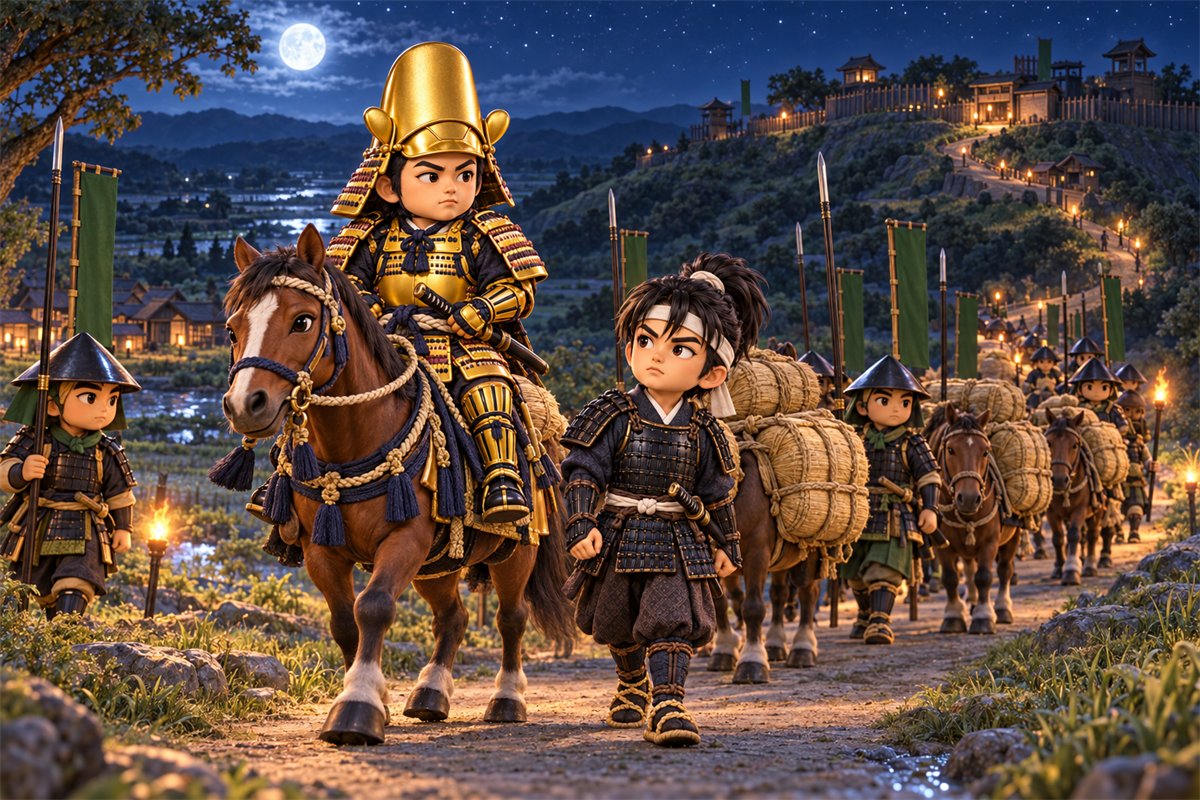
Image: The young Ieyasu (Matsudaira Motoyasu) and the boy Tadakatsu bringing supplies to Ōdaka Castle
In the 5th month of Eiroku 3 (1560), shortly before the Battle of Okehazama, the future Ieyasu, then Matsudaira Motoyasu and a vassal of the Imagawa family, brought food into Ōdaka Castle in Owari (today's Midori Ward, Nagoya). Tadakatsu, aged 13, is said to have fought his first battle on this campaign [Widely accepted]. For more, see our article on Tokugawa Ieyasu.
Honda Tadakatsu at the Battle of Anegawa
Edo-period books say that at the Battle of Anegawa in 1570, Tadakatsu charged alone into the great enemy army [Legend]. The story of his single combat with Magara Naotaka of the Asakura side spread later through storytelling and similar popular works [Folk belief].

From boyhood to old age, he never stopped serving Ieyasu.
How Tall Was Honda Tadakatsu?
Honda Tadakatsu's real height is not known [Unknown]. We could not find a figure supported by evidence in the historical sources, studies or encyclopedias we consulted.
Websites sometimes give a number in centimeters, but none of those we checked pointed to a record behind it. His real armor survives (see the helmet and armor section), but we found no study or museum announcement that estimates his height from it.

He sounds so strong that I picture a giant, but nobody really knows.
Just so. Saying "we don't know" when we don't know is the first step toward understanding history correctly.
How Did Honda Tadakatsu Die? His Last Years, Eye Disease and Death Poem
Image: Honda Tadakatsu in his later years
Honda Tadakatsu died at Kuwana in Ise on December 3, 1610 (the 18th day of the 10th month of Keichō 15), aged 63 by the traditional count [Widely accepted].
The cause of his death is not clear [Unknown]. In 1609, the year before, he is said to have suffered from an eye disease, retired and handed over leadership of the family to his eldest son Tadamasa [Widely accepted]. Whether the eye disease caused his death is not known.
Did He Really Cut His Finger with a Knife?
A story is often told that shortly before his death he cut his finger with a small knife. But we could not find an early source for it, nor any basis for linking the cut with his death. It is a story of unknown origin [Folk belief].
Did He Leave a Death Poem?
A poem is sometimes presented as his jisei (death poem): "Shini tomo na / aa shini tomo na / shini tomo na / fukaki go-on no / kimi o omoeba," meaning "I do not want to die, ah, I do not want to die; I do not want to die, when I think of my lord's great kindness." It is often interpreted as a wish to stay alive to repay that kindness. However, we could not confirm in which book it first appears, or whether he really wrote it [Legend].
His Later Years in Kuwana
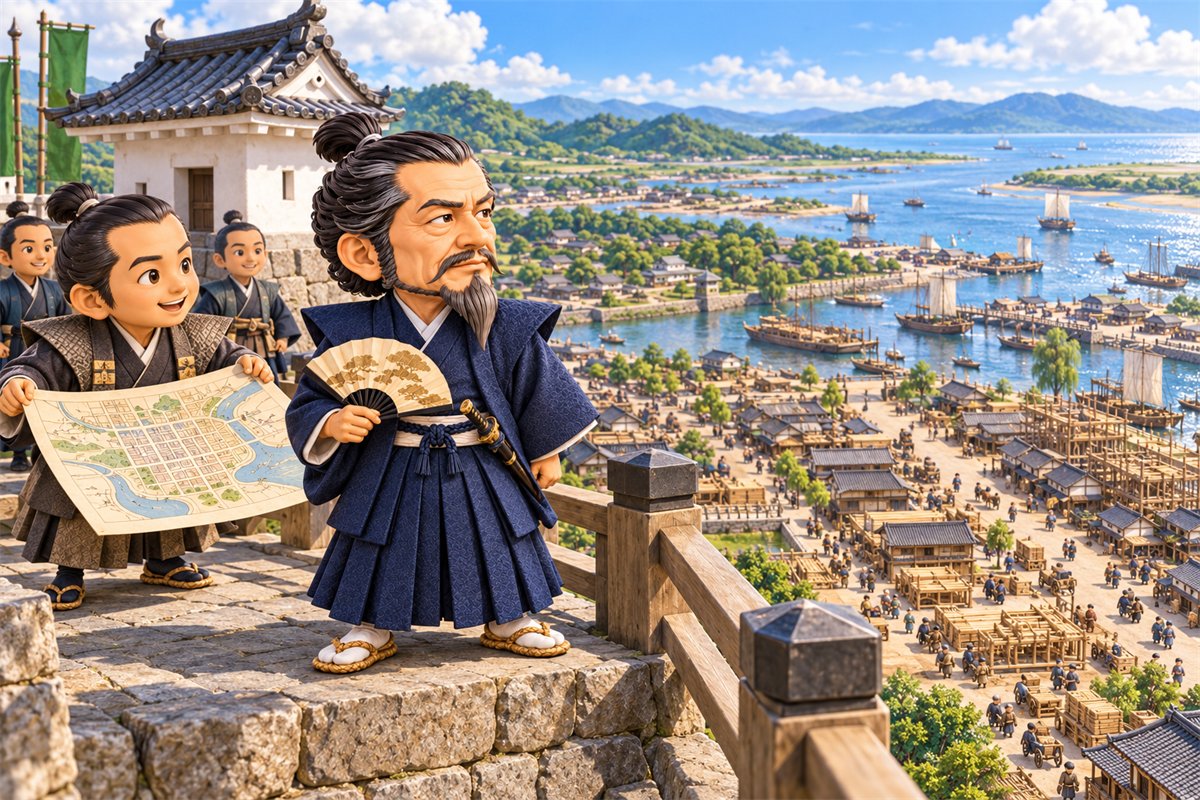
Image: Tadakatsu in his later years, with the castle town of Kuwana
After moving to Kuwana in 1601, Tadakatsu is said to have enlarged the castle and thoroughly rebuilt the town. This "Keichō town planning" is said to have laid the foundations of today's Kuwana [Widely accepted]. He was not only a warrior, but also a lord who built a town.
His Helmet and Armor: What Do the Deer Antlers and Prayer Beads Mean?
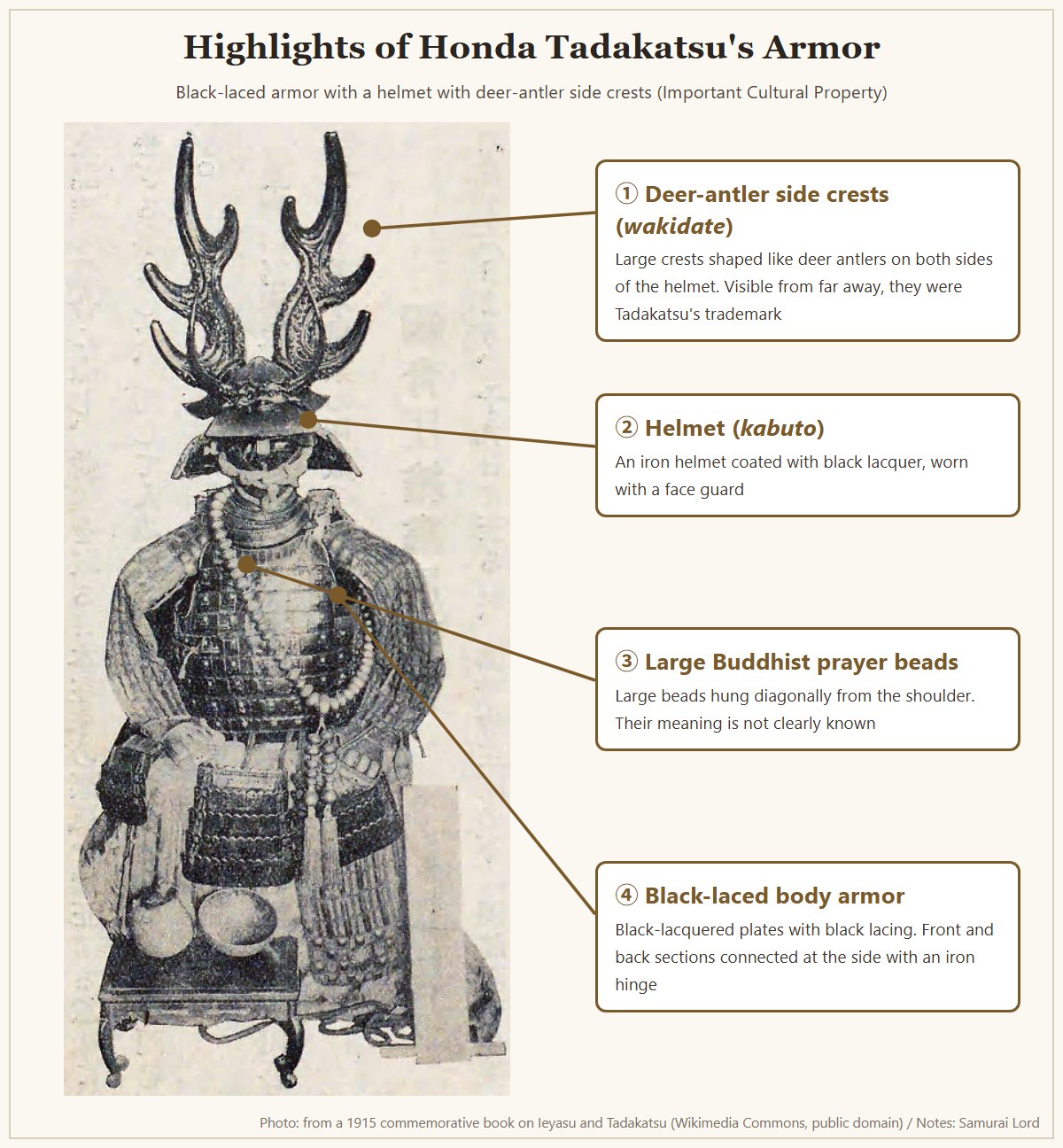
Image: Honda Tadakatsu's armor (photo from a 1915 commemorative book on Ieyasu and Tadakatsu; Wikimedia Commons, public domain), with notes added by Samurai Lord. Tap or click the image to enlarge it
The armor said to have been worn by Honda Tadakatsu survives and is designated an Important Cultural Property of Japan (since 1977). Its Japanese designation is Kuroito-odoshi dōmaru gusoku, with a deer-antler-crested helmet and auxiliary armor, used by Honda Tadakatsu.
- Deer-antler side crests (shikatsuno wakidate): large ornaments shaped like deer antlers stand on both sides of the helmet
- Black lacing (kuroito-odoshi): the armor's plates are laced together with black cord
- Large prayer beads: huge Buddhist prayer beads hang from the shoulder
The Agency for Cultural Affairs also names the large deer antlers and the huge prayer beads as the distinctive features of this armor. Where it can be seen depends on the exhibitions being held.
Source Box ①: The Deer-Antler Helmet in the Kōyō Gunkan
Source
Kōyō Gunkan, chapter 39 (a book on the Takeda family's military lore compiled in the early Edo period; text from Wikisource)
Original (excerpt)
「本多平八郎其歳廿五歳なれ共」「甲にくろきかの角を立」
Translation
"Although Honda Heihachirō was then 25 years old," "he wore black deer antlers on his helmet"
What follows
The passage goes on to say that, without regard for his life, he rode in between the enemy and his own side to help his comrades retreat
What it tells us
This scene is set in 1572, when the Takeda army invaded. It shows that by the early Edo period, the deer-antler helmet was already being described as Tadakatsu's trademark
What Do the Large Prayer Beads Mean?
The huge prayer beads are one of the most striking features of this armor. They are sometimes explained as "a way of mourning those killed in battle," but we could not find the record behind that explanation [Unknown]. Their real meaning is not clearly known.
Deer antlers and giant prayer beads... you could recognize Tadakatsu from far away!
His Family Crest: The Standing Hollyhock, and How It Differs from the Tokugawa Crest
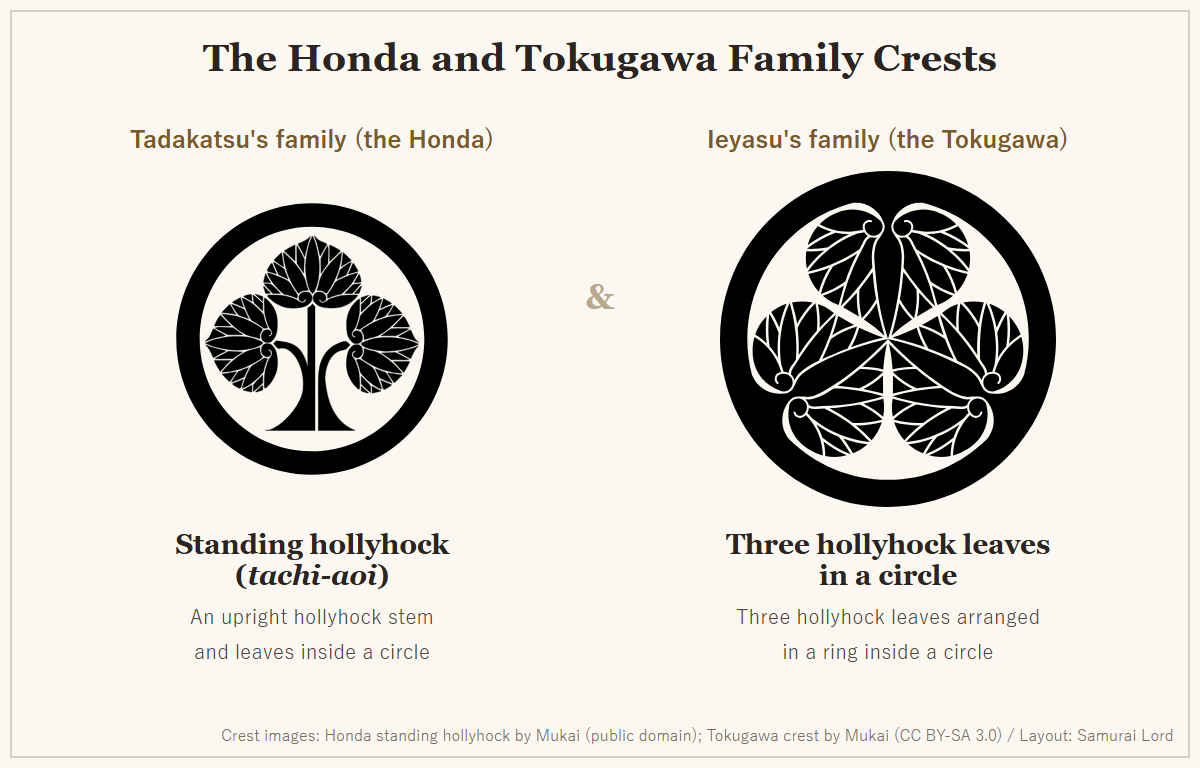
Image: The Honda and Tokugawa family crests compared (crest images: Honda standing hollyhock by Mukai, public domain; Tokugawa crest by Mukai, CC BY-SA 3.0; both from Wikimedia Commons; layout by Samurai Lord). Tap or click the image to enlarge it
The crest of Tadakatsu's family, the Honda, was the standing hollyhock (tachi-aoi): an upright hollyhock stem and leaves inside a circle, also called the "Honda standing hollyhock" [Widely accepted].
The Tokugawa crest, "three hollyhock leaves," is also a hollyhock design, but it arranges three leaves in a ring, which is different from the Honda crest. A tradition says the Tokugawa took their hollyhock from the Honda, but we could not find a record supporting it [Legend].
As for his banner, the Kansei Chōshū Shokafu tells a story that as a young man he used a fan-shaped standard (a marker worn on the back), later gave it to Ieyasu at Ieyasu's request, and received in return a banner with a nakaguro design (a thick black band across the middle of a white field) [Legend].
Where Can You See His Portrait and Statues?
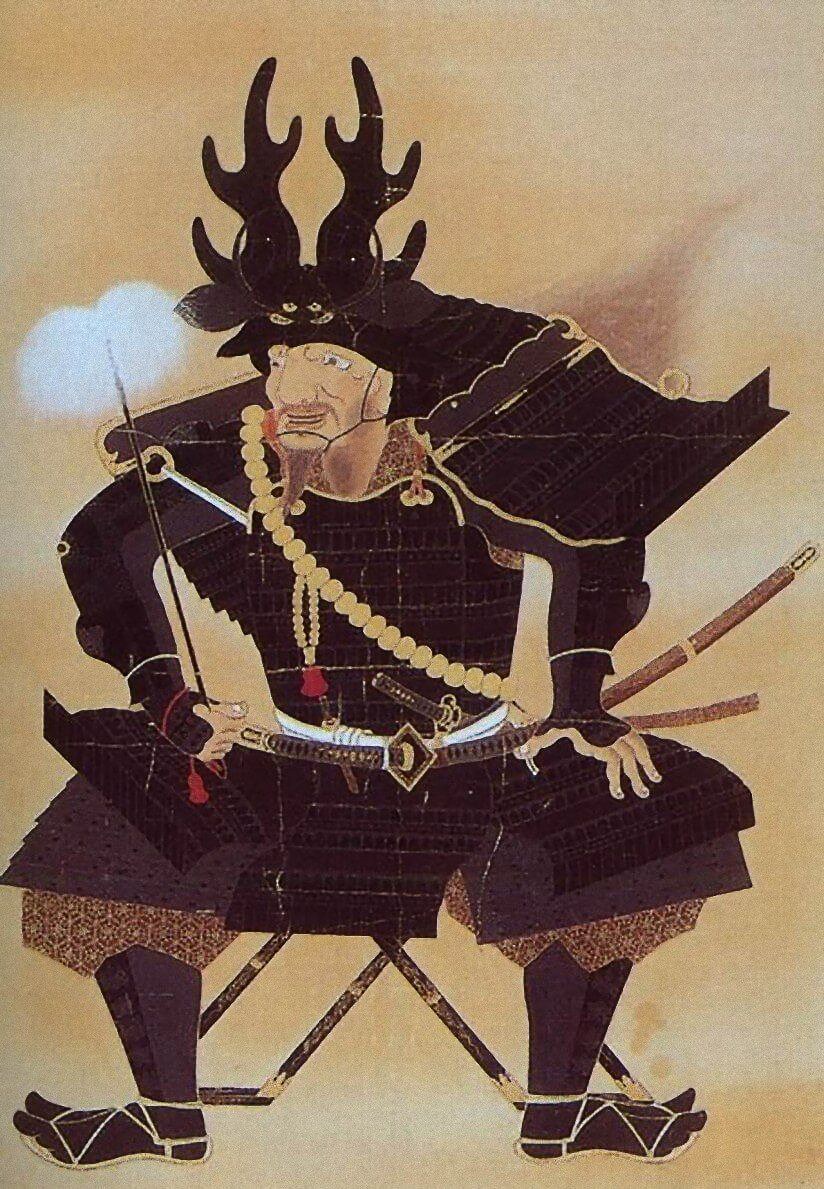
Image: Portrait of Honda Tadakatsu (owned by Ryōgenji temple; kept at the Ōtaki Castle branch of the Chiba Prefectural Central Museum). Wikimedia Commons (public domain)
The best-known portrait of Honda Tadakatsu is the "Portrait of Honda Tadakatsu, color on paper," handed down at Ryōgenji temple in Ōtaki, Chiba Prefecture. It is a cultural property of Chiba Prefecture (designated 1989) and is kept at the Ōtaki Castle branch of the Chiba Prefectural Central Museum. According to Chiba Prefecture, an account of the portrait's origins written in 1849 says that the Ryōgenji portrait was copied in 1691 (Genroku 4) from a painting made in 1595 (Bunroku 4). The original is said to have been commissioned by Tadakatsu himself from an artist of the Tosa school. We have not confirmed the painter's name.
It shows him with the deer-antler helmet, black armor, large prayer beads over the shoulder and a white baton for giving orders, matching the features of the surviving armor well. Ōtaki Town's official site says the Ōtaki Castle branch is currently closed for renovation.
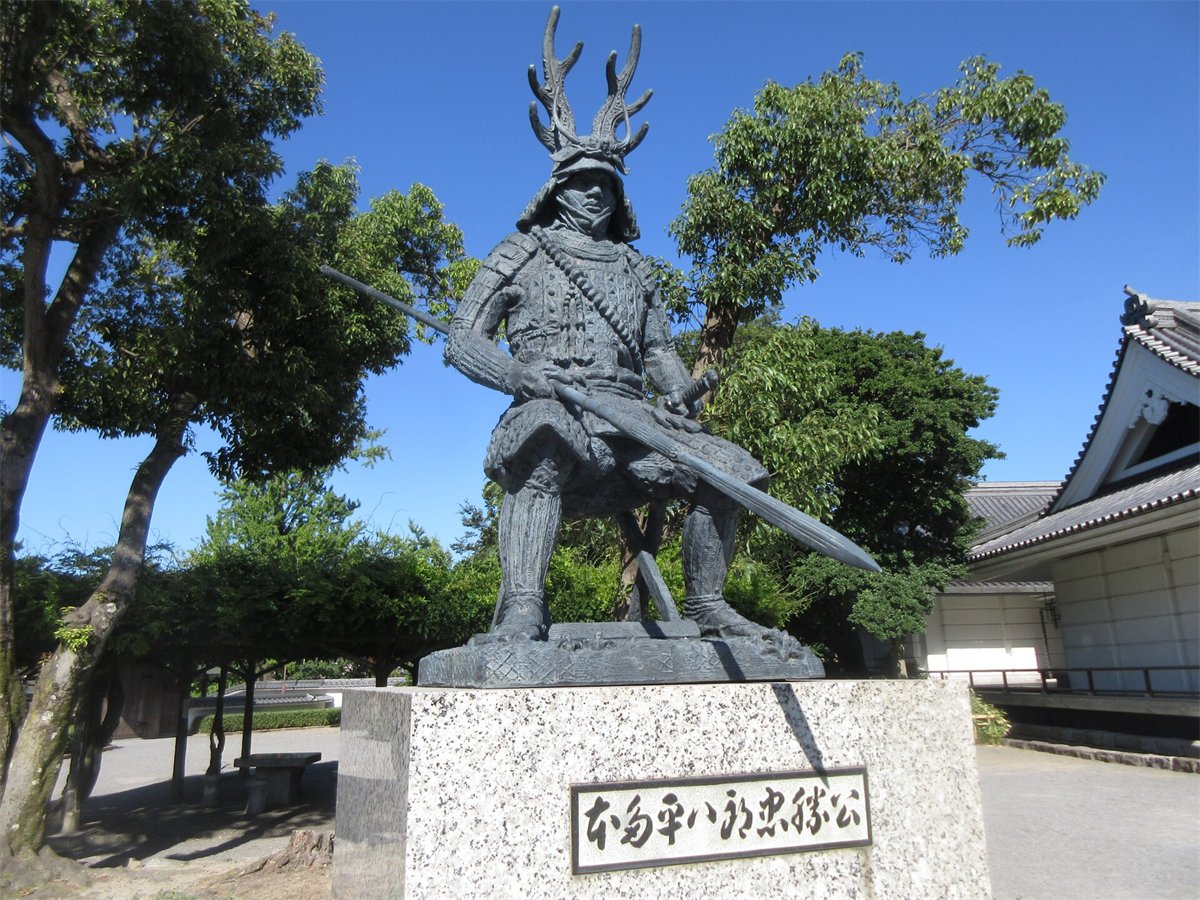
Image: Statue of Honda Tadakatsu in Okazaki Castle Park (Okazaki, Aichi). Wikimedia Commons (photo: Evelyn-rose, CC0)
In his hometown of Okazaki, Aichi Prefecture, a bronze statue of Tadakatsu holding Tonbogiri stands in Okazaki Castle Park (the site of Okazaki Castle, renamed from "Okazaki Park" in December 2024). There is also a statue near the site of Kuwana Castle in Kuwana, Mie Prefecture (in Kakiyasu Community Park).
Places Connected to Honda Tadakatsu
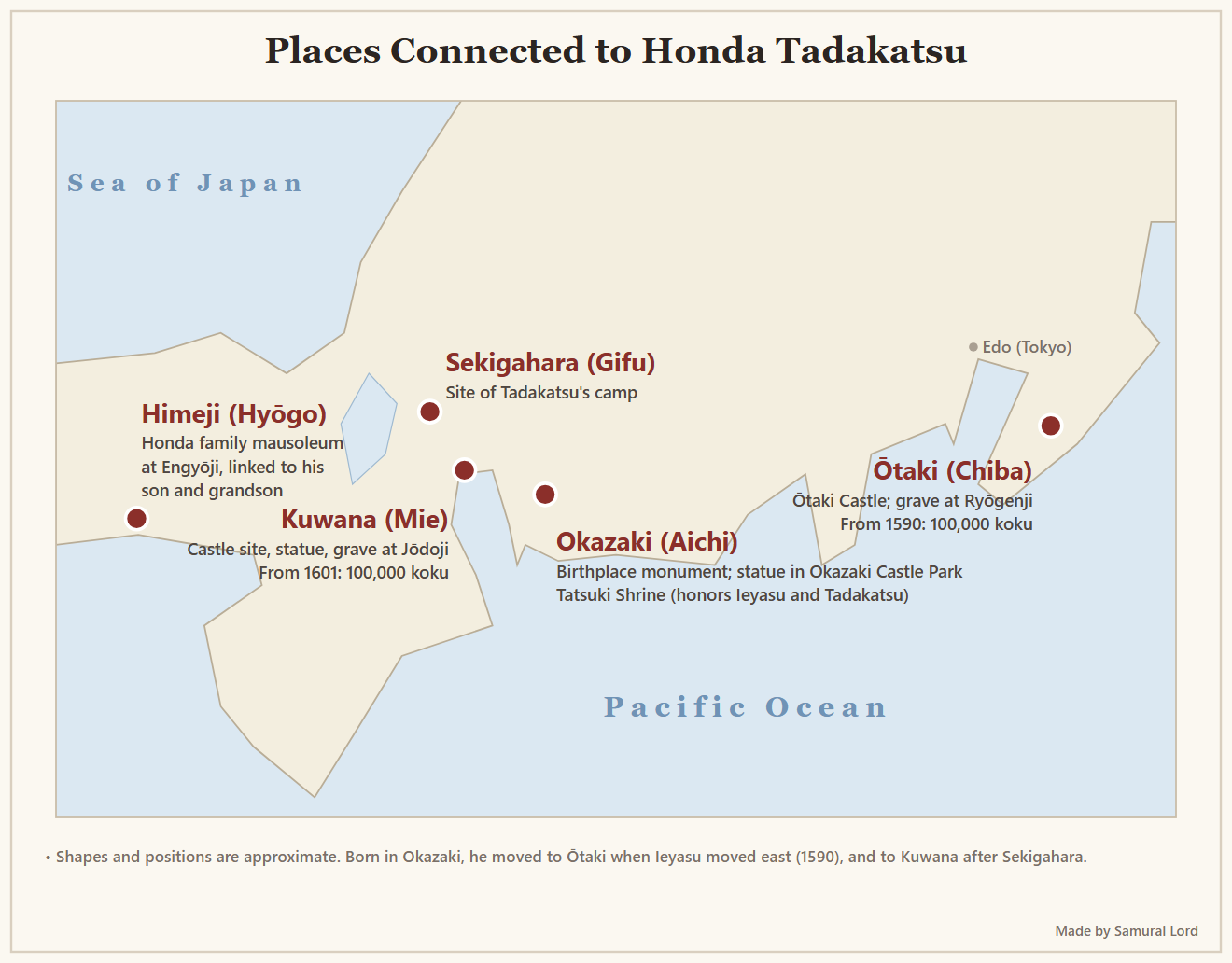
Image: Places connected to Honda Tadakatsu (made by Samurai Lord; positions are approximate). Tap or click the image to enlarge it
| Place | What is there? |
| Okazaki, Aichi | A monument at his birthplace (Nishi-Kuramae), the statue in Okazaki Castle Park, and Tatsuki Shrine, which honors Ieyasu and Tadakatsu |
| Ōtaki, Chiba | Ōtaki Castle and the castle town developed under Tadakatsu (today's castle building is a museum), and Ryōgenji, the temple he founded, with his grave |
| Kuwana, Mie | The site of Kuwana Castle (Kyūka Park and nearby), his statue, and Jōdoji, with his grave |
| Himeji, Hyōgo | The Honda family mausoleum at Engyōji on Mount Shosha, closely linked to his son Tadamasa and grandson Tadatoki |
| Sekigahara, Gifu | The site of Honda Tadakatsu's camp at the Battle of Sekigahara |
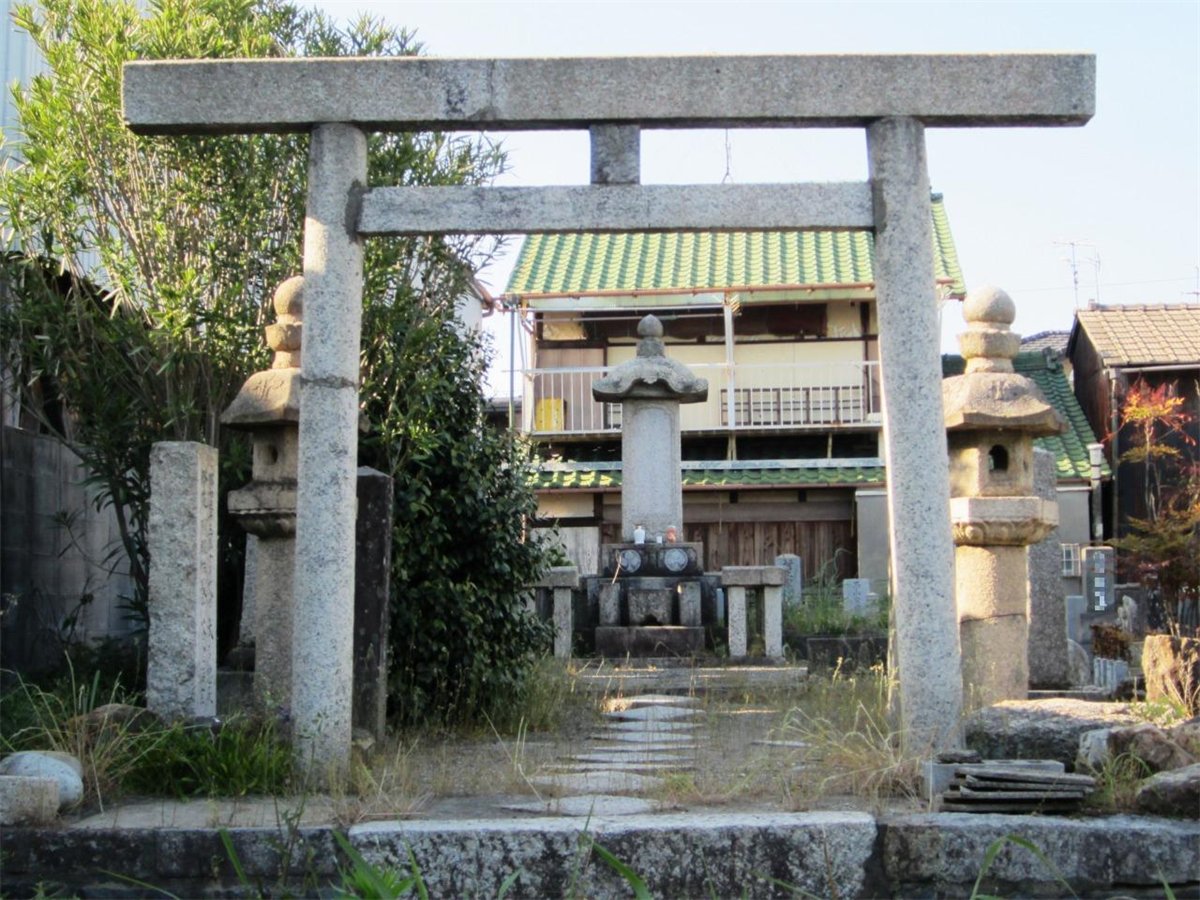
Image: Honda Tadakatsu's grave at Jōdoji temple (Kuwana, Mie). Wikimedia Commons (photo: 立花左近, CC BY-SA 3.0)
His graves are at Jōdoji in Kuwana, where he died, and at Ryōgenji in Ōtaki, among other places [Widely accepted].
Was Honda Tadakatsu Really the Strongest? Checking "57 Battles Without a Wound" and Other Legends
Honda Tadakatsu is sometimes called "the strongest warrior of the Warring States period." But most of the famous stories about his strength appear in books from the Edo period or later. Let us see which story appears in which book.
| Famous story | Where does it appear? | Reliability |
| He fought 57 battles in his life without a single wound | Introduced in encyclopedias and elsewhere, but not supported by the records from his own time that we consulted | [Legend] |
| His enemies sang that he was "too fine for Ieyasu" | The Kōyō Gunkan, compiled in the early Edo period, and others | [Legend] |
| Nobunaga praised him as "a warrior with both flowers and fruit," that is, with both distinction and substance | The Kansei Chōshū Shokafu, the shogunate's genealogy | [Legend] |
| He calmly had his horse's mouth rinsed at a river in front of Hideyoshi's huge army | The Tokugawa Jikki, a history compiled by the shogunate, and others | [Legend] |
Was He Really Never Wounded in 57 Battles?
The story that "he fought in 57 battles in his life and was never once wounded" appears in encyclopedias too, though not always in the same form. The records from his own time that we consulted could not confirm either the number 57 or that he was never wounded [Legend].
On the contrary, a 2022 seminar paper (by 大鹿真和) notes that the Edo-period Butoku Hennen Shūsei says Tadakatsu received a slight wound during the escape through Iga after the Honnō-ji Incident [Legend]. And the Tokugawa army he served was badly defeated at the Battle of Mikatagahara [Fact]. "Never beaten" is not true either.
The Poem "Too Fine for Ieyasu"
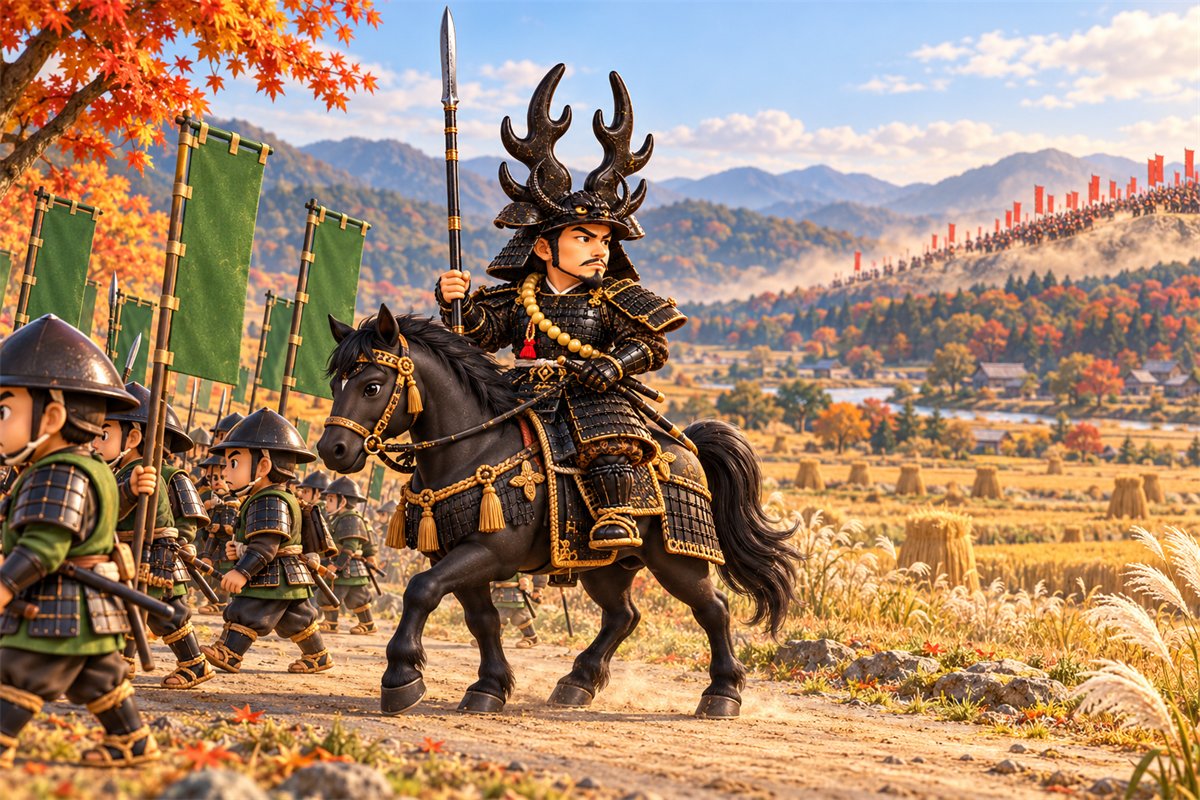
Image: Honda Tadakatsu protecting his retreating comrades (a story told in Edo-period books)
In 1572, Takeda Shingen's great army invaded Tōtōmi (western Shizuoka Prefecture). According to the Kōyō Gunkan, compiled in the early Edo period, the 25-year-old Honda Heihachirō (Tadakatsu) wore black deer antlers on his helmet and rode in between the enemy and his own side to help his comrades retreat. Kosugi Ukon-no-suke of the Takeda side, having seen this, is said to have written a poem about it and set it up on the Mitsuke slope (today's Iwata, Shizuoka) [Legend].
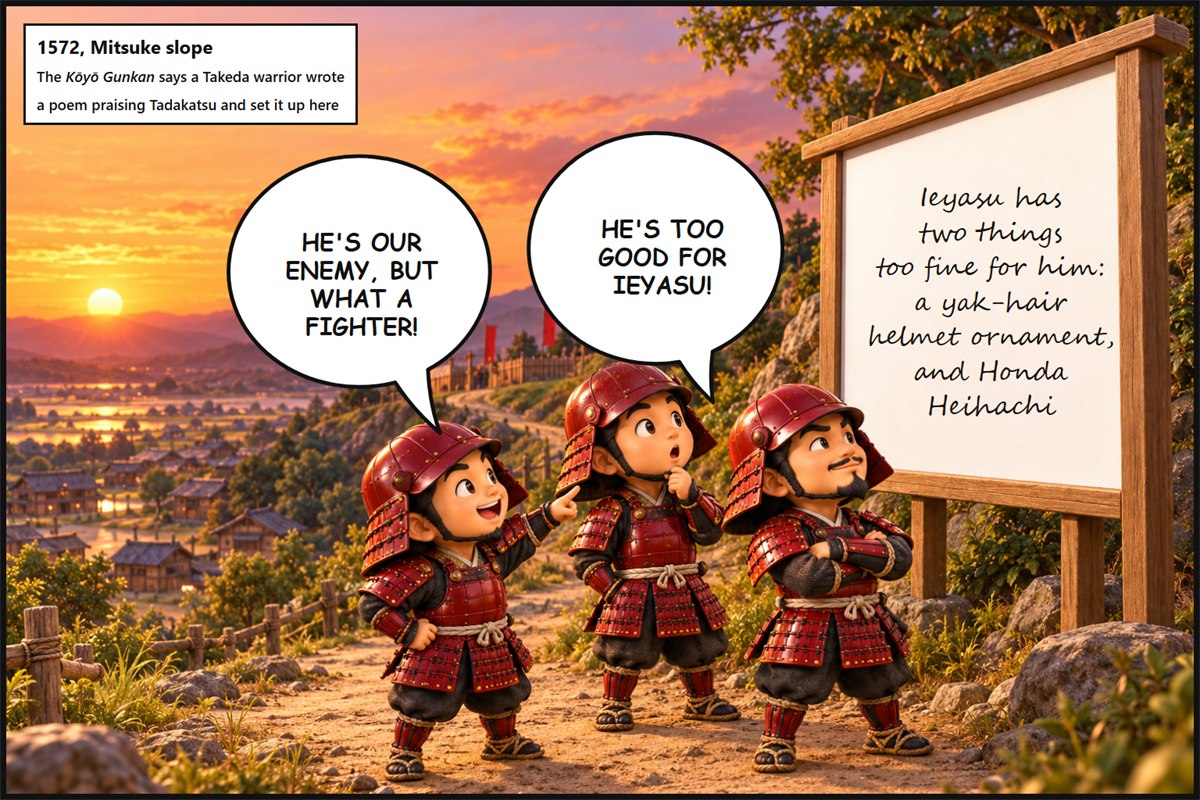
Image: Takeda soldiers reading a poem posted on a slope (a story told in the Kōyō Gunkan)
Source Box ②: The Poem "Too Fine for Ieyasu"
Source
Kōyō Gunkan, chapter 39 (text from Wikisource)
Original (excerpt)
「家康に過たる物は二ツある唐の頭に本多平八」
Translation
Ieyasu has two things too fine for him: a kara no kashira and Honda Heihachi
What it tells us
A kara no kashira was a helmet ornament made from imported yak-tail hair, an expensive item. The Kōyō Gunkan names the poet as "Kosugi Ukon-no-suke," though some encyclopedias give "Kosugi Sakon." The Edo-period 三壺聞書 (volume 18) also records the verse, as an anonymous lampoon associated with the Battle of Nagashino (1575)
This scene is often introduced as the Battle of Hitokotozaka (in Iwata). Whether the poem was really written cannot be confirmed from records of the time. Still, it shows that by the early Edo period, Tadakatsu was remembered as a warrior famous even among his enemies.
Rinsing His Horse's Mouth in Front of Hideyoshi's Army
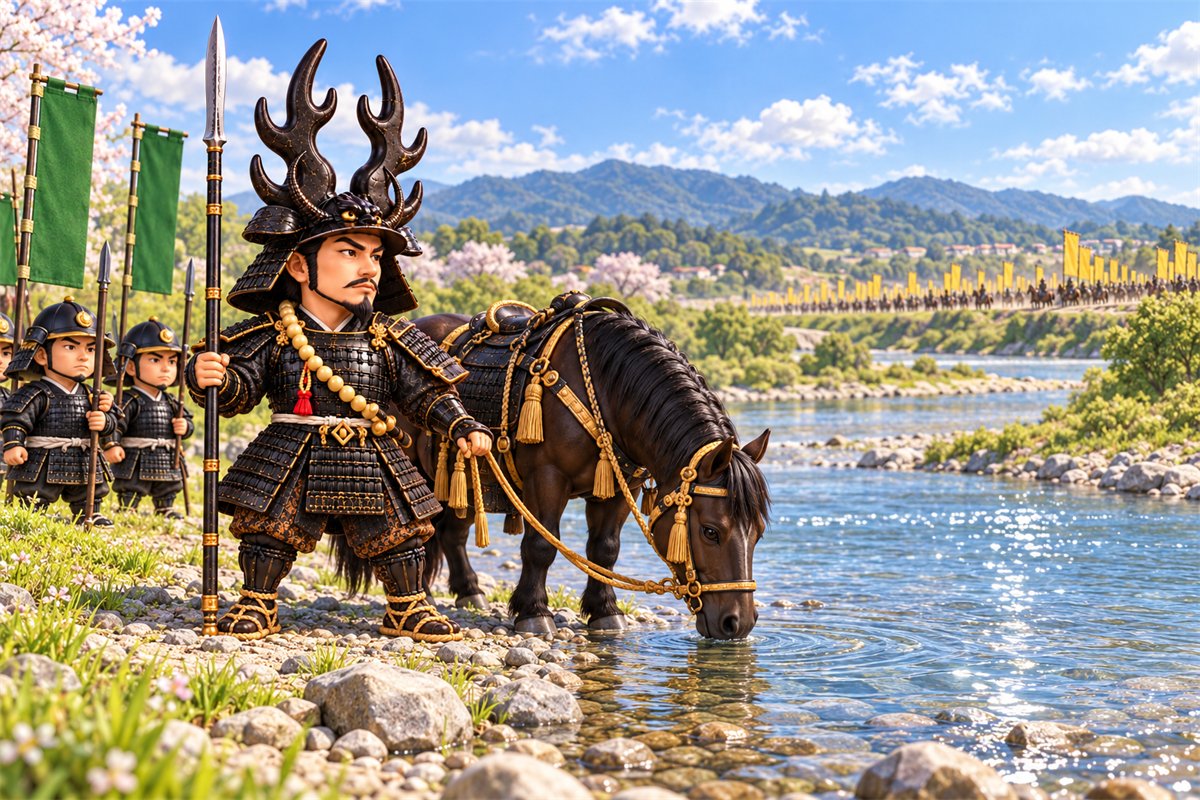
Image: Honda Tadakatsu having his horse's mouth rinsed at a riverbank (a story told in Edo-period books)
During the Komaki-Nagakute campaign of 1584, Tadakatsu is said to have confronted Hashiba (later Toyotomi) Hideyoshi's huge army across a river with only a small force. The Tokugawa Jikki, compiled by the shogunate, tells that Hideyoshi ordered, "What a splendid warrior! Do not shoot a single arrow," while Tadakatsu had his horse's mouth rinsed at the riverbank [Legend]. The number of troops differs from book to book [Debated]. For the campaign itself, see our article on Toyotomi Hideyoshi.
Honda Tadakatsu in Records from His Own Time
His name does appear in records from his own time. For example, the Shinchō Kōki, the chronicle of Oda Nobunaga by his retainer Ōta Gyūichi, describes the fighting of a unit led by "Honda Heihachirō" in Ieyasu's army when Takatenjin Castle (Kakegawa, Shizuoka) fell in 1581 [Fact: Shinchō Kōki].
A written oath (kishōmon, a document swearing to keep a promise before the gods and Buddhas), dated the 14th day of the 9th month of Keichō 5 (October 20, 1600), the day before the Battle of Sekigahara, also survives. Tadakatsu and Ii Naomasa addressed it to Kikkawa Hiroie and Fukuhara Hirotoshi of the Mōri side. Documents like this show that he was involved in negotiation as well as fighting.
Famous Words of Honda Tadakatsu
Most of the sayings attributed to Tadakatsu come from a text said to be his testament, or from books of the Edo period or later. Whether they are really his words cannot be confirmed [Legend]. With that in mind, here is one whose source is known:
- "Whether practicing martial arts or studying, one should keep loyalty in mind and aim to save the realm from its troubles." (a passage from the text said to be his testament, as quoted in the Nihon Jinmei Daijiten)
So most of the "strongest warrior" legends are from later times. But it's true that he was trusted with important work!
Indeed. Even without the legends, he was clearly a retainer Ieyasu could not do without.
Honda Tadakatsu's Descendants and Family Tree
The line of his eldest son, Honda Tadamasa, passed through Himeji and other domains and in the later Edo period became the lords of Okazaki in Mikawa, continuing until the Meiji era [Widely accepted]. We have not confirmed who heads the Honda family today.
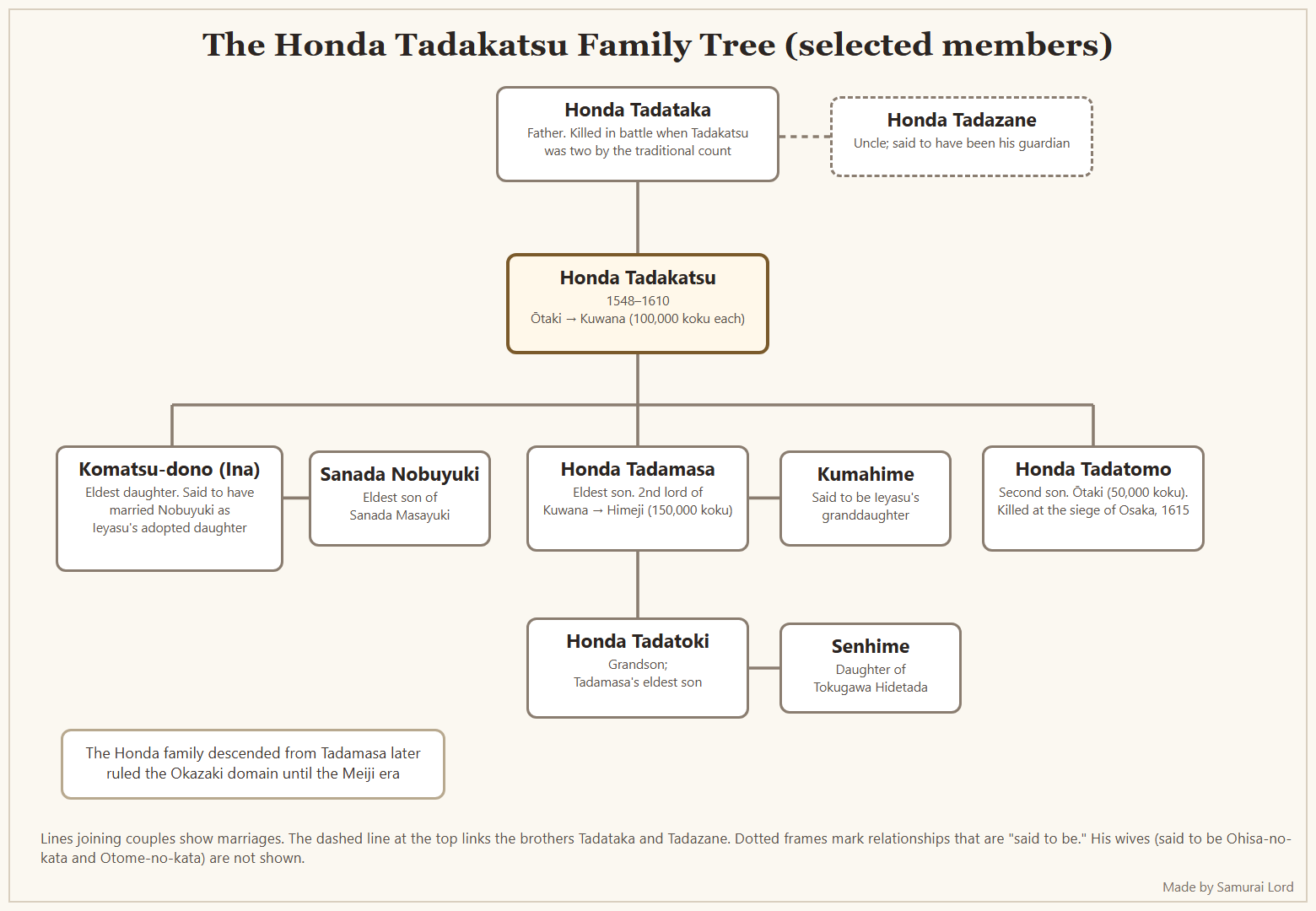
Image: The Honda Tadakatsu family tree (made by Samurai Lord; main people only). Tap or click the image to enlarge it
| Person | Relation to Tadakatsu | Who was he or she? |
| Honda Tadataka | Father | Killed in battle when Tadakatsu was 2 by the traditional count [Widely accepted] |
| Honda Tadazane | Uncle | Said to have been the guardian of the fatherless Tadakatsu. Said to have been killed at the Battle of Mikatagahara [Legend] |
| Komatsu-dono (Ina) | Eldest daughter | Said to have married Sanada Nobuyuki, eldest son of Sanada Masayuki, as Ieyasu's adopted daughter [Widely accepted] |
| Honda Tadamasa | Eldest son | Second lord of Kuwana; later lord of Himeji in Harima (150,000 koku), where he developed Himeji Castle [Widely accepted]. His wife was Kumahime, Ieyasu's granddaughter (a daughter of Matsudaira Nobuyasu) [Widely accepted] |
| Honda Tadatomo | Second son | Lord of Ōtaki in Kazusa (50,000 koku) after his father. Killed at the summer siege of Osaka in 1615 [Widely accepted] |
| Honda Tadatoki | Grandson (Tadamasa's eldest son) | Married Senhime, daughter of Tokugawa Hidetada [Widely accepted] |
His principal wife is said to have been 於久の方 and his secondary wife 乙女の方, but little is known about them.
His Daughter Komatsu-dono and Sanada Nobuyuki
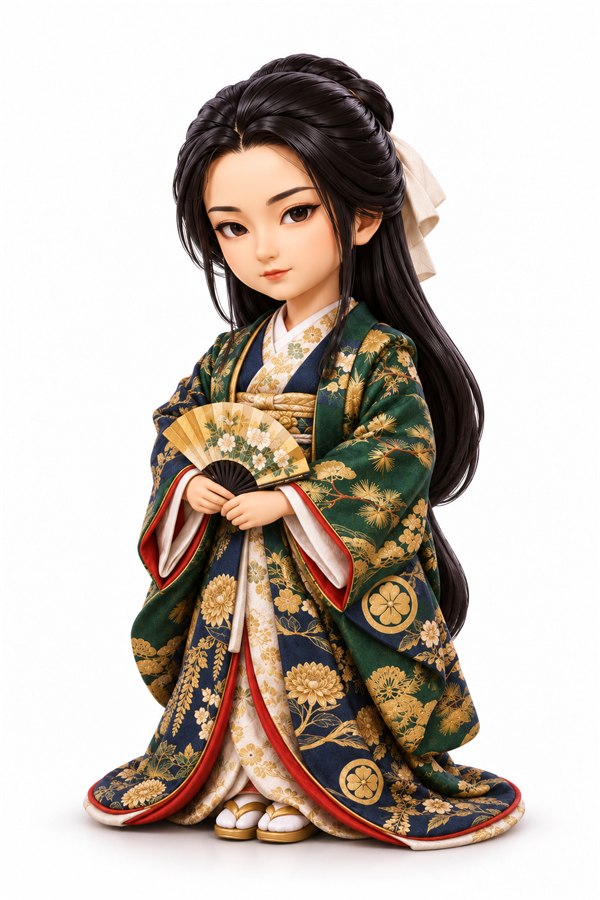
Image: Komatsu-dono
His eldest daughter, Komatsu-dono (also called Komatsuhime or Ina), is said to have become Ieyasu's adopted daughter and married Sanada Nobuyuki, eldest son of Sanada Masayuki, lord of Ueda Castle in Shinano [Widely accepted]. The year of the marriage is given as 1589 in some explanations (such as Ueda City's), but other dates are also proposed [Debated]. Komatsu-dono died in 1620 at Kōnosu in Musashi Province (today's Kōnosu, Saitama), on her way to the hot springs at Kusatsu [Widely accepted].
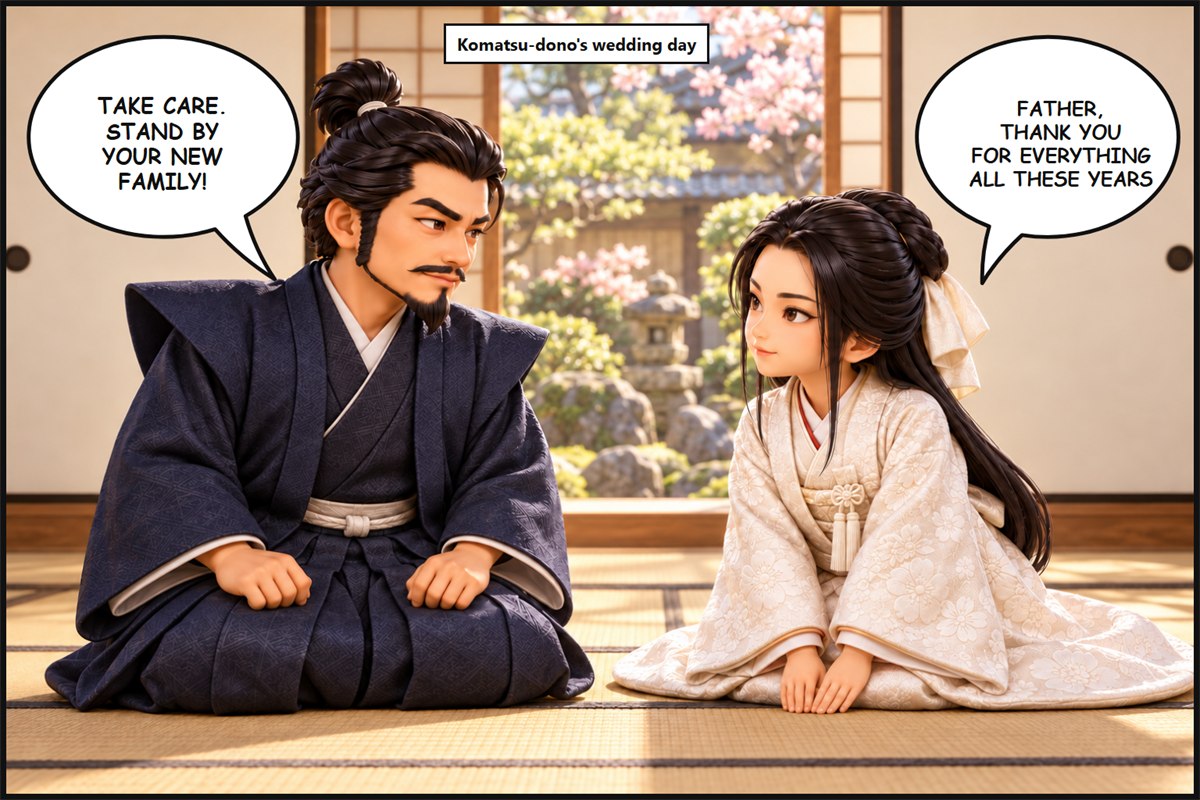
Image: Tadakatsu seeing off his daughter Komatsu-dono on her wedding day
After the Battle of Sekigahara, when Sanada Masayuki and his son Nobushige (better known as Yukimura), who had fought for the Western army, were spared their lives, Edo-period war tales say that Tadakatsu joined his son-in-law Nobuyuki in pleading with Ieyasu for them [Legend].
His Grandson Tadatoki, Senhime and Miyamoto Musashi
His grandson Honda Tadatoki married Senhime (daughter of Tokugawa Hidetada), the former wife of Toyotomi Hideyori [Widely accepted]. Mikinosuke, the adopted son of the swordsman Miyamoto Musashi, served this Tadatoki. For more, see our article on Miyamoto Musashi.
His Spear, Tonbogiri: Where Does the Name Come From, and Where Is It Now?
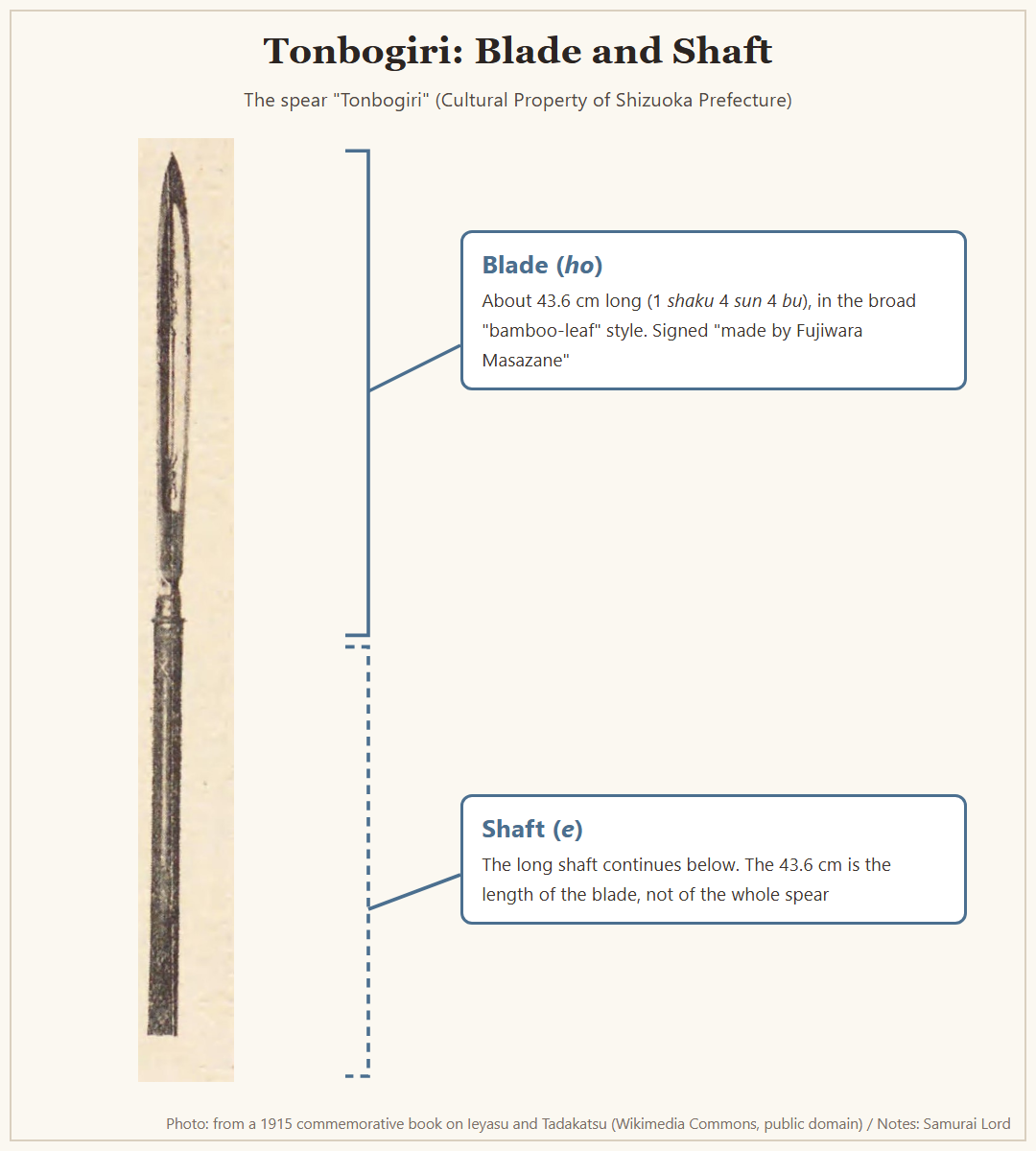
Image: An old photo of Tonbogiri (from a 1915 commemorative book on Ieyasu and Tadakatsu; Wikimedia Commons, public domain), with notes added by Samurai Lord. Tap or click the image to enlarge it
Tonbogiri ("Dragonfly Cutter"), the spear known as Honda Tadakatsu's, still survives and is designated a cultural property of Shizuoka Prefecture (since 1955), under the Japanese title Yari, Meibutsu Tonbogiri ("Spear: the celebrated Tonbogiri").
| Item | Details |
| Maker | The tang is inscribed "made by Fujiwara Masazane" |
| Length | The blade (ho) is 1 shaku 4 sun 4 bu long (about 43.6 cm). This is not the length of the whole spear |
| Where is it now? | Privately owned, and on deposit at the Sano Art Museum in Mishima, Shizuoka Prefecture, since 2013 |
| Can I see it? | It is not always on display. Public showings depend on the museum's exhibitions |
Shizuoka Prefecture's explanation says it is "said to have been owned by Honda Heihachirō Tadakatsu." It is also said to be one of the "Three Great Spears of Japan" [Legend].
Where Does the Name "Tonbogiri" Come From?
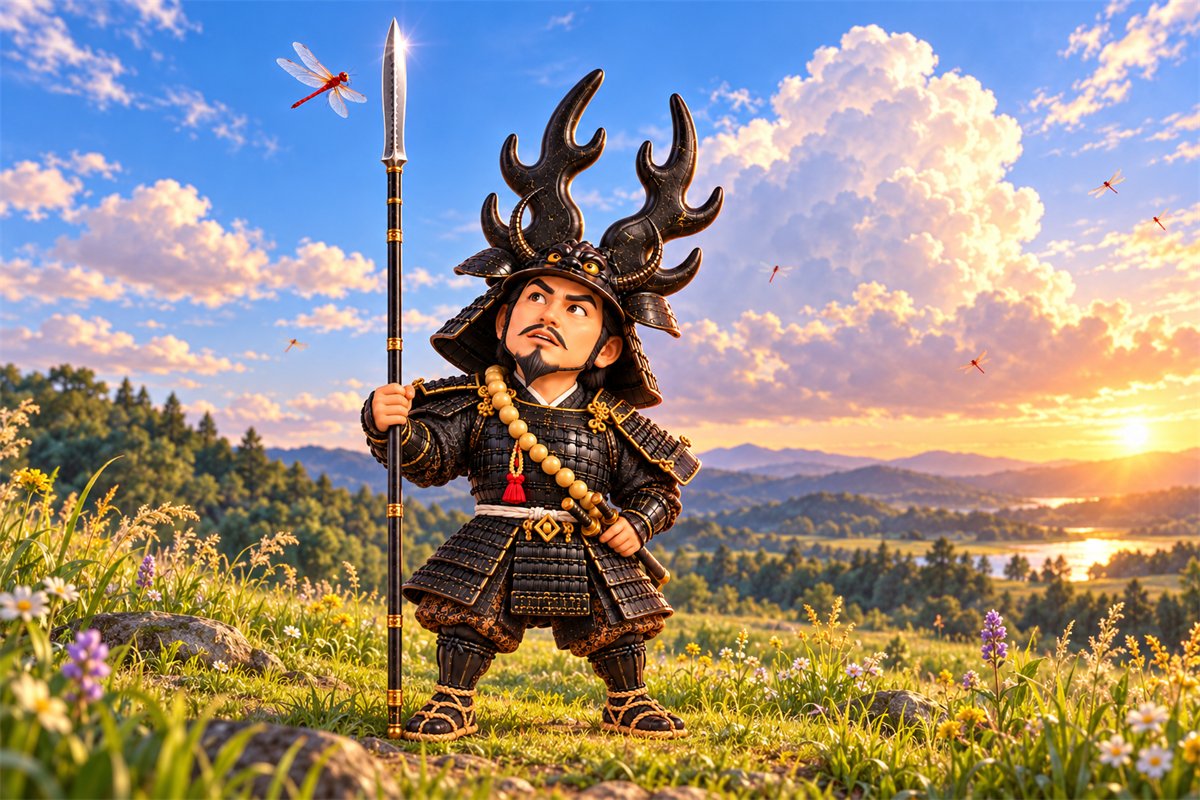
Image: A dragonfly flying near the upright spear (the legend behind its name)
According to legend, the spear was so sharp that a dragonfly that merely touched its blade was cut in two, hence the name "Dragonfly Cutter" [Legend].
The blade alone is 43 cm! Even if the dragonfly story is a legend, it really is an amazing spear!
Was He Related to Honda Masanobu? Family Ties and the Rivalry Story
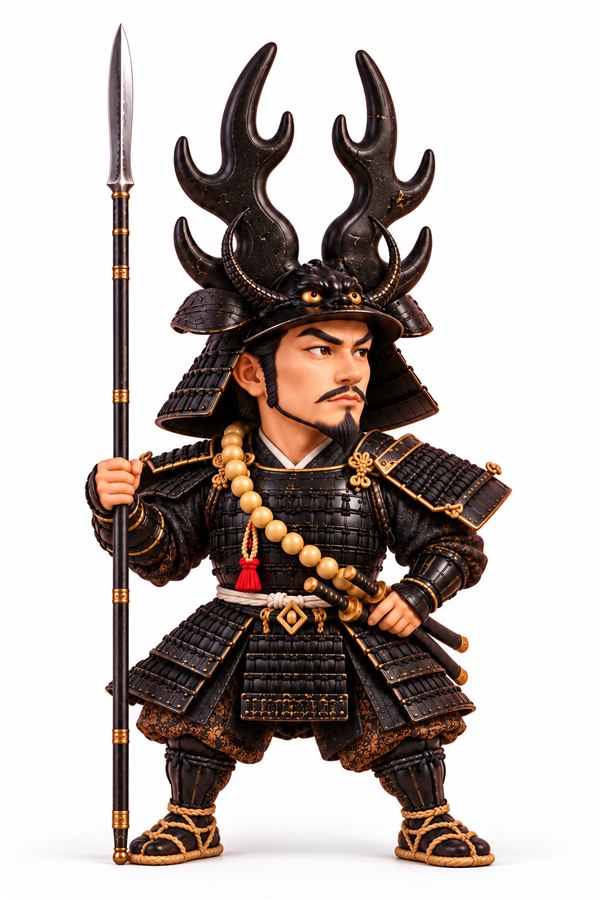
Image: Honda Tadakatsu
Among Ieyasu's retainers was another man with the surname Honda: Honda Masanobu. The two are said to have come from different branches of the Honda clan [Widely accepted].
| Item | Honda Tadakatsu | Honda Masanobu |
| Born | 1548 | 1538 |
| Role under Ieyasu | Fighting on the battlefield, and serving as messenger and negotiator | Advising Ieyasu on government at his side (a strategist) |
| Mikawa Ikkō-ikki uprising (1563–64) | Fought on Ieyasu's side | Turned against Ieyasu, and later returned |
| Lands | Kuwana in Ise, 100,000 koku | 10,000 koku (later 22,000) |
A story is often told that Tadakatsu despised Masanobu and called him a coward, but we could not confirm which book it comes from [Legend]. Their roles certainly differed, but the sources we consulted give no firm grounds for saying that the two were on bad terms.
FAQ
Why is Honda Tadakatsu sometimes shown as a robot in video games?
Games sometimes portray Honda Tadakatsu as a machine-like figure, but this is the games' own invention, probably exaggerating his image as "the strongest warrior." His portrait and surviving armor are better guides to his appearance and equipment (more).
Was Honda Tadakatsu a real person?
Yes. His name appears in records of his own time, such as the Shinchō Kōki, and his armor, spear, portrait and graves survive. Many of the famous stories about his strength, however, come from later books (more).
Who were the "Four Heavenly Kings of the Tokugawa"?
Sakai Tadatsugu, Honda Tadakatsu, Sakakibara Yasumasa and Ii Naomasa. The nickname draws on the Four Heavenly Kings, Buddhist guardian deities; these men were Ieyasu's retainers, not kings. It is a later grouping, not a title used in their own time (more).
Summary: Who Was Honda Tadakatsu?
Honda Tadakatsu was one of the "Four Heavenly Kings of the Tokugawa," who served Tokugawa Ieyasu all his life from boyhood, fought in his major battles, and became the lord of Ōtaki and then Kuwana. He died at Kuwana in 1610, aged 63 by the traditional count.
The legends of the "strongest warrior," such as "57 battles without a wound" and "too fine for Ieyasu," come mainly from later books and traditions, and could not be confirmed from the records of his own time that we consulted. Yet his deer-antler armor and Tonbogiri survive, and his name appears on important documents as Ieyasu's negotiator. Both the legends and the records help us see who Honda Tadakatsu was.
For related people, see our articles on Tokugawa Ieyasu, Hattori Hanzō, Toyotomi Hideyoshi and Miyamoto Musashi.
A warrior who supported Ieyasu long and faithfully, in a way that lives up to the legends. That was Honda Tadakatsu.
Now I want to go and see the statue in Okazaki Castle Park!
Sources & How This Article Was Written
This article is based mainly on the following records and references:
- A record close to his time: Ōta Gyūichi, Shinchō Kōki, book 14 (Wikisource, from the 我自刊我書 edition; available in English as The Chronicle of Lord Nobunaga, translated by J. S. A. Elisonas and J. P. Lamers, Brill, 2011)
- Later records: Kōyō Gunkan, chapter 39 (Wikisource); Tokugawa Jikki (Tōshōgū Gojikki and its appendix); Kansei Chōshū Shokafu (as cited in research)
- Cultural property information (in Japanese): Agency for Cultural Affairs, Cultural Heritage Online (the black-laced armor); Shizuoka Prefecture, "Shizuoka Bunkazai Navi" (the spear Tonbogiri); Chiba Prefectural Board of Education (the portrait of Honda Tadakatsu)
- Encyclopedias and references (in Japanese): Kotobank (Nihon Daihyakka Zensho, Sekai Daihyakka Jiten, Nihon Jinmei Daijiten, Britannica Kokusai Daihyakka Jiten and others); Ueda City Museum, "Komatsuhime"; official sites of Okazaki City, Kuwana City, Ōtaki Town and others
- Study (in Japanese): 大鹿真和, "Honda Tadakatsu's Whereabouts and Activities" (seminar paper, Kaji Kōsuke seminar, Kyoto University of Advanced Science, 2022), used for its survey of his movements and related sources
- Images: the portrait of Honda Tadakatsu (Ryōgenji), the old photos of his armor and Tonbogiri (1915) and the Honda standing hollyhock crest (Mukai) are in the public domain; the Tokugawa crest (Mukai) is CC BY-SA 3.0; the photos of the statue in Okazaki Castle Park (Evelyn-rose, CC0) and his grave at Jōdoji (立花左近, CC BY-SA 3.0) are from Wikimedia Commons. The family tree, map, diagrams, manga panels and illustrations are original works by Samurai Lord
What the Labels Mean
[Fact]Confirmed by sources from the time ([Fact: …]names the source)[Widely accepted]A view widely accepted by researchers[Debated]Accounts, interpretations or ways of counting differ[Unknown]Not established from the sources we checked[Legend]Stories found in later records or traditions[Folk belief]Popular claims with little evidence
This article was written by the Samurai Lord editorial team and is revised as new research and reader feedback come in. If you spot an error, please let us know through our contact form (in Japanese) and we will check and correct it.
Read in Japanese
This article is also available in Japanese: 本多忠勝は何をした人?身長や死因、兜・家紋と最強伝説を解説!