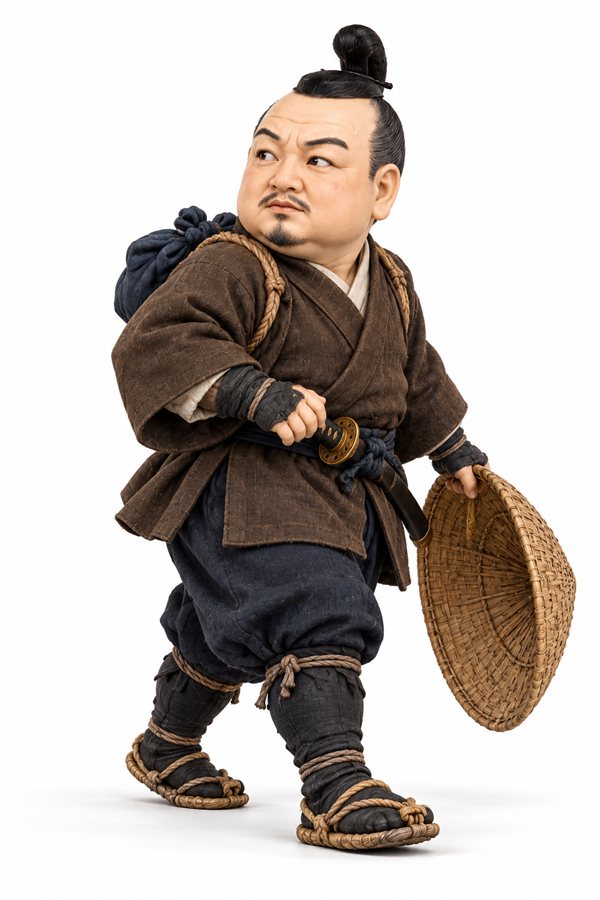
Image: Tokugawa Ieyasu during the escape through Iga
The escape through Iga (Iga-goe, "crossing Iga") was Tokugawa Ieyasu's flight home in June 1582. When Oda Nobunaga was killed in the Honnō-ji Incident, Ieyasu was sightseeing in Sakai (today's Sakai, Osaka Prefecture) with only a small party. He hurried along mountain roads through Iga and Ise (today's Mie Prefecture) and crossed by ship to his home province of Mikawa (today's eastern Aichi Prefecture). Because Ieyasu was later honored as Shinkun ("the divine lord"), the event is also called Shinkun Iga-goe.
Did it really happen? Yes. A diary written at the time records that Ieyasu passed through Iga and Ise and came ashore at Ōhama in Mikawa [Fact: Ietada Nikki]. The exact route and schedule, however, differ from record to record, and historians are still studying them [Debated].
This article shows the route on a map and the schedule day by day, introduces the retainers who went with Ieyasu and the people who helped him, and checks how much of the famous story, including the role of the ninja of Iga, is supported by records from the time and how much comes from later books.
Western dates before October 15, 1582, use the Julian calendar, and later dates use the Gregorian calendar; Japanese dates refer to the historical lunisolar calendar. Ages use the traditional Japanese count, in which a person was counted as one at birth and gained a year at the start of each new year in the Japanese calendar.
Key points are tagged: [Fact] confirmed by records from the time, [Widely accepted] a view widely accepted by researchers, [Debated] accounts, interpretations or ways of counting differ, [Unknown] not established from the sources we checked, and [Legend] stories found in later records or traditions.

I am Uesugi Kenshin. Today's subject is Tokugawa Ieyasu's great crisis, the escape through Iga.

I'm Date Masamune! That's the story where the ninja of Iga guided Ieyasu over the mountains, right?

Heh. The records show a somewhat different picture. Let us check them against a map.
The Short Answers
- When? June 21–24, 1582 (the 2nd to 5th days of the 6th month of Tenshō 10)
- Who? Tokugawa Ieyasu, aged 41 by the traditional count, and thirty-odd retainers. Nobunaga's aide Hasegawa Hidekazu also traveled with them (more)
- From where to where? Sakai → Ujitawara (Kyoto Prefecture) → Shigaraki (Shiga Prefecture) → Iga (Mie Prefecture) → Ise → by ship → Ōhama in Mikawa → Okazaki (more)
- How many days? He left Sakai on June 21, landed in Mikawa late on June 23 or early on June 24, and reached Okazaki on June 24 (more)
- How far? A little over 200 km (about 125 miles) in all. If he crossed into Iga by Sakura Pass, only about 20 km (12 miles) of it lay inside Iga Province (Fujita Tatsuo's estimate; more)
- Did ninja protect him? The records from the time that we checked do not show this. Detailed stories of the men of Iga escorting him appear in later records (more)
Three Things We Learn by Comparing the Sources
- The route on a map: a map of the whole journey based on the Ishikawa Tadafusa Tomegaki and Fujita Tatsuo's research, with a close-up of three theories for crossing into Iga (more)
- Day by day: how far the party traveled each day, and why the records disagree on when Ieyasu reached Mikawa (more)
- Ninja and other famous stories: a table showing which records tell each famous story, from a diary written at the time to a history completed in 1843 (more)
Jump to the part you want to read:
- What was the escape through Iga? When and where did Ieyasu flee?
- What route did Ieyasu take? The map and the theories
- How many days did it take? Schedule and distance
- Why did Ieyasu flee through Iga? Reasons and dangers
- Who went with Ieyasu? Companions and helpers
- Is the escape through Iga a myth? Records vs. later stories
- What happened to Anayama Baisetsu?
- What did Ieyasu do after the escape?
- Can you follow the route today? Related sites
- FAQ
What Was the Escape Through Iga? When and Where Did Ieyasu Flee?
In a single sentence, the escape through Iga was "Ieyasu's flight from Sakai after the Honnō-ji Incident, avoiding Akechi Mitsuhide's forces by taking mountain roads and then crossing by ship from Ise to Mikawa".
At the time, Ieyasu was an ally of Oda Nobunaga, the most powerful warlord in Japan. Invited by Nobunaga, he had visited Azuchi Castle (Shiga Prefecture) and was then touring Kyoto, Osaka and Sakai, guided by Nobunaga's close aide Hasegawa Hidekazu [Fact: Shinchō Kōki]. Because this was a sightseeing trip and not a campaign, he had only thirty-odd attendants with him [Widely accepted]. Then, on June 21, 1582, news came that Nobunaga had been killed by his own general Akechi Mitsuhide at Honnō-ji temple in Kyoto.
Shinkun is a title of respect for Ieyasu after his death. The Tokugawa Jikki, the official history compiled by the Tokugawa shogunate, calls the event "Iga-goe" and describes it as the greatest hardship of Ieyasu's whole life. Modern books often count it among "Ieyasu's three great crises," together with the Mikawa Ikkō-ikki uprising (1563–64) and the Battle of Mikatagahara (1573).
Source Box ①: The Escape Through Iga in the Ietada Nikki
Source
The diary of Matsudaira Ietada, a samurai of Ieyasu's clan who wrote down events day by day: the entry for the 4th day of the 6th month of Tenshō 10 (June 23, 1582). The diary is printed in the Dai Nihon Shiryō (part 11, volume 1) and the Okazaki Shishi; we follow the text quoted in a 2022 lecture by a museum curator in Hekinan City. Editions differ slightly in spelling
Original (excerpt)
「家康いか、伊勢地を御のき候て、大浜へ御あかり候而、町迄御迎ニ越候」
Translation
Lord Ieyasu withdrew by way of Iga and Ise and came ashore at Ōhama (today's Hekinan, Aichi Prefecture), so I went as far as the town to meet him.
What it tells us, and what it does not
It shows that Ieyasu passed through Iga and Ise and returned by ship to Ōhama in Mikawa. It does not tell us which passes or villages he went through, where he stayed, how many people were with him, or who guided him
The same day's entry also records that Anayama Baisetsu, who had been in Sakai with Ieyasu, "cut his belly," meaning seppuku (ritual suicide). Other accounts describe his death differently (more). For the details of the route, we have to compare records compiled later. The next section puts them on a map.
What Route Did Ieyasu Take? The Map and the Theories
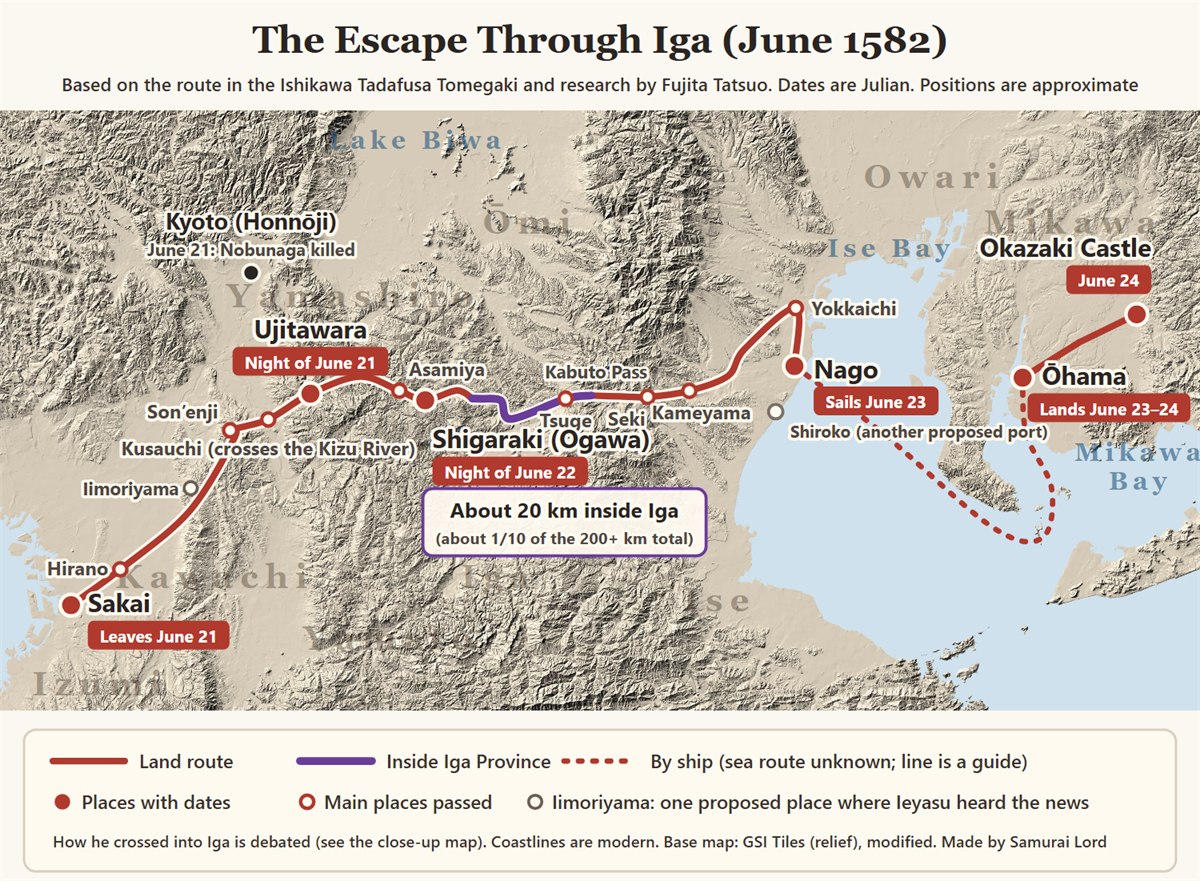
Image: The route of the escape through Iga, based on the journey in the Ishikawa Tadafusa Tomegaki and Fujita Tatsuo's research. Positions are approximate. Made by Samurai Lord; base map: GSI Tiles (Geospatial Information Authority of Japan)
Among the main accounts compared in this article, the one that describes the route in particular detail is the Ishikawa Tadafusa Tomegaki, notes written in the early Edo period by Ishikawa Tadafusa, son of Ōkubo Tadachika, who accompanied Ieyasu on the journey. Researchers regard it as relatively reliable [Widely accepted].
Based on this record, Ieyasu's party took roughly the following route [Widely accepted]:
- June 21 (the 2nd day of the 6th month): Sakai → Hirano (Osaka) → Hotani and Son’enji (Hirakata, Osaka Prefecture) → across the Kizu River at Kusauchi (Kyōtanabe, Kyoto Prefecture) → Ujitawara (Kyoto Prefecture)
- June 22 (the 3rd day): Ujitawara → Asamiya → Ogawa in Shigaraki (Kōka, Shiga Prefecture)
- June 23 (the 4th day): Ogawa → Marubashira and Tsuge in Iga (Iga City, Mie Prefecture) → over Kabuto Pass (Kameyama, Mie Prefecture) → Seki and Kameyama → Yokkaichi → by ship from Nago (Suzuka, Mie Prefecture)
- Night of June 23 to June 24: lands at Ōhama in Mikawa (Hekinan, Aichi Prefecture) → Okazaki
Three Theories for Crossing into Iga
The part of the route on which theories differ is the stretch on June 23 from Ogawa in Shigaraki to Tsuge in Iga [Debated].
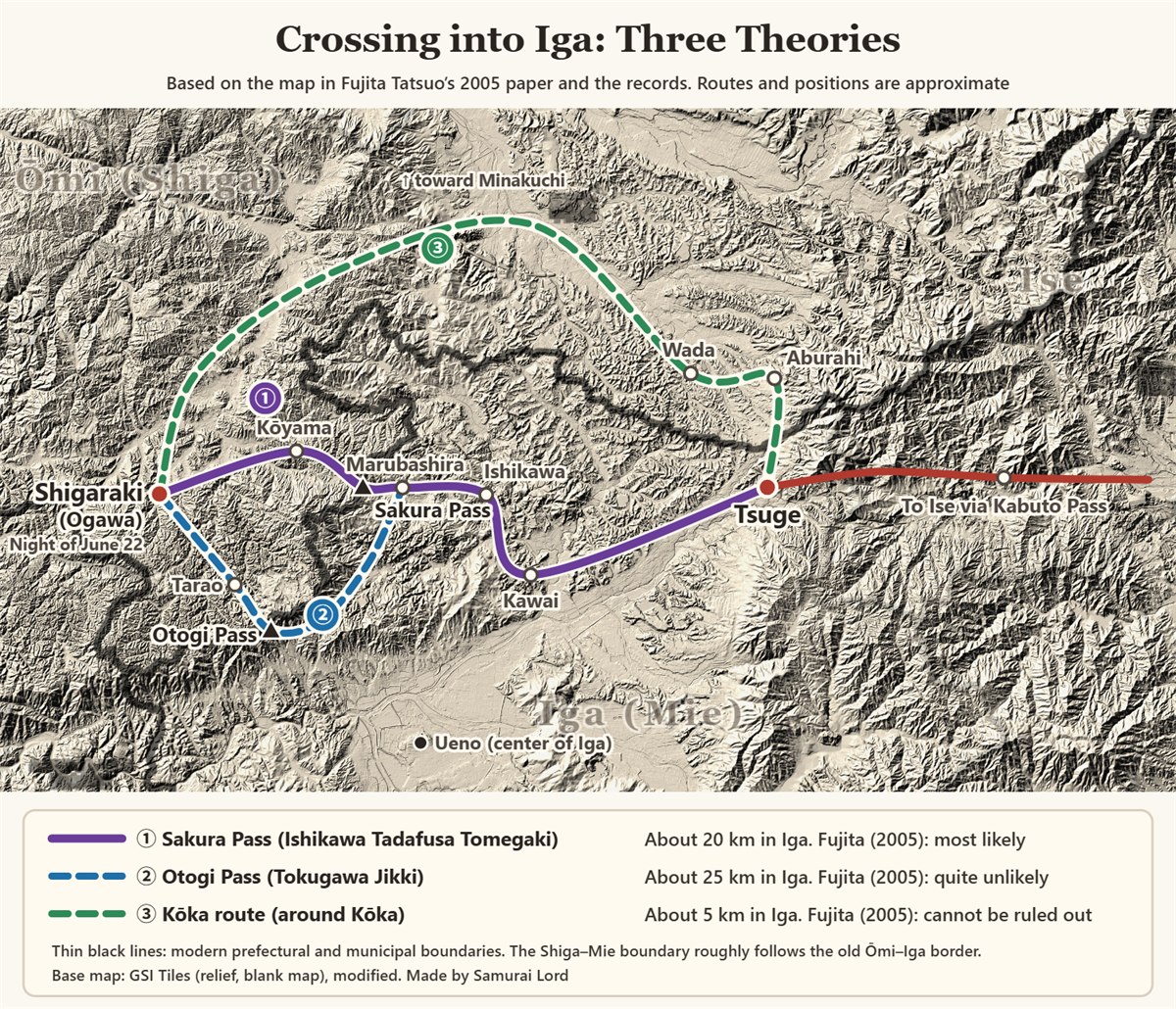
Image: Three theories for the route from Ogawa in Shigaraki to Tsuge in Iga, based on the map in Fujita Tatsuo's 2005 paper. Positions are approximate. Made by Samurai Lord; base map: GSI Tiles (Geospatial Information Authority of Japan)
| Theory | Route and the record behind it | Distance inside Iga Province |
| Sakura Pass | Ogawa → Kōyama → Sakura Pass → Marubashira → Tsuge. From the place names in the Ishikawa Tadafusa Tomegaki | About 20 km (12 miles) |
| Otogi Pass | Ogawa → Tarao → Otogi Pass → Marubashira → Tsuge. The route given in the shogunate's Tokugawa Jikki | About 25 km (16 miles) |
| Kōka route | Ogawa → Aburahi in Kōka (Kōka, Shiga Prefecture) → Tsuge. A route around Kōka examined by Fujita in 2005 | About 5 km (3 miles) |
Fujita Tatsuo of Mie University concluded in a 2005 paper that the Sakura Pass route is the most likely, that the Otogi Pass route is quite unlikely, and that the Kōka route cannot be ruled out. The Otogi Pass route is a detour that goes out of its way toward Ueno, the center of Iga. The Kōka route has been considered possible partly because documents from Ieyasu survive in the families of Kōka samurai.
However, one of the grounds for the Kōka route has been the word "Kōka-goe" (crossing Kōka) in the manuscript 戸田本三河記. Some have pointed out, after comparing manuscripts, that the word may originally have been written "Kabuto-goe," the Kabuto Pass crossing.
There is also a local theory that he crossed at Goinogi Pass, near the border between Kōka and Iga, but it is said to have no support in the records.
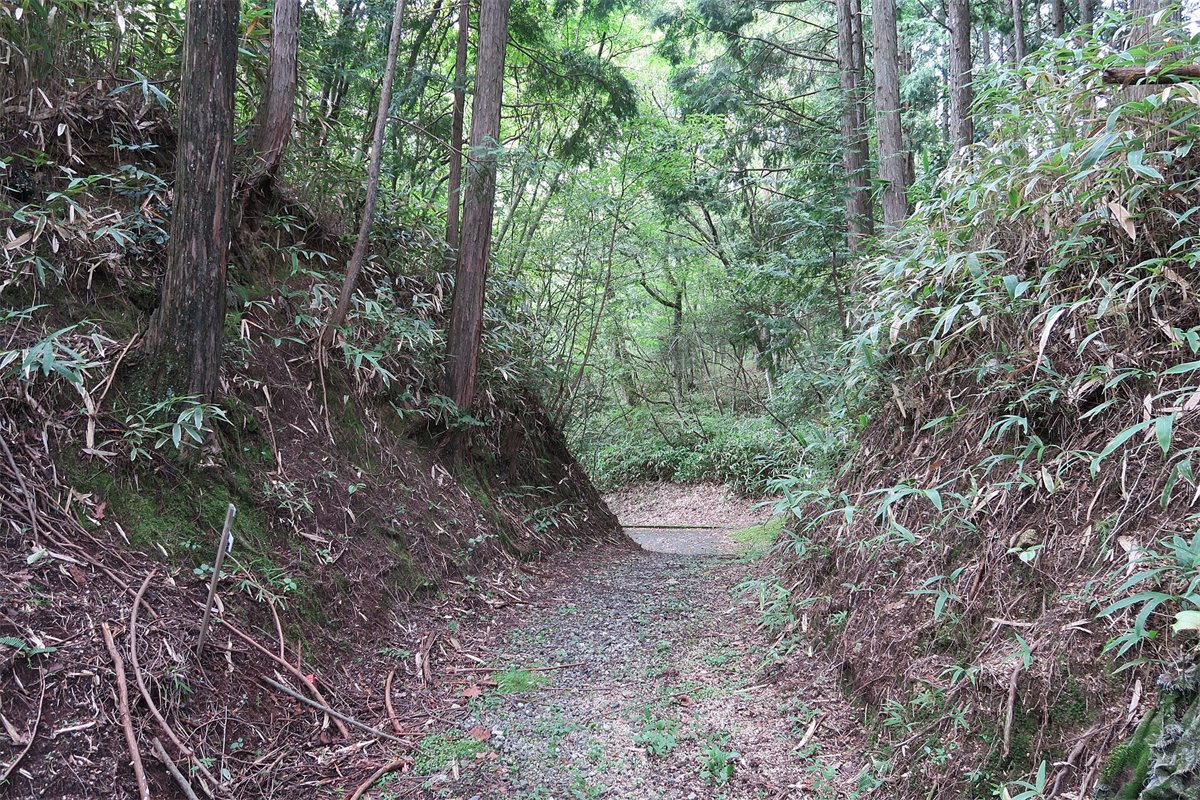
Image: Sakura Pass, on the border between Kōka in Shiga Prefecture and Iga in Mie Prefecture. Wikimedia Commons (photo: Motokoka, CC BY-SA 4.0)
"The Escape Through Iga," Yet Only About 20 km in Iga
Despite the name, the stretch inside Iga Province (around today's Iga City, Mie Prefecture) was only a small part of the journey. By Fujita's estimate, the whole journey from Sakai to Mikawa was a little over 200 km (about 125 miles). On the Sakura Pass route, only about 20 km (12 miles) of it lay inside Iga, roughly one tenth of the total.
Most of the journey ran through Yamashiro (southern Kyoto Prefecture), Ōmi (Shiga Prefecture) and Ise (northern Mie Prefecture), and across the waters of Ise Bay.
It's called the escape through Iga, but Iga was only about a tenth of it!
Indeed. That the name and the facts differ a little is part of what makes this story interesting.
Where Did He Board the Ship, and Where Did He Land?
The records disagree about where he boarded the ship in Ise [Debated]. The Ishikawa Tadafusa Tomegaki says Nago (today's Suzuka, Mie Prefecture), while the Mikawa Monogatari and the Tokugawa Jikki say Shiroko (also in Suzuka). An explanation by Mie Prefecture also notes two theories, "Shiroko and Wakamatsu" and "Nago and Yokkaichi," and says nothing can be stated for certain.
Where he came ashore in Mikawa, on the other hand, is recorded as Ōhama (Hekinan, Aichi Prefecture) in the Ietada Nikki, written at the time [Fact: Ietada Nikki].
How the Records Describe the Route
Here is how the main records describe the route:
| Record (when written) | Places passed | Ship |
| Ietada Nikki (a diary from the time) | Says only "by way of Iga and Ise" | Came ashore at Ōhama |
| Shinchō Kōki (a chronicle later compiled by Nobunaga's retainer Ōta Gyūichi) | By way of Ujitawara | From Kuwana to Atsuta (does not match the other records) |
| Mikawa Monogatari (around 1626) | Iga Province | Boarded at Shiroko, landed at Ōno (Tokoname, Aichi Prefecture) |
| Ishikawa Tadafusa Tomegaki (early Edo period) | Ujitawara, Shigaraki, Marubashira, Tsuge, Kabuto, Seki, Yokkaichi | Boarded at Nago, landed at Ōhama |
| Tokugawa Jikki (completed 1843) | Ujitawara, Shigaraki, Otogi Pass, Tsuge, Kabuto | Boarded at Shiroko, landed at Ōhama |
Did He Pass Through Nara (Yamato)?
The Tōdaiki, a chronicle from the early Edo period, says that Ieyasu took the "Yamato road" (the road through today's Nara Prefecture) and stopped at Takada Castle (Yamatotakada, Nara Prefecture) [Legend: Tōdaiki]. Among the copies of old documents collected by the Tokugawa shogunate, there is also a letter from Ieyasu that begins with the words "when I crossed Yamato this time." Based on such records, some argue that Ieyasu passed through Nara, and the theory has been reported in Japanese newspapers [Debated]. The exact route, and how to evaluate the documents cited as evidence, still need study. The maps in this article follow the route in the Ishikawa Tadafusa Tomegaki.
How Many Days Did It Take? Schedule and Distance
Here is the schedule reconstructed by Fujita Tatsuo and others from the Ishikawa Tadafusa Tomegaki [Widely accepted]. The distances are the numbers of ri (a traditional Japanese unit of distance) given in the record. The kilometer figures assume about 3.9 km per ri and are only a guide, not exact measurements of the distance walked.
| Date | Places passed and overnight stops | Distance |
| June 21 (2nd day) | Leaves Sakai, passes Son’enji and Kusauchi, and crosses the Kizu River. Stays at the residence of the Yamaguchi family in Ujitawara | 13 ri (about 50 km / 31 miles) |
| June 22 (3rd day) | From Ujitawara through Asamiya to Ogawa in Shigaraki; stays at the residence of the Tarao family | 6 ri (about 23 km / 14 miles) |
| June 23 (4th day) | From Ogawa to Marubashira and Tsuge in Iga. Enters Ise over Kabuto Pass and goes on to Seki, Kameyama and Yokkaichi. Boards a ship at Nago | 17 ri to Yokkaichi (about 66 km / 41 miles) |
| Night of June 23 to June 24 (5th day) | Spends the night on the ship and lands at Ōhama in Mikawa. Reaches Okazaki Castle on June 24 | At sea |
The party covered about 50 km on the first day, a shorter 23 km or so on the second, and as much as 66 km on the third. The historian Imatani Akira, as introduced by Fujita, suggested that on the second day the party cautiously stopped at Ogawa to judge the situation in northern Iga, and on the third day, finding no enemies, pushed on as far as it could.
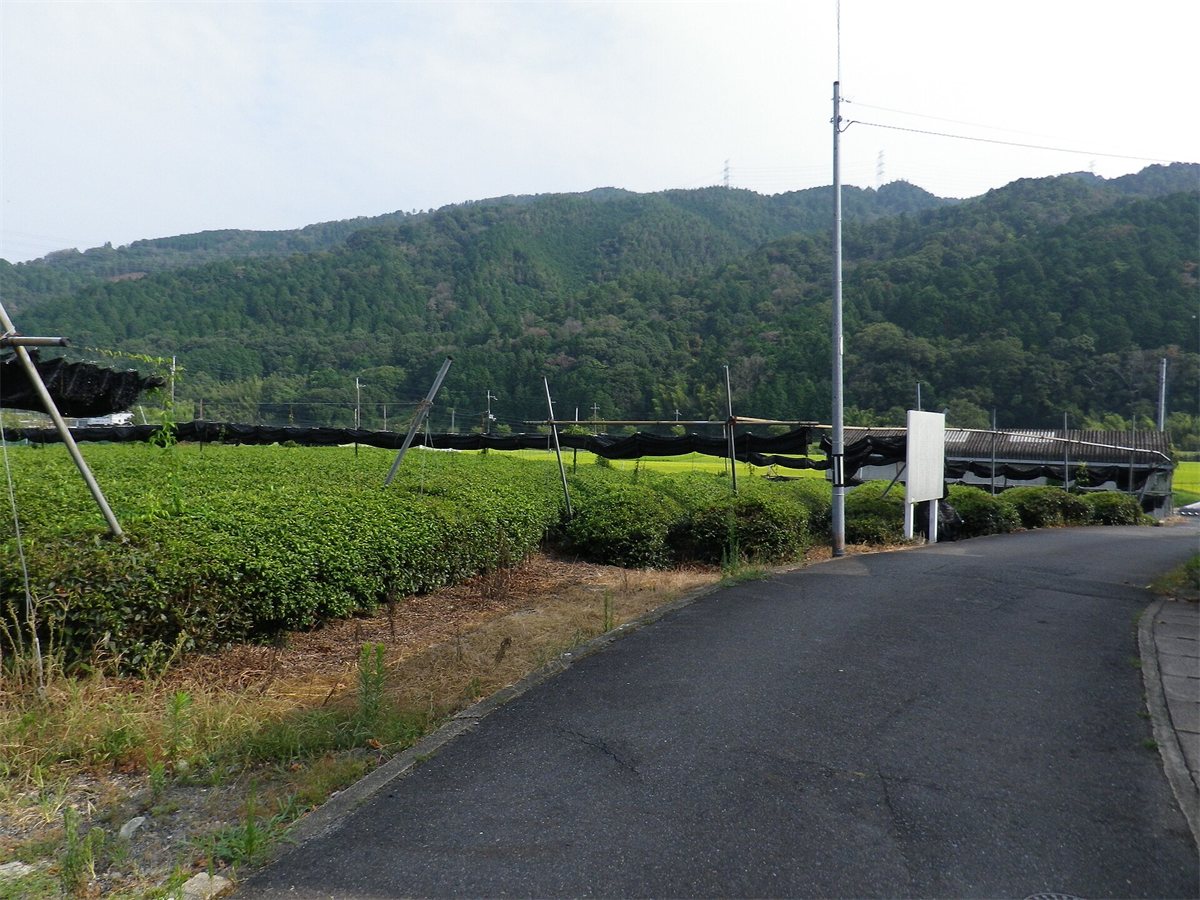
Image: The area of the Yamaguchi family's castle site, where Ieyasu is said to have stayed on the first night (Ujitawara, Kyoto Prefecture). Wikimedia Commons (photo: officeshema, CC BY 3.0)
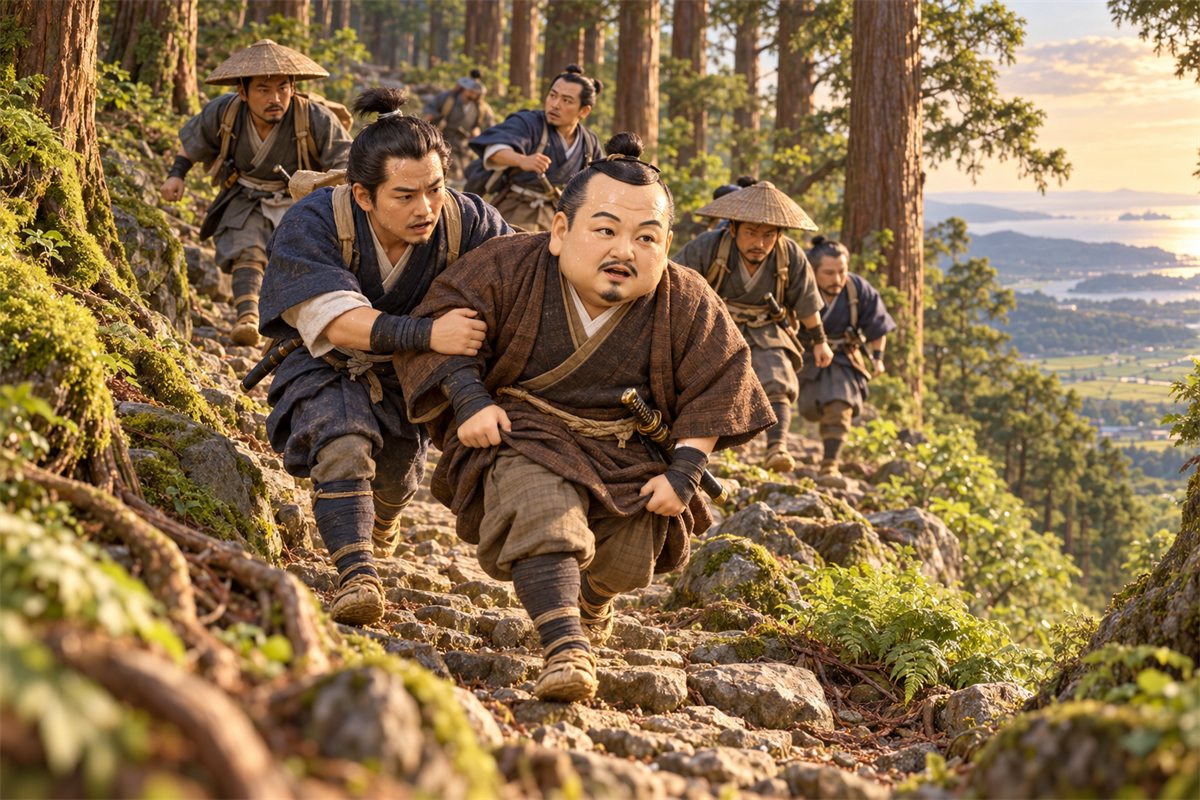
Image: Ieyasu's party hurrying along the mountain road over Kabuto Pass
When Did He Reach Mikawa?
The records also disagree about when he arrived in Mikawa.
| Record | Landing in Mikawa | Arrival at Okazaki |
| Ietada Nikki (a diary from the time) | The entry for the 4th day (June 23) says he came ashore at Ōhama | Not recorded |
| Ishikawa Tadafusa Tomegaki and Fujita's reconstruction | Late on the night of June 23 or early on June 24 | June 24 (5th day) |
| Tokugawa Jikki (completed 1843) | Reached Shiroko in Ise on the 6th day (June 25) and sailed from there | The 7th day (June 26) |
The shogunate's Tokugawa Jikki says he returned to Okazaki on the 7th day, but this does not match the Ietada Nikki, written at the time. The Okazaki Shishi (history of Okazaki City, 1934) also notes that some books give the 7th but follows the Ietada Nikki. The Ietada Nikki records the landing at Ōhama in its entry for the 4th day of the 6th month (June 23). Fujita and others reconstruct the landing as late on June 23 or early on June 24 and the return to Okazaki as June 24. The records differ on the schedule [Debated].

More than 200 km in about three days from Sakai! By car today it's nothing, but back then it was on foot, on horseback and by ship.
And on roads where they could be attacked at any moment. Next, let us see why they chose such a route.
Why Did Ieyasu Flee Through Iga? Reasons and Dangers
Why Was Ieyasu in Sakai?
Earlier in 1582, after the war that destroyed the Takeda family, Nobunaga had given Ieyasu the province of Suruga (Shizuoka Prefecture). To thank him, Ieyasu visited Nobunaga at Azuchi Castle in the 5th month of Tenshō 10, together with Anayama Baisetsu. Nobunaga told Ieyasu to take his time and see the sights of Kyoto, Osaka, Nara and Sakai, and assigned his aide Hasegawa Hidekazu as his guide [Fact: Shinchō Kōki]. Ieyasu entered Sakai on the 29th day of the 5th month, and on the 1st day of the 6th month (June 20) he was entertained at a tea gathering [Fact: diary of Uno Mondo].
Where Did He Hear the News?
On the morning of June 21, Ieyasu left Sakai for Kyoto [Fact: diary of Uno Mondo]. Where he received the news of the Honnō-ji Incident differs from record to record [Debated]:
- On the way to Kyoto, near Iimoriyama in Kawachi (Shijōnawate and Daitō, Osaka Prefecture): the Ishikawa Tadafusa Tomegaki and other records. They say that Honda Tadakatsu, who had gone ahead toward Kyoto, met the Kyoto merchant Chaya Shirōjirō coming from the city, and turned back to tell Ieyasu
- In Sakai: the Shinchō Kōki, the Mikawa Monogatari, the letters of the Jesuit missionary Luís Fróis, and others
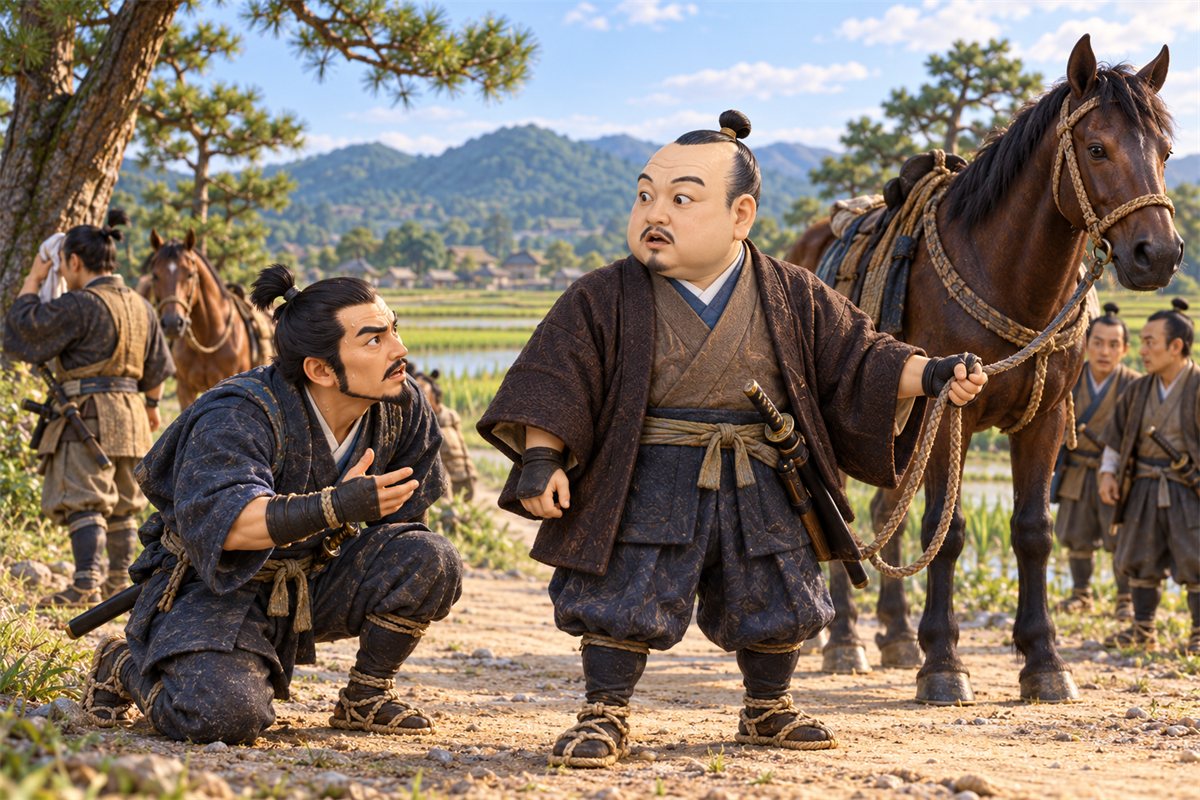
Image: Ieyasu hearing the news of the Honnō-ji Incident (a story told in the Ishikawa Tadafusa Tomegaki and other records) [Legend]
Did Ieyasu Plan to Go to Chion-in and Commit Seppuku?
A well-known story says that when Ieyasu heard the news, he declared he would go to Chion-in temple in Kyoto and cut his belly to follow Nobunaga in death, and that Honda Tadakatsu and others persuaded him to return to Mikawa instead [Legend].
Among the records we checked, this story appears in the Ishikawa Tadafusa Tomegaki and also in the shogunate's Tokugawa Jikki (1843). It does not appear in the Mikawa Monogatari (around 1626), written by Ieyasu's retainer Ōkubo Tadataka.
Why Was It So Dangerous?
There were three main reasons why Ieyasu's party was in danger:
- Too few men: he had only thirty-odd attendants, not an army ready to fight
[Widely accepted] - The main roads were in Akechi hands: the major highways around Kyoto and Ōmi (Shiga Prefecture) were controlled by Akechi Mitsuhide's forces
[Widely accepted] - "Hunting" fleeing warriors: in times of war, local samurai, villagers and bandits sometimes attacked warriors on the run to take their swords and belongings (ochimusha-gari). Anayama Baisetsu, who had been in Sakai with Ieyasu, lost his life on the way home
[Fact: Ietada Nikki]
Iga was also a special case. Nobunaga had attacked and conquered Iga only the year before, in 1581 (the Tenshō Iga War) [Fact: Shinchō Kōki], so for Ieyasu, Nobunaga's ally, it was hardly a friendly land. Fujita cites the Seishū Gunki, an Edo-period record, which says that right after the Honnō-ji Incident an uprising broke out in Iga against castles held by Nobunaga's side.
Why Did He Choose This Route?
Ieyasu still chose this route, it is thought, because beyond Iga lay Ise (northern Mie Prefecture), where Nobunaga's son Oda Nobukatsu and other Oda forces held power. From Ise, a ship across Ise Bay would take him quickly to Mikawa [Widely accepted].
He also had connections with the samurai of Shigaraki and Kōka (Kōka, Shiga Prefecture). Edo-period records say that his guide Hasegawa Hidekazu was on good terms with Tarao Mitsutoshi of Shigaraki and asked him for help [Legend].
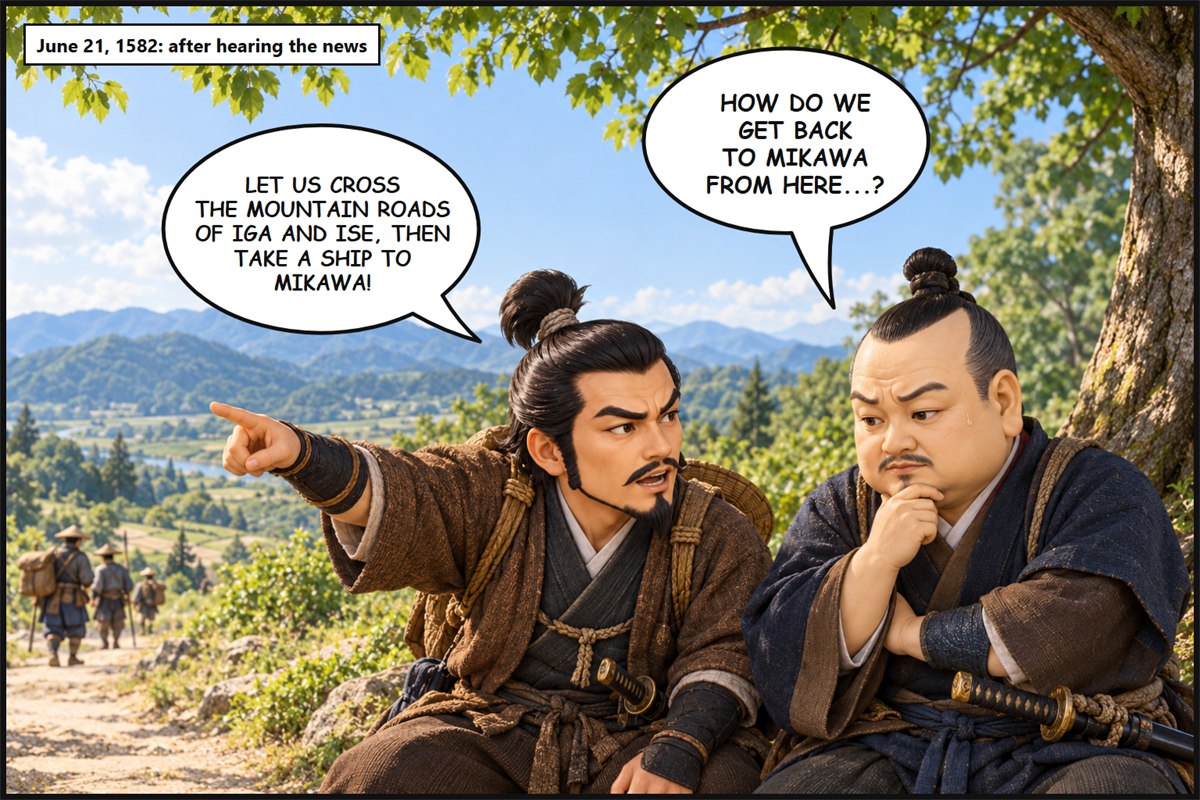
Image: Ieyasu and Honda Tadakatsu deciding the way home
Crossing unknown mountain roads with so few men... that must have been nerve-racking for them.
That is exactly why help from people who knew the roads mattered. Next, let us look at who traveled with Ieyasu and who helped him.
Who Went with Ieyasu? Companions and Helpers
The Retainers Who Went with Him
The Ishikawa Tadafusa Tomegaki lists 34 names of men who attended Ieyasu in Sakai. Written in the early Edo period, it is regarded as a relatively reliable later account [Widely accepted]. It is not a complete roster of the whole party, but it shows who the main retainers were. All four of the men later called the "Four Heavenly Kings of the Tokugawa" were there [Widely accepted].
| Name | Who he was |
| Sakai Tadatsugu | The most senior of Ieyasu's retainers; one of the Four Heavenly Kings |
| Honda Tadakatsu | A famous spearman; one of the Four Heavenly Kings |
| Sakakibara Yasumasa | One of the Four Heavenly Kings |
| Ii Naomasa | A young retainer, then aged 22 by the traditional count; one of the Four Heavenly Kings |
| Ishikawa Kazumasa | A senior retainer ranked alongside Sakai Tadatsugu |
| Ōkubo Tadachika | Later a senior official of the Tokugawa shogunate; father of Ishikawa Tadafusa, who wrote the Ishikawa Tadafusa Tomegaki |
| Hattori Masanari (Hanzō) | A spear-wielding commander who led the men of Iga |
| Watanabe Moritsuna | A warrior nicknamed "Spear Hanzō" |
The list also includes Kōriki Kiyonaga, Suganuma Sadamasa, Abe Masakatsu, Ōkubo Tadasuke, Nagai Naokatsu and others. But the list was written in the early Edo period. Besides the retainers, Hasegawa Hidekazu and servants seem to have been with the party, and the total number of people is not known [Unknown].
The People Who Helped Ieyasu
| Person | What he did | Reliability |
| Hasegawa Hidekazu (Nobunaga's aide) | Assigned by Nobunaga as Ieyasu's sightseeing guide. After the Honnō-ji Incident he stayed with Ieyasu and acted as a go-between with the samurai of Shigaraki and Kōka | Sightseeing guide: [Fact: Shinchō Kōki]; go-between: [Legend] |
| Chaya Shirōjirō (a Kyoto merchant) | Brought the news of the Honnō-ji Incident | [Legend] (told in many Edo-period records) |
| The Yamaguchi family (a samurai family of Ujitawara; its head was 山口光広) | Hosted the party on the first night | [Widely accepted] |
| Tarao Mitsutoshi (a samurai of Shigaraki) | Hosted the party on the second night; his son guided them as far as Marubashira in Iga | Lodging: [Widely accepted]; guiding: [Legend] |
| Wada Hachirō (和田定教, a samurai of Kōka) | A copy of Ieyasu's sworn oath dated July 1 (the 12th day of the 6th month) shows that he sent hostages to Ieyasu. His exact role as a guide is Fujita's inference | Hostages: [Fact] |
| Kadoya Shichirōjirō (a shipping merchant from Ise) | Provided a ship | [Legend] |
Source Box ②: Ieyasu's Sworn Oath to Wada Hachirō (Copy)
Source
A copy of a kishōmon (a written oath sworn before the gods and buddhas) dated the 12th day of the 6th month of Tenshō 10 (July 1, 1582), from Tokugawa Ieyasu to Wada Hachirō (和田定教), a samurai of Kōka. It survives in the Wada family documents and in a collection of old documents kept by the Tokugawa shogunate (listed in the Tokugawa Institute for Forestry History's catalog of Ieyasu's documents; original text from Fujita Tatsuo's paper)
Original (excerpt)
「今度質物早速被出候段、祝着之事」「御身上向後見放申間敷候」
Translation
"I am pleased that you promptly provided hostages on this occasion." "Hereafter, I will not abandon you."
What it tells us
The copy records Ieyasu's thanks to Wada Hachirō, a samurai of Kōka, for promptly providing hostages, and his promise not to abandon him in the future
In his 2005 paper, Fujita looked at the 31 documents related to the escape through Iga in the Aichi Kenshi (history of Aichi Prefecture). Of these, he gives most weight to two documents written by Ieyasu at the time, both handed down in families of Kōka samurai: this oath, and a draft of a letter of June 23 (the 4th day) to Gamō Katahide and his son Ujisato, who were guarding Azuchi Castle, saying that Ieyasu would without fail punish Mitsuhide (kept by the Yamanaka family of Kōka). Fujita also notes that he could not confirm any documents from the time handed down in the families of the Iga men who are said to have protected Ieyasu.
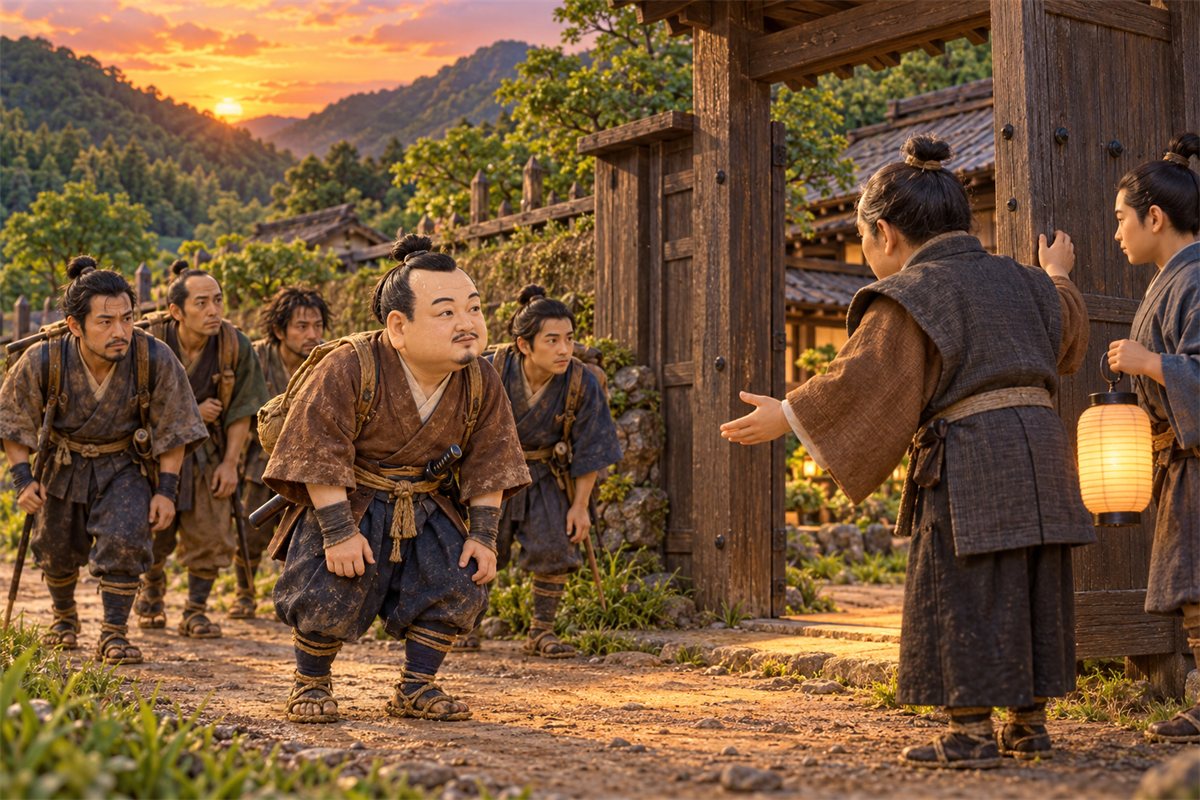
Image: Ieyasu's party welcomed at a residence in Shigaraki
To learn what kind of groups the samurai of Kōka and Iga formed, see our article "Were Ninjas Real?", which also covers shinobi groups across Japan.
Did Ninja Protect Ieyasu? What Did Hattori Hanzō Do?
The most famous version of the escape through Iga says that Hattori Hanzō (Masanari) gathered the men of Iga, the warriors often pictured today as ninja, and protected Ieyasu. The list in the Ishikawa Tadafusa Tomegaki includes Masanari among Ieyasu's attendants [Widely accepted]. But the stories that he guided the party or gathered the men of Iga are told in detail only in later records [Legend].
As we saw above, one form of support documented at the time is the hostages sent to Ieyasu by Wada Hachirō, a samurai of Kōka. For a record-by-record comparison of what Hanzō did, see our article on Hattori Hanzō (What did he do during the escape through Iga?).
Is the Escape Through Iga a Myth? Records vs. Later Stories
If you ask whether the escape through Iga is a myth, the answer is that "the escape itself really happened". The Ietada Nikki, written at the time, records that Ieyasu returned to Ōhama in Mikawa by way of Iga and Ise [Fact: Ietada Nikki]. The missionary Luís Fróis also reported in a letter the following year that Ieyasu made it through dangerous roads.

Image: Matsudaira Ietada writing his diary
However, many of the famous stories about the escape were written down decades or even centuries later. Not every later story is invented, but it matters to read them with an eye on which record tells them.
When Were the Records Written?
| Type of record | Main records | What they tell us, and cautions |
| Records from the time | The Ietada Nikki; the diary of Uno Mondo of the Honganji temple; Fróis's letter; Ieyasu's letters and oath (surviving as drafts or copies) | That the escape happened, that Anayama Baisetsu died, and that a Kōka samurai sent hostages to Ieyasu. They say almost nothing about the route or the number of people |
| Records compiled a little later | The Shinchō Kōki; the Mikawa Monogatari (around 1626); the Ishikawa Tadafusa Tomegaki | Detailed routes and names. They include stories handed down in the families of those who made the journey, and they sometimes contradict one another |
| Later records | Family histories of the Iga men (several exist, including one said to date from 1726); the Kansei Chōshū Shokafu (completed 1812); the Tokugawa Jikki (1843) | Detailed accounts of what the Iga men and various families did. Some were written to record a family's merits, and some dates do not match the records from the time |
Where Do the Famous Stories Come From?
| Famous story | Records that tell it | Reliability |
| Ieyasu said he would go to Chion-in and commit seppuku | The Ishikawa Tadafusa Tomegaki, the Tokugawa Jikki and others (not in the Mikawa Monogatari) | [Legend] |
| Chaya Shirōjirō handed out silver to clear the way | The Chaya family's history; the Tokugawa Jikki | [Legend] |
| Honda Tadakatsu pulled in a boat loaded with brushwood on the Kizu River, crossed, and then smashed the boat | The Tokugawa Jikki (1843) | [Legend] |
| The party was served sekihan (red rice for celebrations) at the Tarao residence | The Ishikawa Tadafusa Tomegaki and others | [Legend] |
| Hattori Hanzō gathered the men of Iga to protect Ieyasu | Family histories of the Iga men; the Kansei Chōshū Shokafu and others | [Legend] |
| Ieyasu used money to get through dangerous places | Fróis's letter (from the time, though Fróis did not see it himself); the Ishikawa Tadafusa Tomegaki also says Ieyasu handed out money | Reported in a letter from the time |
In a letter to the Society of Jesus dated February 13, 1583 (a Japanese translation is printed in the Dai Nihon Shiryō, part 11, volume 1), the missionary Luís Fróis reported that because Ieyasu had plenty of soldiers and money, he was able to get through by threats and gifts. Fróis was not there himself, but his letter was written the year after the escape, making it a record from the time.
"He Never Actually Went Through Iga"?
The stretch inside Iga Province was only about 20 km, or about 5 km on the Kōka route (see the route section). That is why some say "it was really an escape through Kōka." But both the Sakura Pass and Otogi Pass routes pass Marubashira and Tsuge in northern Iga, and even on the Kōka route, Tsuge, the last place before Kabuto Pass, is in Iga. It is going too far to say he never went through Iga at all.
"It Wasn't Really That Dangerous"?
Fujita argues that on any of the routes he considered, the party could have crossed Iga Province within half a day, and that the hardships of this stretch may not have been as great as traditionally claimed. He also points to the samurai of Kōka and Iga who gathered around Ieyasu to protect him.
But this view concerns only the stretch inside Iga. As the death of Anayama Baisetsu on his way home shows, the journey as a whole, crossing hostile country with only a few men, was a matter of life and death.
So it's no myth, but parts of the story have grown bigger over time!
Just so. If we look at when and by whom each record was written, we can get closer to what really happened.
What Happened to Anayama Baisetsu?
Anayama Baisetsu (personal name Nobutada) was a general from the family of Takeda Shingen. His mother was Shingen's sister and his wife was Shingen's daughter [Widely accepted]. In 1582 he left the Takeda family and went over to the Oda–Tokugawa side, visited Nobunaga at Azuchi Castle with Ieyasu, and came to Sakai as well [Fact].
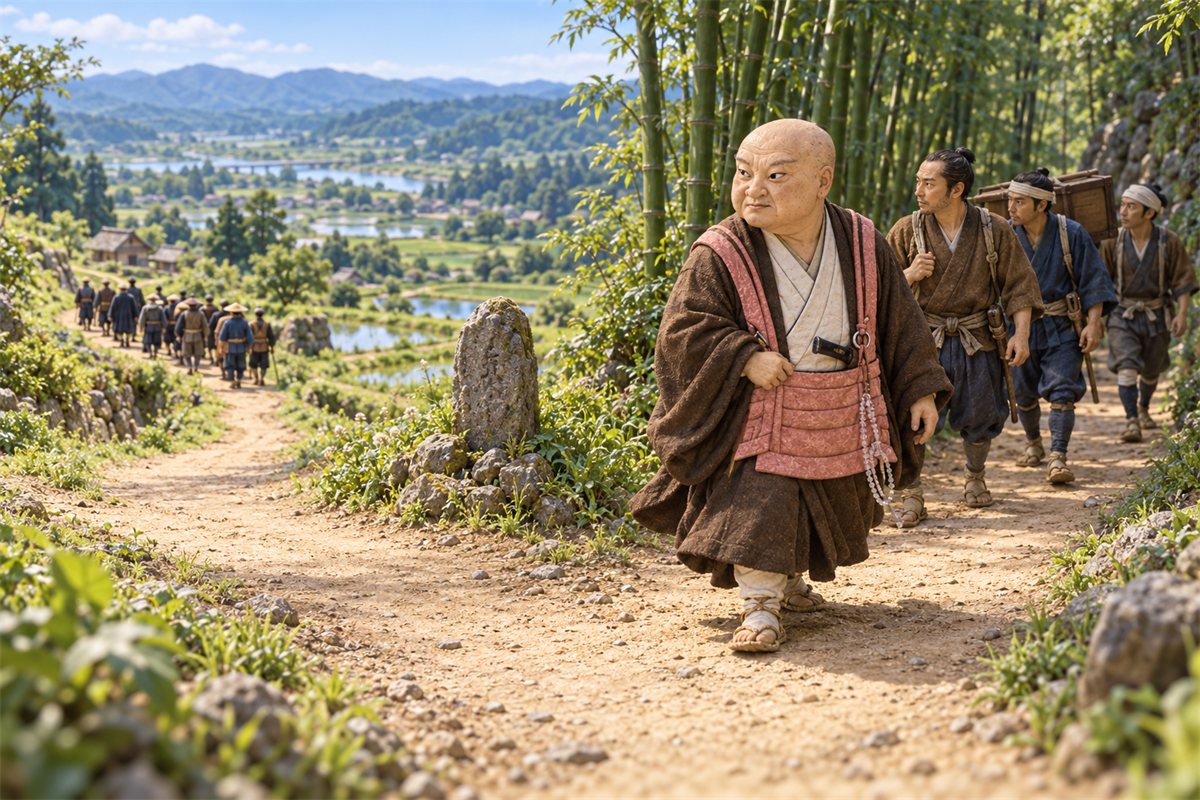
Image: Anayama Baisetsu taking a different road from Ieyasu's party
After the Honnō-ji Incident, Baisetsu set off separately from Ieyasu's party, a little later and with only his own retainers. The Mikawa Monogatari says he fell behind because he distrusted Ieyasu, while Fróis says he set out late and had few retainers [Debated].
That Baisetsu died on his way home is confirmed by records from the time [Fact]. How he died, however, differs from record to record [Debated]. The Ietada Nikki says he "cut his belly," while the Mikawa Monogatari and Fróis's letter say he was attacked and killed by an ikki band (an armed group of local samurai and villagers). The place is said to be around Ujitawara (Kyoto Prefecture) or around the Kizu River (Kyōtanabe, Kyoto Prefecture) [Debated].
Reisenji temple in Shimizu Ward, Shizuoka City, keeps a portrait of Baisetsu that his son had painted the year after his death. It is designated a cultural property of Shizuoka Prefecture.
They were in Sakai together, but their fates split on the road home...
Indeed. Help from people who knew the roads, and quick decisions, likely played a part in Ieyasu's survival.
What Did Ieyasu Do After the Escape?
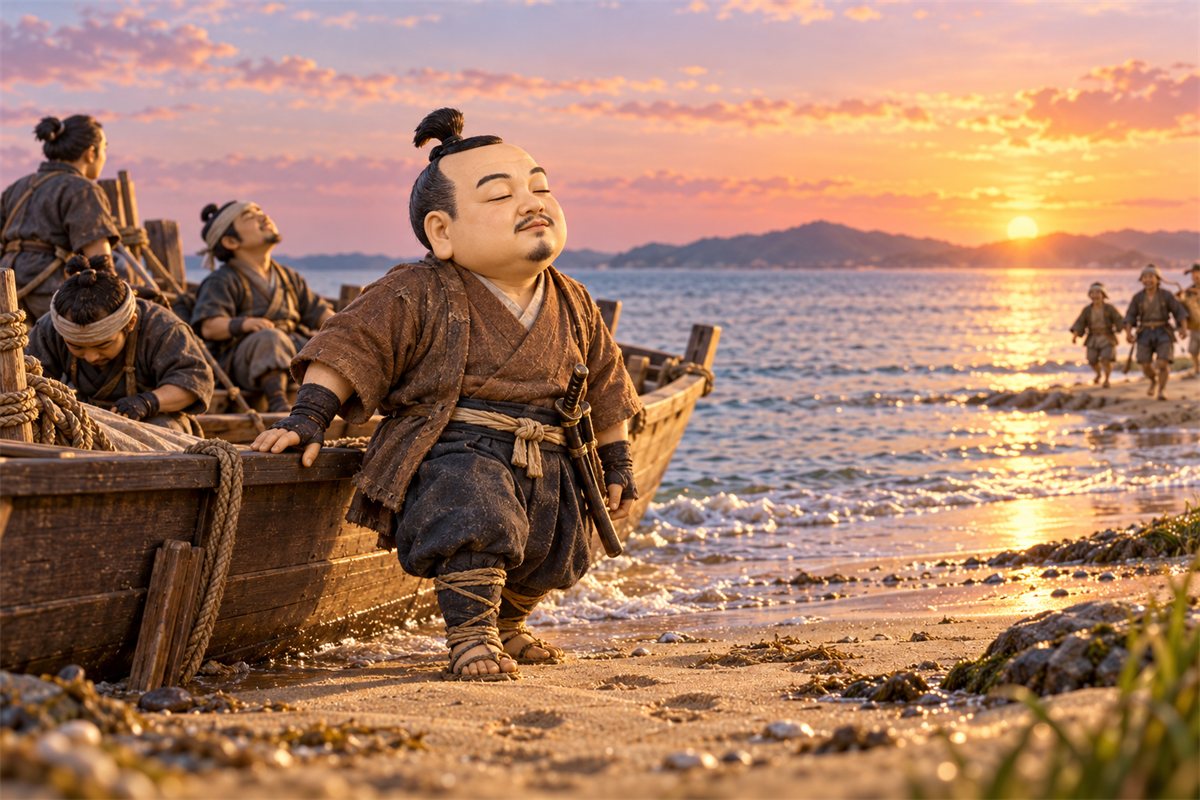
Image: Ieyasu arriving by ship at Ōhama in Mikawa
Ieyasu landed at Ōhama between the night of June 23 and the early morning of June 24 and returned to Okazaki Castle on June 24 [Widely accepted]. He hurried to prepare to strike Mitsuhide, and on July 3 (the 14th day of the 6th month) he led his army as far as Narumi in Owari (Midori Ward, Nagoya) [Fact]. A letter Ieyasu wrote that day says he was going up to Kyoto to mourn "the lord," Nobunaga. Given his military preparations, this is understood as an intention to avenge Nobunaga.
But on July 2 (the 13th day of the 6th month of Tenshō 10), the day before, Hashiba (later Toyotomi) Hideyoshi, who had rushed back from western Japan, had already defeated Mitsuhide at the Battle of Yamazaki [Fact]. On hearing that Mitsuhide had been killed, Ieyasu is said to have turned his army back [Widely accepted].
After this, Ieyasu sent troops into Kai and Shinano (Yamanashi and Nagano Prefectures), where Oda authority had collapsed after Nobunaga's death, and greatly expanded his lands while fighting the Hōjō family and others over them. This struggle is called the Tenshō-Jingo War.
It is also known that men of Kōka and Iga later served the Tokugawa family. Stories linking their employment to their service during the escape through Iga appear in later family histories and similar records [Legend]. For the rest of Ieyasu's life, see our article on Tokugawa Ieyasu.
Can You Follow the Route Today? Related Sites
Along the route of the escape through Iga, monuments and castle sites still stand, and there are walking courses that trace the route. Note, though, that for some places Ieyasu's visit can be confirmed from the records, while for others it is only a local tradition.
| Place (today's address) | What you can see | Connection with Ieyasu |
| Kyōtanabe (Kyoto Prefecture) | Monuments marking the route of Lord Ieyasu's escape through Iga, in front of Kintetsu Miyamaki Station and at Kannonji temple | Crossed the Kizu River around Kusauchi [Widely accepted] |
| Ujitawara (Kyoto Prefecture) | The site of Yamaguchi Castle; a town walking course along the Shigaraki Road, following Ieyasu's route | Stayed the first night at the Yamaguchi residence [Widely accepted] |
| Site of Ogawa Castle (Shigaraki, Kōka, Shiga Prefecture) | The castle site of the Tarao family | Stayed the second night at the Tarao residence in Ogawa [Widely accepted] |
| Sakura Pass and Otogi Pass (on the border of Kōka and Iga) | Mountain pass roads; a monument stands at Otogi Pass | Which pass he used is debated [Debated] |
| Tokueiji temple (Tsuge, Iga, Mie Prefecture) | A temple where Ieyasu is said to have stopped. Letters of donation from the Tōdō family, lords of Iga in the Edo period, survive | The story of his visit: [Legend] |
| Kabuto (Kameyama, Mie Prefecture) | The site of Kabuto Castle | Entered Ise over Kabuto Pass [Widely accepted] |
| Shiroko and Nago (Suzuka, Mie Prefecture) | Port towns | Candidates for where he boarded the ship [Debated] |
| Ōhama (Hekinan, Aichi Prefecture) | A port town | Where he came ashore [Fact: Ietada Nikki] |
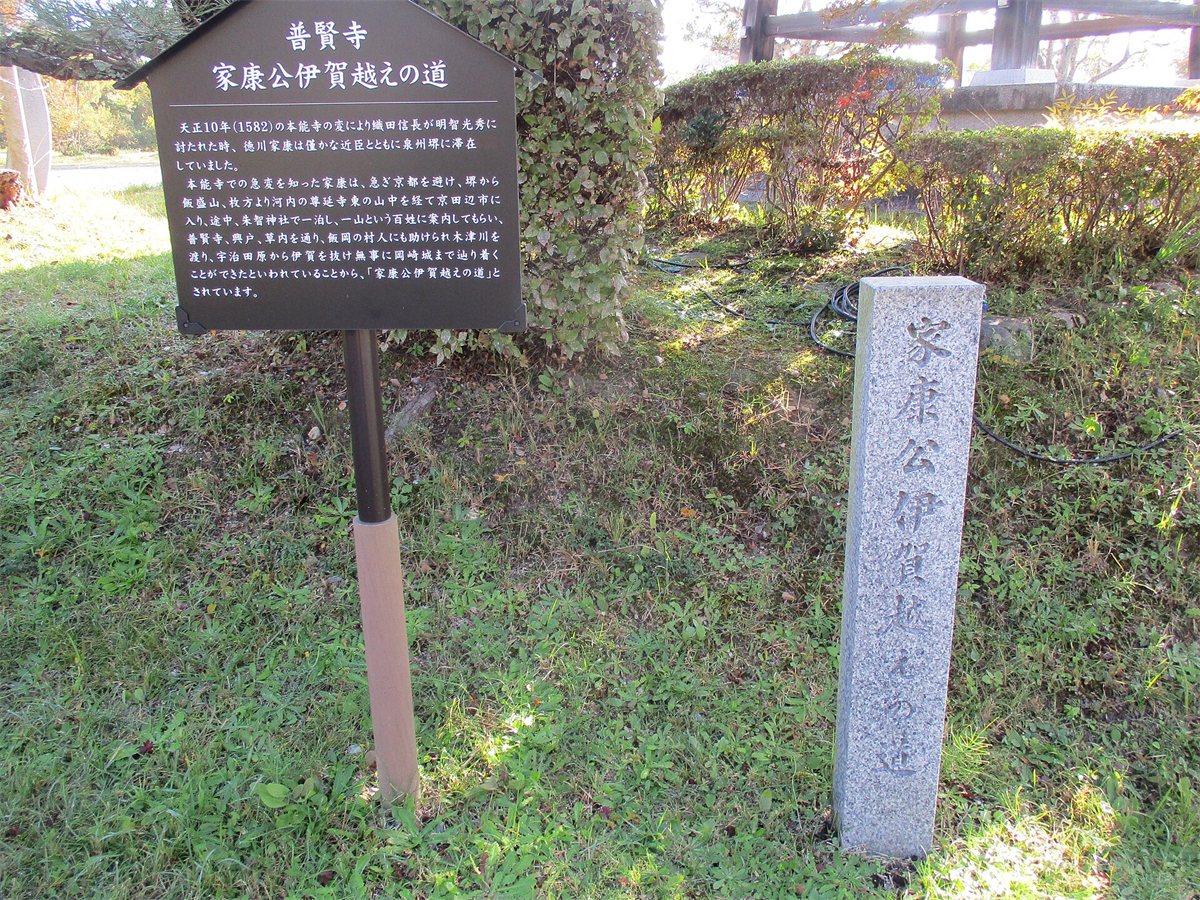
Image: The monument marking the route of Lord Ieyasu's escape through Iga, in the Fugenji area (Kannonji temple) of Kyōtanabe, Kyoto Prefecture. Wikimedia Commons (photo: Asset utilitist, CC0)
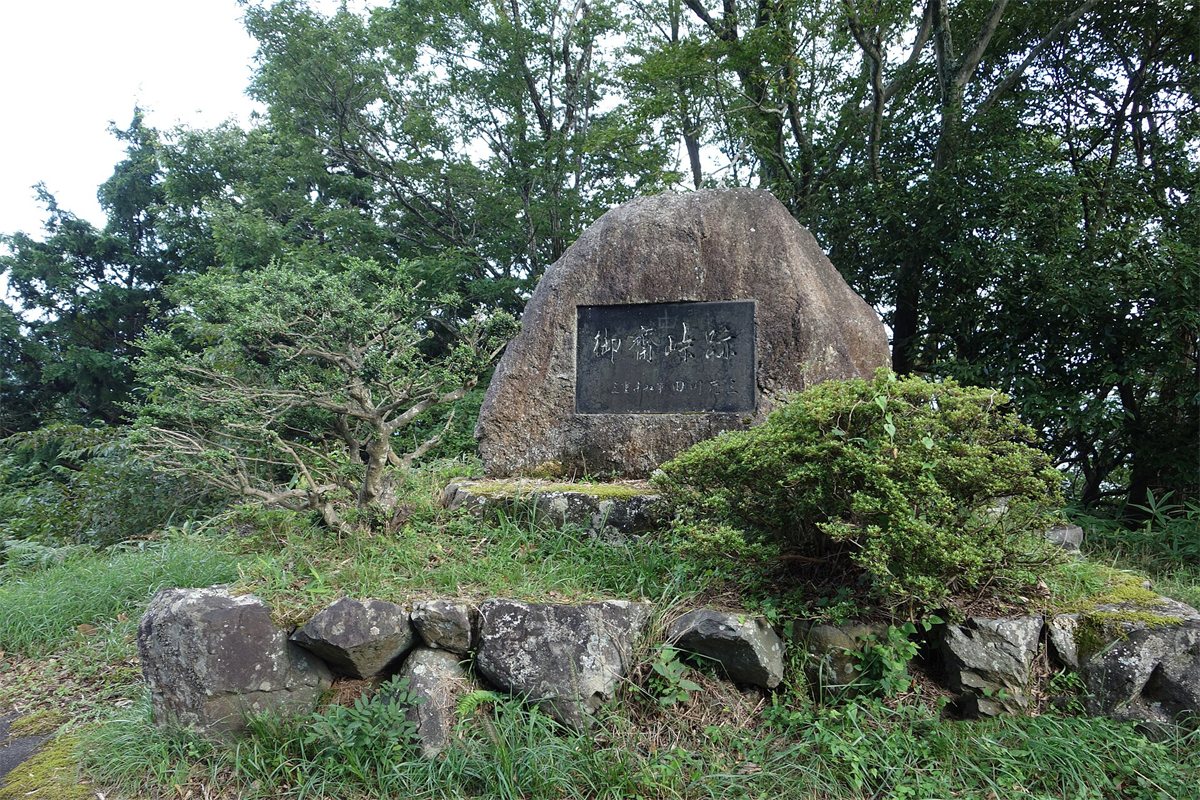
Image: The monument at Otogi Pass, on the border between Kōka in Shiga Prefecture and Iga in Mie Prefecture. Wikimedia Commons (photo: Motokoka, CC BY-SA 4.0)
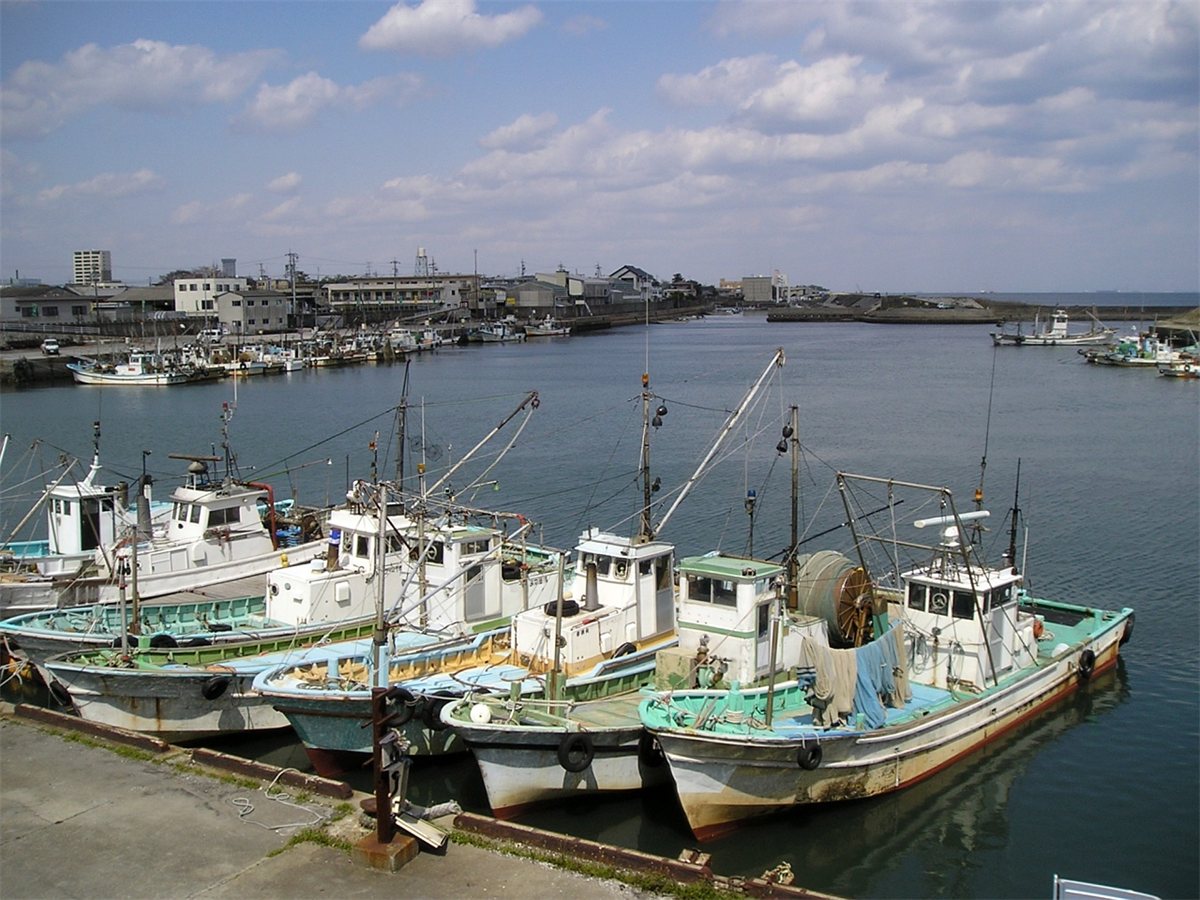
Image: Today's port at Shiroko (Suzuka, Mie Prefecture), one of the candidates for where Ieyasu boarded the ship. Wikimedia Commons (photo: Si-take., CC BY-SA 3.0)
FAQ
What does "Iga-goe" mean, and how do you pronounce it?
Iga-goe (pronounced "ee-gah-go-eh") means "crossing Iga." With the honorific Shinkun ("the divine lord," a title for Ieyasu after his death), it is also called Shinkun Iga-goe.
How far did Ieyasu travel, and how many days did it take?
A little over 200 km (about 125 miles) from Sakai to Mikawa, by Fujita Tatsuo's estimate. He is thought to have left Sakai on the morning of June 21, 1582, landed at Ōhama in Mikawa late on June 23 or early on June 24, and returned to Okazaki on June 24 (more).
Why is the escape through Iga so famous?
Because Ieyasu, who left Sakai with only a few men, crossed hostile country in just a few days with help from local people along the way and got home safely to Mikawa. It was made possible by the cooperation of the samurai of Shigaraki and Kōka and by quick decisions. The Ieyasu who survived would later found the Tokugawa shogunate.
Did ninja really protect Ieyasu?
The records from the time that we checked do not show this. Detailed accounts of Hattori Hanzō gathering the men of Iga to escort Ieyasu appear in later records. What a document from the time does show is that a samurai of Kōka sent hostages to Ieyasu as a pledge of support (more).
Is it related to the puppet play Igagoe Dōchū Sugoroku?
No. Igagoe Dōchū Sugoroku is an Edo-period puppet play (ningyō jōruri, also known as bunraku) based on a revenge killing at Kagiya-no-Tsuji in Iga Ueno (Iga City, Mie Prefecture) in 1634. It is a different event, more than 50 years after Ieyasu's escape.
Summary: What Was the Escape Through Iga?
The escape through Iga was Tokugawa Ieyasu's flight from Sakai after the Honnō-ji Incident in June 1582, through Iga and Ise and then by ship back to Mikawa. It really happened: the Ietada Nikki, a diary written at the time, records it.
According to the Ishikawa Tadafusa Tomegaki, the route ran from Sakai through Ujitawara, Ogawa in Shigaraki, and Marubashira and Tsuge in Iga, entered Ise over Kabuto Pass, and went by ship from Nago to Ōhama. Only about 20 km of it lay inside Iga, and there are three theories about how he crossed into Iga: by Sakura Pass, by Otogi Pass, or around Kōka.
The story that Ieyasu said he would go to Chion-in and commit seppuku, and the prominent role given to the men of Iga, come from later records. On the other hand, a document of Ieyasu from the time (surviving as a copy) shows that a samurai of Kōka sent him hostages and cooperated with him.
For related people, see our articles on Tokugawa Ieyasu, Hattori Hanzō, Honda Tadakatsu, Akechi Mitsuhide and Oda Nobunaga.
Compare the map with the records, and the true shape of the escape through Iga comes into view.
I'd like to walk over Sakura Pass and Otogi Pass someday!
Sources & How This Article Was Written
This article is based mainly on the following records and references:
- Records from the time: Matsudaira Ietada, Ietada Nikki (entry for the 4th day of the 6th month of Tenshō 10; printed in the Dai Nihon Shiryō, part 11, volume 1, and the Okazaki Shishi; text as quoted in a 2022 lecture by a museum curator in Hekinan City); the diary of Uno Mondo (from the Dai Nihon Shiryō, part 11, volume 1); Luís Fróis's letter dated February 13, 1583 (ibid.); copies of Ieyasu's oath (Wada family documents) and the draft of his letter (Yamanaka family documents), from Fujita Tatsuo's paper and the Tokugawa Institute for Forestry History's catalog of Tokugawa Ieyasu's documents (in Japanese)
- Later records: Ōta Gyūichi, Shinchō Kōki (Wikisource; available in English as The Chronicle of Lord Nobunaga, translated by J. S. A. Elisonas and J. P. Lamers, Brill, 2011); Ōkubo Tadataka, Mikawa Monogatari (Wikisource); the Ishikawa Tadafusa Tomegaki and the Tōdaiki (from the Dai Nihon Shiryō, part 11, volume 1); the Tōshōgū Gojikki (part of the Tokugawa Jikki; Wikisource)
- Studies (in Japanese; titles translated by us): Fujita Tatsuo, "Reconsidering the 'Shinkun Iga-goe'" (Aichi Kenshi Kenkyū, no. 9, 2005); Historiographical Institute, the University of Tokyo, Dai Nihon Shiryō, part 11, volume 1; Ōta Hiroshi, "Ōmi and Tokugawa Ieyasu ②: The Divine Lord's Crossing of Kōka and Iga" (COCOSHIGA, 2023); for the reading of the Toda-bon Mikawa-ki, we referred to the comparison of manuscripts in the blog "Shinobi no Yakata Ninja Column" (2024)
- Public sources (in Japanese; titles translated by us): Mie Prefecture, "Ieyasu's 'Iga-goe' and the Men of Kōka and Iga"; Sakai City Museum, "Tokugawa Ieyasu and Sakai, Seen Through the Museum's Collection"; Shizuoka Prefecture, "Portrait of Anayama Baisetsu" (Shizuoka Bunkazai Navi)
- Maps and images: the base maps are GSI Tiles from the Geospatial Information Authority of Japan, with routes added by Samurai Lord. The photos of Sakura Pass and the Otogi Pass monument (Motokoka, CC BY-SA 4.0), the area of Yamaguchi Castle (officeshema, CC BY 3.0), the Kannonji monument (Asset utilitist, CC0) and Shiroko Port (Si-take., CC BY-SA 3.0) are from Wikimedia Commons. The manga panel and illustrations are original works by Samurai Lord
What the Labels Mean
[Fact]Confirmed by sources from the time ([Fact: …]names the source)[Widely accepted]A view widely accepted by researchers[Debated]Accounts, interpretations or ways of counting differ[Unknown]Not established from the sources we checked[Legend]Stories found in later records or traditions
We keep "what a record says" separate from "what actually happened."
This article was written by the Samurai Lord editorial team and is revised as new research and reader feedback come in. If you spot an error, please let us know through our contact form (in Japanese) and we will check and correct it.
Read in Japanese
This article is also available in Japanese: 伊賀越えとは?家康のルートや日数・メンバーを地図で解説!