Image: An illustration of Akechi Mitsuhide. All illustrations in this article are imaginative.
In 1582, one warlord attacked his own lord, Oda Nobunaga, at Honnō-ji Temple in Kyoto and brought down the most powerful man in Japan. His name was Akechi Mitsuhide. Yet only 11 days later, he was defeated by Hashiba (later Toyotomi) Hideyoshi and lost his life.
Mitsuhide is usually remembered as a traitor. But records from his own time also show a cultured man who cared for his retainers and loved poetry and the tea ceremony. This article covers how he died, why he turned on Nobunaga, his character, and his descendants—separating what records from his own time confirm from stories created later.
Key points are tagged: [Fact] confirmed by records from the period, [Widely accepted] supported by most historians, [Debated] competing theories, [Unknown] not known from any source, and [Legend], [Fiction], or [Folk belief] for later stories. A tag like [Fact: Shinchō Kōki] names the source.
.jpg)
I am Uesugi Kenshin. Today's subject is the man who struck down his lord, Nobunaga. But to dismiss him with the single word "traitor" would miss how many mysteries surround him.
.jpg)
I'm Date Masamune! Why did Lord Mitsuhide attack Lord Nobunaga? And what happened to him in the end?
.jpg)
Neither question has one settled answer. Let us separate what we know from what we do not.
What We Know (Key Points)
- Who was he? A warlord who served the shogun Ashikaga Yoshiaki and then Oda Nobunaga, who put him in charge of Sakamoto Castle in Ōmi (Shiga) and the province of Tanba (Kyoto)
[Fact] - How did he die? On July 2, 1582, he lost the Battle of Yamazaki to Hideyoshi; that night, while fleeing, he was most likely killed by local villagers hunting fugitives. Exactly who struck him and how is not clear
[Widely accepted] - Why did he rebel? Mitsuhide left no record explaining it, and the question is still open. A theory involving Nobunaga's policy on Shikoku has drawn attention
[Debated] - Descendants? No descendant through an unbroken male line can be confirmed. But his bloodline continues through his daughters, including Hosokawa Gracia
[Widely accepted]
Jump to the part you want to read:
- How did he die—where, and at whose hands?
- Why did he betray Nobunaga?
- What was he like? His character in his letters
- Does he have living descendants?
- His family crest
Who Was Akechi Mitsuhide? Names, Origins, and Basic Facts
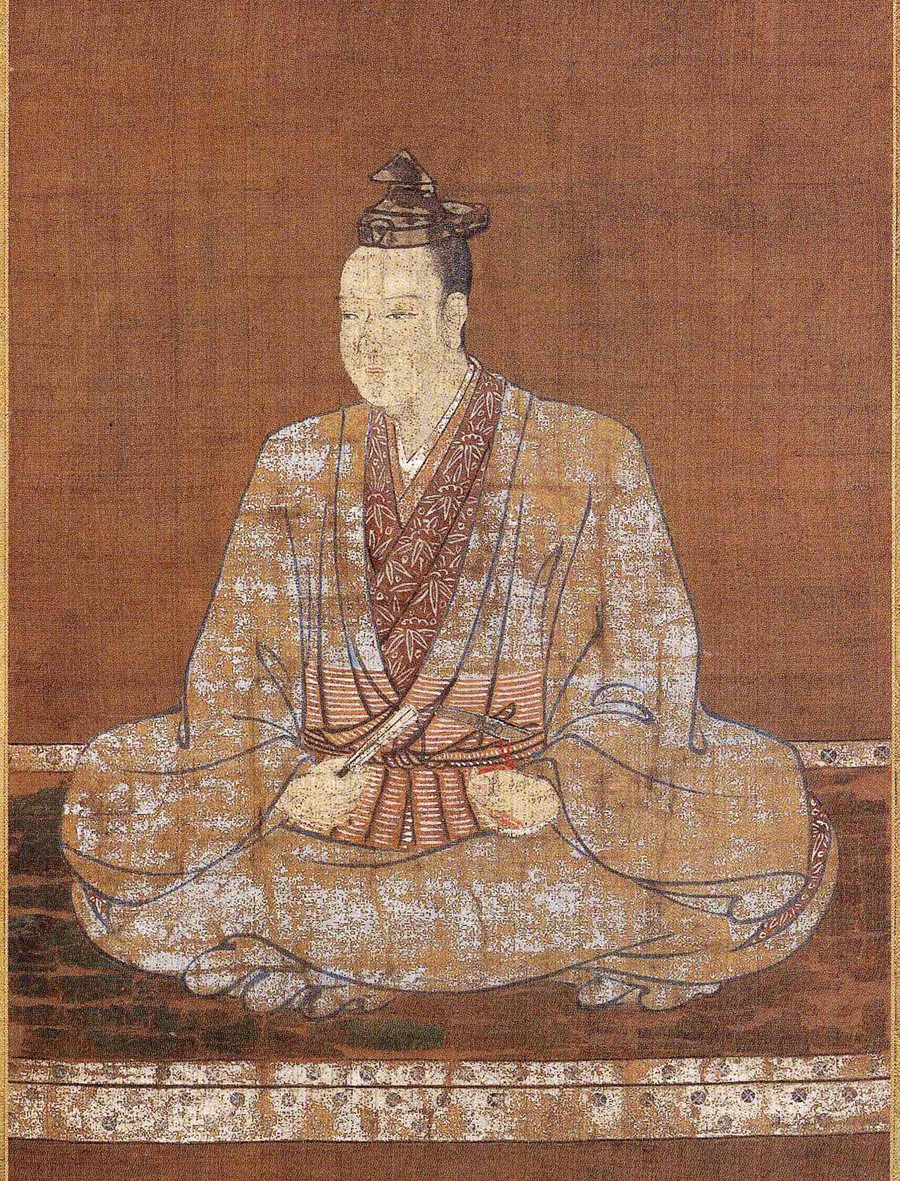
Image: Portrait of Akechi Mitsuhide (detail, Hontoku-ji Temple, Kishiwada, Osaka). It is said to be the only old portrait of him.
In a nutshell, Akechi Mitsuhide was "a warlord who served both the Ashikaga shoguns and Oda Nobunaga, rose high under Nobunaga, and then killed his lord in the Honnō-ji Incident."
Three Things That Show His Character
- He took care of his retainers: he held memorial services for 18 retainers killed in battle, naming each one—even the lowest in rank
[Fact: Saikyō-ji donation letter] - A man of culture: he often held linked-verse (renga) gatherings, and Nobunaga allowed him to host tea ceremonies
[Fact] - He could be ruthless: just before the burning of Mount Hiei, he ordered that a hostile village be "cut down to the last person"
[Fact: letter to Wada Hidezumi]
Quick Profile
| Item | Details | Reliability |
| Lived | ?–1582 (his birth year is not settled) | [Debated] |
| Birthplace | Most likely Mino province (Gifu); Ōmi (Shiga) and other places have also been suggested | [Debated] |
| Names | Jūbei (common name); Mitsuhide (personal name); Koretō Hyūga-no-kami (from 1575) | [Fact] |
| Lords served | Ashikaga Yoshiaki → Oda Nobunaga | [Fact] |
| Main castles | Sakamoto (Ōtsu, Shiga), Kameyama (Kameoka, Kyoto), Fukuchiyama (Fukuchiyama, Kyoto) | [Fact] |
| Wife | Hiroko, of the Tsumaki family | [Widely accepted] |
| Children | Tama (Hosokawa Gracia), Jūgorō (Mitsuyoshi), and others | [Widely accepted] |
| Family crest | Bellflower (kikyō) | [Widely accepted] |
| Death | Killed by fugitive-hunters after the Battle of Yamazaki | [Widely accepted] |
"Koretō Hyūga-no-kami"—and the Nickname "Kinka-atama"
"Jūbei" was his everyday name and "Mitsuhide" his personal name. In 1575, on Nobunaga's recommendation, he received the court title Hyūga-no-kami and the old Kyushu family name Koretō [Fact: Shinchō Kōki]. So at the time of the Honnō-ji Incident, he probably called himself not "Akechi" but "Koretō Hyūga-no-kami Mitsuhide" [Widely accepted].
He is also known by the nickname "Kinka-atama" ("kumquat head," meaning bald and shiny), and some stories say Nobunaga called him that. But these stories come from Edo-period books and cannot be confirmed in records from his time [Legend].
His Birth Year and Birthplace Are Not Settled
Few records survive from Mitsuhide's early life, so neither his birth year nor his birthplace is settled. The main theories are [Debated]:
| Item | Main theory | Source |
| Birth year | 1528 (aged 55 at death) | Akechi Gunki and other Edo-period books |
| Birth year | 1516 (aged 67 at death) | Tōdaiki (an early Edo-period record) |
| Birthplace | Akechi in Mino province (local traditions in Kani and Ena, Gifu) | Edo-period genealogies |
| Birthplace | Ōmi province (Shiga) and elsewhere | Edo-period local histories |
Mitsuhide first appears in a reliable record in 1566, in a medical notebook called the Shinyakuhō. It records treatments taught by "Akechi Jūbei-no-jō" at Tanaka Castle in Ōmi (Takashima, Shiga), written down by Yoneda Sadayoshi, who later became a senior retainer of the Hosokawa. It was identified in 2014 among the papers of the Yoneda family in Kumamoto [Fact: Shinyakuhō].
Where Do the Stories About Mitsuhide Come From?
The Sources of Mitsuhide's Stories
- 1. Records from his own time: Mitsuhide's own letters, the Shinchō Kōki (a chronicle of Nobunaga by his retainer Ōta Gyūichi), the diary of the court noble Yoshida Kanemi (Kanemi Kyōki), and the Jesuit Luís Fróis's Historia de Japam. These are the most reliable
- 2. Edo-period war tales and genealogies: the Akechi Gunki (around 1690), the Taikōki, and family trees. Most stories about his birth and many anecdotes come from these, along with many errors and inventions
- 3. Plays, storytelling, novels, and TV dramas: stories meant to entertain (fiction)
How Did Akechi Mitsuhide Die? Where, and at Whose Hands?
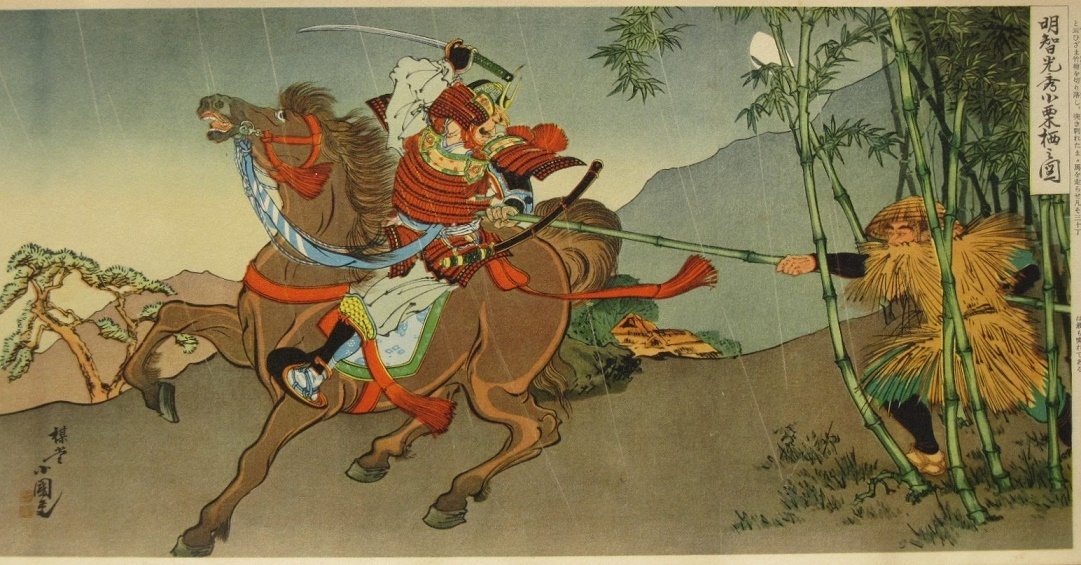
Image: "Dew at Ogurisu," a woodblock print by Kokunimasa (Utagawa Kunimasa V), 1894. It shows Mitsuhide being attacked with a bamboo spear at Ogurisu—a scene based on stories told from the Edo period on.
The Short Answer
- On July 2, 1582 (the 13th day of the 6th month of Tenshō 10), he was defeated by Hashiba Hideyoshi at the Battle of Yamazaki
[Fact] - That night, while fleeing toward his home castle of Sakamoto (Ōtsu, Shiga), he was most likely killed by villagers hunting fleeing soldiers near Ogurisu (Fushimi Ward, Kyoto). Some accounts say he was badly wounded and took his own life
[Widely accepted] - Who exactly struck him, and exactly how it happened, cannot be known from records of the time
[Unknown]
Sources: Hashiba Hideyoshi's letter (Asano Family Documents); Yoshida Kanemi, Kanemi Kyōki; Ōta Gyūichi Kyūki
His Last Moments: Records and Legends
In a later letter, the victorious Hideyoshi wrote, in effect, that "Akechi fled into a thicket in Yamashina and his head was picked up by farmers" [Fact: Hashiba Hideyoshi's letter]. It was written by the winner, but it shows that, according to records of the time, Mitsuhide was killed by local people while trying to escape.
A separate account by Ōta Gyūichi, author of the Shinchō Kōki, says that as Mitsuhide rode along a narrow path at Ogurisu with a dozen or so horsemen, a farmer hiding in the bushes stabbed him in the hip with a rusty spear [Widely accepted: Ōta Gyūichi Kyūki].
The famous story that "a farmer named Nakamura Chōbei stabbed him with a bamboo spear," on the other hand, comes from Edo-period essays, and there is no reliable basis for it, including the name [Legend]. The place where he is said to have been attacked is known as the "Akechi Thicket" (Akechi-yabu) and still exists in Ogurisu, Fushimi Ward.
What Happened to His Head?
A head said to be Mitsuhide's was delivered to Oda Nobutaka the next day and first put on display at Honnō-ji. Then, together with the body of his senior retainer Saitō Toshimitsu—captured and executed on July 6—it was displayed at Awataguchi in Kyoto, and on July 13 a burial mound for both men was built just east of Awataguchi, according to Yoshida Kanemi's diary [Fact: Kanemi Kyōki].
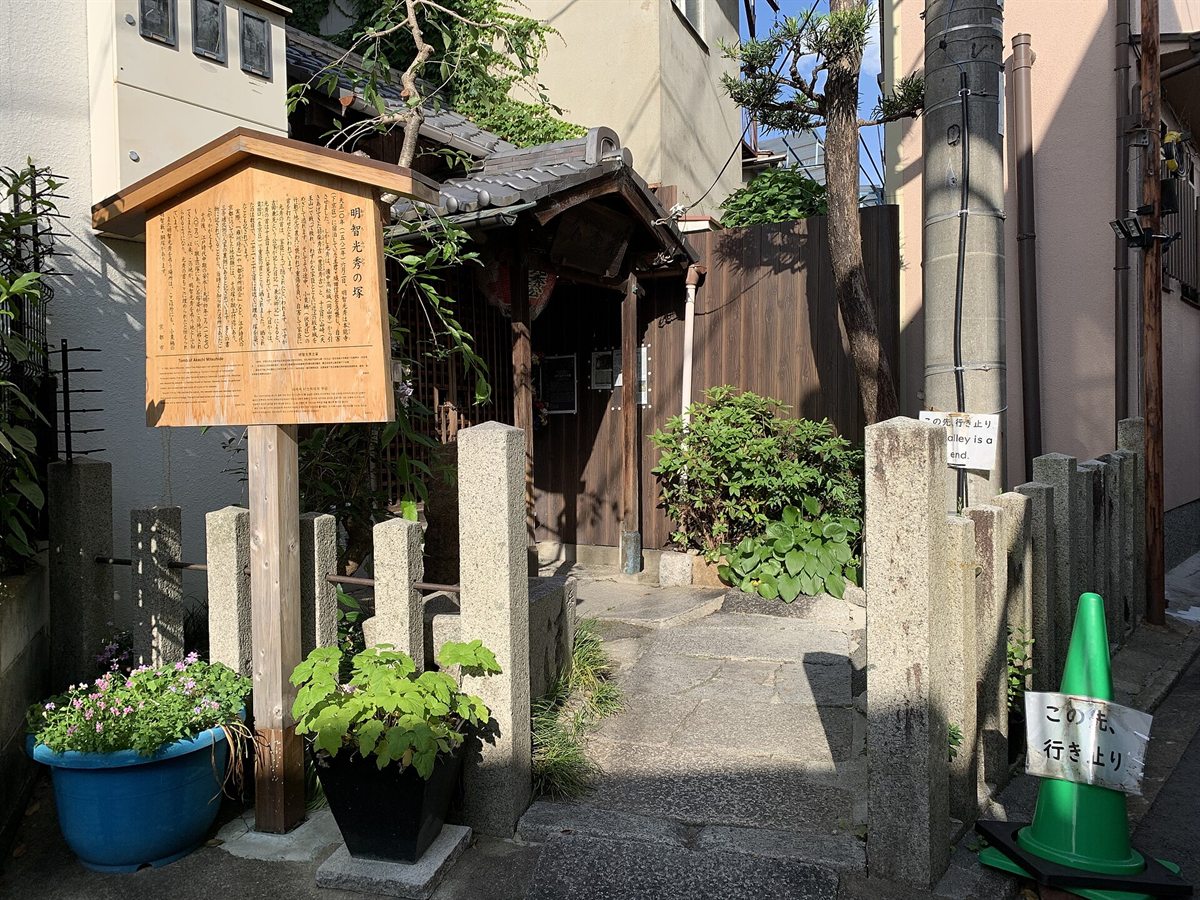
Image: The mound of Akechi Mitsuhide in Higashiyama, Kyoto. Photo: inunami (CC BY 2.0, Wikimedia Commons)
Today, a "Mound of Akechi Mitsuhide" stands near Sanjō-Shirakawa in Higashiyama Ward, Kyoto, said to mark where his head was buried [Legend]. Kokushō-ji Temple in Kameoka, Kyoto, also has a head mound, where a retainer is said to have brought his head back and buried it [Legend].
Who Defeated Mitsuhide?
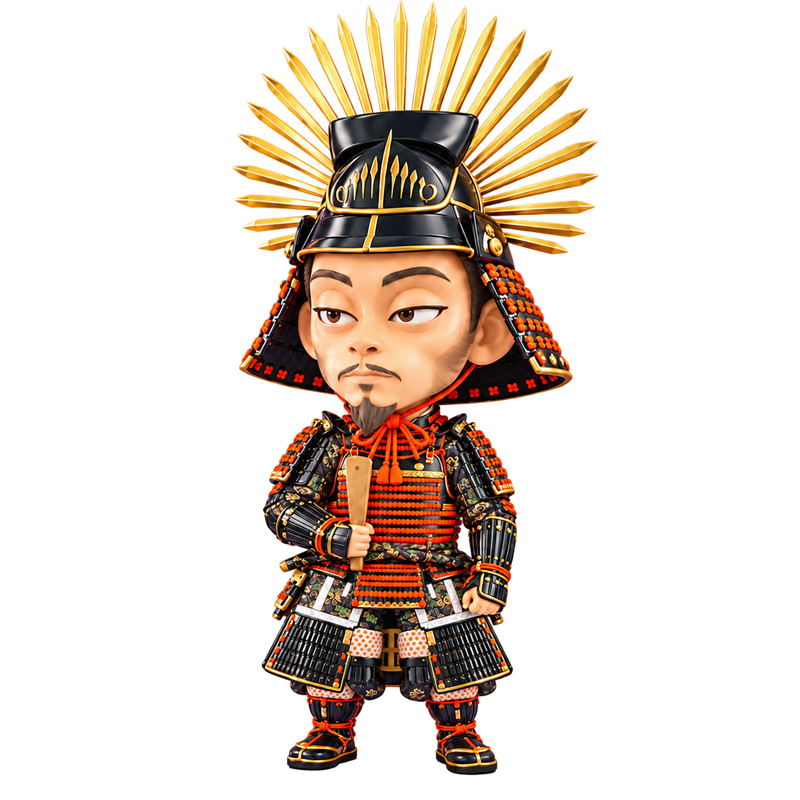
Image: Hashiba (Toyotomi) Hideyoshi (illustration)
It was the army of Hashiba (Toyotomi) Hideyoshi that beat Mitsuhide at Yamazaki. On hearing of the Honnō-ji Incident, Hideyoshi rushed back from Bitchū (Okayama)—the famous "Great Return from Chūgoku"—and met Mitsuhide together with Oda Nobutaka, Niwa Nagahide, and others [Fact].
According to Hideyoshi's letter, his brother Hashiba Hidenaga and Kuroda Kanbei fought on the "mountain side" at the foot of Mount Tennō [Fact: Hashiba Hideyoshi's letter]. You can read more about them in our article on Toyotomi Hidenaga and our article on Kuroda Kanbei.
Still, the people who actually took Mitsuhide's life were most likely not famous warriors, but nameless villagers preying on fleeing soldiers [Widely accepted].
How Old Was He When He Died? His Death Poem
.png)
Because his birth year is not settled, his age at death is not certain either. Edo-period sources such as the Akechi Gunki say 55, while the Tōdaiki says 67—both by the traditional Japanese count [Debated].
His supposed death poem begins, "Obedience and rebellion are not two separate gates…" and ends, "waking from a dream of fifty-five years, I return to the one source." But this too comes from the Akechi Gunki, and it has been pointed out that it imitates the words of a man from the Edo period [Legend: Akechi Gunki].
.jpg)
So many books say "he died at 55," but we really don't know!
If we do not know when he was born, we cannot know his age. Not glossing over such things is what matters.
Why Did Mitsuhide Betray Nobunaga? Theories About the Honnō-ji Incident
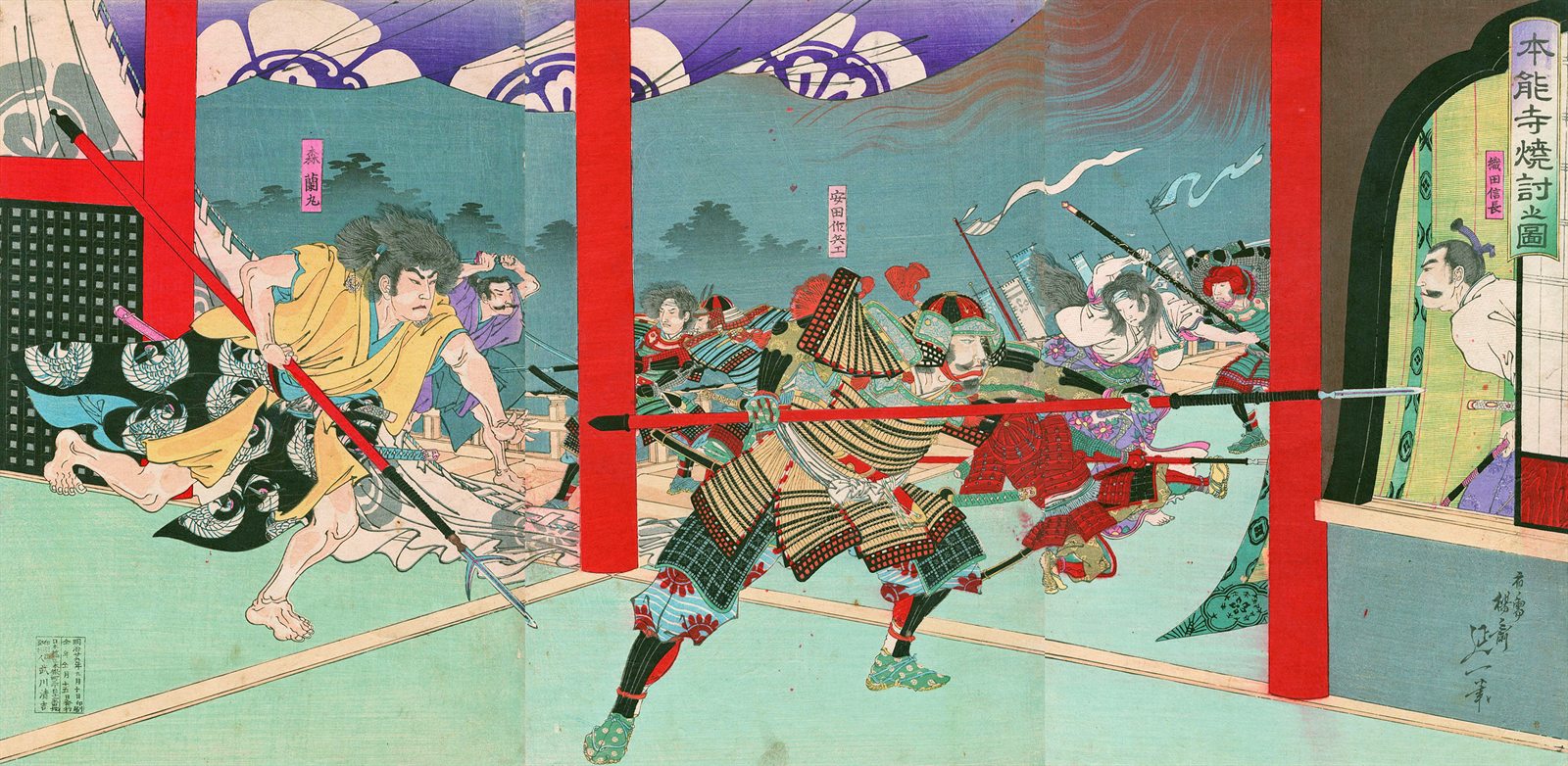
Image: "The Burning of Honnō-ji," a woodblock print by Yōsai Nobukazu (Meiji era, Nagoya City). It shows Nobunaga fighting in the burning temple.
The Short Answer
- No record has been found in which Mitsuhide himself explains why he attacked Nobunaga
[Unknown] - Many theories have been put forward over the centuries, and the question remains open
[Debated] - In recent years, the "Shikoku theory"—that Nobunaga's change of policy toward Shikoku left Mitsuhide humiliated and in danger—has drawn attention, helped by newly found documents
[Debated]
Sources: Shinchō Kōki; Ishigai Family Documents (Hayashibara Museum of Art); research on the Honnō-ji Incident (Fujita Tatsuo, Kirino Sakujin, and others)
.png)
The Main Theories
| Theory | What it says | Evidence and weak points |
| Grudge | Nobunaga repeatedly humiliated him, and resentment built up | Most stories—being struck at a banquet, being removed as host—come from Edo-period books |
| Ambition | Mitsuhide wanted to rule Japan himself | Nobunaga staying at Honnō-ji with few guards was a rare chance. But Mitsuhide was poorly prepared for what came after |
| Shikoku | As go-between with the Chōsokabe clan, he lost face and was put at risk when Nobunaga changed policy | Based on the Ishigai Family Documents made public in 2014. Whether this alone explains the coup is debated |
| Ashikaga Yoshiaki | He aimed to restore the exiled shogun Ashikaga Yoshiaki | A letter written after the coup mentions the shogun's return to Kyoto. No proof Yoshiaki ordered it |
| Imperial court | Court nobles wary of Nobunaga were involved | Once popular, but the diary it relied on was misread; few historians support it today |
| Jesuits and others | Missionaries or others were behind it | Almost no support among historians |
Many historians think several factors combined rather than a single reason.
The Shikoku Theory: Chōsokabe Motochika and New Documents
Nobunaga had put Mitsuhide in charge of dealing with Chōsokabe Motochika of Shikoku. The elder brother of Mitsuhide's senior retainer Saitō Toshimitsu had been adopted into the Ishigai family, the family of Motochika's wife, so the Akechi had close ties with the Chōsokabe [Fact: Ishigai Family Documents].
But Nobunaga changed course: he demanded that Motochika give up everything but Tosa and a small part of another province, and he ordered an invasion of Shikoku. The army was due to set out the day after the Honnō-ji Incident [Widely accepted].
In 2014, a letter from Motochika to Saitō Toshimitsu, written just before the coup, was found among the Ishigai Family Documents held by the Hayashibara Museum of Art in Okayama. It showed Motochika was willing to accept some of Nobunaga's demands, and it is seen as evidence of how difficult Mitsuhide's position as go-between had become [Fact: Ishigai Family Documents].
Did He Really Say "The Enemy Is at Honnō-ji"?
Mitsuhide is famously supposed to have declared, as he set out, "The enemy is at Honnō-ji!" But this cannot be confirmed in records from his own time [Unknown].
The phrase grew out of Hayashi Razan's Oda Nobunaga Fu (c. 1641) and the Akechi Gunki, and became widely known through Rai San'yō's Nihon Gaishi (1827) [Folk belief]. In fact, a note later written by one of Mitsuhide's own soldiers says the men were not told they were attacking Honnō-ji and thought they were going to attack Tokugawa Ieyasu [Widely accepted: Honjō Soemon Oboegaki].
Was His "Toki wa ima" Verse a Warning?
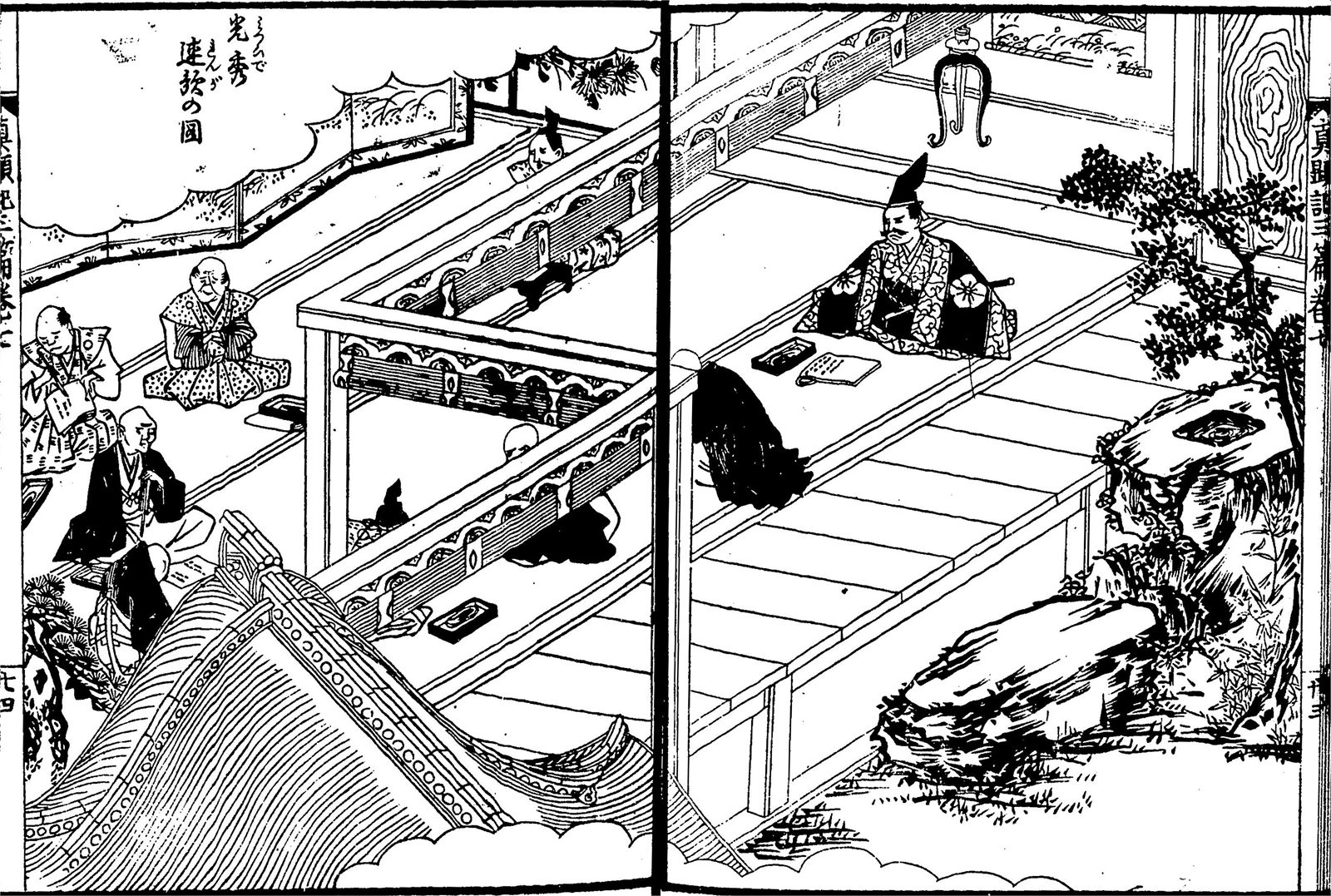
Image: "Mitsuhide Composing Linked Verse," from the Ehon Taikōki (late Edo period, illustrated by Okada Gyokuzan)
A few days before the Honnō-ji Incident, on the 28th day of the 5th month, Mitsuhide held a linked-verse gathering on Mount Atago in Kyoto (the Atago Hyakuin) and opened with the verse "Toki wa ima / ame ga shita shiru / satsuki kana" [Fact].
A famous reading takes "toki" ("now is the time") as a pun on Toki, Mitsuhide's clan, and "ame ga shita shiru" as "to rule the realm"—making the verse a hidden declaration of his plan. But linked verse is a group game of connecting lines, and reading one verse on its own has long been criticized. There are also different readings of the words, so we cannot say whether it was a warning [Debated].
A "Three-Day Reign"? Mitsuhide's 11 Days
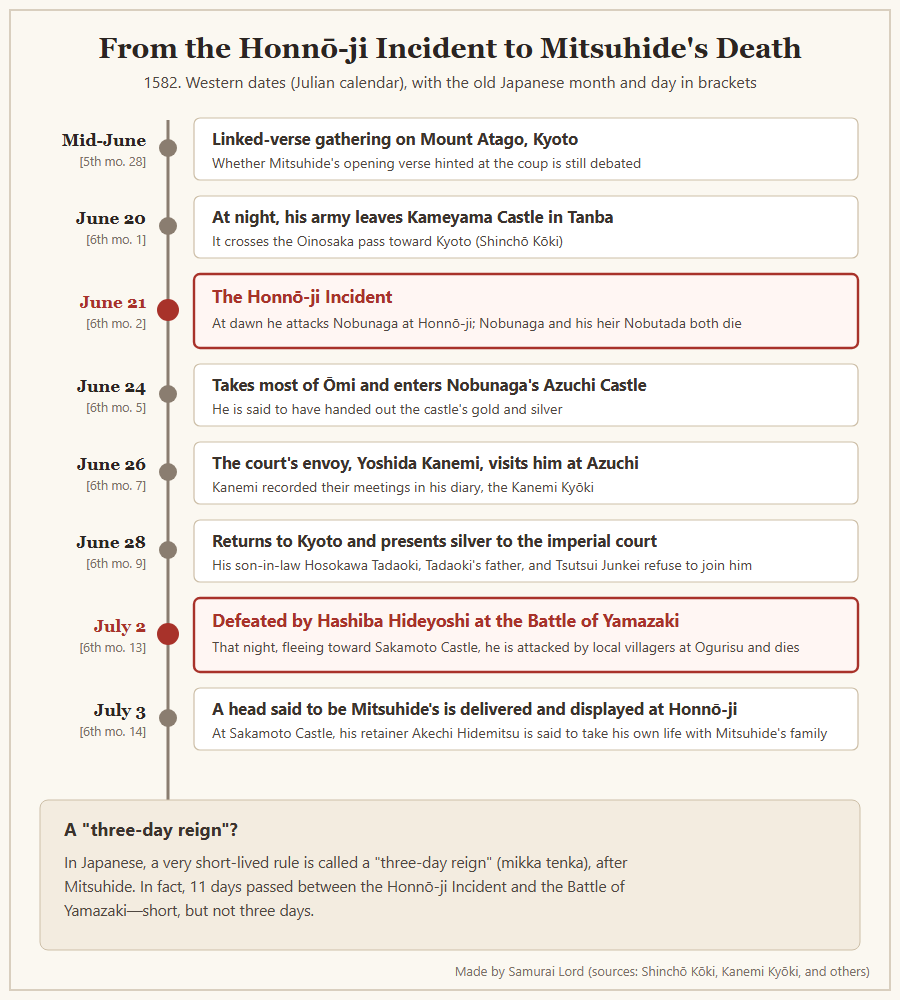
Image: From the Honnō-ji Incident to Mitsuhide's death (made by Samurai Lord). Tap or click the image to enlarge it.
In Japanese, a very short-lived rule is called a "three-day reign" (mikka tenka), after Mitsuhide. In fact, 11 days passed between the Honnō-ji Incident (June 21) and the Battle of Yamazaki (July 2) [Fact]. Depending on how you count, it was about 10 or 12 days—short, but not three.
During those days, Mitsuhide entered Azuchi Castle, took control of Ōmi, and presented silver to the imperial court, hurrying to build a new government. But his son-in-law Hosokawa Tadaoki and Tadaoki's father, Fujitaka, as well as Tsutsui Junkei of Yamato, did not join him, and he was defeated by Hideyoshi, who had raced back from western Japan [Fact].
In 2021, an early Edo-period book (the Itsuya no Kakimono) drew attention for recording a retainer's testimony that on the day of the attack, Mitsuhide himself waited at Toba, south of Kyoto, away from Honnō-ji [Debated].
Even after striking down his lord, a man cannot hold the realm if no allies come. Even one as sharp as Mitsuhide misjudged that.
So it was 11 days, not 3. Still far too short…!
What Was Akechi Mitsuhide Like? His Character in His Letters
Mitsuhide has been called both "a lord who cared for his men" and "a cold schemer." Here we look at records from his time in the order "what the record says → what we can read from it → what we cannot know."
Record 1: Rice for the Souls of 18 Fallen Retainers
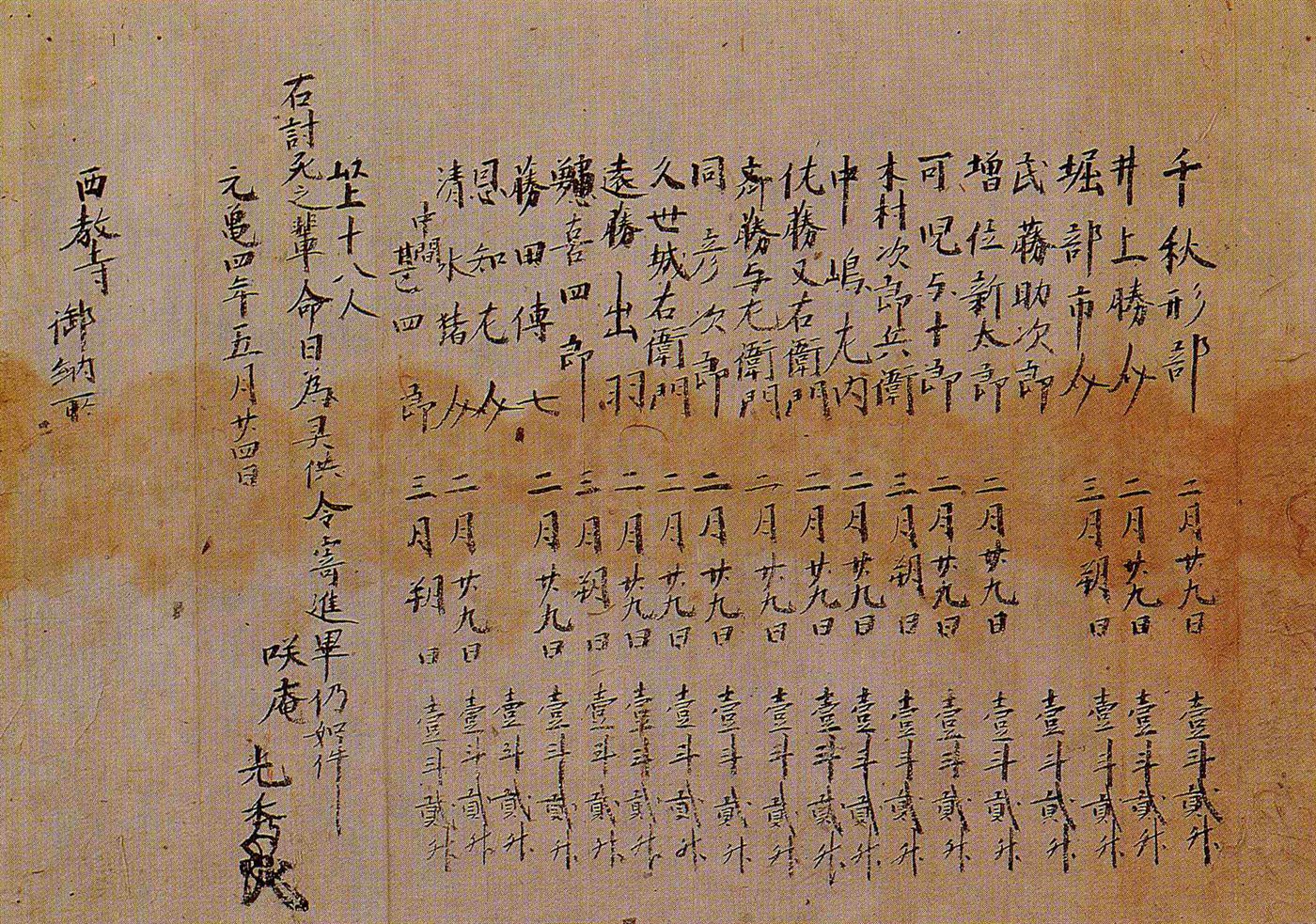
Image: Mitsuhide's letter donating rice for memorial services (1573, Saikyō-ji Temple, Ōtsu, Shiga). It lists the names of fallen retainers and the days they died.
- What the record says: In 1573, Mitsuhide donated rice to Saikyō-ji Temple for memorial services for 18 retainers killed in a battle at Imakatata (Ōtsu). The letter names all 18, including a low-ranking servant (chūgen) who had no family name
[Fact: Saikyō-ji donation letter] - What we can read from it: Mitsuhide honored not only high-ranking warriors but also the lowest servants, naming each one. It is a document that suggests real care for his men
- What we cannot know: This one letter is not enough to say he had a "kind personality." Memorial services for the fallen also mattered for holding a band of retainers together
Letters in which Mitsuhide asks after retainers wounded in battle are also said to survive [Widely accepted]. Note that the donation letter of 1577 rediscovered in 2024 at Shōju Raigō-ji Temple in Ōtsu is a different document from the one at Saikyō-ji.
Record 2: His Gratitude to Nobunaga in His House Rules
In 1581, Mitsuhide set out rules for his retainers in war (the Kachū Gunpō). At the end, he wrote, in effect, that he had been sunk low "like broken tiles under water," yet Nobunaga had taken him up and entrusted him with a great army [Widely accepted: Akechi Mitsuhide's house rules, Goryō Shrine].
That he wrote of his debt to Nobunaga so plainly exactly one year before the Honnō-ji Incident is striking when we think about his motives. Some historians, however, are cautious about whether Mitsuhide really wrote this document.
Record 3: Poetry, Tea, and Medicine
Mitsuhide often took part in linked-verse gatherings and sometimes hosted them. According to the Shinchō Kōki, in 1578 he was among the retainers Nobunaga allowed to hold tea ceremonies [Fact: Shinchō Kōki].
The Shinyakuhō mentioned above also shows that the young Mitsuhide had medical knowledge and taught it to others [Fact: Shinyakuhō].
The Hard Side: The Mount Hiei Letter and Fróis's Verdict
Mitsuhide was not simply a gentle man of culture. In 1571, ten days before the burning of Mount Hiei, he wrote from Usayama Castle (Ōtsu) to Wada Hidezumi, a local lord of Ogoto (Ōtsu). Pleased that the Wada and others had sided with the Oda, he added: "As for Ōgi, it must by all means be cut down to the last person"—that is, the village of Ōgi (Ōgi-chō, Ōtsu), which refused to cooperate, was to be wiped out [Fact: letter to Wada Hidezumi].
It was once said that Mitsuhide opposed the burning of Mount Hiei, but this letter shows that he was in fact at the center of the operation [Widely accepted].
The Jesuit Luís Fróis, who lived at the same time, wrote harshly that Mitsuhide "loved treachery and secret meetings" and was "cruel in his punishments," while also noting that he was "skilled in building castles" and knew how to use "seasoned warriors" [Fact: Fróis, Historia de Japam]. Fróis disliked Mitsuhide, who was cold toward Christianity, so his view is not neutral.
Stories from Later Books (Legends)
The following stories come from books written in the Edo period and later and cannot be confirmed in records from his time [Legend].
- His wife sold her hair to help him: when Mitsuhide was poor and could not pay for a linked-verse gathering, his wife Hiroko sold her black hair to raise the money. The poet Matsuo Bashō later wrote a haiku about this story
- He threw away a lucky charm: as a young man he picked up a statue of the god Daikoku. Told it would make him "the head of a thousand men," he threw it away, saying he did not mean to stop at a thousand (Yamaga Gorui)
- A master marksman: when he served the Asakura, he fired a hundred shots at a distant target and hit it with most of them (Akechi Gunki)
Careful enough to name each fallen retainer, yet merciless toward his enemies—that is the Mitsuhide the records reveal.
Care for his men, and the cold edge of a warlord in a violent age. You cannot describe Mitsuhide with only one of them.
He named even the lowest servants in that memorial letter… He had a surprisingly kind side!
Nobunaga's Retainer: Mitsuhide's Rise and Achievements (Timeline)
.png)
Mitsuhide originally served Ashikaga Yoshiaki, the shogun of the Muromachi shogunate. When Yoshiaki entered Kyoto with Nobunaga's help, Mitsuhide came to work for both men, and in time he became one of Nobunaga's leading retainers [Widely accepted].
After the burning of Mount Hiei in 1571, he was given the Shiga district of Ōmi and built Sakamoto Castle—one of the first of Nobunaga's retainers to be entrusted with a castle of his own [Fact: Shinchō Kōki]. He was then put in charge of conquering Tanba (central Kyoto and eastern Hyōgo prefectures). In 1580, in a document scolding his retainer Sakuma Nobumori, Nobunaga named Mitsuhide's work first, praising it: "Hyūga-no-kami's work in Tanba has brought honor before the whole realm" [Fact: Shinchō Kōki].
| Year | Event | Notes |
| 1566 | Appears as "Akechi Jūbei-no-jō" in the Shinyakuhō | The earliest reliable record of him |
| 1568 | Ashikaga Yoshiaki enters Kyoto with Nobunaga | Mitsuhide serves Yoshiaki |
| 1569 | Defends Yoshiaki's lodging in the Honkoku-ji Incident | Named in the Shinchō Kōki |
| 1571 | Takes part in the burning of Mount Hiei; later builds Sakamoto Castle | Put in charge of the Shiga district of Ōmi |
| 1573 | Holds memorial services for retainers killed at Imakatata | Saikyō-ji donation letter |
| 1575 | Becomes "Koretō Hyūga-no-kami"; begins the conquest of Tanba | On Nobunaga's recommendation |
| 1578 | His daughter Tama marries Hosokawa Tadaoki | At Nobunaga's suggestion |
| 1579 | Completes the conquest of Tanba | Also takes Tango |
| 1580 | Receives all of Tanba; develops Kameyama and Fukuchiyama castles | Nobunaga praises his work |
| 1581 | Organizes the great cavalry parade in Kyoto; sets his house rules | A sign of Nobunaga's trust |
| June 21, 1582 | The Honnō-ji Incident | Kills Nobunaga and Nobutada |
| July 2, 1582 | Defeated at Yamazaki; dies | Just 11 days after the coup |
Why would a man so highly trusted by Nobunaga turn on him? That is the great mystery of the Honnō-ji Incident.
His Wife Hiroko and His Daughters: Hosokawa Gracia and His Sons-in-Law
Hiroko: His Principal Wife
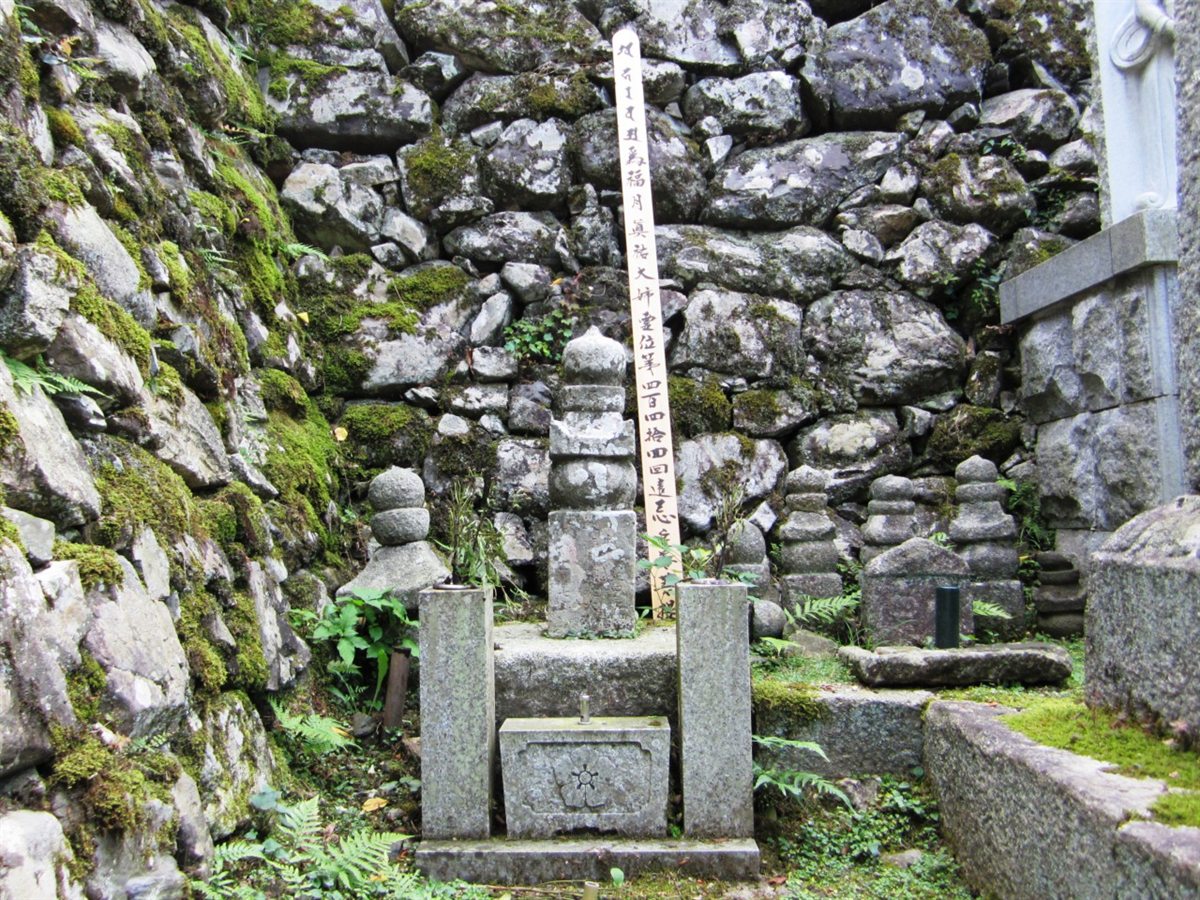
Image: Hiroko's grave at Saikyō-ji Temple (Ōtsu). Photo: 立花左近 (CC BY-SA 3.0, Wikimedia Commons)
Mitsuhide's principal wife was Hiroko, a daughter of the Tsumaki family [Widely accepted]. When she fell ill in 1576, Mitsuhide asked Yoshida Kanemi to pray for her recovery [Fact: Kanemi Kyōki]. Saikyō-ji's death register records that she died late that same year [Widely accepted].
Mitsuhide is often described as a devoted husband who never took a concubine. Some genealogies, however, say he had concubines, and the truth is not known [Debated].
His Daughters and Their Husbands
Mitsuhide had several daughters, but how many cannot be settled from the records; the Edo-period Akechi Gunki says he had three sons and four daughters [Legend: Akechi Gunki]. The daughters and husbands best confirmed in records are:
| Daughter | Married to | What happened |
| Tama (Hosokawa Gracia) | Hosokawa Tadaoki, son of Hosokawa Fujitaka | Baptized as a Christian; died at her family's Osaka residence in 1600, just before the Battle of Sekigahara |
| Daughter | Akechi Hidemitsu, Mitsuhide's senior retainer | Said to have died with Hidemitsu at Sakamoto Castle in 1582 |
| Daughter | Tsuda Nobuzumi, Nobunaga's nephew | Nobuzumi was killed right after the coup on suspicion of siding with Mitsuhide |
Mitsuhide married his daughters into powerful families such as the Hosokawa and Nobunaga's own clan. Yet at the Honnō-ji Incident, his son-in-law Hosokawa Tadaoki refused to join him and for a time confined Tama at Midono, deep in the mountains of Tango [Widely accepted].
Does Akechi Mitsuhide Have Living Descendants? Bloodlines and Legends
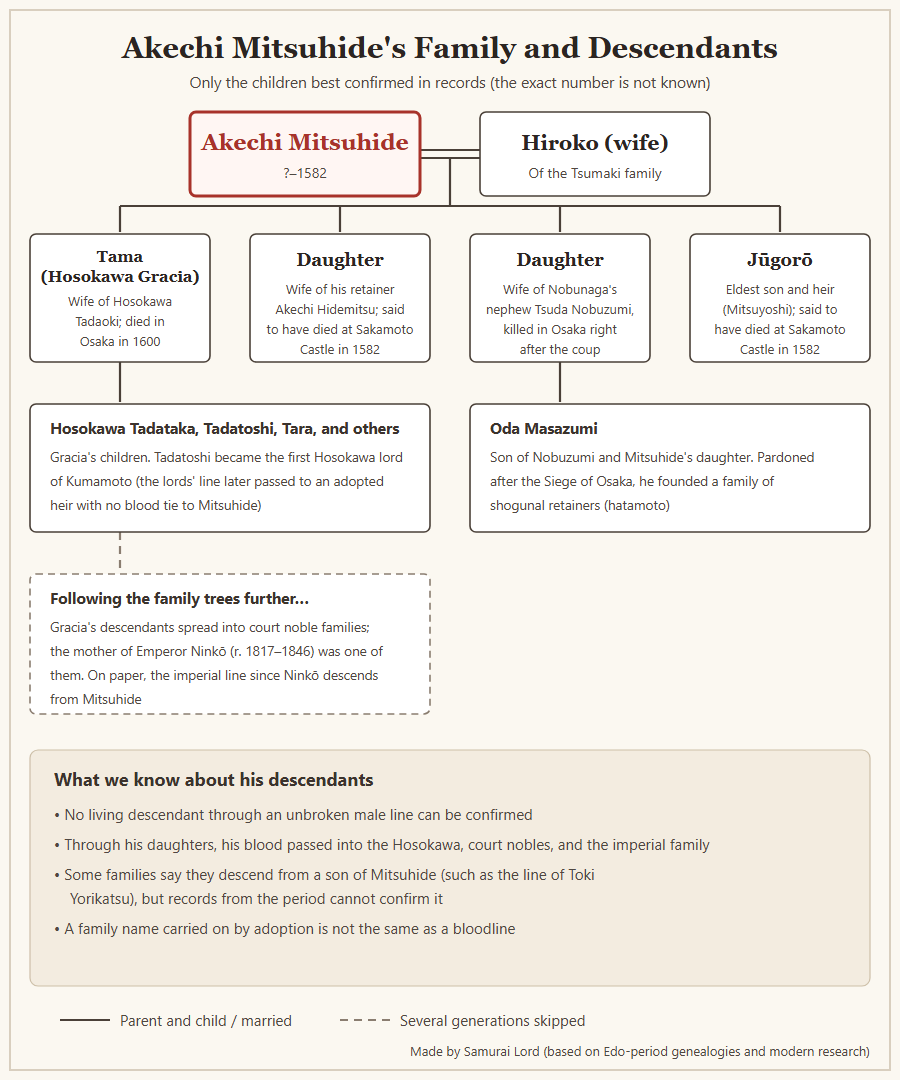
Image: Akechi Mitsuhide's family and descendants (made by Samurai Lord). Tap or click the image to enlarge it.
The Short Answer
- After the Battle of Yamazaki the Akechi house was destroyed, and no descendant through an unbroken male line can be confirmed
[Unknown] - But descendants through his daughters lead to the Hosokawa family, court nobles, and even the imperial family
[Widely accepted] - Some families say they descend from a son of Mitsuhide, but records from the period cannot confirm it
[Debated]
Sources: genealogies of the Hosokawa and court noble families; records of the fall of the Akechi after the Honnō-ji Incident (Kanemi Kyōki and others)
Through His Daughters to the Hosokawa and the Imperial Family
Mitsuhide's daughter Tama (Hosokawa Gracia) and Hosokawa Tadaoki had several children, including Tadataka, Tadatoshi, and a daughter, Tara. Tadatoshi became the first Hosokawa lord of Kumamoto [Fact]. However, the Kumamoto lords later adopted an heir from a branch of the family without Gracia's blood, so the lords' line itself lost its blood tie to Mitsuhide partway through [Widely accepted]. A family that continues is not the same as a bloodline that continues.
Meanwhile, the descendants of Gracia's children spread into court noble families, and following the family trees, the mother of Emperor Ninkō (reigned 1817–1846) was one of them. On paper, then, the imperial line from Ninkō onward descends from Mitsuhide [Widely accepted].
The son of the daughter who married Tsuda Nobuzumi, Oda Masazumi, later became a direct retainer (hatamoto) of the Tokugawa shogunate and founded a family that lasted [Widely accepted].
Families Said to Descend from Mitsuhide: Chris Peppler, Sakamoto Ryōma, and Others
Some families are said to descend from Mitsuhide based on stories that one of his sons survived.
- Chris Peppler: The Japanese TV and radio personality Chris Peppler is said to descend, through his maternal grandmother of the Toki family, from Toki Yorikatsu, whom one theory makes a son of Mitsuhide. After a TV program looked into it, some researchers said he could fairly be called a descendant, but the theory that Yorikatsu was Mitsuhide's son cannot itself be confirmed in records from the time
[Debated] - Sakamoto Ryōma: Because the Sakamoto family crest uses a bellflower, he is sometimes called a descendant of the Akechi, but this is thought to be a later writer's invention
[Fiction] - Families claiming descent from "Ozurumaru": Some families claim descent from a son named Ozurumaru who supposedly survived, but no such person can be found in the records
[Folk belief]
"Cannot be confirmed" is not the same as "not a descendant." Still, it is important to keep bloodlines that records can confirm separate from descent that exists only in family tradition.
His blood reached all the way to the imperial family? Amazing!
Blood passes through daughters, too. Mitsuhide's house fell, yet his line lives on in unexpected places.
Did Akechi Mitsuhide Survive? The Theory That He Became the Monk Tenkai
The Short Answer
- There is a theory that Mitsuhide survived the Battle of Yamazaki and became Nankōbō Tenkai, a monk who served Tokugawa Ieyasu—but there is no solid evidence for it
[Folk belief] - Historians point out that records show Tenkai's early life as a different person from Mitsuhide
[Widely accepted]
Sources: Sonehara Satoshi, Shinkun Ieyasu no Tanjō (2008); National Diet Library, Collaborative Reference Database (on the Mitsuhide = Tenkai theory)
Tenkai was a monk who served three shoguns—Ieyasu, Hidetada, and Iemitsu—in the early Edo period and was involved in building the Nikkō Tōshō-gū shrine. Because parts of his early life are unclear, the idea arose that he was "really Mitsuhide."
| Evidence claimed | What we actually know |
| A place in Nikkō is called "Akechidaira," supposedly named by Tenkai | This is a legend; no record shows Tenkai named it |
| Mitsuhide's bellflower crest appears at Nikkō Tōshō-gū | The decoration said to be a bellflower is closer to part of a different crest (the mokkō) |
| Mitsuhide's and Tenkai's handwriting look alike | In a comparison on a TV program, the handwriting was judged to be by different people |
Tenkai is also said to have died in 1643. If Mitsuhide had been born in 1528, he would have lived to about 115—hard to believe [Widely accepted]. Other survival legends, such as Mitsuhide hiding in the mountains of Mino under the name Arafuka Koroku, are told in various places, but all are legends [Legend].
What Was Akechi Mitsuhide's Family Crest? The Bellflower
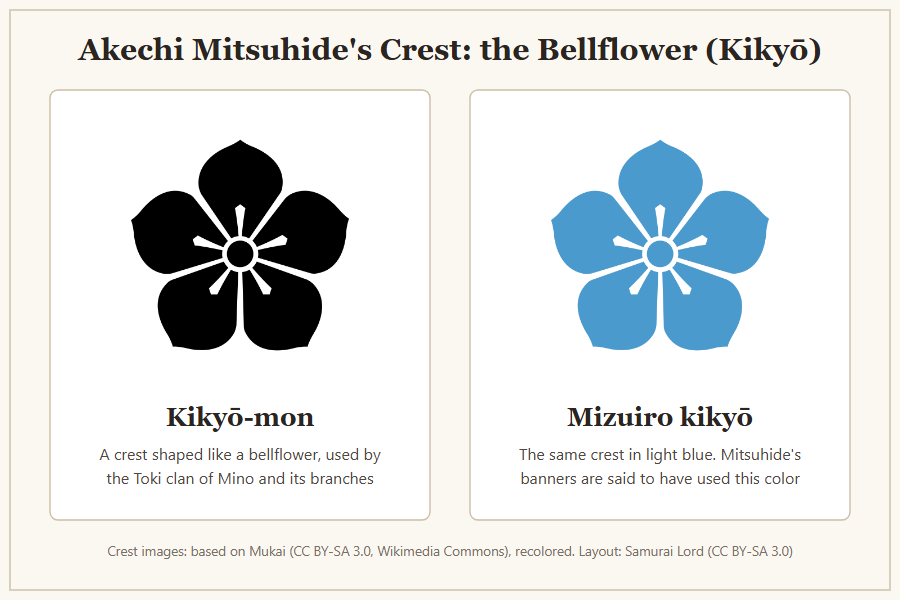
Image: The bellflower crest and the light-blue bellflower (based on images by Mukai, CC BY-SA 3.0, recolored)
Mitsuhide's family crest was the bellflower (kikyō-mon), shaped like a Japanese bellflower. It was used by the Toki, a leading clan of Mino (Gifu), and their branches, and the Akechi, said to descend from the Toki, are thought to have used it as well [Widely accepted].
Mitsuhide's banners are said to have shown the crest in light blue, the "mizuiro kikyō" [Legend]. That is why light-blue bellflower banners so often appear in dramas and games about his era.
The bellflower was not Mitsuhide's alone—other warlords' families, such as that of Katō Kiyomasa, also used it. Seeing a bellflower does not automatically mean "Mitsuhide."
Portrait, Castles, Graves, and Places to Visit
His Portrait: The Only Old Portrait, at Hontoku-ji
The portrait shown at the start of this article belongs to Hontoku-ji Temple in Kishiwada, Osaka. It carries an inscription dated 1613 and is said to be the only old portrait of Mitsuhide [Widely accepted]. He looks young in it, so it may not show him as he was at the time of the Honnō-ji Incident.
His Castles: Sakamoto, Kameyama, and Fukuchiyama
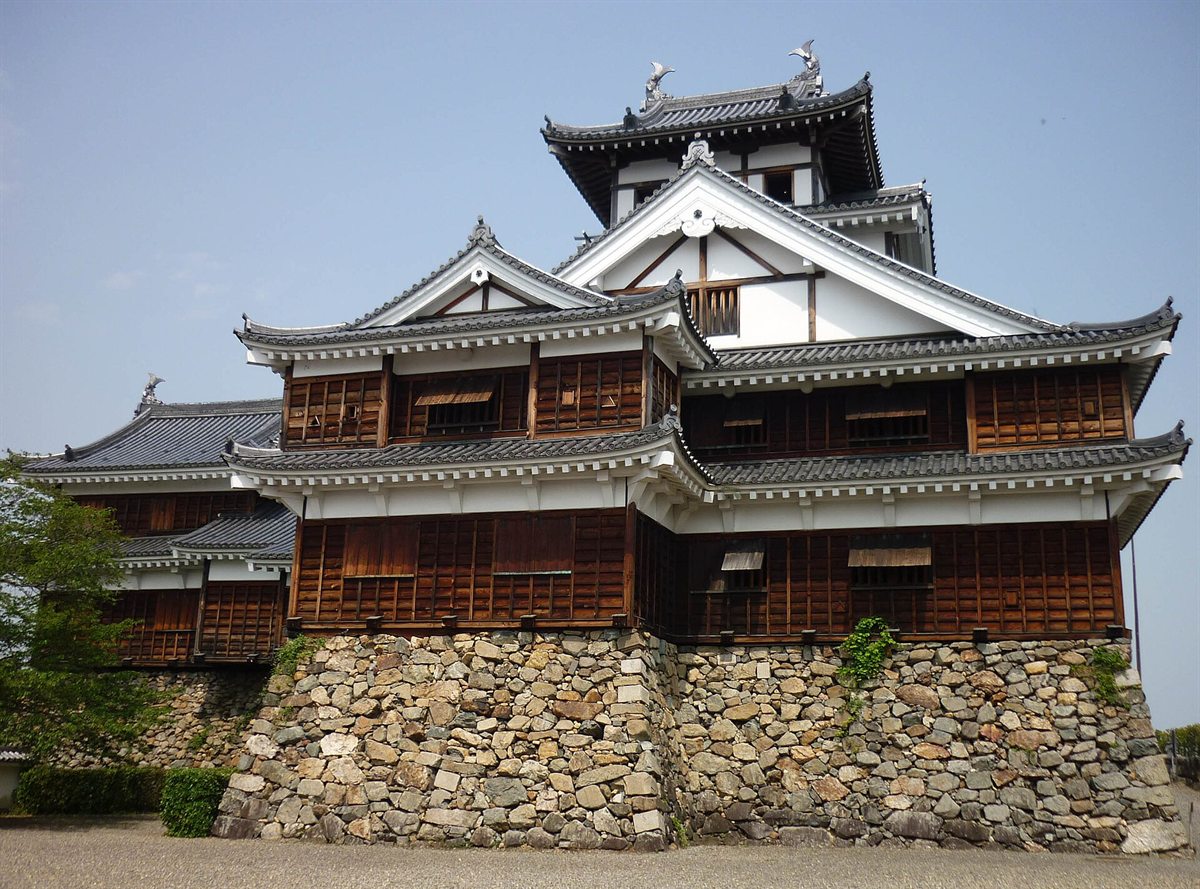
Image: Fukuchiyama Castle (Fukuchiyama, Kyoto). The current keep was rebuilt in 1986.
| Castle | Location | Mitsuhide's connection |
| Sakamoto Castle | Ōtsu, Shiga (on Lake Biwa) | His home base, built from around 1571. Fróis praised it as magnificent. Only parts of its stone walls remain |
| Kameyama Castle | Kameoka, Kyoto | Built as his base for conquering Tanba; he marched from here to Honnō-ji |
| Fukuchiyama Castle | Fukuchiyama, Kyoto | Developed after the conquest of Tanba; its castle town is seen as the start of today's Fukuchiyama |
In Fukuchiyama and Kameoka, Mitsuhide is still remembered fondly as the man who founded their castle towns, and he is enshrined at Goryō Shrine in Fukuchiyama.
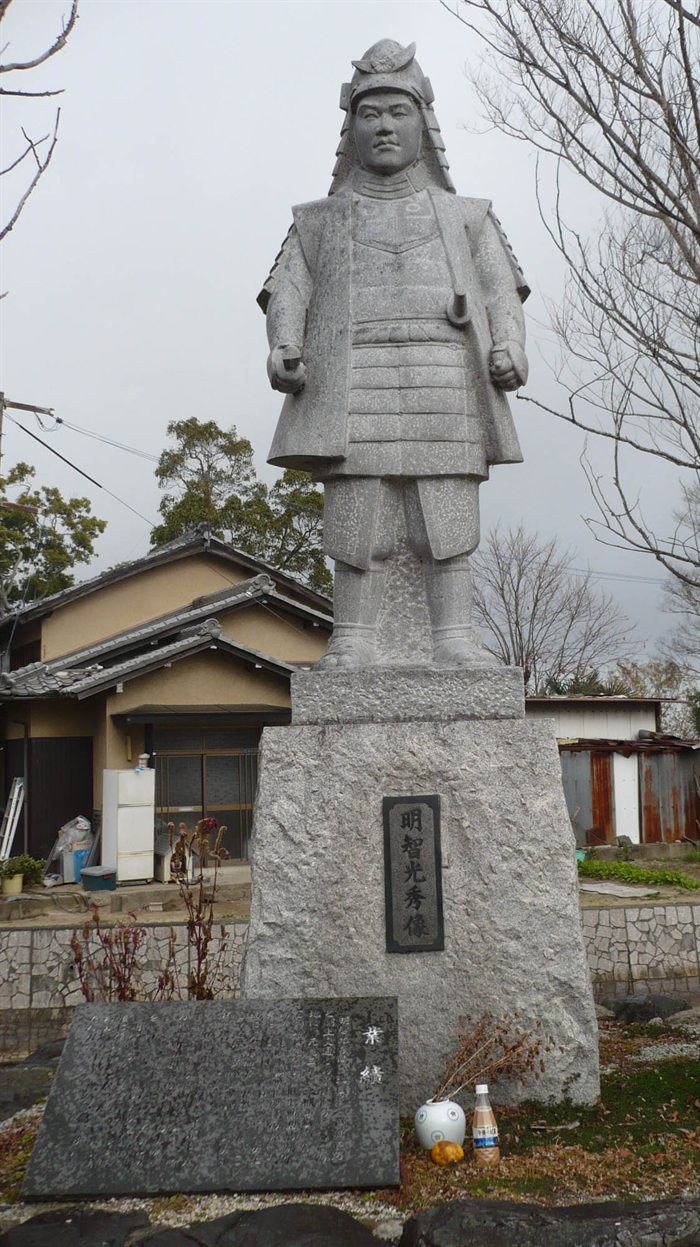
Image: Statue of Akechi Mitsuhide at Sakamoto Castle Ruins Park (Ōtsu). Photo: ブレイズマン (CC BY-SA 3.0, Wikimedia Commons)
Graves and Head Mounds
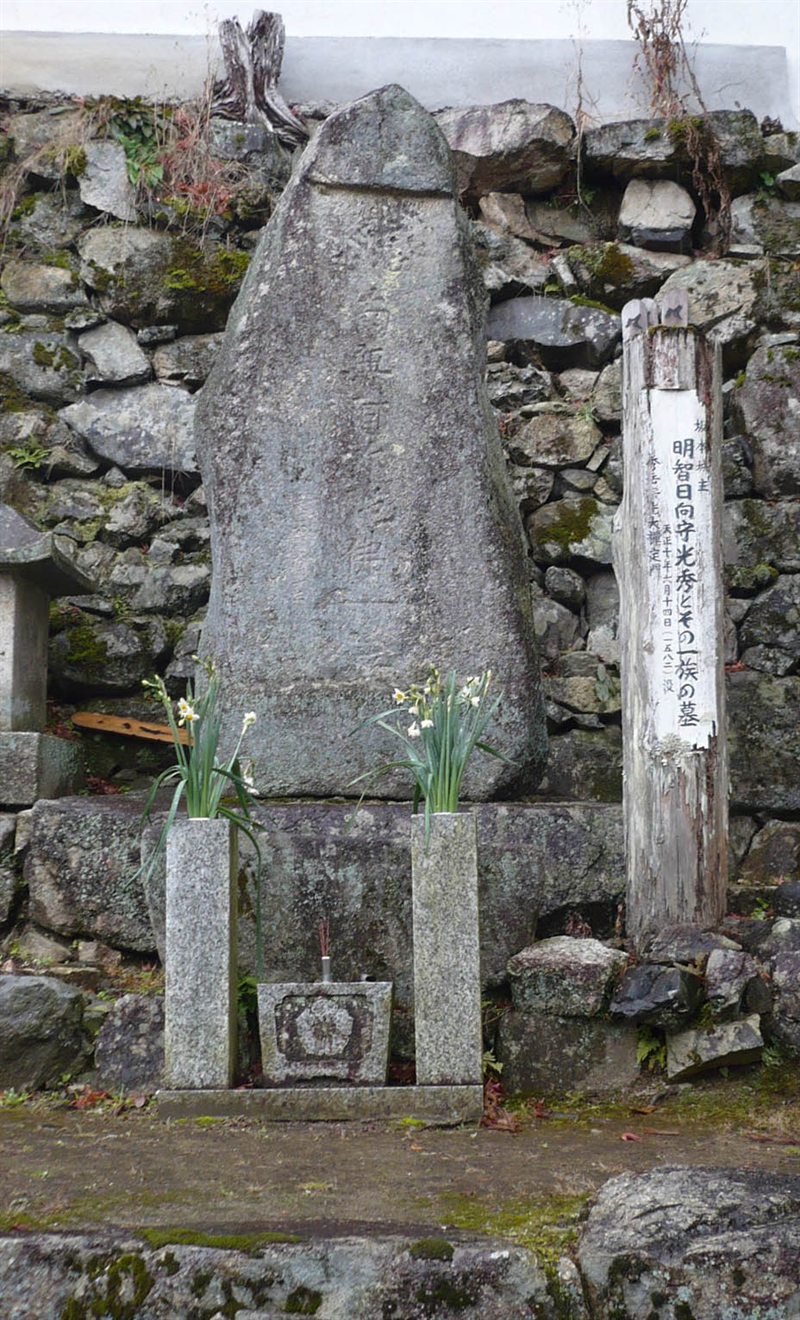
Image: The graves of Akechi Mitsuhide and his family at Saikyō-ji Temple (Ōtsu)
- Saikyō-ji Temple (Sakamoto, Ōtsu, Shiga): the Akechi family temple, with the graves of Mitsuhide and his family and of his wife Hiroko, and the donation letter for his fallen retainers
- Mound of Akechi Mitsuhide (Higashiyama Ward, Kyoto): said to be where his head was buried
- Kokushō-ji Temple (Kameoka, Kyoto): has a head mound where a retainer is said to have buried his head
- Akechi Thicket (Ogurisu, Fushimi Ward, Kyoto): where he is said to have been attacked
- Okunoin, Mount Kōya (Wakayama): has a memorial tower for Mitsuhide
Frequently Asked Questions (FAQ)
How old was Akechi Mitsuhide when he died?
His birth year is not settled, so we do not know for certain. Edo-period sources such as the Akechi Gunki say 55, and the Tōdaiki says 67 (both by the traditional Japanese count).
Did Mitsuhide really rule for only three days?
No. Eleven days passed between the Honnō-ji Incident (June 21, 1582) and the Battle of Yamazaki (July 2). In Japanese, "three-day reign" is simply a figure of speech for a very short rule.
Why did Akechi Mitsuhide betray Oda Nobunaga?
Nobody knows for sure, because Mitsuhide left no record of his reasons. Theories include a personal grudge, ambition, Nobunaga's change of policy toward Shikoku, and a plan to restore the shogun Ashikaga Yoshiaki. Many historians think several factors combined.
Was Akechi Mitsuhide the monk Tenkai?
There is no solid evidence for it. The theory rests on things like a place name in Nikkō, decorations at Tōshō-gū, and handwriting, but none is convincing, and records show Tenkai's early life as a different person.
Has Akechi Mitsuhide appeared in Japanese TV dramas?
Yes. He is the hero of NHK's 2020 historical drama Kirin ga Kuru ("Awaiting Kirin"), and he also appears in Dō Suru Ieyasu (2023) and Toyotomi Kyōdai! ("The Toyotomi Brothers!," 2026).
How is "Akechi Mitsuhide" pronounced, and what was he called?
It is pronounced "ah-keh-chee meet-soo-hee-deh." His everyday name was Jūbei, and from 1575 he also used the name Koretō Hyūga-no-kami.
Summary: Who Was Akechi Mitsuhide?
.png)
Akechi Mitsuhide was a warlord who served Ashikaga Yoshiaki and Oda Nobunaga, rose under Nobunaga to command Sakamoto Castle and the province of Tanba, and then killed his lord in the Honnō-ji Incident of 1582. Just 11 days later, he was defeated by Hideyoshi at Yamazaki and died while fleeing.
Why he turned on Nobunaga remains unresolved. His birth year and the exact details of his death are not known either. Yet records from his own time show both the care of a lord who honored each fallen retainer by name and the hardness of a warlord who showed his enemies no mercy.
To learn more, read about the lord he served in Who Was Oda Nobunaga? Life, Death, Personality & Yasuke Explained, about the man who defeated him in Who Was Toyotomi Hideyoshi? Life, Death & Six Fingers Explained, and about Hidenaga and Kanbei, who fought on the Mount Tennō side at Yamazaki, in our article on Toyotomi Hidenaga and our article on Kuroda Kanbei.
Traitor, or a lord who cared for his men? Following the records, Mitsuhide was both—and neither alone.
Because we don't know "why," I want to learn even more about Lord Mitsuhide!
Sources & How This Article Was Written
This article is based mainly on the following records and research:
- Records from his own time: the Shinchō Kōki (Ōta Gyūichi), the Kanemi Kyōki (Yoshida Kanemi), Hashiba Hideyoshi's letter (Asano Family Documents), Luís Fróis's Historia de Japam, Mitsuhide's own letters (to Wada Hidezumi, the Saikyō-ji donation letter, and others), the Shinyakuhō (Yoneda Family Documents), and the Ishigai Family Documents (Hayashibara Museum of Art)
- Records written later by people of his time: the Ōta Gyūichi Kyūki, the Honjō Soemon Oboegaki, and the Itsuya no Kakimono
- Books written in the Edo period and later (Akechi Gunki, Tōdaiki, Taikōki, Yamaga Gorui, Hayashi Razan's Oda Nobunaga Fu, Rai San'yō's Nihon Gaishi, and others): the sources of his birth year, anecdotes, and "The enemy is at Honnō-ji," labeled
[Legend],[Folk belief], or[Fiction]in this article - Research and references: Sonehara Satoshi, Shinkun Ieyasu no Tanjō (Yoshikawa Kōbunkan, 2008); National Diet Library, Collaborative Reference Database; research on the Honnō-ji Incident and Mitsuhide (Takayanagi Mitsutoshi, Kuwata Tadachika, Fujita Tatsuo, Kirino Sakujin, and others); guides from the cities of Kyoto, Fukuchiyama, Ōtsu, and others—all in Japanese
- Images: the portrait of Mitsuhide (Hontoku-ji), the donation letter (Saikyō-ji), two Meiji-era woodblock prints (Yōsai Nobukazu and Kokunimasa), the illustration from the Ehon Taikōki, and the photos of Fukuchiyama Castle and the Saikyō-ji graves are public-domain images from Wikimedia Commons; the photo of Mitsuhide's mound is by inunami (CC BY 2.0); the photos of Hiroko's grave (by 立花左近) and the Sakamoto statue (by ブレイズマン) and the crest (by Mukai) are under CC BY-SA 3.0. The timeline, family tree, crest chart, and illustrations are original to Samurai Lord
What the Labels Mean
[Fact]Confirmed by sources from the period ([Fact: …]names the source)[Widely accepted]The view held by most historians[Debated]Historians disagree[Unknown]No source tells us[Legend][Fiction][Folk belief]Stories created later, or claims with little evidence ([Legend: …]names the book where the story appears)
This article was written by the Samurai Lord editorial team and is revised as new research and reader feedback come in. If you spot an error, please let us know through our contact form (in Japanese) and we will check and correct it.
Read in Japanese
This article is also available in Japanese: 明智光秀とは?死因と最後・本能寺の変の理由・子孫を史実で解説