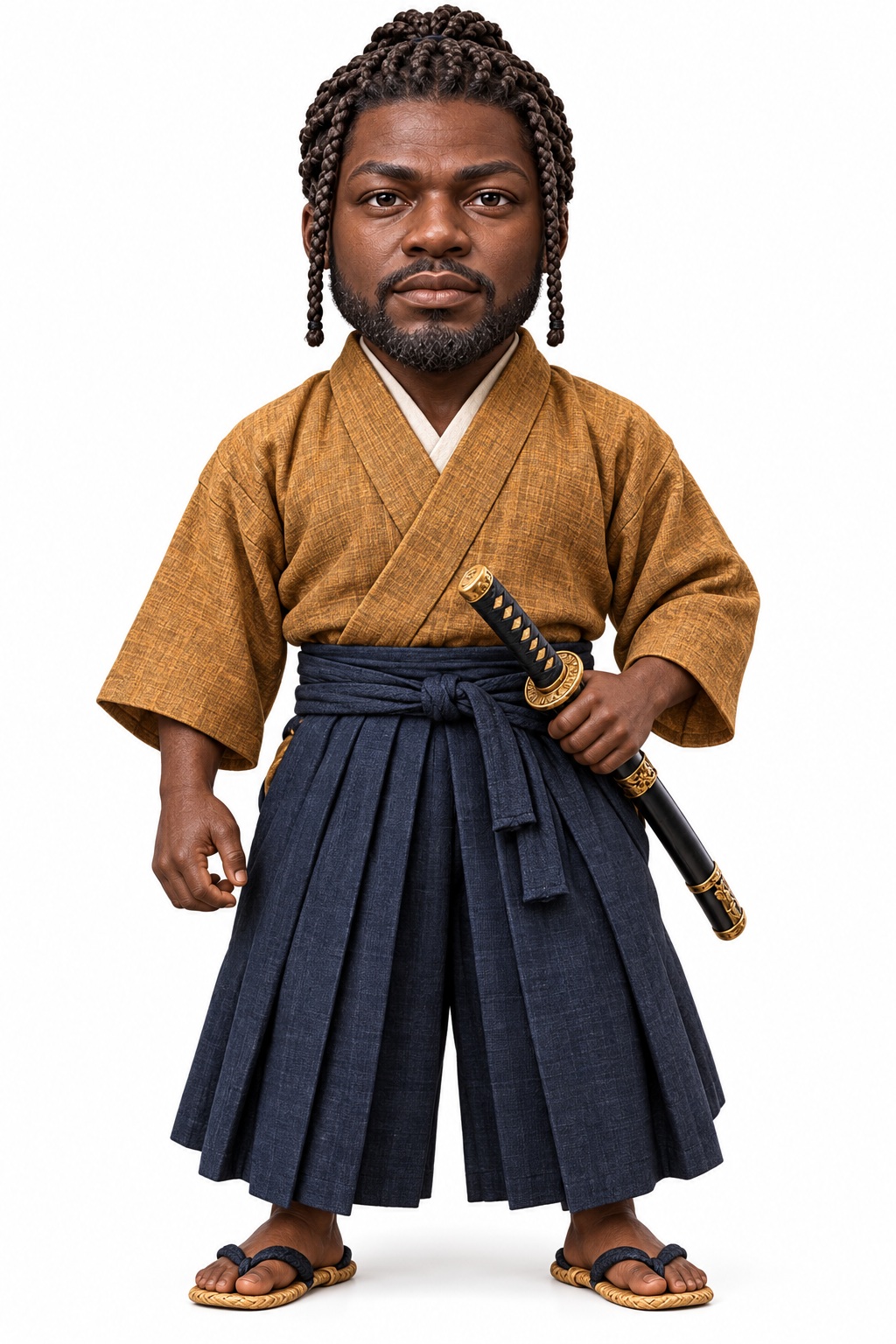
Image: An illustration of Yasuke. All illustrations in this article are creative works loosely based on the historical accounts; appearance, clothing and settings are imagined.
Yasuke was a man from Africa who served Oda Nobunaga, the most powerful warlord in Japan, in 1581 and 1582. He appears in Japanese records written by Nobunaga's own retainer and by a retainer of the Tokugawa family, and in the letters of Jesuit missionaries who saw him.
Today he is often called "the African samurai" or "the Black samurai," and since the video game Assassin's Creed Shadows was announced in 2024, he has been at the center of a heated debate. Yet the sources about him are few and short. This article sets out what the records actually say, how historians read them, and what remains unknown: whether he was a samurai, what he did at Honnō-ji, and what became of him.
Key points are tagged: [Fact] confirmed by records from Yasuke's own time, [Widely accepted] supported by most historians, [Debated] historians read the evidence differently, [Unknown] not known from any source, and [Legend] or [Fiction] for later stories and invented settings. A tag like [Fact: Ietada's Diary] names the record.
.jpg)
I am Uesugi Kenshin. Today's subject came from across the sea and served at Oda Nobunaga's side.
.jpg)
I'm Date Masamune! Yasuke is the samurai from the video game, right? Was he really a samurai?
.jpg)
Even historians disagree on that. First, let us look at what the records actually say.
The Short Answers
- Was he real? Yes. He appears both in Japanese records (the Shinchō Kōki and Ietada's Diary) and in Jesuit letters
[Fact](more) - What was his connection to Nobunaga? Brought to Kyoto by Jesuit missionaries in March 1581, he caught Nobunaga's interest and served him for about 15 months. A diary written at the time says Nobunaga paid him a stipend
[Fact: Ietada's Diary](more) - Was he a samurai? Historians disagree. Some see his stipend, house and sword as proof of samurai status; others say the evidence does not go that far
[Debated](more) - What happened to him? He fought during the Honnō-ji Incident, surrendered, and was sent to the Jesuits. After that he disappears from the records, and no descendants are known
[Unknown](more)
Jump to the part you want to read:
- Who was Yasuke?
- Was Yasuke a real person? The records that mention him
- How did Yasuke come to Japan?
- Yasuke and Oda Nobunaga
- Was Yasuke a samurai?
- Yasuke during the Honnō-ji Incident
- What happened to Yasuke?
- Yasuke in Assassin's Creed Shadows: history vs. fiction
Who Was Yasuke?
In a nutshell, Yasuke was "an African man who came to Japan with Jesuit missionaries, won the favor of Oda Nobunaga, and served at his side for about 15 months."
A few names come up often in this article:
- Oda Nobunaga (1534–1582): the warlord who had brought much of central Japan under his control by 1581. He was killed in 1582 when one of his own generals turned on him (the Honnō-ji Incident)
- The Sengoku period: Japan's "Warring States" era, from the late fifteenth to the late sixteenth century, when regional lords (daimyo) fought for power
- The Jesuits: a Catholic religious order whose missionaries were active in Japan from 1549
- Alessandro Valignano: the Jesuit "Visitor," an inspector sent to oversee the order's missions in Asia, who brought Yasuke to Japan
Quick Profile
| Item | Details | Reliability |
| Name | Yasuke (written 弥助 in one copy of the Shinchō Kōki and 弥介 in Ietada's Diary). His African name is unknown | [Fact] |
| Born / died | Unknown. In 1581 he "looked 26 or 27" by the Japanese way of counting age (about 24 to 26 by Western reckoning), so he was probably born in the mid-1550s | [Unknown] |
| Origin | Africa. The exact region is uncertain; Mozambique is the best-known theory | [Debated] |
| Height | 6 shaku 2 bu, about 182 cm (about 6 ft) | [Fact: Ietada's Diary] |
| Arrived in Japan | Probably in 1579, with Valignano | [Widely accepted] |
| Served | Oda Nobunaga, from about March 1581 to June 1582 | [Fact] |
| Last record | June 1582: sent to the Jesuit church in Kyoto after the Honnō-ji Incident | [Fact: Jesuit annual report] |
Where does the name "Yasuke" come from?
One copy of the Shinchō Kōki says that Nobunaga took the man into his service and had him called "Yasuke" [Widely accepted: Shinchō Kōki, Sonkeikaku copy]. Ietada's Diary writes the name with a different second character, but the reading is the same; such variations were common at the time. Yasuke was an ordinary Japanese given name of the period.
His original name is not recorded anywhere. You may read that "Yasuke" came from an African, Arabic or Portuguese name, but these are guesses, not findings from the sources [Unknown].
"The African samurai": a modern nickname
In English, Yasuke is widely known as "the African samurai" or "the Black samurai." These are modern nicknames. The records from his own time do not call him a samurai, and whether his position amounted to samurai status is exactly what historians debate (see Was Yasuke a samurai?). In this article we simply call him Yasuke.
Was Yasuke a Real Person? The Records That Mention Him
The Short Answer: Yes
- The Shinchō Kōki, a chronicle of Nobunaga's life by his retainer Ōta Gyūichi, records that a Black man came to meet Nobunaga in 1581
[Fact: Shinchō Kōki] - Ietada's Diary, kept by Matsudaira Ietada, a retainer of Tokugawa Ieyasu, records in 1582 that Nobunaga had with him a man named Yasuke who stood 6 shaku 2 bu tall
[Fact: Ietada's Diary] - Jesuit missionaries in Japan described him in their letters and reports
[Fact]
Japanese and European writers, with very different points of view, recorded him independently, so there is no doubt that Yasuke existed. But he appears in the records only between March 1581 and June 1582.
The main records about Yasuke
| Record | Written by / when | What it says about Yasuke |
| Jesuit letters | Luís Fróis, Lourenço Mexia and others, 1581–82 | The crowds in Kyoto, his meeting with Nobunaga, that he spoke some Japanese, and a rumor that he would be made a "tono" (lord) |
| Shinchō Kōki, Book 14 | Ōta Gyūichi, Nobunaga's retainer | In 1581 a Black man came to meet Nobunaga; he looked 26 or 27 and was stronger than ten men |
| Shinchō Kōki, Sonkeikaku copy | One manuscript copy of the same work | Nobunaga gave him a stipend, the name Yasuke, a short sword and a house, and sometimes had him carry his belongings |
| Ietada's Diary | Matsudaira Ietada, a Tokugawa retainer | In 1582 Nobunaga had with him a Black man to whom he paid a stipend; 6 shaku 2 bu tall, named Yasuke |
| Jesuit annual report | Luís Fróis, November 1582 | During the Honnō-ji Incident he fought, surrendered, and was sent to the Jesuit church on Akechi Mitsuhide's orders |
These five are the main records from Yasuke's own time. All of them are short, and none was written by Yasuke himself or records his own words.
The Shinchō Kōki is available in English as The Chronicle of Lord Nobunaga (translated by J. S. A. Elisonas and J. P. Lamers, Brill, 2011). The extra passage found only in the Sonkeikaku copy may not appear in translations based on other manuscripts. The quotations in this article are our own translations from the Japanese.
Are there photos or portraits of Yasuke?
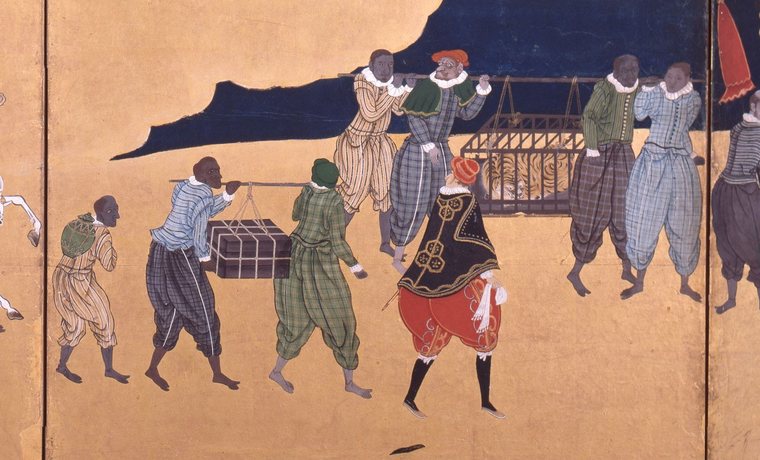
Image: Detail of a Nanban screen by Kanō Naizen (c. 1600, Kobe City Museum). Among the men carrying cargo from a Portuguese ship are some who appear to be African. This is not a portrait of Yasuke.
There are, of course, no photographs, since photography was invented in the nineteenth century. Nor does any portrait of Yasuke made in his lifetime survive [Unknown].
Japanese "Nanban" screens, paintings of the Portuguese "southern barbarians" and their ships, often show African attendants, but none of these figures can be identified as Yasuke. The statues, paintings and character designs of Yasuke you may see online are modern works of imagination, as are the illustrations in this article.
.jpg)
So there are only a handful of records about him!
Indeed. That is why every word in them must be read with care.
How Did Yasuke Come to Japan?
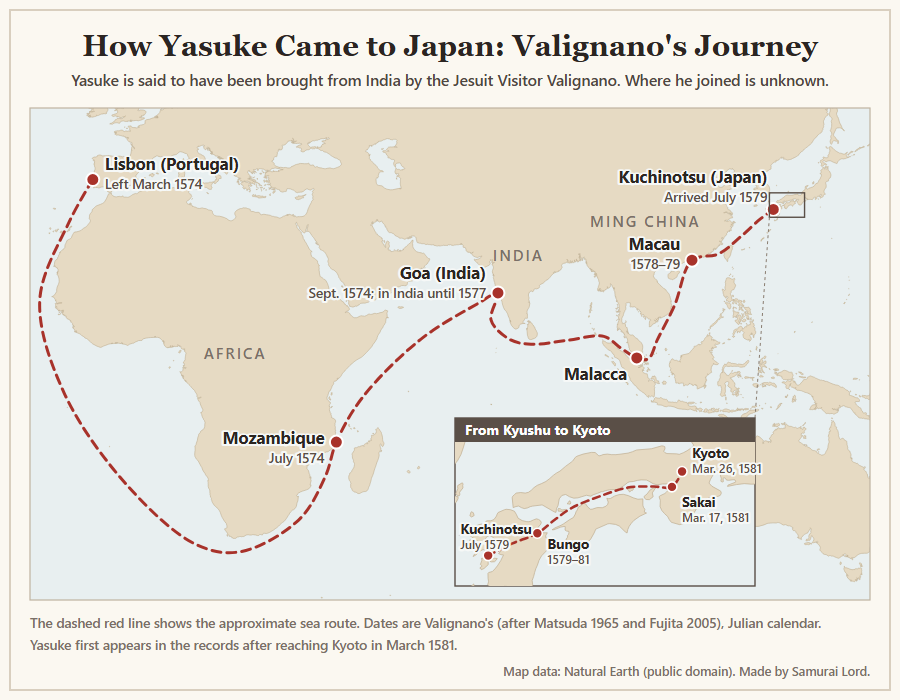
Image: Valignano's journey and how Yasuke came to Japan (made by Samurai Lord). Tap or click to enlarge.
Yasuke was brought to Japan by Alessandro Valignano, an Italian Jesuit who served as "Visitor," inspecting the order's missions across Asia. Valignano left Lisbon in 1574, stopped at Mozambique on the East African coast and at Goa in India, spent time in Malacca and Macau, and reached Kuchinotsu in southern Japan in July 1579 [Fact].
Yasuke is said to have been brought by Valignano from India, and he probably arrived in Japan with him in 1579 [Widely accepted]. Where and on what terms he joined Valignano's party is not clearly recorded [Unknown]. The Jesuit report of 1582 calls him the man "whom the Visitor had given to Nobunaga." That he could be given away suggests he had been a servant of the Jesuits, quite possibly an enslaved one, rather than a free traveler [Widely accepted].
Was Yasuke from Mozambique?
The idea that Yasuke came from Mozambique goes back to a later source, the Histoire ecclésiastique des isles et royaumes du Japon by the French Jesuit François Solier, published in 1627, more than 40 years after Yasuke's time. The Japanese scholar Fujita Midori also describes him as coming from Mozambique [Debated].
The Jesuit records from his own time call him a cafre, a word the Portuguese used for Black Africans, especially from the east and south of the continent. It does not pin down a precise homeland. Modern writers have suggested other regions, such as present-day Ethiopia or South Sudan, but these are educated guesses rather than findings from the sources [Debated].
Yasuke and Oda Nobunaga: How They Met and How He Served

Image: An imaginative illustration of Yasuke's meeting with Nobunaga. Appearance, clothing and setting are imagined.
It helps to keep three time spans apart:
- When he came to Japan: July 1579, probably with Valignano
[Widely accepted] - When he appears in the records: March 1581 to June 1582
[Fact] - When he served Nobunaga: from about March 1581 until the Honnō-ji Incident in June 1582, about 15 months
[Fact]
Nothing is recorded about the year and a half between 1579 and 1581. Valignano spent much of that time in Kyushu, including the province of Bungo (today's Ōita Prefecture), and Yasuke was probably with him [Widely accepted].
Crowds in Kyoto and a meeting with Nobunaga (March 1581)
In March 1581, Valignano set out from Bungo to meet Nobunaga, traveling to Kyoto by way of the port of Sakai. According to the Jesuit letters, crowds gathered in both cities to see the tall Valignano and the African man with him. In Kyoto, onlookers mobbed the Jesuit church so violently that people were injured [Fact: Jesuit letters].
Hearing the rumors, Nobunaga sent for him. On March 27, 1581 (the 23rd day of the 2nd month of Tenshō 9), the missionary Organtino brought him to Honnō-ji, the temple where Nobunaga was staying. The letters say Nobunaga suspected that the color of his skin was ink, had him strip to the waist and wash, and found that it did not change [Fact: Jesuit letters].
Source Box 1: Shinchō Kōki, Book 14
Source: Ōta Gyūichi, Shinchō Kōki, Book 14, entry for the 23rd day of the 2nd month of Tenshō 9 (March 27, 1581)
Original: 「きりしたん国より黒坊主参り候。年の齢廿六、七と見えたり。惣の身の黒き事、牛の如し。彼の男、健やかに、器量なり。しかも、強力十の人に勝たり」
Our translation: "A black man [kurobōzu] came from the Christian lands. He looked to be about 26 or 27. His whole body was as black as an ox. The man was healthy and of fine appearance [kiryō], and his strength surpassed that of ten men."
What it tells us: This Japanese record shows that Yasuke was real and that he met Nobunaga. Kurobōzu was a term of the time for a dark-skinned man and would be considered offensive today. In most manuscripts, this entry gives neither his name nor how he was treated.
Taken into Nobunaga's service
Source Box 2: Shinchō Kōki, Sonkeikaku copy
Source: a manuscript copy of the Shinchō Kōki held by the Sonkeikaku Bunko library in Tokyo; the passage continues the same entry
Original: 「彼黒坊被成御扶持、名をハ号弥助と、さや巻之のし付幷私宅等迄被仰付、依時御道具なともたさせられ候」
Our translation: "[Nobunaga] granted this black man a stipend, had him called Yasuke, and even gave him a short sword in a decorated scabbard and a private residence. At times he had him carry his belongings."
What it tells us: This is the most detailed description of how Nobunaga treated Yasuke. But it is not found in the other manuscripts, and the historian Kaneko Hiraku has pointed out that it may have been added when this copy was made.
Some key terms:
- Fuchi (stipend): a regular allowance, usually paid in rice, that a lord gave to people in his service
- Sayamaki: a type of short sword worn at the waist (koshigatana). Noshitsuke means its scabbard was decorated with thin plates of gold or silver
- Private residence: a house of his own to live in
- Belongings (dōgu): the lord's personal items; the text does not say what they were
On the road with Nobunaga (May 1582)
In the spring of 1582, Nobunaga destroyed the Takeda clan of Kai Province (today's Yamanashi Prefecture). On his way home he passed through the lands of his ally Tokugawa Ieyasu, and one of Ieyasu's retainers, Matsudaira Ietada, noted in his diary that Yasuke was in Nobunaga's party.
Source Box 3: Ietada's Diary
Source: Matsudaira Ietada, Ietada Nikki (Ietada's Diary), entry for the 19th day of the 4th month of Tenshō 10 (May 11, 1582)
Original: 「上様御ふち候大うす進上申候、くろ男御つれ候、身ハすみノコトク、タケハ六尺二分、名ハ弥介ト云」
Our translation: "His Lordship [Nobunaga] had with him a black man, presented by the Christians [daiusu], to whom he pays a stipend. His body is black as ink, he is 6 shaku 2 bu tall, and his name is Yasuke."
What it tells us: A diary written at the time confirms his name, his height, and that Nobunaga paid him a stipend. Ietada probably saw Yasuke with his own eyes.
Six shaku two bu is about 182 cm, or roughly 6 feet. Japanese men of the time are thought to have averaged under 160 cm (about 5 ft 3 in), so he must have stood out.
Timeline: Yasuke in the records
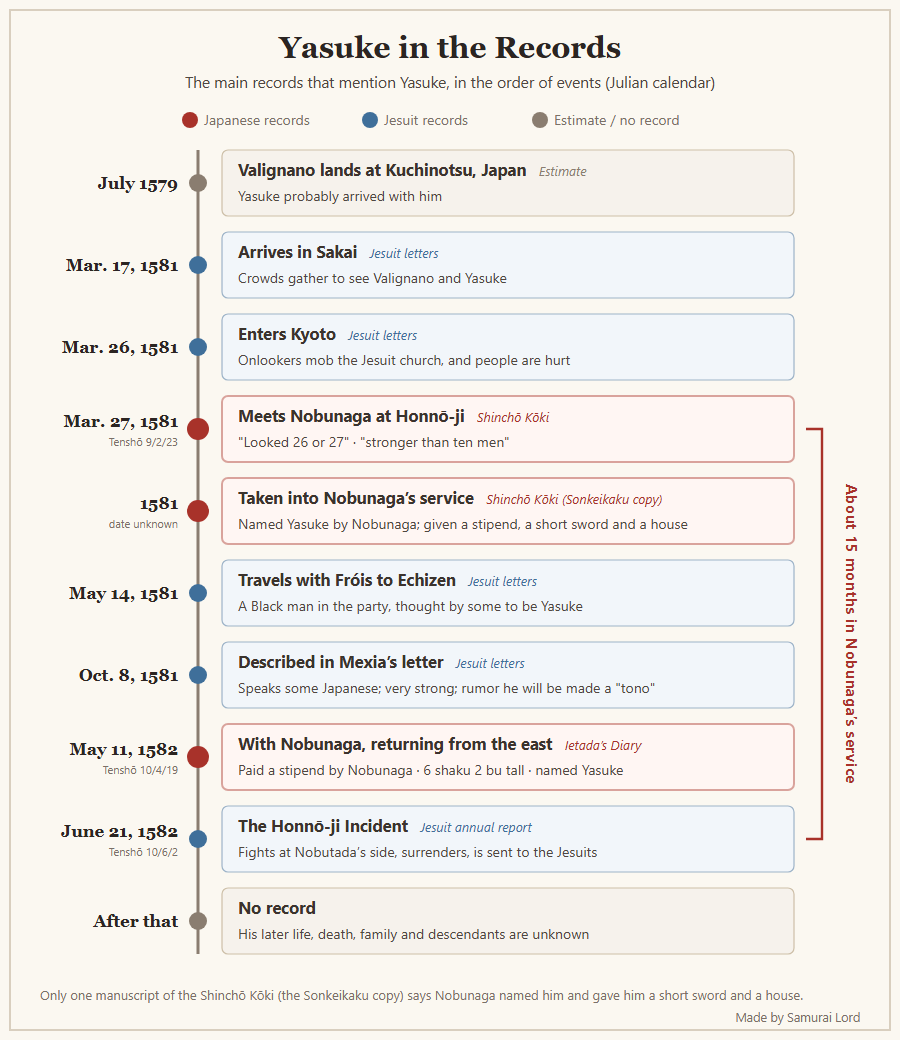
Image: Yasuke in the records (made by Samurai Lord). Tap or click to enlarge.
| Date | Event | Record |
| July 1579 | Valignano lands at Kuchinotsu; Yasuke probably with him | Estimate |
| March 1581 | Crowds mob him in Sakai and Kyoto | Jesuit letters |
| March 27, 1581 | Meets Nobunaga at Honnō-ji | Shinchō Kōki |
| 1581 | Given a stipend, the name Yasuke, a short sword and a house | Shinchō Kōki (Sonkeikaku copy) |
| May 1581 | A Black man travels with Fróis to Echizen (thought by some to be Yasuke) | Jesuit letters |
| October 1581 | Described as speaking some Japanese; rumor he will be made a "tono" | Mexia's letter |
| May 11, 1582 | In Nobunaga's party, returning from the Kai campaign | Ietada's Diary |
| June 21, 1582 | Fights in the Honnō-ji Incident, surrenders, and is sent to the Jesuits | Jesuit annual report |
Dates before October 1582 are given in the Julian calendar, which Europe used at the time.
Nobunaga did not merely stare at a curious visitor. He paid him a stipend and kept him close.
And a diary from that very time mentions the stipend! So he was treated as a retainer?
How to read that is exactly the question of whether he was a samurai.
Was Yasuke a Samurai?
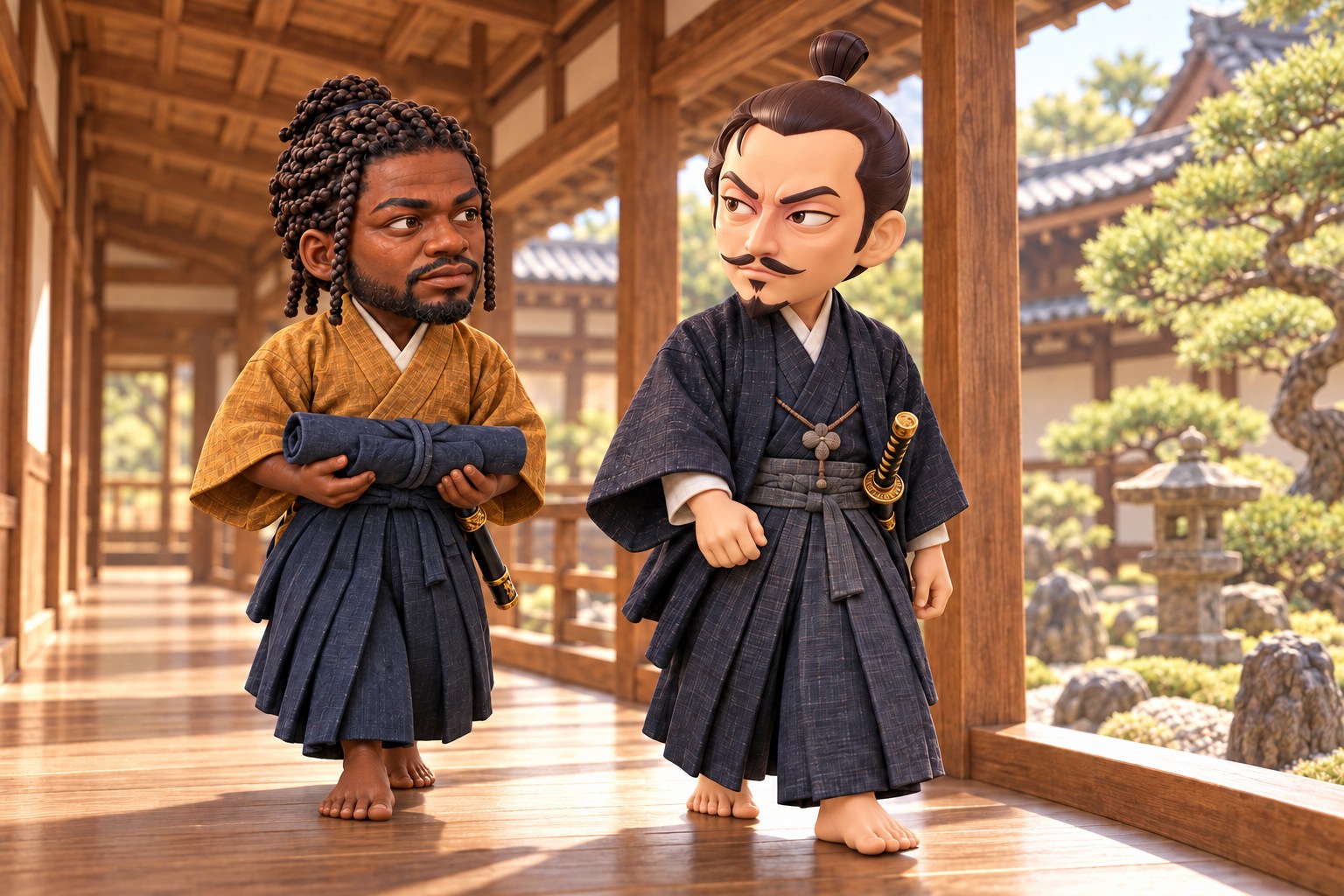
Image: An imaginative illustration of Yasuke carrying Nobunaga's belongings. What he carried, and this scene itself, are not recorded.
The Short Answer
- What records from his own time establish is that Nobunaga took a liking to Yasuke, paid him a stipend and kept him close, and that Yasuke fought during the Honnō-ji Incident
[Fact] - The statements that Nobunaga named him and gave him a short sword and a house appear in only one manuscript of the Shinchō Kōki
[Widely accepted: Shinchō Kōki, Sonkeikaku copy] - Whether all this amounts to samurai status is debated among historians
[Debated]
The answer turns on two questions. First, how much weight should a passage found in only one manuscript carry? Second, what exactly did "samurai" mean in sixteenth-century Japan? The word had no single fixed definition.
What the records say, and what they don't
| In records from his time | Only in the Sonkeikaku copy | In no record |
| Nobunaga liked him and had him shown around Kyoto (Jesuit letters) | Nobunaga named him Yasuke | Distinction in battle |
| Spoke some Japanese; very strong (Jesuit letters) | A short sword (sayamaki) | A fief of his own |
| Looked 26 or 27; stronger than ten men (Shinchō Kōki) | A house | A family name |
| Paid a stipend by Nobunaga; 6 shaku 2 bu tall; named Yasuke (Ietada's Diary) | Sometimes carried Nobunaga's belongings | His own thoughts or words |
| Fought at the Honnō-ji Incident and surrendered (Jesuit annual report) | (The stipend is mentioned here too) | What happened to him afterward |
Keep in mind that the records about Yasuke are very few, so "not recorded" does not mean "did not happen." The lack of a family name or a fief is not proof that he was not a samurai, and it is not proof that he was.
How historians read the evidence
Historians disagree less about the facts than about how to read them. Rather than counting heads, here is how each piece of evidence is interpreted. (Japanese names are given family name first.)
| Evidence | Read as samurai status | A more cautious reading |
| A stipend (Ietada's Diary; Sonkeikaku copy) | A lord–retainer bond with a stipend, a key condition of samurai status (Hirayama Yū) | Granting a house, a sword and a stipend does not by itself make someone a samurai (Watanabe Daimon) |
| A house (Sonkeikaku copy) | Being given a residence is strong evidence that he was treated as a retainer (Hirayama Yū) | The passage is in only one manuscript and may have been added in copying (Kaneko Hiraku) |
| A short sword (Sonkeikaku copy) | Being allowed to wear a sword shows he was not a lowly servant (Hirayama Yū) | Same as above |
| Carrying belongings (Sonkeikaku copy) | A personal attendant close to his lord | Suggests a role closer to a servant (Watanabe Daimon) |
Hirayama Yū, a historian of the Sengoku period, argues that with a stipend, a residence and a sword, there can be "little doubt" that Yasuke held samurai status in Nobunaga's service. He suggests that Yasuke had not received a family name simply because he served for only a little over a year.
Watanabe Daimon, by contrast, writes that the available information makes the question "hard to judge," and that Yasuke seems to have been more like a servant. Goza Yūichi, interviewed by the Sankei Shimbun newspaper, described Yasuke's position as "like that of an entertainer" and cautioned against calling him a samurai outright.
Sources (in Japanese; quotations are our translations): Hirayama Yū's posts on X (2024); Watanabe Daimon, "Was Yasuke, the Black man employed by Oda Nobunaga, of samurai status?" (Yahoo! News Expert, July 25, 2024); interview with Goza Yūichi (Sankei Shimbun, August 5, 2024); Kaneko Hiraku, Oda Nobunaga to iu rekishi (Bensei Shuppan, 2009)
"Samurai" in Japanese and in English
Image: An illustration of Yasuke deep in thought.
Part of the confusion comes from the word itself. In Sengoku-period Japan, samurai (侍) often meant a particular rank of retainer in a warrior household, set apart from lower servants such as chūgen and komono. But what exactly made someone a samurai was never fixed, and historians draw the line in different places [Debated].
In English, "samurai" usually means the whole warrior class of pre-modern Japan: a sword-carrying fighter. So when Yasuke is called "the African samurai" in English, the phrase does not always mean the same thing as the Japanese debate over whether he held samurai status.
You will also see Yasuke described as "the first foreign-born samurai" or "the only Black samurai." The records do not support claims that strong, so this article does not use them.
Did Nobunaga plan to make Yasuke a lord?
In a letter dated October 8, 1581, the Jesuit Lourenço Mexia wrote that some people who saw Yasuke said Nobunaga would make him a "tono" (lord) [Fact: Mexia's letter].
This was a rumor among onlookers, reported secondhand, not something Nobunaga is recorded as saying. There is no record that Yasuke ever became a lord with land of his own.
The same words can be read in different ways. That is why we must go back to the original text.
And "samurai" doesn't even mean quite the same thing in Japanese and in English!
Yasuke During the Honnō-ji Incident
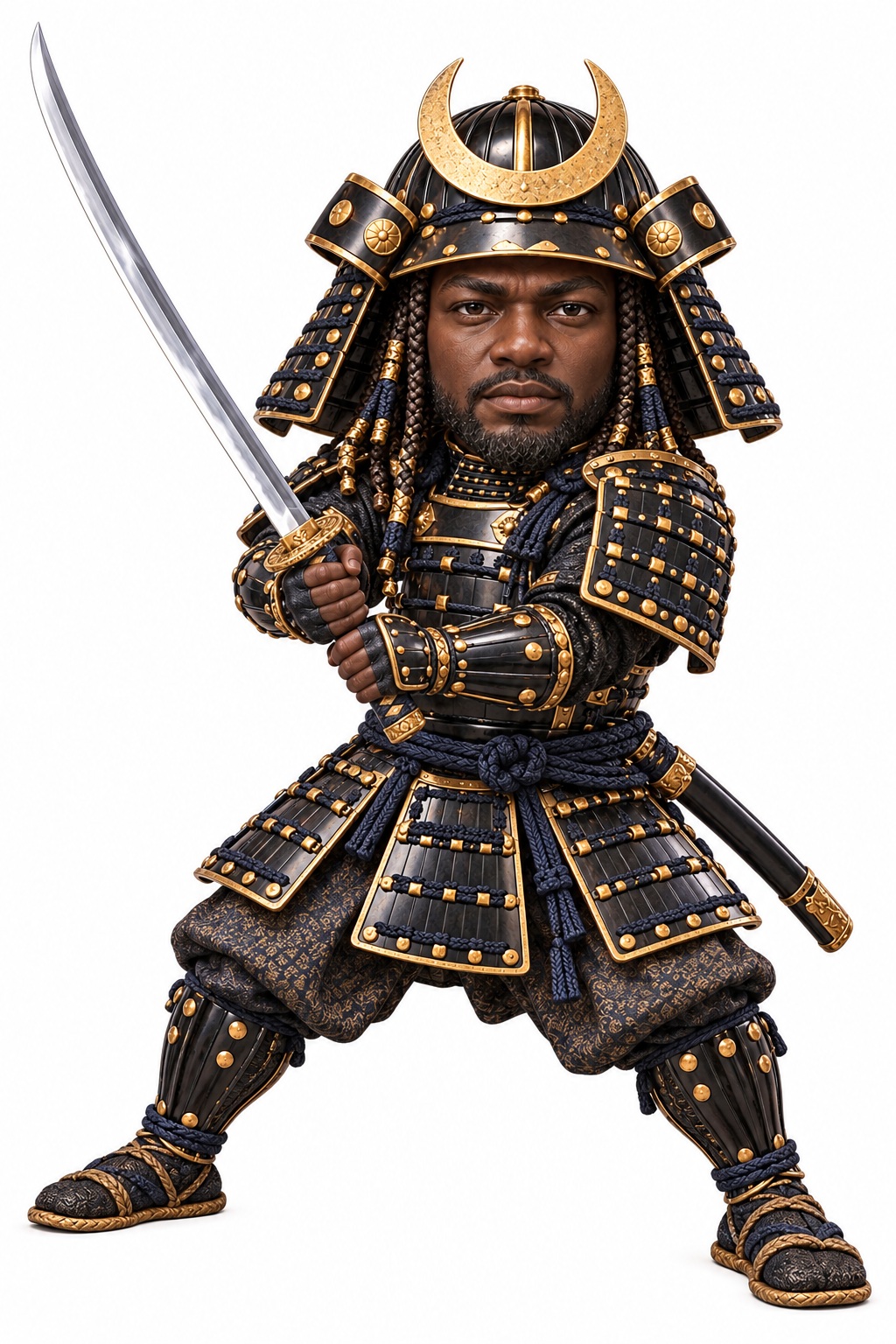
Image: An imaginative illustration of Yasuke in battle. What he wore and what weapons he used are not recorded.
The Short Answer
- On June 21, 1582 (the 2nd day of the 6th month of Tenshō 10), Nobunaga's general Akechi Mitsuhide attacked him at Honnō-ji in Kyoto. After Nobunaga died, Yasuke went to Nobunaga's eldest son and heir, Oda Nobutada, and fought
[Fact: Jesuit annual report] - After fighting for a long time, he surrendered his sword to Akechi's men and, on Mitsuhide's orders, was sent to the Jesuit church
[Fact: Jesuit annual report]
Source Box 4: The Jesuit annual report
Source: Luís Fróis's report dated November 5, 1582, in the Jesuits' annual letters from Japan, originally written in Portuguese
Our translation (from Murakami Naojirō's Japanese translation, 1943): "The Black man whom the Visitor had given to Nobunaga went, after Nobunaga's death, to the residence of his heir and fought there for quite a long time. One of Akechi's retainers came up to him and told him to hand over his sword without fear, and he gave it up."
What it tells us: This is the only record of what Yasuke did during the Honnō-ji Incident.
Nobutada had been staying at the temple of Myōkaku-ji. When the attack came, he moved to the nearby Nijō palace (the Nijō Shin-gosho) and fought there until he took his own life. The "residence of his heir" where Yasuke fought was most likely this place [Widely accepted].
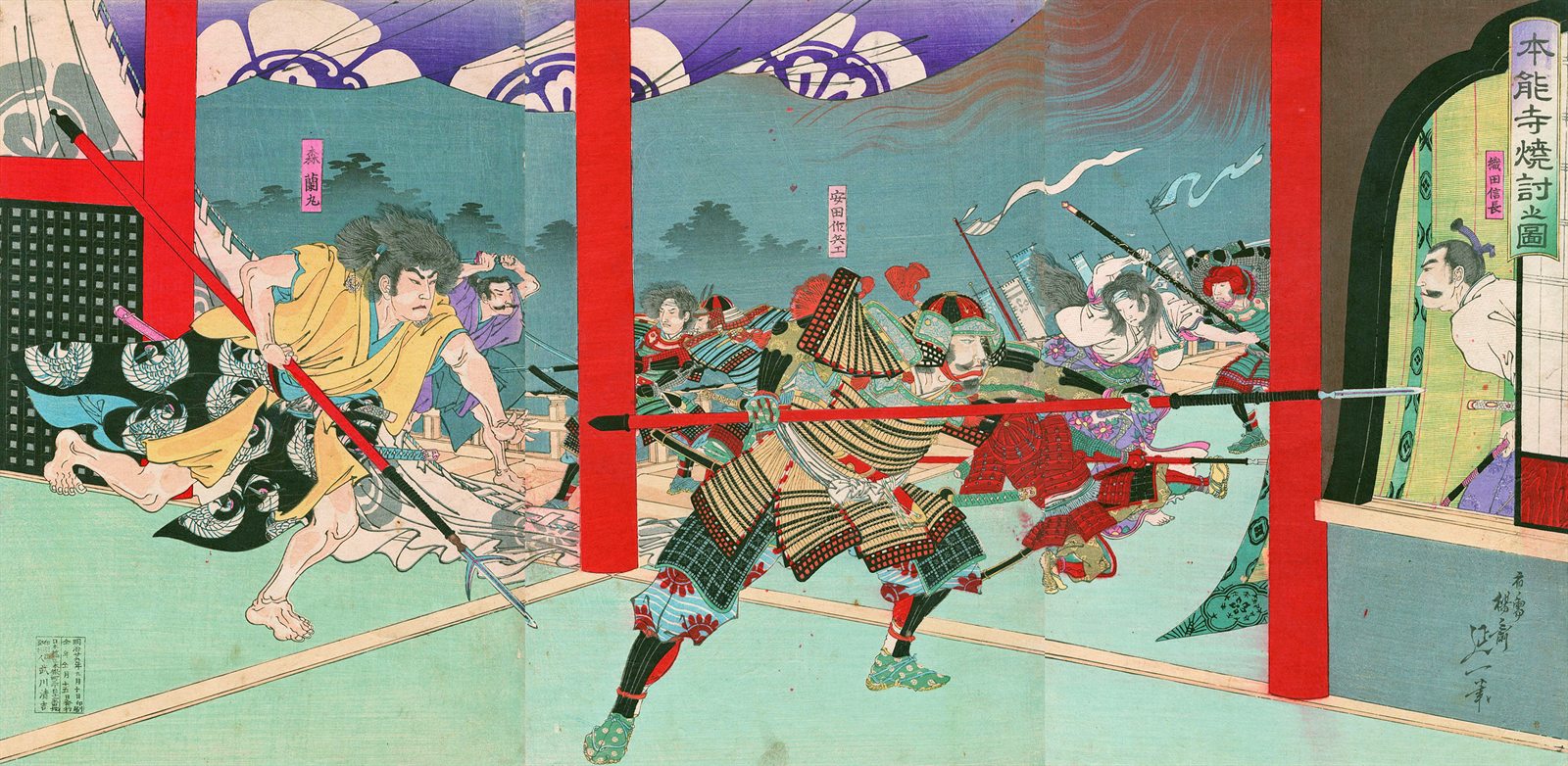
Image: "The Burning of Honnō-ji," a woodblock print by Yōsai Nobukazu (Meiji era, Nagoya City). It shows Nobunaga fighting in the burning temple; Yasuke does not appear in it.
When his men asked what to do with Yasuke, Mitsuhide is reported to have said that the Black man "was an animal and knew nothing, and was not Japanese," and so should not be killed. He ordered him taken to "the church of the Padres of India" [Fact: Jesuit annual report].
These words reflect the prejudice of the time against Africans. Yet the result was that Yasuke's life was spared and he was handed over to the missionaries.
Did Yasuke carry away Nobunaga's head?
Start with what the record says: according to the Jesuit report, Yasuke went to Nobutada after Nobunaga had died, fought there, and surrendered. No record says he carried away Nobunaga's body or head [Fact: Jesuit annual report].
A museum in Seto, Aichi Prefecture (the Nishiyama Natural History Museum), displays what it calls Nobunaga's death mask. According to the director's family tradition, it was made from Nobunaga's head, which Yasuke secretly carried away [Legend]. The story has spread through television and the internet, but no record of the time confirms it, and it does not fit the report that Yasuke fought at Nobutada's side rather than at Honnō-ji.
What Happened to Yasuke?
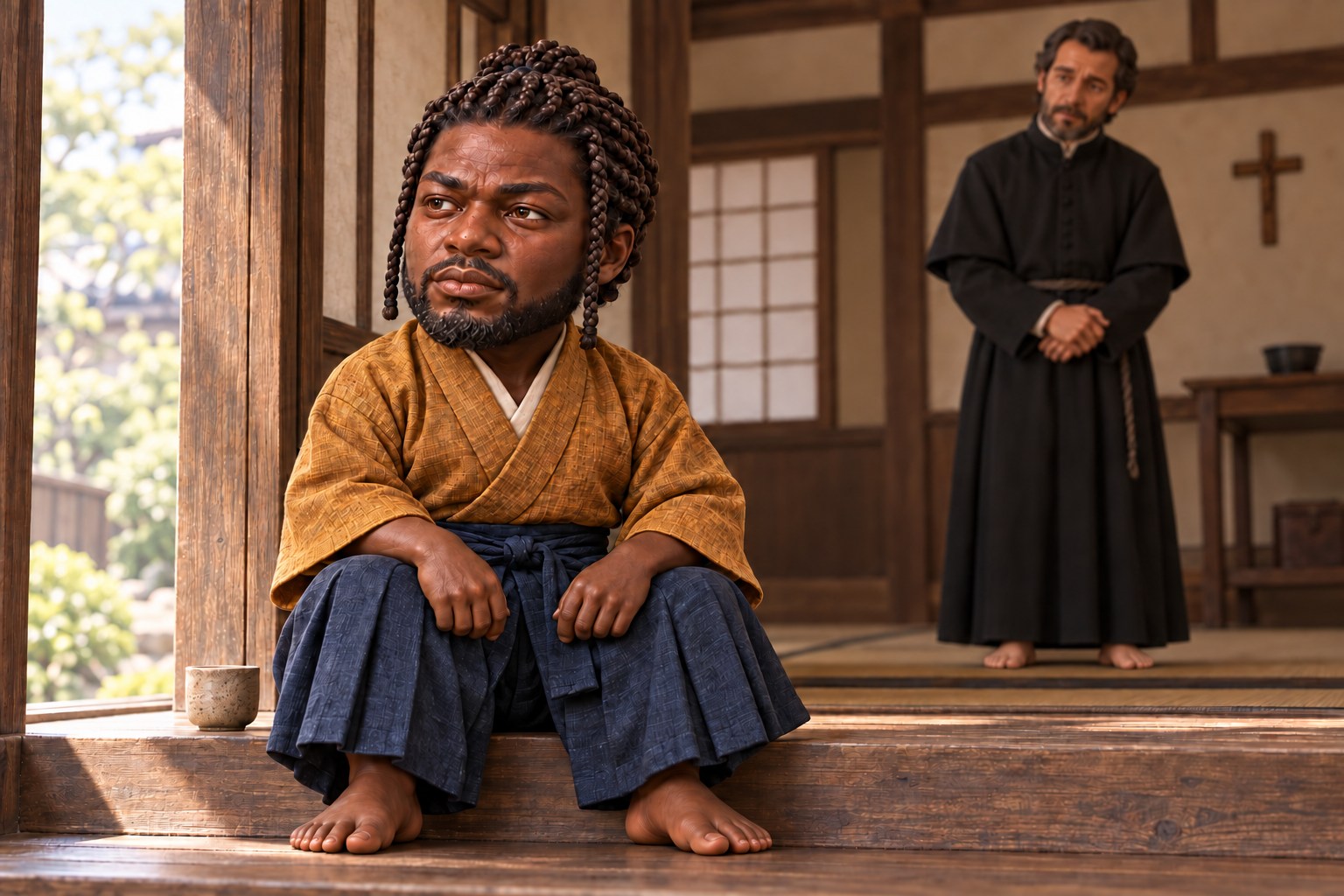
Image: An imaginative illustration of Yasuke after he was sent to the missionaries. Clothing, building and expression are imagined; it does not depict his later life.
The Short Answer
- After the record that he was sent to the Jesuit church, Yasuke disappears from history
[Unknown] - There is no record of a wife or children, and no descendants can be confirmed
[Unknown]
No record tells us where Yasuke went after he was handed over to the Jesuits, or when and where he died. Whether he went back to Kyushu with the missionaries or left Japan is unknown.
Was Yasuke the African gunner at Okitanawate?
In 1584, two years after Honnō-ji, the Arima and Ryūzōji clans fought the Battle of Okitanawate in Shimabara, Kyushu. Jesuit records say that an African man loaded the cannons on the Arima side [Fact: Fróis, History of Japan].
Some have wondered whether this was Yasuke, but the man is not named, and there is no evidence that they were the same person [Unknown]. Other Africans brought by the Portuguese were also in Japan at the time.
Does Yasuke have descendants?
There is no record of Yasuke's wife or children, and no family or person is known to descend from him [Unknown]. Claims about descendants that circulate online cannot be confirmed in the records.
Some novels, manga and films show Yasuke surviving Honnō-ji and going on to new adventures, or introduce descendants of his. These are the authors' inventions [Fiction].
Fifteen months in the records, and then nobody knows what became of him...
What is not known must be written as not known. That is the honest way to face the records.
What Was Yasuke Like? Clues in the Records
Image: An illustration of Yasuke smiling.
No record describes Yasuke's personality or feelings directly. Below, each clue is set out as what the record says → what we can say → what we don't know.
Clue 1: He spoke some Japanese
- The record: Mexia's letter says Yasuke could speak some Japanese
[Fact: Mexia's letter] - What we can say: If he arrived in 1579, he had learned some Japanese within about a year and a half
- What we don't know: How well he spoke, or whether he could read and write
Clue 2: He was strong and strikingly tall
- The record: The Shinchō Kōki says his "strength surpassed that of ten men," and Ietada's Diary gives his height as 6 shaku 2 bu (about 182 cm)
[Fact] - What we can say: His strength and height made a strong impression on the Japanese who saw him
- What we don't know: Nothing is recorded about his skill with weapons or his experience of battle before Honnō-ji
Clue 3: Nobunaga took a liking to him
- The record: According to the Jesuit letters, Nobunaga was delighted with Yasuke, kept him near, and had him taken around Kyoto with an escort. He is also said to have had some talent as a performer
[Fact: Mexia's letter] - What we can say: Nobunaga took a strong interest in Yasuke and treated him well
- What we don't know: What his performances were, or what he and Nobunaga talked about
Clue 4: He fought on at Honnō-ji
- The record: Even after Nobunaga's death, he went to Nobutada and fought for a long time
[Fact: Jesuit annual report] - What we can say: During the incident, Yasuke did not flee; he fought on the Oda side
- What we don't know: Whether he fought out of loyalty or simply had no other choice. His feelings are not recorded
Little can be said about Yasuke with certainty. Even so, these short records show a man who traveled from Africa, learned some Japanese within two years of arriving, served at the side of Japan's most powerful ruler, and in the end fought on the Oda side.
Africans in Sixteenth-Century Japan
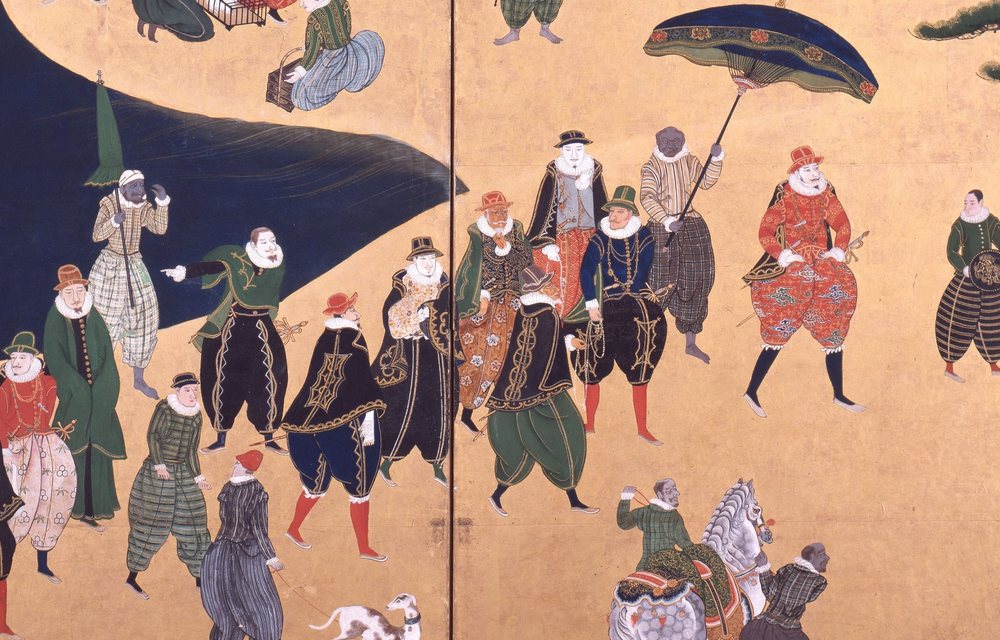
Image: Detail of a Nanban screen by Kanō Naizen (c. 1600, Kobe City Museum). Several men who appear to be African are shown, including an attendant holding a parasol over a Portuguese captain. None of them is Yasuke.
Yasuke arrived during the era of the "Nanban trade," when Portuguese ships came to the ports of Kyushu. The Portuguese brought people from Africa, India and Southeast Asia with them as sailors, servants and slaves.
| Year | Event | Source |
| 1540s | The Portuguese captain Jorge Álvares reports that the Japanese were eager to see Africans and came from far away to look at them | Álvares's report |
| 1581 | Yasuke comes to Kyoto and meets Nobunaga | Shinchō Kōki and others |
| 1584 | At the Battle of Okitanawate, an African man loads the cannons of the Arima side | Fróis, History of Japan, and others |
| 1593 | At Nagoya in Hizen (Saga Prefecture), Africans with a Portuguese party dance for Toyotomi Hideyoshi, who rewards them | Fróis, History of Japan |
Japanese people, too, were being sold abroad as slaves in this period. In 1587, Toyotomi Hideyoshi ordered the Christian missionaries out of Japan; a memorandum dated the day before his expulsion edict includes an article forbidding the sale of Japanese people to China, the "southern barbarian" lands and Korea [Fact: Hideyoshi's memorandum of 1587]. The buying and selling of people was widespread in both Asia and Europe at the time.
Sources (in Japanese): Fujita Midori, Afurika "hakken" (Iwanami Shoten, 2005); Lúcio de Sousa and Oka Mihoko, Daikōkai jidai no Nihonjin dorei (Chūkō Sensho, expanded edition 2021)
Yasuke in Assassin's Creed Shadows: History vs. Fiction
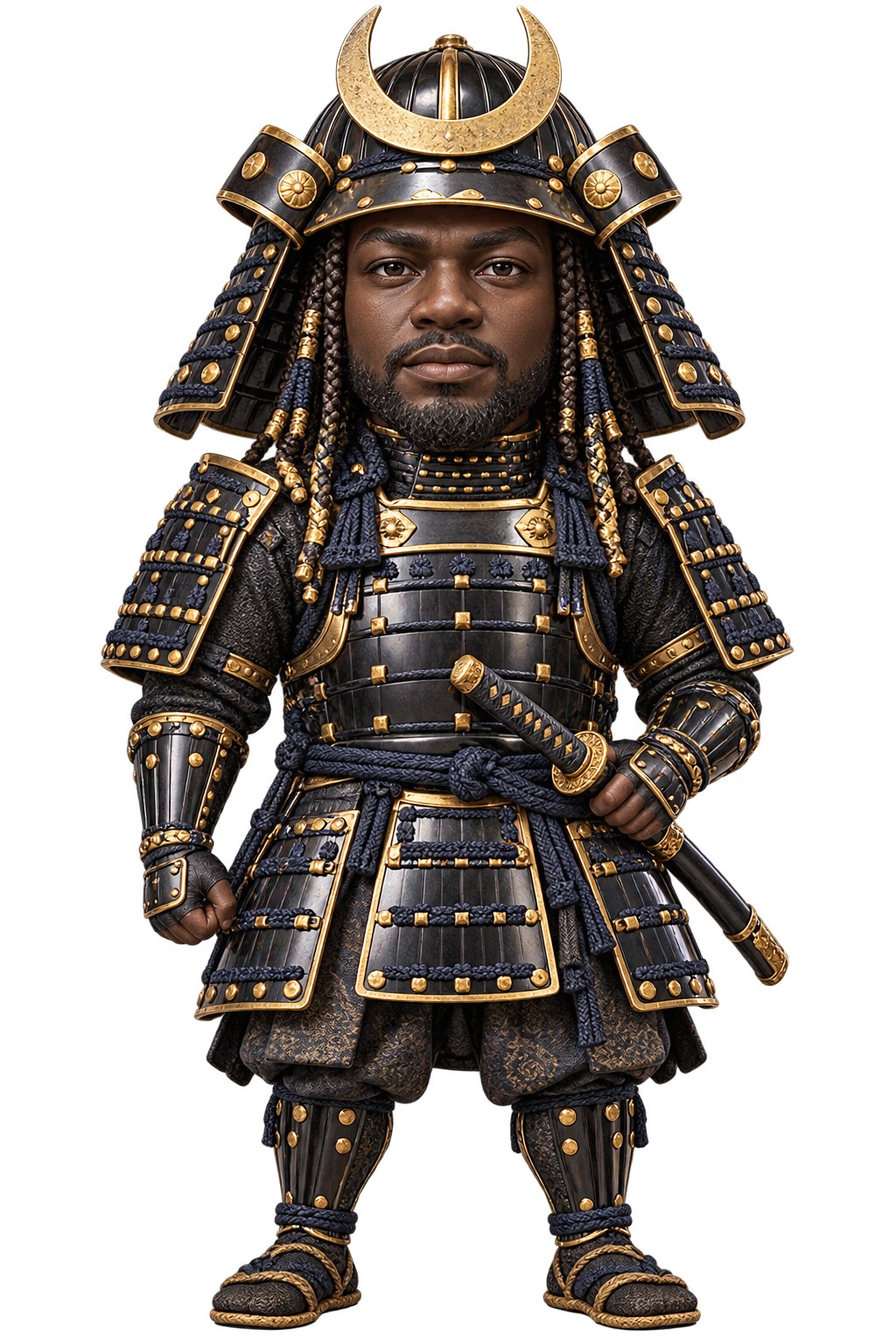
Image: An illustration of Yasuke in armor. Games and other works often show him like this, but there is no record that he ever wore armor.
Yasuke has appeared in novels, manga, anime, films and games, often as the hero. All of these are stories built by their creators on a few short records. Here is how common portrayals compare with the records.
| Common portrayal | What the records say | Verdict |
| Fights on the battlefield in full armor | No record of armor. The only fighting recorded is during the Honnō-ji Incident | [Fiction] |
| A master swordsman or great warrior | He was very strong (Shinchō Kōki); nothing is recorded about his skill with weapons | [Fiction] |
| A samurai retainer of Nobunaga | He received a stipend, and in one manuscript a house and a sword; whether that made him a samurai is debated | [Debated] |
| Adventures after Honnō-ji | No record after he was sent to the Jesuits | [Fiction] |
| Rescues Nobunaga's head | No record; he fought and surrendered at Nobutada's side | [Legend] |
The controversy over Assassin's Creed Shadows
In May 2024, the French game company Ubisoft unveiled Assassin's Creed Shadows, set in Sengoku-period Japan, with Yasuke as one of its two main characters, portrayed as a samurai. The announcement set off a heated debate in Japan and abroad over whether Yasuke really was a samurai. The game was released in March 2025.
The arguments spread beyond Yasuke's status to how the game depicted Japan and how online encyclopedias described him. In a statement in July 2024, Ubisoft said it had never intended to present its games as "factual representations of history," and acknowledged that its portrayal of Yasuke as a samurai is a matter of debate.
The game is historical fiction. What Yasuke does in it belongs to the game's story and does not settle his historical status. Equally, criticism of the game does not erase what the records do say about him.
Other works featuring Yasuke
| Type | Works |
| Novels (Japanese) | Kurusu Yoshio, Kurosuke (1968); Endō Shūsaku, Kuronbō (1971) |
| Manga | Hyouge Mono, Nobunaga no Chef, and others |
| Anime | Yasuke (Netflix, 2021) |
| NHK historical dramas | Nobunaga: King of Zipangu (1992), Hideyoshi (1996), Gunshi Kanbei (2014) |
| Film | Kitano Takeshi, Kubi (2023) |
| Games | Nioh (2017), Samurai Warriors 5 (2021), Assassin's Creed Shadows (2025), and others |
In English, Thomas Lockley and Geoffrey Girard's African Samurai (2019) did much to make Yasuke widely known. It is a popular narrative history, and some historians, including Goza Yūichi, have criticized it for filling gaps in the records with speculation. A Hollywood film about Yasuke was also announced, but it stalled after its lead actor died in 2020 and has not been made.
So the Yasuke in games and the Yasuke in the records really are different!
Enjoy a story as a story. But knowing what the records say makes it all the more interesting.
Frequently Asked Questions
Was Yasuke a real person?
Yes. He appears both in Japanese records (the Shinchō Kōki and Ietada's Diary) and in Jesuit letters and reports. However, he appears in them only between March 1581 and June 1582.
Was Yasuke a samurai?
Historians disagree. A diary written at the time says Nobunaga paid him a stipend, and one manuscript of the Shinchō Kōki adds that he was given a house and a sword. Some historians see this as samurai status; others think the evidence does not go that far.
How tall was Yasuke?
Ietada's Diary gives his height as 6 shaku 2 bu, about 182 cm (about 6 ft). He was much taller than most Japanese men of the time.
Where was Yasuke from?
He is believed to have come from Africa. Mozambique is the best-known theory, but it comes from a later source, and the records from his own time do not name his homeland.
Are there any portraits of Yasuke?
No. No portrait made in his lifetime survives, and the Africans shown in Nanban screens cannot be identified as Yasuke. Pictures of him online are modern works of imagination.
When and how did Yasuke die?
No one knows. The last record says he was sent to the Jesuit church in Kyoto after the Honnō-ji Incident in June 1582. Nothing is known about his later life or his death.
Does Yasuke have descendants?
None can be confirmed. There is no record of a wife or children.
Summary: Who Was Yasuke?
Yasuke was an African man who came to Japan with Jesuit missionaries, caught the interest of Oda Nobunaga, and served at his side on a stipend for about 15 months. During the Honnō-ji Incident he fought beside Nobunaga's heir, surrendered, and was spared. After that he disappears from history.
Whether he was a samurai depends on how one reads the evidence of his stipend, house and sword, and on what one means by "samurai." Rather than accepting confident claims from either side, it is worth going back to what the records actually say.
For more on the man Yasuke served, see our article on Oda Nobunaga; for the general who attacked him at Honnō-ji, see our article on Akechi Mitsuhide.
Only fifteen months of records, yet in them a real man truly lived.
Read the few records carefully, and Yasuke slowly comes into view!
Sources & How This Article Was Written
This article is based mainly on the following records and research:
- Japanese records from Yasuke's time: Ōta Gyūichi, Shinchō Kōki, Book 14 (including the Sonkeikaku Bunko manuscript); Matsudaira Ietada, Ietada Nikki. The Shinchō Kōki is available in English as The Chronicle of Lord Nobunaga, translated by J. S. A. Elisonas and J. P. Lamers (Brill, 2011)
- Jesuit records: letters by Luís Fróis, Lourenço Mexia and others (1581–82); Fróis's report of November 5, 1582, in the Jesuit annual letters from Japan (Japanese translation by Murakami Naojirō, 1943); Fróis, História de Japam
- A later source: François Solier, Histoire ecclésiastique des isles et royaumes du Japon (1627)
- Research (in Japanese unless noted): Fujita Midori, Afurika "hakken" (Iwanami Shoten, 2005); Kaneko Hiraku, Oda Nobunaga to iu rekishi (Bensei Shuppan, 2009); Matsuda Kiichi's essay on Valignano's life in Nihon junsatsuki (Tōgensha, 1965); Lúcio de Sousa and Oka Mihoko, Daikōkai jidai no Nihonjin dorei (Chūkō Sensho, 2021); Thomas Lockley and Geoffrey Girard, African Samurai (Hanover Square Press, 2019; in English)
- Historians' views (in Japanese): Hirayama Yū's posts on X (2024); Watanabe Daimon (Yahoo! News Expert, July 25, 2024); interview with Goza Yūichi (Sankei Shimbun, August 5, 2024)
- Other: National Diet Library of Japan, online exhibition Hon no Mangekyō no. 14 (in Japanese); Ubisoft's statement on Assassin's Creed Shadows (July 2024)
- Images: the Nanban screen by Kanō Naizen (Kobe City Museum) and Yōsai Nobukazu's print of Honnō-ji are public-domain images from Wikimedia Commons. The map is based on Natural Earth data (public domain). The map, timeline and illustrations are original to Samurai Lord
What the Labels Mean
[Fact]Confirmed by sources from Yasuke's own time ([Fact: …]names the source)[Widely accepted]The view held by most historians ([Widely accepted: …]names the source)[Debated]Historians disagree[Unknown]No source tells us[Legend][Fiction]Stories created later, or settings invented for novels and games
This article was written by the Samurai Lord editorial team and is revised as new research and reader feedback come in. If you spot an error, please let us know through our contact form (in Japanese) and we will check and correct it.
Read in Japanese
This article is also available in Japanese: 弥助とは?信長との関係・侍だったのか・その後を史料で解説