Image: An illustration based on his portrait. All illustrations in this article are imaginative.
Long before he ruled Japan, when he was still called Hashiba Hideyoshi, Toyotomi Hideyoshi had a clever commander at his side: Takenaka Hanbei (1544–1579). His personal name was Takenaka Shigeharu.
He is famous as one of Hideyoshi's two great “strategists,” alongside Kuroda Kanbei. Yet he died young, in an army camp, and very few records from his own time mention him. Most of what people “know” about Hanbei the genius strategist was created in the Edo period (1603–1868) and later.
This article covers how he died, his relationship with Kuroda Kanbei, his character, his descendants, and his graves—separating what records from his own time confirm from stories created later.
Key points are tagged: [Fact] confirmed by records from the period, [Widely accepted] supported by most historians, [Debated] competing theories, [Unknown] not known from any source, and [Legend] or [Fiction] later stories. A tag like [Fact: Shinchō Kōki] or [Legend: Kuroda Kafu] names the source.
.jpg)
I am Uesugi Kenshin. Today's subject is the clever young man who stood beside Hideyoshi in his early days. He is hugely popular—and yet, in truth, a man of many mysteries, with very few records.
.jpg)
I'm Date Masamune! In the article on Lord Kanbei, I was surprised to learn that the story of Hanbei saving Kanbei's son came from a later book. How much of what we hear about Lord Hanbei is true?
.jpg)
A good question. Today we shall find the line between what we know and what we do not, one story at a time.
Who Was Takenaka Hanbei?
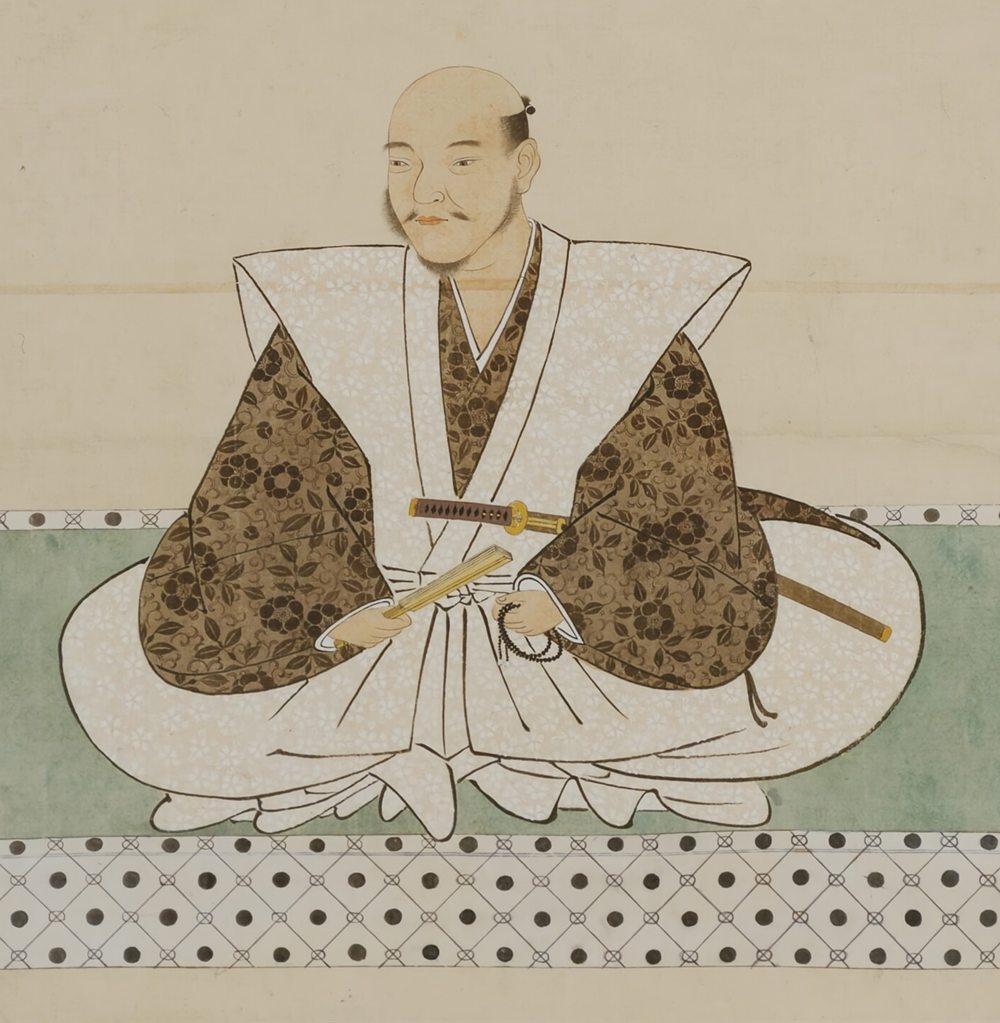
Image: Portrait of Takenaka Shigeharu (Hanbei), handed down in the Takenaka family (detail)
In a nutshell, Takenaka Hanbei was “a warlord from Mino who was assigned to Hideyoshi's army by the Oda, and who helped Hideyoshi by talking enemies over to his side (chōryaku) and by attacking castles.”
Takenaka Hanbei at a Glance
- He was born in Mino (Gifu Prefecture) in 1544 and died of illness in 1579, in camp during the siege of Miki Castle
[Fact] - Nobunaga's chronicle, the Shinchō Kōki, records him winning castles by persuading their commanders to switch sides
[Fact: Shinchō Kōki] - Most of the famous “genius strategist” stories were created by Edo-period war tales and storytellers
[Widely accepted]
Three Things That Show His Character
- Talks before force: the deeds recorded in his own time are mostly about persuading enemies to change sides, not about storming castles
[Fact: Shinchō Kōki] - Remembered as a man without greed: an Edo-period book says he tore up a letter in which Hideyoshi promised him more land
[Legend: Bukō Zakki] - A gentle face: one book describes him as having “the looks of a woman”
[Legend: Taikōki and others]
Jump to the part you want to read:
- How did he die? Was it tuberculosis?
- His relationship with Kuroda Kanbei
- Stories that reveal his character
- Does he have living descendants?
- Where is his grave?
Quick Profile
| Item | Details | Reliability |
| Lived | 1544–1579 | [Fact] |
| Birthplace | Ōmidō Castle, Mino province (today's Ōno, Ibi District, Gifu) | [Widely accepted] |
| Names | Hanbei (common name); Shigeharu (personal name); Shigetora (name in his youth) | [Widely accepted] |
| Lords served | Saitō Yoshitatsu and Tatsuoki → Oda Nobunaga (working under Hideyoshi as a support commander) | [Widely accepted] |
| Castle | Bodaisan Castle (Tarui, Fuwa District, Gifu) | [Widely accepted] |
| Wife | Tokugetsu-in (daughter of Andō Morinari) | [Widely accepted] |
| Son | Takenaka Shigekado | [Fact] |
| Family crests | Kumai-zasa (nine bamboo leaves), kokumochi (black disc) | [Widely accepted] |
| Death | Illness (the disease is unknown), aged 34 or 35 (36 by the traditional Japanese count) | [Fact] |
Hanbei or Shigeharu? His Names and the Nickname “Today's Zhuge Liang”
| Name | Reading | What kind of name? |
| Hanbei (半兵衛) | HAHN-bay | His everyday name—and the one he is best known by |
| Shigeharu (重治) | shee-geh-HAH-roo | His personal name |
| Shigetora (重虎) | shee-geh-TOH-rah | The name he is said to have used as a young man |
“Takenaka Hanbei” and “Takenaka Shigeharu” are the same man [Fact]. He is said to have used the name Shigetora when he was young [Widely accepted].
He is sometimes called “Ima Kōmei”—“today's Zhuge Liang,” after the brilliant strategist of China's Three Kingdoms period. But it is not clear when this nickname came into use [Unknown].
Where Do the Stories About Hanbei Come From?
What has been written about Hanbei falls into four groups, and they are not equally reliable. Throughout this article, each story is marked with the group it belongs to.
The Sources of Hanbei's Stories
- 1. Records from his own time: the Shinchō Kōki, a chronicle of Nobunaga by his retainer Ōta Gyūichi, and documents kept at temples. These are the most reliable—but Hanbei appears in only a few passages
- 2. A book by his son: the Toyokagami, a life of Hideyoshi written in 1631 by Hanbei's son, Takenaka Shigekado. A record written by a family member
- 3. Edo-period war tales and family records: the Taikōki (c. 1625), the Takenaka Kafu, the Kuroda Kafu (1688), anecdote collections, and others. Most were written more than 50 years after his death
- 4. Storytelling, puppet plays, and novels: stories meant to entertain (fiction). Much of the “genius strategist Hanbei” image was born here
Most of the famous stories come from groups 3 and 4, and group 1 has very little. That is why historians say the real Hanbei is hard to see [Widely accepted].
How Did Takenaka Hanbei Die? Was It Tuberculosis?
-683x1024.png)
The Short Answer
- He died of illness in camp during the siege of Miki Castle in Harima (Miki, Hyōgo) on July 6, 1579 (the 13th day of the 6th month of Tenshō 7)
[Fact] - He was 34 or 35 (36 by the traditional Japanese count)
[Fact] - The disease was never recorded, so we do not know what it was. The idea that it was tuberculosis is a modern guess
[Debated]
Sources: Shinchō Kōki; Watanabe Daimon, “What Was the End of Takenaka Hanbei, Hideyoshi's Genius Strategist?” (Yahoo! News Expert, in Japanese); Ikeuchi Shōichi, ed., Takenaka Hanbei no Subete (1996)
The Shinchō Kōki Says Only “Died of Illness in Camp”
The record from his own time that reports Hanbei's death is the Shinchō Kōki, the chronicle of Nobunaga compiled by his retainer Ōta Gyūichi. It says only that Takenaka Hanbei, a commander assigned to Hideyoshi, “died of illness at the camp in Banshū” (Harima, today's Hyōgo) [Fact: Shinchō Kōki].
It does not say what the illness was or what symptoms he had. The historian Watanabe Daimon points out that we cannot even tell whether Hanbei had been ill for a long time or died suddenly.
Where Does the Tuberculosis Theory Come From?
The cause most often given for Hanbei's death is tuberculosis (called rōgai in his day). Hayakawa Satoshi, a medical scientist and professor at Nihon University, notes that few primary sources survive, but suggests it is likely that Hanbei had tuberculosis [Debated].
However, the Shinchō Kōki and the other records we checked for this article do not describe his symptoms, so tuberculosis cannot be confirmed [Unknown]. It is best treated as one plausible guess.
Source: an article by Hayakawa Satoshi (professor, Nihon University) in President Online, 2026 (in Japanese)
Why Is He Remembered as Sickly?
Hanbei is often described as frail. This comes from Edo-period books such as the Taikōki and the Jōzan Kidan, which say he was thin and weak, with “the looks of a woman” [Legend: Taikōki, Jōzan Kidan]. It cannot be confirmed in records from his own time.
His early death in camp probably strengthened the image of the “sickly genius strategist” as well.
His Last Words: “To Die in Camp Is a Warrior's Wish”
When Hanbei became seriously ill, Hideyoshi urged him to go to Kyoto to recover. Hanbei refused, saying that to die in camp was what a warrior truly wished for—or so the story goes [Legend: Takenaka Kafu].
This story comes from the Takenaka Kafu, a family record compiled later, so it cannot simply be taken as fact. Still, the Shinchō Kōki confirms that Hanbei stayed at the siege of Miki until the end. Another well-known story says that before he died, he advised Hideyoshi to take Miki Castle by starving it out, but where this story comes from is unclear [Folk belief].
.jpg)
I always thought it was tuberculosis… So the disease wasn't even recorded!
When the records are silent, the honest answer is “we do not know.” And it is exactly when we do not know that people love to make up stories.
Takenaka Hanbei and Kuroda Kanbei: Did He Really Save Kanbei's Son?
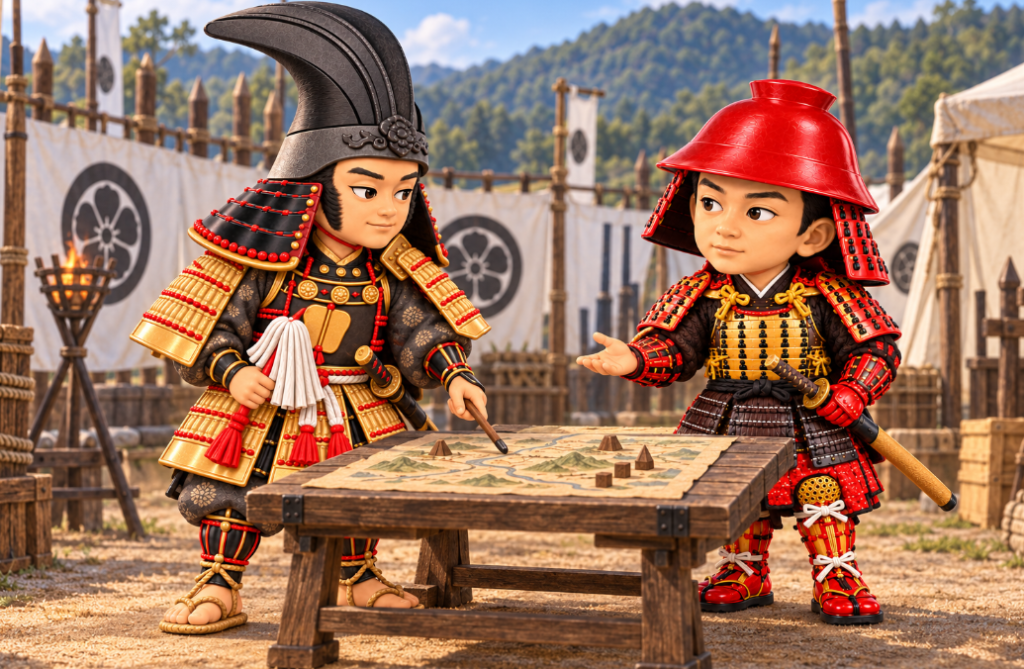
Image: Hanbei and Kanbei planning in camp (illustration)
In short, Hanbei and Kanbei were fellow commanders who supported Hideyoshi at the same time, and later generations called them “the Two Hyōe” (Ryō-bei), after the “-bei” in both their names [Widely accepted]. But they worked together for only about a year. The famous story of Hanbei saving Kanbei's son comes from a later book; what records really show is a bond between their sons.
Sources: Shinchō Kōki (the attack on Fukuhara Castle, 1577); Kuroda Kafu (1688); the site of Takenaka Shigekado's and Kuroda Nagamasa's positions at Sekigahara
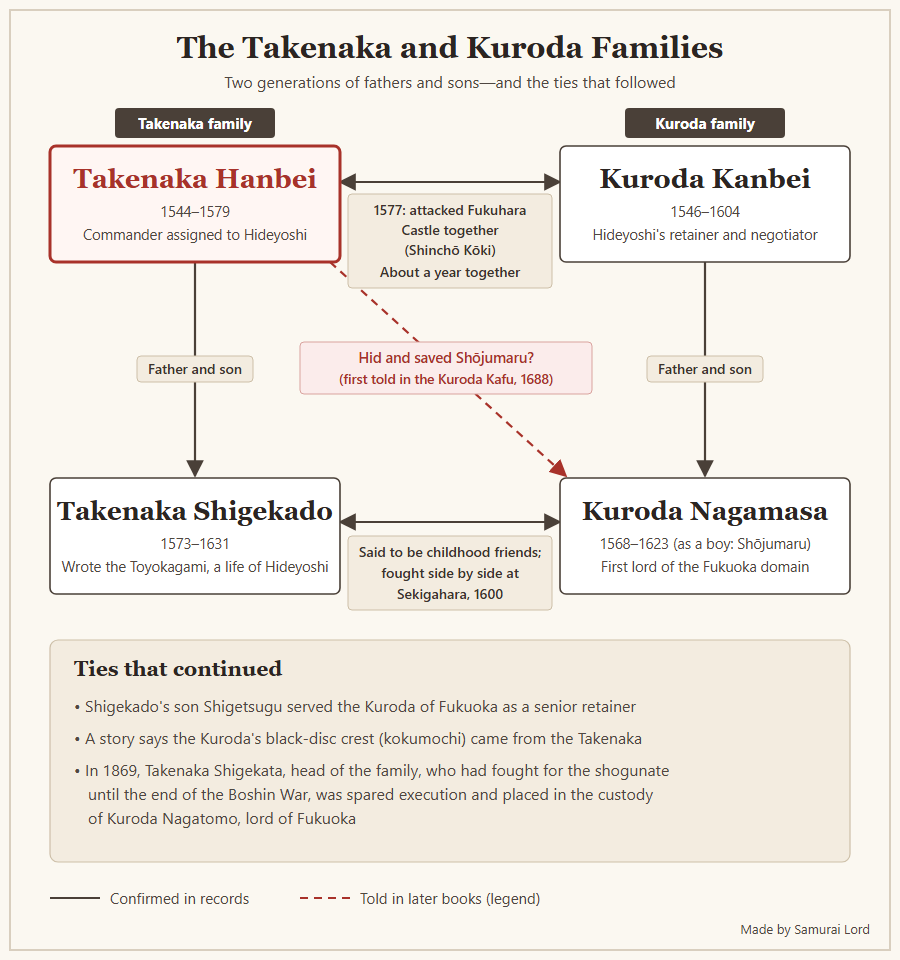
Image: The Takenaka and Kuroda families (made by Samurai Lord). Tap or click the image to enlarge it.
The Two Men: Only About a Year Together
The Shinchō Kōki confirms that the two served on the same battlefield. In late 1577, during Hideyoshi's campaign in Harima, Hanbei and Kanbei attacked Fukuhara Castle (also called Sayo Castle, in Sayo, Hyōgo) together [Fact: Shinchō Kōki].
But in late 1578, Kanbei was imprisoned in Araki Murashige's Arioka Castle, and Hanbei died in July 1579, while Kanbei was still in his cell. So the two stood side by side for only about a year. In the records we checked, nothing from their own time shows directly how close they were [Unknown].
For Kanbei's life story, see our article on Kuroda Kanbei.
The Shōjumaru Story First Appears in the Kuroda Kafu (1688)
Here is the famous story. In 1578, when Kanbei went into Arioka Castle and did not come back, Nobunaga decided he had switched sides and ordered the death of Kanbei's son Shōjumaru (the future Kuroda Nagamasa), who was being held as a hostage. Hanbei handed over a false head instead, then hid the boy and kept him safe on his own lands.
This story first appears in the Kuroda Kafu, a history compiled by the Kuroda family in 1688—more than a century after Hanbei's death. It cannot be confirmed in records from the time, and most historians now think it was likely created later [Legend: Kuroda Kafu].
For more, see the section “His Relationship with Takenaka Hanbei” in our Kuroda Kanbei article.
The Next Generation: Their Sons Fought Side by Side at Sekigahara
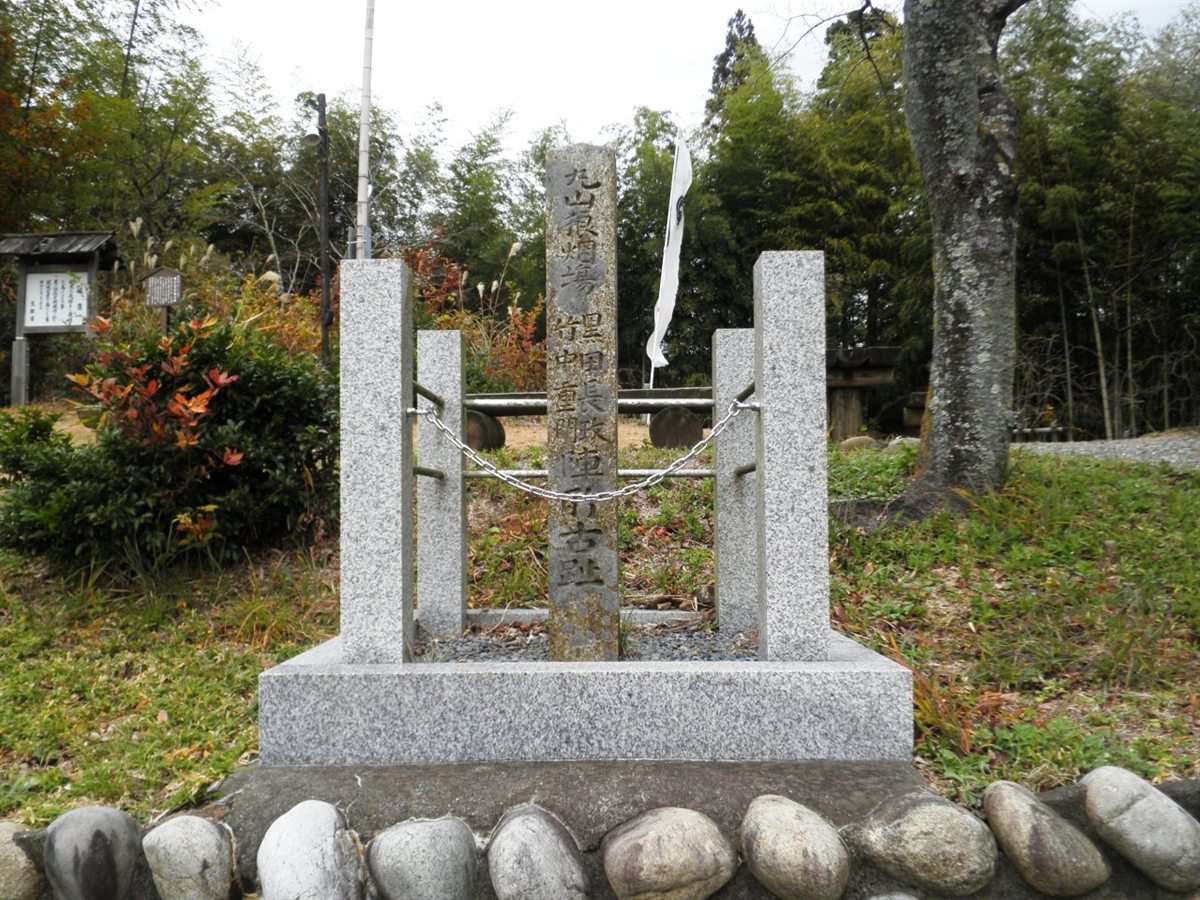
Image: The site of Kuroda Nagamasa's and Takenaka Shigekado's positions at the Battle of Sekigahara (Sekigahara, Gifu). Photo: 立花左近 (CC BY-SA 3.0, Wikimedia Commons)
What records do show is a bond in the next generation. Hanbei's son Takenaka Shigekado and Kanbei's son Kuroda Nagamasa are said to have been childhood friends [Widely accepted]. At the Battle of Sekigahara in 1600, Shigekado first sided with the Western Army, but switched to the Eastern Army through the mediation of Ii Naomasa, and in the main battle he fought alongside Nagamasa's troops [Fact]. In Sekigahara today, a single stone marker shows where both men took up their positions.
What is more, one of Shigekado's sons, Takenaka Shigetsugu, served the Kuroda of the Fukuoka domain as a senior retainer, thanks to the family's tie with Nagamasa [Widely accepted]. There is also a story that the Kuroda's black-disc crest, the kokumochi, came from the Takenaka family [Legend].
However, the friendship between the sons does not prove that the fathers were close, or that the Shōjumaru story is true. “There was a real bond in the next generation” and “the rescue story is a fact” are two separate questions.
Even if the fathers' friendship cannot be proven, their sons stood shoulder to shoulder at Sekigahara. That, too, is a bond.
I had no idea their sons were childhood friends who fought together at Sekigahara!
Stories That Reveal His Character
-683x1024.png)
Many stories describe Hanbei's character, but very few come from records of his own time. Below, stories confirmed by records and stories that first appear in later books are kept apart, each shown with its source.
Stories Found in Records from His Time
- Winning a castle by talking—and 100 pieces of silver from Nobunaga: in 1578, he persuaded the commander of Hachimanyama Castle in Bizen (Okayama), held by the Ukita, to switch sides. Hanbei reported to Nobunaga in Kyoto, who praised him and gave him 100 ryō of silver
[Fact: Shinchō Kōki] - A signature mark shaped like a phoenix: the kaō (personal signature mark) he used in 1579, the year he died, was a very unusual design based on the words sennen ōtori—“the thousand-year phoenix”
[Fact]. Like Nobunaga's mark shaped after the character for the mythical kirin, it is said to express a wish for peace[Debated]
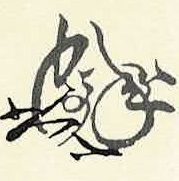
Image: Takenaka Hanbei's kaō, “the thousand-year phoenix” (from Satō Shin'ichi, Kaō o Yomu; Wikimedia Commons)
It suits Hanbei that what Nobunaga's chronicle remembers is not a feat of swordsmanship but a castle won by persuasion.
Stories from Later Books (Legends)
The following stories cannot be confirmed in records from his time; they come from books and anecdote collections written in the Edo period and later [Legend]. Even so, they show clearly what kind of man later generations believed Hanbei to be.
- He rode a cheap horse on purpose: when Hideyoshi said a man of his rank should not ride such a shabby horse, Hanbei replied, “With a fine horse, I would hate to lose it, so I would hesitate to dismount and miss my chance to fight. A horse I can abandon at any moment is best”
[Legend: Meishō Genkōroku] - He tore up a promise of more land: when Hideyoshi tried to give him a letter promising more land, Hanbei tore it up: “If this exists, one day my son may resent you—‘You did so much for my father, so why not for me?’”
[Legend: Bukō Zakki] - “Never leave in the middle of war stories”: when his young son got up to go to the toilet while Hanbei was telling war stories, Hanbei scolded him: “Even if you wet yourself, you must not leave. If people say a Takenaka boy was so absorbed in war stories that he soiled the floor, that would bring honor to our house”
[Legend: Buhen Banashi Kikigaki] - A face like a woman's: he was slender with a gentle, womanly face, and on the battlefield he simply sat quietly on his horse
[Legend: Taikōki, Jōzan Kidan]
Free of greed, practical rather than showy, and strict in teaching his son a warrior's discipline—the Hanbei that later generations imagined was a surprisingly earnest, selfless man.
A Story Called Fiction: Burning Kanbei's Promise
Another famous story says that when Kanbei came to complain that Hideyoshi had never delivered the extra land he had promised, Hanbei took the letter of promise, burned it, and told him, “It is because this letter exists that you feel discontent.” But the historian Takayanagi Mitsutoshi concluded that it must be invented, because almost the same story is told about Date Masamune [Fiction].
The Saying “Shiranu Kao no Hanbei”
In Japanese, pretending not to know something you know is called “shiranu kao no Hanbei”—“Hanbei with an innocent face.” One theory says this Hanbei is Takenaka Hanbei. But the stories behind the saying were created for the stage, in Edo-period puppet plays such as Konoshitakage Hazama Kassen (1789), and are not history [Fiction].
So many stories say he had no greed. Later people, it seems, saw in Hanbei the image of the selfless master strategist.
The cheap-horse story is so practical—I love it! But it's only a legend, isn't it?
The Seizure of Inabayama Castle: What Really Happened?
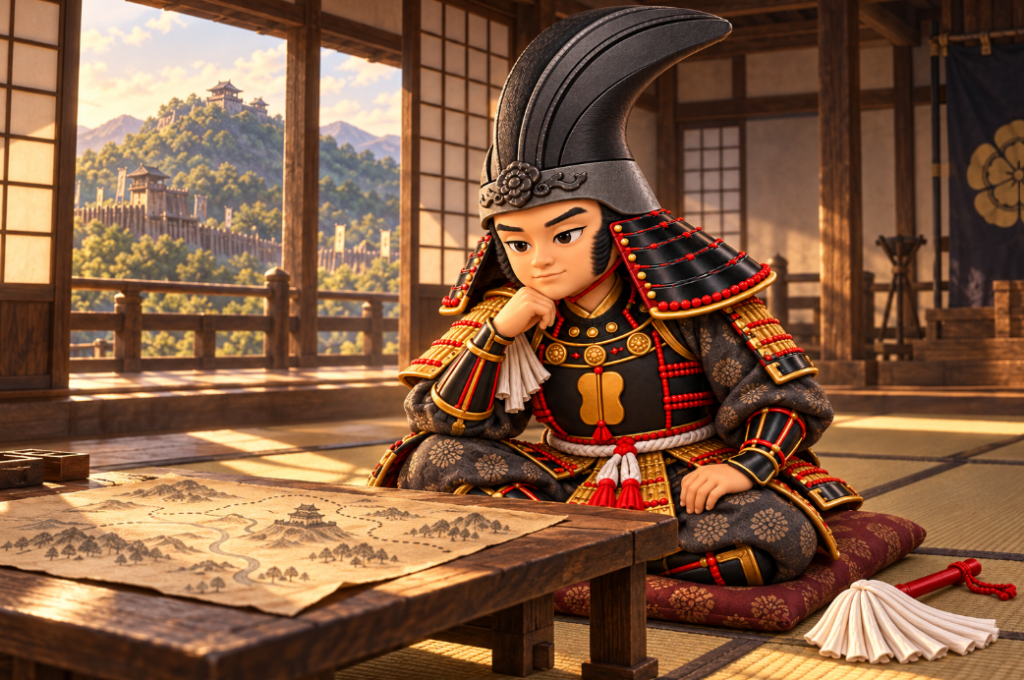
Image: Hanbei planning, with a mountain castle in the distance (illustration)
What made Hanbei's name was his seizure of Inabayama Castle (later Gifu Castle), the castle of his own lord, Saitō Tatsuoki.
The Short Answer
- In 1564, Hanbei and his father-in-law, Andō Morinari, seized Inabayama Castle
[Widely accepted] - The occupation lasted at least into late summer, and Tatsuoki's side seems to have taken the castle back soon after
[Widely accepted] - Colorful details—that he took it with only a handful of men, or that it was revenge for being urinated on—come from later books
[Legend]
Sources: the Keinen-ji Monjo (temple documents showing the occupation still continued in the 7th month); Katsumata Shizuo, “The Rise and Fall of the Saitō of Mino,” in Gifu Kenshi (1980)
What Can Be Confirmed
Early in 1564 (the 2nd month of Eiroku 7), Hanbei attacked Inabayama Castle with the troops of his father-in-law, Andō Morinari. They killed Saitō Hida-no-kami and other close aides of Tatsuoki and drove Tatsuoki out of the castle [Widely accepted]. Documents kept at Keinen-ji Temple show that the occupation was still going on near the end of the 7th month [Fact: Keinen-ji Monjo].
After that, the castle went back to Tatsuoki's side. Edo-period books turn this into a noble tale—Hanbei seized the castle to bring his lord to his senses, then returned it once he had made his point. But since the fighting dragged on for about half a year, historians think it more natural that he gave the castle up under attack from Tatsuoki's supporters [Widely accepted].
Details Added Later
Edo-period books tell the story like this. Because Hanbei looked mild, the Saitō retainers looked down on him, and Saitō Hida-no-kami, Tatsuoki's favorite, urinated on his face from a castle tower. A few days later, Hanbei entered the castle on the pretext of nursing his sick younger brother, who was stationed there, bringing in boxes with weapons hidden inside. He then cut down Hida-no-kami and took the castle [Legend]. Some versions say he did it with just 16 men.
It makes a thrilling tale, but every part of it comes from later books and cannot be confirmed in records from the time.
Revenge for being urinated on…! It sounds like a TV drama.
Indeed, it is almost too good a story. The better the story, the more carefully we must check where it came from.
Life and Achievements: A Short Timeline
| Year | Event | Notes |
| 1544 | Born at Ōmidō Castle in Mino (Ōno, Gifu) | His father was Takenaka Shigemoto |
| 1559 | Moves with his father to Bodaisan Castle (Tarui) | A mountain castle his father built |
| c. 1560 | Becomes head of the family and serves the Saitō | After his father's death or retirement |
| 1564 | Seizes Inabayama Castle | Gives it up after about half a year |
| 1567 | The Saitō fall; he takes refuge with Azai Nagamasa | Leaves after about a year and returns home to Iwate (Tarui) |
| 1570 | Becomes a support commander (yoriki) under Hideyoshi | Recorded in the Toyokagami |
| 1573 | His son Shigekado is born | Later the author of the Toyokagami |
| 1577 | Joins Hideyoshi's Harima campaign and attacks Fukuhara Castle with Kanbei | Recorded in the Shinchō Kōki |
| 1578 | Wins over Hachimanyama Castle in Bizen; receives 100 ryō of silver from Nobunaga | That autumn, Kanbei is imprisoned at Arioka Castle |
| 1579 | Dies of illness in camp during the siege of Miki Castle | July 6 |
When Did He Join Hideyoshi—and Is the “Three Visits” Story True?
After the Saitō fell, Hanbei took refuge with Azai Nagamasa, but left after about a year and went back to his home in Iwate (Tarui) [Widely accepted].
In 1570, when the Oda army attacked the Azai, Hideyoshi asked Nobunaga to assign “the Takenaka of Mino” and others to him as support commanders, and Nobunaga agreed—according to the Toyokagami, written by Hanbei's son Shigekado [Widely accepted: Toyokagami]. This is why historians think that Hanbei was not Hideyoshi's own retainer, but a yoriki—a commander assigned to Hideyoshi's army by the Oda [Widely accepted]. Another view is that, like his younger brother Shigenori, he was first taken into Nobunaga's direct service and then placed under Hideyoshi [Debated].
There is also a famous story that Hideyoshi visited Hanbei three times in his hiding place before Hanbei finally agreed to serve him. But historians point out that this simply copies the scene in the Chinese novel Romance of the Three Kingdoms in which Liu Bei visits Zhuge Liang three times [Fiction].
Hideyoshi as Liu Bei, courting his Zhuge Liang? Far too neat a story.
His Work in the Harima Campaign
In Hideyoshi's campaign in Harima (Hyōgo), which began in 1577, Hanbei attacked Fukuhara Castle with Kanbei [Fact: Shinchō Kōki], and in 1578 he won Hachimanyama Castle in Bizen by persuasion and received 100 ryō of silver from Nobunaga [Fact: Shinchō Kōki]. Because these deeds were written down in Nobunaga's own chronicle, some historians conclude that Hanbei clearly held an important place in Hideyoshi's army [Widely accepted].
The next year, 1579, Hanbei died in the siege lines around Miki Castle, where Bessho Nagaharu was holding out. Miki Castle fell in early 1580, about seven months later [Fact].
His Wife Tokugetsu-in and His Son Takenaka Shigekado
Tokugetsu-in: Daughter of Andō Morinari
Hanbei's wife was the daughter of Andō Morinari, a powerful warlord of western Mino. She is known by her Buddhist name, Tokugetsu-in [Widely accepted]. It was this father-in-law, Morinari, who seized Inabayama Castle together with Hanbei.
Few records tell us more about her—her own name, when she was born, or how she lived after Hanbei's death are largely unknown [Unknown].
Takenaka Shigekado: Author of a Life of Hideyoshi
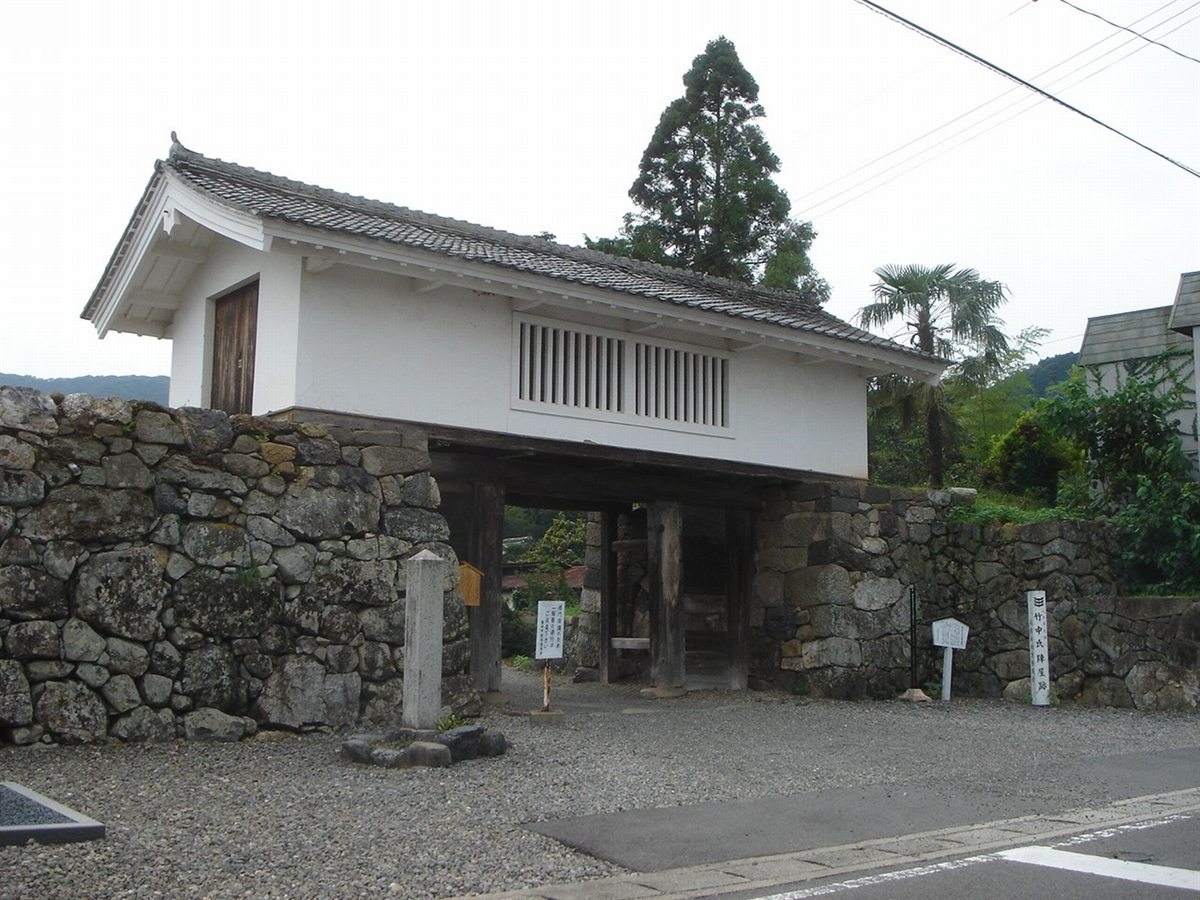
Image: The gatehouse at the Takenaka jin'ya ruins (Tarui, Gifu), part of the residence Shigekado built. Photo: Monami (CC BY-SA 3.0, Wikimedia Commons)
Hanbei's son, Takenaka Shigekado (1573–1631), was only a small boy when his father died. With his relative Takenaka Shigetoshi as his guardian, he served Hideyoshi and fought at Komaki-Nagakute, in the Odawara campaign, and in the invasions of Korea [Fact].
At the Battle of Sekigahara in 1600, as described above, he fought for the Eastern Army alongside Nagamasa's troops. Because the battle was fought on his own lands, Ieyasu ordered him to build a mound for the heads of the dead and to repair damaged temples and shrines. It was also Shigekado who captured Konishi Yukinaga of the Western Army, who had fled into the Ibuki mountains, and sent him to Ieyasu [Fact].
In place of Bodaisan Castle on the mountaintop, Shigekado built a residence at the foot of the mountain (later known as the Takenaka jin'ya), and after Sekigahara he kept his lands at Iwate (Tarui) as a hatamoto, a direct retainer of the shogun [Widely accepted]. In 1631, near the end of his life, he completed the Toyokagami, a life of Hideyoshi [Fact]—the son recording the man his father had served.
The story of how Hanbei came to serve Hideyoshi is written in this son's book. Hanbei's fame owes much to his son.
Does Takenaka Hanbei Have Living Descendants?
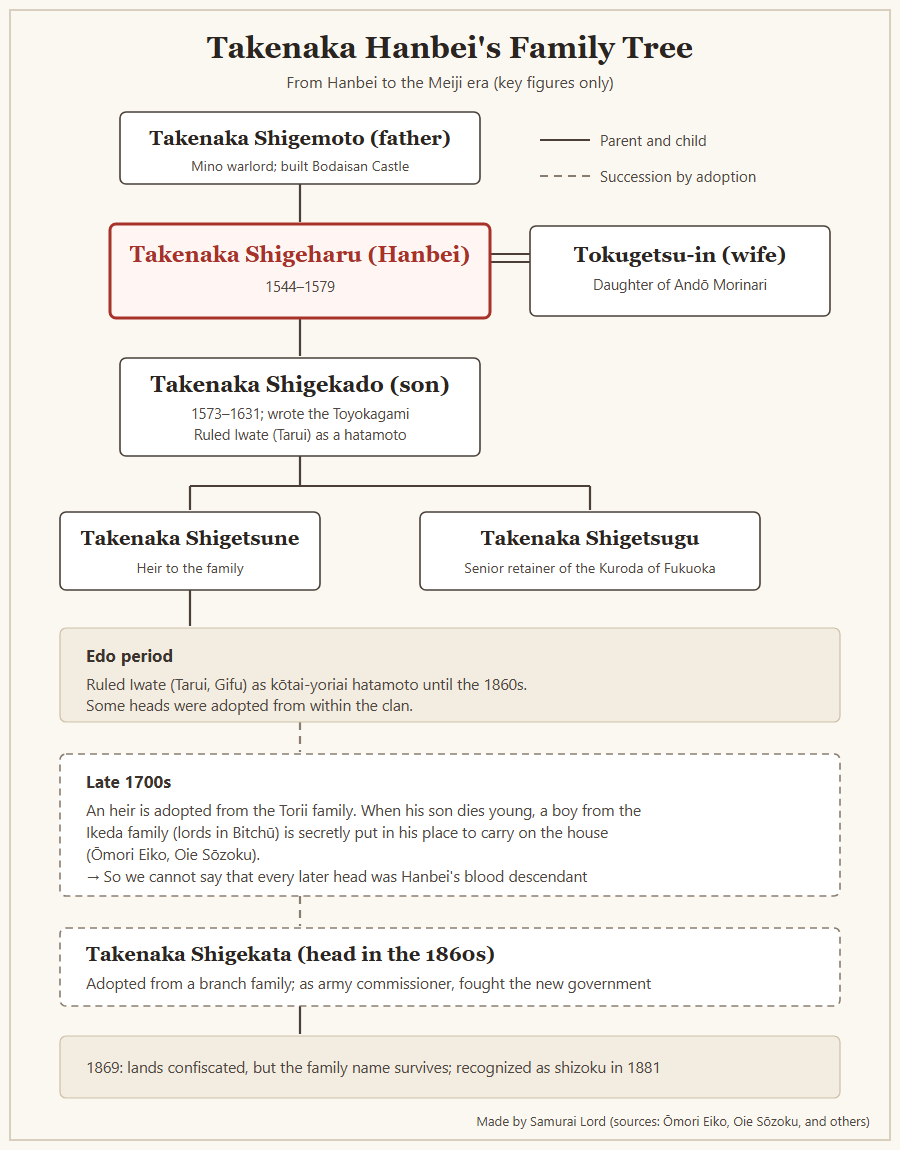
Image: Takenaka Hanbei's family tree (made by Samurai Lord). Tap or click the image to enlarge it.
The Short Answer
- The Takenaka family continued as hatamoto of the Tokugawa shogunate until the 1860s, and became shizoku (former samurai) in the Meiji era
[Fact] - But heirs were adopted from other families along the way, so we cannot say that every head of the family was Hanbei's blood descendant
[Widely accepted] - Some people today are described as his descendants, but we have not been able to confirm this with a family tree or other records
[Unknown]
Sources: Kazoku Shakui Seigan Jinmei Jiten (a dictionary of petitions for peerage titles, Yoshikawa Kōbunkan, 2015); Ōmori Eiko, Oie Sōzoku: Daimyō-ke no Kutō (Kadokawa Sensho, 2004)—both in Japanese
The Edo Period to Meiji: A Kōtai-yoriai Family
Shigekado's family ruled their lands at Iwate (Tarui) as hatamoto for generations. At about 5,000 koku, the domain was too small to make them daimyo (10,000 koku or more), but they held the special rank of kōtai-yoriai and made the same alternate-attendance journeys to Edo as daimyo [Fact].
The family head in the 1860s, Takenaka Shigekata, became the shogunate's army commissioner and led the former shogun's troops at the Battle of Toba–Fushimi in 1868. Because he went on fighting the new government until the Hakodate War, the family lost its lands. Shigekata was spared execution and—of all people—placed in the custody of Kuroda Nagatomo, lord of Fukuoka [Fact]. The family name survived when the previous head, Shigeaki, was granted 300 koku, and in 1881 the family was recognized as shizoku [Fact].
Nearly 300 years after Hanbei's death, the Takenaka and the Kuroda crossed paths once again—a curious twist of fate.
“Family” and “Bloodline” Are Not the Same
In samurai families of the Edo period, a house with no heir could be abolished, so adopting an heir to carry on the family was completely normal. The Takenaka adopted heirs from within the clan, and in the late 1700s they also adopted an heir from the Torii family [Fact].
What is more, when that adopted heir's son died young, the Takenaka did not report it; instead, they secretly put a boy from the Ikeda family, lords in Bitchū, in his place to carry on the house—as the historian Ōmori Eiko has shown [Widely accepted]. Shigekata, the head in the 1860s, was also adopted from a branch of the family.
In other words, “the Takenaka family continued” and “Hanbei's bloodline continued” are not the same thing. The accurate answer is that we cannot say every head of the family was Hanbei's blood relative.
What About Descendants Today?
A family of traditional doll makers in Arakawa Ward, Tokyo, has been introduced by local media as having Takenaka Hanbei as an ancestor, and a story online says their doll making began with a daughter of Takenaka Shigekata. However, we have not been able to check any family tree or other record that confirms this [Unknown].
Are Any Celebrities Descended from Him?
Claims that certain Japanese celebrities descend from Takenaka Hanbei can be found online, but as far as we have been able to check, none has been confirmed by a family tree or similar record [Unknown]. Still, “not confirmed” does not mean “not a descendant.” And sharing the surname Takenaka does not by itself make someone Hanbei's descendant.
So even when a family carries on, the blood ties aren't always clear…
In an age when keeping the house alive mattered above all, that was common. To read stories about descendants, separate the “house” from the “blood.”
Where Is Takenaka Hanbei's Grave?
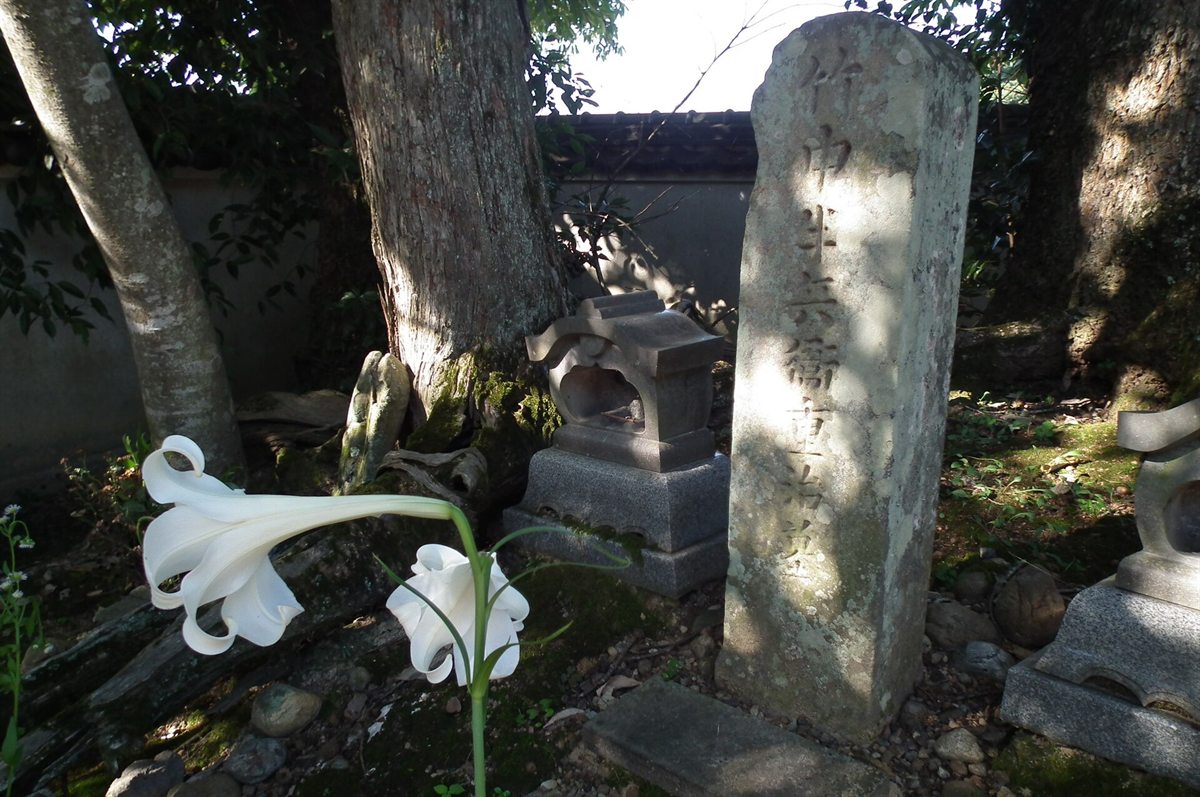
Image: Takenaka Hanbei's grave at Hiraiyama in Miki, Hyōgo. Photo: 松岡明芳 (CC BY-SA 3.0, Wikimedia Commons)
There are three main places said to hold Hanbei's grave: two in Miki (Hyōgo), where he died, and one in Tarui (Gifu), his home.
| Place | What it is | Visiting notes |
| Grave at Hiraiyama (Hirai, Miki, Hyōgo) | Near the camp where Hanbei died; a grave surrounded by white walls. Every year on July 13, local residents of Hirai hold a memorial service | About a 30-minute walk from Ebisu Station (Kobe Electric Railway). You cannot park on the road in front of the grave; use the space beside the Hirai community hall or the parking lot at the site of Hideyoshi's headquarters (City of Miki) |
| Eiun-ji Temple (Shijimi-chō, Miki, Hyōgo) | A second grave site in Miki | The Miki City Tourism Association also lists this grave |
| Zendō-ji Temple (Iwate, Tarui, Fuwa District, Gifu) | The Takenaka family temple. His son Shigekado is said to have moved Hanbei's grave here. The grave site was restored in 2019 through a local appreciation society | A memorial service is held every June. The trail up to the Bodaisan Castle ruins starts behind the temple |
Sources: City of Miki, Miki City Tourism Association, Gifu Prefecture's official tourism site, and the “Toyotomi Gifu Tabi” site (all checked in October 2026; in Japanese)
“So which one is the real grave?” The official guides describe it differently. Zendō-ji's side says Shigekado moved the grave (and his remains) there, while Miki carefully maintains Hiraiyama as “Hanbei's grave.” Rather than calling one of them the only real grave, it is best to see each as a place where people have long honored Hanbei's memory [Debated].
There is also a Takenaka grave at Jōdo-ji Temple in Higashiōmi, Shiga, but it is said to belong to Takenaka Chikugo-no-kami, one of the Takenaka retainers.
If you plan to visit, check the latest information from Miki, Tarui, or the temples on memorial-service dates and parking.
Family Crest, Helmet, and Places to Visit
Family Crests: Kumai-zasa and Kokumochi
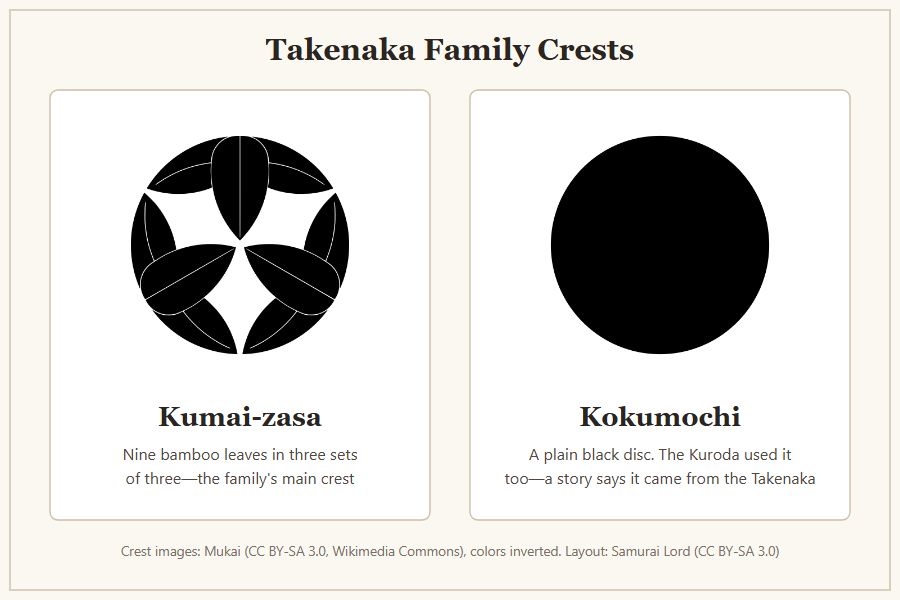
Image: The Takenaka family crests (made from images by Mukai, CC BY-SA 3.0, with colors inverted)
The best-known Takenaka crest is the kumai-zasa—nine bamboo leaves arranged in three sets of three [Widely accepted]. From the mid-Edo period, a version enclosed in a circle was also used [Widely accepted].
The other is the kokumochi, a plain black disc. A story says that an ancestor was hit in the chest by an arrow but was saved by a rice cake (mochi) he carried inside his robe [Legend]. The Kuroda family used a black-disc crest too, and some say it was handed down from the Takenaka, but this is not certain [Legend].
His Helmet: the Ichi-no-Tani Helmet
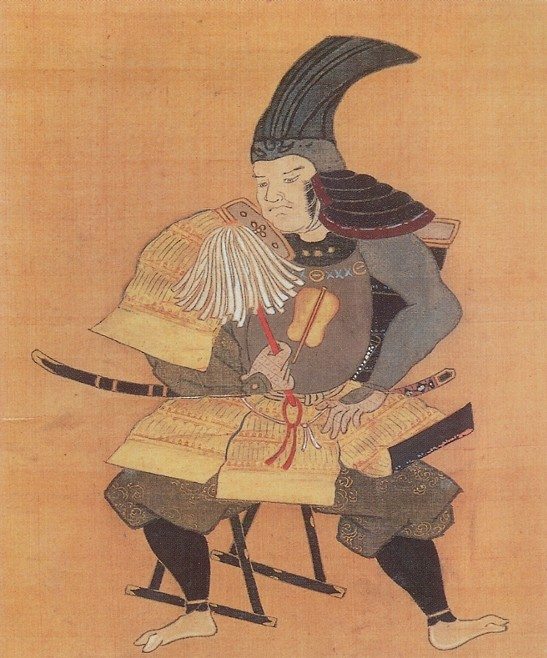
Image: Portrait of Takenaka Hanbei (Zendō-ji Temple, Tarui, Gifu). On his head is the ichi-no-tani helmet.
In the portrait at Zendō-ji (a cultural property of Tarui), Hanbei wears an ichi-no-tani-nari kabuto, a helmet that rises tall like a wall. Its shape is said to represent the cliff at Ichi-no-Tani that Minamoto no Yoshitsune famously rode down in the Genpei War [Widely accepted]. A story says Hanbei designed this helmet himself, but this is not certain [Legend].
The portrait was painted in the Edo period, and the bronze statue of Hanbei in front of JR Tarui Station is based on it [Widely accepted].
Places to Visit
- Takenaka jin'ya ruins (Iwate, Tarui, Gifu): the site of the residence built by his son Shigekado. A white-walled gatehouse and stone walls survive, and the site is a Gifu Prefecture historic site. A statue of Hanbei stands near the entrance
- Bodaisan Castle ruins (Tarui): the mountain castle of Hanbei and his father, Shigemoto—one of the largest in western Mino, with a hiking trail
- Zendō-ji Temple (Tarui): the Takenaka family temple, with Hanbei's grave and portrait
- Ōmidō Castle ruins (Ōno, Ibi District, Gifu): said to be where Hanbei was born
- Hiraiyama (Miki, Hyōgo): the site of the camp where Hanbei died during the siege of Miki Castle; the site of Hideyoshi's headquarters is nearby
- Kuroda Nagamasa and Takenaka Shigekado battle position site (Sekigahara, Gifu): where the two sons took up their positions side by side at the Battle of Sekigahara
Frequently Asked Questions (FAQ)
Are Takenaka Hanbei and Takenaka Shigeharu the same person?
Yes. “Hanbei” was his everyday name, and “Shigeharu” was his personal name. As a young man he is said to have used the name Shigetora.
How old was Takenaka Hanbei when he died?
He died of illness in camp during the siege of Miki Castle on July 6, 1579, aged 34 or 35 (36 by the traditional Japanese count). The disease was never recorded.
What is Takenaka Hanbei famous for?
As a commander assigned to Hideyoshi's army by the Oda, he helped Hideyoshi's Harima campaign by persuading enemy commanders to switch sides and by attacking castles. He is also known for seizing his own lord Saitō Tatsuoki's Inabayama Castle in 1564.
Who was greater, Takenaka Hanbei or Kuroda Kanbei?
It is hard to compare them. Hanbei died in 1579, and so few records from his time survive that most of his exploits come from later books. Kanbei left many letters, and records confirm that he played a major role from Hideyoshi's unification of Japan through to Sekigahara.
Does Takenaka Hanbei appear in TV dramas?
Yes. He appears in NHK's 2026 historical drama Toyotomi Kyōdai! (“The Toyotomi Brothers!”) and in many earlier historical dramas. Dramas include invented scenes, so this article describes Hanbei as the historical sources show him.
Does Takenaka Hanbei have living descendants?
The Takenaka family continued as hatamoto through the Edo period and became shizoku in the Meiji era, but heirs were also adopted from other families along the way. Claims about specific living descendants, including celebrities, have not been confirmed by family trees as far as we could check.
Summary: Who Was Takenaka Hanbei?
-683x1024.png)
Takenaka Hanbei was a warlord from Mino, assigned to Hideyoshi by the Oda, who supported the Harima campaign with negotiation and siege work. He died of illness in camp at the siege of Miki Castle in 1579, still only in his mid-thirties.
Many of the famous stories—the “genius strategist,” the “three visits,” the rescue of Shōjumaru—were created in the Edo period and later. Records from his own time say little about him, but what they do show is a master of persuasion who won castles by talking.
His son Shigekado fought beside Kuroda Nagamasa at Sekigahara, and the Takenaka family carried on until the end of the shogunate. That Hanbei's name has been told and retold for so long, despite so few records, shows how strongly later generations were drawn to this clever commander who died young.
To learn more, read about his fellow commander in Who Was Kuroda Kanbei (Yoshitaka)? Hideyoshi's Christian Strategist Explained, about the man he served in Who Was Toyotomi Hideyoshi? Life, Death & Six Fingers Explained, about Hideyoshi's brother in Who Was Toyotomi Hidenaga? Hideyoshi's Brother, Wife, Death & Family Tree, and about Nobunaga, who rewarded Hanbei with silver, in Who Was Oda Nobunaga? Life, Death, Personality & Yasuke Explained.
Few records, and yet later generations could not stop telling his story—that is Takenaka Hanbei.
Even the parts we “don't know” make me like Lord Hanbei more!
Sources & How This Article Was Written
This article is based mainly on the following records and research:
- Shinchō Kōki (Ōta Gyūichi): the attack on Fukuhara Castle, the winning of Hachimanyama Castle and the reward of silver, and his death in camp
- Toyokagami (Takenaka Shigekado, 1631): Hideyoshi's request to have Hanbei and others assigned to him
- Keinen-ji Monjo: evidence that the occupation of Inabayama Castle continued into the 7th month
- Books written in the Edo period and later (Taikōki, Jōzan Kidan, Takenaka Kafu, Kuroda Kafu of 1688, Meishō Genkōroku, Bukō Zakki, Buhen Banashi Kikigaki, the puppet play Konoshitakage Hazama Kassen, and others): the sources of the character stories, the details of the Inabayama story, and the Shōjumaru story, labeled
[Legend]or[Fiction]in this article - Modern research and articles: Ikeuchi Shōichi, ed., Takenaka Hanbei no Subete (Shinjinbutsu Ōraisha, 1996); Satō Shin'ichi, Kaō o Yomu (Heibonsha, 1988); Ōmori Eiko, Oie Sōzoku (Kadokawa Sensho, 2004); Kazoku Shakui Seigan Jinmei Jiten (Yoshikawa Kōbunkan, 2015); online articles by Watanabe Daimon (Yahoo! News Expert) and Hayakawa Satoshi (President Online)—all in Japanese
- Local government and tourism guides: City of Miki, Miki City Tourism Association, Town of Tarui, and Gifu Prefecture's tourism site (graves and places to visit)
- Images: the portrait of Takenaka Shigeharu (from the Takenaka family), the portrait of Takenaka Hanbei (Zendō-ji), and his kaō are public-domain images from Wikimedia Commons; the photos of the Hiraiyama grave (by 松岡明芳), the Takenaka jin'ya (by Monami), and the Sekigahara battle site (by 立花左近), and the family crests (Mukai), are used under CC BY-SA 3.0. The diagrams and illustrations are original to Samurai Lord
What the Labels Mean
[Fact]Confirmed by sources from the period ([Fact: …]names the source)[Widely accepted]The view held by most historians[Debated]Historians disagree[Unknown]No source tells us[Legend][Fiction][Folk belief]Stories created later, or claims with little evidence ([Legend: …]names the book where the story appears)
This article was written by the Samurai Lord editorial team and is revised as new research and reader feedback come in. If you spot an error, please let us know through our contact form (in Japanese) and we will check and correct it.
Read in Japanese
This article is also available in Japanese: 竹中半兵衛とは?死因・黒田官兵衛との関係・墓・子孫を史実で解説