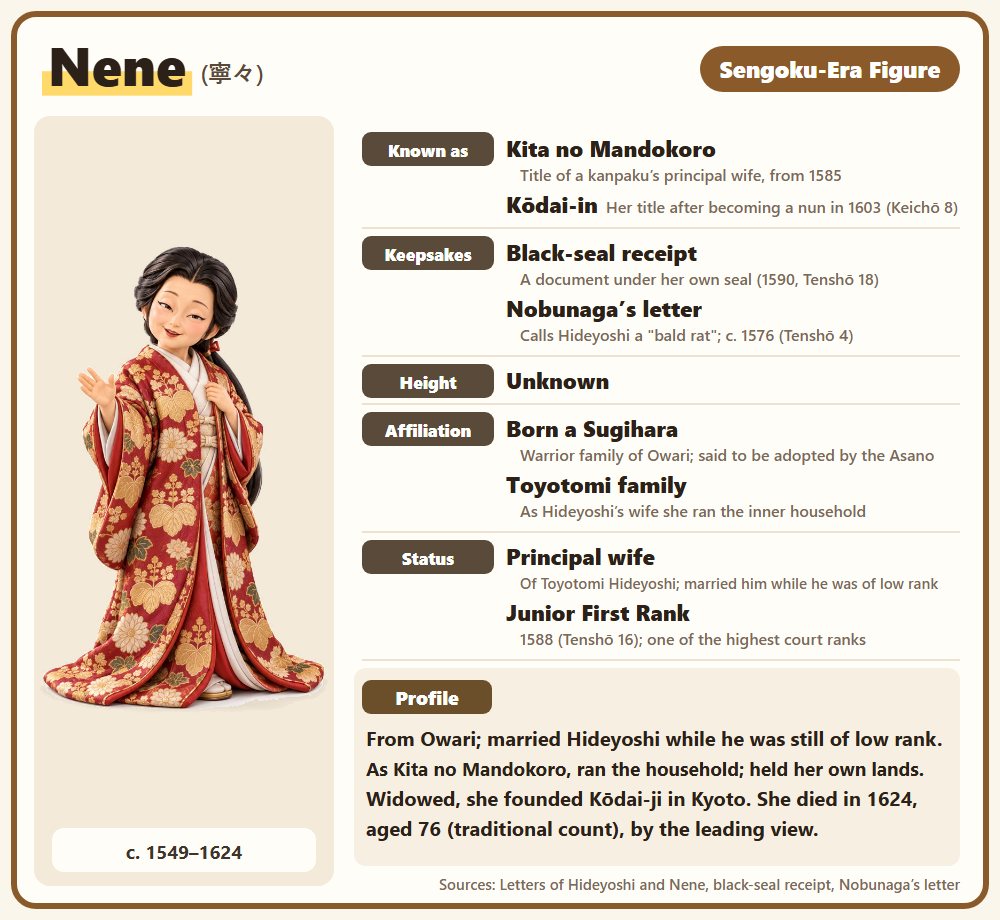
Nene was the principal wife (the highest-ranking wife in his household) of Toyotomi Hideyoshi. After Hideyoshi became kanpaku (imperial regent), she was called Kita no Mandokoro, and after she became a nun following his death, Kōdai-in. All three names refer to the same person.
Born into a warrior family in Owari (today's western Aichi Prefecture), she married Hideyoshi when he was still of low rank. When Hideyoshi rose to rule the country, she managed the Toyotomi household's domestic affairs as Kita no Mandokoro, and she had her own lands and her own seal [Fact]. After Hideyoshi's death she moved to Kyoto, founded Kōdai-ji temple, and died in 1624 (Kan'ei 1) [Fact].
This article explains what Nene did, what "Kita no Mandokoro" and "Kōdai-in" mean, her age difference with Hideyoshi and how they married, her relationship with Chacha (Yodo-dono), and how old she was when she died, based on letters and other records.
Historical dates give the Western year with the Japanese era; months and days follow the Japanese lunisolar calendar unless otherwise stated. Modern dates use the Gregorian calendar. Ages use the traditional Japanese count, in which a person was counted as one at birth and gained a year at the start of each new year in the Japanese calendar.
Key points are tagged: [Fact] confirmed by records from the time, [Widely accepted] a view widely accepted by researchers, [Debated] accounts or interpretations differ, [Unknown] not established from the sources we checked, [Legend] stories found in later records or traditions, and [Folk belief] popular claims with little evidence.

I am Uesugi Kenshin. Today's story is about Nene, the wife of Toyotomi Hideyoshi.

I'm Date Masamune! So Kita no Mandokoro and Kōdai-in were both Nene!

She had many names. Read the letters Hideyoshi sent her, and you will see how much she did.
The Short Answers
- What names was she known by? Nene. Also Kita no Mandokoro (北政所) and Kōdai-in (高台院) (more)
- Her real name? Not certain. Hideyoshi's letters address her as "One" or "Ne," and she signed herself "Ne" (more)
- What did she do? As Hideyoshi's principal wife and Kita no Mandokoro, she managed the Toyotomi household's domestic affairs and had her own lands and seal. After his death she founded Kōdai-ji in Kyoto (more)
- When was she born? 1549 (Tenbun 18) is the leading view; 1548 and 1542 have also been proposed (more)
- Age difference with Hideyoshi? About 12 years, if Hideyoshi was born in 1537 (Tenbun 6) (more)
- Did she have children? No child of her own has been confirmed in the sources we checked. She and Hideyoshi adopted children such as her nephew Hideaki and Gōhime, a daughter of Maeda Toshiie (more)
- Were she and Chacha rivals? Historians point out that the story of their rivalry spread through later tales. Some historians see them as having worked together to protect the Toyotomi family (more)
- When and at what age did she die? On the 6th day of the 9th month of 1624 (Kan'ei 1), in Kyoto. The leading view is that she was 76 by the traditional count. The sources we checked do not identify the cause of death (more)
- Her grave? The Otamaya (mausoleum) of Kōdai-ji in Kyoto (more)
Three Things We Learn by Reading the Sources
- Nene's own letter: in a letter congratulating her nephews' children on their wedding, the elderly Kōdai-in looked back on her own wedding to Hideyoshi as "humble" (Source Box ①)
- Hideyoshi's letter to "One": when Hideyori was born, Hideyoshi wrote to Nene, who was looking after Osaka Castle in his absence, that the child should be named "Hiroi" (Source Box ②)
- Kita no Mandokoro's black-seal receipt and lands: a photo of a receipt she issued with her own seal, and records of her lands of more than 10,000 koku, show what being "Kita no Mandokoro" involved (more)
Jump to the part you want to read:
- Who was Nene? Kita no Mandokoro, Kōdai-in and her names
- Nene and Hideyoshi: their age difference and marriage
- Were Nene and Chacha (Yodo-dono) rivals?
- Whose daughter was Nene? Her family tree
- Did Nene have children? Her adopted children Hideaki and Gōhime
- What did Kita no Mandokoro do? Her lands, seal and Hideyoshi's letters
- Nene after Hideyoshi's death: Sekigahara and the Siege of Osaka
- How old was Nene when she died? Her grave at Kōdai-ji
- Places linked to Nene: Kōdai-ji, Entoku-in and Nene-no-Michi
- FAQ
The labels such as [Fact] and [Debated] show how certain each point is (their meanings are listed at the end of the article).
Who Was Nene? Kita no Mandokoro, Kōdai-in and Her Names
In a single sentence, Nene was "the woman who, as the wife of Hideyoshi, ruler of Japan, ran the inner side of the Toyotomi household, and who went on watching over her relatives and the Toyotomi family after his death".
Here is her life in broad outline:
- Born in Owari: born a daughter of the Sugihara family, and adopted into the Asano family
[Widely accepted] - Marries Hideyoshi: said to have been in 1561 (Eiroku 4); she became the wife of Hideyoshi (then Kinoshita Tōkichirō), who was still of low rank
[Debated] - Wife of a castle lord: when Hideyoshi became lord of Nagahama (Shiga Prefecture), she kept his household as the wife of the castle's lord
- Kita no Mandokoro: in 1585 (Tenshō 13) Hideyoshi became kanpaku, and she came to be called Kita no Mandokoro. In 1588 (Tenshō 16) she received Junior First Rank (ju-ichii), one of the highest ranks of the imperial court
[Fact] - Moves to Kyoto: Hideyoshi died in 1598 (Keichō 3), and the next year she left Osaka Castle and moved to Kyoto
[Widely accepted] - Kōdai-in: in 1603 (Keichō 8) she became a nun, was called Kōdai-in, and later founded Kōdai-ji
[Widely accepted] - Death: she died in Kyoto on the 6th day of the 9th month of 1624 (Kan'ei 1)
[Fact]
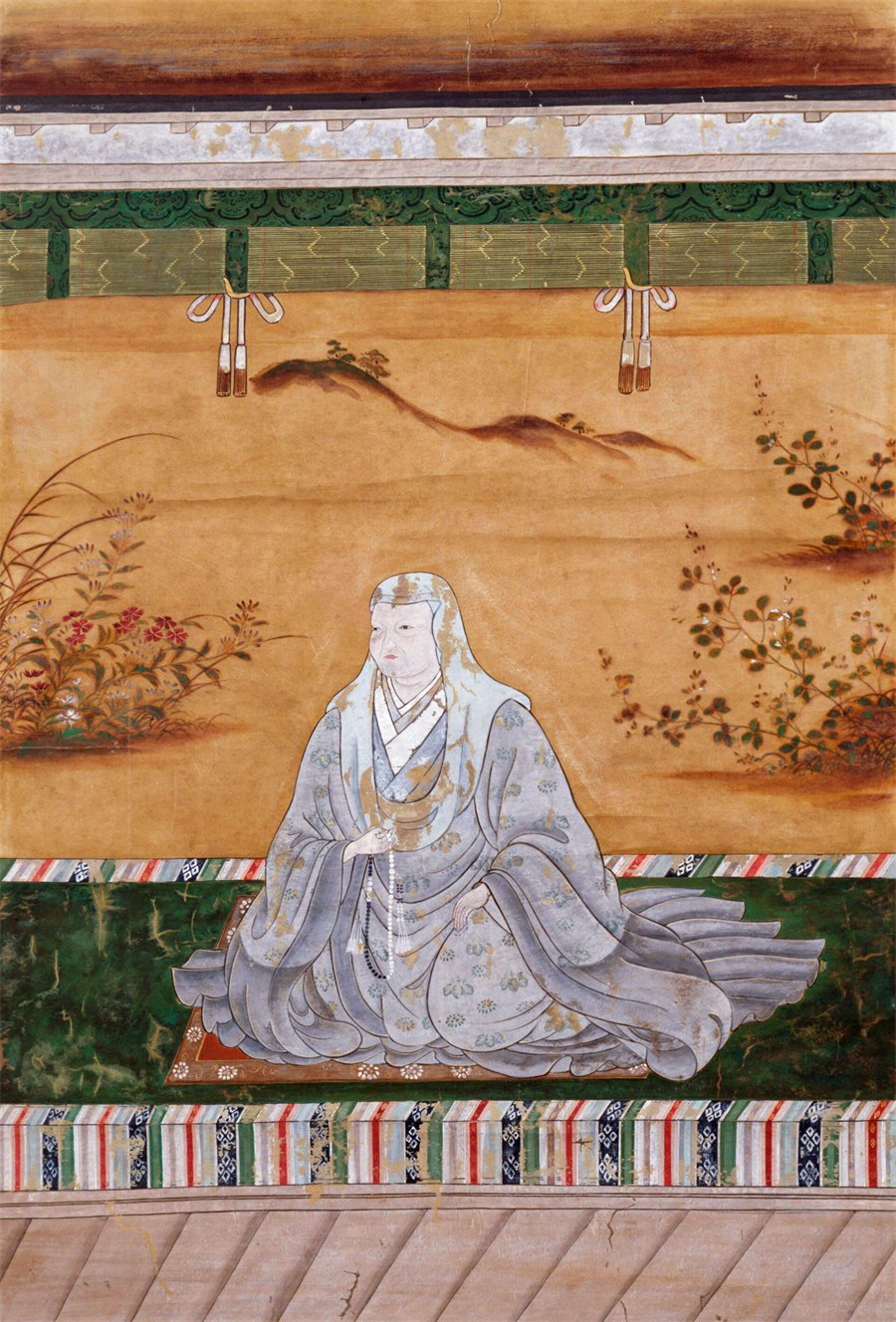
Image: Copy of the portrait of Kōdai-in handed down at Kōdai-ji (a copy made by the Historiographical Institute, University of Tokyo). Wikimedia Commons (public domain)
Her Names, and the Records They Appear In
Nene had many names. The table below shows which name appears in which kind of record.
| Name | What kind of name? | Where it appears |
| One / Ne | The names Hideyoshi used for her in letters | Addresses of letters in Hideyoshi's own hand (1592, Tenshō 20; 1593, Bunroku 2; and others) [Fact] |
| Mandokoro | Short for "Kita no Mandokoro"; a form Hideyoshi used in letters | Addresses of Hideyoshi's letters [Fact] |
| Ne | Her own signature | Her letters from her last years (one dated the 7th day of the 5th month, thought to be from 1624, and others) [Fact] |
| 豊臣吉子 | The name written in a court document | The Kokushi Daijiten encyclopedia identifies it as the name recorded in her court-rank certificate (iki) |
| Kita no Mandokoro | The title of the principal wife of a kanpaku | From 1585 (Tenshō 13), when Hideyoshi became kanpaku |
| Kōdai-in | An ingō (a title ending in "-in") granted by the emperor | From the 11th month of 1603 (Keichō 8) |
| Nene | The name most widely used today | Used in research books and encyclopedias, and in the 2026 NHK drama Toyotomi Kyōdai! |
Was Her Real Name "Nene" or "One"?
Her own signature reads "Ne," and Hideyoshi's letters use "One," "Ne" and similar forms [Fact]. How her formal name should be read, however, is debated among historians [Debated].
Historians differ on whether her real name was "Nene," "Ne" or "Nei" (寧). "One" is thought to be her name with the honorific prefix "O-" added. In this article we use the widely known "Nene" throughout.
What Does "Kita no Mandokoro" Mean?
Kita no Mandokoro was originally a title for the principal wife of a sesshō or kanpaku (imperial regent) [Fact]. "Kita" (north) referred to the inner, private side of a household, as opposed to the place where the husband carried out his public duties.
Hideyoshi's wife became so famous that today "Kita no Mandokoro" almost always means Nene. Note that Hideyoshi's mother was called Ōmandokoro ("Great Mandokoro"), a different person from Nene.
What Does "Kōdai-in" Mean?
Kōdai-in was an ingō (a title ending in "-in") that Nene received from Emperor Go-Yōzei in the 11th month of 1603 (Keichō 8). Around the same time, at 55 by the traditional count, she became a nun [Widely accepted]. From then on she lived dressed as a nun.
Junior First Rank and "豊臣吉子"
In the 4th month of 1588 (Tenshō 16), Emperor Go-Yōzei visited the Jurakudai, Hideyoshi's residence in Kyoto (the imperial visit to the Jurakudai). After that, Kita no Mandokoro was granted Junior First Rank (ju-ichii), one of the very highest ranks of the court. Kōdai-ji preserves a court document recording the imperial command to grant her this rank, dated the 19th day of the 4th month of Tenshō 16; this type of document is called a kuzen'an [Fact].
According to the Kokushi Daijiten, her name appears as 豊臣吉子 in the iki, a document certifying the award of her court rank. Besides the names she was usually called by, she had a name for use in court documents.
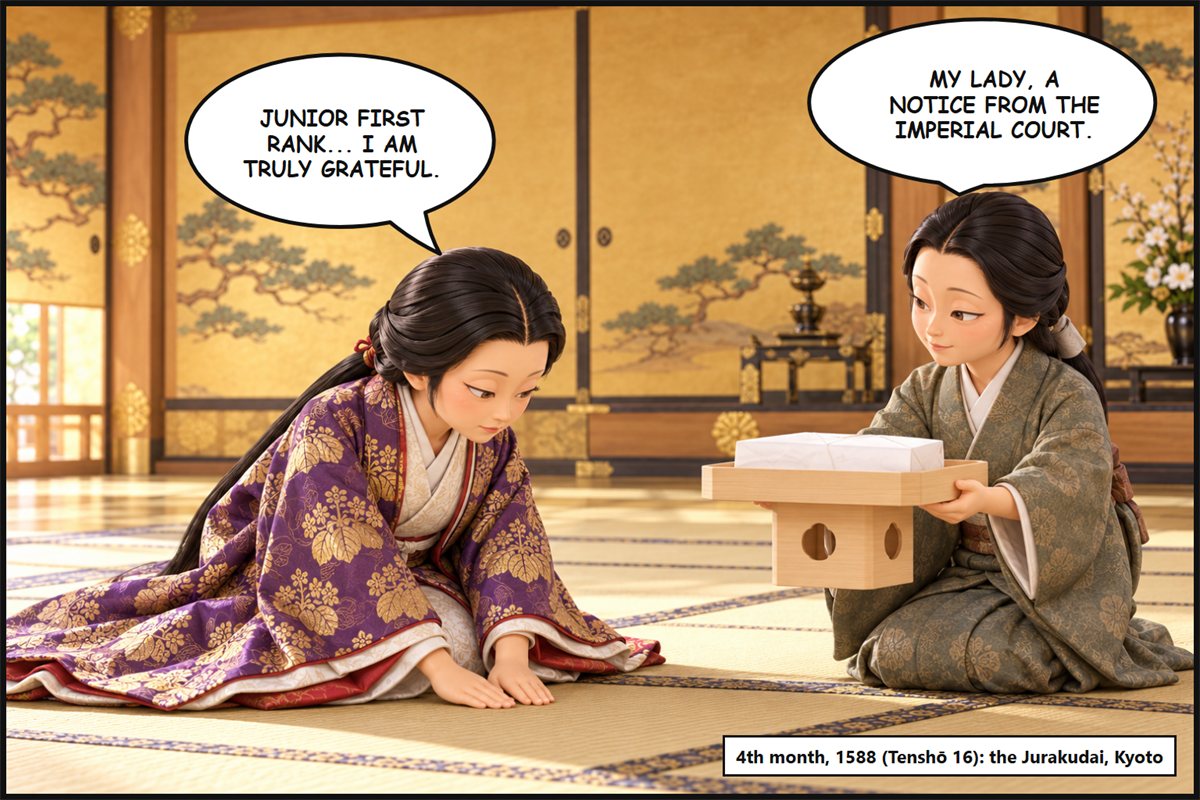
Image: Kita no Mandokoro receiving the court document granting her Junior First Rank

So she even had a special name for court documents!
She was the wife of the ruler of the realm. Keep the name in court documents and the name she was usually called by separate.
Nene and Hideyoshi: Their Age Difference and Marriage
To give the conclusion first: Nene and Hideyoshi were about 12 years apart (if Nene was born in 1549, Tenbun 18, and Hideyoshi in 1537, Tenbun 6). Their marriage is most often dated to 1561 (Eiroku 4), but there are other views.
When Was Nene Born? Her Age Under Each Theory
There are three theories about Nene's birth year [Debated]. Her age at marriage and at death changes depending on which one is taken.
| Theory of her birth year | Age in 1561 (Eiroku 4) | Age in 1565 (Eiroku 8) | Age at death in 1624 (Kan'ei 1) |
1549 (Tenbun 18) [Widely accepted] | 13 | 17 | 76 |
| 1548 (Tenbun 17) | 14 | 18 | 77 |
| 1542 (Tenbun 11) | 20 | 24 | 83 |
All ages are by the traditional Japanese count.
The 1549 theory is the leading one because a genealogy of the Kinoshita family (the line of Nene's birth family), compiled in the early Edo period, gives her age at death as 76, and Kōdai-ji and Osaka Castle Museum also give 76 by the traditional count [Widely accepted].
The 1542 theory comes from the age of 83 given in the Kansei Chōshū Shokafu, a collection of genealogies compiled in the late Edo period. If this theory were taken, however, Nene would be older than her elder brother Kinoshita Iesada, who is said to have been born in 1543 (Tenbun 12).
When Did They Marry?
Nene and Hideyoshi's marriage is most often dated to 1561 (Eiroku 4), and encyclopedias also give this year [Widely accepted]. On the other hand, the historian Kuroda Motoki places it around 1565 (Eiroku 8), when Hideyoshi had gained some standing as Nobunaga's retainer [Debated].
A Love Match? The Story of Her Mother's Opposition
It is often said that Nene and Hideyoshi's marriage was "a love match, rare in the Sengoku period." This story is based on a note in a genealogy of the Sugihara family (Nene's birth family), compiled in the mid-Edo period.
The note gives, as "one account," the story that her mother, Asahi, opposed the marriage because of Hideyoshi's low status, and that Nene's aunt 七曲 and her husband Asano Nagakatsu adopted Nene and married her off [Legend].
However, marriages among warrior families of the Sengoku period often helped build ties between households. How the two met, and what they felt when they married, cannot be confirmed from the records.
The "Humble Wedding" in Her Own Words
On the other hand, a letter survives in which Nene herself mentions their wedding. It is a letter to her nephew Kinoshita Nobutoshi, dated the 7th day of the 5th month and thought to be from 1624 (Kan'ei 1), the year she died.
According to the letter, on the 22nd day of the 4th month, Nobutoshi's daughter Okuri married Kumanosuke (利当), the eldest son of Nobutoshi's elder brother Toshifusa. Hearing that the wedding had been held in a hurry, Nene wrote this in her letter of congratulations:
Source Box ①: Kōdai-in's (Nene's) Letter of Congratulations to Her Nephew
Source
A letter in Kōdai-in's own hand, dated the 7th day of the 5th month (thought to be from 1624), to Kinoshita Nobutoshi (Nagoya City Museum; Important Cultural Property). We follow the transcription in the materials of Osaka Castle Museum's special exhibition "Kōdai-in" (2024)
Quotation (excerpt)
「さやうにとりあへすなる事、すゑはんしやうのはしにて候。我々なともそさうなる事にて候つれとも、天下かくれもなき事になりまいらせ候つるまゝ、はんしやうにて候ハんと、めてたく思ひまいらせ候」
Translation
Such a hurried wedding marks the beginning of lasting prosperity. Our own [wedding], too, was a humble affair, yet [afterward] we became known throughout the realm. I am delighted to think that the young couple, too, will prosper.
Signature
At the end of the letter she writes "Kōdai-in" (かうたい院), and signs it "Ne" (ね)
What this letter tells us, and what it does not
It shows that Nene herself looked back on her wedding to Hideyoshi as "humble," and used it to encourage the young couple. But the letter does not tell us the year of her marriage, or whether it was a love match
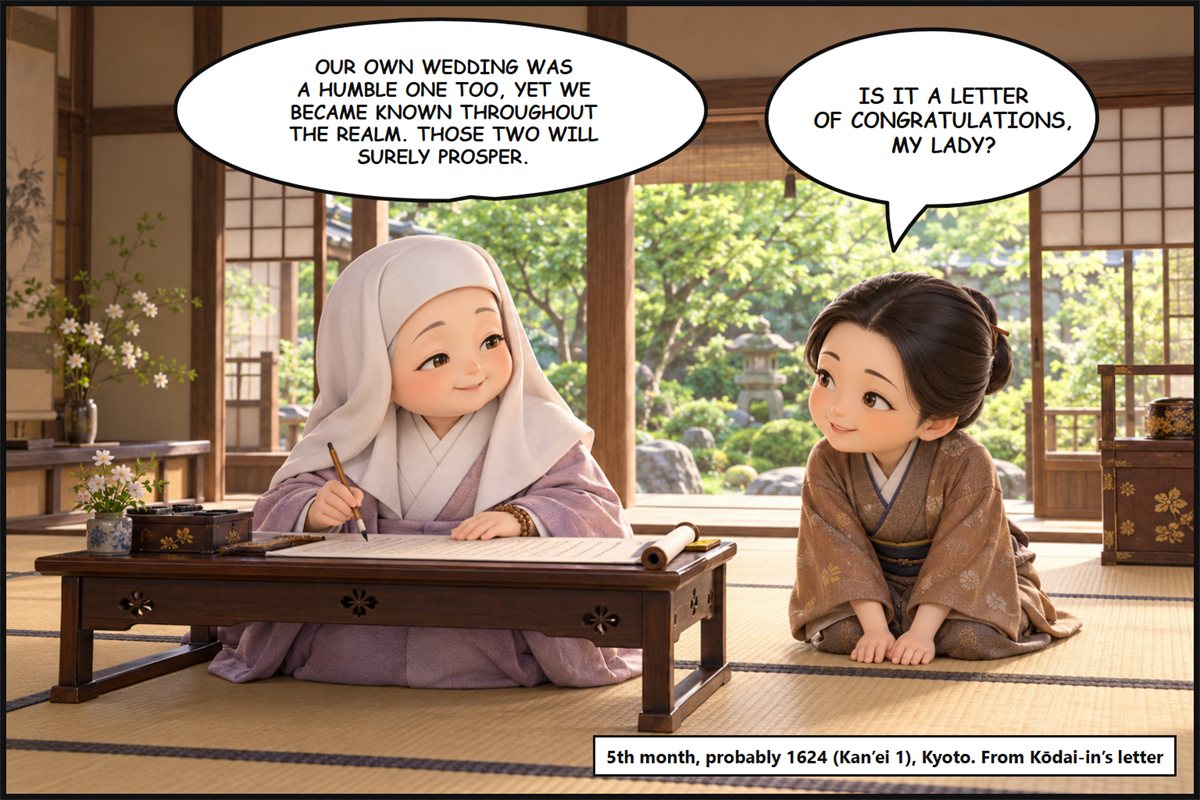
Image: Kōdai-in writing a letter congratulating her nephews' children on their wedding
She herself went from a humble wedding to being the wife of the realm's ruler. There could be no more heartening congratulations.
That moves me more than whether it was a love match!
Were Nene and Chacha (Yodo-dono) Rivals? Their Positions and Roles
To give the conclusion first: the historian Goza Yūichi points out that the story of a rivalry between Nene and Chacha spread from later tales, and that there is no record from the time supporting such a conflict. Some historians interpret the two as having worked together to protect the Toyotomi family. How close they actually were, however, cannot be known.
How Nene and Chacha Differed
| Point of comparison | Nene (Kita no Mandokoro) | Chacha (Yodo-dono) |
| Birth | Daughter of the Sugihara, a warrior family of Owari (adopted into the Asano family) | Daughter of Azai Nagamasa, daimyo of northern Ōmi, and Oichi, Nobunaga's sister |
| Position as Hideyoshi's wife | Principal wife | Generally known as a "consort." Some research sees her as a "secondary wife" ranking next to the principal wife |
| Children | No biological children are known | Bore Tsurumatsu and Hideyori |
| After Hideyoshi's death | Moved to Kyoto in 1599 (Keichō 4) and later became the nun Kōdai-in | Supported her son Hideyori at Osaka Castle |
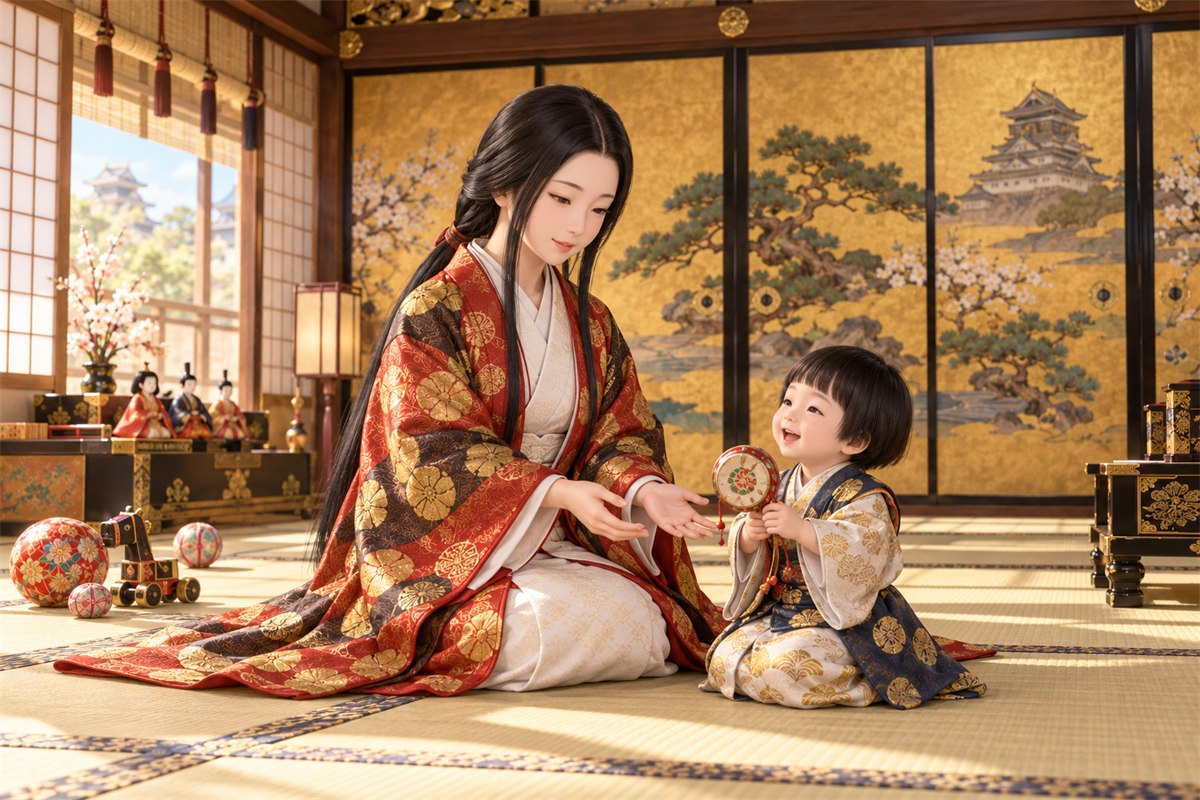
Image: Chacha playing with the infant Hideyori at Osaka Castle
For Chacha's background, Oichi and the three Azai sisters, see our article on Oichi.
Where Did the Story of Their "Rivalry" Come From?
The view contrasting "Kita no Mandokoro, the wise wife who supported her husband," with "Yodo-dono, who destroyed the Toyotomi family" spread through Edo-period tales such as the Ehon Taikōki, a popular book published from 1797 (Kansei 9), and was carried on into modern history books. However, we could not confirm this portrayal in the records from the time checked for this article [Folk belief].
What the Records Show, and What They Do Not
- In the records: on the 22nd day of the 5th month of 1593 (Bunroku 2), Hideyoshi, at Nagoya in Kyushu, mentioned Yodo-dono's pregnancy in a letter to Kita no Mandokoro
[Fact]. A letter from Hideyori to Kōdai-in (Nene), dated the 4th day of the 1st month and thought to be from 1615 (Keichō 20), also survives at Kōdai-ji[Fact] - Historians' views: some historians see the two as having cooperated toward the same goal of protecting the Toyotomi family. Osaka Castle Museum's 2024 special exhibition also described Kōdai-in after Hideyoshi's death as having "worked hard to preserve the Toyotomi family, in cooperation with Yodo-dono and others at Osaka Castle"
- What we don't know: how close the two were, and whether there was jealousy or resentment between them, cannot be known from the records
To declare that "they hated each other" goes beyond the records, and so does declaring that "they were really the best of friends."
So it's important to separate what we know from what we don't!
Whose Daughter Was Nene? The Sugihara, Asano and Kinoshita Families
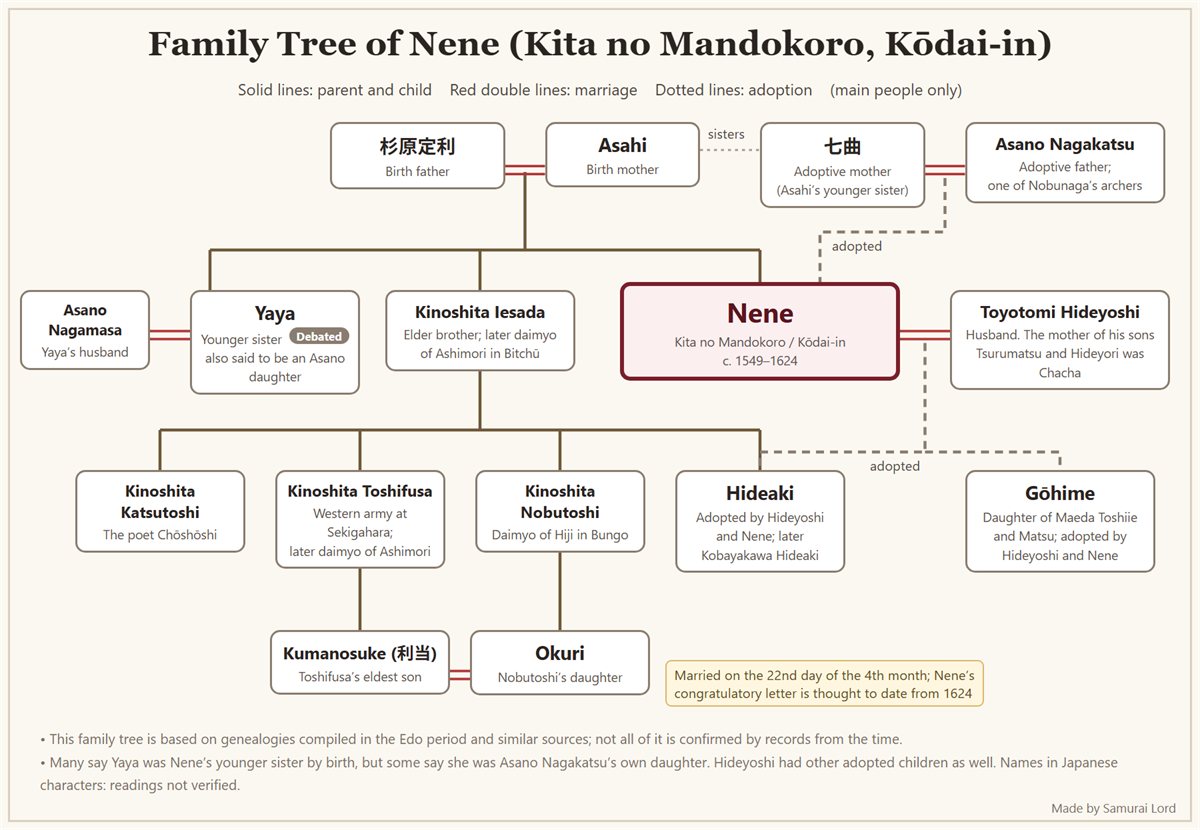
Image: Nene's family tree (main people only; made by Samurai Lord). Tap (click) the image to enlarge it
Nene's birth father is generally identified as 杉原定利, and her mother as Asahi [Widely accepted]. Nene was adopted by her mother's younger sister, 七曲, and her husband, Asano Nagakatsu [Widely accepted]. (Names in Japanese characters are given as written, because we have not verified how they are read.) Asano Nagakatsu was a warrior who served in Oda Nobunaga's corps of archers [Widely accepted].
Her siblings were her elder brother Kinoshita Iesada and her younger sister Yaya. Yaya was the wife of Asano Nagamasa; many say she was Nene's younger sister by birth, but some say she was Asano Nagakatsu's own daughter [Debated].
Iesada's sons included Kinoshita Katsutoshi (known as the poet Chōshōshi), Toshifusa, Nobutoshi, and Hideaki, who went on to head the Kobayakawa family. Nene stayed involved with her nephews, and even in her last years she was sending letters to Nobutoshi.
The Kinoshita families of Toshifusa (Ashimori in Bitchū, today's Okayama City) and Nobutoshi (Hiji in Bungo, Ōita Prefecture) continued as daimyo throughout the Edo period [Fact]. Why Hideyoshi has no descendants is explained in our article on Toyotomi Hideyoshi.
Did Nene Have Children? Her Adopted Children Hideaki and Gōhime
No biological children of Nene and Hideyoshi have been confirmed in the sources we checked [Widely accepted]. Those sources do not establish the circumstances either [Unknown].
Instead, Nene and Hideyoshi adopted and raised children of relatives and others. Two of them were especially close to Nene.
| Name | Relation to Nene | Later life |
| Hideaki | Son of her elder brother Kinoshita Iesada (her nephew). Born in 1582 (Tenshō 10). Adopted by Hideyoshi and Nene as a small child [Widely accepted] | Adopted by Kobayakawa Takakage in 1594 (Bunroku 3); later called Kobayakawa Hideaki |
| Gōhime | Daughter of Maeda Toshiie and Matsu. Adopted by Hideyoshi and Nene [Widely accepted] | Married Ukita Hideie |

Image: Kita no Mandokoro watching over Gōhime and Hideaki in the garden of Osaka Castle
A written acknowledgment of a loan also survives from 1602 (Keichō 7), showing financial dealings between Hideaki and Nene's household [Fact]. For Gōhime and the Maeda family, see our article on Maeda Toshiie.
What Did Kita no Mandokoro Do? Her Lands, Seal and Hideyoshi's Letters
Nene is often described as "the wife who supported her husband," the model of naijo no kō (a wife's help to her husband through running the household). But when we follow the documents of her time, we find that Nene had her own lands and her own seal, and looked after Hideyoshi's affairs while he was away.
She Had Her Own Lands
By a vermilion-seal letter of Hideyoshi dated the 23rd day of the 3rd month of 1592 (Tenshō 20), lands totaling more than 10,000 koku at Hirano, Tennōji and elsewhere in Settsu (today's Osaka Prefecture) were granted to "Lady Kita no Mandokoro" [Fact]. Landholdings were assessed in koku, which expressed their productive value as an equivalent amount of rice.
In an inventory of 1604 (Keichō 9), after Hideyoshi's death, her lands amounted to more than 16,000 koku, including the share of her lady-in-waiting Kōzōsu [Fact]. The location and size of her lands changed over the years.
A Document Issued Under Her Own Seal (the Black-Seal Receipt)
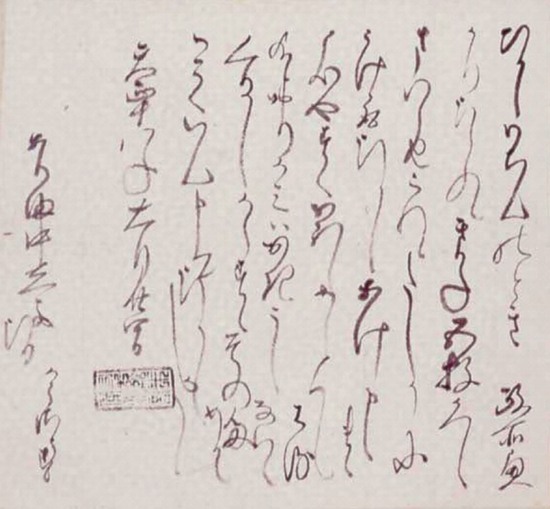
Image: The black-seal receipt of Kita no Mandokoro (dated the 24th day of the 11th month of 1590, Tenshō 18; Nagoya City Museum). Wikimedia Commons (public domain)
The black-seal receipt of Kita no Mandokoro, dated the 24th day of the 11th month of 1590 (Tenshō 18), was written by her lady-in-waiting Kōzōsu and stamped with Kita no Mandokoro's black seal. It is a receipt confirming that five pieces of gold that Kita no Mandokoro had lent to Arima Noriyori had been returned [Fact].
It is just a single receipt, but it shows that Kita no Mandokoro lent out her own money and issued documents under her own seal.
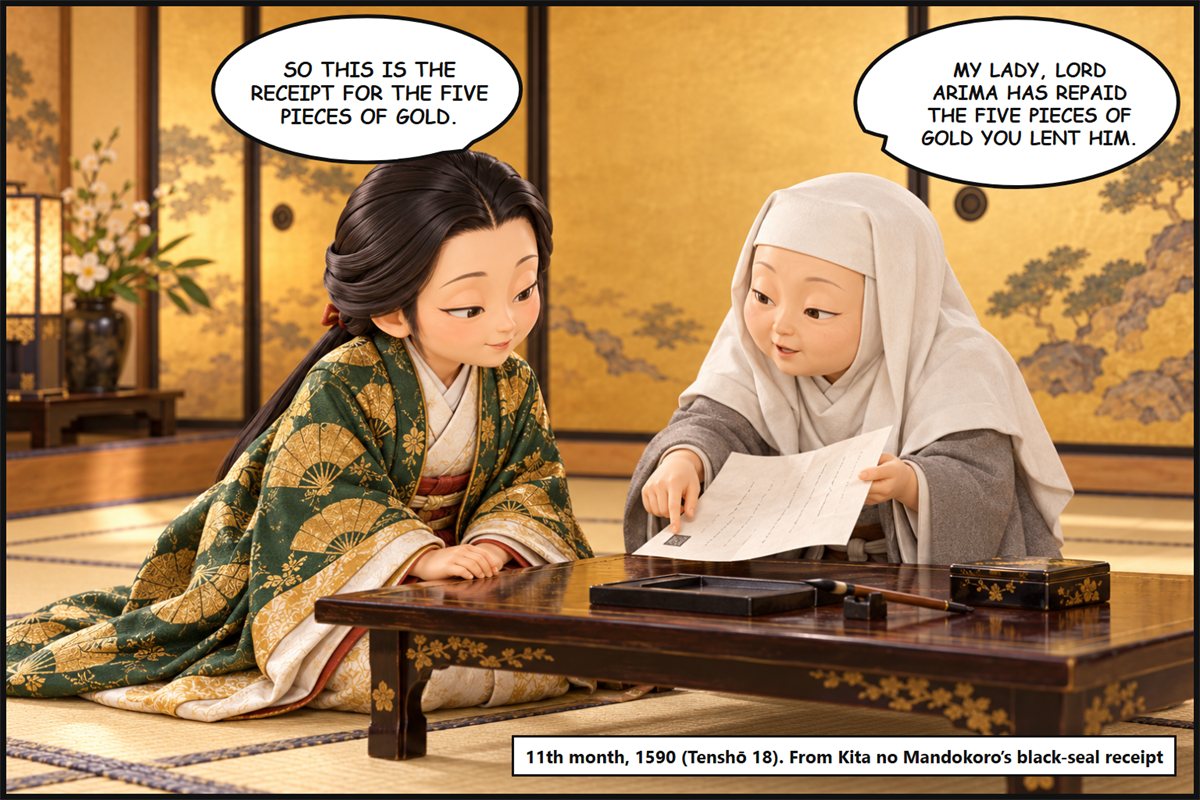
Image: Kita no Mandokoro and her lady-in-waiting Kōzōsu checking the receipt
Hideyoshi's Letters: Managing the Household in His Absence
Hideyoshi was often away on long campaigns, to unify the country and to invade Korea. Even then, he wrote to Nene often from his camps [Fact].
For example, in a letter to "One" from Nagoya in Hizen (today's Saga Prefecture, Kyushu), dated the 6th day of the 5th month of 1592 (Tenshō 20), he thanks her for summer robes (katabira) and writes that since he intends to take China (Ming) as well, he will send for her when that time comes [Fact].
On the 3rd day of the 8th month of 1593 (Bunroku 2), Yodo-dono gave birth to a boy at Osaka Castle: the future Hideyori. On hearing the news, Hideyoshi at once wrote to Nene, who was looking after Osaka Castle in his absence.
Source Box ②: Hideyoshi's Letter to "One" (9th Day of the 8th Month of Bunroku 2)
Source
A letter in Toyotomi Hideyoshi's own hand, dated the 9th day of the 8th month (of Bunroku 2, 1593), to One (Kōdai-ji, Kyoto; Important Cultural Property). We follow the transcription in the materials of Osaka Castle Museum's special exhibition "Kōdai-in" (2024)
Quotation (excerpt)
「すなわちこのなわひろいこと可申候。したゝゝまて、おのしもつけ候ましく候。ひろいゝゝゝと可申候」
Translation
Let the child's name be "Hiroi," meaning a foundling. Even those of the lowest status must not add the honorific prefix "O-." Call him "Hiroi, Hiroi."
About the words
The name carried the wish that the child, like a "found" (hiroi) child, would grow up strong. At this time a ceremony was held in which the newborn was briefly "abandoned," and the retainer 松浦重政 acted as the one who "found" him. Hideyoshi himself, it is said, soon began calling him "O-Hiroi" and doted on him
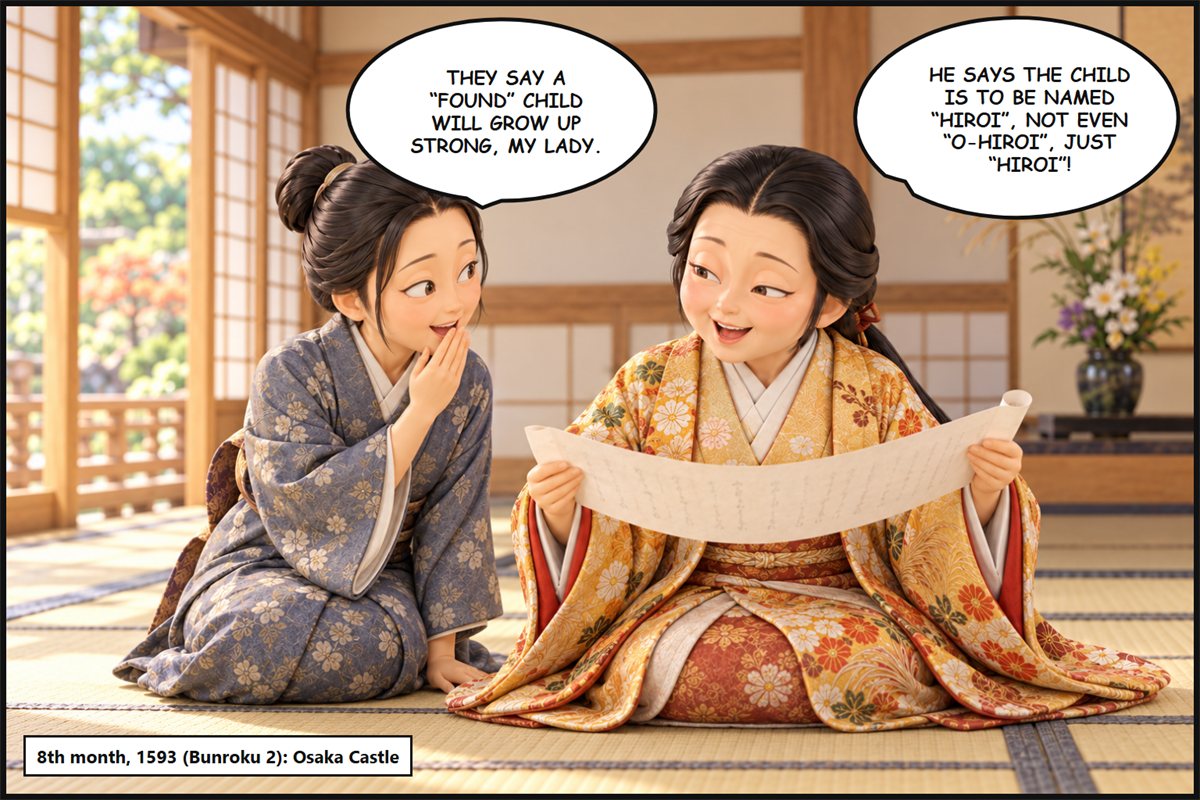
Image: Kita no Mandokoro reading Hideyoshi's letter aloud
Nobunaga's Letter (the "Bald Rat")
A famous letter to Nene is one from Oda Nobunaga. It bears no year, but is thought to date from around 1576 (Tenshō 4) [Widely accepted]. It is a reply to Nene, who had come to Azuchi to pay her respects. In summary, it says the following [Fact]:
- Thank you for the many gifts
- You have become far more beautiful than when I last saw you
- It is outrageous that Tōkichirō (Hideyoshi) complains about you
- That "bald rat" will never find another wife as fine as you
- So carry yourself with dignity, and do not be jealous
- Show this letter to Tōkichirō as well
How Nene and Hideyoshi reacted to this letter is shown in the manga in our article on Toyotomi Hideyoshi.
What Others Said About Her
Osaka Castle Museum quotes the missionary Luís Fróis as describing Nene as exceptionally thoughtful and possessing rare qualities (Fróis wrote from the standpoint of a Christian missionary). Her brother-in-law Asano Nagamasa also wrote that she consistently treated people with compassion [Fact].
In the leap 3rd month of 1599 (Keichō 4; a second 3rd month added that year to keep the calendar in step with the seasons), the year after Hideyoshi's death, seven commanders including Katō Kiyomasa and Fukushima Masanori tried to attack Ishida Mitsunari. The historian Goza Yūichi points out that Kita no Mandokoro may have mediated between the two sides at this time.
She held lands, lent money and issued documents under her own seal. "A wife's help to her husband" does not begin to cover it.
So Hideyoshi wrote her so many letters because he relied on her!
Nene After Hideyoshi's Death: Sekigahara and the Siege of Osaka
Hideyoshi died at Fushimi Castle on the 18th day of the 8th month of 1598 (Keichō 3). Nene's main moves after that were as follows.
Leaving Osaka Castle for Kyoto
In the 9th month of 1599 (Keichō 4), Nene left the Nishinomaru (western enclosure) of Osaka Castle and moved to Kyoto [Widely accepted]. Tokugawa Ieyasu then moved into the Nishinomaru.
This departure has been explained as the result of Nene siding with Ieyasu. However, her leaving Osaka Castle alone does not show that she supported Ieyasu.

Image: Kita no Mandokoro leaving Osaka Castle for Kyoto
Was She on Ieyasu's Side at Sekigahara?
The story that "Kita no Mandokoro supported Ieyasu (the Eastern army) and made her nephew Hideaki join the Eastern army" is well known. But historians' views differ on which side Nene supported at Sekigahara [Debated]. Among the records from the time checked for this article, we found none showing that she told Hideaki to join the Eastern army.
In fact, at the Battle of Sekigahara in 1600 (Keichō 5), Nene's relatives were split between East and West.
- Her nephew Toshifusa: joined the Western army. His lands were confiscated, but his life was spared because he was related to Kōdai-in
[Widely accepted] - Her nephew Hideaki: went over to the Eastern army during the battle. Ieyasu praised his part at Sekigahara in a letter dated the 24th day of the 9th month
[Fact] - Her nephew Katsutoshi: withdrew to Higashiyama in Kyoto after Sekigahara
[Widely accepted]
Her relatives acted in different ways, and the sources checked for this article do not show that Nene told any of them which side to take. Which side Nene was on cannot be determined.
At the Time of the Siege of Osaka
In 1614 (Keichō 19) and the following year, the Siege of Osaka was fought between the Toyotomi and Tokugawa families. At this time Kōdai-in (Nene) was in Kyoto.
During the summer campaign of 1615 (Keichō 20), on Ieyasu's orders, her nephew Toshifusa guarded Kōdai-in in Kyoto [Widely accepted]. In recognition, Toshifusa was allowed to inherit the lands of Ashimori in Bitchū (25,000 koku), which had been confiscated after his father Iesada's death. Osaka Castle fell, and Hideyori's ruling house came to an end.
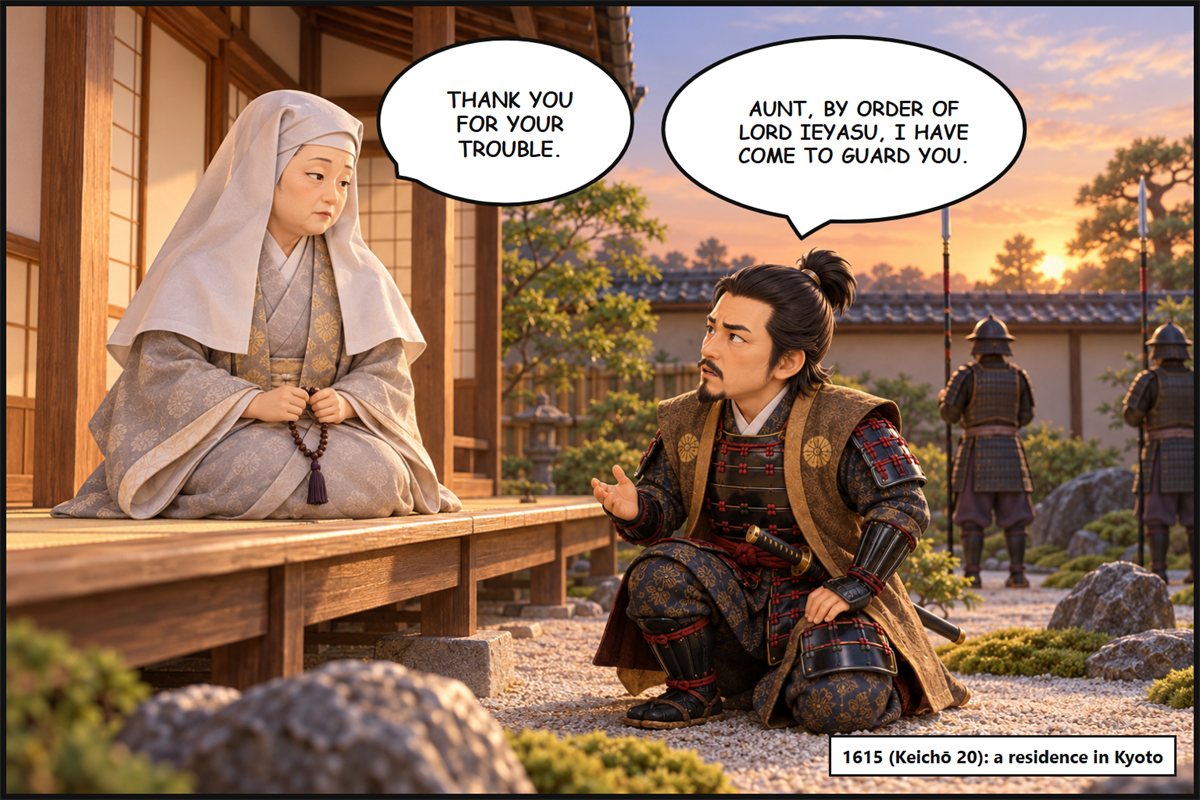
Image: Her nephew Toshifusa arriving to guard Kōdai-in's residence in Kyoto at the time of the Siege of Osaka
So Nene was in Kyoto when the Toyotomi family fell...
Even after the Toyotomi family fell, the bond between Nene and the Kinoshita family continued. Her congratulatory letter in her last years is one example.
How Old Was Nene When She Died? Her Grave at Kōdai-ji
Nene (Kōdai-in) died in Kyoto on the 6th day of the 9th month of 1624 (Kan'ei 1) [Fact]. In the Western calendar, this is October 17, 1624 (Gregorian calendar).
The leading view is that she was 76 by the traditional count when she died [Widely accepted] (77 and 83 are also given). If she was born in 1549 (Tenbun 18), she was about 74 or 75 by modern reckoning.
The sources checked for this article do not identify her cause of death [Unknown].
Tokugawa Hidetada, who had already passed the office of shogun to his son Iemitsu, sent condolences to her nephew Kinoshita Toshifusa in a letter dated the 21st day of the 10th month, thought to be from 1624 [Fact].
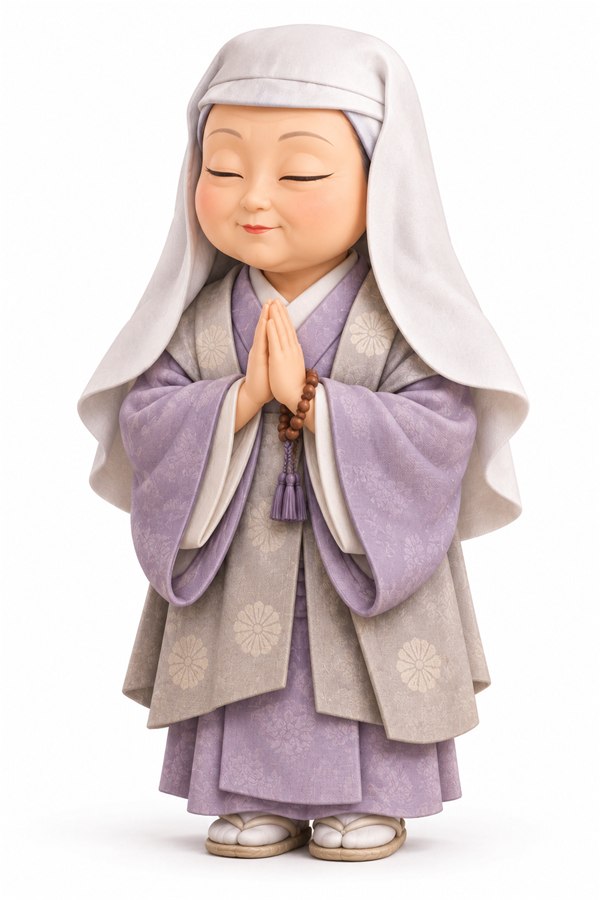
Image: Kōdai-in after becoming a nun
What Is Kōdai-ji?
Kōdai-ji (Higashiyama Ward, Kyoto) is the temple Nene founded to pray for the late Hideyoshi. According to the temple's official explanation it was founded in 1606 (Keichō 11); some encyclopedias give 1605 (Keichō 10).
Tokugawa Ieyasu gave a great deal of support when the temple was built [Fact]. The temple explains that in 1624 (Kan'ei 1) it welcomed Sankō Jōeki of Kennin-ji as its founding abbot and took the name "Kōdai-ji."
Where Is Her Grave?
Nene's grave is the Otamaya (mausoleum) of Kōdai-ji. Hideyoshi and Kita no Mandokoro are enshrined in the Otamaya, and Kōdai-ji explains that her grave lies beneath her statue. The Otamaya is an Important Cultural Property of Japan.
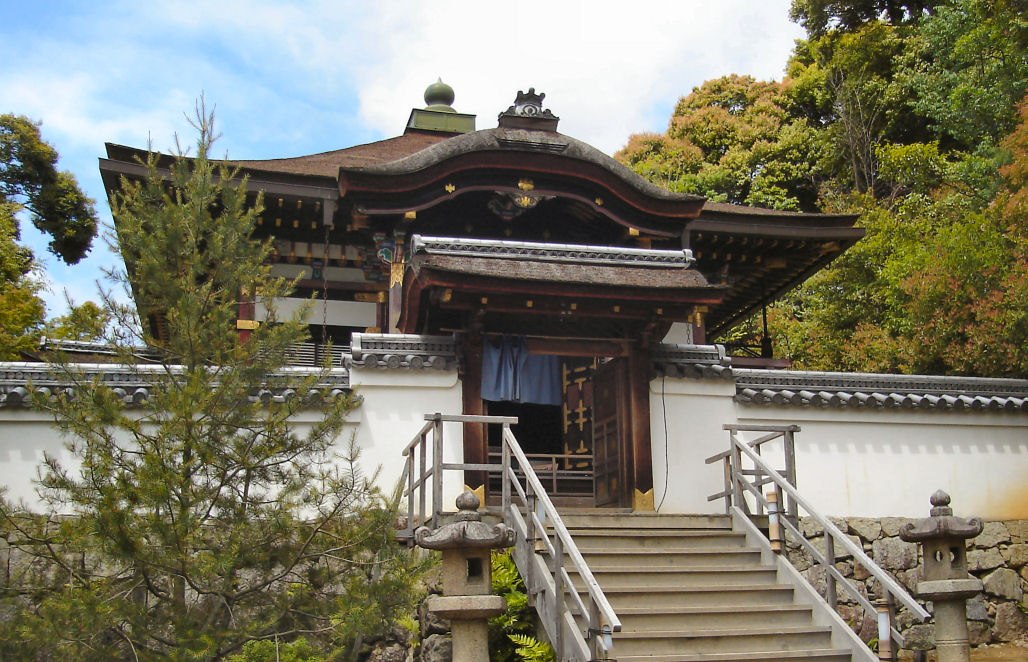
Image: The Otamaya of Kōdai-ji. Photo: +- (CC BY-SA 3.0), Wikimedia Commons
Places Linked to Nene: Kōdai-ji, Entoku-in and Nene-no-Michi
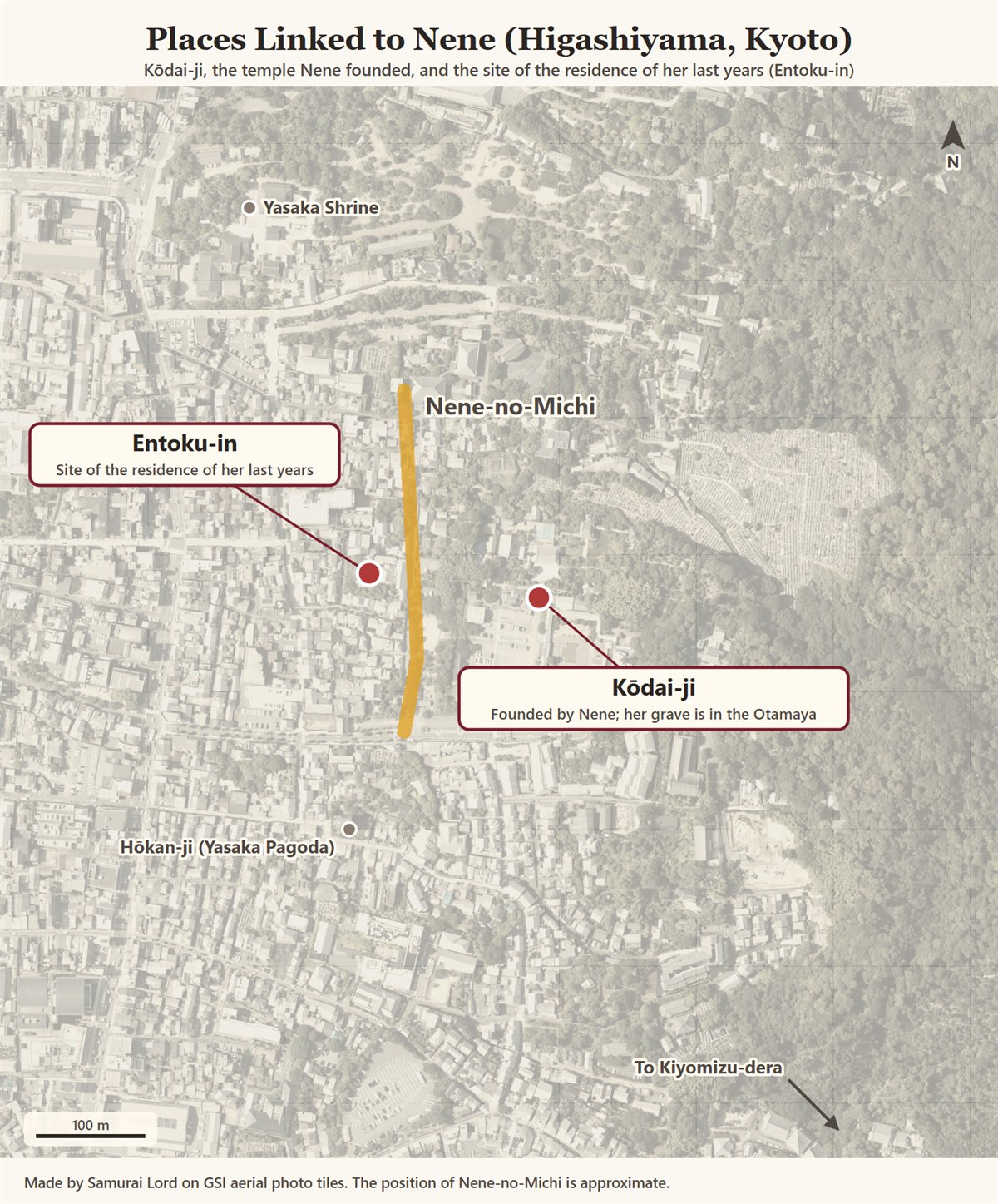
Image: Places linked to Nene in Higashiyama, Kyoto (made by Samurai Lord on aerial photo tiles from the Geospatial Information Authority of Japan). Tap (click) the image to enlarge it
| Place | Connection with Nene |
| Kōdai-ji (Higashiyama Ward, Kyoto) | The temple Nene founded. Her grave is in the Otamaya |
| Entoku-in (Higashiyama Ward, Kyoto) | The site of the residence where Nene lived in her last years. The temple explains that buildings from Fushimi Castle were moved here in 1605 (Keichō 10) |
| Nene-no-Michi (Higashiyama Ward, Kyoto) | A stone-paved street running north and south to the west of Kōdai-ji, named after Nene |
| Osaka Castle (Osaka) | The castle where she lived with Hideyoshi (today's keep was rebuilt in 1931, Shōwa 6) |
| Nagahama (Nagahama, Shiga Prefecture) | Where she lived when Hideyoshi was lord of Nagahama Castle |
| Ashimori (Okayama City) | The domain of the Kinoshita family of her brother Iesada and her nephew Toshifusa |
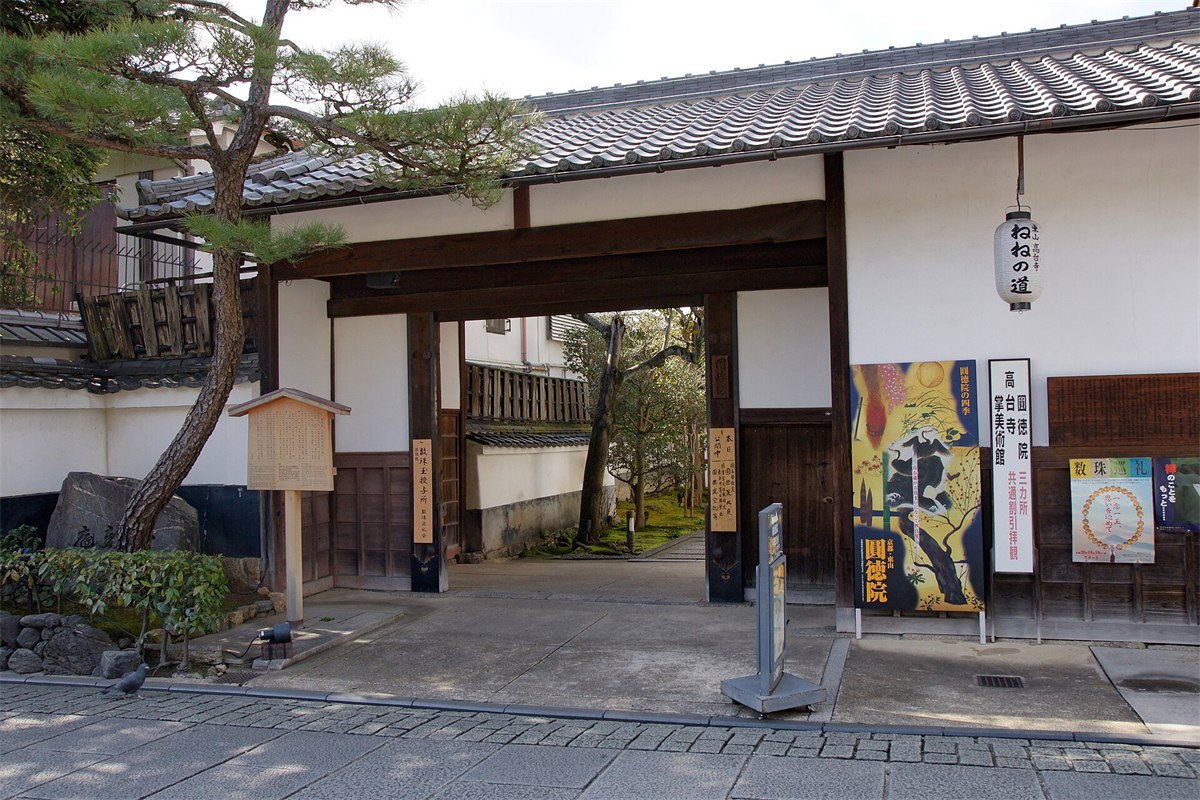
Image: Entoku-in. Photo: 663highland (CC BY 2.5), Wikimedia Commons
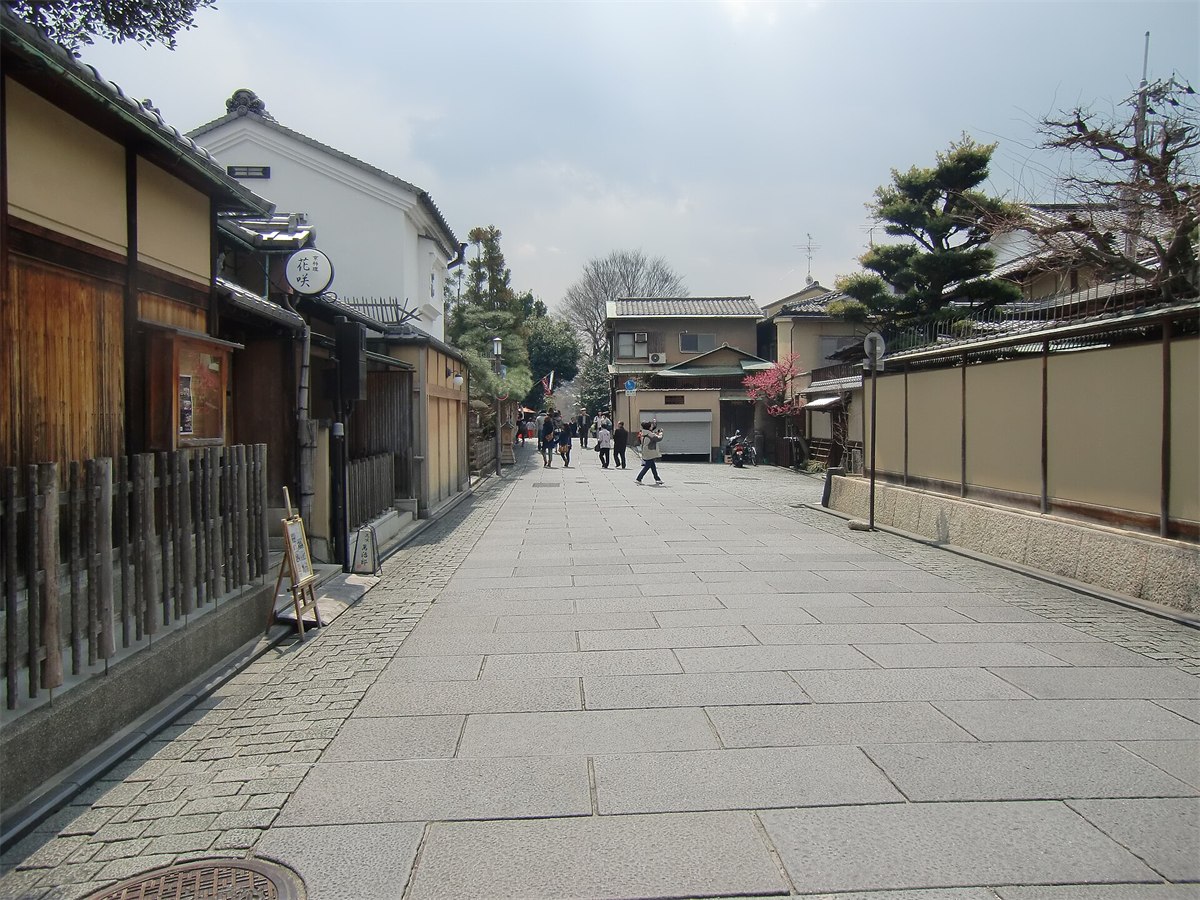
Image: Nene-no-Michi. Photo: 上野宝彦 (CC BY-SA 3.0), Wikimedia Commons
Nene's Life on a Timeline
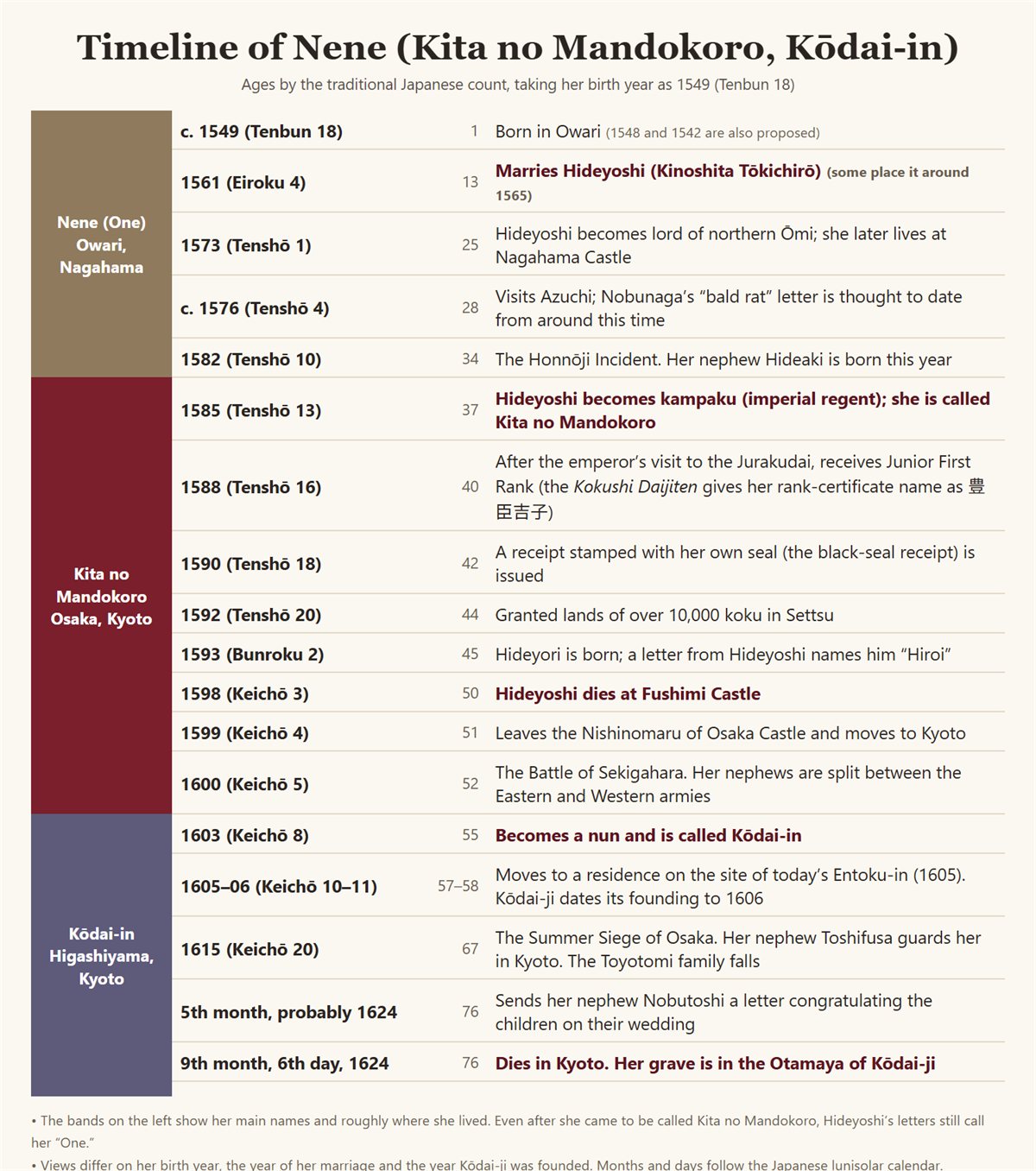
Image: Timeline of Nene (made by Samurai Lord). Tap (click) the image to enlarge it
Because there are different theories about the year of her birth and her marriage, the timeline shows the main ones side by side. Ages are by the traditional Japanese count, taking her birth year as 1549 (Tenbun 18).
FAQ
Was Nene beautiful?
The sources checked for this article say little about Nene's appearance. Nobunaga praised her in a letter as having become "far more beautiful" than when he last saw her, but this is thought to include some flattery (more). The surviving portrait shows her after she became a nun.
Are there famous words of Nene?
Among words of Nene whose source is clear is this line from a letter of her last years: "Ours, too, was a humble affair, yet we became known to everyone in the realm" (more).
What was the relationship between Nene and Matsu (Maeda Toshiie's wife)?
Nene and Hideyoshi adopted Gōhime, a daughter of Toshiie and Matsu, and the two families were close (see our article on Maeda Toshiie).
Do Hideyoshi and Nene have descendants?
No biological children of Nene and Hideyoshi are known, so no direct descendants of the couple are known. The Kinoshita lines descended from Nene's brother continued as daimyo families through the Edo period (more).
Does Nene appear in the NHK drama Toyotomi Kyōdai!?
Yes. She appears as Hideyoshi's wife, Nene. However, the drama includes scenes that are not in the records.
Summary: Who Was Nene?
Nene was the principal wife of Toyotomi Hideyoshi. After Hideyoshi became kanpaku she was called Kita no Mandokoro, and after becoming a nun, Kōdai-in. The reading of her personal name is debated. Hideyoshi's letters use forms such as "One" and "Ne," while she signed herself "Ne."
Born in Owari around 1549 (Tenbun 18), she married Hideyoshi in a year usually given as 1561 (Eiroku 4). As Kita no Mandokoro, she had her own lands and seal and looked after Hideyoshi's affairs while he was away. Historians point out that the story of her rivalry with Chacha (Yodo-dono) spread through later tales, and some historians see the two as having worked together.
After Hideyoshi's death she moved to Kyoto and founded Kōdai-ji. Her relatives were split between East and West at Sekigahara, and even after the Toyotomi family fell in the Siege of Osaka, Nene went on watching over her nephews. She died on the 6th day of the 9th month of 1624 (Kan'ei 1), at 76 by the traditional count (the leading view).
For the people involved, see also our articles on Toyotomi Hideyoshi, Toyotomi Hidenaga, Oichi, Maeda Toshiie, Tokugawa Ieyasu and Oda Nobunaga.
As the wife of the realm's ruler, and as a person in her own right, Nene comes clearly into view in her letters.
"A humble wedding, yet known throughout the realm": what wonderful words of encouragement!
Sources & How This Article Was Written
This article is based mainly on the following records and references:
- Records from the time: letters in Toyotomi Hideyoshi's own hand (Kōdai-ji, the Tokugawa Art Museum, Saga Prefectural Nagoya Castle Museum and others); a letter in Kōdai-in's own hand (dated the 7th day of the 5th month, thought to be from 1624, Kan'ei 1; Nagoya City Museum); the black-seal receipt of Kita no Mandokoro (Tenshō 18; Nagoya City Museum); a vermilion-seal letter of Toyotomi Hideyoshi (dated the 23rd day of the 3rd month of Tenshō 20; same); a kuzen'an (court document recording an imperial command) of Emperor Go-Yōzei (dated the 19th day of the 4th month of Tenshō 16; Kōdai-ji); Oda Nobunaga's letter to Nene (private collection); a letter of Tokugawa Ieyasu (dated the 24th day of the 9th month of Keichō 5; Nagoya City Museum); a black-seal letter of Tokugawa Hidetada (dated the 21st day of the 10th month, thought to be from 1624, Kan'ei 1; same); the writings of Luís Fróis
- Later records: a note in a genealogy of the Sugihara family (mid-Edo period); Kansei Chōshū Shokafu (late Edo period); Ehon Taikōki (published from 1797, Kansei 9)
- Studies (in Japanese; titles translated by us): Fukuda Chizuru, Kōdai-in (Yoshikawa Kōbunkan, Jinbutsu Sōsho series, 2024); Kuroda Motoki, Hashiba Hideyoshi and His Family (KADOKAWA, 2025); Goza Yūichi, The True Story of the Toyotomi Brothers and Their Family (Gentōsha Shinsho, 2025); Ono Kyōichi, on changes in Hideyoshi's plans to conquer Ming China as seen in his own letters (Kagoshima Prefectural Museum of Culture Reimeikan). For the books, we checked their content through the publishers' descriptions and articles by the authors (PRESIDENT Online and others)
- Official materials (in Japanese): Osaka Castle Museum, press release for the special exhibition "Kōdai-in: The Partner of the Ruler Hideyoshi" (March 6, 2024; transcriptions and explanations of the letters); Kōdai-ji, "History of Kōdai-ji"; Entoku-in, "Origins of Entoku-in"; Nagoya City Museum, transcriptions of the "Toyotomi family documents"; Agency for Cultural Affairs, "Cultural Heritage Online: Black-seal receipt of Kita no Mandokoro"; a reference case from Nagano Prefectural Library (on the date of Nobunaga's letter); Kotobank (Nihon Daihyakka Zensho, Sekai Daihyakka Jiten, Yamakawa Nihonshi Shōjiten)
- Images: the copy of the portrait of Kōdai-in (Historiographical Institute, University of Tokyo; public domain), the black-seal receipt of Kita no Mandokoro (Nagoya City Museum; public domain), the Otamaya of Kōdai-ji (+-, CC BY-SA 3.0), Entoku-in (663highland, CC BY 2.5) and Nene-no-Michi (上野宝彦, CC BY-SA 3.0) are from Wikimedia Commons. The map uses aerial photo tiles from the Geospatial Information Authority of Japan as its base. The family tree, timeline, manga panels and illustrations are original works by Samurai Lord
What the Labels Mean
[Fact]Confirmed by sources from the time ([Fact: …]names the source)[Widely accepted]A view widely accepted by researchers[Debated]Accounts or interpretations differ[Unknown]Not established from the sources we checked[Legend]Stories found in later records or traditions[Folk belief]Popular claims with little evidence
We keep "what a record says" separate from "what actually happened." What is written in records compiled in later times is named in the text by the name of the record, and is not all treated as [Fact]. Translations of the source excerpts in this article are by the Samurai Lord editorial team.
This article was written by the Samurai Lord editorial team and is revised as new research and reader feedback come in. If you spot an error, please let us know through our contact form (in Japanese) and we will check and correct it.
Read in Japanese
This article is also available in Japanese: 寧々(ねね)とは?北政所・高台院の名前や秀吉・茶々との関係を解説!