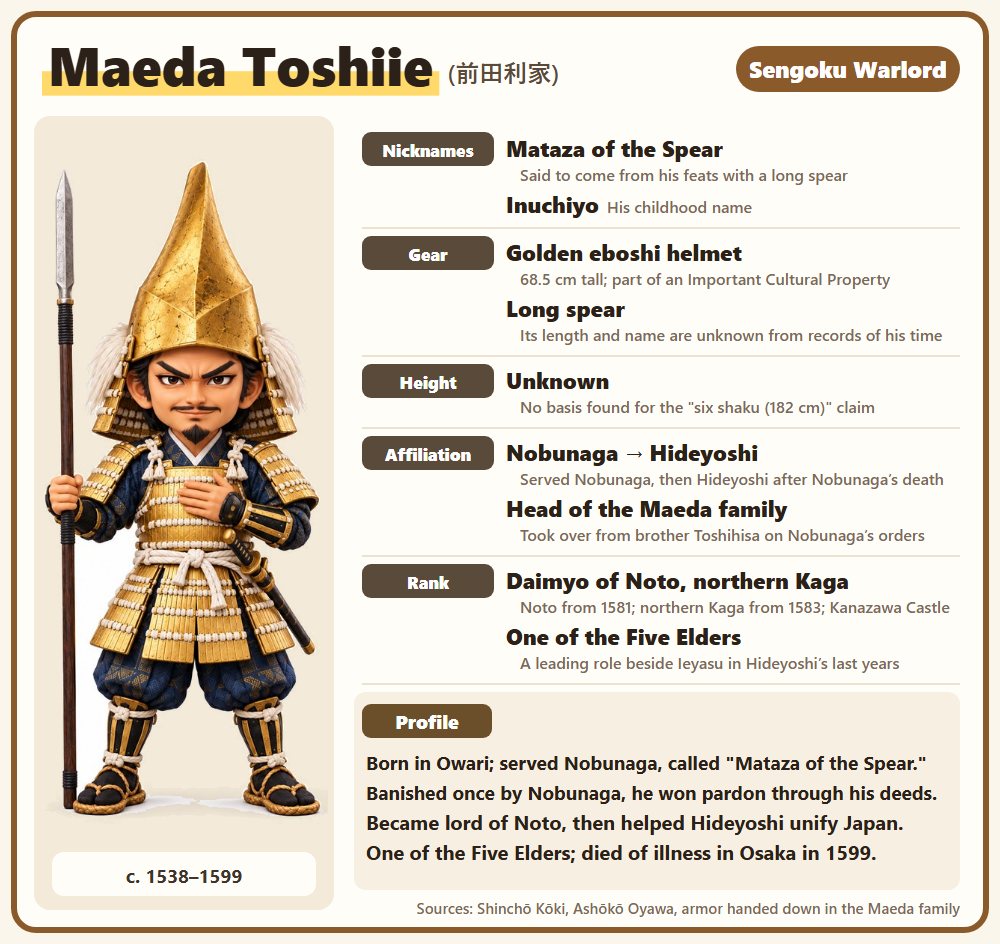
Maeda Toshiie (1538?–1599) was a samurai who served both Oda Nobunaga and Toyotomi Hideyoshi, the two warlords who played central roles in Japan's sixteenth-century unification. As a young man he was famous for his skill with a long spear and was nicknamed "Mataza of the Spear." He rose to become a daimyo (a regional lord) ruling Noto and Kaga, today's Ishikawa Prefecture on the Sea of Japan coast. In Hideyoshi's last years he was one of the Five Elders, the council of great lords asked to protect Hideyoshi's young heir, and stood on an equal footing with Tokugawa Ieyasu.
In the Edo period (1603–1868), his family's domain was known as "Kaga Hyakumangoku": the domain of Kaga, worth a million koku of rice. Toshiie laid its foundations, and his sons made it great. This article covers how he died, the stories about his wife Matsu, and his road to the million-koku domain, separating what the records of his own time say, what later books added, and what remains unknown.
Key points are tagged: [Fact] confirmed by records from Toshiie's own time, [Widely accepted] held by most historians, [Debated] historians disagree, [Unknown] not established from the sources we checked, and [Legend] or [Folk belief] for later stories and popular claims. A tag like [Fact: Shinchō Kōki] names the record.

I am Uesugi Kenshin. Today's subject had close ties to all three great unifiers: Nobunaga, Hideyoshi and Ieyasu.

I'm Date Masamune! Maeda Toshiie... wasn't he the one who got along so well with his wife, Matsu?

Indeed. But there is more to him than that. Let us follow his path from the battlefield to the rank of daimyo.
The Short Answers
- What did he do? He rose from Nobunaga's retainer to daimyo of Noto Province and helped Hideyoshi unify Japan. In Hideyoshi's last years he was one of the Five Elders protecting the Toyotomi family
[Fact](more) - How did he die? He died of illness at his residence in Osaka on April 27, 1599 (Keichō 4, the 3rd day of the intercalary 3rd month)
[Fact]. Exactly what the illness was is not known[Unknown](more) - Who was his wife? Matsu, later known as Hōshun-in, was his principal wife. She is said to have had two sons and nine daughters
[Widely accepted], and many stories tell of how she supported him (more) - Did his family survive? Yes. His house continued as the Maeda lords of the Kaga domain until the end of the Edo period
[Fact](more)
Jump to the part you want to read:
- Who was Maeda Toshiie? Quick profile
- How did Maeda Toshiie die?
- His wife Matsu and the "bags of gold"
- Children, descendants and family tree
- How was Maeda Keiji related to him?
- Timeline of his life
- Did Toshiie betray Shibata Katsuie at Shizugatake?
- What was "Kaga Hyakumangoku"?
- Helmet, spear and family crest
Who Was Maeda Toshiie? Quick Profile
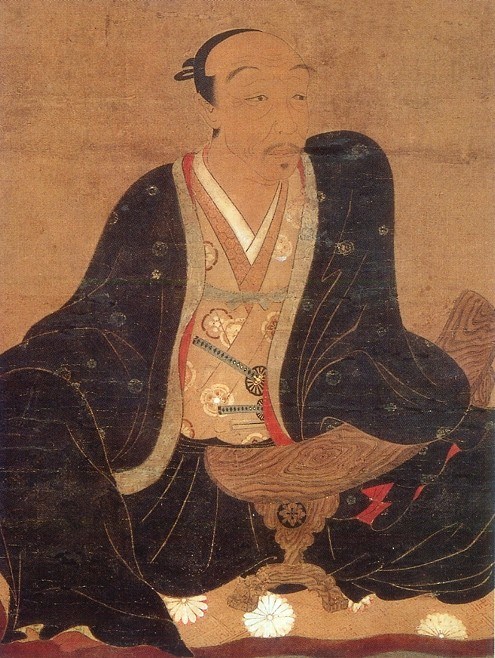
Image: Portrait of Maeda Toshiie. Wikimedia Commons (public domain)
In a nutshell, Maeda Toshiie was "a retainer of Nobunaga who rose to become a daimyo, helped Hideyoshi unify Japan, and laid the foundations of the million-koku Kaga domain".
A few terms come up often in this article:
- The Sengoku period: Japan's "Warring States" era, from the late fifteenth to the late sixteenth century, when regional lords (daimyo) fought for power
- Oda Nobunaga (1534–1582): the warlord Toshiie served first, who brought much of central Japan under his control before he was killed at Honnō-ji in 1582
- Toyotomi Hideyoshi (1537–1598): Toshiie's old friend and fellow retainer of Nobunaga, who took over Nobunaga's power and unified Japan
- Kaga and Noto: two provinces on the Sea of Japan coast. Kaga is the southern part of today's Ishikawa Prefecture, and Noto, a peninsula, the northern part
- Koku: a unit for measuring rice, about 180 liters. A domain's size was expressed in koku (see Kaga Hyakumangoku)
| Item | Details | Reliability |
| Name | Maeda Toshiie. His childhood name was Inuchiyo; as an adult he was called Magoshirō, and later Matazaemon | [Fact] |
| Born | Usually given as 1538 (Tenbun 7); some say 1537 (Tenbun 6) | [Debated] |
| Birthplace | Arako in Owari Province (today's Nakagawa Ward, Nagoya) | [Widely accepted] |
| Father | Maeda Toshiharu (also called Toshimasa), lord of Arako Castle. Toshiie is said to have been his fourth son, or by some accounts his second | [Debated] |
| Lords served | Oda Nobunaga, then Toyotomi Hideyoshi | [Fact] |
| Wife | Matsu (later Hōshun-in) | [Fact] |
| Children | Including his eldest son Toshinaga (2nd head of the family), his fourth son Toshitsune (3rd head), and his daughter Gōhime | [Fact] |
| Lands | Noto (from 1581) and northern Kaga (from 1583), with Kanazawa Castle as his base | [Fact] |
| Office | One of the Five Elders; guardian of Hideyoshi's son Hideyori | [Fact] |
| Died | April 27, 1599 (Keichō 4, intercalary 3rd month, 3rd day), at his residence in Osaka | [Fact] |
| Cause of death | Illness; the disease is not known | [Unknown] |
| Age at death | 62 by the traditional Japanese count if born in 1538, or 63 if born in 1537 | [Debated] |
| Family crest | The Maeda family is associated with the umebachi (the "Kaga Umebachi" plum blossom); the precise design Toshiie himself used is uncertain | [Widely accepted] |
| Grave | Nodayama, Kanazawa | [Fact] |
The "traditional Japanese count" (kazoedoshi) makes a baby one year old at birth and adds a year every New Year, so it is one or two years higher than the Western age. This article says which count it uses whenever it gives an age.
What Did He Do? Three Key Points
- 1. From spearman to daimyo: He served at Nobunaga's side, won fame on the battlefield, and was given the whole province of Noto (the north of today's Ishikawa Prefecture) to rule
[Fact] - 2. He helped Hideyoshi unify Japan: After Nobunaga's death he followed Hideyoshi and held the northern provinces for him. It was Toshiie who made Kanazawa Castle the family's base
[Fact] - 3. He protected the Toyotomi family as one of the Five Elders: In Hideyoshi's last years he was given the task of protecting the young Hideyori, in a leading position alongside Tokugawa Ieyasu within the Toyotomi government
[Widely accepted]

He became a daimyo through his deeds on the battlefield? Amazing!
Not only through strength in battle. His skill at dealing with Hideyoshi and Ieyasu is also why the Maeda family lasted.
How Did Maeda Toshiie Die? His Final Days
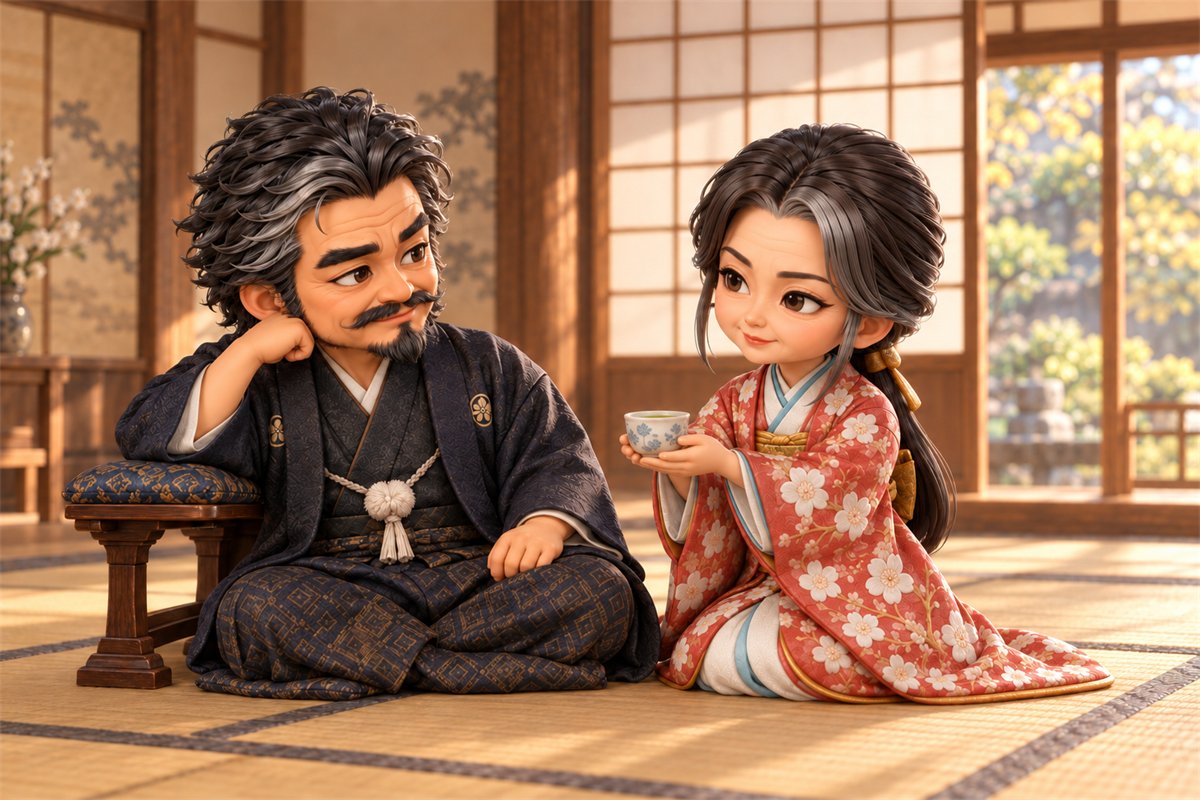
Image: Toshiie and Matsu in his last years
Maeda Toshiie died on April 27, 1599, at his own residence in Osaka [Fact]. In the Japanese calendar of the time, this was the 3rd day of the intercalary 3rd month of Keichō 4. If he was born in 1538, he was 62 by the traditional Japanese count. It was just over seven months after the death of Hideyoshi.
He died of illness. But it is impossible to name the disease in modern medical terms [Unknown]. The records of the time describe his symptoms, but no one could examine him the way a modern doctor would.
Ill for a Year Before His Death
We know about Toshiie's illness from notes left by Maeda family retainers and from research based on them. According to a paper by the historian Ikeda (池田仁子) in the journal Kanazawa-jō Kenkyū (Kanazawa Castle Studies), no. 14, the records say the following [Widely accepted: Ikeda's study]. The dates follow the Japanese lunar calendar of the time.
| When | What the records say |
| Keichō 3 (1598), 4th–5th months (about May–June) | He took a cure at the hot springs of Kusatsu in Kōzuke (today's Gunma Prefecture). An acupuncturist went with him and treated him with needles |
| About 30 days later | The treatment helped at first, but then he began to pass urine the color of pale ink. This continued after he returned to Kanazawa |
| Keichō 4 (1599), 2nd month | A thin white "worm" came up from his throat |
| Keichō 4, 3rd month, 15th day | Two more "worms" came up |
| Keichō 4, 3rd month, 21st day | He had his wife Matsu write down his will |
| Keichō 4, intercalary 3rd month, 3rd day | He died at his residence in Osaka |
Note: The old Japanese calendar was lunisolar. Twelve lunar months were about 11 days shorter than a solar year, so to keep the months in step with the seasons, an extra month was added every two or three years. In 1599 (Keichō 4), the 3rd month was followed by a second, "intercalary" 3rd month. So although "the 3rd day of the intercalary 3rd month" looks earlier than "the 21st day of the 3rd month," it actually came about ten days later. In the Western calendar it was April 27, 1599.
These records are based on the notes of retainers who were close to Toshiie. But many of the notes were written after his death, and some details may have grown in the telling.
What Were the "Worms"? Do We Know the Disease?
People at the time believed that many illnesses of the stomach and intestines were caused by "worms" inside the body. Ikeda's paper explains Toshiie's "worm" illness as roundworms (an intestinal parasite), but it does not go so far as to say they were the direct cause of his death [Widely accepted: Ikeda's study].
Online you may see claims that he died of stomach cancer or gallstones. But the symptoms in the records are not enough to identify the disease. The most accurate answer is "He died of an illness, and we do not know what it was" [Unknown].
Worms coming up from his throat... People back then really had a hard time.
It was an age when no one could know the true nature of an illness. I myself was struck down by a sudden illness. I cannot think of it as someone else's problem.
Protecting the Toyotomi Family to the End
After Hideyoshi died in 1598, Toshiie served at Osaka Castle as the guardian of Hideyoshi's son Hideyori, who was then only five (six by the Japanese count). Early in 1599, it came to light that Tokugawa Ieyasu was arranging marriages with other daimyo families without permission, against the rules Hideyoshi had left. Toshiie and the other leaders protested [Fact]. For a time, tension between Ieyasu and Toshiie ran so high that fighting seemed possible.
Despite his illness, Toshiie went to see Ieyasu at Fushimi (in today's Kyoto) on the 29th day of the 2nd month of Keichō 4 (late March 1599), and Ieyasu returned the visit to Toshiie in Osaka on the 8th day of the 3rd month (early April) [Widely accepted]. Meeting face to face, the two men settled the dispute for the time being. Ieyasu also sent Toshiie letters asking after his health [Fact].
About a month later Toshiie died. With him gone, the balance of power within the Toyotomi government shifted sharply, and events moved toward the Battle of Sekigahara the following year. For more on Ieyasu, see our article on Tokugawa Ieyasu.
Who Was His Wife Matsu? Is the "Bags of Gold" Story True?
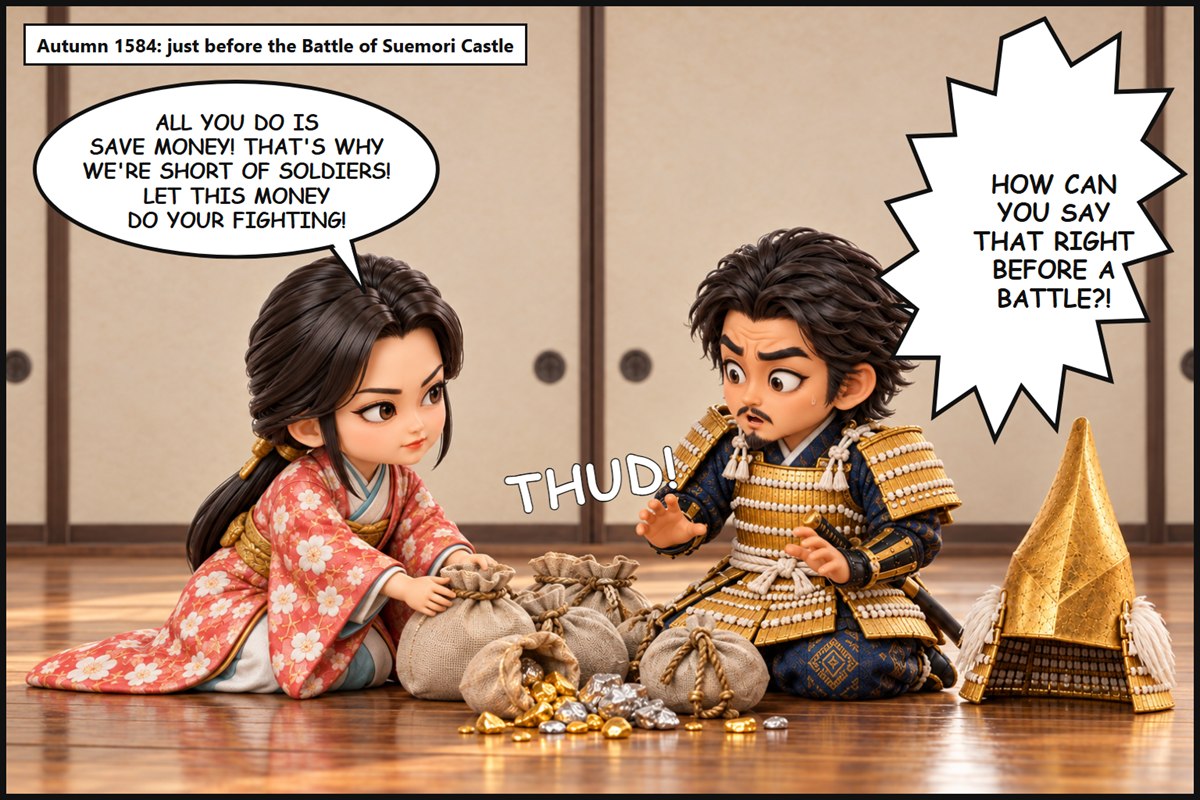
Image: A manga panel of the story in which Matsu pushed bags of gold and silver at Toshiie. It is based on a story in Kawasumi Taikōki, a book from the early Edo period; the dialogue is rewritten in plain modern language
Toshiie's wife Matsu was born in 1547 (Tenbun 16), about nine years after Toshiie [Fact]. After his death she became a Buddhist nun and took the name Hōshun-in [Fact]. Many stories remember her as a capable, strong-minded wife who supported her husband.
How Old Were They When They Married?
Some accounts say the two married when Matsu was twelve by the traditional Japanese count. This is the view that they married in 1558 (Eiroku 1). But at least one museum notes that the year of the marriage is not clear from the records, so we cannot say for certain [Debated].
If Toshiie was born in 1538, the age gap was nine years; if he was born in 1537, it was ten [Debated]. Marrying so young seems shocking today, but it was not unusual in samurai families of the Sengoku period.
Mother of Two Sons and Nine Daughters
Matsu is said to have had two sons and nine daughters with Toshiie [Widely accepted]. Her eldest son Toshinaga later became the second head of the Maeda family, and her daughter Gōhime was adopted by Hideyoshi. The children are covered in the section on children and descendants below.
"Let This Money Do Your Fighting!"
The most famous story about Matsu is set just before the Battle of Suemori Castle in 1584 (Tenshō 12), when she is said to have pushed bags of gold and silver at Toshiie.
That autumn, Sassa Narimasa, lord of Etchū (today's Toyama Prefecture), attacked the Maeda castle of Suemori (in today's Hōdatsushimizu, Ishikawa). Toshiie decided to go to its rescue and was putting on his armor. Just then Matsu opened the treasure storehouse and brought out bags of gold and silver.
Source Box 1: Matsu and the Bags of Gold
Source: Kawasumi Taikōki, volume 5 (a collection of hearsay about Hideyoshi, compiled in the early Edo period, around the Genna era of 1615–1624)
What it says (our translation): "'This time, take this gold and silver with you and let it wield the spear,' she said, and threw the leather bag of gold at Lord Matazaemon (Toshiie), or so I have heard."
The rest of the story (summary): Before this, Matsu had said: "I have always heard that Narimasa is a tough opponent. Morning and evening I told you to gather soldiers rather than hoard money." Angered just before setting out for battle, Toshiie began to draw his short sword, and the women around him had to stop him
Our note: The book was put together about forty years after the battle, and the passage ends with "or so I have heard." Since there is no way to confirm that Matsu really said this, it is best read as a story from a later time
Toshiie then relieved Suemori Castle and drove off Narimasa's army [Fact]. This battle was one of his greatest achievements.
Throwing the money at him! Matsu-san was tough!
Hmm. Even if the story was written down later, it shows how much people believed Toshiie relied on her.
A Hostage in Edo After Toshiie's Death
In the year Toshiie died, a rumor spread that Tokugawa Ieyasu was preparing to attack the Maeda family (the so-called "Kaga campaign" scare). The Maeda chose not to fight Ieyasu, and the following year, 1600, Matsu went to Edo (present-day Tokyo) as a hostage [Fact].
Matsu was not able to return to Kanazawa until 1614, fourteen years later. She died at Kanazawa Castle in 1617 [Fact]. Matsu's move to Edo was an important demonstration of the Maeda family's submission to Ieyasu; together with Toshinaga's political handling, it allowed the family to keep its lands.
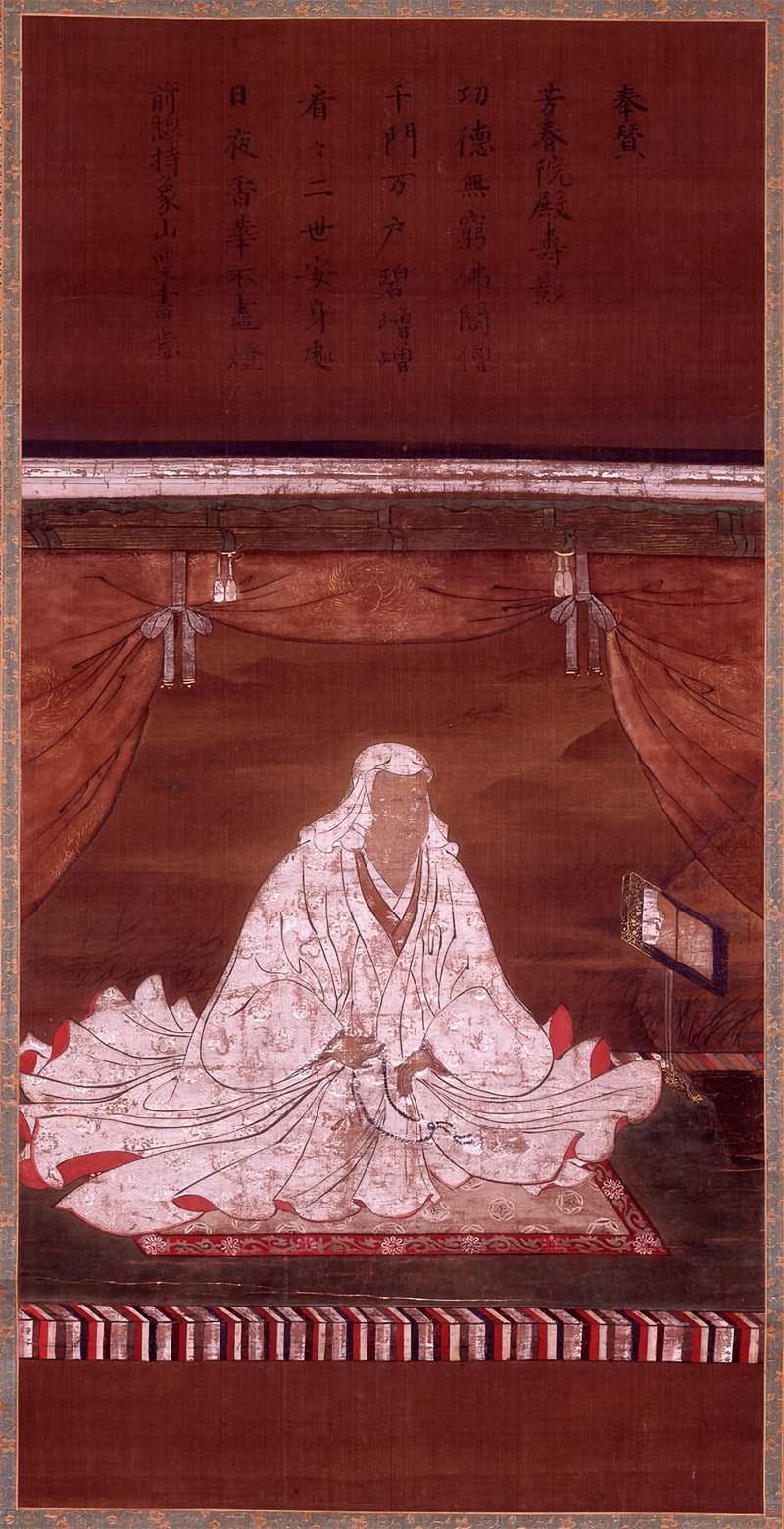
Image: "Portrait of the Wife of Maeda Toshiie" (Sōji-ji Temple, Important Cultural Property), showing Matsu after she became a nun. Wikimedia Commons (public domain)
Matsu's appearance is preserved in the "Portrait of the Wife of Maeda Toshiie" at Sōji-ji Temple in Yokohama, a national Important Cultural Property [Fact]. The inscription above the picture uses the word juei, meaning a portrait made while the subject was still alive [Fact]. It is thought to have been painted between 1599 and 1617, after Toshiie's death, when she was a nun [Widely accepted].
Maeda Toshiie's Children, Descendants and Family Tree
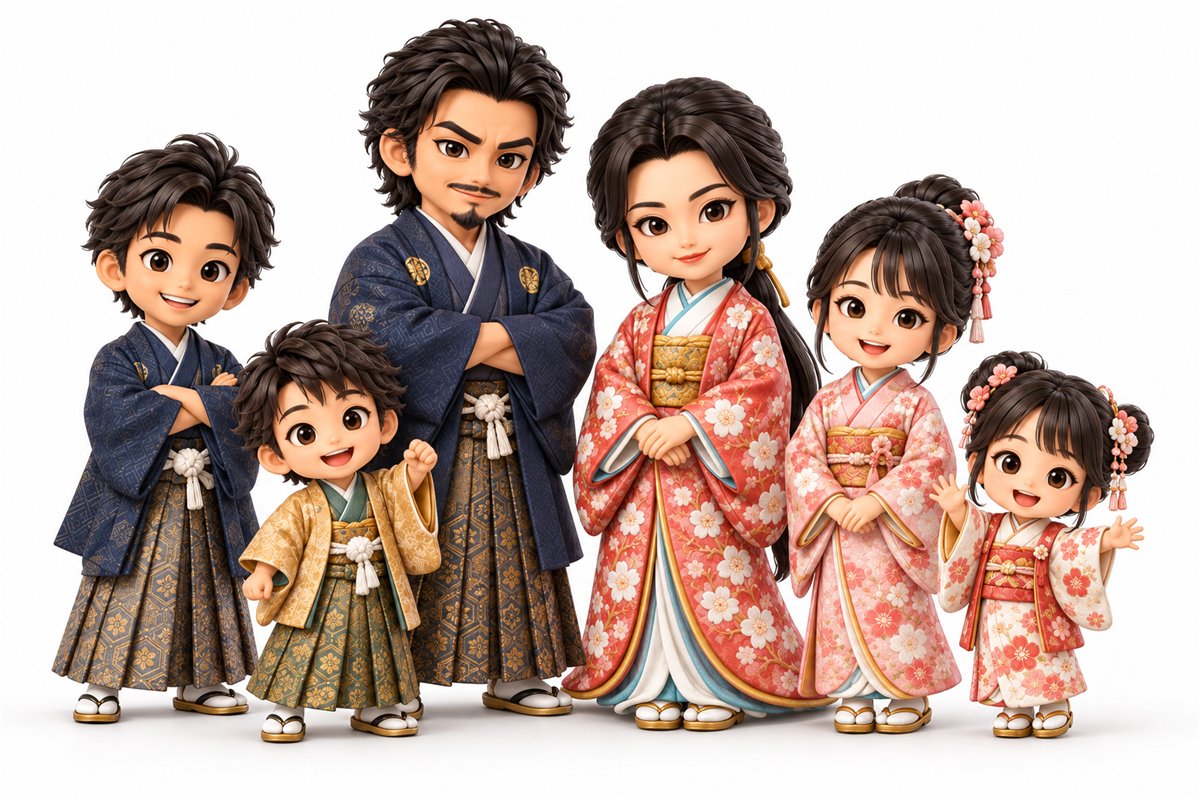
Image: Toshiie, Matsu and their children
Toshiie had children with Matsu and with other consorts. Some of his children are listed below:
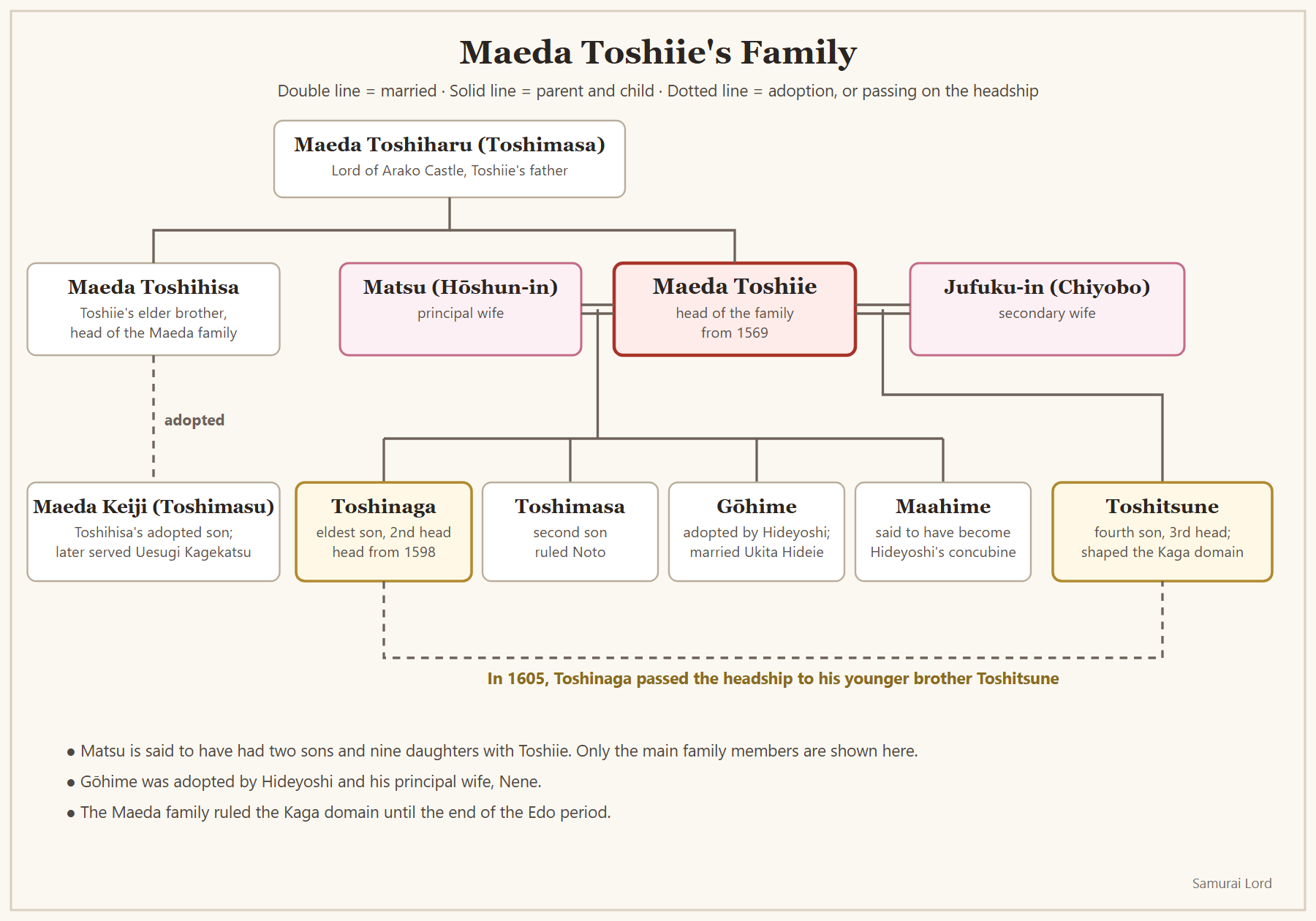
Image: Family tree of Maeda Toshiie's main family members (created by Samurai Lord). Tap or click the image to enlarge it
| Name | Mother | Who they were |
| Maeda Toshinaga | Matsu | Eldest son and Toshiie's successor as 2nd head of the family. At Sekigahara he sided with the Tokugawa and came to rule the three provinces of Kaga, Noto and Etchū |
| Maeda Toshimasa | Matsu | Second son. He ruled Noto, but lost his lands after the Battle of Sekigahara and lived at Saga in Kyoto |
| Maeda Toshitsune | Jufuku-in (secondary wife) | Fourth son. He succeeded his elder brother Toshinaga as 3rd head of the family and developed the Kaga domain's administration |
| Gōhime | Matsu | Adopted by Hideyoshi; became the wife of Ukita Hideie (one of the Five Elders) |
| Maahime | Matsu | Became a concubine of Hideyoshi |
Gōhime was adopted by Hideyoshi and his principal wife Nene, and is said to have been greatly loved [Widely accepted]. It shows how close the Maeda and Hideyoshi families were.
The Second Lord: Maeda Toshinaga
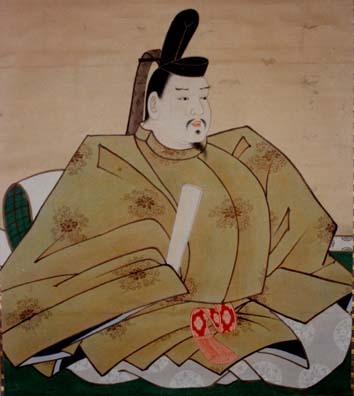
Image: Portrait of Maeda Toshinaga. Wikimedia Commons (public domain)
Toshiie's eldest son, Maeda Toshinaga (1562–1614), took over as head of the family from his father in 1598 (Keichō 3) [Fact]. After Toshiie's death he avoided conflict with Ieyasu and fought on the Tokugawa side in the Battle of Sekigahara (1600). As a result he came to rule the three provinces of Kaga, Noto and Etchū, and the domain reached the size known as "Kaga Hyakumangoku" [Fact].
Are There Descendants of Maeda Toshiie Today?
The Maeda family ruled the Kaga domain for about 270 years, until the end of the Edo period [Fact]. The family continued after the Meiji Restoration, and the treasures and old books handed down in the family are still cared for by a foundation, the Maeda Ikutokukai [Fact].
Toshiie's daughters also married into many other daimyo families, so his bloodline is thought to have spread beyond the Maeda house. But whether any particular person is "a descendant of Toshiie" can only be known by tracing that family line step by step [Unknown].
How Was Maeda Keiji Related to Toshiie?
Image: The flamboyant Maeda Keiji and an exasperated Toshiie
Maeda Keiji (also Keijirō; his personal name is said to have been Toshimasu), a favorite of novels, manga and games, was the adopted son of Toshiie's elder brother, Maeda Toshihisa [Fact]. That made him Toshiie's nephew by adoption.
Toshihisa had been head of the Maeda family, but in 1569 (Eiroku 12), on Nobunaga's orders, he gave up the headship to his younger brother Toshiie [Fact]. Had Toshihisa stayed in charge, his adopted son Keiji might have inherited the family.
What Became of Keiji?
Keiji later left the Maeda family and served Uesugi Kagekatsu, the adopted son of Uesugi Kenshin [Fact]. A diary of his journey from Fushimi in Kyoto to Kagekatsu's castle town of Yonezawa (in today's Yamagata Prefecture) in 1601, the Maeda Keiji Dōchū Nikki, is believed to be in his own hand and is kept at the Yonezawa City Library [Widely accepted].
On the other hand, we do not know who his real father was, or when he was born and died [Unknown]. There is also a famous story that Keiji tricked Toshiie into taking a freezing cold bath and slipped away from the family while he was in it, but this is an anecdote from later times that cannot be confirmed [Legend].
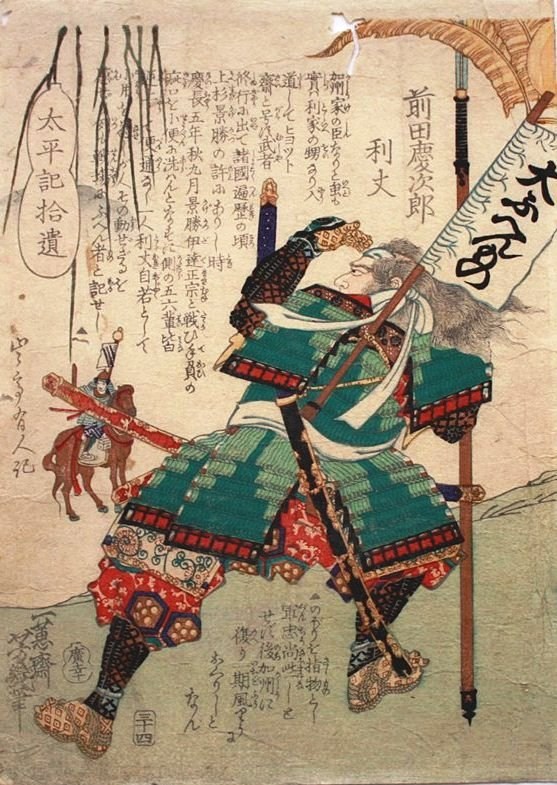
Image: Maeda Keijirō from Utagawa Yoshiiku's woodblock print series Taiheiki Shūi (late Edo period). Wikimedia Commons (public domain)
Keiji served my adopted son Kagekatsu. His name is a familiar one to the Uesugi house as well.
From the Maeda to the Uesugi! He really was a free spirit.
Timeline of Maeda Toshiie's Life
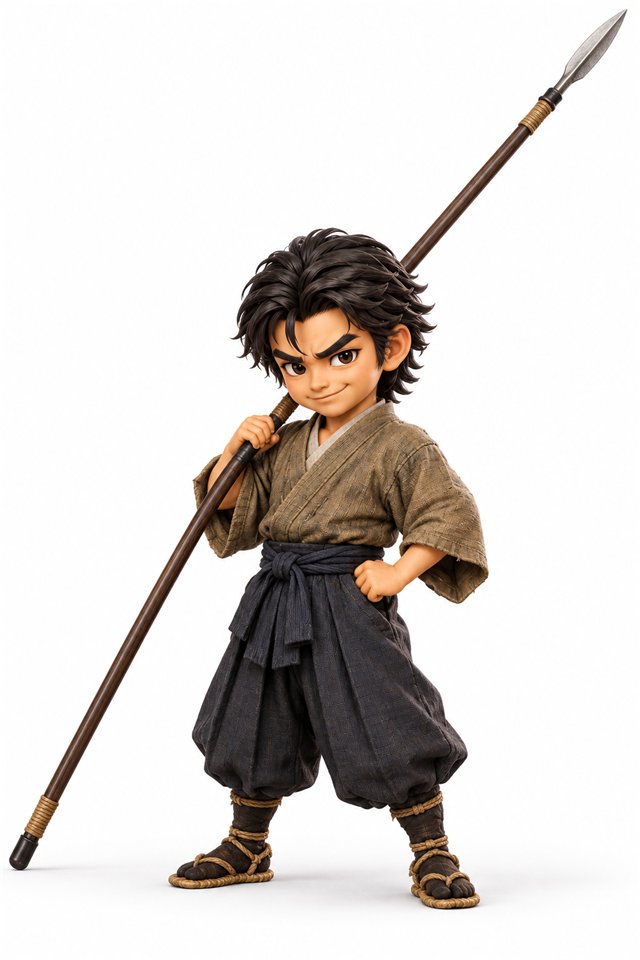
Image: The young Toshiie (Inuchiyo)
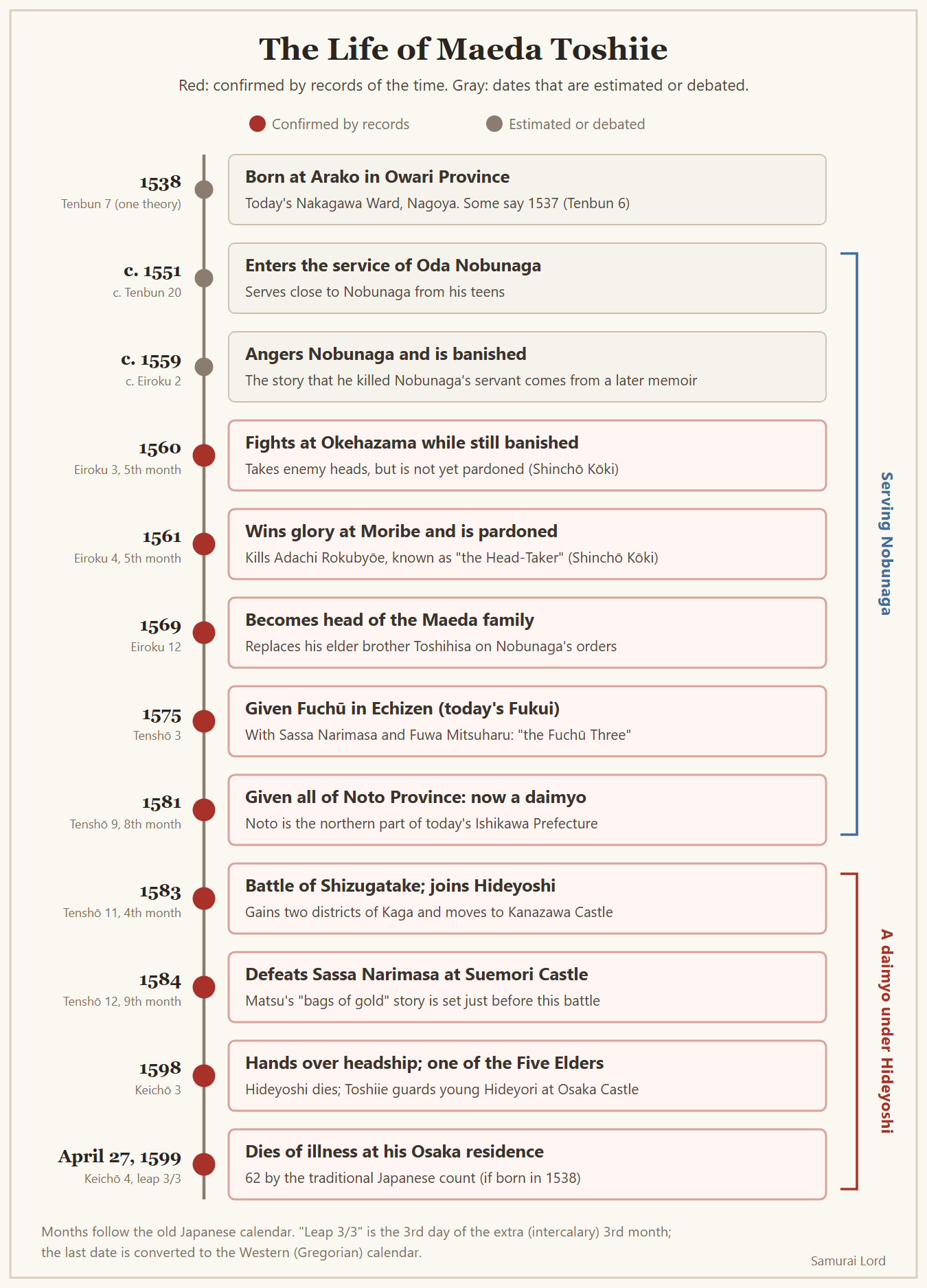
Image: Timeline of Maeda Toshiie's life (created by Samurai Lord). Tap or click the image to enlarge it
| Year | Event |
| 1538 (Tenbun 7) | Born at Arako in Owari (some say 1537) |
| c. 1551 (Tenbun 20) | Enters the service of Oda Nobunaga |
| c. 1558 (Eiroku 1) | Said to marry Matsu |
| 1559 (Eiroku 2) | Angers Nobunaga and is banished from his service |
| 1560 (Eiroku 3) | Fights at the Battle of Okehazama although still banished |
| 1561 (Eiroku 4) | Wins glory at the Battle of Moribe and is pardoned |
| 1569 (Eiroku 12) | On Nobunaga's orders, takes over the Maeda family from his elder brother Toshihisa |
| 1575 (Tenshō 3) | Given Fuchū in Echizen (today's Echizen City, Fukui) |
| 1581 (Tenshō 9) | Given the whole province of Noto and becomes a daimyo |
| 1582 (Tenshō 10) | Nobunaga dies in the Honnō-ji Incident |
| 1583 (Tenshō 11) | Battle of Shizugatake. Joins Hideyoshi, gains two districts of Kaga and moves to Kanazawa Castle |
| 1584 (Tenshō 12) | Defeats Sassa Narimasa at the Battle of Suemori Castle |
| 1593 (Bunroku 2) | Hideyoshi's son Hideyori is born; Toshiie is later made his guardian |
| 1598 (Keichō 3) | Hands over the headship to his eldest son Toshinaga. Becomes one of the Five Elders. Hideyoshi dies |
| 1599 (Keichō 4) | Dies in Osaka on April 27 (the 3rd day of the intercalary 3rd month) |
"Mataza of the Spear": Why Did Nobunaga Banish Him?
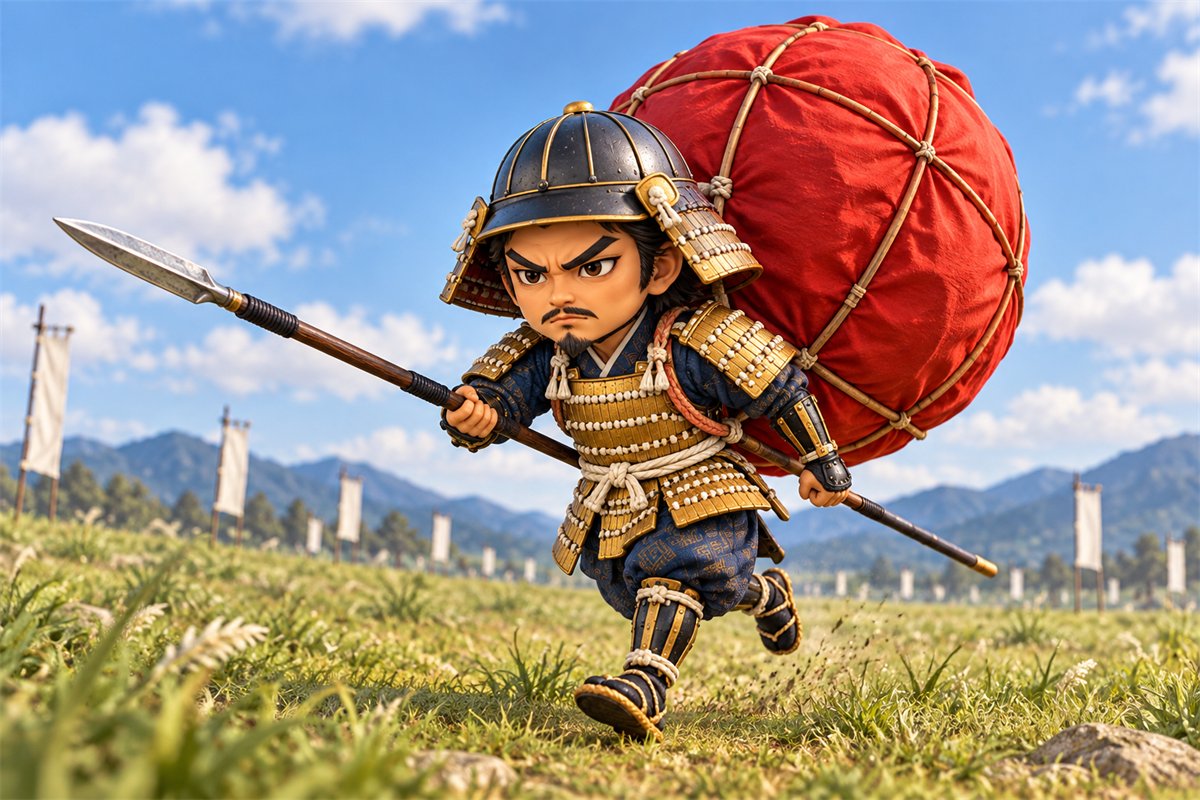
Image: The young Toshiie charging across a battlefield with a red horo on his back
Toshiie served at Nobunaga's side from his teens. He won distinction in battle with a long spear and, according to tradition, came to be called "Yari no Mataza," or "Mataza of the Spear" [Widely accepted]. "Mataza" was a shortened form of his name, Matazaemon.
Nobunaga's Red Horo Guard
Toshiie was chosen as one of the Akahoro-shū, the "Red Horo Corps," an elite group that served as Nobunaga's personal guard [Widely accepted]. A horo was a cloth stretched over a bamboo frame and worn on the back. When the rider galloped, it filled with wind and billowed out. Because it stood out so clearly, it was worn by the samurai who carried their lord's orders across the battlefield.
The year he was chosen for the Red Horo Corps is not clear from the records [Unknown].
Banished for Killing Nobunaga's Servant?
Around 1559 (Eiroku 2), Toshiie angered Nobunaga and was banished from his service. The best-known explanation is that Jūami, a man who attended to Nobunaga's personal needs, stole Toshiie's kōgai (a hair-dressing tool carried in a sword scabbard), and Toshiie, in a rage, cut him down.
But this story comes from the Ashōkō Oyawa (also known by other titles such as Toshiie Yawa), in which the retainer Murai Nagaakira wrote down what he had heard from Toshiie, and some of its dates do not fit [Legend]. The Shinchō Kōki, the chronicle of Nobunaga written by his retainer Ōta Gyūichi, says that Toshiie had fallen out of Nobunaga's favor, but does not say why.
Source Box 2: The Shinchō Kōki on Toshiie's Return
Source: Ōta Gyūichi, Shinchō Kōki, opening volume, "The Battle of Moribe" (5th month of Eiroku 4, 1561)
What it says (our translation): "At this time Maeda Matazaemon was in disfavor with the lord and did not come to serve. At the battle against Yoshimoto (Okehazama), he took one head in the morning fighting and two heads when the enemy collapsed, and presented them, but was still not called back. This time, Matazaemon was pardoned."
Our note: At Moribe, Toshiie killed a strong warrior named Adachi Rokubyōe, known as "Kubitori Adachi" (Adachi the Head-Taker). This record from his own time shows that he kept fighting without being forgiven, and was pardoned only after almost two years
Records of this period often mention taking enemy heads. That is because the head of a defeated enemy was the accepted proof of a warrior's deeds.
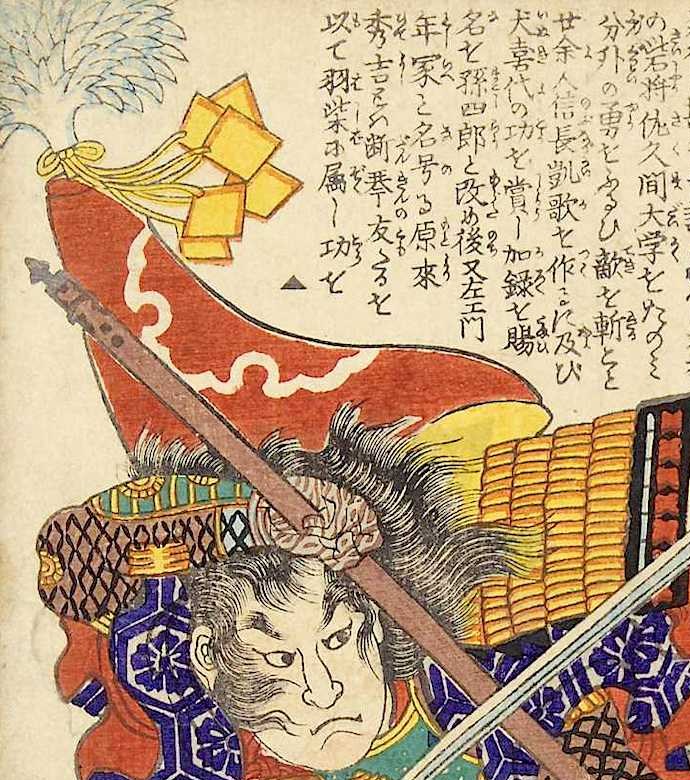
Image: Detail of Saeda Inukiyo (Maeda Toshiie) from Utagawa Yoshiiku's woodblock print series Taiheiki Eiyūden (1867), shown with a red horo on his back. Prints of this time often gave historical figures slightly altered names. Wikimedia Commons (public domain)
Taking Over the Maeda Family from His Brother
Back in Nobunaga's service, Toshiie went on to distinguish himself in battles across the country. In 1569 (Eiroku 12), Nobunaga made Toshiie head of the Maeda family in place of his elder brother Toshihisa [Fact]. The fourth (or second) son had become master of the house.
Even after being thrown out, he went into battle on his own and won glory!
Indeed. Nobunaga must have been watching a man who refused to give up.
Shibata Katsuie and the Battle of Shizugatake: Did Toshiie Betray Him?
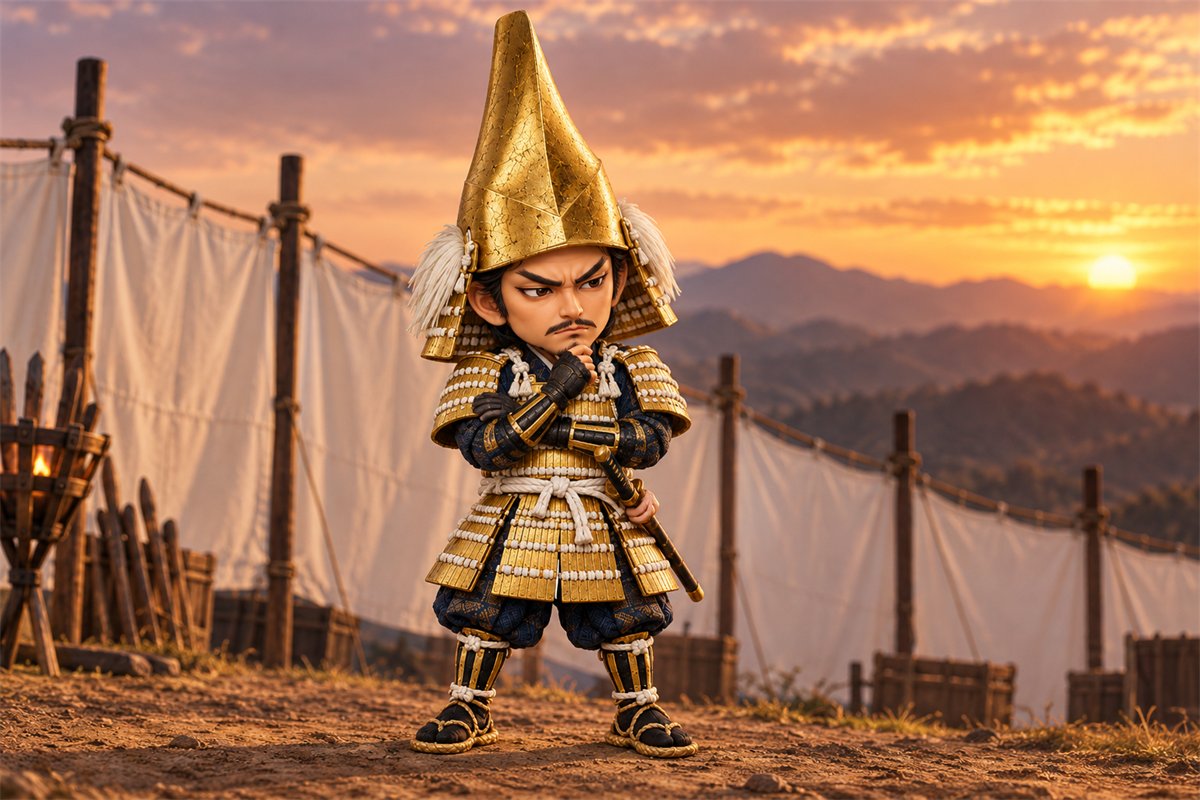
Image: Toshiie torn by doubt at the Battle of Shizugatake
In 1575 (Tenshō 3), after Nobunaga subdued Echizen (today's Fukui Prefecture), he gave Toshiie the area of Fuchū in Echizen (today's Echizen City). Together with Sassa Narimasa and Fuwa Mitsuharu, Toshiie was one of the "Fuchū Three", who fought under Shibata Katsuie, Nobunaga's commander in the north [Fact]. In 1581 (Tenshō 9) Toshiie was given the whole province of Noto and became a daimyo [Fact].
Nobunaga's Death and the Katsuie–Hideyoshi Rivalry
In 1582 (Tenshō 10), Nobunaga died in the Honnō-ji Incident [Fact]. Toshiie pulled back from the front in Etchū and put down a revolt that broke out in Noto [Fact]. For the incident itself, see our article on Akechi Mitsuhide.
After Nobunaga's death, Shibata Katsuie and Hashiba (later Toyotomi) Hideyoshi became rivals within the Oda family. Toshiie stood on the side of Katsuie, with whom he had fought in the north for years, but he had also been close to Hideyoshi since they were young. He owed something to both men, and his position was a difficult one.
Withdrawing in the Middle of the Battle
In 1583 (Tenshō 11), Katsuie and Hideyoshi clashed around Mount Shizugatake in northern Ōmi (today's Nagahama, Shiga Prefecture). This was the Battle of Shizugatake. In the middle of the battle, Toshiie's troops, who were on Katsuie's side, left the field without fighting [Fact]. This is thought to have been a major trigger for the collapse of Katsuie's army [Widely accepted].
Whether it was a "betrayal" agreed with Hideyoshi in advance, or a withdrawal by a man who could not take either side, is not clear [Debated]. For the course of the battle, see the Battle of Shizugatake section of our article on Shibata Katsuie.
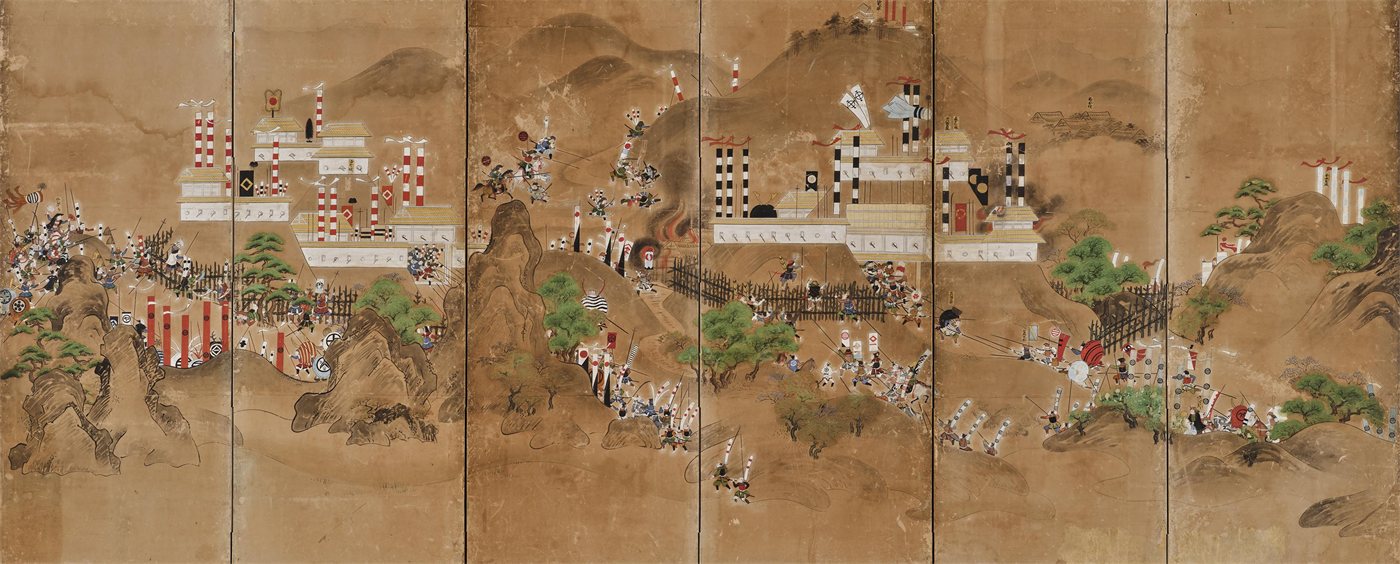
Image: Folding screen of the Battle of Shizugatake (painted in the Edo period). Wikimedia Commons (public domain). Tap or click the image to enlarge it
After the battle, Toshiie followed Hideyoshi and is said to have joined the attack on Katsuie's Kitanoshō Castle (in today's Fukui City) [Widely accepted]. Hideyoshi rewarded him with two districts of Kaga, and Toshiie moved his base from Noto to Kanazawa Castle in Kaga [Fact].
Toshiie and Toyotomi Hideyoshi: From Old Friends to the Five Elders
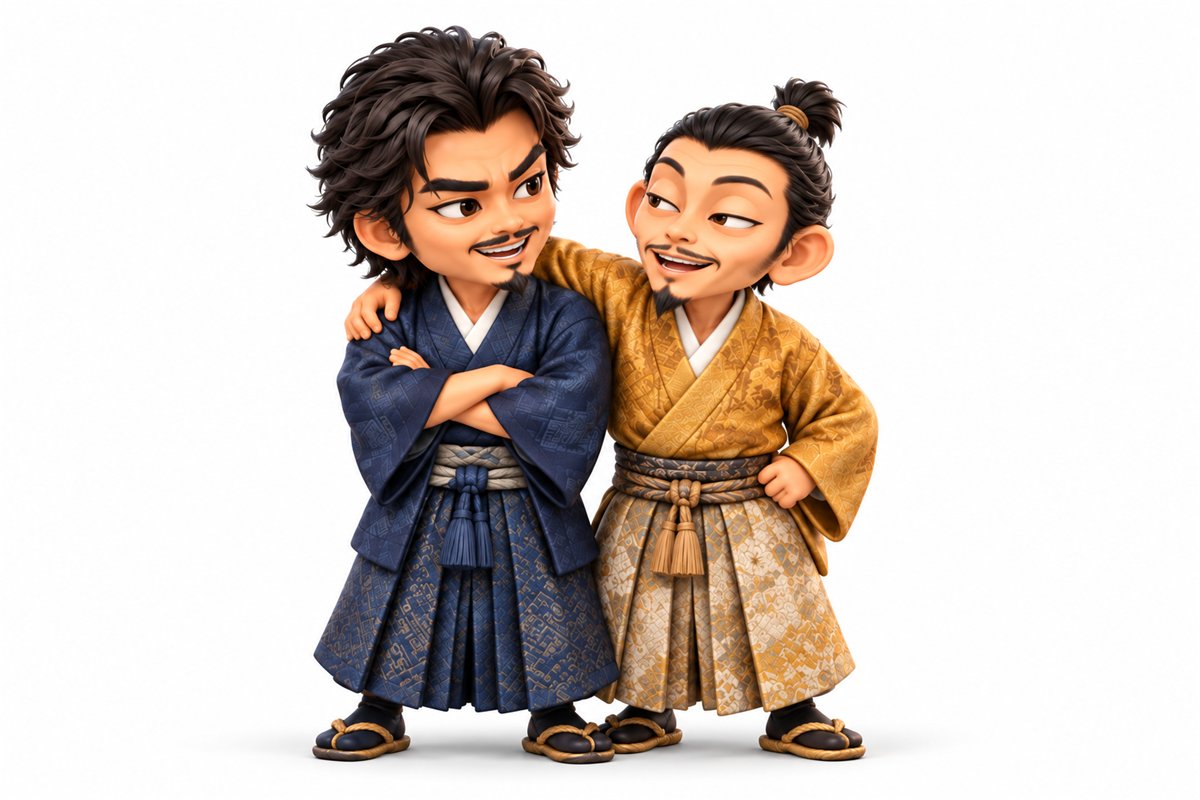
Image: Toshiie and Hideyoshi, friends since their youth
Toshiie and Hideyoshi had served Nobunaga together since they were young and are said to have been very close [Widely accepted]. Toshiie's daughter Gōhime was adopted by Hideyoshi, and another daughter, Maahime, became one of Hideyoshi's concubines, so the two families were closely tied as well [Widely accepted]. For more on Hideyoshi, see our article on Toyotomi Hideyoshi.
Supporting Hideyoshi's Unification of Japan
Under Hideyoshi, Toshiie's job was to hold the northern provinces. When Hideyoshi forced Sassa Narimasa of Etchū to surrender in 1585 (Tenshō 13), Toshiie's eldest son Toshinaga was given three districts of Etchū [Fact]. Toshiie also took part in Hideyoshi's great campaigns, including the siege of Odawara in 1590 (Tenshō 18) and the invasions of Korea from 1592 (Bunroku 1), when he was stationed at Nagoya Castle in Hizen, northern Kyushu (not today's city of Nagoya) [Fact].
What Were the Five Elders?
In his last years, worried about his young son Hideyori, Hideyoshi entrusted the government of the Toyotomi family to five powerful daimyo. They were the Five Elders (Go-Tairō) [Fact].
- Tokugawa Ieyasu, Maeda Toshiie, Mōri Terumoto, Ukita Hideie and Uesugi Kagekatsu
After Hideyori was born in 1593 (Bunroku 2), Toshiie was also made his moriyaku, or guardian [Widely accepted]. Among the Five Elders, he is thought to have held an especially weighty position, on a par with Ieyasu [Widely accepted].
When Hideyoshi died in the 8th month of Keichō 3 (September 1598), Toshiie moved into Osaka Castle to protect Hideyori. But the very next year, Toshiie himself died of illness.
Hideyoshi and Toshiie really were good friends, weren't they?
Entrusting your child to a friend of many years. We can see how much Hideyoshi relied on him.
What Was "Kaga Hyakumangoku," the Million-Koku Domain?
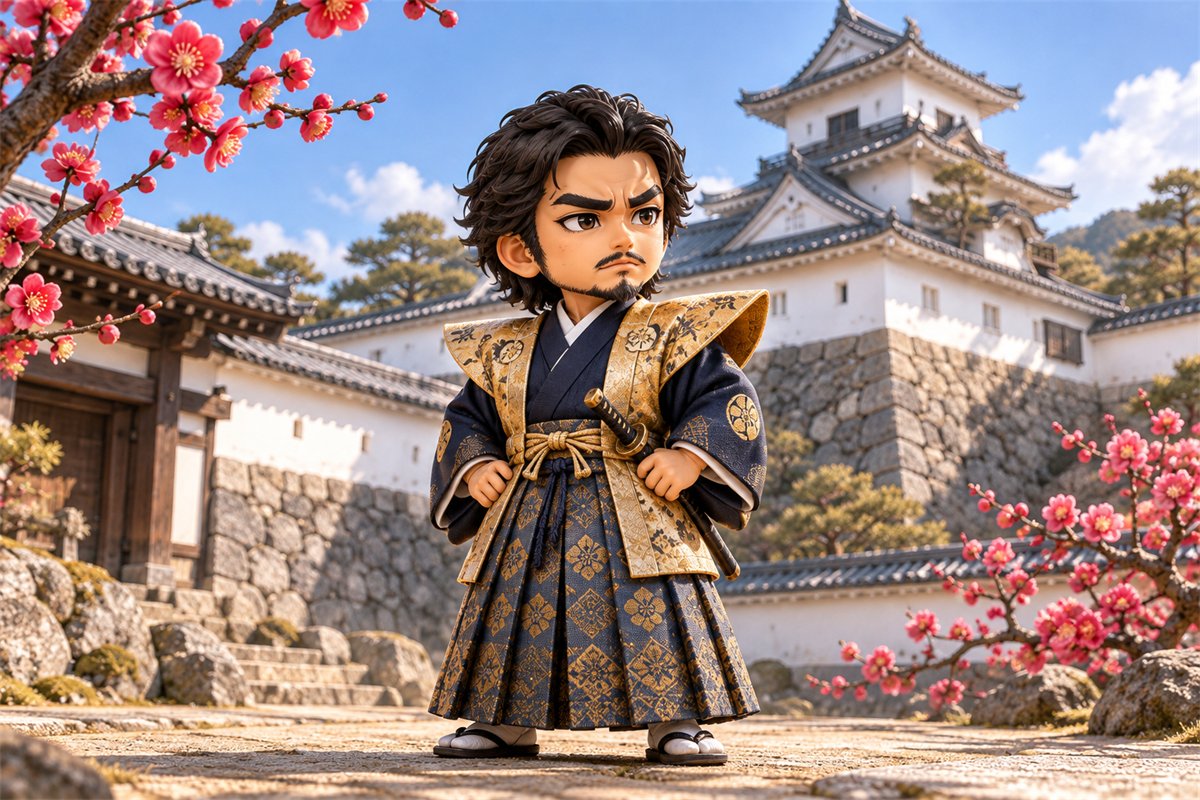
Image: Toshiie after he moved to Kanazawa Castle
Kaga Hyakumangoku ("Kaga, one million koku") describes the fact that in the Edo period, the assessed yield (kokudaka) of the Kaga domain, ruled by the Maeda family, exceeded one million koku, the largest of any daimyo's domain [Fact]. The assessed yield expressed how much a piece of land could produce, converted into an amount of rice.
A koku is a unit of volume for rice, about 180 liters. It is often described as "the amount of rice one adult eats in a year," but that is only a rough way to imagine the quantity. Also, the assessed yield was not the amount of rice actually harvested.
How Large Were Toshiie's Lands?
The lands Toshiie ruled grew like this:
- 1575: Fuchū in Echizen (shared with two other commanders)
- 1581: The whole province of Noto (the north of today's Ishikawa Prefecture)
- 1583: Adds the Ishikawa and Kahoku districts of Kaga (around today's Kanazawa) and moves to Kanazawa Castle
- 1585: His eldest son Toshinaga is given three districts of Etchū (today's Toyama Prefecture)
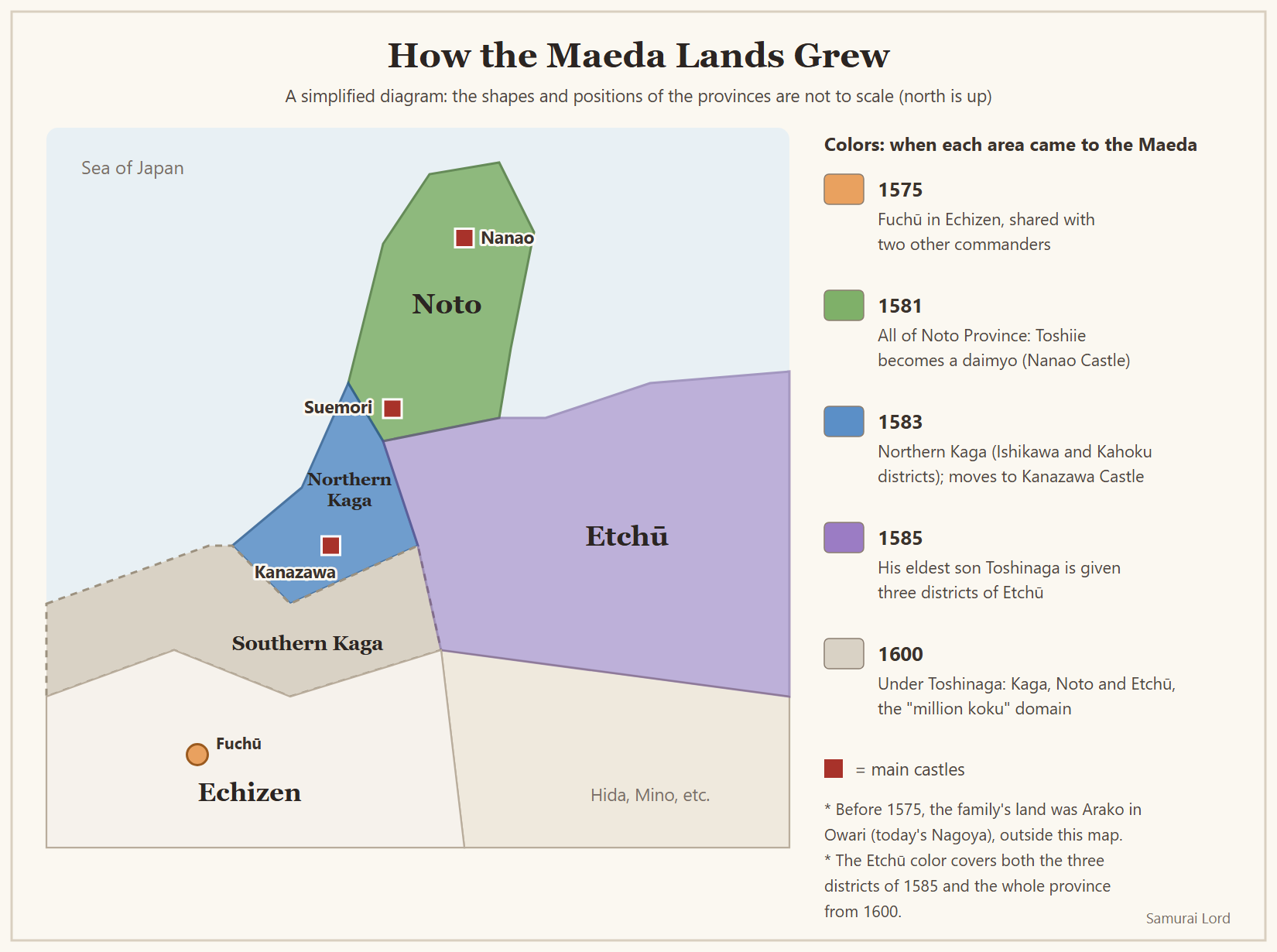
Image: How the Maeda lands grew (simplified diagram created by Samurai Lord). Tap or click the image to enlarge it
In other words, in Toshiie's time the Maeda family did not yet hold all of Kaga. The family reached the "million koku" size, ruling the three provinces of Kaga, Noto and Etchū, only under his son Toshinaga, after Toshiie's death, when Toshinaga sided with the Tokugawa at the Battle of Sekigahara (1600) [Fact].
Still, it was Toshiie who won a foothold in Noto and Kaga and chose Kanazawa Castle as the family's base. That is why he is called "the founder of Kaga Hyakumangoku".
The Battle of Suemori Castle
The battle that secured the Maeda hold on Kaga and Noto was the Battle of Suemori Castle in the 9th month of Tenshō 12 (autumn 1584). Sassa Narimasa of Etchū attacked Suemori Castle, which stood between Kaga and Noto, with a large army, trying to cut the Maeda lands in two. Toshiie rushed from Kanazawa and relieved the castle [Fact]. Matsu's "bags of gold" story is said to have taken place just before this battle.
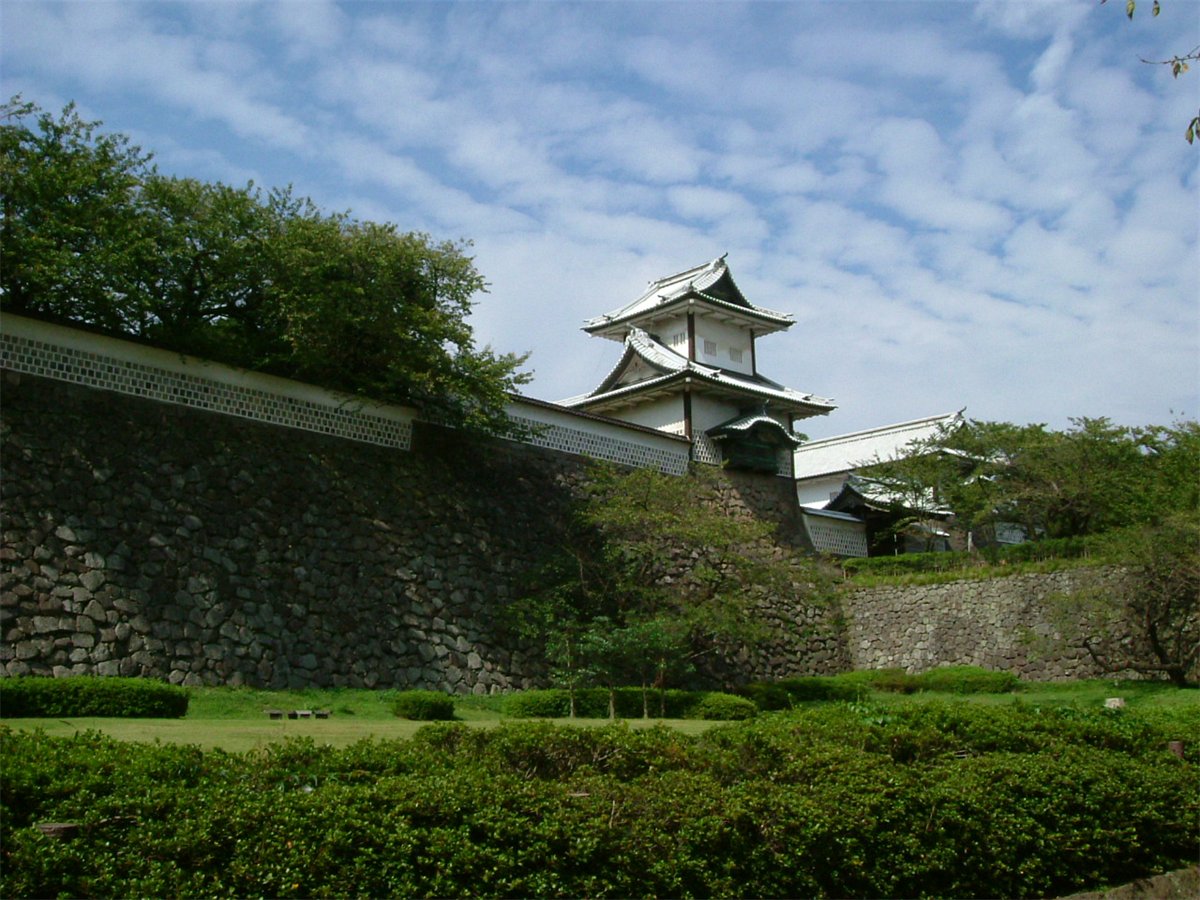
Image: The Ishikawa Gate of Kanazawa Castle (Kanazawa). The present gate was rebuilt in 1788 (Tenmei 8). Wikimedia Commons (photo by Yusuke.ogawa, public domain)
Maeda Toshiie's Helmet, Spear and Family Crest
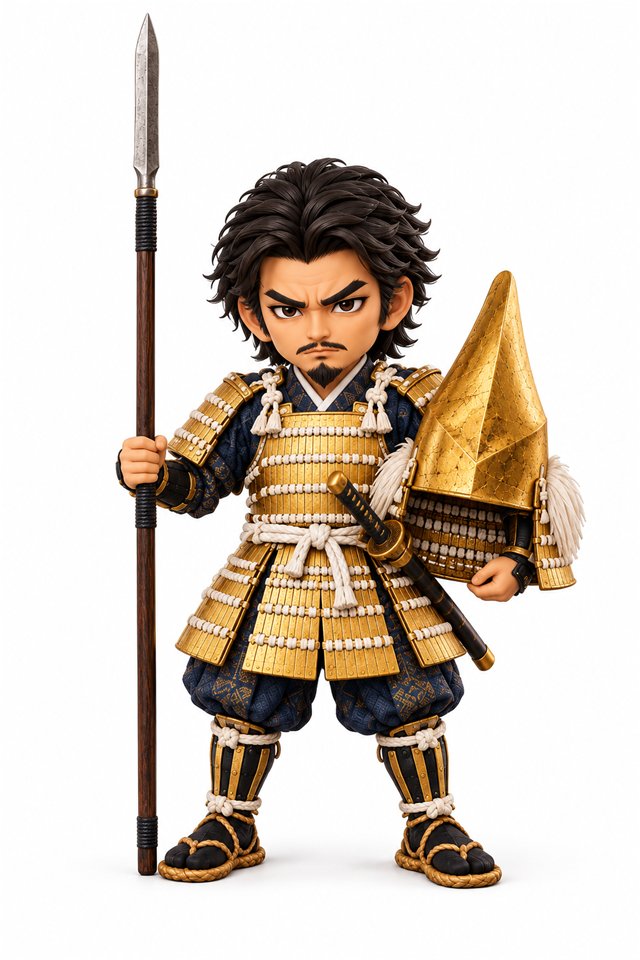
Image: Toshiie holding his golden helmet
The Tall Golden Helmet
Toshiie's best-known helmet is a gleaming golden one, tall and pointed, in the shape called naga-eboshi-nari ("tall court-cap shape"). The armor that goes with it, the Kin Kozane Shiroito Sugake Odoshi Dōmaru Gusoku (gold-lacquered scale armor laced with white silk cord), belongs to the Maeda Ikutokukai foundation and is a national Important Cultural Property [Fact]. The helmet is 68.5 centimeters (about 27 inches) tall [Fact].
According to a note of its history kept with the armor box, Toshiie gave this armor to his retainer Okumura Nagatomi as a reward for the Battle of Suemori Castle [Widely accepted]. It was later returned from the Okumura family to the Maeda family.
The Spear of "Mataza of the Spear"
As his nickname suggests, Toshiie was a master of the long spear [Widely accepted]. However, the length or name of the spear he used cannot be confirmed from records of his own time [Unknown].
The Maeda Crest: Kaga Umebachi

Image: Kaga Umebachi. Wikimedia Commons (by Mukai, CC BY-SA 3.0)
The Maeda family crest is the umebachi, a design based on the plum blossom. The version known as the Maeda crest is the "Kaga Umebachi," in which the stamens at the center of the flower are shaped like swords [Widely accepted]. However, it is difficult to confirm from records of his own time exactly what form of the crest Toshiie himself used [Unknown].
The umebachi is closely associated with Sugawara no Michizane, the ninth-century scholar who is worshipped as the god of learning, and the Maeda family claimed to be his descendants. But the family is said to have originally claimed descent from the Fujiwara clan, and it seems to have stressed its descent from Michizane only from the time of Toshiie's son Toshitsune, around the end of the Kan'ei era (the early 1640s) [Widely accepted]. Whether the family was really related to Michizane by blood cannot be confirmed [Unknown].
What Was Toshiie Like? The Abacus and the Devoted Husband
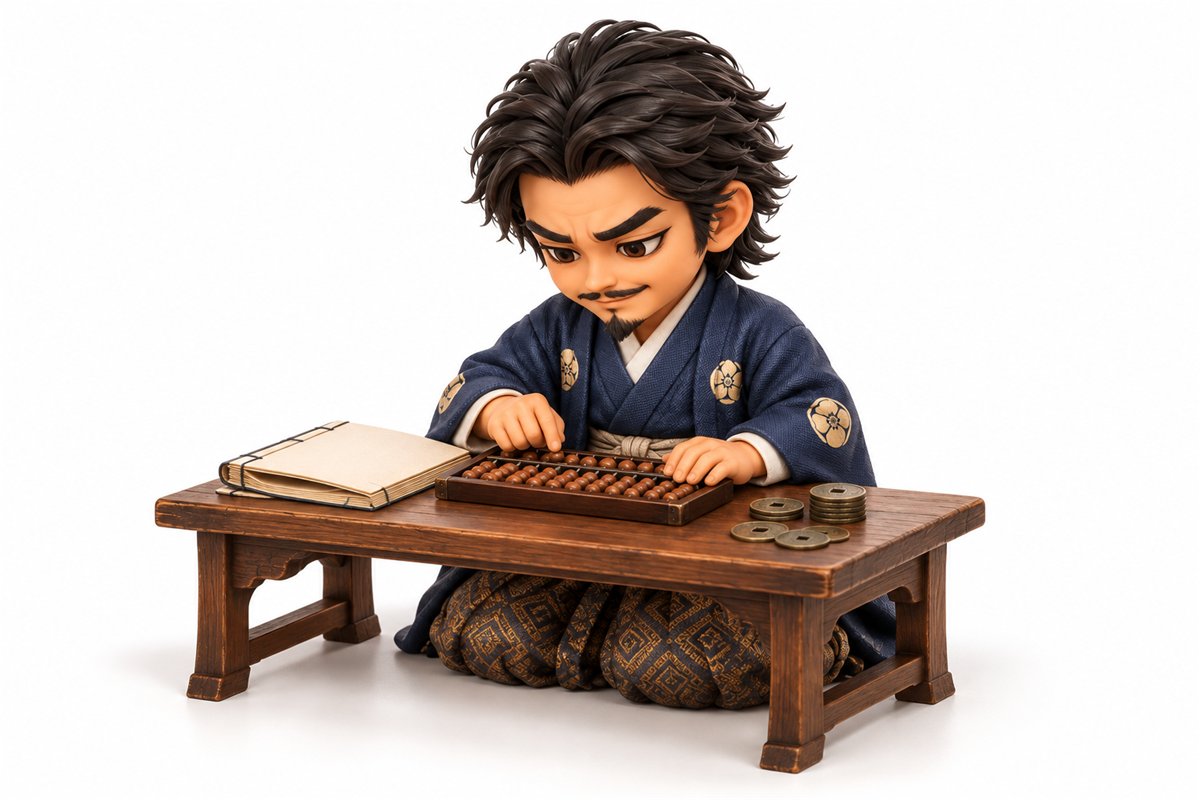
Image: Toshiie working an abacus
A Warlord Who Used an Abacus
Toshiie is said to have been careful with money. The Maeda Ikutokukai foundation owns an abacus (soroban) said to have been used by him, known as "Kōtokukō's Abacus (used by Maeda Toshiie)" [Fact]. "Kōtokukō" is a name for Toshiie. It is said to have been used at Nagoya in Kyushu during the invasions of Korea [Legend].
For a daimyo, being able to count soldiers, supplies and money accurately was as important as fighting. Perhaps Matsu's "bags of gold" story grew out of Toshiie's reputation for keeping a close eye on his money.
Toshiie and Matsu: A Strong Bond
If they married in 1558, as one account states, their marriage lasted about forty-one years. A record called the Kōtokukō Ikaishō says that on the 21st day of the 3rd month of Keichō 4, shortly before his death, Toshiie had Matsu write down his will [Legend]. The story suggests the deep trust between the two.
A Respected Elder in His Last Years
There are also stories that in his youth he wore flashy clothes and behaved outrageously [Legend]. People like this were called kabukimono, eccentrics who drew attention with showy looks and unconventional behavior. In his later years, on the other hand, Toshiie is described as calm and good-natured, a man many daimyo relied on [Widely accepted]. His effort to settle his dispute with Ieyasu through talks is one sign of this.
A master of the spear, good with numbers, and a loving husband. He had so many good points!
Perhaps he learned from the mistakes of his youth.
Places Connected with Maeda Toshiie, and His Grave
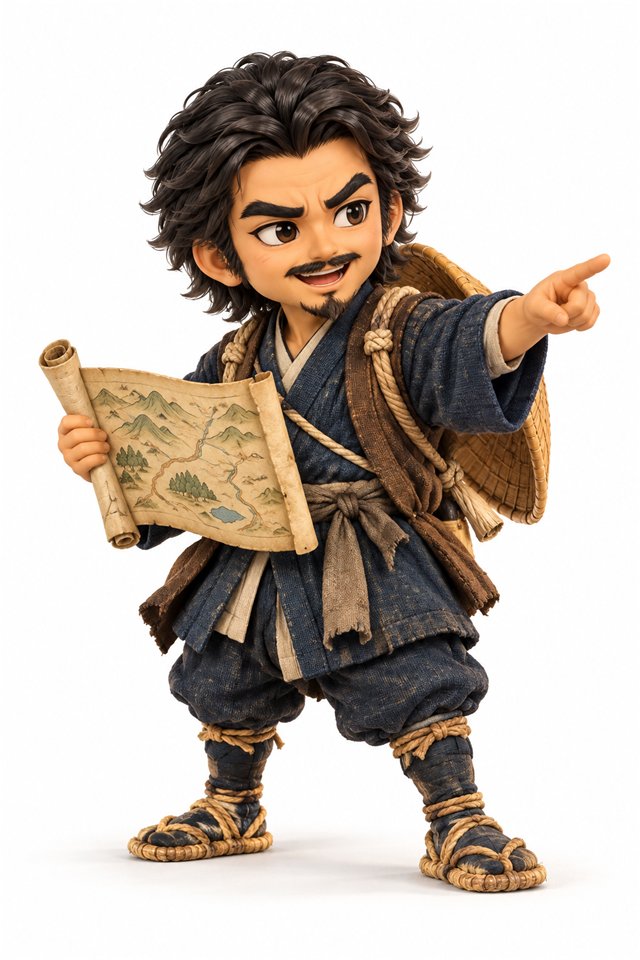
Image: A journey to places connected with Toshiie
| Place | What it is | Location |
| Arako Castle site (Fuji Gongen Tenmangū) | The site of Arako Castle, traditionally associated with Toshiie's birth. A stone monument marks his birthplace | Nakagawa Ward, Nagoya, Aichi |
| Kanazawa Castle | The castle Toshiie made his base, now Kanazawa Castle Park | Kanazawa, Ishikawa |
| Oyama Shrine | A shrine dedicated to Toshiie, founded in 1873 (Meiji 6). Since 1998, Matsu has been enshrined there too | Kanazawa, Ishikawa |
| Nodayama Cemetery (graves of the Maeda lords of Kaga) | The Maeda family cemetery, with the graves of Toshiie and Matsu | Kanazawa, Ishikawa |
| Suemori Castle site | The scene of the Battle of Suemori Castle | Hōdatsushimizu, Hakui District, Ishikawa |
| Sōji-ji Temple | The temple that owns Matsu's portrait, the "Portrait of the Wife of Maeda Toshiie" | Yokohama, Kanagawa |
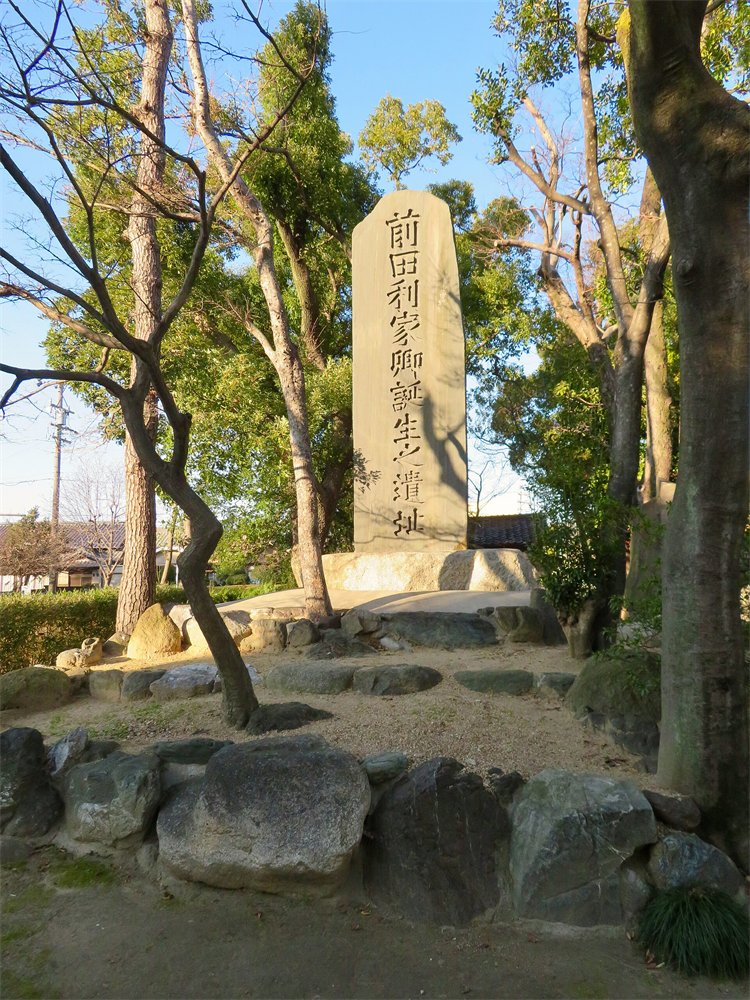
Image: The monument to Maeda Toshiie's birthplace at the Arako Castle site (Fuji Gongen Tenmangū, Nakagawa Ward, Nagoya). Wikimedia Commons (photo by KKPCW, CC BY-SA 4.0)
Image: The gate of Oyama Shrine (Kanazawa). The windows at the very top have stained glass. Wikimedia Commons (photo by cattan2011, CC BY 2.0)
Frequently Asked Questions (FAQ)
How big was the age gap between Toshiie and Matsu?
Nine years, if Toshiie was born in 1538 (Tenbun 7) and Matsu in 1547 (Tenbun 16). If Toshiie was born in 1537 (Tenbun 6), the gap was ten years.
Whom did Maeda Toshiie kill?
The Shinchō Kōki records that at the Battle of Moribe he killed Adachi Rokubyōe, a warrior known as "Adachi the Head-Taker." There is also a story that he cut down Jūami, a man who attended to Nobunaga's personal needs, but that story comes from a memoir written down later.
How tall was Maeda Toshiie?
We do not know. A claim that he was six shaku tall (about 182 cm, or 6 feet) is widespread, but we found no basis for it in the records we checked.
Is Maeda Toshiie in Shōgun?
Not by name. Shōgun (James Clavell's novel and its TV adaptations) gives its characters fictional names, and its story begins in 1600, the year after Toshiie died. Its Council of Regents, however, echoes Hideyoshi's real Council of Five Elders, in which Toshiie and Tokugawa Ieyasu were the two leading members. Toshiie's death in 1599 was one of the events that opened the way for Ieyasu's rise.
Is the Maeda Toshiie of video games historically accurate?
Toshiie appears in game series such as Samurai Warriors and Sengoku Basara, sometimes as Shibata Katsuie's young protégé and sometimes as a comic, devoted husband to Matsu. These are fictional characters loosely based on history. His closeness to Katsuie and Hideyoshi and his reputation as a spearman have a basis in the records, but most of the personalities and dialogue are invented.
Did Maeda Toshiie leave any famous words?
Several sayings are attributed to him, but most come from notes his retainers wrote down from memory or from books of later times. Sayings that cannot be confirmed as his own words are not presented here as verified quotations.
Why was his childhood name "Inuchiyo"?
Inuchiyo was Toshiie's childhood name. It combines inu (dog) and chiyo (a thousand generations, a wish for a long life). In the past, children were sometimes given names of strong or familiar animals in the hope that they would grow up healthy. But no record explains why Toshiie in particular was named Inuchiyo.
Are there descendants of Maeda Toshiie today?
Toshiie's house continued as the ruling Maeda family of the Kaga domain until the end of the Edo period, and in the Meiji era its head became a marquis (a rank of the new nobility). The family's treasures and old books are still cared for by a foundation, the Maeda Ikutokukai. Toshiie's daughters also married into many daimyo families, so his bloodline spread to other houses as well. But whether a particular person is his descendant can only be known by tracing the family line step by step.
Where did Maeda Toshiie die?
At the Maeda residence in Osaka. His grave is at Nodayama in Kanazawa, his home base.
Summary: Who Was Maeda Toshiie?
Maeda Toshiie was a warrior who made his name as a spearman in Nobunaga's service, was banished but won his way back through his deeds, became the daimyo of Noto, and after Nobunaga's death helped Hideyoshi unify Japan, ending his life as one of the Five Elders.
After his death, his wife Matsu and his son Toshinaga avoided war with Ieyasu, and the Maeda family survived through the whole Edo period as the lords of the million-koku Kaga domain. Toshiie laid the foundations, and his family protected them and built on them.
For more on the lord he served first, see our article on Oda Nobunaga; for his close friend, see our article on Toyotomi Hideyoshi; and for the commander he parted from at Shizugatake, see our article on Shibata Katsuie.
Strength in battle, ties with other people, and the support of his family. With all three, he built the foundations of a million-koku domain.
Now I want to know even more about Matsu!
Sources & How This Article Was Written
This article is based mainly on the following records and references:
- Records from Toshiie's time: Ōta Gyūichi, Shinchō Kōki (available in English as The Chronicle of Lord Nobunaga, translated by J. S. A. Elisonas and J. P. Lamers, Brill, 2011)
- Later records and compilations: Kawasumi Taikōki; Ashōkō Oyawa (also called Toshiie Yawa; Murai Nagaakira's notes of what he heard from Toshiie); Kōtokukō Ikaishō (高徳公遺誡鈔); Heki Ken, Maeda Seikei (a modern compilation)
- Studies and references (in Japanese): 池田仁子 (Ikeda), "近世初期加賀藩藩主前田家の病と治療・医家" (Kenkyū Kiyō Kanazawa-jō Kenkyū, no. 14, 2016); Iwasawa Yoshihiko, Maeda Toshiie (Yoshikawa Kōbunkan); Kotobank (Nihon Daihyakka Zensho and other encyclopedias); explanations by Oyama Shrine, the Maeda Tosa-no-kami Family Museum, the Yonezawa City Library and the Agency for Cultural Affairs' database of designated cultural properties
- Images: the portrait of Maeda Toshiie, the "Portrait of the Wife of Maeda Toshiie," the portrait of Maeda Toshinaga, the folding screen of the Battle of Shizugatake, the two woodblock prints by Utagawa Yoshiiku and the photo of the Ishikawa Gate are public-domain images from Wikimedia Commons. The photo of the Arako Castle site (KKPCW, CC BY-SA 4.0), the photo of Oyama Shrine (cattan2011, CC BY 2.0) and the Kaga Umebachi crest (Mukai, CC BY-SA 3.0) are also from Wikimedia Commons. The timeline, family tree, map, illustrations and manga panel are original to Samurai Lord
What the Labels Mean
[Fact]Confirmed by sources from Toshiie's own time ([Fact: …]names the source)[Widely accepted]The view held by most historians ([Widely accepted: …]names the source)[Debated]Historians disagree[Unknown]Not established from the sources we checked[Legend][Folk belief]Stories created later, or popular claims with little evidence
This article was written by the Samurai Lord editorial team and is revised as new research and reader feedback come in. If you spot an error, please let us know through our contact form (in Japanese) and we will check and correct it.
Read in Japanese
This article is also available in Japanese: 前田利家とは何をした人?死因は?まつとの関係や加賀百万石への道を解説