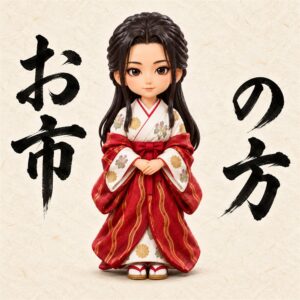
Image: An illustration of Shibata Katsuie. All illustrations in this article are creative works based on the records and portraits; faces, clothing and settings are imagined.
Shibata Katsuie (c. 1522–1583) was one of the leading generals of Oda Nobunaga, the warlord who came close to uniting Japan in the sixteenth century. As a young man he fought against Nobunaga for Nobunaga's younger brother. Pardoned, he became one of Nobunaga's most trusted commanders and was put in charge of the conquest of the northern provinces from Kitanoshō Castle in Echizen (today's Fukui). After Nobunaga's death in 1582 he clashed with Toyotomi (then Hashiba) Hideyoshi, lost the Battle of Shizugatake in 1583, and died at Kitanoshō with his wife Oichi, Nobunaga's sister.
He is remembered as "Oni Shibata," Shibata the Demon, a fierce and fearless warrior. But much of that image comes from books written long after his death. This article sets out what records from his own time say, what later books added, and what remains unknown.
Key points are tagged: [Fact] confirmed by records from Katsuie's own time, [Widely accepted] held by most historians, [Debated] historians disagree, [Unknown] not known from any source, and [Legend] or [Folk belief] for later stories and popular claims. A tag like [Fact: Shinchō Kōki] names the record.
.jpg)
I am Uesugi Kenshin. Today's subject was one of Nobunaga's fiercest generals. I faced him myself in the north.
.jpg)
I'm Date Masamune! All I know about Shibata Katsuie is that he lost to Hideyoshi...
.jpg)
Then let us see what he did before that defeat. It changes the picture.
The Short Answers
- Who was he? One of Oda Nobunaga's top generals, who governed Echizen and led the conquest of the northern provinces. After Nobunaga's death he fought Hideyoshi for the leading position in the Oda family
[Fact](more) - How did he die? On June 14, 1583, he took his own life at Kitanoshō Castle (Fukui) as Hideyoshi's army stormed it, and his wife Oichi died with him
[Fact]. He is said to have been 62 by the traditional Japanese count, but his birth year is uncertain (more) - Why did he lose? Hideyoshi outmaneuvered him after the Kiyosu Conference. At Shizugatake, the force of his nephew Sakuma Morimasa was beaten and Maeda Toshiie's troops left the field
[Fact]. Together, these are thought to have caused the collapse of his army[Widely accepted](more) - Was he married to Oichi? Yes. Nobunaga's sister Oichi became his wife in 1582, after Nobunaga's death
[Fact](more)
Jump to the part you want to read:
- Who was Shibata Katsuie? Quick profile
- How did Katsuie die? The fall of Kitanoshō Castle
- The rivalry with Hideyoshi and the Battle of Shizugatake
- Katsuie and Oichi
- Katsuie's life and achievements
- Family crest and portrait
- Children and descendants
Who Was Shibata Katsuie? Quick Profile
In a nutshell, Katsuie was "Nobunaga's senior general in the north, who fought Hideyoshi for the leadership of the Oda family after Nobunaga's death and lost".
A few terms come up often in this article:
- The Sengoku period: Japan's "Warring States" era, from the late fifteenth to the late sixteenth century, when regional lords (daimyo) fought for power
- Oda Nobunaga (1534–1582): the warlord Katsuie served, who brought much of central Japan under his control before he was killed at Honnō-ji in 1582
- Toyotomi Hideyoshi (1537–1598): Katsuie's fellow general and later rival, who took over Nobunaga's power and unified Japan. He was called Hashiba Hideyoshi in 1582–83
- Echizen: a province on the Sea of Japan coast, today the northern part of Fukui Prefecture. Katsuie's castle, Kitanoshō, stood in today's city of Fukui
| Item | Details | Reliability |
| Name | Shibata Katsuie. Common name Gonroku; later titled Shuri-no-suke, so he was also called "Shuri" | [Fact] |
| Born | Usually given as 1522 (Daiei 2); 1526 and 1527 have also been suggested | [Debated] |
| Birthplace | Kamiyashiro Village in Owari Province (today's Meitō Ward, Nagoya), according to the Edo-period gazetteer Chōshū Fushi | [Legend] |
| Parents | His father is said to be Shibata Katsuyoshi, but no reliable record confirms it; his mother is unknown | [Unknown] |
| Lords served | Chief retainer of Nobunaga's younger brother, Oda Nobukatsu (Nobuyuki); later a retainer of Oda Nobunaga | [Fact] |
| Castle | Kitanoshō Castle in Echizen (today's Fukui), built from 1575 | [Fact] |
| Wife | Oichi, Nobunaga's sister, married in 1582. Any earlier wife is unknown | [Fact] |
| Children | Whether he had children of his own is unclear. He adopted nephews such as Katsutoyo and Katsumasa | [Debated] |
| Died | June 14, 1583 (Tenshō 11, 4th month, 24th day), at Kitanoshō Castle | [Fact] |
| Cause of death | Ritual suicide (seppuku) as the castle fell | [Fact] |
| Age at death | Said to be 62 by the traditional Japanese count (or 57 or 58, depending on his birth year) | [Debated] |
| Family crest | Futatsu Karigane ("two wild geese") | [Widely accepted] |
| Grave | Saikō-ji Temple in Fukui, among other places | — |
How Did Shibata Katsuie Die? The Fall of Kitanoshō Castle
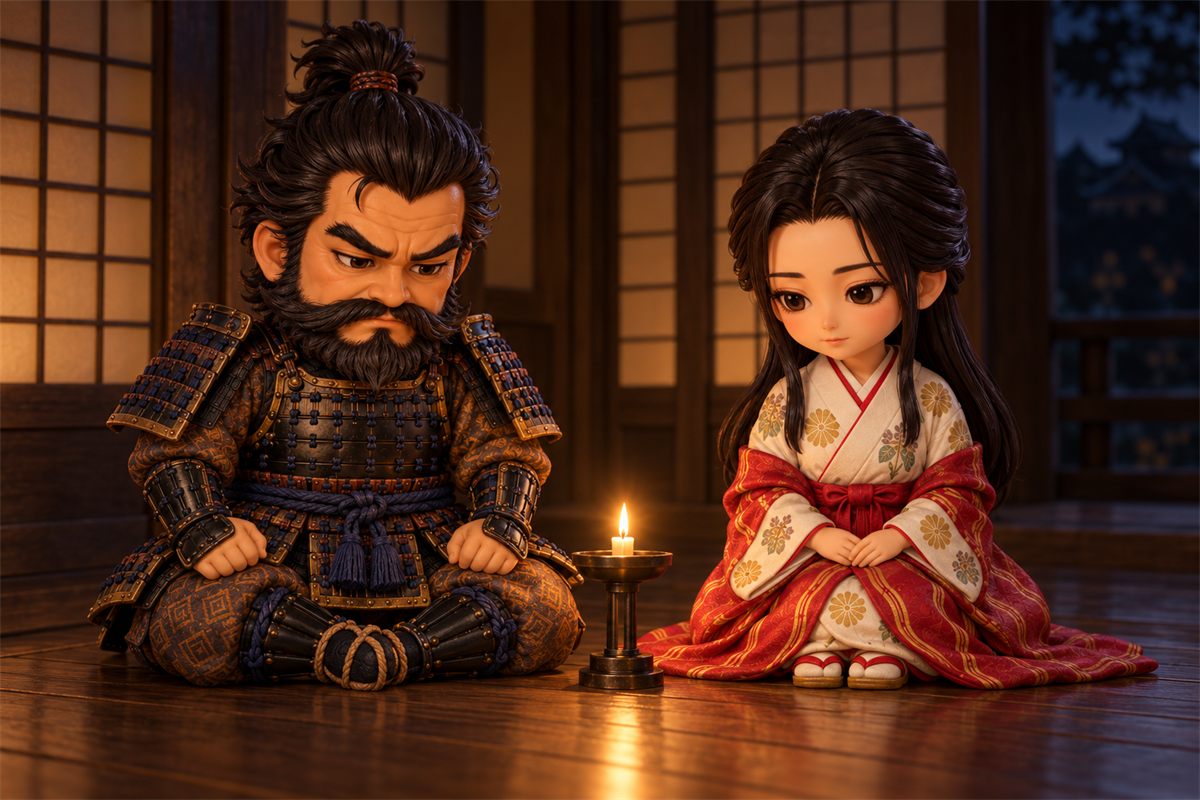
Image: An imagined scene of Katsuie and Oichi on the last night at Kitanoshō Castle. Faces, clothing and the room are imagined.
Shibata Katsuie died on June 14, 1583 (the 24th day of the 4th month of Tenshō 11 in the Japanese calendar), at Kitanoshō Castle in Echizen, in today's city of Fukui. Defeated by Hideyoshi at Shizugatake in Ōmi Province (Shiga), he fled back to his castle, where Hideyoshi's army surrounded him. He died there together with his wife, Oichi [Fact].
From Shizugatake back to Kitanoshō
Beaten at Shizugatake on June 11, 1583 (the 21st day of the 4th month), Katsuie retreated north into Echizen and shut himself up in Kitanoshō Castle [Fact]. The battle itself is described in the Shizugatake section below.
On the way, he is said to have stopped at Fuchū Castle (in today's Echizen City), held by the Maeda family, and exchanged farewells with Maeda Toshiie [Legend]. On the 23rd day, Hideyoshi's army surrounded Kitanoshō [Fact].
The last night
With the castle surrounded, Katsuie is said to have held a last banquet with the members of his family and the retainers who remained, to say farewell [Widely accepted: Shibata Taijiki]. The story comes from the Shibata Taijiki, written the same year by Ōmura Yūko, a writer in Hideyoshi's service.
The reports of the Jesuit missionary Luís Fróis add that Katsuie did not blame the retainers who had deserted him, and urged those who had stayed to the end to save their own lives [Widely accepted: Fróis's reports]. Fróis had met Katsuie in person, but he did not witness this scene himself.
Oichi's three daughters, Chacha, Hatsu and Gō, were sent out of the castle before it fell [Widely accepted]. What became of them is told in our article on Oichi.
What Hideyoshi's letter says
One of the detailed accounts of Katsuie's death written at the time comes from the victor himself. In a letter to Kobayakawa Takakage of the Mōri family, dated the 15th day of the 5th month of Tenshō 11 (1583), Hideyoshi described the fall of Kitanoshō like this [Fact: Mōri family documents].
Source Box 1: Hideyoshi on Katsuie's last stand
Source: letter of Hashiba Hideyoshi to Kobayakawa Takakage, 15th day of the 5th month of Tenshō 11 (1583), in the Mōri family documents
Summary: We attacked the main castle from dawn on the 24th and broke in by midday. Katsuie and some two hundred men held out in the keep. Katsuie, too, charged out and fought seven times, but could not hold. He climbed to the "ninth story" of the keep and called out to everyone around
Katsuie's words (our rendering): "Watch how Shuri cuts open his belly, and learn from it for the future."
Then (summary): Katsuie stabbed his wife and children, then cut his belly together with some eighty men. The letter does not say who the children were; Oichi's three daughters had been sent out of the castle
What it tells us: this letter was written by the winner to tell another lord of his victory. By making Katsuie's end heroic, Hideyoshi also made his own victory look greater. Even the "ninth story" may not be an exact description of the keep
Kitanoshō Castle was built by Katsuie from 1575 as his base in the north. Hideyoshi's letter suggests it had a very tall keep, but excavations have not found the keep itself, and what it really looked like is unknown [Unknown].
.jpg)
So the winner, Hideyoshi, wrote a detailed account of the loser's death!
The stronger the enemy, the greater the victory looks. Reading a source means thinking about why it was written.
What was the cause of his death, and how old was he?
Katsuie died by seppuku (ritual suicide) as his castle fell [Fact]. The Shibata Taijiki says he cut his belly from the left side to the right and then down from below his chest to his navel, and had his retainer Nakamura Bunkasai strike off his head to end his suffering [Widely accepted: Shibata Taijiki]. Since this was written by a man in Hideyoshi's service, it may dramatize his end.
If he was born in 1522, he was 62 by the traditional Japanese way of counting age. Other theories give 57 or 58, and because his birth year is uncertain, his exact age is not known [Debated].
Katsuie's death poem
Source Box 2: Katsuie's death poem
Source: Ōmura Yūko, Shibata Taijiki (also called Shibata Kassenki; written in 1583), and other accounts
The poem: Natsu no yo no / yumeji hakanaki / ato no na wo / kumoi ni ageyo / yama hototogisu
Our translation: My life was brief as a dream on a summer night; mountain cuckoo, carry my name up to the clouds.
What it tells us: the castle fell in early summer by the old calendar, when the hototogisu (lesser cuckoo) sings. Oichi is also said to have left a death poem with "summer night" and "cuckoo," so the two poems answer each other
There is no way to prove that they really wrote these poems, but the fact that they appear in a record written the same year is an important clue [Widely accepted]. Oichi's poem is in our article on Oichi.
How much of the story is certain?
Here are the stories about Katsuie's death, sorted by where they come from.
| Story | Source | Our verdict |
| Kitanoshō fell and Katsuie committed seppuku | Hideyoshi's letter (1583); Shibata Taijiki (1583) | [Fact] |
| Oichi died with Katsuie | Shibata Taijiki and others | [Fact] |
| He held a farewell banquet | Shibata Taijiki | [Widely accepted] |
| "Watch how I cut my belly and learn from it" | Hideyoshi's letter | [Widely accepted] |
| He urged his retainers to save themselves | Fróis's reports | [Widely accepted] |
| The keep is described as "nine stories" | Hideyoshi's letter; Shibata Taijiki | [Fact] |
| How tall the keep really was | No trace of the keep found in excavations | [Unknown] |
| He said farewell to Maeda Toshiie at Fuchū | Maeda family records (Edo period) | [Legend] |
| He died at 62 | Calculated from a birth year given in an Edo-period gazetteer | [Debated] |
The Rivalry with Hideyoshi and the Battle of Shizugatake
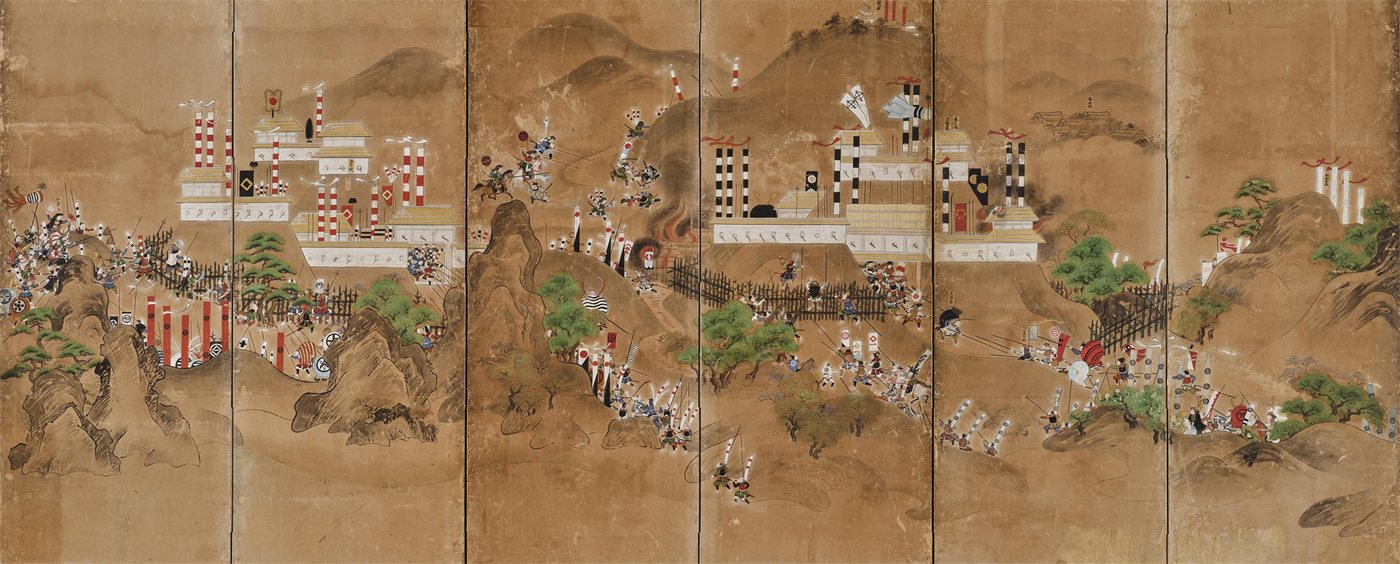
Image: Folding screen of the Battle of Shizugatake (painted in the Edo period). Wikimedia Commons (public domain). Tap or click to enlarge.
The Battle of Shizugatake, where Katsuie lost to Hideyoshi, was fought in the 4th month of 1583 in the hills around Lake Yogo, at the northern tip of Ōmi Province (today's Nagahama, Shiga). It decided who would lead the Oda family after Nobunaga's death, and the victor, Hideyoshi, took his first big step toward ruling Japan [Fact].
Where the rivalry began: the Kiyosu Conference
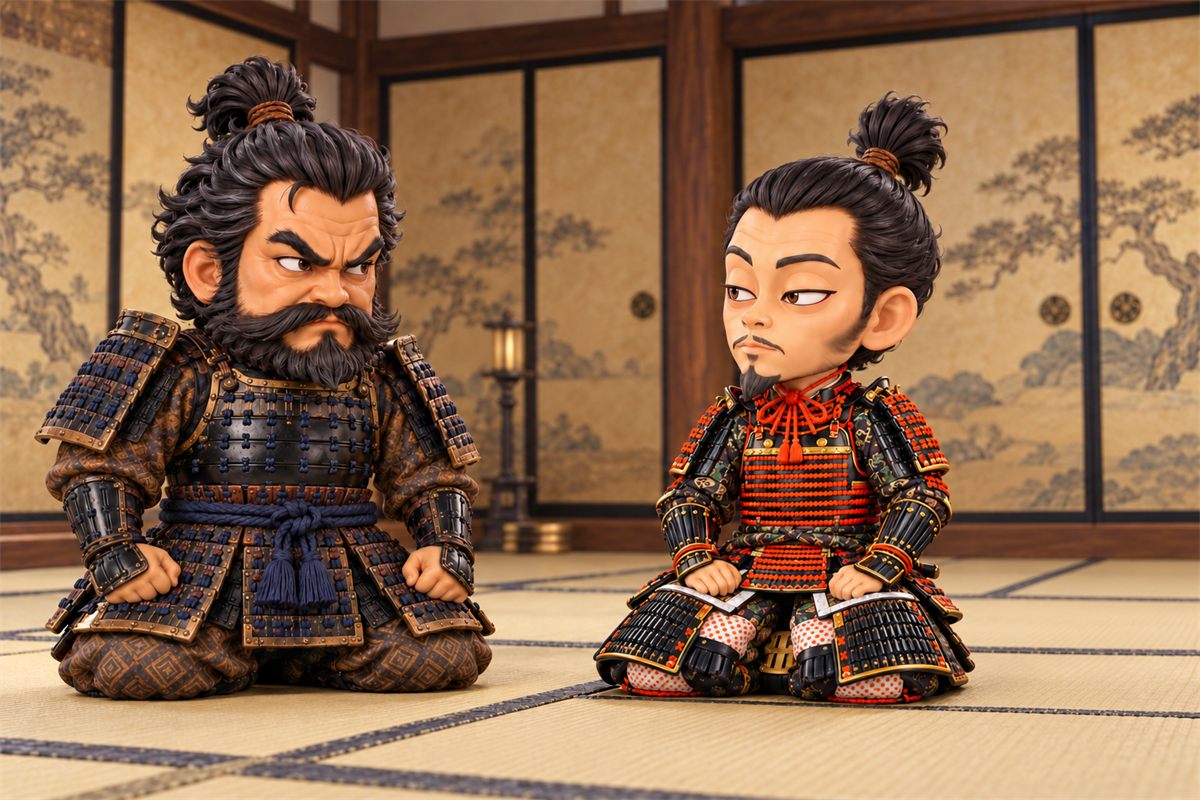
Image: An imagined scene of the rivalry between Katsuie and Hideyoshi around the time of the Kiyosu Conference
On June 21, 1582, Nobunaga was killed at Honnō-ji Temple in Kyoto, and his eldest son and heir, Nobutada, died at Nijō in the same coup (the Honnō-ji Incident). On July 16 (the 27th day of the 6th month), the Oda family's senior retainers met at Kiyosu Castle in Owari to decide what came next. This was the Kiyosu Conference [Fact]. Four men took part: Shibata Katsuie, Hashiba Hideyoshi, Niwa Nagahide and Ikeda Tsuneoki [Fact].
The conference confirmed that Nobutada's two-year-old son, Sanbōshi (later Oda Hidenobu), would head the Oda family [Fact]. (He was three by the Japanese way of counting.)
The famous version of the story says that Katsuie backed Nobunaga's third son, Nobutaka, while Hideyoshi backed Sanbōshi, and that Hideyoshi won because he had avenged Nobunaga by defeating Akechi Mitsuhide. But this version comes from the Kawasumi Taikōki, written in the early Edo period. Some recent research argues that Sanbōshi's succession was never in question, and that the real debate was over who would act for him until he grew up [Debated].
In the division of Nobunaga's lands, Katsuie gained Nagahama Castle and three districts of northern Ōmi, which had been Hideyoshi's, while Hideyoshi gained Yamashiro and Kawachi provinces near Kyoto [Fact]. This is thought to have made Hideyoshi more powerful than Katsuie [Widely accepted]. In the 10th month, Hideyoshi held Nobunaga's funeral at Daitoku-ji Temple in Kyoto [Fact], presenting himself as Nobunaga's political heir [Widely accepted]. Around the same time, Katsuie wrote to Hori Hidemasa, who sided with Hideyoshi, complaining that Hideyoshi was breaking the agreements made at Kiyosu [Fact: Katsuie's letter].
A winter trapped by snow
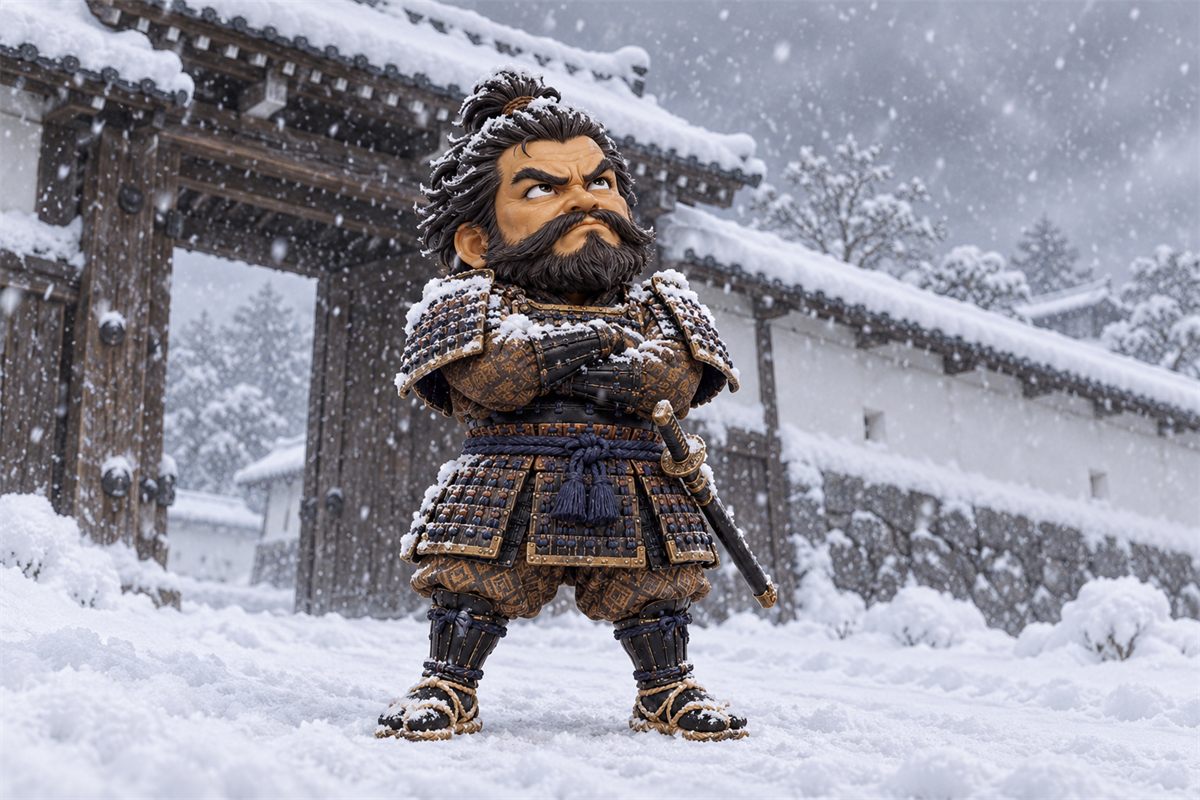
Image: An imagined scene of Katsuie at Kitanoshō, unable to move because of the snow
In the 12th month of Tenshō 10 (December 1582 to January 1583), Hideyoshi marched into Ōmi with a large army and forced Katsuie's adopted son, Shibata Katsutoyo, to surrender Nagahama Castle. He then moved into Mino and made Oda Nobutaka at Gifu Castle surrender as well [Fact]. Katsuie's home province of Echizen lay under deep snow, and he could not move a large army in winter to help them [Widely accepted].
In the 1st month of 1583, Takigawa Kazumasu, Katsuie's ally in Ise, rose against Hideyoshi, and Hideyoshi turned to attack him [Fact]. Katsuie asked the Mōri family, through the former shogun Ashikaga Yoshiaki, who was living under their protection, to strike Hideyoshi from behind. The Mōri did not move [Fact].
Snow was not the only reason Katsuie lost. Hideyoshi moved fast, castles and generals on Katsuie's side went over to Hideyoshi one after another, and Katsuie could get no help from other lords.
So he could only wait out the winter in the snow?
I know the weight of northern snow well. Moving a large army through deep winter snow is hard, in Echigo or in Echizen.
How the battle unfolded
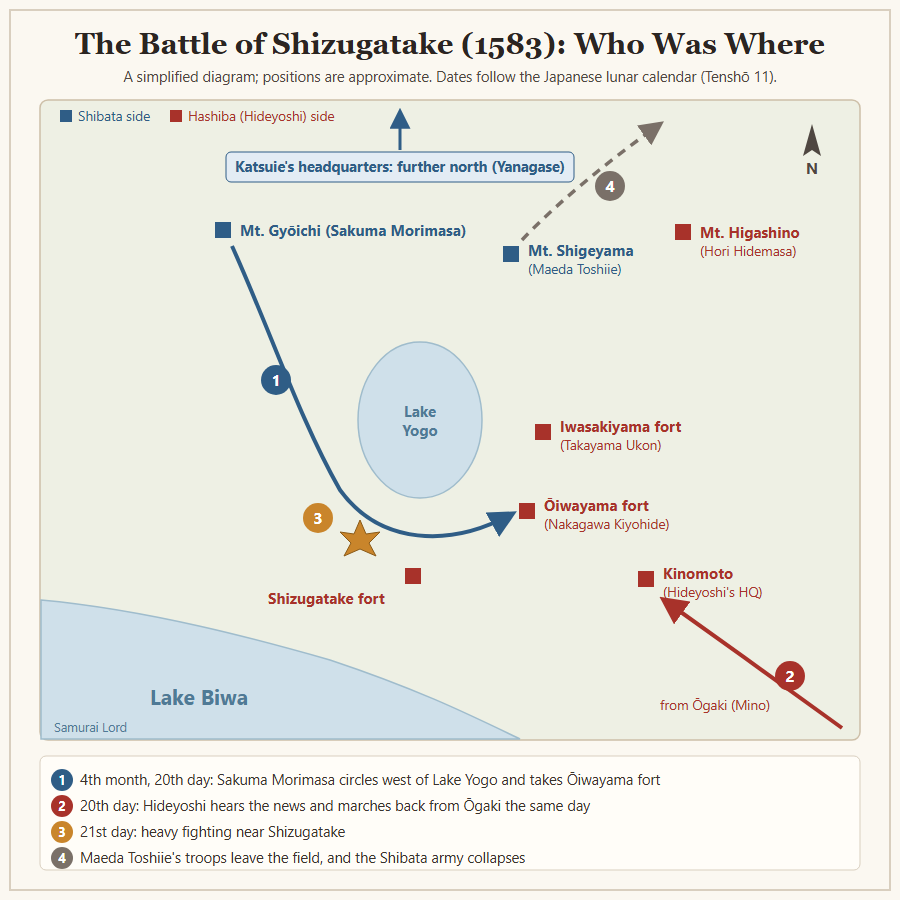
Image: The positions at the Battle of Shizugatake (simplified diagram, Samurai Lord). Tap or click to enlarge.
In the 3rd month of 1583, as the snow began to melt, Katsuie marched into northern Ōmi with Sakuma Morimasa, Maeda Toshiie and others and set up camp at Yanagase. His army is said to have numbered about 30,000 [Widely accepted]. Hideyoshi brought his army back from Ise and made his headquarters at Kinomoto (Nagahama). The two sides built forts on the hills around Lake Yogo and faced each other [Fact].
- 4th month, 16th day (June 6): Nobutaka, who had surrendered once, rises again at Gifu. Hideyoshi leads part of his army to Ōgaki in Mino
- 20th day (June 10): with Hideyoshi away, Sakuma Morimasa circles west of Lake Yogo and takes the fort on Ōiwayama. Its commander, Nakagawa Kiyohide, is killed
- 20th day: hearing the news, Hideyoshi marches from Ōgaki back to Kinomoto the same day (the "Mino Ōgaeshi")
- 21st day (June 11): from before dawn, Morimasa's force and Hideyoshi's army fight hard near Shizugatake. Morimasa's force is beaten, Maeda Toshiie's troops leave the field, and Katsuie's main army collapses
Hideyoshi's unexpectedly fast return is thought to have decided the battle [Widely accepted]. The detail that he covered the roughly 50 kilometers (30 miles) from Ōgaki to Kinomoto in only about five hours comes from later books [Legend]. Hideyoshi's younger brother, Toyotomi Hidenaga, also had his camp at Kinomoto [Widely accepted].
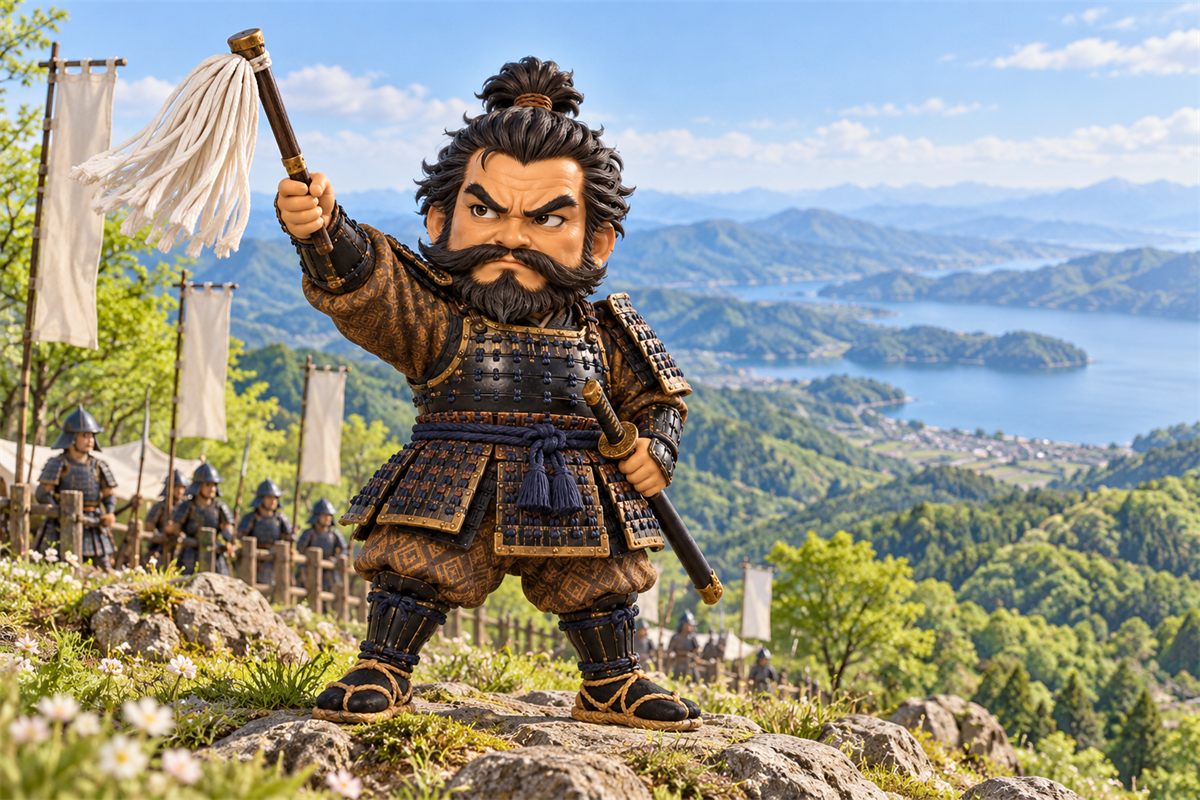
Image: An imagined scene of Katsuie commanding his army at Shizugatake
Did Sakuma Morimasa go too far?
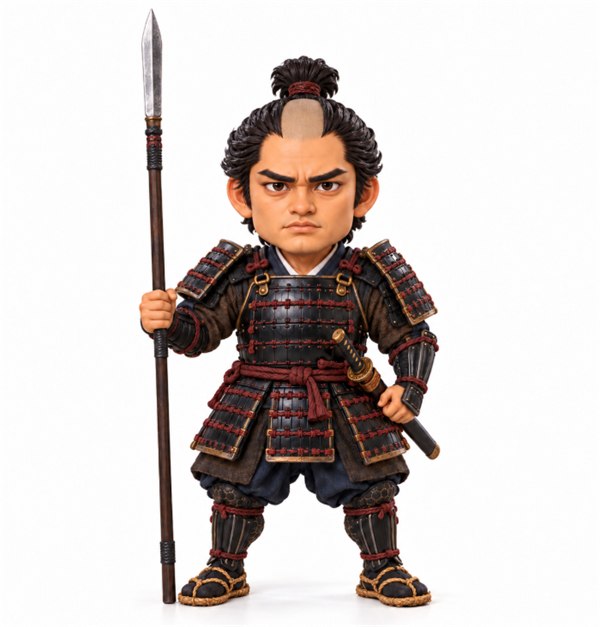
Image: An illustration of Sakuma Morimasa
Sakuma Morimasa, who took the Ōiwayama fort, was the son of Katsuie's older sister, that is, his nephew [Fact]. He is said to have been called "Oni Genba," Genba the Demon, for his ferocity [Legend].
Later war chronicles say that Katsuie ordered Morimasa again and again to pull back after taking the fort, but Morimasa refused and stayed, so he was caught by Hideyoshi's returning army. The story is well known, but the exchange of orders cannot be checked in detail against records from the time [Debated].
After the battle Morimasa was captured and executed in Kyoto [Fact].
Did Maeda Toshiie betray Katsuie?
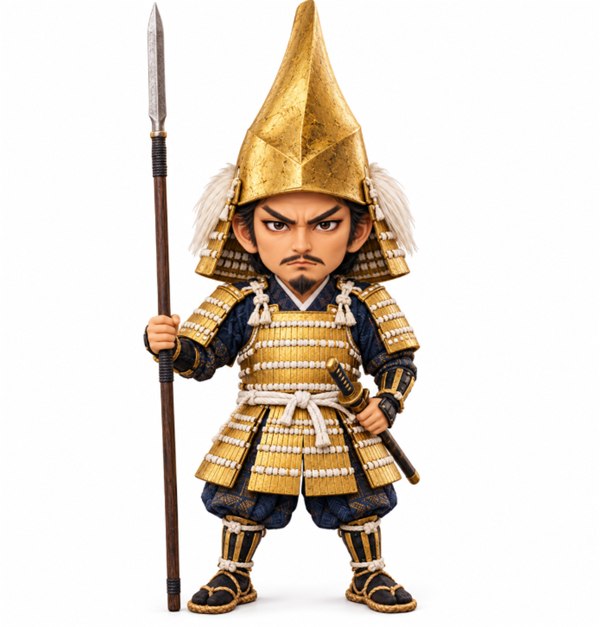
Image: An illustration of Maeda Toshiie
In the middle of the battle, the troops of Maeda Toshiie, who was on Katsuie's side, left the field [Fact]. This is thought to have been a major trigger for the collapse of Katsuie's army [Widely accepted]. Toshiie held lands at Fuchū in Echizen and had fought for years in the north under Katsuie's command. He is also said to have been a friend of Hideyoshi since their younger days [Widely accepted].
Whether Toshiie's withdrawal was a betrayal arranged with Hideyoshi in advance is unclear. In the 11th month of the previous year, Toshiie had visited Hideyoshi as Katsuie's envoy, and some historians think Hideyoshi won him over then. Others think that Toshiie, who owed loyalty to both men, simply pulled out rather than fight either of them [Debated].
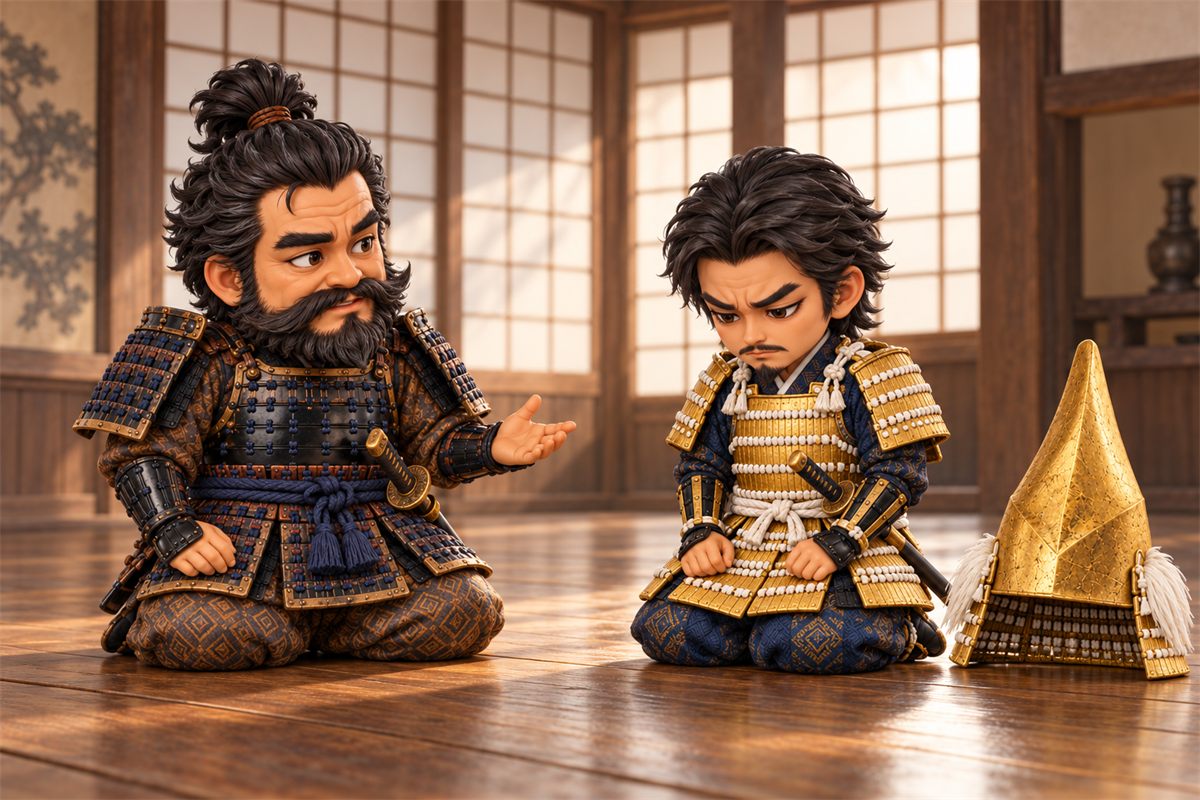
Image: An imagined scene of the farewell between Katsuie and Toshiie at Fuchū Castle (based on a story told by the Maeda family)
Edo-period records of the Maeda family say that the defeated Katsuie stopped at Fuchū Castle and, far from blaming Toshiie for withdrawing, thanked him for his years of service and told him: "You are on good terms with Hideyoshi. Go to him" [Legend]. Critics point out that this story is very convenient for the Maeda family, so it cannot be taken as fact. Toshiie is said to have led Hideyoshi's vanguard against Kitanoshō afterward [Widely accepted].
The Seven Spears of Shizugatake
Several young warriors on Hideyoshi's side won fame in this battle. Seven of them later became known as the "Seven Spears of Shizugatake" [Widely accepted]:
- Katō Kiyomasa, Fukushima Masanori, Katō Yoshiaki, Hirano Nagayasu, Wakisaka Yasuharu, Kasuya Takenori and Katagiri Katsumoto
The name "Seven Spears," however, spread from Oze Hoan's Taikōki in the early Edo period [Widely accepted]. The Shibata Taijiki, written in the year of the battle, names nine men, adding Sakurai Iekazu and Ishikawa Kazumitsu, who were rewarded with lands by Hideyoshi for being "first spears" in the fighting [Fact: Shibata Taijiki]. Ishikawa was killed in the battle, and his younger brother inherited his place.
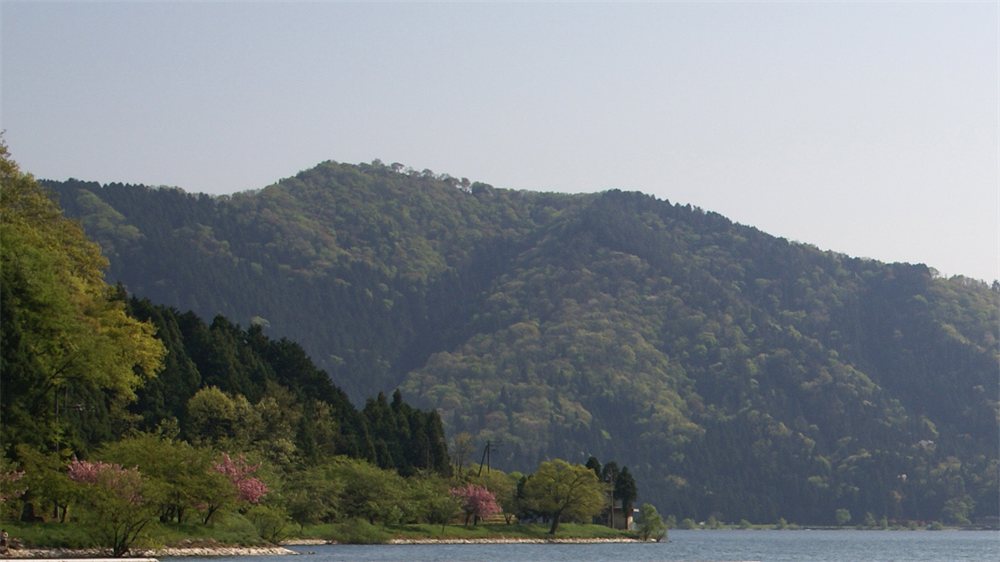
Image: Mount Shizugatake seen from Lake Yogo (Nagahama, Shiga). Wikimedia Commons (photo: 663highland, CC BY 2.5)
Katsuie and Oichi
Katsuie's wife was Oichi, Nobunaga's younger sister. She had first been married to Azai Nagamasa of Ōmi, and after Nobunaga destroyed Nagamasa, she lived with her three daughters under the protection of the Oda family [Fact].
Why did Katsuie marry Oichi?
They married soon after the Kiyosu Conference, around the 8th month of 1582. The wedding is said to have been held at Gifu Castle, the seat of Nobunaga's third son, Nobutaka [Widely accepted].
The traditional view is that Nobutaka, who was close to Katsuie, arranged the marriage. But a letter Katsuie wrote in the 10th month of the same year says, in effect, that he married after consulting Hideyoshi and gaining everyone's approval, so some historians think Hideyoshi also agreed to it [Debated].
For Katsuie, probably the most senior retainer of a family that had just lost its lord, marrying his lord's sister carried great political weight. How Oichi herself felt about the marriage, no record tells us [Unknown].
How big was the age gap?
If Katsuie was born in 1522 and Oichi in 1547, he was 25 years older. Other combinations of the proposed birth years give a gap of about 20 to 28 years, but since neither birth year is certain, the exact difference is not known [Debated].
Less than a year together
From their wedding to their deaths at Kitanoshō, Katsuie and Oichi were married for less than a year. They had no known children together. Oichi's life, her first marriage to Azai Nagamasa and her three daughters are covered in detail in our article on Oichi.
Katsuie's Life and Achievements
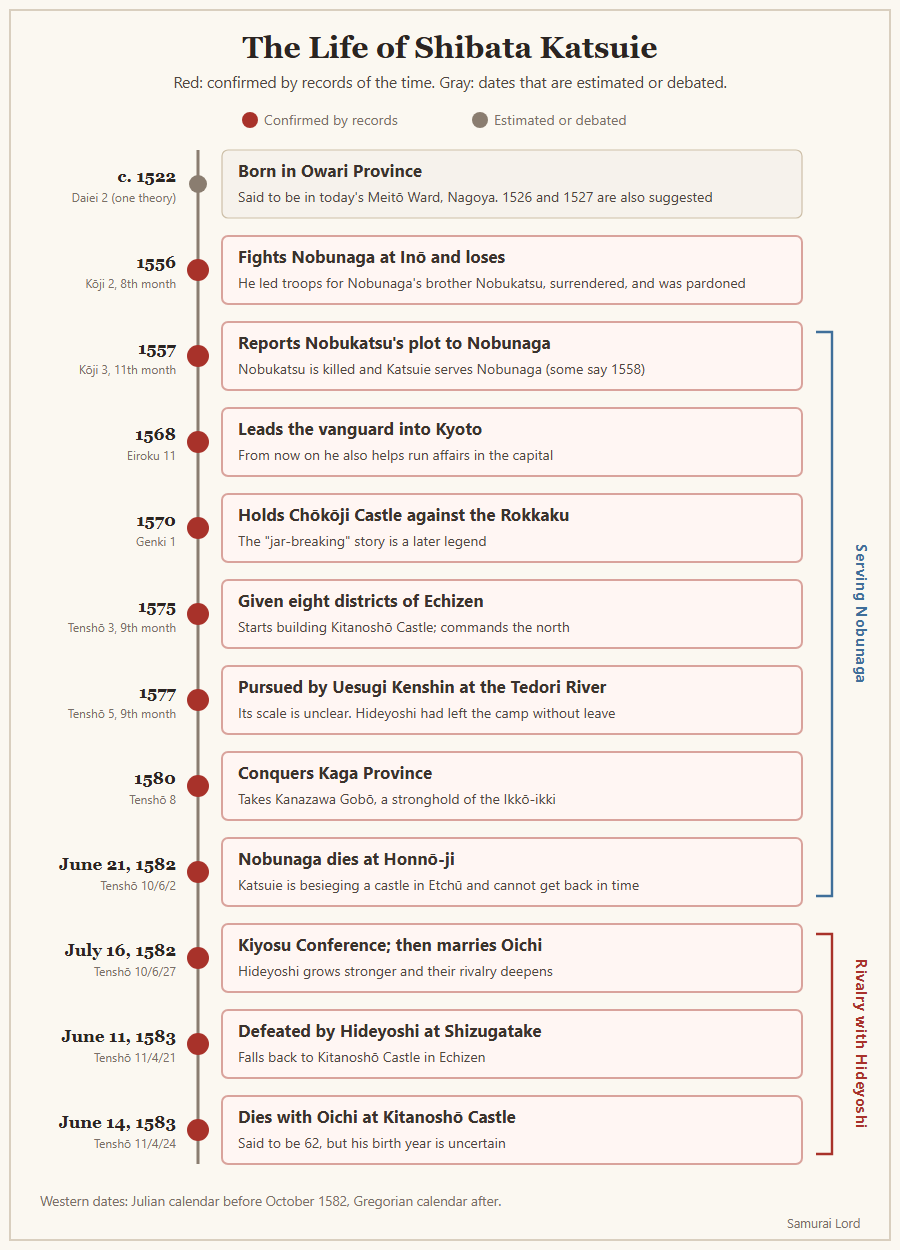
Image: Timeline of Shibata Katsuie's life (Samurai Lord). Tap or click to enlarge.
Katsuie's life falls into four parts: (1) serving Nobunaga's brother Nobukatsu, (2) fighting across central Japan as one of Nobunaga's senior generals, (3) governing Echizen and leading the conquest of the north, and (4) his rivalry with Hideyoshi after Nobunaga's death. Almost nothing is recorded about his first thirty years or so [Unknown].
Origins and early years
Little is known about Katsuie's family. He is thought to have come from a family of local landholders in Owari Province [Widely accepted].
He first appears clearly in the Shinchō Kōki, a chronicle of Nobunaga's life by his retainer Ōta Gyūichi, in its account of the Battle of Kayazu. After the death of Nobunaga's father, Oda Nobuhide, Katsuie had become a chief retainer of Nobunaga's younger brother, Oda Nobukatsu (also called Nobuyuki), and the chronicle says he killed an enemy chief retainer in a battle against the Oda branch family at Kiyosu Castle [Fact: Shinchō Kōki]. The battle is usually dated to 1552 [Widely accepted].
Fighting Nobunaga at Inō, and being pardoned
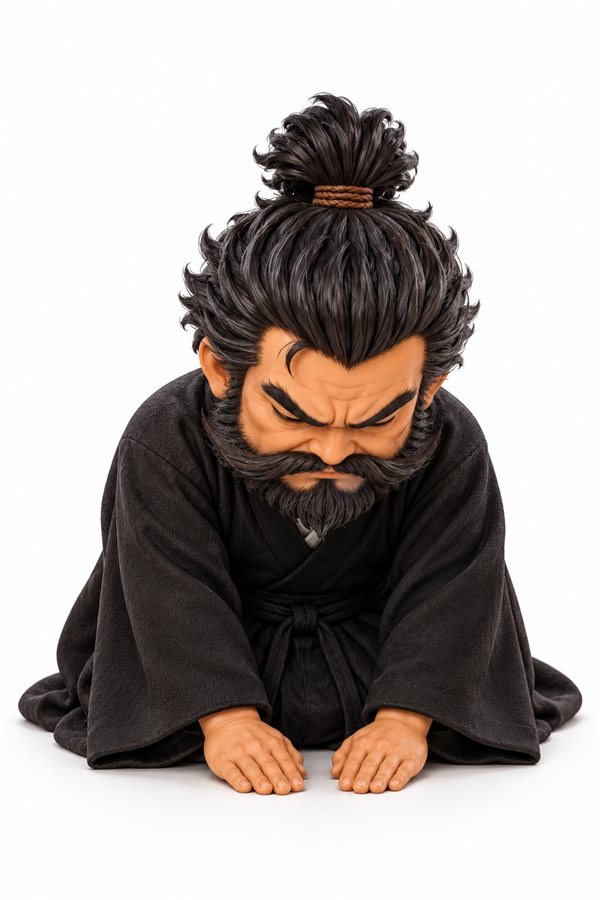
Image: An imagined scene of Katsuie begging Nobunaga's pardon
After Nobunaga became head of the family, Katsuie and the senior retainer Hayashi Hidesada tried to put Nobunaga's brother Nobukatsu in his place. In the 8th month of 1556, Katsuie led Nobukatsu's troops against Nobunaga and was defeated. This was the Battle of Inō [Fact: Shinchō Kōki].
Thanks to the pleas of the brothers' mother, Lady Dota, Nobukatsu and Katsuie were pardoned. The Shinchō Kōki says Katsuie and the others went to Kiyosu Castle in plain black robes to apologize to Nobunaga [Fact: Shinchō Kōki].
Turning on Nobukatsu
Later, Nobukatsu plotted again to overthrow Nobunaga. This time Katsuie told Nobunaga about the plot. Nobunaga pretended to be ill, lured Nobukatsu to Kiyosu Castle, and had him killed [Fact: Shinchō Kōki]. This is usually dated to the 11th month of 1557, though some date it to 1558 [Debated].
Katsuie is said to have abandoned Nobukatsu because Nobukatsu had come to favor a newcomer among his retainers and treat Katsuie lightly [Widely accepted]. When people say Katsuie "betrayed" someone, it is Nobukatsu they mean. From then on, Katsuie served Nobunaga.
One of Nobunaga's senior generals
For some years afterward, including the Battle of Okehazama in 1560, few records show what Katsuie did [Unknown]. He comes to the fore in 1568, when Nobunaga marched into Kyoto in support of Ashikaga Yoshiaki. Katsuie fought as one of the commanders of the vanguard and also helped run affairs in the capital [Fact].
In 1570 he was given charge of Chōkōji Castle in Ōmi (today's Ōmihachiman, Shiga), and when the Rokkaku family attacked the area, he defeated them near the Yasu River [Fact]. After that he took part in many of Nobunaga's major campaigns, including the Battle of Anegawa, the fighting against the Ikkō-ikki (armed leagues of followers of the Jōdo Shinshū, or Ikkō, school of Buddhism) at Nagashima in Ise, and the attack on Makishima Castle, where the shogun Ashikaga Yoshiaki had shut himself in [Fact].
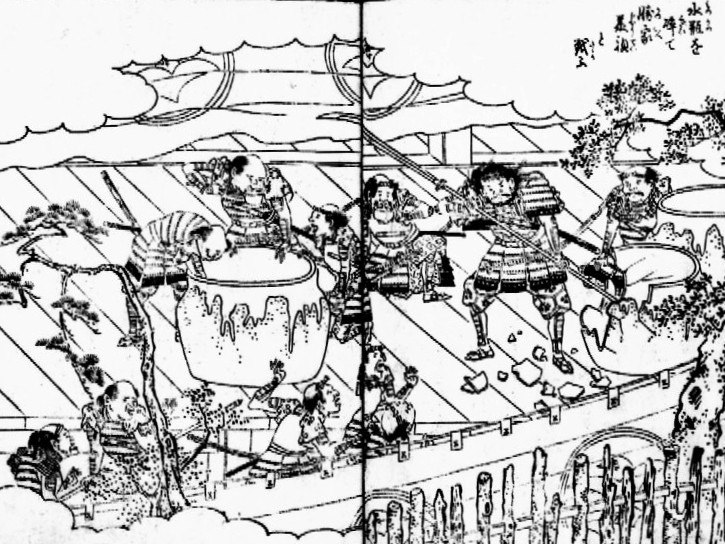
Image: The "jar-breaking" scene, from the Ehon Taikōki (an Edo-period illustrated book). Wikimedia Commons (public domain)
Chōkōji Castle is also the setting of the legend of "Kamewari Shibata," Shibata the Jar-Breaker. Cut off from water, Katsuie is said to have shared out the last of it among his men, then smashed the water jars to show there was no turning back, led a sortie and won. But the story appears only in later books and cannot be confirmed in records from the time [Legend].
Governing Echizen and building Kitanoshō
In 1575, after crushing the Ikkō-ikki in Echizen, Nobunaga entrusted eight districts of Echizen to Katsuie. He also gave Katsuie a set of rules for governing the province [Fact: Shinchō Kōki]. Around this time Katsuie began building Kitanoshō Castle [Fact].
Three commanders, Maeda Toshiie, Sassa Narimasa and Fuwa Mitsuharu, were assigned to serve under Katsuie as yoriki, attached commanders [Fact]. From Echizen, Katsuie led the campaigns into Kaga (southern Ishikawa), Noto and Etchū (Toyama) as commander-in-chief of the north.
The Tedori River and Uesugi Kenshin
In 1577, when Uesugi Kenshin of Echigo besieged Nanao Castle in Noto, Nobunaga sent a large relief army under Katsuie. Hideyoshi was part of it, but he quarreled with Katsuie and left the camp without Nobunaga's permission, which made Nobunaga furious [Fact: Shinchō Kōki].
Nanao fell before Katsuie's army arrived, and as it withdrew, Kenshin's army is said to have attacked it at the Tedori River in Kaga on the 23rd day of the 9th month (November 3, 1577). This is the Battle of Tedorigawa [Widely accepted].
Kenshin's own letter claims that more than a thousand Oda soldiers were killed. But other records give few details of the battle, and how large it really was remains unclear [Debated].
Kenshin-sama, you fought Katsuie at the Tedori River, didn't you?
Indeed. My letter did say we took more than a thousand heads...
The winner's letters tend to tell a bigger story. That is why we must check them against other records.
Conquering Kaga and rising to the top
After Kenshin died in 1578, the situation in the north turned in the Oda's favor. In 1580 Katsuie took Kanazawa Gobō, the stronghold of the Ikkō-ikki, and brought Kaga under control [Fact].
The same year, Nobunaga expelled his long-serving retainer Sakuma Nobumori, and Katsuie is thought to have become the most senior of Nobunaga's retainers [Widely accepted]. In 1581 he led Maeda Toshiie and the other Echizen commanders to Kyoto for Nobunaga's great cavalry parade [Fact: Shinchō Kōki].
Where was Katsuie during the Honnō-ji Incident?
When Nobunaga was killed at Honnō-ji on June 21, 1582, Katsuie was in Etchū, besieging Uozu Castle (in today's Toyama Prefecture), held by the Uesugi. Uozu fell on the next day, before Katsuie had heard of Nobunaga's death [Fact].
When the news reached him, he returned to Kitanoshō and planned to attack Akechi Mitsuhide with Niwa Nagahide. But by the time he marched into Ōmi, Hideyoshi had hurried back from western Japan and defeated Mitsuhide at the Battle of Yamazaki (July 2, 1582) [Fact]. Katsuie's delay is thought to have been caused by the need to hold off the Uesugi [Widely accepted]. For the Honnō-ji Incident, see our article on Akechi Mitsuhide.
Hideyoshi had avenged Nobunaga; Katsuie had arrived too late. That difference shaped their positions at the Kiyosu Conference that followed.
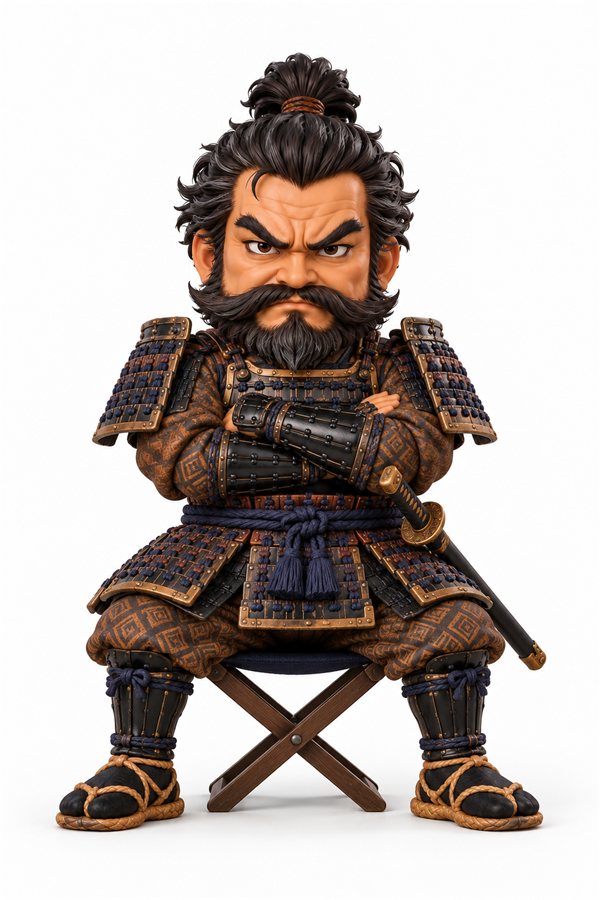
Image: An illustration of Shibata Katsuie
Nicknames and Character: Why "Oni Shibata"?
Katsuie has several nicknames that celebrate his courage. Most of them, however, spread from Edo-period books.
| Nickname | Meaning | Source |
| Gonroku | Katsuie's common name | Records from his time [Fact] |
| Oni Shibata | "Shibata the Demon," as strong as a demon | Later books [Legend] |
| Kakare Shibata | "Charge-Ahead Shibata," unmatched in attack | A song in the Edo-period essay collection Okinagusa [Legend] |
| Kamewari Shibata | "Shibata the Jar-Breaker," from a legend about Chōkōji Castle | Later books [Legend] |
"Kakare Shibata" comes from a line that sums up Nobunaga's generals: "Tōkichi is cotton, Gorōza is rice, Shibata charges, Sakuma retreats." Tōkichi (Hideyoshi) is as useful as cotton, Gorōza (Niwa Nagahide) as indispensable as rice, Shibata is the one to lead an attack, and Sakuma (Nobumori) is good at retreating [Legend].
Katsuie through the eyes of Luís Fróis
An important view of Katsuie from his own time comes from the Jesuit missionary Luís Fróis, who visited Kitanoshō and met him. Fróis described Katsuie as one of the two leading generals under Nobunaga and as the bravest and boldest warrior in Japan in Nobunaga's day [Fact: Fróis's reports].
Fróis also wrote that Katsuie was a follower of Zen but did not hate other religions; he would neither hinder nor help the spread of Christianity in Echizen [Fact: Fróis's reports]. Together with the report that he urged his retainers to save themselves at the end, this suggests a man who was not only fierce in battle but also cared for his followers.
Family Crest and Portrait
Here are two things often used to picture Katsuie and his house: his family crest and his portrait. With both, it is worth asking whether they really date from his lifetime.
The Shibata crest: Futatsu Karigane
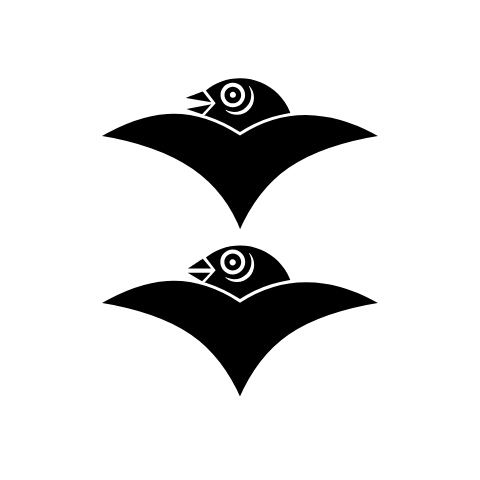
Image: Futatsu Karigane, the Shibata version. Based on an image by Mukai on Wikimedia Commons (CC BY-SA 3.0), with colors inverted
The crest associated with Katsuie is Futatsu Karigane, "two wild geese," one above the other. In the Shibata version, the upper goose has its beak open [Widely accepted].
However, no record from Katsuie's lifetime shows exactly what crest he used. The later folding screen of the Battle of Nagashino shows the two geese on Katsuie's banner, and in the Edo period the Shibata family of shogunal retainers (hatamoto), descended from his adopted son, used "two wild geese in a circle" [Widely accepted].
The portrait of Shibata Katsuie
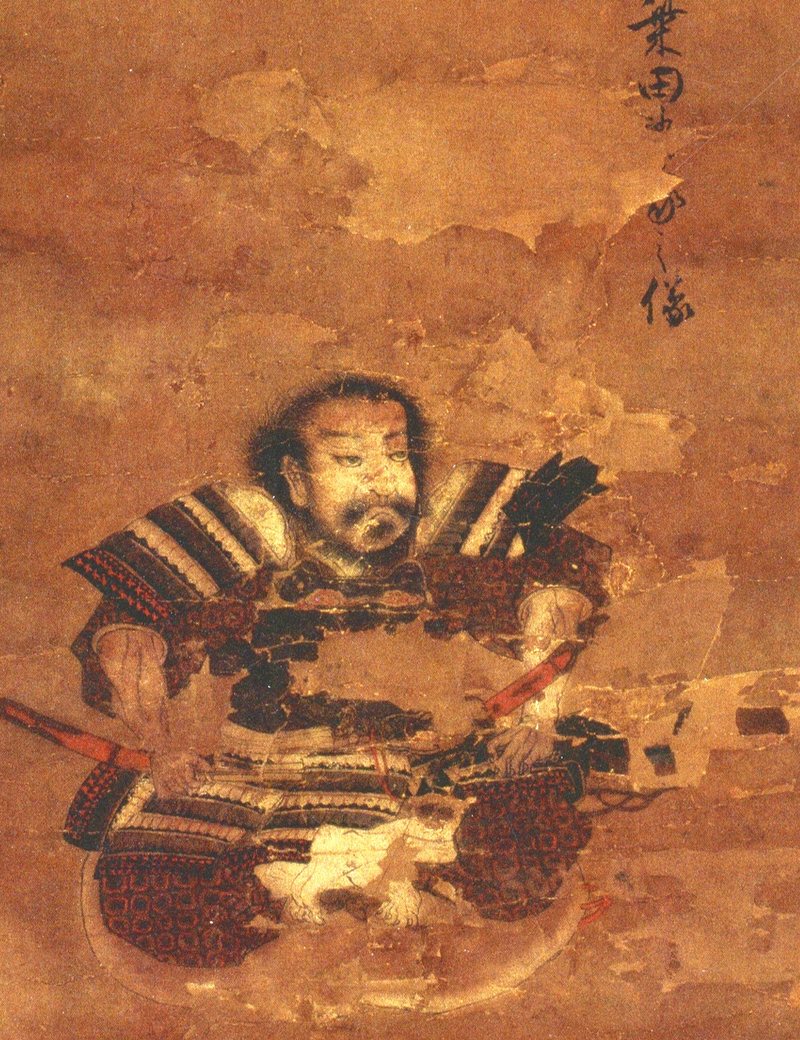
Image: Portrait of Shibata Katsuie (detail; private collection). Wikimedia Commons (public domain)
The best-known image of Katsuie is this portrait of Shibata Katsuie. It was handed down in a Shibata family of Yanagawa in Chikugo (today's Fukuoka Prefecture), said to be relatives of Katsuie, and is said to show him during the siege of Kitanoshō [Legend].
The original was rediscovered in 1993 and, after restoration, shown at the Fukui City History Museum in 2006 [Fact]. Who painted it and when are unclear, and how closely it shows Katsuie's real face is unknown [Unknown].
A statue of Katsuie also stands at Shibata Shrine, on the site of Kitanoshō Castle in Fukui (see the photo under places connected with Katsuie).
Children and Descendants
Whether Katsuie had children of his own is unclear. An Edo-period genealogy of Owari domain samurai lists a son named Katsusato, but this cannot be confirmed [Debated]. Instead, Katsuie is said to have adopted several nephews, sons of his sisters [Widely accepted].
| Name | Relation to Katsuie | What happened |
| Shibata Katsutoyo | Said to be his sister's son, adopted | Given Nagahama Castle, but surrendered it to Hideyoshi in late 1582. Died of illness just before Shizugatake |
| Shibata Katsumasa | Said to be his sister's son, adopted (Sakuma Morimasa's younger brother) | Said to have been killed at Shizugatake |
| Shibata Katsutoshi (Gonroku) | Adopted son, or possibly his own son | Said to have been captured after Shizugatake and put to death |
Does Katsuie have living descendants?
Whether Katsuie's own bloodline continued cannot be confirmed. However, Shibata Katsushige, a son of his adopted son Katsumasa, served the Tokugawa, and his family continued as hatamoto, direct retainers of the shogun [Widely accepted: Kansei Chōshū Shokafu]. This Shibata family is said to have lasted until the end of the Edo period [Widely accepted]. The Shibata family of Yanagawa, which handed down the portrait, is also said to have been related to Katsuie [Widely accepted].
Whether anyone today is a descendant of Katsuie can only be checked by tracing each generation of these families [Unknown].
Kitanoshō Castle and Places Connected with Katsuie
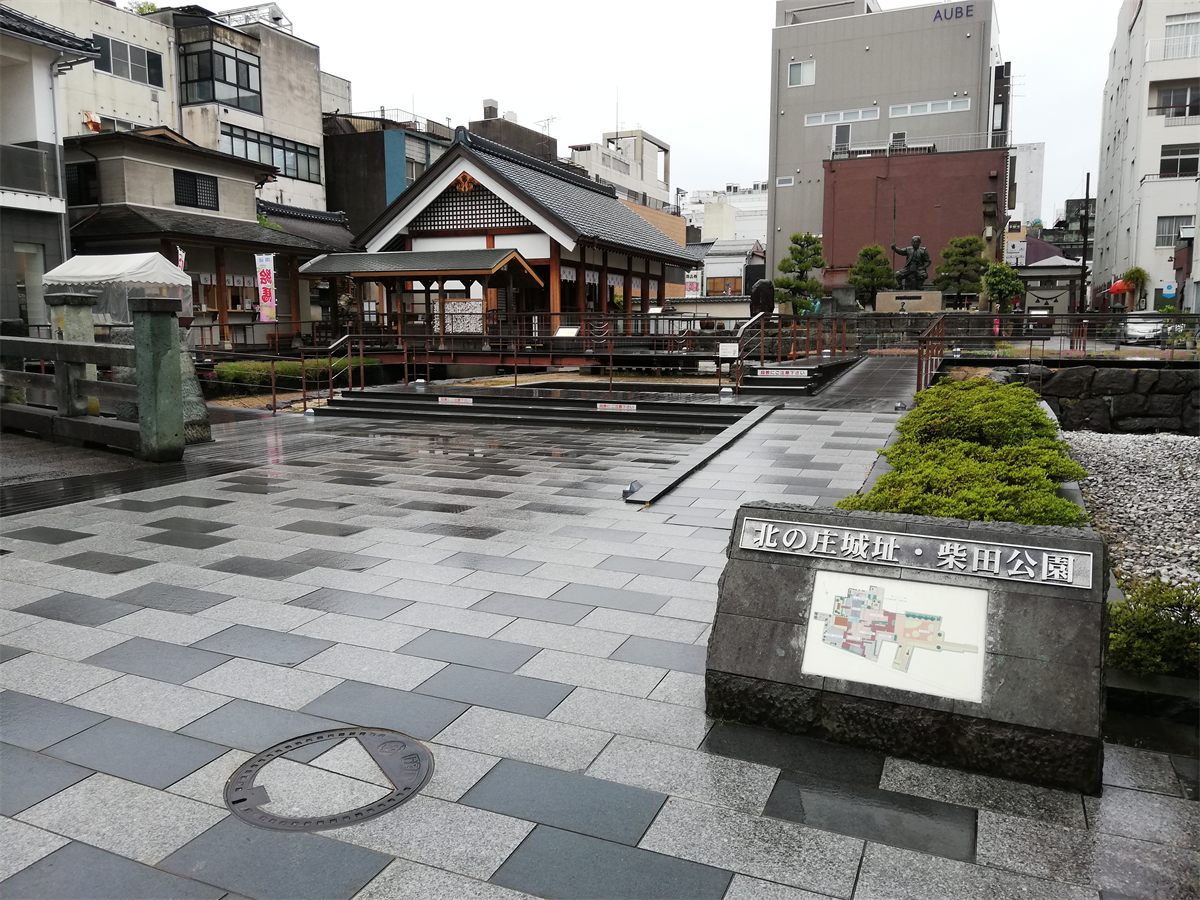
Image: The Kitanoshō Castle site and Shibata Park in Fukui, with Shibata Shrine and the statue of Shibata Katsuie in the background. Wikimedia Commons (photo: 先従隗始, CC0)
Kitanoshō Castle stood in the center of today's city of Fukui. After Katsuie's death, Fukui Castle was built nearby in the Edo period, and the remains of Kitanoshō were buried under the town. Today part of the site is Shibata Park, with Shibata Shrine, which honors Katsuie [Fact].
| Place | What it is | Location |
| Kitanoshō Castle site and Shibata Park | Site of Katsuie's castle, with Shibata Shrine and his statue | Fukui, Fukui Prefecture |
| Saikō-ji Temple | Temple with the graves of Katsuie and Oichi | Fukui, Fukui Prefecture |
| Shizugatake battlefield | Site of the Battle of Shizugatake; the summit looks over Lake Yogo and Lake Biwa | Nagahama, Shiga Prefecture |
| Bangaku-ji Temple | Said to be Katsuie's family temple, where memorial services are held for him; "Bangaku" was one of his names | Takashima, Shiga Prefecture |
| Birthplace | The place where Katsuie is said to have been born | Meitō Ward, Nagoya, Aichi Prefecture |
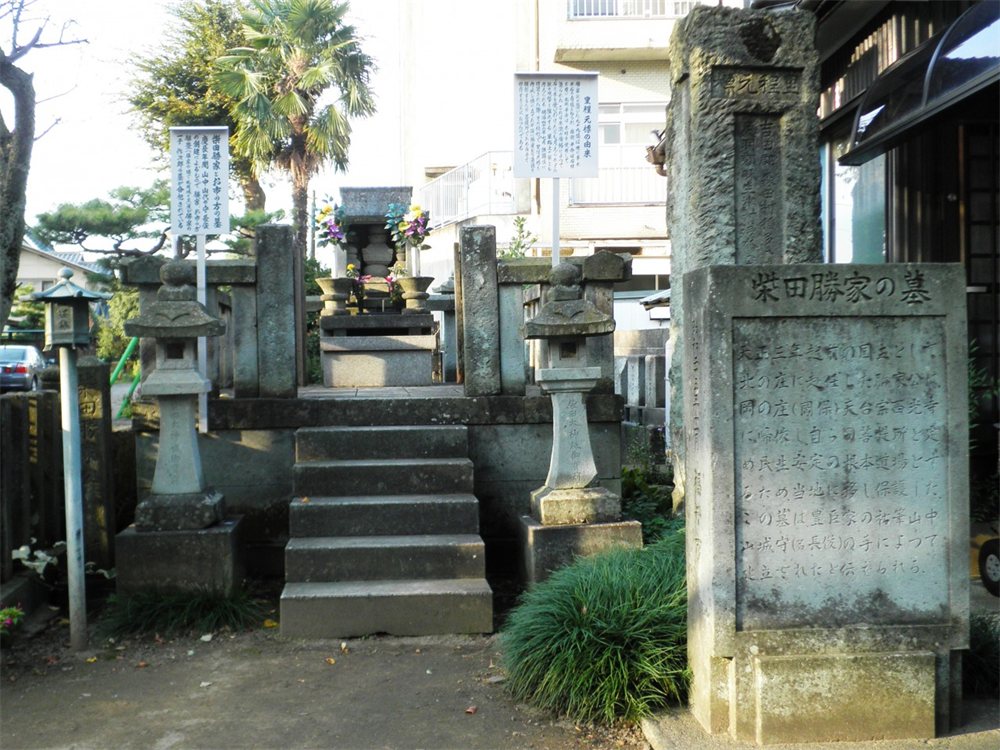
Image: The graves of Shibata Katsuie and Oichi at Saikō-ji Temple, Fukui. Wikimedia Commons (photo: 立花左近, CC BY-SA 3.0)
Frequently Asked Questions
How did Shibata Katsuie die?
He committed seppuku (ritual suicide) on June 14, 1583, when Hideyoshi's army stormed his castle, Kitanoshō, in Echizen (today's Fukui). His wife Oichi died with him. Hideyoshi's own letter describes his last stand.
Why did Shibata Katsuie and Hideyoshi fight?
After Nobunaga's death in 1582, both men wanted to lead the Oda family. Hideyoshi, who had avenged Nobunaga by defeating Akechi Mitsuhide, gained power after the Kiyosu Conference and clashed with Katsuie, who is thought to have been the most senior of Nobunaga's retainers. The two had already quarreled during the Tedori River campaign of 1577.
Did Maeda Toshiie betray Katsuie?
Toshiie was one of the commanders serving under Katsuie in the north. At Shizugatake his troops left the field in the middle of the battle, and he later joined Hideyoshi. Whether he had agreed on this with Hideyoshi in advance is not known.
What does "Oni Shibata" mean?
It means "Shibata the Demon," a nickname praising his ferocity in battle. Like "Kakare Shibata" (Charge-Ahead Shibata) and "Kamewari Shibata" (Shibata the Jar-Breaker), it spread mainly through books written after his death.
Is the Shibata Katsuie of video games historically accurate?
Games such as the Samurai Warriors series and Nioh 2 feature Katsuie as a powerful warrior. The broad outline of his life, as Nobunaga's general, Oichi's husband and Hideyoshi's rival at Shizugatake, is based on history, but his fighting abilities and most scenes are invented.
How tall was Shibata Katsuie?
Unknown. No record from his time gives his height, and figures seen online have no clear source.
Where is Kitanoshō Castle today?
It stood in the center of today's city of Fukui. Part of the site is now Shibata Park, with Shibata Shrine and a statue of Katsuie.
Summary: Who Was Shibata Katsuie?
Shibata Katsuie was a general who first fought against Nobunaga for Nobunaga's brother, was pardoned and became one of Nobunaga's senior generals in charge of the north, and after Nobunaga's death fought Hideyoshi, lost at Shizugatake, and died with Oichi at Kitanoshō Castle.
Much of his fierce image, "Oni Shibata" or "the Jar-Breaker," comes from later books, but Luís Fróis, who knew him, also called him one of the bravest warriors of the age. And it is telling that what we know of his death comes from the man who defeated him and from a writer in that man's service.
For more on the lord he served, see our article on Oda Nobunaga; for the man who defeated him, see our article on Toyotomi Hideyoshi; and for his wife, see our article on Oichi. Hideyoshi's strategist, Kuroda Kanbei, also fought at Shizugatake.
The records of the defeated are few. Yet even the victor's letter shows how strong Katsuie was.
So he was much more than the man who lost to Hideyoshi!
Sources & How This Article Was Written
This article is based mainly on the following records and references:
- Records from Katsuie's time: Ōta Gyūichi, Shinchō Kōki (available in English as The Chronicle of Lord Nobunaga, translated by J. S. A. Elisonas and J. P. Lamers, Brill, 2011); Hideyoshi's letter to Kobayakawa Takakage, dated the 15th day of the 5th month of Tenshō 11 (1583), in the Mōri family documents; Ōmura Yūko, Shibata Taijiki (also called Shibata Kassenki; 1583); Katsuie's letter to Hori Hidemasa (10th month of 1582); the reports of Luís Fróis (his História de Japam and Jesuit letters); Uesugi Kenshin's letter on the Tedori River campaign
- Later records (Edo period): Kawasumi Taikōki, Oze Hoan's Taikōki, Chōshū Fushi, Okinagusa, Kansei Chōshū Shokafu, and the Maeda family genealogy
- Studies and references (in Japanese): Taniguchi Katsuhiro, Nobunaga-gun no shireikan (Chūkō Shinsho); Shiba Hiroyuki, Kiyosu kaigi (Ebisu Kōshō Shuppan); Takayanagi Mitsutoshi, Shizugatake no tatakai; exhibition notes of the Fukui City History Museum
- Images: the portrait of Shibata Katsuie, the folding screen of the Battle of Shizugatake and the Ehon Taikōki illustration are public-domain images from Wikimedia Commons. The Futatsu Karigane crest (Mukai, CC BY-SA 3.0), the photo of Shizugatake from Lake Yogo (663highland, CC BY 2.5), the photo of the graves at Saikō-ji (立花左近, CC BY-SA 3.0) and the photo of the Kitanoshō Castle site (先従隗始, CC0) are also from Wikimedia Commons. The timeline, battle diagram and illustrations are original to Samurai Lord
What the Labels Mean
[Fact]Confirmed by sources from Katsuie's own time ([Fact: …]names the source)[Widely accepted]The view held by most historians ([Widely accepted: …]names the source)[Debated]Historians disagree[Unknown]No source tells us[Legend][Folk belief]Stories created later, or popular claims with little evidence
This article was written by the Samurai Lord editorial team and is revised as new research and reader feedback come in. If you spot an error, please let us know through our contact form (in Japanese) and we will check and correct it.
Read in Japanese
This article is also available in Japanese: 柴田勝家とは何をした人?最後は?お市との結婚や賤ヶ岳の戦いを解説