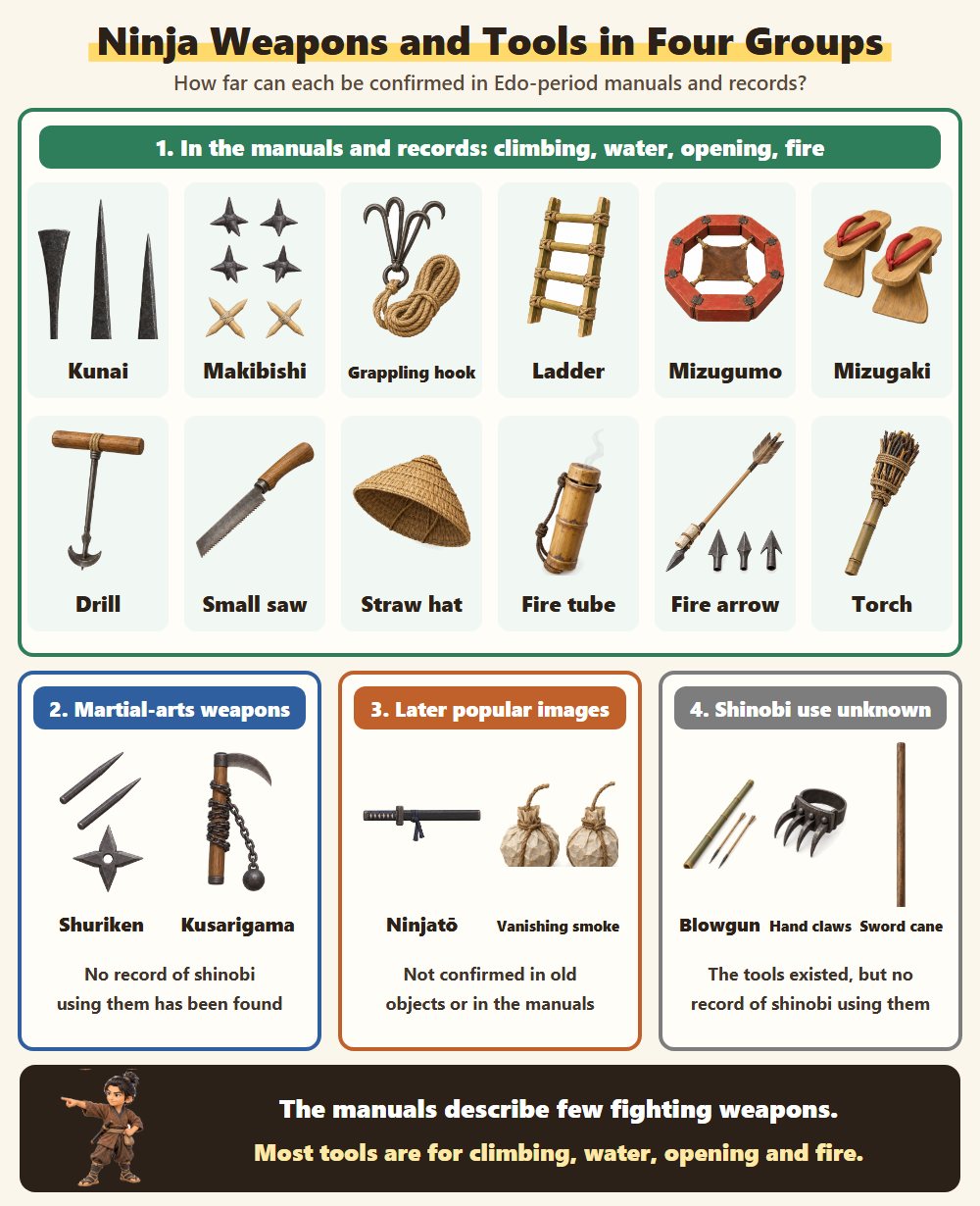
What weapons and tools did ninja really use? The ninja manuals of the Edo period (1603–1868) describe far fewer fighting weapons than you might expect. Most of their tools were for climbing, crossing water, opening doors and using fire [Widely accepted].
Shuriken and the kusarigama were real martial-arts weapons. But no record has yet been found of shinobi (the historical ninja) using them [Widely accepted].
In this guide we check each tool against original drawings from the ninja manual Bansenshūkai, held by the National Archives of Japan, and against an order list for shinobi tools written in 1628.

I am Uesugi Kenshin. Today: a field guide to ninja tools.

I'm Date Masamune! Ninja fought with throwing stars, didn't they?

The manuals are mostly about tools for climbing, opening and fire. Let us look at them one by one.
The Short Answers
- Shuriken (ninja stars): A samurai martial-arts weapon. No record of shinobi using them has been found (more)
- Kunai: An iron tool for climbing stone walls and boring holes. Drawn in a ninja manual (more)
- Kusarigama: A sickle with a chain and weight, taught in martial-arts schools. No record of shinobi using it (more)
- Ninjatō (ninja sword): The familiar straight sword with a square guard, worn on the back, is not confirmed as a historical shinobi weapon (more)
- Makibishi (caltrops): Scattered at an exit in advance to stop pursuers. In a ninja manual (more)
- Mizugumo: A ring-shaped float for crossing moats, not shoes for walking on water (more)
Jump to the part you want to read:
- Ninja weapons and tools list: what do the records show?
- Shuriken (ninja stars): did ninja use them?
- Kunai: what was it used for, and how big was it?
- Kusarigama: was it a ninja weapon?
- Ninjatō (ninja sword): what do the records show?
- Makibishi: ninja caltrops
- Mizugumo: could ninja walk on water?
- The six tools of the shinobi
- Tools for climbing, water, opening and fire
- What did real shinobi order? A list from 1628
- Did ninja use smoke bombs, blowguns and hand claws?
- Where to see ninja tools
- FAQ
Ninja Weapons and Tools List: What Do the Records Show?
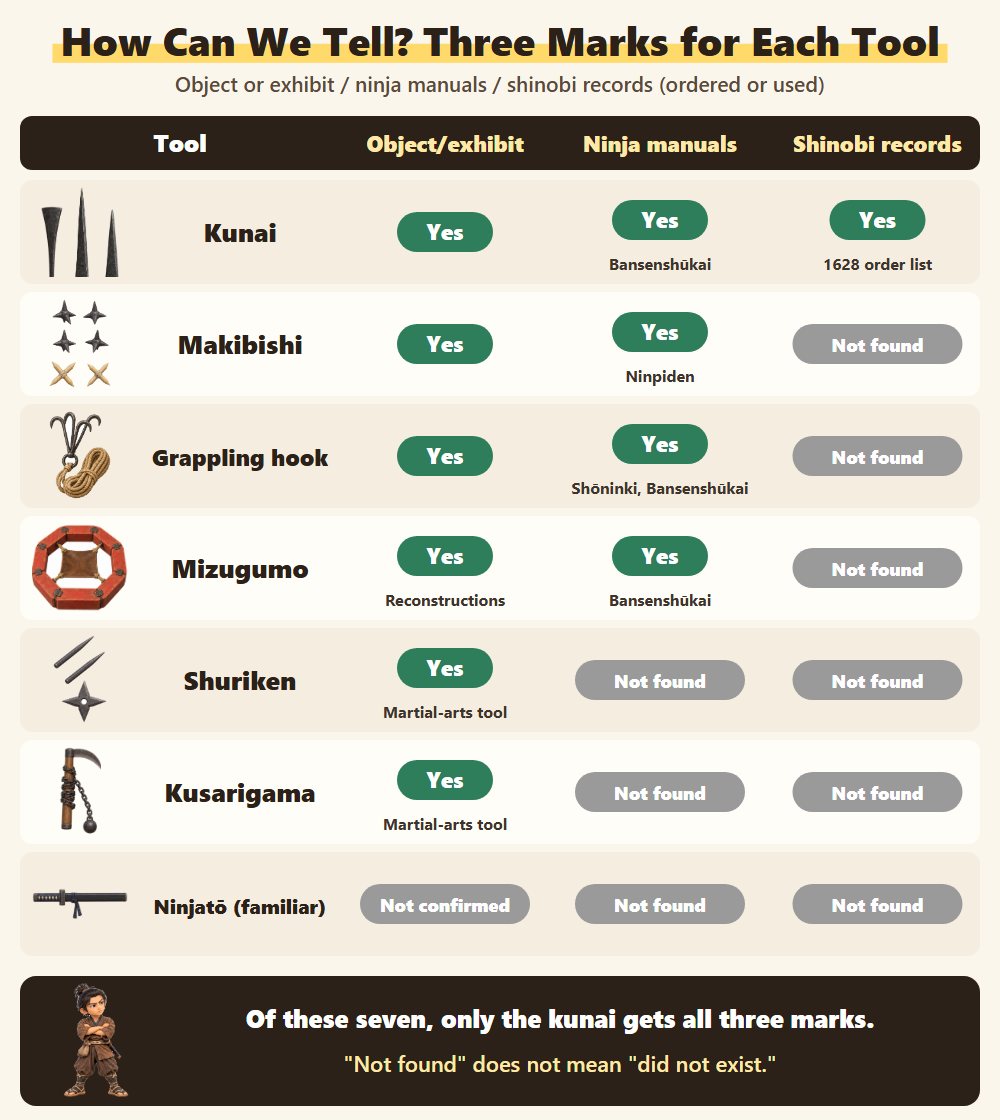
In this guide every tool gets three marks: "object or exhibit," "ninja manuals" and "shinobi records."

So being in a manual and being recorded in use are two different things!
The three marks mean:
- Object or exhibit: a tool of that shape is shown in a museum or similar (including items of unknown date and reconstructions)
- Ninja manuals: an Edo-period ninja manual has a drawing or description of it
- Shinobi records: a record says shinobi ordered or used it
| Tool | What for? | Object or exhibit | Ninja manuals | Shinobi records |
| Kunai | Climbing walls, boring holes | Yes | Yes | Yes (an order) |
| Makibishi | Scattered to stop pursuers | Yes | Yes | Not found |
| Grappling hook | Hooking on and climbing | Yes | Yes | Not found |
| Mizugumo | Crossing moats and rivers | Yes (reconstructions) | Yes | Not found |
| Shuriken | A thrown martial-arts weapon | Yes | Not found | Not found |
| Kusarigama | A martial-arts weapon | Yes | Not found | Not found |
| Ninjatō (familiar design) | – | Not confirmed | Not found | Not found |
The main ninja manuals in this article were compiled in the Edo period. The Bansenshūkai dates from 1676 and the Shōninki from 1681 [Widely accepted]. They are not eyewitness reports from the Sengoku period (about 1467–1600).
"Not found" does not mean "did not exist." Records we have not seen may still turn up.
Shuriken (Ninja Stars): Did Ninja Use Them?
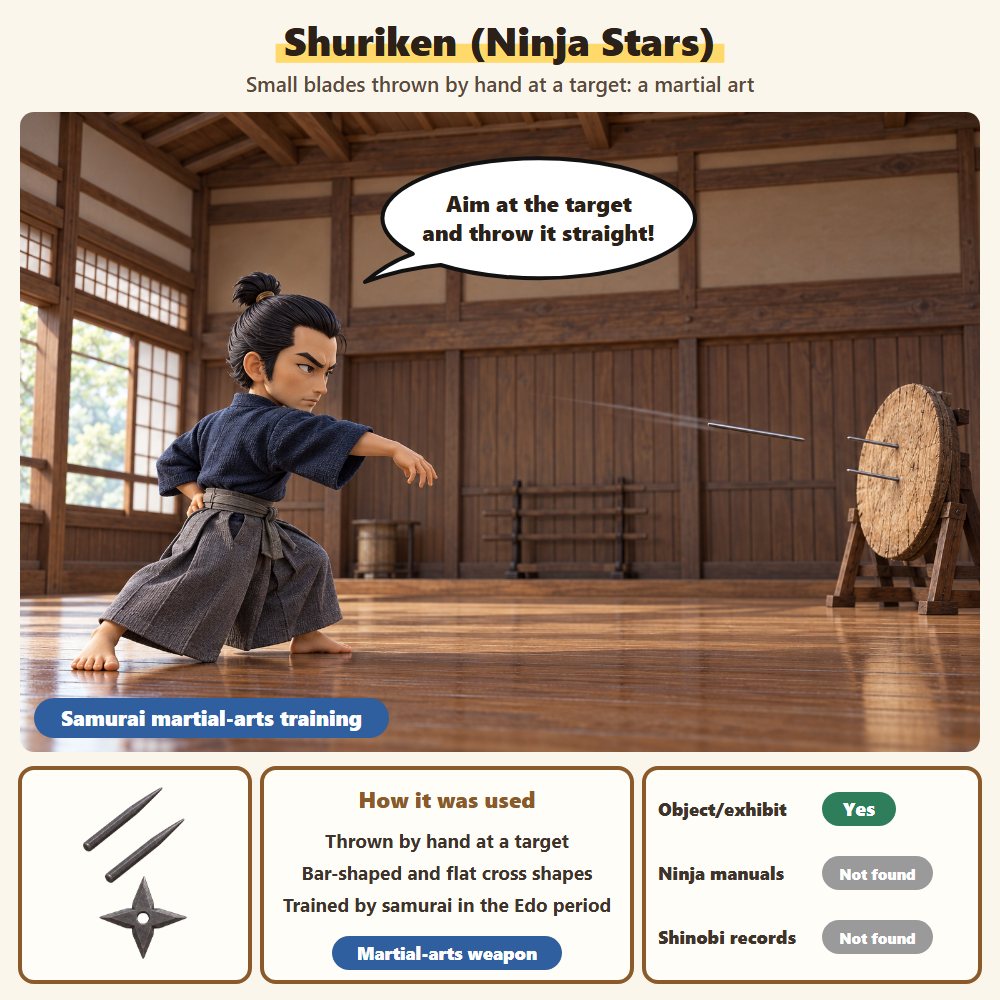
Shuriken were weapons that samurai trained with in martial arts. No record of shinobi using them has been found yet.
So there were bar-shaped shuriken too!
A shuriken is a small blade thrown by hand at a target. There are long, thin bar shuriken (bō shuriken) and flat, cross-shaped or star-shaped ones called kuruma-ken — the "ninja stars" [Widely accepted].
In the Edo period there were schools teaching shuriken techniques, practiced mainly by samurai [Widely accepted]. The Negishi school, for example, was founded by the swordsman Negishi Shōrei in the 19th century [Widely accepted].
However, the ninja manuals found so far do not describe shuriken, and no historical source has been found showing shinobi using them [Widely accepted]. The 1628 order list of the Hosokawa shinobi does not include shuriken either [Fact].
A military manual of 1618, the Gunpō Jiyōshū, says a torch thrown into an enemy camp during a night raid "works well as a shiriken" — the word seems to have covered anything thrown by hand [Widely accepted].
In Edo-period pictures, shuriken are bar-shaped. Flat star and cross shapes appeared in a book of 1942 and spread through ninja stories after World War II [Widely accepted]. How kabuki plays linked ninja and shuriken is covered in Were Ninjas Real?
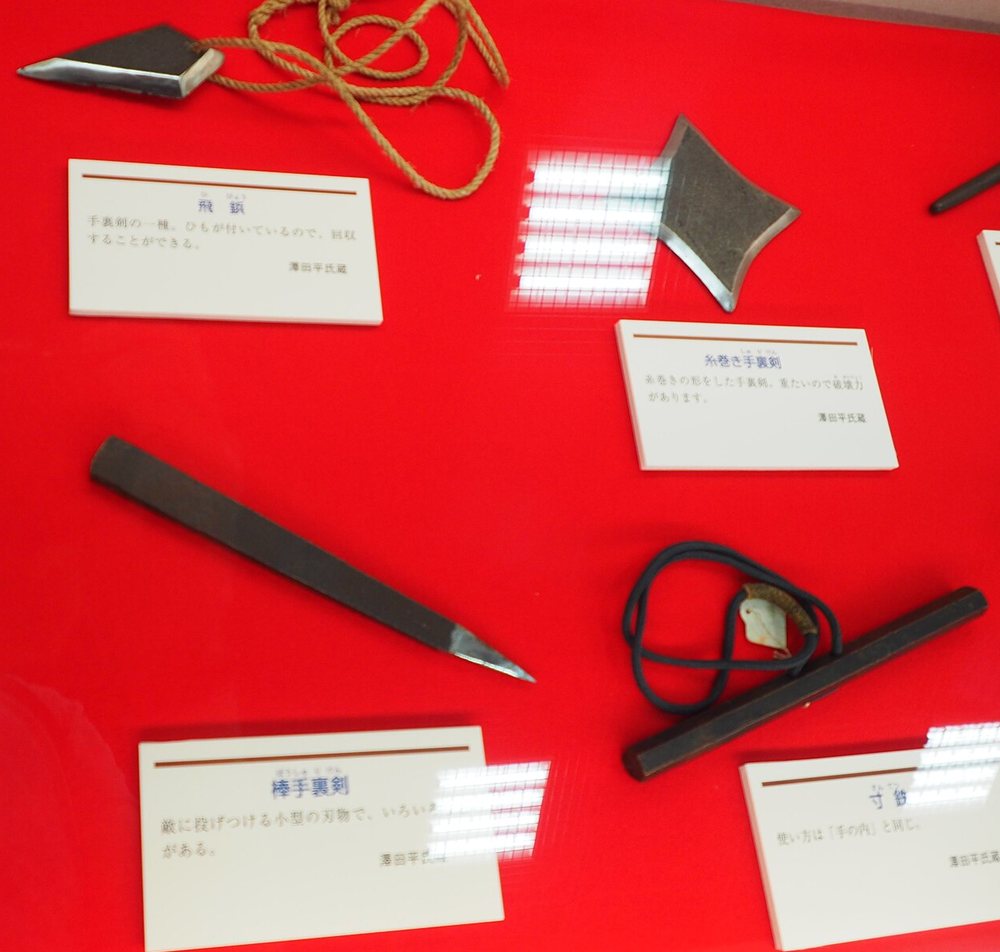
Image: Shuriken on display at the Kusuri Gakushūkan museum in Kōka City, Shiga Prefecture. Wikimedia Commons (photo: Motokoka, CC BY-SA 4.0; cropped)
Kunai: What Was It Used For, and How Big Was It?
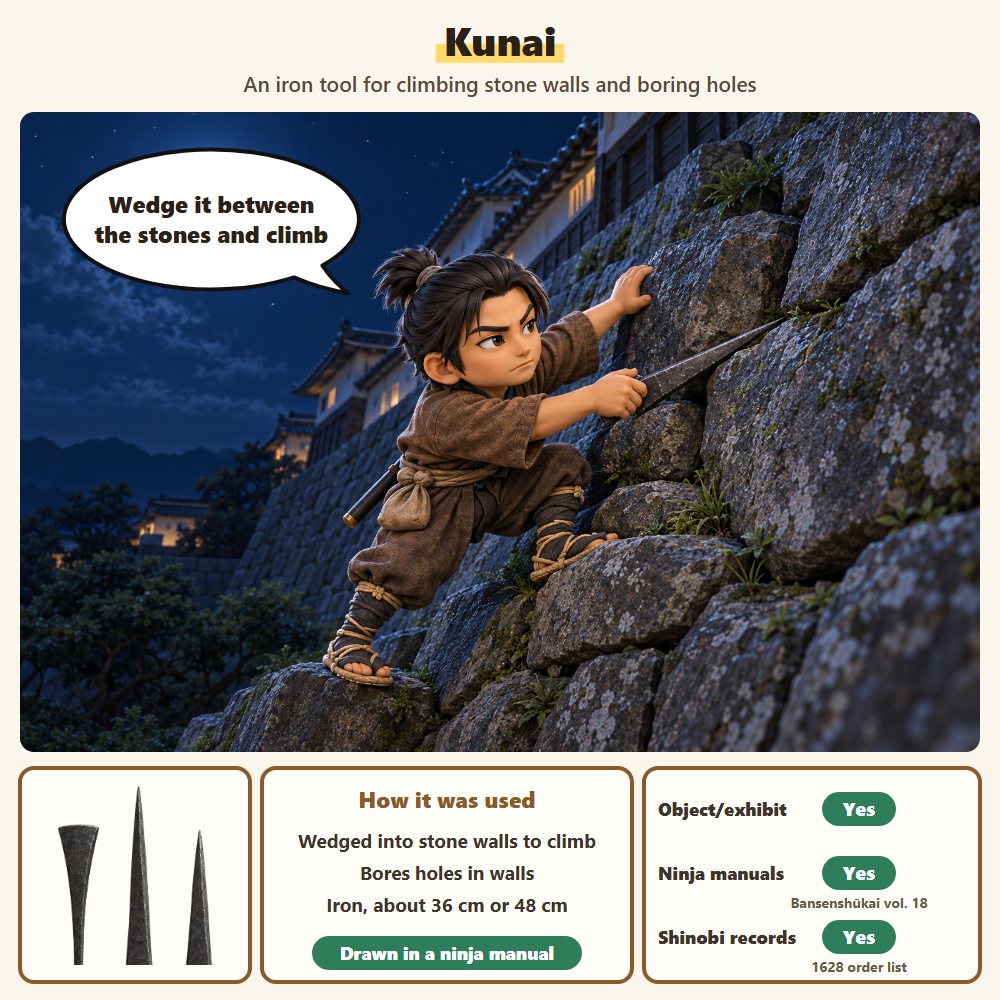
The kunai was a tool for climbing stone walls and making holes in walls. It is drawn in a ninja manual.
I thought it was a throwing weapon!
The kunai is a pointed iron tool. In the Bansenshūkai it appears in the volume on climbing tools (volume 18), with a drawing [Fact].
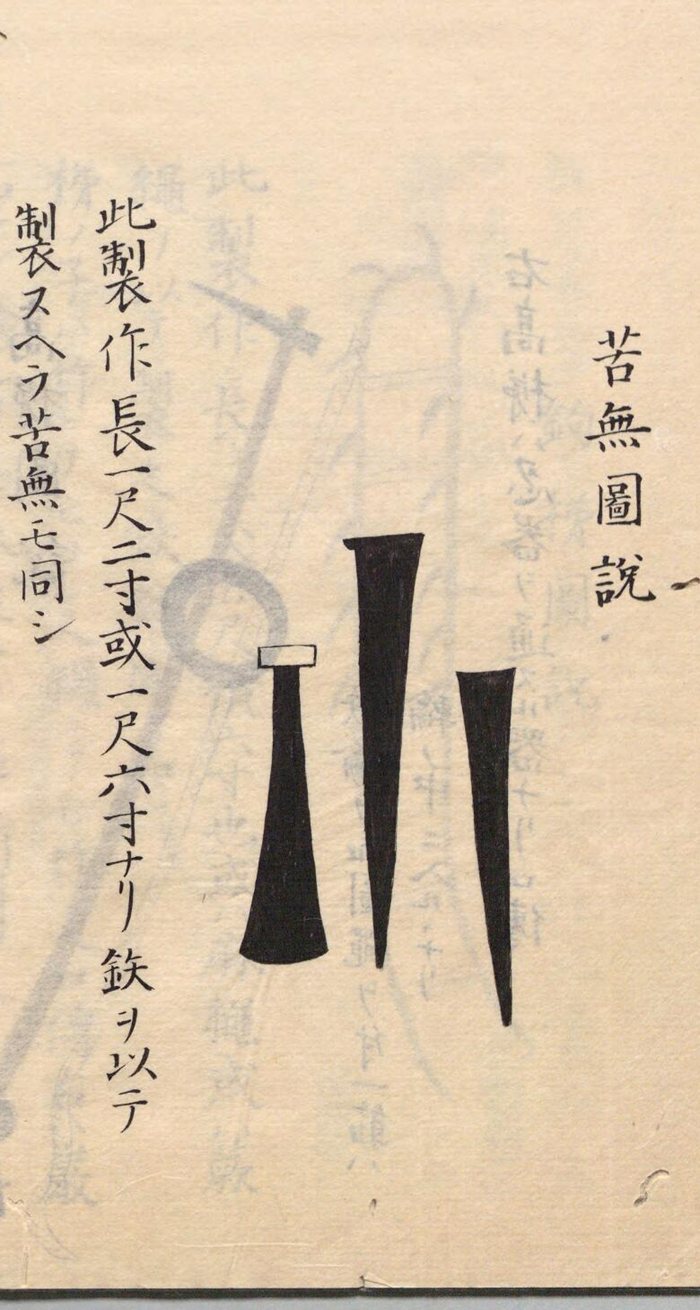
Image: The kunai diagram in Bansenshūkai, volume 18 (manuscript copy). National Archives of Japan (Naikaku Bunko, call no. 特113-0005, book 9, frame 7; cropped)
Primary Source: Bansenshūkai, Volume 18, "Kunai"
Source
A manuscript copy of the Bansenshūkai (National Archives of Japan, Naikaku Bunko, call no. 特113-0005). It is a hand-written copy of the 1676 manual, presented to the Tokugawa shogunate in 1789.
Original (excerpt)
此製作長一尺二寸或一尺六寸ナリ 鉄ヲ以テ製ス ヘラ苦無モ同シ
Translation
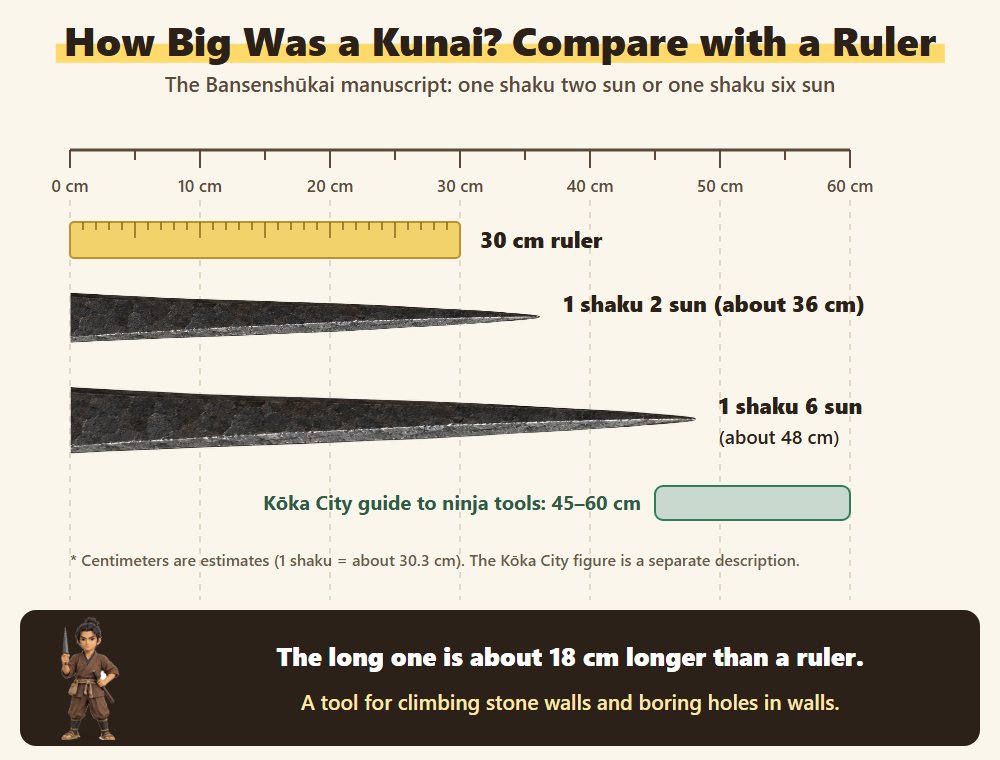
Length: one shaku two sun (about 36 cm) or one shaku six sun (about 48 cm). Made of iron. The spatula-shaped kunai is the same.
What it shows
The kunai was a "climbing tool" with a drawing and set lengths in a ninja manual. The centimeters are estimates, using 1 shaku = about 30.3 cm.
A memorandum handed down in the Sawamura family of Iga calls the kunai "a tool for climbing stone walls and making holes in walls" [Widely accepted] (as quoted in a study by Ueda Tetsuya).
The 1628 order list of the Hosokawa shinobi also includes ten "kunai" [Fact] (see the order list).
In the sources we checked, we found no description of throwing kunai [Unknown].
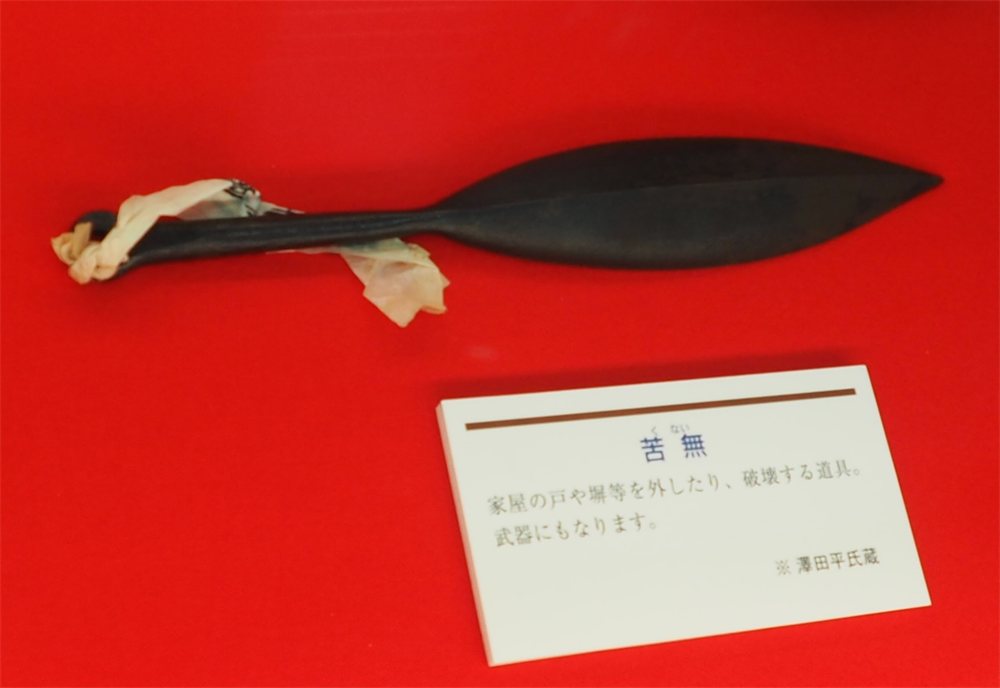
Image: A kunai on display at the Kusuri Gakushūkan museum in Kōka City, Shiga Prefecture. Wikimedia Commons (photo: Motokoka, CC BY-SA 4.0)
Some museum displays show leaf-shaped kunai like this one.
Kusarigama: Was It a Ninja Weapon?
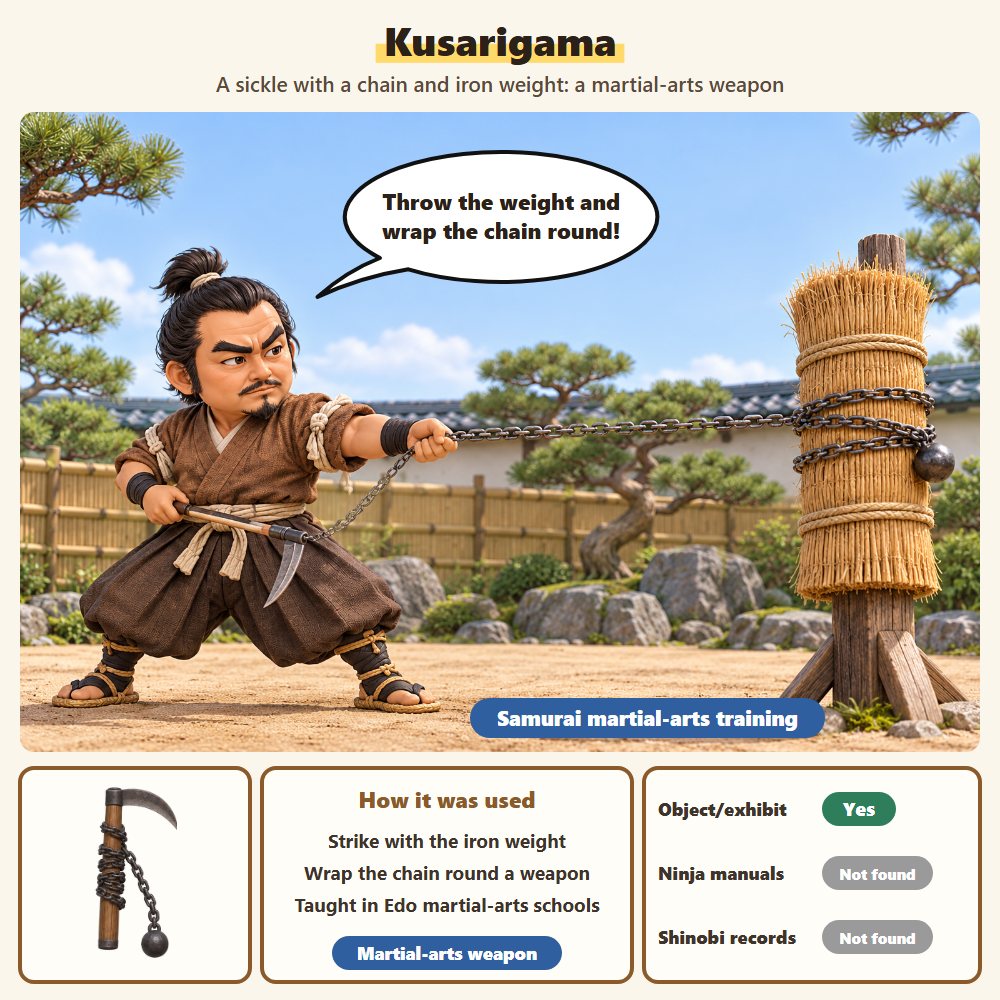
The kusarigama was a martial-arts weapon, handed down alongside sword and spear training.
And no record of shinobi using it has been found.
The kusarigama is a sickle with a long chain attached to the handle and an iron weight (fundō) at the end of the chain. The weight was used to strike, and the chain to wrap around an opponent's weapon [Widely accepted].
It is said to have appeared in the late Muromachi period or in the Sengoku period [Debated]. In the Edo period it was handed down in martial-arts schools such as the Isshin-ryū and Tendō-ryū [Widely accepted].
We found no example of shinobi using a kusarigama in the ninja manuals or in shinobi records [Unknown]. The opening-tools volume of the Bansenshūkai has a sickle with a folding handle, but no chain [Fact].
The story of Miyamoto Musashi fighting a kusarigama user named Shishido comes from the Nitenki, a book of 1776 [Legend]. For Musashi, see our article on Miyamoto Musashi.
Ninjatō (Ninja Sword): What Do the Records Show?
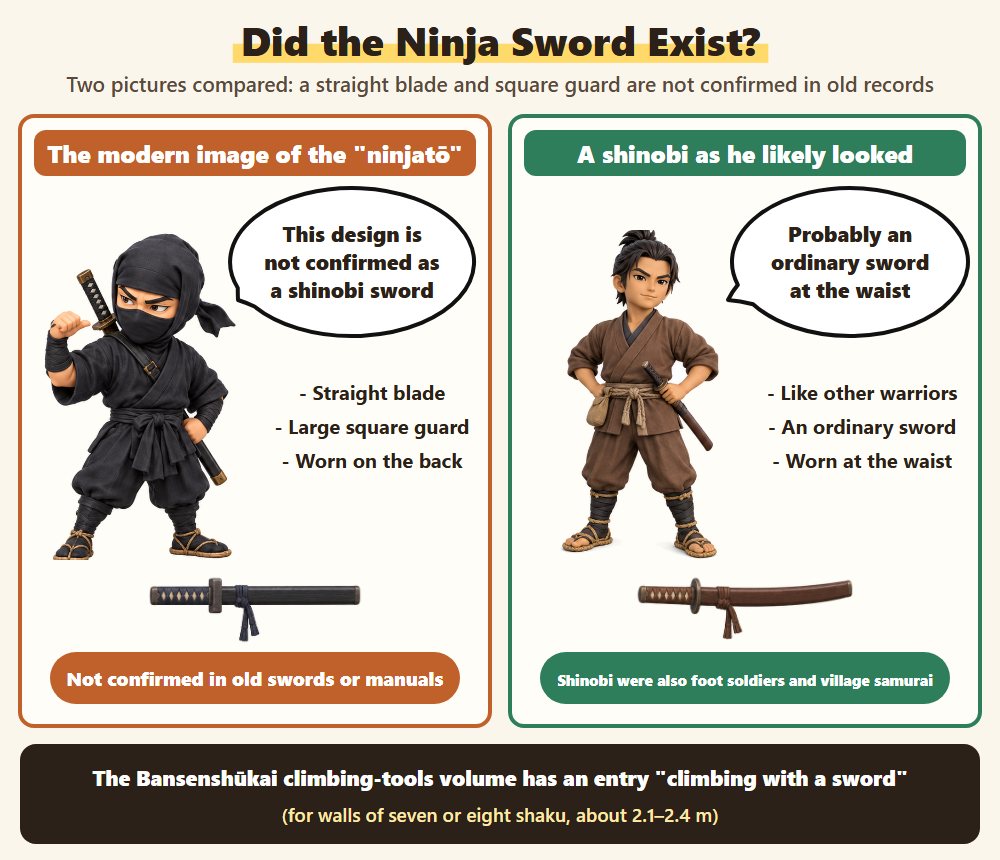
The "ninja sword" — straight blade, square guard, worn on the back — is not confirmed in old swords or in the manuals.
Then what sword did real shinobi wear?
The "ninjatō" — a straight blade with a large square guard (tsuba), worn on the back — cannot be confirmed in old surviving swords or in the ninja manuals [Unknown].
Sengoku-period shinobi were often foot soldiers or village samurai [Widely accepted]. They are thought to have worn ordinary swords like other warriors [Widely accepted].
The Bansenshūkai's volume on climbing tools has an entry called "climbing with a sword" (tachi-nobori), for walls of seven or eight shaku, but we found no basis for the story that ninja stood on a large square guard to climb walls [Folk belief].
On the other hand, Yamada Yūji (Mie University) notes that the ninja manual Mizukagami describes making a small hole in the end of a sword's scabbard (saya) and breathing through it under water [Widely accepted]. He adds that it would be hard to use as it stands. This is separate from any proof of a special "ninja sword."
Makibishi: Ninja Caltrops
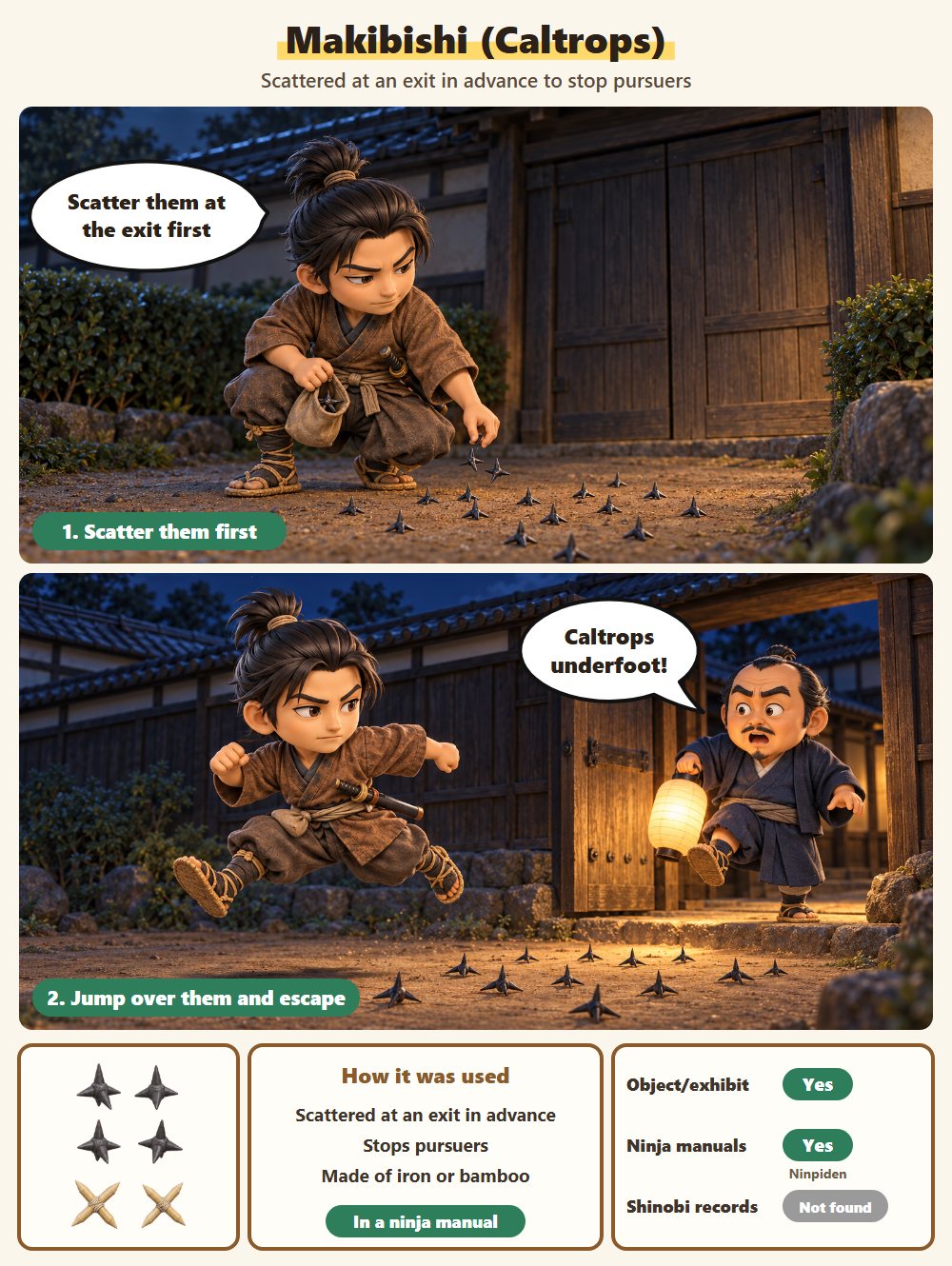
Scatter them at the exit first. Only you know where they are, so only you can avoid them.
The one who knows where they lie never steps on them!
Makibishi are small spiked objects scattered on the ground or floor to stop pursuers — caltrops [Widely accepted].
The ninja manual Ninpiden (said to date from 1655) says in its section on caltrops that they can be made of iron or of bamboo, with a drawing [Widely accepted]. They were meant to stop people coming out of a house you had slipped into, and to make your own retreat easier [Widely accepted].
Yamada Yūji of Mie University explains that a shinobi scattered them at the exit in advance, jumped over them because he knew where they were, and escaped while pursuers who did not know stepped on them [Widely accepted].
The name comes from their resemblance to the spiky seed of the hishi, the water caltrop (Trapa) [Widely accepted]. The war tale Banshū Sayō Gunki also mentions "iron hishi and bamboo hishi" carried in a grass bag [Widely accepted]. When they first came into use, and whether ninja were the first to use them, is not known [Unknown].
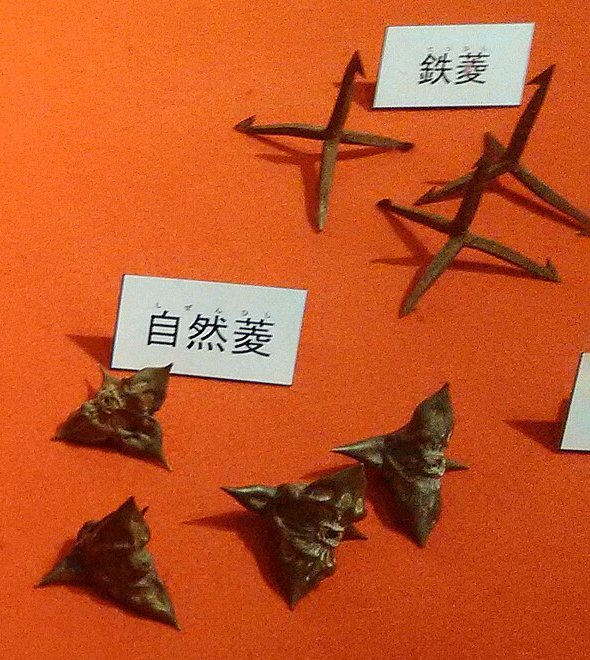
Image: Iron caltrops and water-caltrop seeds (natural caltrops) on display at Shinobi no Sato Plala in Kōka City, Shiga Prefecture. Wikimedia Commons (photo: Motokoka, CC BY-SA 4.0; cropped)
We could not confirm any old record of water-caltrop seeds being used as caltrops as they were [Unknown].
Mizugumo: Could Ninja Walk on Water?
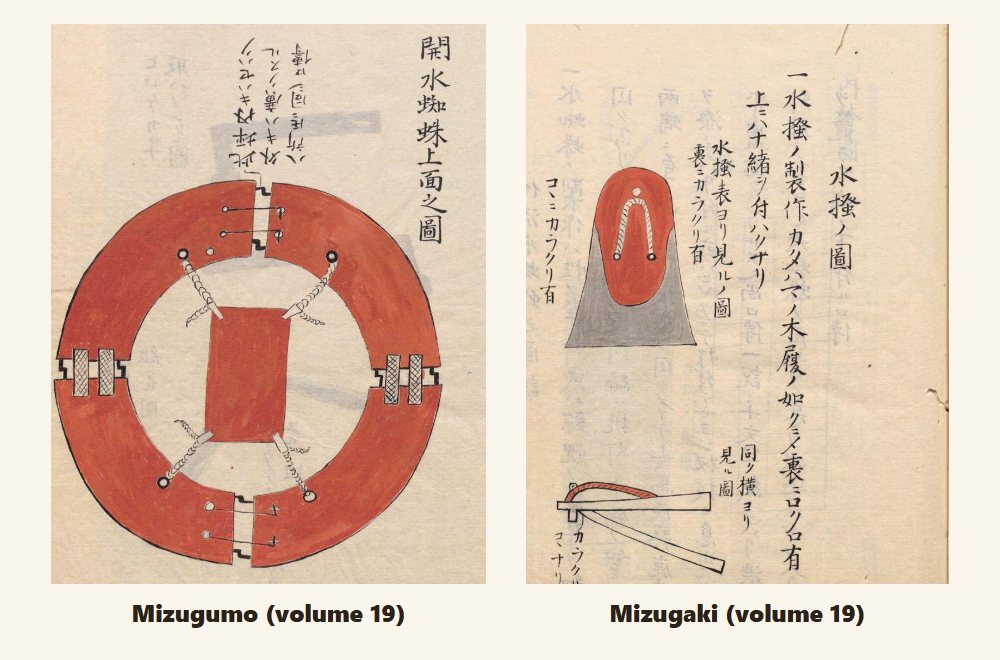
Image: The mizugumo (left) and mizugaki (right) diagrams in Bansenshūkai, volume 19 (manuscript copy). National Archives of Japan (Naikaku Bunko, call no. 特113-0005, book 9, frames 14 and 15; cropped and placed side by side)
The foot thong belongs to the mizugaki, the paddle shoes. The mizugumo itself is a ring-shaped float.
So it was never a pair of shoes for walking on water!
The mizugumo ("water spider") is a float in the Bansenshūkai's volume on water tools (volume 19) [Fact]. The manuscript draws a ring of joined wooden boards, about 66 cm across (two shaku one sun eight bu), with a leather seat hung in the middle and hinges so it could be folded [Fact].
The opening of volume 19 calls this school's mizugumo and its box boat "the best tools for crossing rivers and moats" [Fact].
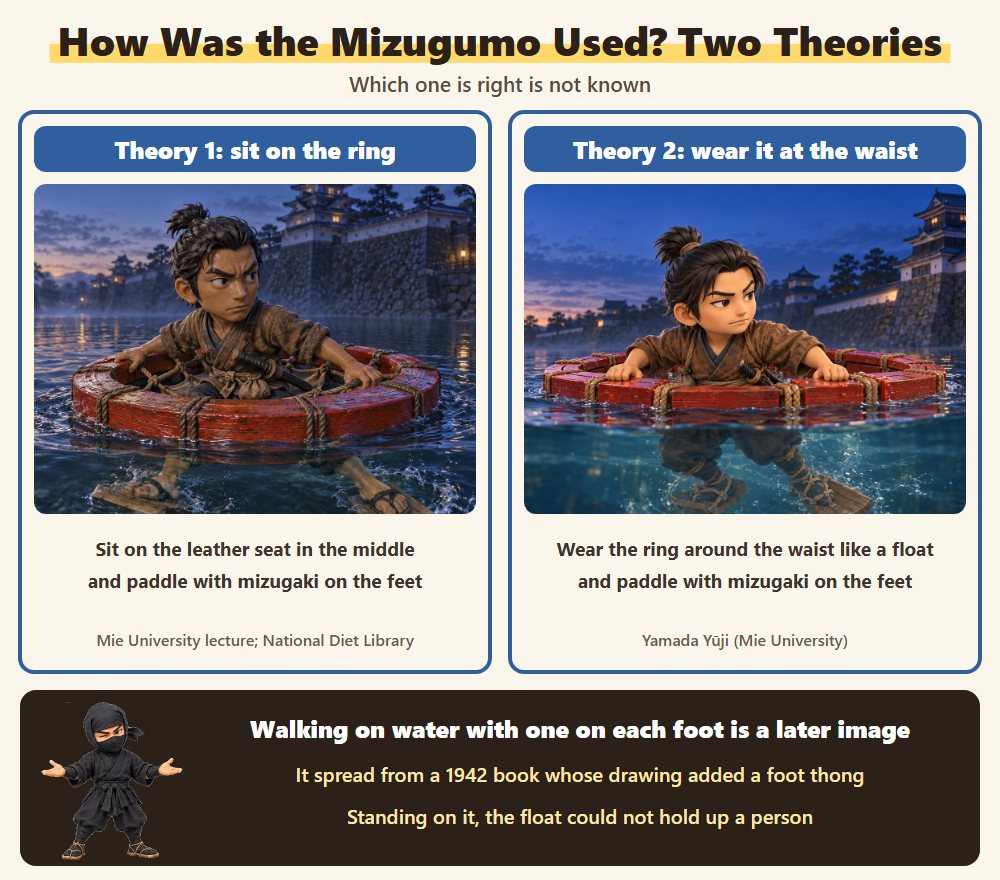
There are two theories of how it was used: sitting in the middle of the ring and paddling with mizugaki (paddles worn on the feet), or wearing the ring around the waist like a float [Debated]. Which is right is not known.
The idea of wearing it on both feet to walk on water is said to have spread from a 1942 book whose drawing added a foot thong that is not in the original mizugumo diagram [Widely accepted]. Yamada Yūji reports that when the buoyancy was measured for standing on it with both feet, it was nowhere near enough to hold up a person [Widely accepted].
The Six Tools of the Shinobi
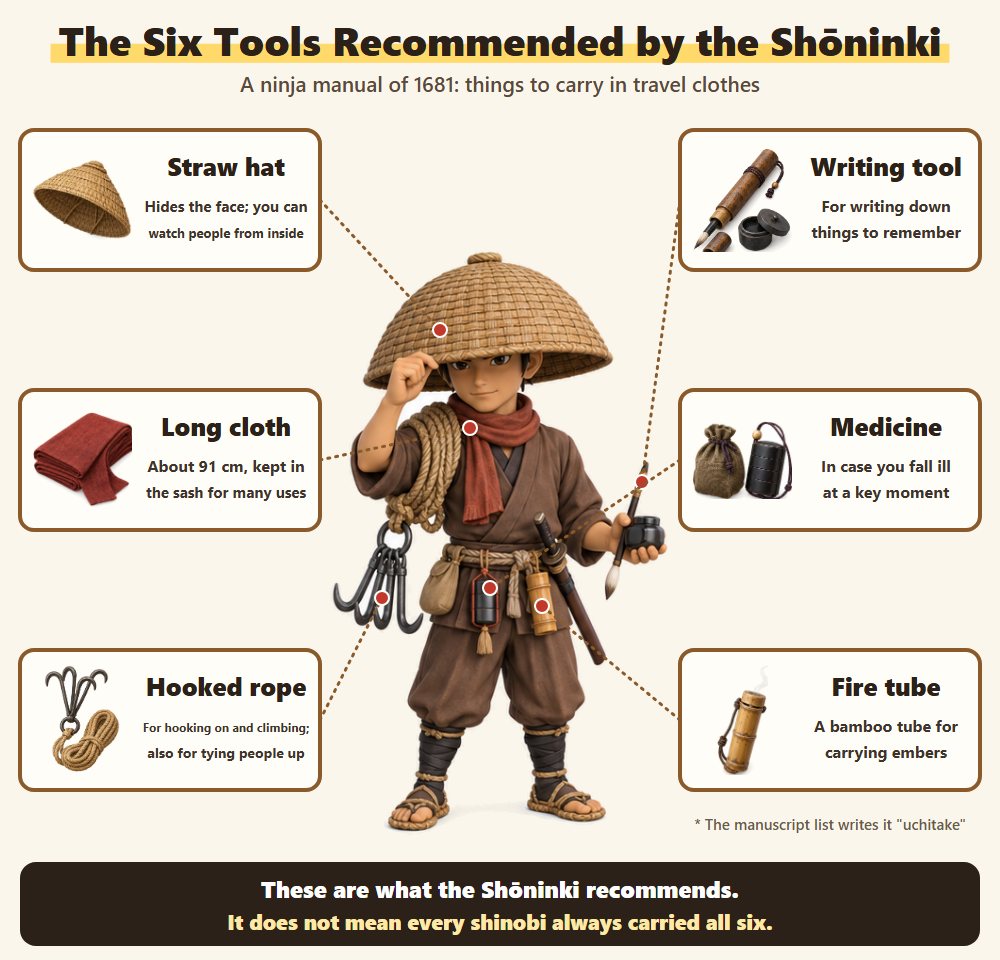
The Shōninki recommends six things to carry: a deep straw hat, a hooked rope, a writing implement, medicine, a long cloth and a fire-carrying tube.
They all look like ordinary travel gear!
The "six tools of the shinobi" (shinobi rokugu) are listed in the ninja manual Shōninki (1681) [Fact].
| Tool | Use |
| Amigasa (deep straw hat) | Hides the face and lets you watch people from inside the hat |
| Kaginawa (hooked rope) | For hooking on and climbing; also for tying people up |
| Sekihitsu (writing implement) | For writing things down (the exact form in this book is not known) |
| Kusuri (medicine) | In case you fall ill at an important moment |
| Sanjaku tenugui (long cloth) | A cloth about 91 cm long, kept in the sash for many uses |
| Tsuketake (fire tube) | A bamboo tube for carrying embers, used when fire is needed at night |
In the manuscript of the Shōninki at the National Diet Library, the fire tube is written "uchitake" in the list and "tsuketake" in the explanation [Fact].
The six tools are what the Shōninki recommends. It does not mean every shinobi always carried all six.
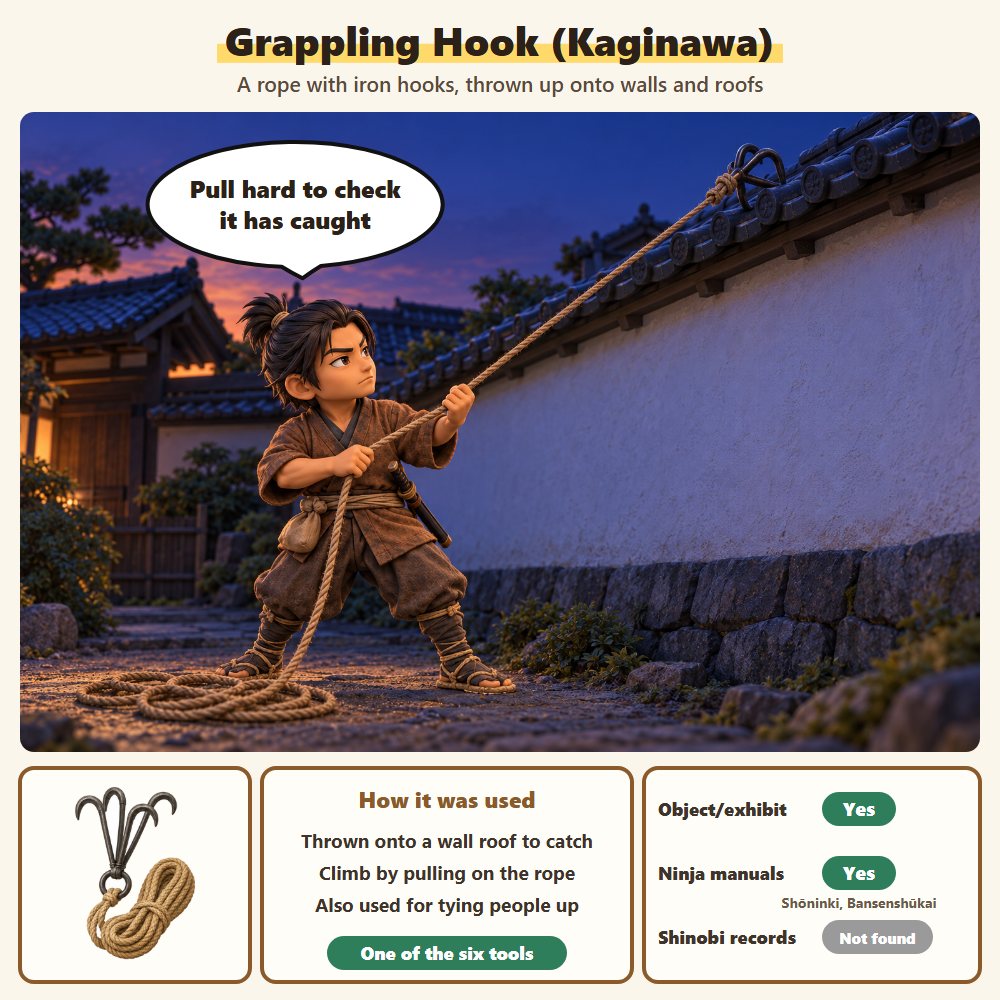
The Bansenshūkai also draws the hooked rope, as uchikagi: four forged iron hooks gathered in an iron ring, with a hemp rope of one jō five shaku (about 4.5 m) [Fact].
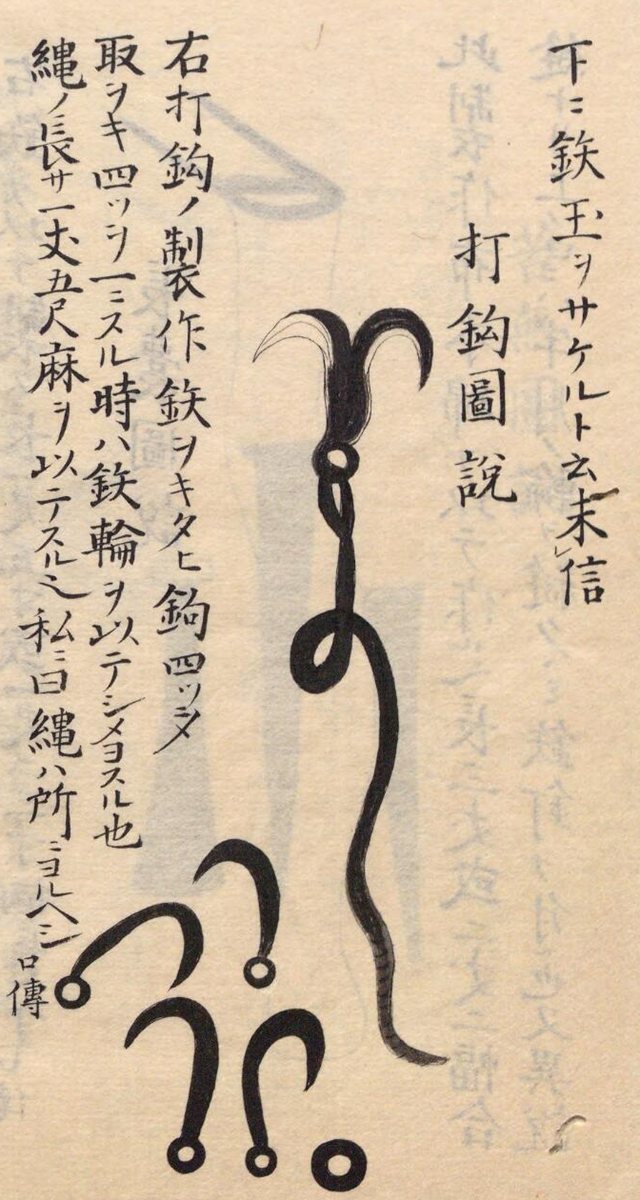
Image: The grappling hook (uchikagi) diagram in Bansenshūkai, volume 18 (manuscript copy). National Archives of Japan (Naikaku Bunko, call no. 特113-0005, book 9, frame 8; cropped)
Ration pills
Separate from the "medicine" of the six tools, the Bansenshūkai is said to give recipes for portable food and medicine: hyōrōgan (ration pills), kikatsugan (against hunger) and suikatsugan (against thirst) [Widely accepted].
Hisamatsu Makoto of Mie University has introduced the ingredients of a ration pill from a later manual, the Kōshū-ryū Ninpō Densho Rōdanshū (a copy of 1845), and calculated its nutrition [Widely accepted].
Tools for Climbing, Water, Opening and Fire
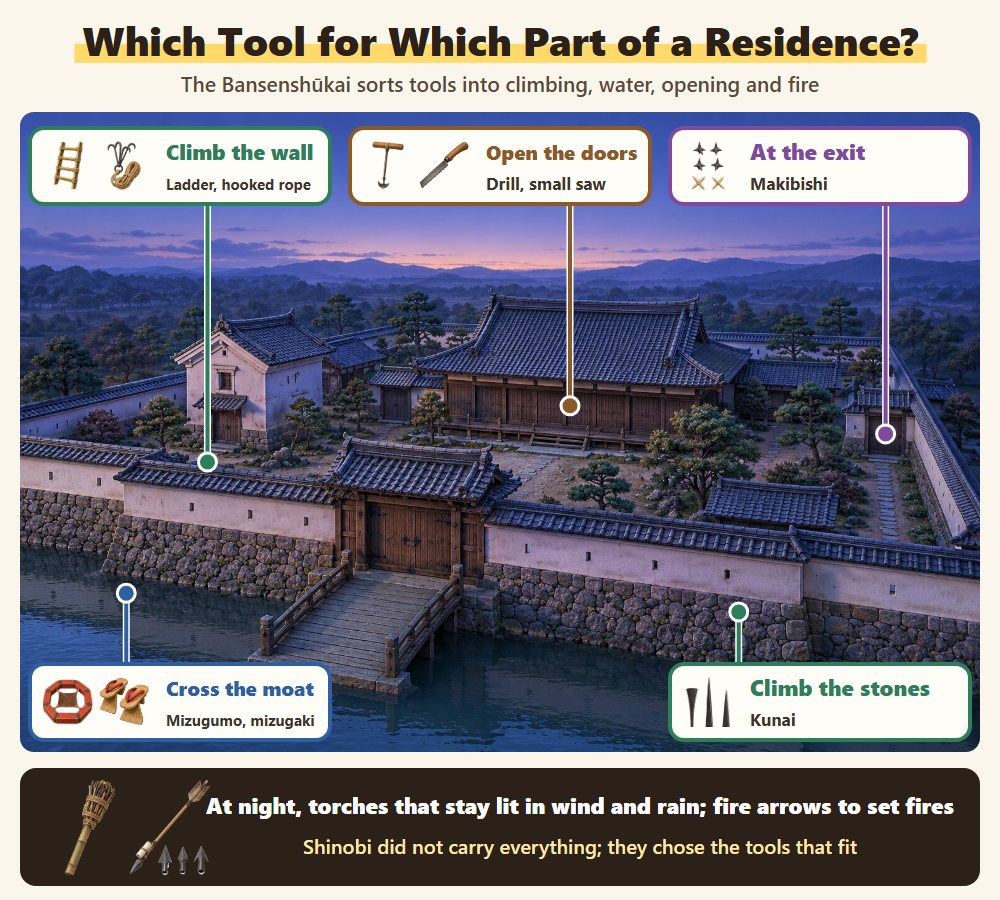
Moats call for the mizugumo, walls for ladders and hooked ropes, doors for drills and saws. Each place has its tool.
That many tools just to get inside a residence!
The Bansenshūkai sorts shinobi tools into four groups: climbing tools, water tools, opening tools and fire tools [Fact].
- Climbing tools: bamboo ladders, the grappling hook (uchikagi), the kunai and more. One ladder is made by carrying just two bamboo poles and assembling it on the spot
[Fact]. - Water tools: the mizugumo, mizugaki, a floating bridge, a raft of bundled reeds and more
[Fact]. - Opening tools: a tool for lifting door latches, drills, a small saw (shikoro), shears, a folding sickle and more
[Fact]. The manual says to avoid tools that are bulky, numerous or noisy[Fact]. - Fire tools: torches, fire arrows and more — not firearms. The manual gives three advantages: setting fire to castles and camps, signaling to allies, and torches that stay lit in wind and rain
[Fact]. Over 200 fire tools and recipes are said to be described[Widely accepted].
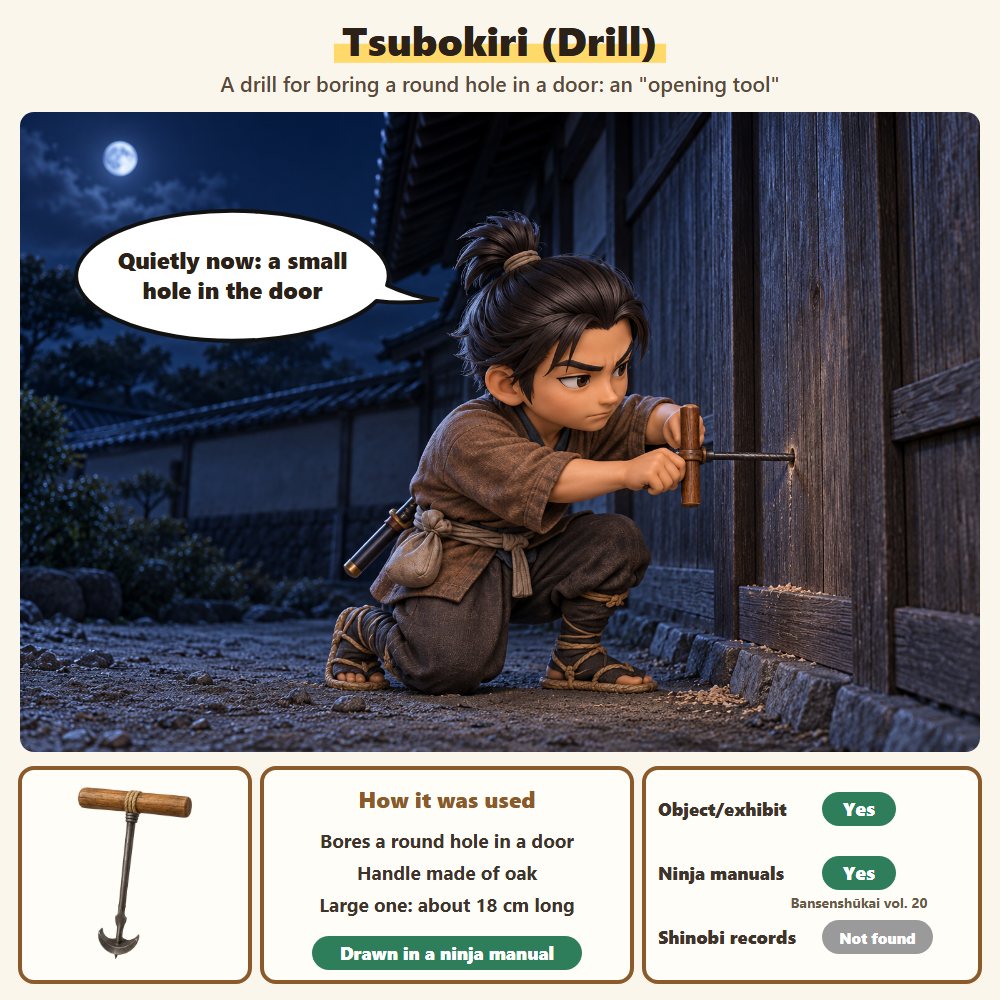
The tsubokiri is a drill for making a round hole in a door. In the Bansenshūkai, the large tsubokiri is six sun (about 18 cm) long overall, with a handle of oak [Fact].
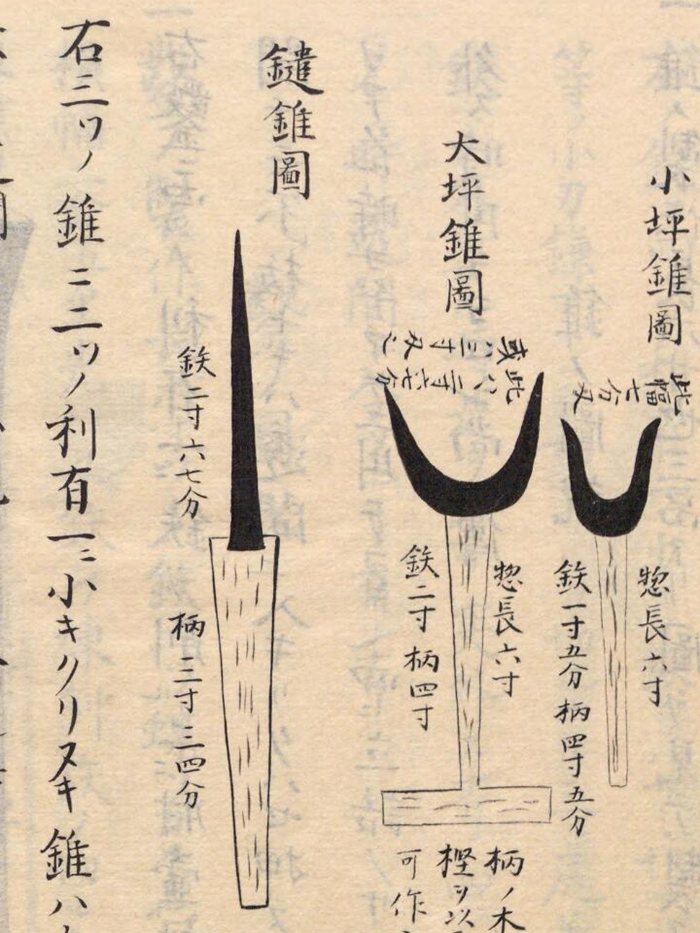
Image: Drill diagrams in Bansenshūkai, volume 20 (manuscript copy). National Archives of Japan (Naikaku Bunko, call no. 特113-0005, book 9, frame 28; cropped)
Did Ninja Carry All Their Tools?
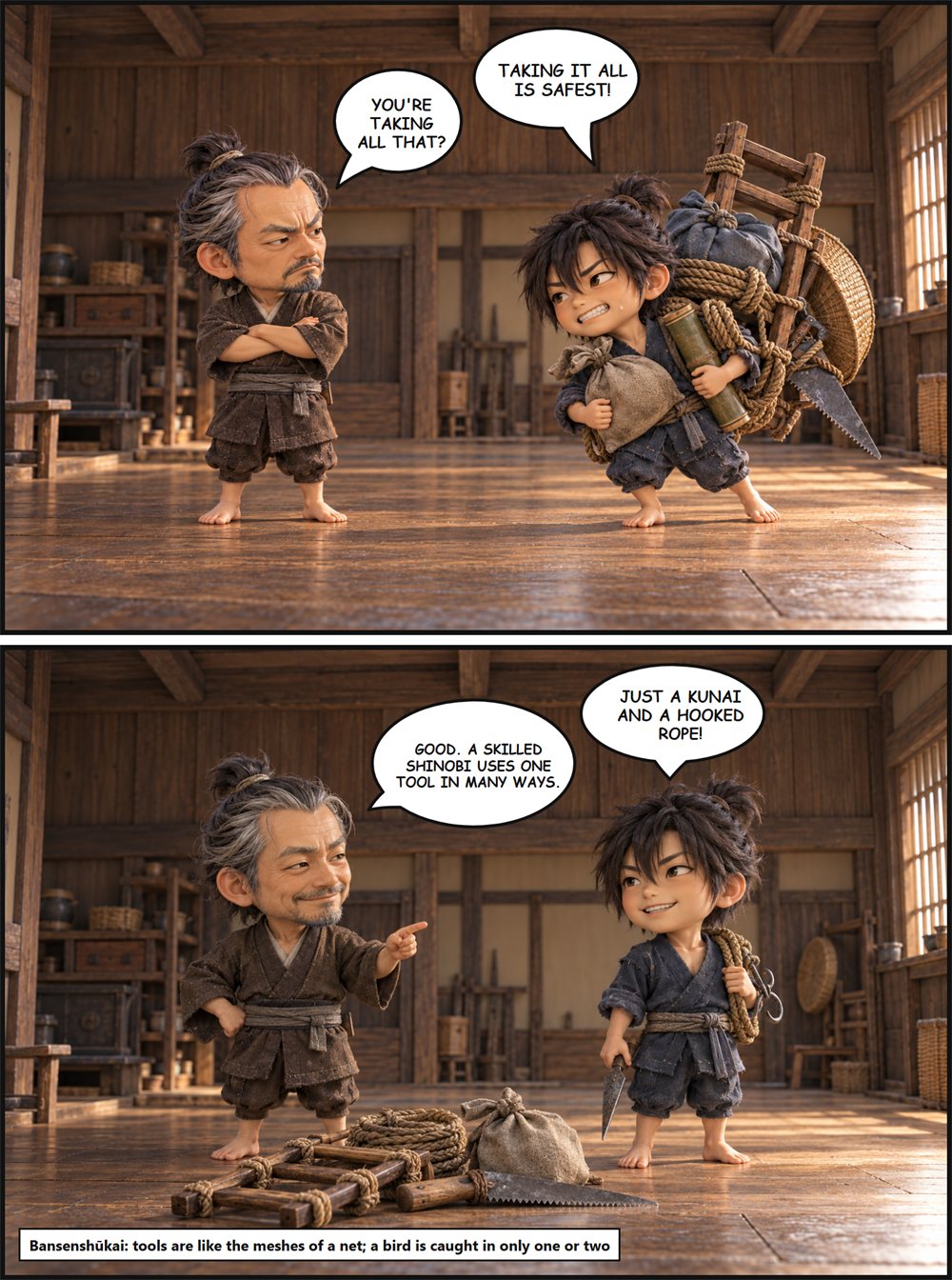
The Bansenshūkai advises against carrying many tools. The opening of the climbing-tools volume says [Fact]:
Primary Source: Bansenshūkai, Opening of Volume 18
Source
A manuscript copy of the Bansenshūkai (National Archives of Japan, Naikaku Bunko, call no. 特113-0005, book 9, frame 3)
Original (excerpt)
譬ハ網ノ目ノコトシ / 忍器モ亦其コトシ / 多持行コトナカレ
Translation (summary)
Tools are like the meshes of a net. However many meshes there are, a bird is caught in only one or two. So it is with shinobi tools. Do not carry many. A skilled shinobi uses one tool in many ways.
What it shows
The manual taught shinobi to think about the situation and take only the tools that fit it.
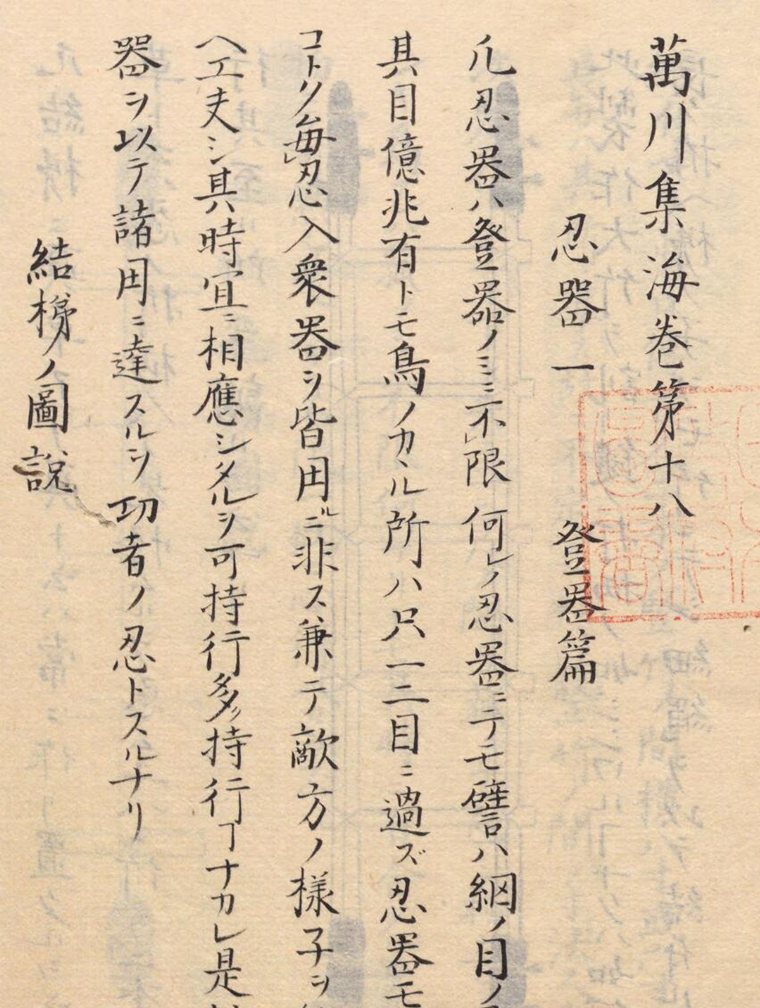
Image: The opening of the climbing-tools volume, Bansenshūkai, volume 18 (manuscript copy). National Archives of Japan (Naikaku Bunko, call no. 特113-0005, book 9, frame 3; cropped)
What Did Real Shinobi Order? A List from 1628
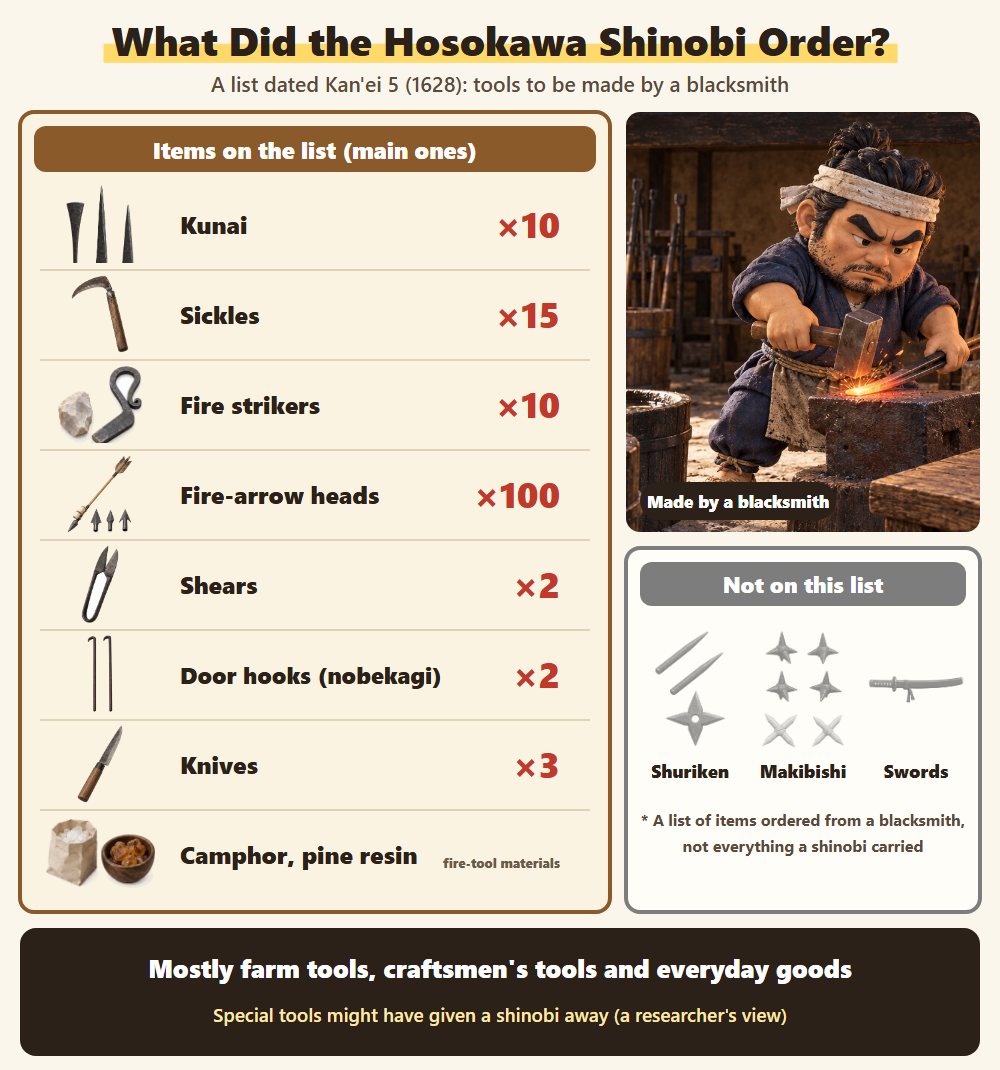
In 1628 the head of the Hosokawa shinobi wrote down the tools to be made by a blacksmith, with numbers and prices. A record of real shinobi tools.
Ten kunai and a hundred fire-arrow heads!
On the 19th day of the 7th month of Kan'ei 5 (1628) in the Japanese lunisolar calendar, Yoshida Sukeemon, head of the Oshinobi-no-shū — the shinobi unit serving Hosokawa Tadatoshi, then lord of Kokura in Buzen Province — put his seal on a written list [Fact]. It records the items, numbers and prices of shinobi tools to be made by a blacksmith [Fact].
| Item in the list | Number | What is it? |
| kunai | 10 | An iron tool for climbing and boring holes |
| kama (sickle) | 15 | For clearing brush |
| hiuchi (fire striker) | 10 | For making fire |
| hiya no ne (fire-arrow heads) | 100 | Arrowheads for fire arrows |
| hasami (shears) | 2 | For cutting small pieces of iron, bamboo or wood |
| nobekagi | 2 | A tool for opening doors |
| hōchō (knife) | 3 | Possibly a small utility knife (Ueda's view) |
| camphor, pine resin | – | Materials for fire tools |
Ueda Tetsuya, who studied this list, points out that the tools were made in bulk by a blacksmith and that many were farm tools, craftsmen's tools or everyday goods. He thinks special tools would have risked giving a shinobi away [Widely accepted].
Some item names match tools in the later ninja manuals [Widely accepted], but we cannot tell whether they had the same shapes and sizes.
Shuriken, makibishi and swords do not appear in this list [Fact]. But it is a list of items ordered from a blacksmith, not everything a shinobi carried.
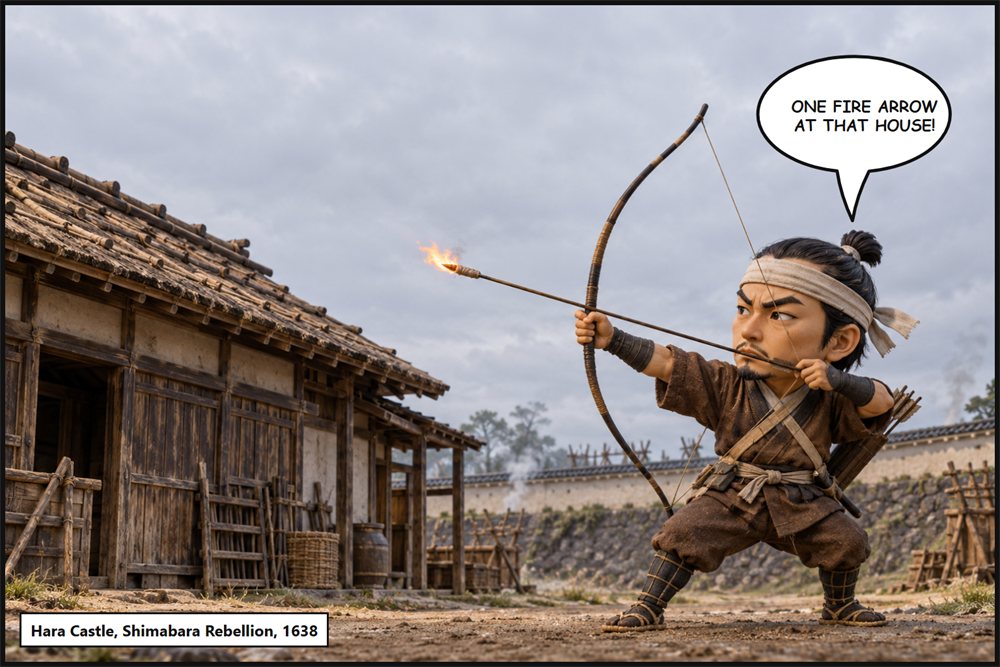
There is also a record of Hosokawa shinobi using such tools. On the 28th day of the 2nd month of Kan'ei 15 (1638), at Hara Castle during the Shimabara Rebellion, Yoshida Jūemon (Sukeemon's son) of the Oshinobi-no-shū is recorded to have shot a fire arrow at the half-burned house of Amakusa Shirō and set it alight [Fact]. This is a separate record from the 1628 list.
Primary Source: Records of the Hosokawa Shinobi
Source
Bubun Gokyūki, volume 41 (the 1628 list) and volume 49 (the 1638 record), as transcribed in the Kumamoto Kenshiryō and quoted by Ueda Tetsuya, "The Shinobi of the Hosokawa of Kumamoto Domain" (Ninja Kenkyū no. 3, 2020)
Original (excerpt)
くない 十 代十匁
本丸ニ而四郎家ニ弓火矢仕焼立申候 御しのび吉田十右衛門
Translation
Kunai, ten; price, ten monme of silver (a monme is about 3.75 g).
In the main compound, a fire arrow was shot with a bow at Shirō's house and burned it. Yoshida Jūemon, of the shinobi.
What it shows
In the early Edo period, shinobi serving a daimyo had tools such as kunai made, and used fire arrows in battle.
Did Ninja Use Smoke Bombs, Blowguns and Hand Claws?
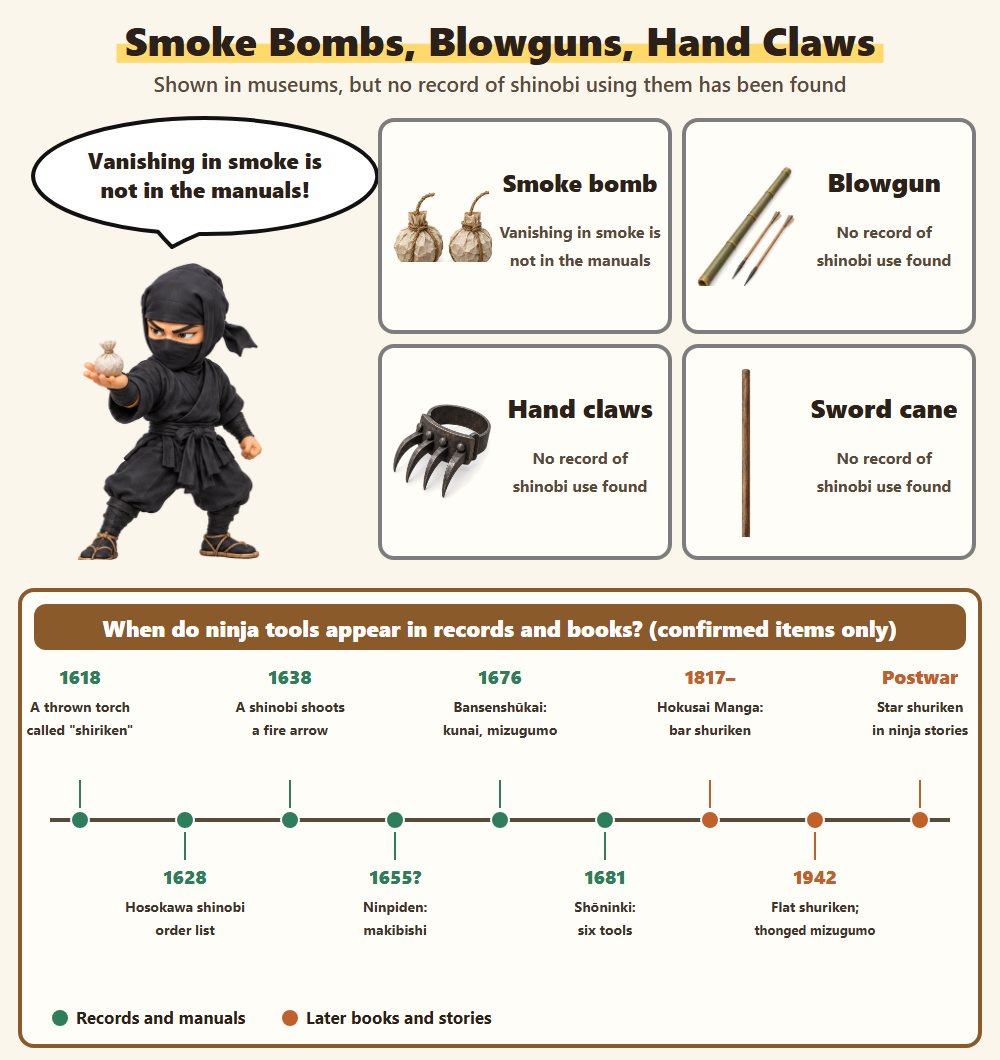
Researchers find no trick of vanishing in a puff of smoke in the manuals. Edo-period stories made ninja into sorcerers.
And blowguns and hand claws aren't in the manuals either?
Yamada Yūji and other researchers note that the ninja manuals contain no technique for vanishing in a puff of smoke [Widely accepted]. In the manuals we checked for this article, we also found no tool for hiding behind a smoke screen [Unknown]. Edo-period stories portrayed ninja as sorcerers who commanded giant snakes and toads [Fiction].
The fire-tools volume of the Bansenshūkai does include an item called torinoko [Fact].
Blowguns (fukiya), hand claws (tekkōkagi) and sword canes (shikomizue) are sometimes shown as ninja tools in museums. The tools themselves existed, but we could not confirm in the manuals or records that shinobi used them [Unknown].
Where to See Ninja Tools
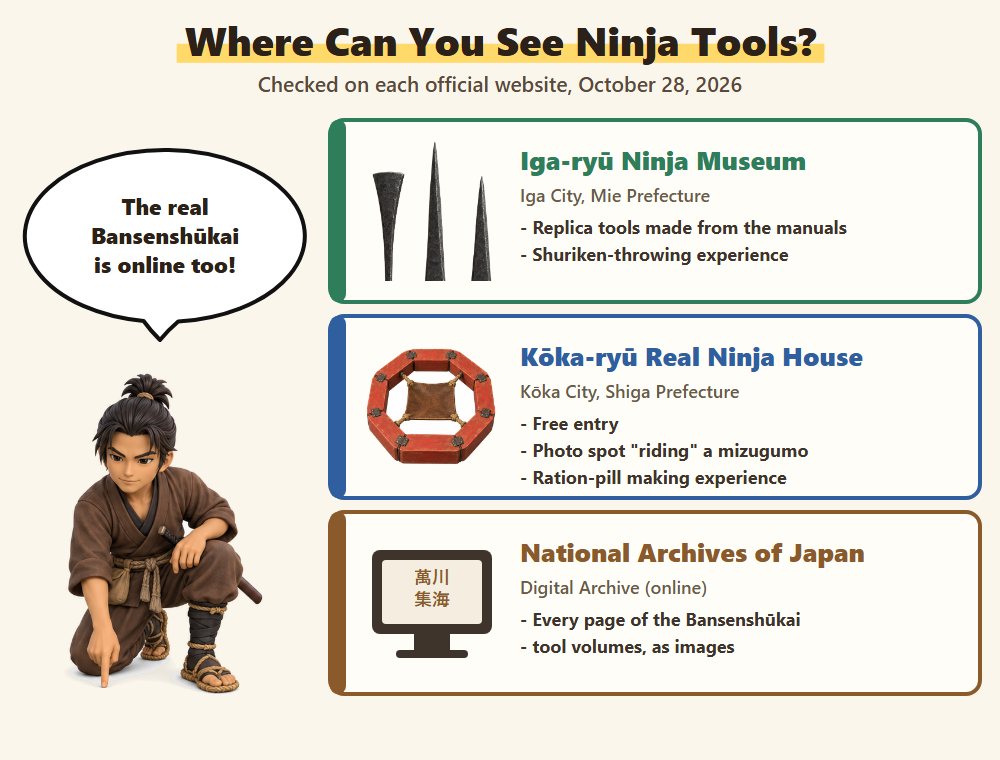
In Iga and Kōka you can see tools made from the manuals.
And the whole Bansenshūkai can be read online!
The Iga-ryū Ninja Museum (Iga City, Mie Prefecture) shows replica tools made from the ninja manuals (checked on the official website, October 28, 2026).
The Kōka-ryū Real Ninja House (Kōka City, Shiga Prefecture) is free to enter, with a photo spot where you seem to ride a mizugumo and a ration-pill making activity (checked on the official website, October 28, 2026).
The National Archives of Japan Digital Archive shows every page of the Bansenshūkai tool volumes introduced here.
FAQ
Which ninja tools are in the records?
P: Edo-period ninja manuals describe the kunai, grappling hook, ladders, mizugumo, makibishi, drills, torches and more. The 1628 order list of the Hosokawa shinobi includes kunai, sickles, fire strikers and fire-arrow heads (more).
Did ninja really use shuriken (ninja stars)?
P: Shuriken were real weapons used in samurai martial-arts training, but no record of shinobi using them has been found (more).
Was the kunai a throwing weapon?
P: In the manual it is a climbing tool, and in the sources we checked we found no description of throwing it (more).
Could ninja walk on water with the mizugumo?
P: No. The mizugumo is a ring-shaped float, not shoes. One theory says users sat in the ring; another says they wore it around the waist. Its exact use is not known (more).
Did the ninjatō really exist?
P: The familiar design — a straight blade with a large square guard, worn on the back — has not been confirmed, in surviving swords or in the manuals, as a special shinobi sword (more).
Summary: What Weapons and Tools Did Ninja Use?
Summary
- Edo-period ninja manuals mostly describe tools for climbing, crossing water, opening doors and using fire.
- The kunai is drawn in the Bansenshūkai and appears in a 1628 order list of the Hosokawa shinobi.
- Makibishi are in the Ninpiden, and the mizugumo in the Bansenshūkai. The mizugumo was not for walking on water.
- Shuriken and the kusarigama were real martial-arts weapons, but no record of shinobi using them has been found.
- The familiar straight "ninja sword" is not confirmed as a shinobi weapon, and researchers find no vanishing-in-smoke technique in the manuals.
Real shinobi tools looked like ordinary tools, which may have helped shinobi avoid being found out.
Next I'll read whether ninja were real at all!
For how shinobi appear in the records, the regional groups and famous ninja, see Were Ninjas Real? For the warrior who led the men of Iga, see our article on Hattori Hanzō.
Sources & How This Article Was Written
This article is based mainly on the following records and references:
- Ninja manuals: a manuscript copy of the Bansenshūkai (National Archives of Japan, Naikaku Bunko, call no. 特113-0005, book 9); a manuscript copy of the Shōninki (National Diet Library, call no. 214-9)
- Studies (in Japanese; titles translated by us): Ueda Tetsuya, "The Shinobi of the Hosokawa of Kumamoto Domain" (Ninja Kenkyū no. 3, International Ninja Research Society, 2020); Yamada Yūji, "The Bansenshūkai in the Sanada Treasure Museum" (Ninja Kenkyū no. 7, 2024); Yamada Yūji, "Iga, Home of the Ninja" (a series on Iga Portal: the makibishi, shuriken, water and fire installments)
- Public sources: National Diet Library, "NINJA: In Fiction and in Reality" (Kaleidoscope of Books no. 33, 2023); Japan Tourism Agency, multilingual commentary database (Kōka City, "Ninja Tools," FY2024); Iga-ryū Ninja Museum, "Iga-ryū Ninjutsu"
- Dictionaries: Kotobank (the Sekai Daihyakka Jiten, Nihon Daihyakka Zensho and Nihon Kokugo Daijiten entries for shuriken, kusarigama and tetsubishi)
- Images: The Bansenshūkai drawings are held by the National Archives of Japan (cropped). The photos of the makibishi, kunai and shuriken on display are by Motokoka (CC BY-SA 4.0, Wikimedia Commons).
What the Labels Mean
[Fact]Confirmed by sources from the time (including what a manual drawing or record says)[Widely accepted]A view widely accepted by researchers[Debated]Accounts or interpretations differ[Unknown]Not established from the sources we checked[Legend]Stories found in later records or local traditions[Folk belief]Widely believed, but no supporting evidence has been found[Fiction]Details created for novels, plays or manga
We keep "what a record says" separate from "what actually happened."
This article was written by the Samurai Lord editorial team and is revised as new research and reader feedback come in. If you spot an error, please let us know through our contact form (in Japanese) and we will check and correct it.
Read in Japanese
This article is also available in Japanese: 忍者の武器・道具は何があった?まきびし・鎖鎌・苦無・水蜘蛛などを詳しく紹介!