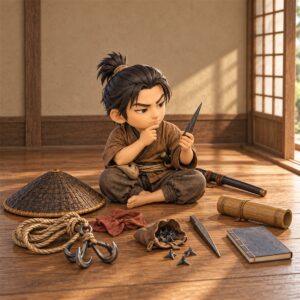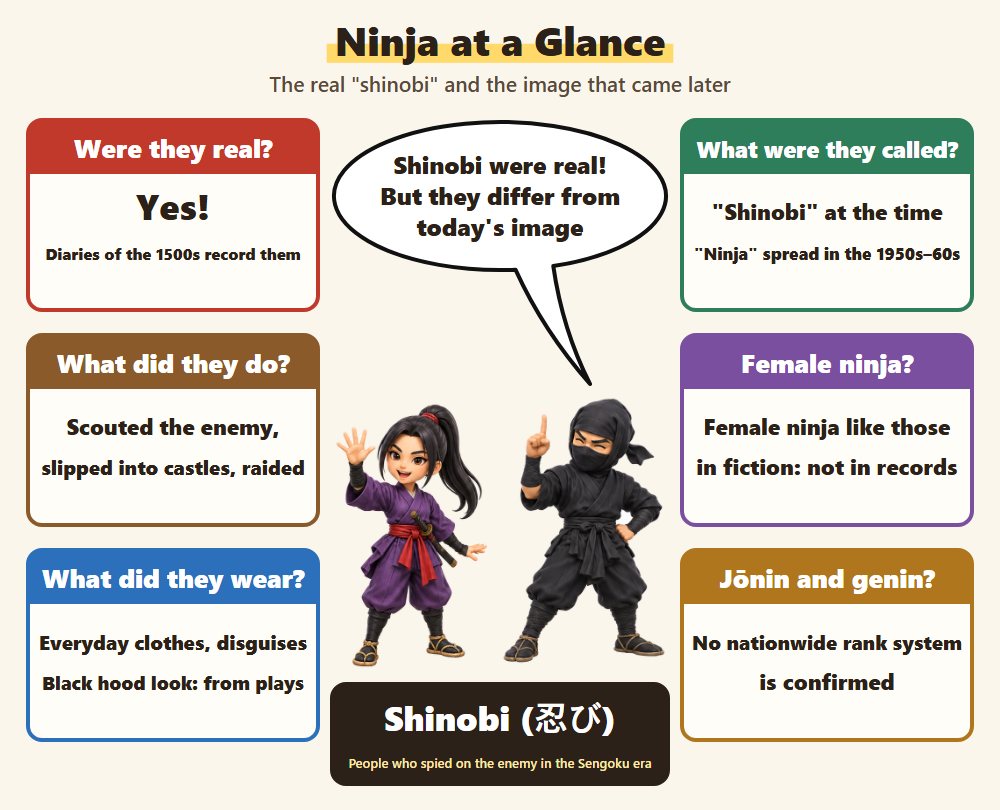
Were ninjas real? Yes. People called "shinobi" really existed [Fact].
But the black-hooded ninja throwing stars is an image that spread later, through Edo-period plays and other works [Widely accepted].
In this article, we separate the real shinobi of the records from the image that came later. Compare 14 regional groups and eight famous figures through maps, illustrated cards and the sources behind their stories, and see what is known about kunoichi.
Japanese months and days refer to the historical lunisolar calendar. Key points are tagged: [Fact] confirmed by records from the time ([Fact: …] means the named record says so), [Widely accepted] a view widely accepted by researchers, [Debated] accounts or interpretations differ, [Unknown] not established from the sources we checked, [Legend] stories from later records or tradition, and [Fiction] details created for novels or plays (details).

I am Uesugi Kenshin. Today's subject is the ninja.

I'm Date Masamune! Ninja wore black and threw stars, right?

That look spread through Edo-period plays. Let us look at the real shinobi in the records.
The Short Answers
- Were they real? Yes. Shinobi appear in a diary of 1541 (more)
- What did they do? Scouted the enemy, slipped into castles and made night raids (more)
- What does "shinobi" mean? Someone who acts in secret; it was used for spies and infiltrators. "Ninja" spread in Japan from the late 1950s (more)
- Were there female ninja? No reliable record confirms female ninja like those in modern fiction (more)
- Where were they? Iga and Kōka, plus stories tied to the Hōjō, Takeda, Date and others (more)
- What did they wear? Everyday clothes and disguises. The black-hooded look came from plays (more)
Jump to the part you want to read:
- Were ninjas real? What the records show
- What did ninja do? Ninja vs. samurai
- What does "shinobi" mean? Where the word "ninja" comes from
- Kunoichi: were there female ninjas?
- Ninja groups across Japan and the lords they served
- Famous ninja: was Hattori Hanzō a ninja?
- Ninja outfit: what did real shinobi wear?
- Ninja weapons and tools: what is documented?
- Ninja ranks: jōnin, chūnin and genin
- Do ninjas still exist? Where to see ninja history
- FAQ
Were Ninjas Real? What the Records Show
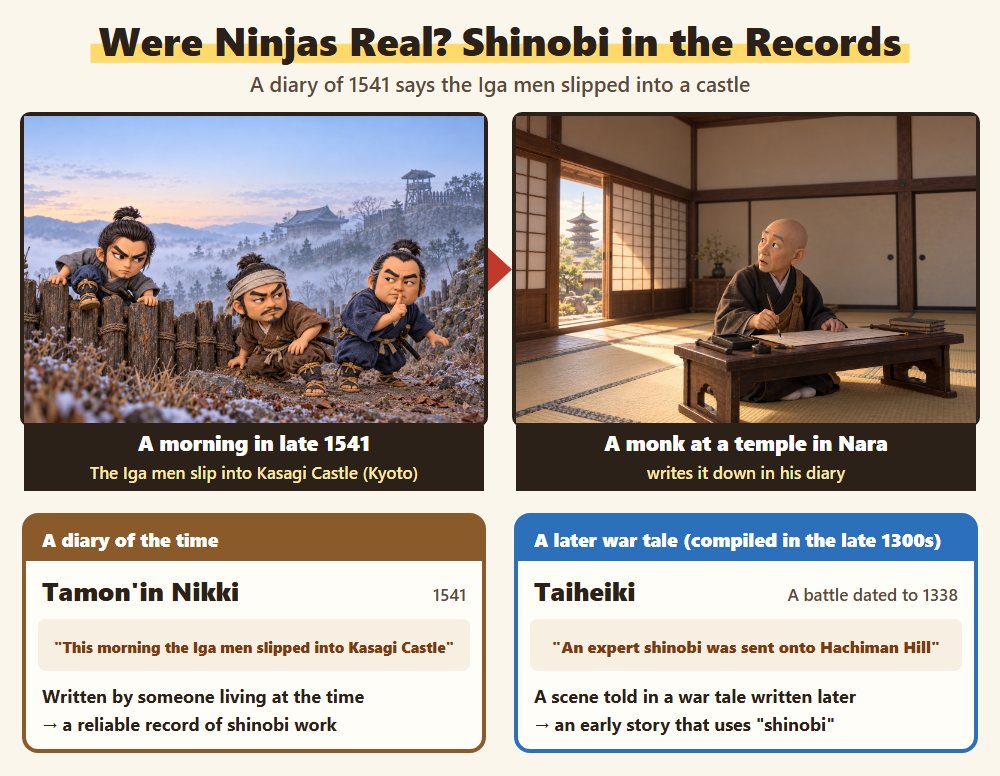
A diary of 1541 says the Iga men slipped into a castle. Real shinobi work was written down at the time.

So real shinobi truly existed!
The Tamon'in Nikki, a diary kept by monks of Tamon'in at Kōfuku-ji temple in Nara, says that one morning in late 1541 (the 26th day of the 11th month of Tenbun 10), the "Iga-shū" (men of Iga) slipped into Kasagi Castle in today's Kyoto Prefecture [Fact]. It adds that they set fire to some of the monks' quarters.
From the Sources: The Tamon'in Nikki (1541)
Source
The Tamon'in Nikki, a diary by monks of Kōfuku-ji temple in Nara. The wording follows the passage quoted from this diary in the Buke Myōmokushō, a late Edo-period compilation (the 1935 printed edition edited by Tsuji Zennosuke begins the same way)
Original (excerpt)
「今朝伊賀衆笠置城忍ヒ入テ少々坊舎放火」
Translation
This morning, the Iga men slipped into Kasagi Castle and set fire to a few of the monks' quarters.
What this tells us
That in the Sengoku period, men from Iga did the work of slipping into castles, and that someone living at the time wrote it down.
The word "shinobi" also appears in an older work, the Taiheiki, a war tale compiled in the late 1300s. In a battle dated to 1338, "an expert shinobi" is sent onto Hachiman Hill [Fact: Taiheiki]. War tales were written afterward, though, so whether the scene really happened is a separate question [Legend].
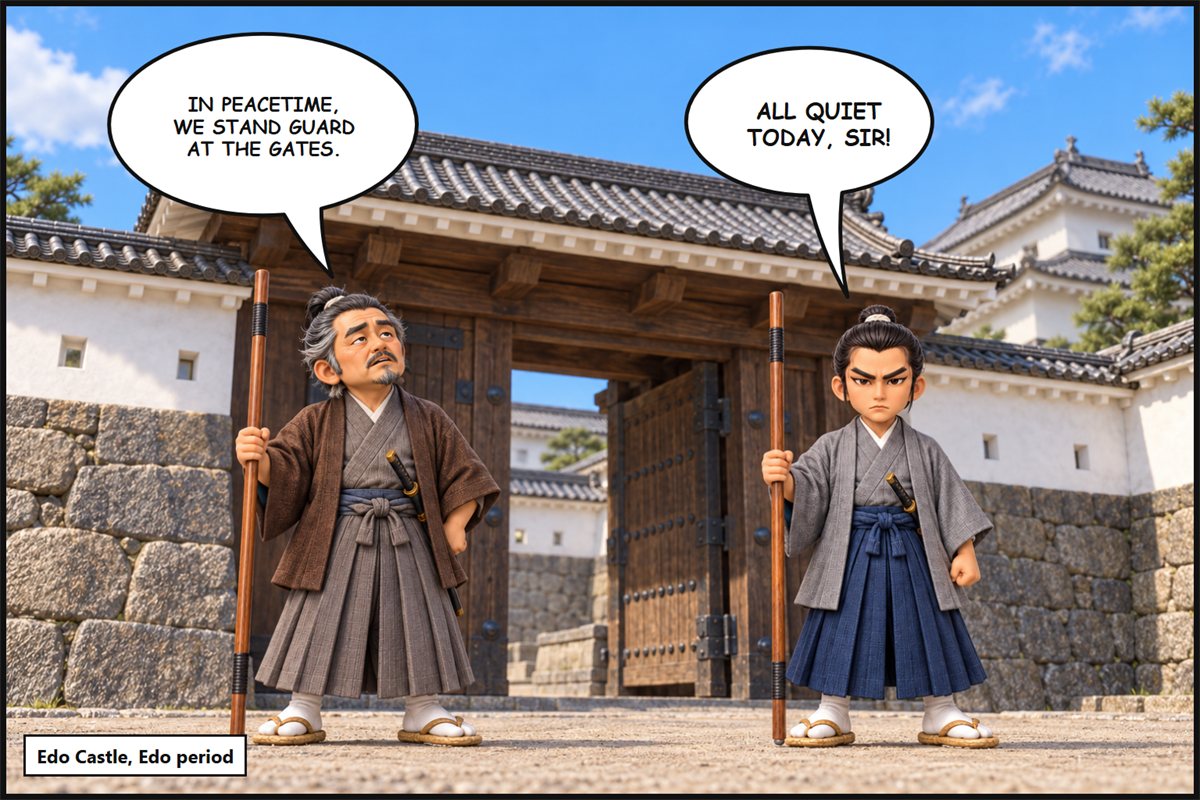
Shinobi were most active in the Sengoku ("Warring States") period of the 1400s–1500s. In the peaceful Edo period (1603–1868), their work shifted to serving the shogunate (Japan's military government) and domains (han, territories governed by regional lords) as gate guards and watchmen [Widely accepted].
What Did Ninja Do? Ninja vs. Samurai
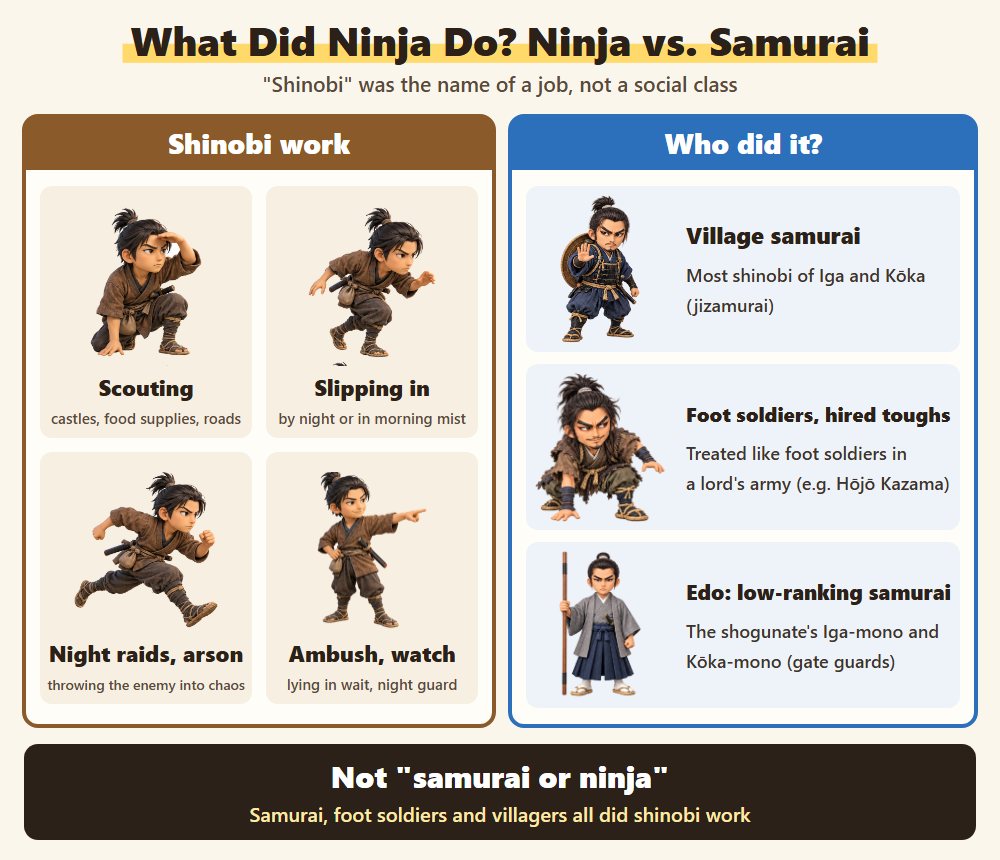
"Shinobi" was the name of a job, not a social class. Samurai, foot soldiers and villagers did this work.
I thought samurai and ninja were different people!
A shinobi's most important job was finding out about the enemy: the land, the castles and the food supplies. They also made night raids, set fires, seized castles, laid ambushes and kept watch at night [Widely accepted].
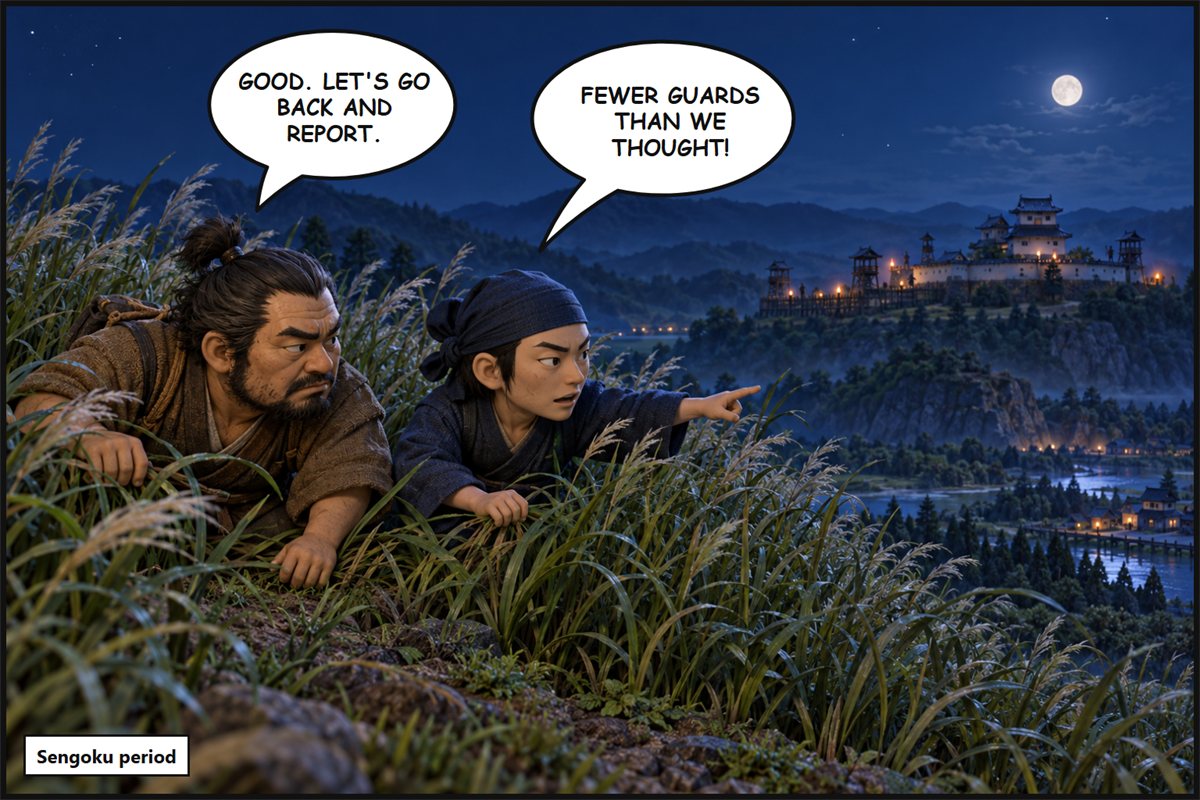
"Samurai" described a social status, while "shinobi" described a role; the same person could be both. Many shinobi of Iga and Kōka were local samurai landholders known as jizamurai. In the armies of Sengoku warlords, shinobi were treated much like foot soldiers (ashigaru), and rough hired men were sometimes among them [Widely accepted].
In the Edo period, the "Iga-mono" were low-ranking samurai of the shogunate, below the rank allowed to meet the shogun [Widely accepted]. So instead of asking "samurai or ninja?", it is more accurate to say that samurai, foot soldiers and villagers all did shinobi work.
What Does "Shinobi" Mean? Where the Word "Ninja" Comes From
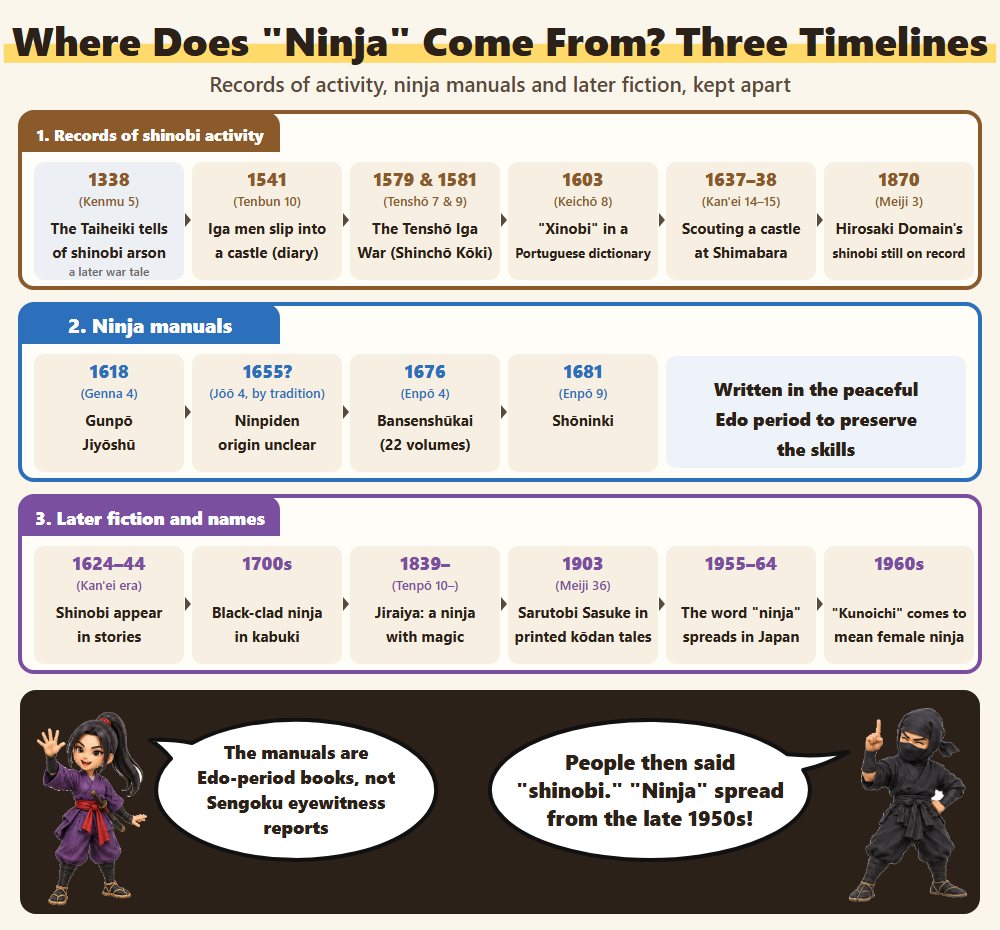
People at the time said "shinobi." The reading "ninja" spread in Japan from the late 1950s.
And the ninja manuals were written in the Edo period, not the Sengoku period!
"Shinobi" (忍び) comes from a verb meaning to move secretly or stealthily. Besides "shinobi," different regions used names such as suppa, rappa, kusa and kamari [Widely accepted]. The Nippo Jisho (Vocabulario da Lingoa de Iapam), a Japanese–Portuguese dictionary published in 1603, lists "Xinobi" as a spy who slips into castles or camps in wartime to learn about the enemy [Fact].
The reading "ninja" (忍者) became common in Japan through novels and manga of the late 1950s and early 1960s [Widely accepted]. The word "ninja" was appearing in English by the early 1960s.
Ninja Manuals: What Is the Bansenshūkai?
After the wars ended in the Edo period, ninja manuals were written to preserve the skills [Widely accepted]. The three best-known are the Bansenshūkai (1676), the Shōninki (1681) and the Ninpiden (said to have been compiled in 1655).
The Bansenshūkai has 22 volumes and is thought to have been compiled by Fujibayashi Yasutake of Iga [Widely accepted]. It covers the right state of mind (seishin), how a commander should use shinobi (shōchi), infiltrating openly (yōnin) and in secret (innin), reading the weather and the time (tenji), and tools (ninki). Its opening section on seishin teaches that the arts must never be used for personal gain [Widely accepted].
Because it was compiled in a time of peace, not every method it describes was necessarily used in the Sengoku period.
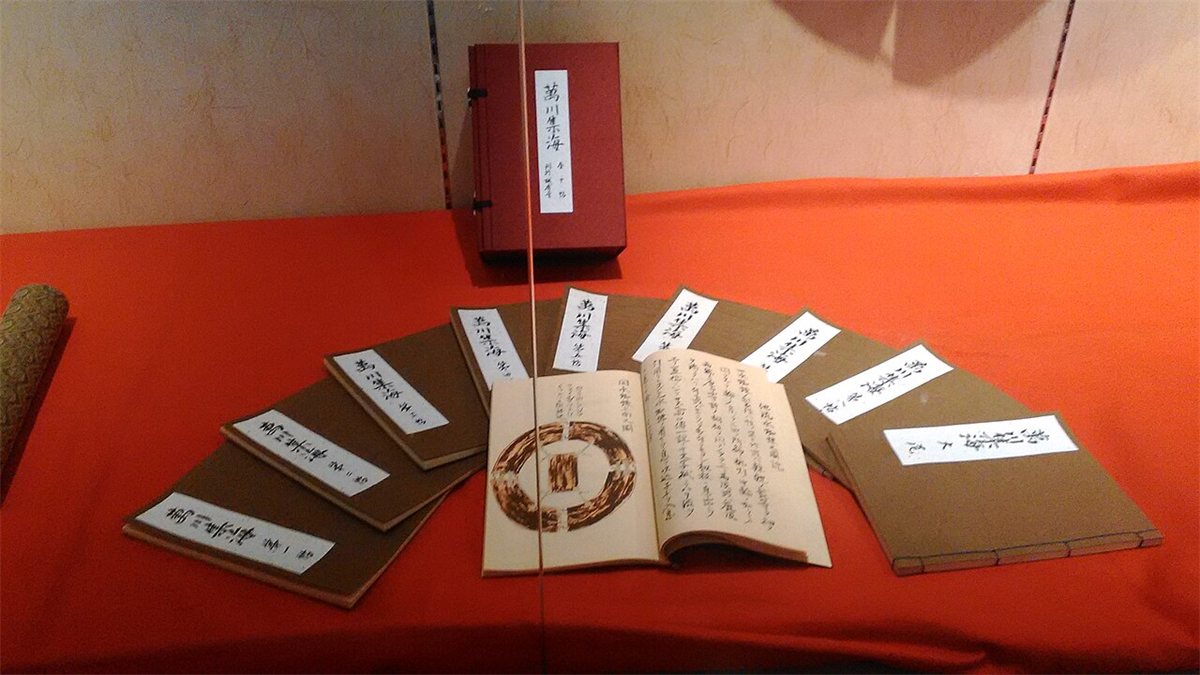
Image: The Bansenshūkai on display at Shinobi no Sato PLALA in Kōka City, Shiga Prefecture. Wikimedia Commons (photo: Motokoka, CC BY-SA 4.0)
Edo-period fiction also turned ninja into sorcerers who rode giant toads or commanded serpents. Jiraiya of the Jiraiya Gōketsu Monogatari (from 1839) is one example [Fiction].
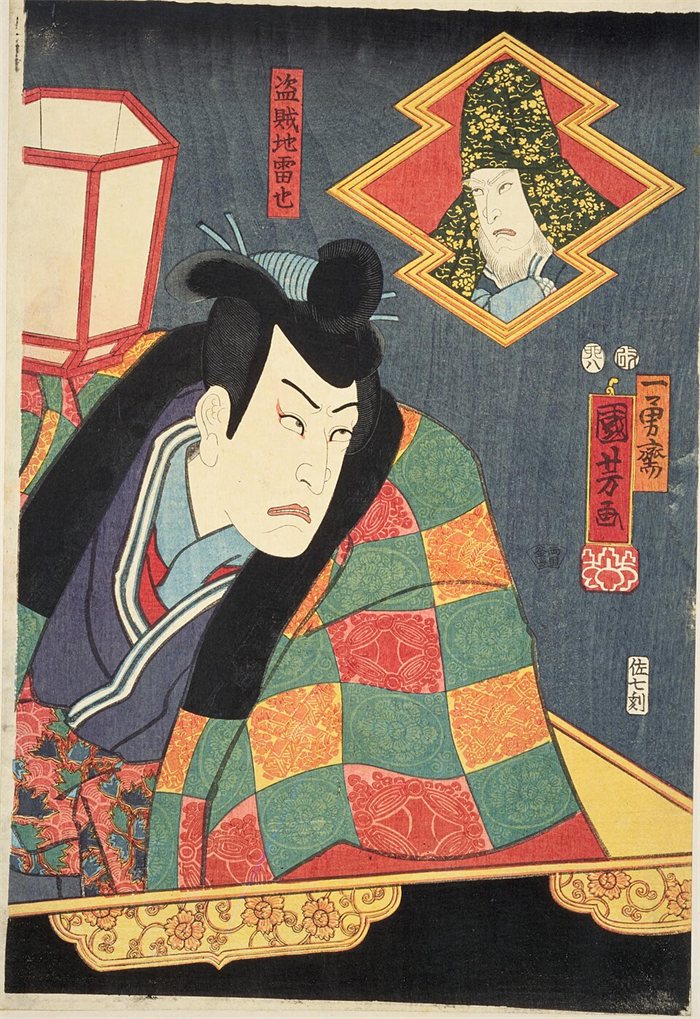
Image: Utagawa Kuniyoshi, "The Bandit Jiraiya" (1855). Public domain (National Diet Library / Wikimedia Commons)
Kunoichi: Were There Female Ninjas?
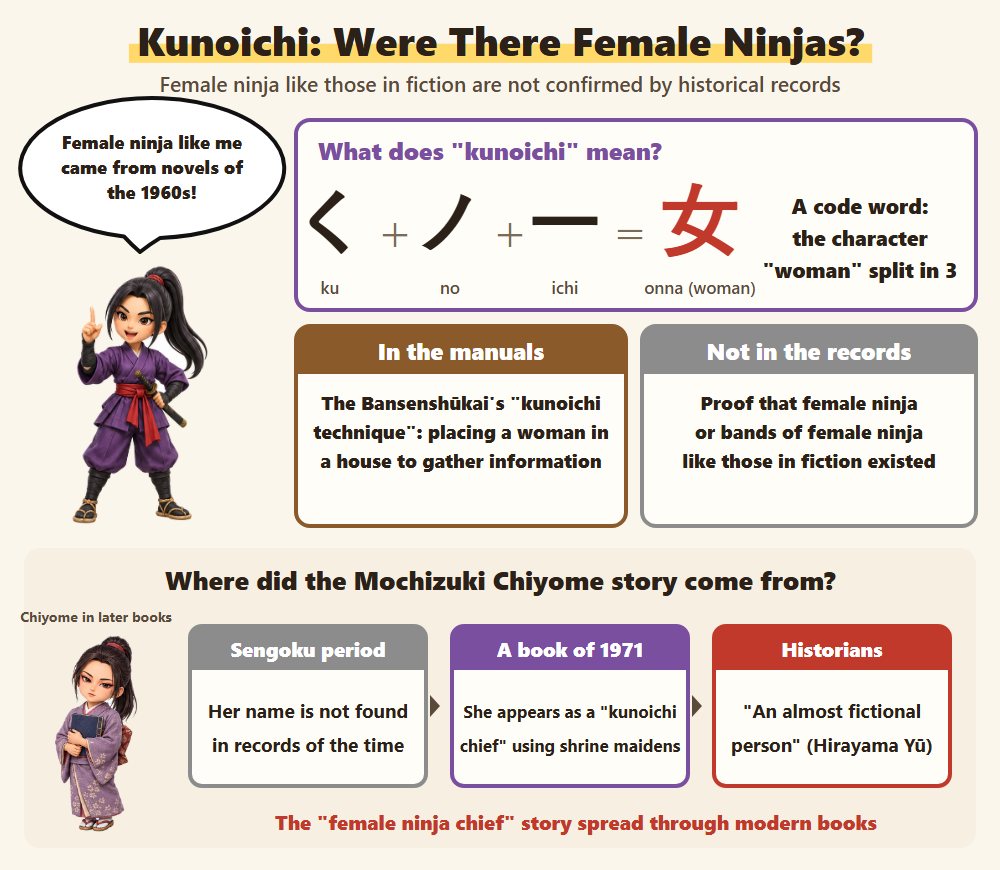
A manual describes placing women inside a household to gather information. That is not proof of bands of female ninja.
And the Chiyome story came from a much later book!
"Kunoichi" (くノ一) is a code word made by splitting the character for "woman" (女) into three parts: ku, no and ichi [Widely accepted].
The Edo-period manual Bansenshūkai describes a "kunoichi technique": placing a woman in a place men cannot enter, such as the inner quarters of a household, to gather information [Widely accepted]. It does not describe female ninja as such.
No reliable record of female ninja like those in today's fiction has been found [Widely accepted]. "Kunoichi" came to mean "female ninja" through Japanese novels, especially from the 1960s [Widely accepted].
Was Mochizuki Chiyome Real?
Mochizuki Chiyome is known as the "kunoichi chief" who served Takeda Shingen, but her name is not found in records of the Sengoku period [Unknown].
Researcher Yoshimaru Katsuya traces the interpretation of Chiyome as a female ninja chief, who used shrine maidens (miko, women who serve at shrines) to gather information for the Takeda, to Inagaki Shisei's 1971 book Kōshō Nihonshi [Widely accepted].
Researcher Yoshimaru Katsuya regards most of that story as speculation, and historian Hirayama Yū calls her "an almost fictional person" [Widely accepted]. The image of Chiyome as a female ninja chief spread through modern books.
Ninja Groups Across Japan and the Lords They Served
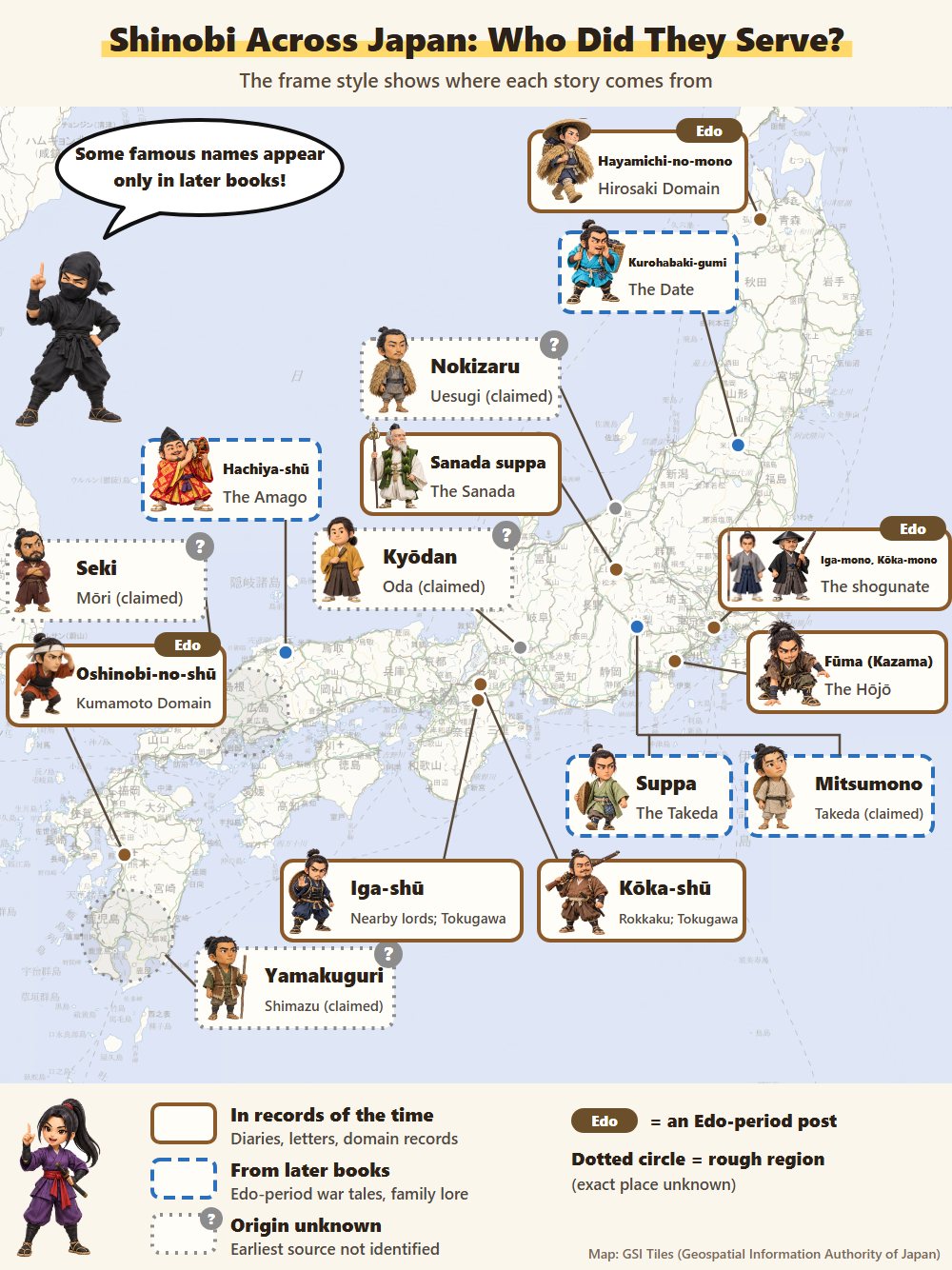
Lords all over Japan used shinobi. But some famous group names appear only in later books.
I only knew Iga, Kōka and Fūma!
Let us look at them one by one. The frame style shows where each story comes from.
On the map, a solid frame marks a group found in records of the time, a blue dashed frame a story from later books such as Edo-period war tales, and a gray dotted frame a name whose origin cannot be confirmed.
Historian Hirayama Yū notes that, with very few exceptions, names such as the Takeda Mitsumono, the Date Kurohabaki-gumi, the Uesugi Nokizaru, the Hōjō Fūma band and the Oda Kyōdan do not appear in records of their own time [Widely accepted].
| Name | Lord | Where the story comes from |
| Iga-shū | Hired by nearby lords; the Tokugawa | Records of the time |
| Kōka-shū | The Rokkaku; the Tokugawa | Records of the time |
| Fūma (Kazama) | The Hōjō | Hōjō documents (the Kotarō story is later) |
| Suppa | The Takeda | Kōyō Gunkan (early Edo period) |
| Mitsumono | Said to be the Takeda | Bansenshūkai and other Edo-period books |
| Sanada suppa | The Sanada | Research based on records (the chief's story is later) |
| Nokizaru | Said to be the Uesugi | Unknown |
| Kurohabaki-gumi | The Date | Date Hikan and other Edo-period books |
| Hayamichi-no-mono | Hirosaki Domain (Edo period) | Domain records |
| Kyōdan | Said to be the Oda | Only a name in a ninja manual |
| Hachiya-shū | The Amago | Later war tales and books |
| Seki | Said to be the Mōri | Unknown |
| Oshinobi-no-shū | Kumamoto Domain (Edo period) | Domain records |
| Yamakuguri | Said to be the Shimazu | Unknown |
Iga-shū: The Village Samurai League of Iga
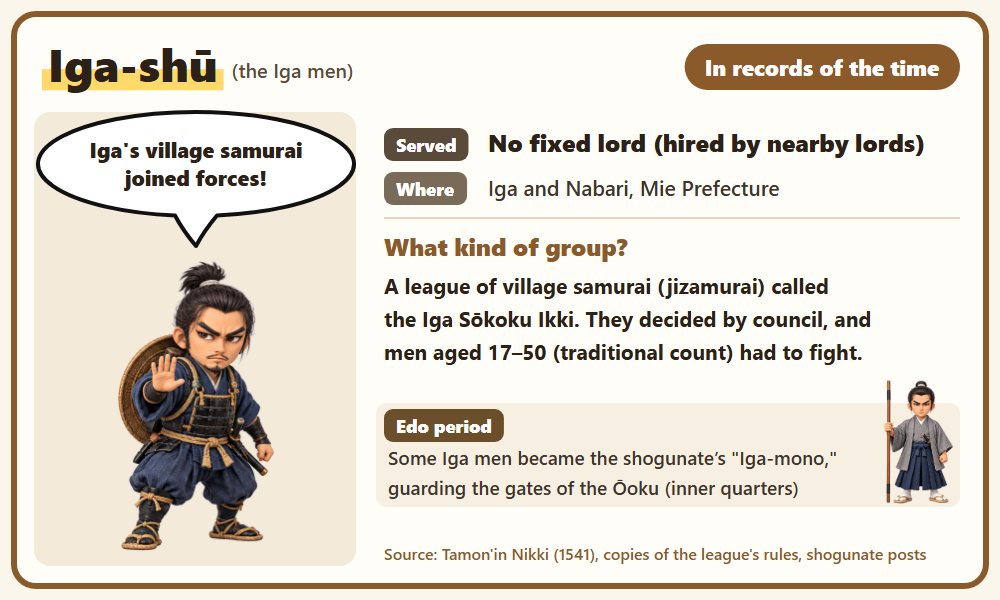
The Iga-shū were the local samurai landholders (jizamurai) of Iga Province, today's Iga and Nabari in Mie Prefecture. In a land where no great lord held firm control, they formed a league called the Iga Sōkoku Ikki and decided important matters by council [Widely accepted].
The Iga-shū had no fixed lord and worked for lords in neighboring provinces. The men who slipped into Kasagi Castle in 1541 were Iga-shū [Fact]. In 1581, Oda Nobunaga's huge army invaded and crushed Iga (the Tenshō Iga War) [Fact].
In the Edo period, some people of Iga origin and their descendants became the shogunate's "Iga-mono," guarding entrances to the Ōoku, the shogun's inner residential quarters, and patrolling empty residences [Widely accepted]. For the warrior who commanded the Iga-mono, see our article on Hattori Hanzō.
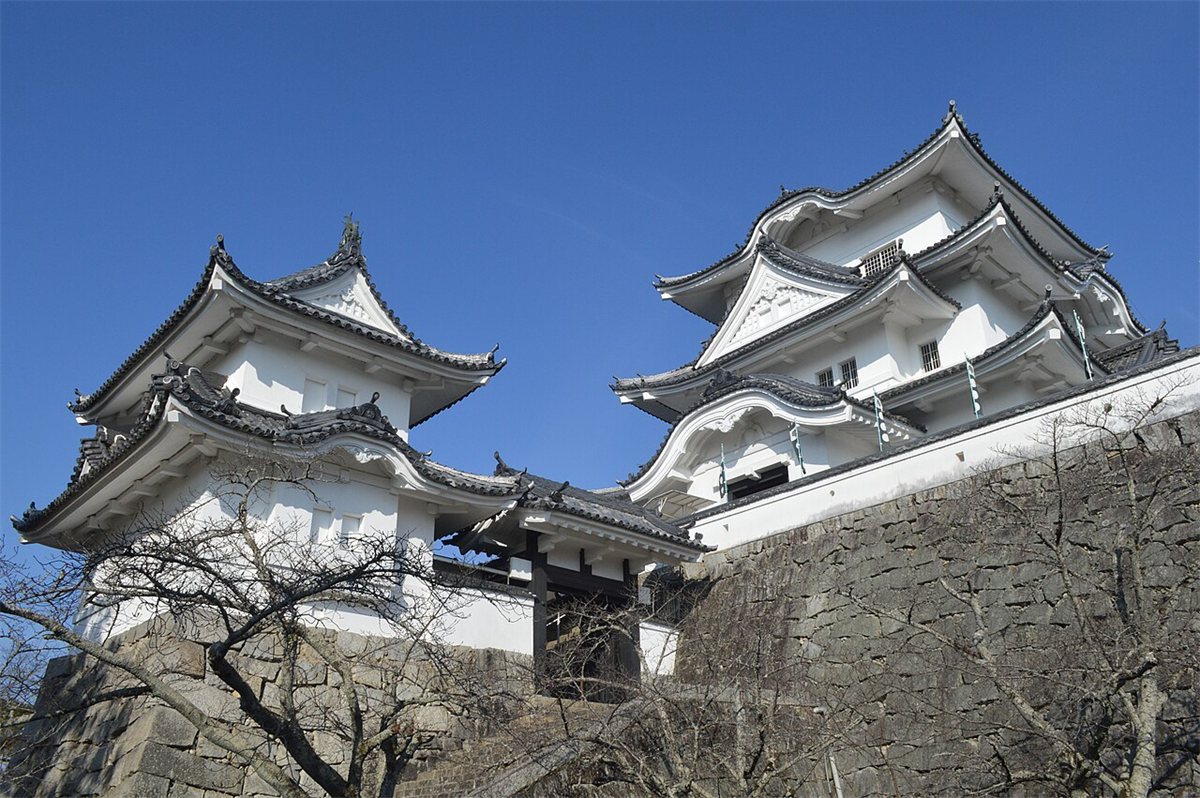
Image: Iga Ueno Castle (Iga City, Mie Prefecture). The present keep was built in 1935. Wikimedia Commons (photo: Asturio Cantabrio, CC BY-SA 4.0)
Kōka-shū: Shinobi Who Ruled by Council
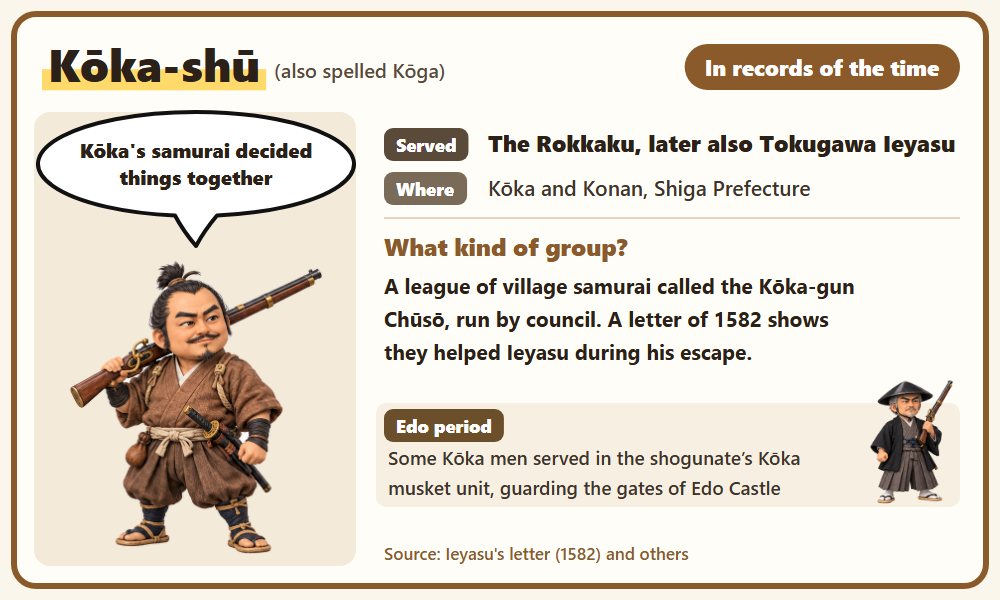
The Kōka-shū were the village samurai of Kōka District in Ōmi Province, today's Kōka and Konan in Shiga Prefecture. The name is pronounced "Kōka" (also spelled "Kōga"). In the Muromachi period they belonged to the Rokkaku of Ōmi and are said to have numbered 53 families [Widely accepted].
The Kōka samurai also formed a league, the Kōka-gun Chūsō, and decided matters by council [Widely accepted]. Iga and Kōka lie on either side of a range of mountains; they were linked by marriage and even held joint meetings at their border [Widely accepted]. Yamada Yūji of Mie University says the idea of Iga and Kōka as sworn enemies is an invention [Widely accepted].
In 1582, after the Honnō-ji Incident, Kōka samurai helped Tokugawa Ieyasu during his escape through Iga, as documents of the time show [Fact]. See our article on the escape through Iga. In the Edo period, some Kōka men served in the shogunate's Kōka musket unit, guarding the gates of Edo Castle [Widely accepted].
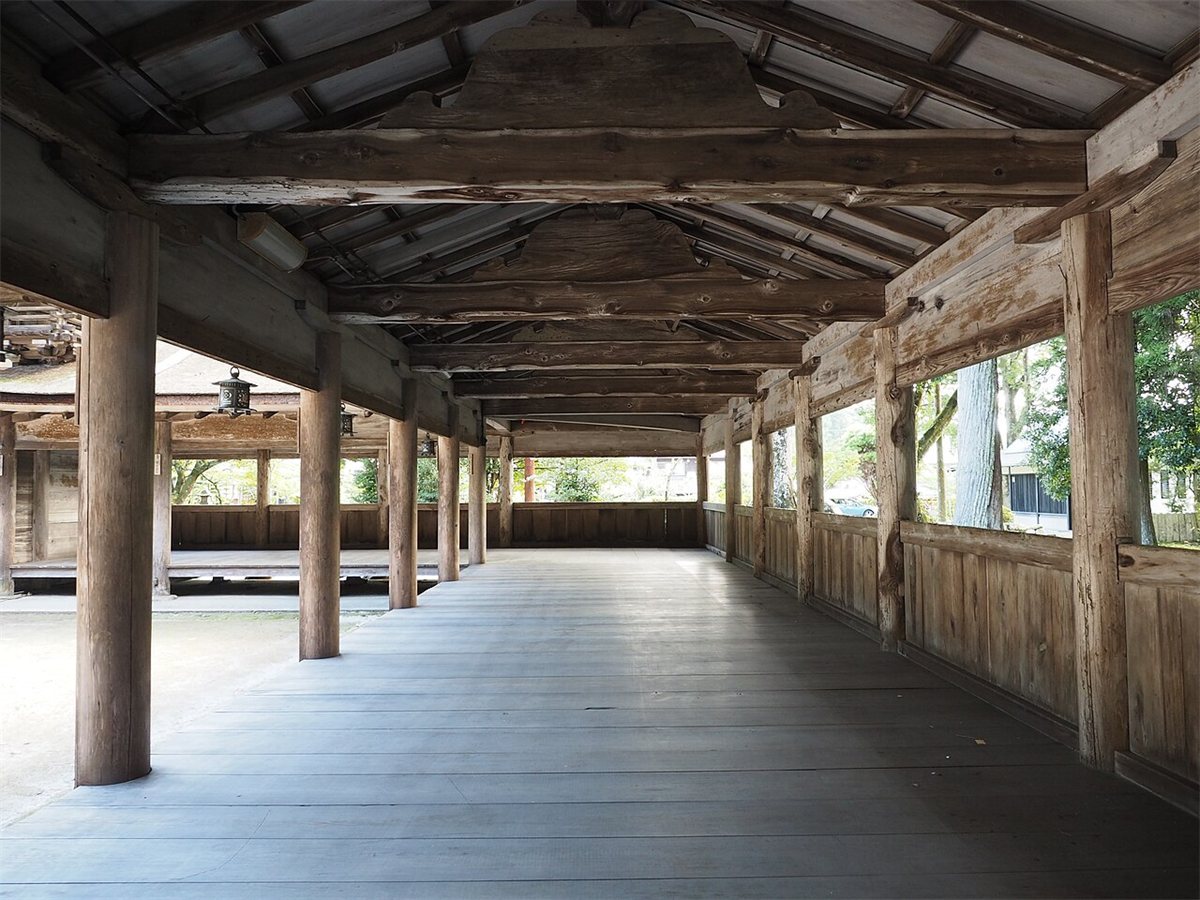
Image: The cloister of Aburahi Shrine (Kōka City, Shiga Prefecture), where the Kōka-shū are said to have held meetings. Wikimedia Commons (photo: Motokoka, CC BY-SA 4.0)
Fūma: The "Kazama" Band in Hōjō Documents
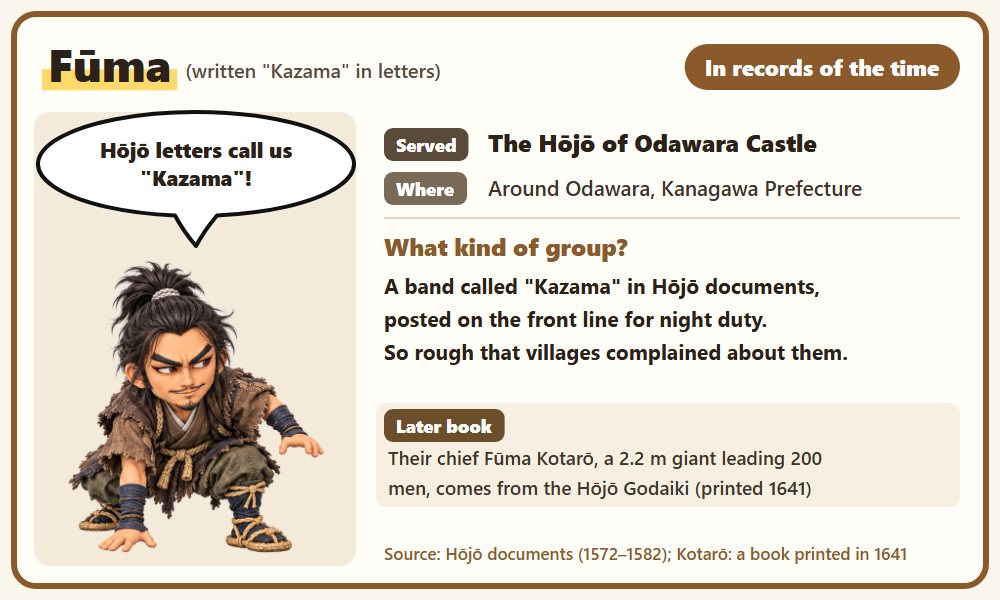
The Fūma are known as a band that served the Hōjō of Odawara. Hōjō documents mention a group called "Kazama" (風間) that took on front-line duties such as night watches [Widely accepted].
A document of 1572 orders villages to provide lodging, fodder and firewood because the Kazama would be stationed there. Another document, responding to villagers' complaints, rules that the Kazama would no longer be stationed in their village [Widely accepted]. They seem to have been rough enough to be a burden on the villages where they stayed.
The story that their chief, Fūma Kotarō, was a giant about 2.2 m (7 ft 2 in) tall who led 200 men comes from the Hōjō Godaiki, printed in 1641 [Legend].
Suppa: The Shinano Shinobi Hired by Takeda Shingen
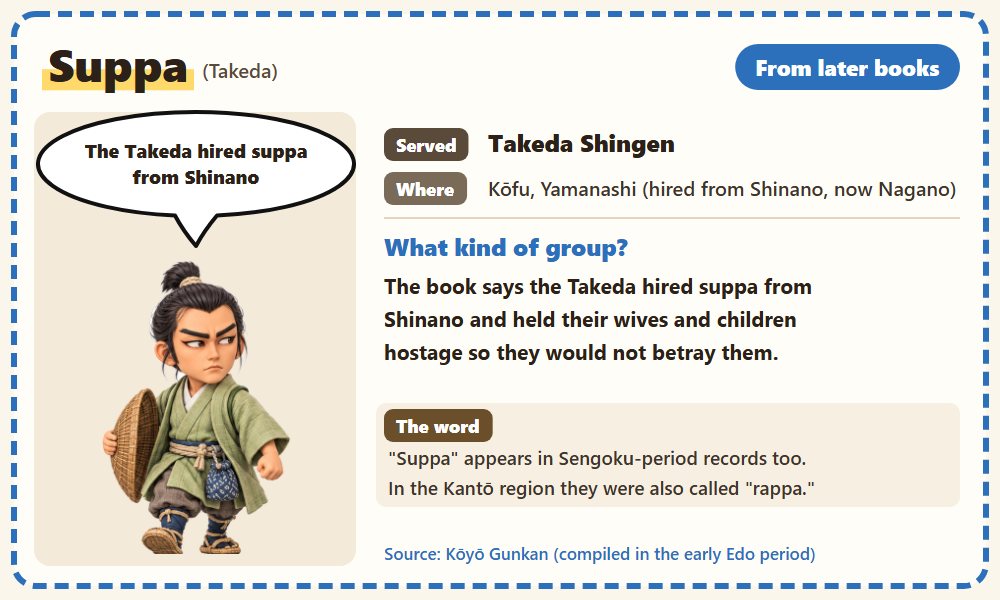
Suppa was one of the words used for shinobi in the Sengoku period. In the Kantō region they were also called rappa, and some were rough men [Widely accepted].
The Kōyō Gunkan, a military history of the Takeda family, says Shingen hired suppa from Shinano (today's Nagano Prefecture) and held their wives and children hostage so they would not betray him [Legend]. The book took shape in the early Edo period, so this account needs to be checked against sources from Shingen's lifetime.
Mitsumono: Takeda Shingen's Shinobi?
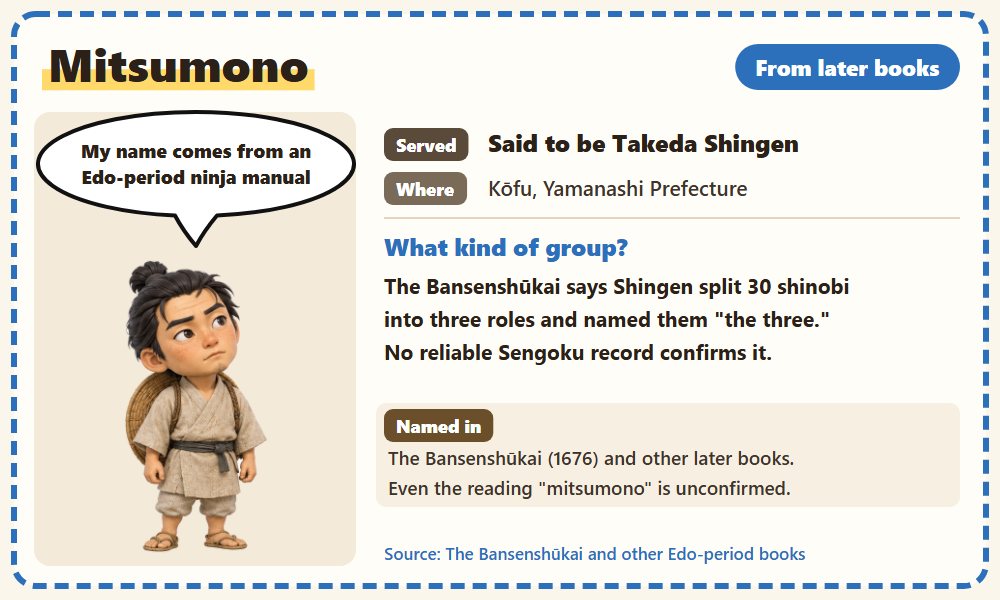
"Mitsumono" is a name often given to Takeda Shingen's shinobi. The Edo-period manual Bansenshūkai (1676) says Shingen divided 30 shinobi into three roles and called them "the three" (三者) [Legend].
No reliable Sengoku-period source has been identified that confirms this organization, as Hirayama Yū also points out. The historical reading of 三者 as "mitsumono" is also unconfirmed [Unknown].
The Sanada Suppa: Shinobi Used by Sanada Masayuki
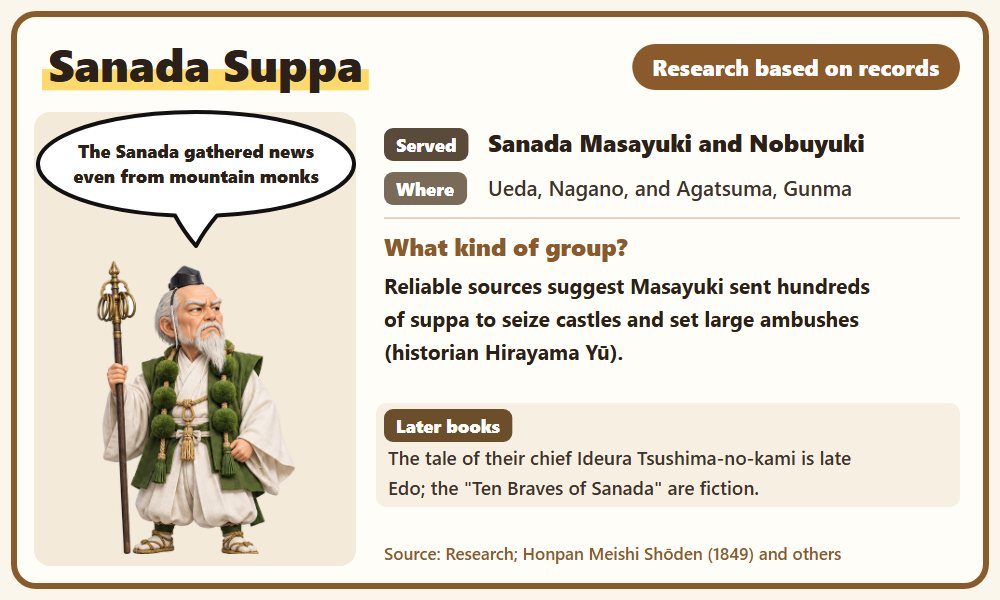
Reliable sources are said to show that Sanada Masayuki made heavy use of suppa [Widely accepted]. Hirayama Yū believes Masayuki sent hundreds of suppa to seize castles and set large ambushes against his enemies.
The story of their chief, Ideura Tsushima-no-kami, comes from books of the late Edo period [Legend]. The "Ten Braves of Sanada," including Sarutobi Sasuke and Kirigakure Saizō, are characters of Meiji- and Taishō-era stories [Fiction].
Nokizaru: Were They Uesugi Kenshin's Shinobi?
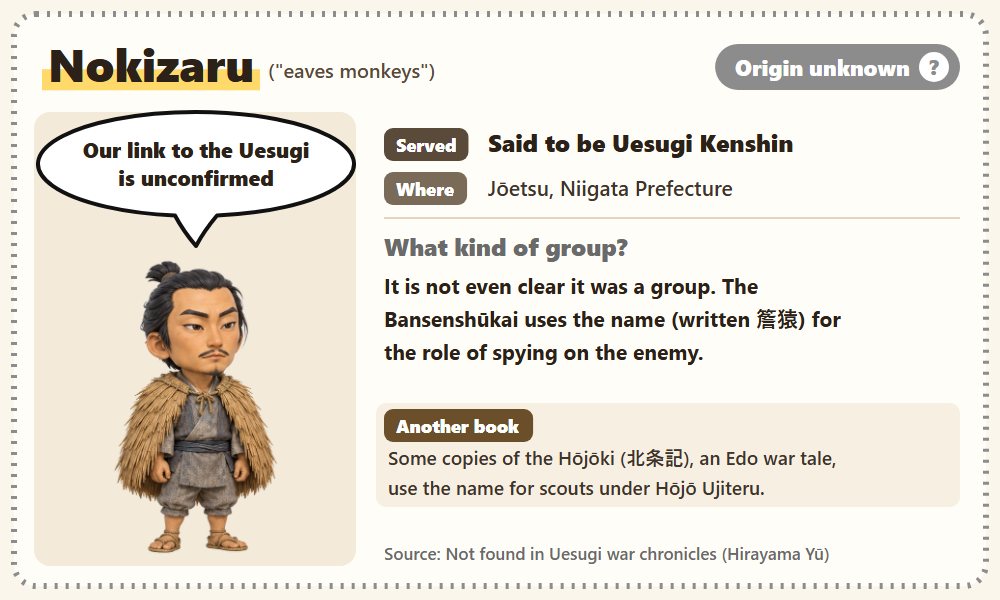
"Nokizaru" ("eaves monkeys") is often described as Uesugi Kenshin's band of shinobi. But the name is not found in the Uesugi family's war chronicles, and the sources checked for this article do not establish when Nokizaru first came to be described as Kenshin's shinobi [Unknown].
The Edo-period manual Bansenshūkai uses the name (written 簷猿) for the role of spying on the enemy [Widely accepted]. Some copies of the Hōjōki (北条記), an Edo-period war chronicle about the Hōjō clan, use "nokizaru" for scouts serving Hōjō Ujiteru [Widely accepted].
Kurohabaki-gumi: Date Masamune's Shinobi?
So the Date had shinobi too!
So the story goes. But it comes from books of the Edo period.
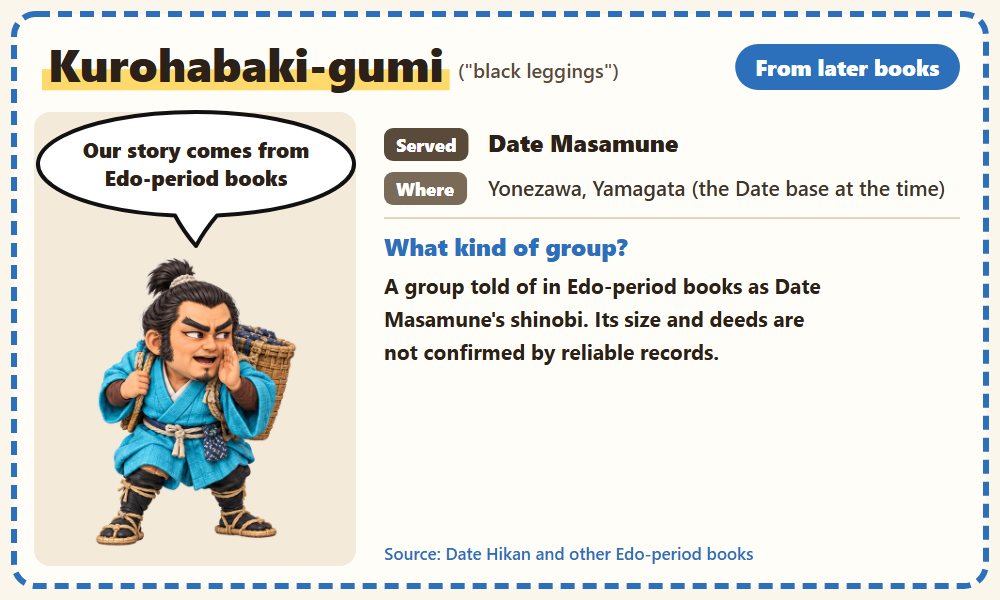
The Kurohabaki-gumi ("black leggings band") are told of as Date Masamune's shinobi in the Date Hikan and other Edo-period histories of the Date family [Legend].
Their numbers and deeds are not confirmed by reliable records, and Hirayama Yū lists them among the groups that do not appear in sources of their own time [Unknown].
Hayamichi-no-mono: Hirosaki's Shinobi Until 1870
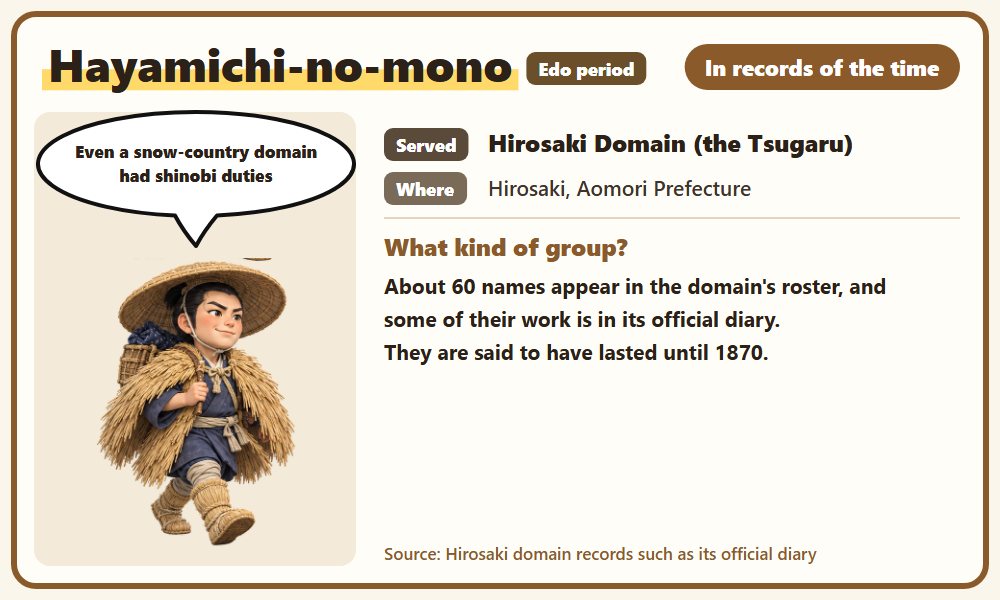
The Tsugaru family of Hirosaki Domain (Aomori Prefecture) had a shinobi post called Hayamichi-no-mono. About 60 names appear in the domain's roster, and some of their work is recorded in its official diary [Widely accepted].
The post is said to have continued until 1870 [Widely accepted].
Kyōdan: Oda Nobunaga's Shinobi in a Manual
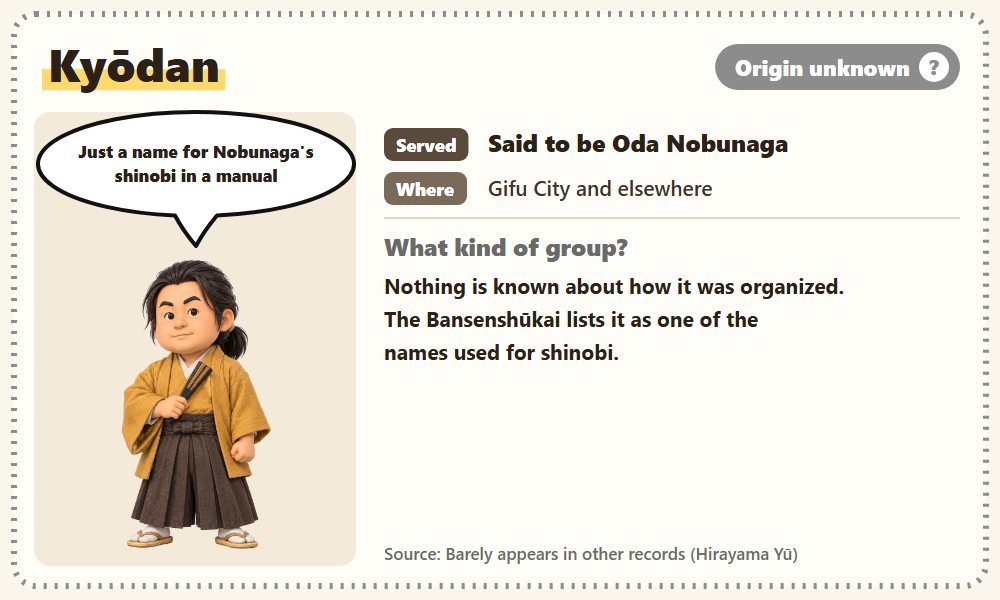
"Kyōdan" appears in the Edo-period manual Bansenshūkai as a name for shinobi treasured by Oda Nobunaga [Legend]. It barely appears in other records, and how the group was organized is unknown [Unknown].
Hachiya-shū: The Band That Helped Amago Tsunehisa Retake His Castle
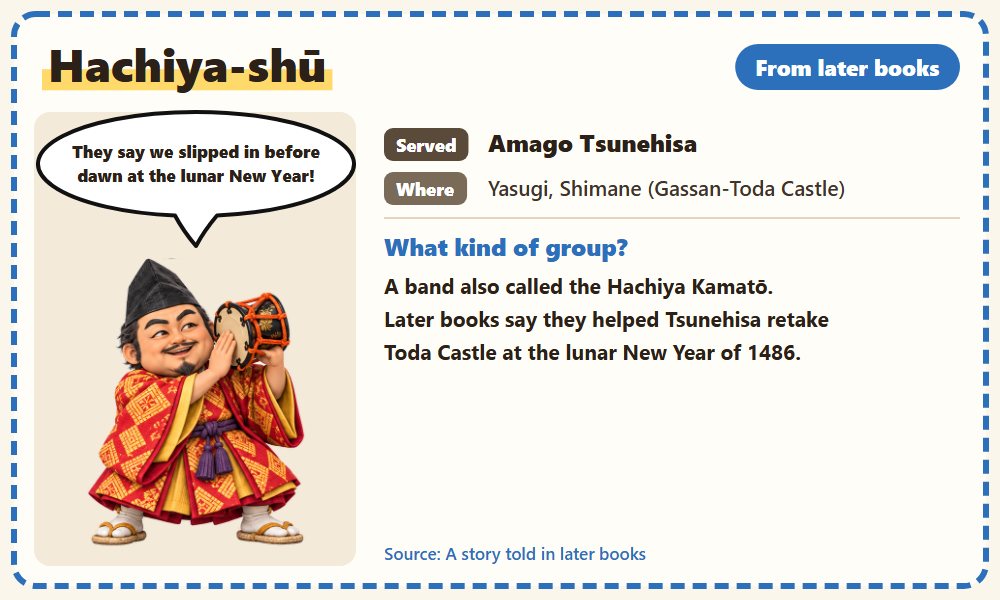
The Hachiya-shū are remembered as a band that helped Amago Tsunehisa of Izumo (Shimane Prefecture). They were also called the Hachiya Kamatō [Legend].
Later accounts say the Hachiya Kamatō helped Tsunehisa retake Gassan-Toda Castle on the first day of the Japanese lunar year in 1486 [Legend]. Some say more than 70 of them entered the castle before dawn.
Seki: The Mōri Clan's Shinobi?
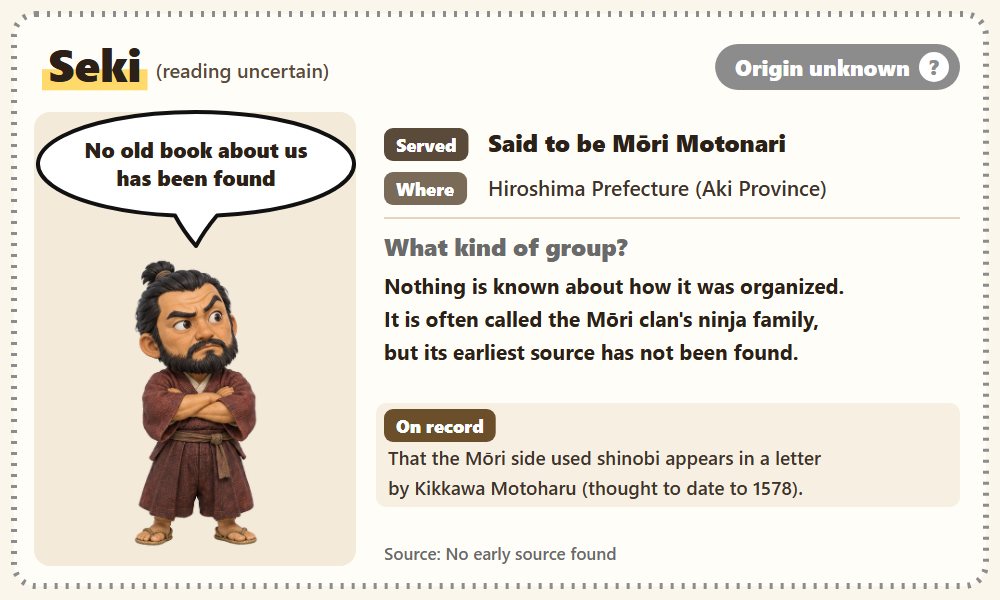
The Seki (世鬼) are sometimes introduced as Mōri Motonari's family of shinobi. But the earliest book to say so has not been found [Unknown].
That the Mōri side used shinobi at all is shown by a letter of Kikkawa Motoharu, thought to date to 1578, which discusses whether shinobi could be sent to an Oda camp [Widely accepted].
Oshinobi-no-shū: Kumamoto's Shinobi at Shimabara
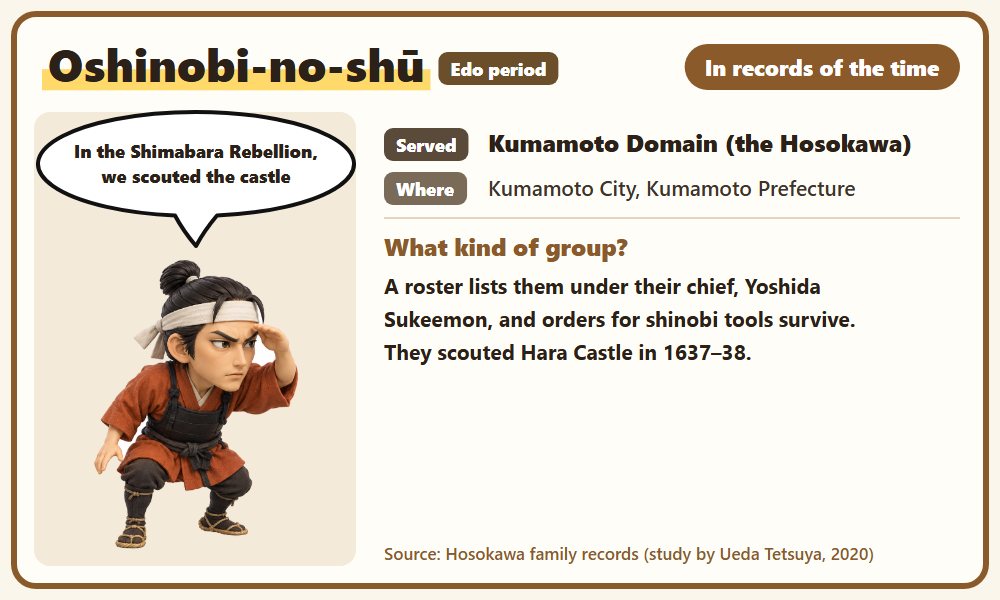
The Hosokawa family of Kumamoto Domain had a band of shinobi called the Oshinobi-no-shū. A roster lists them under their chief, Yoshida Sukeemon, and orders to a blacksmith for shinobi tools survive [Widely accepted].
Hosokawa records show that they scouted Hara Castle during the Shimabara Rebellion, which began in 1637 [Widely accepted].
Yamakuguri: The Shimazu Clan's Shinobi?
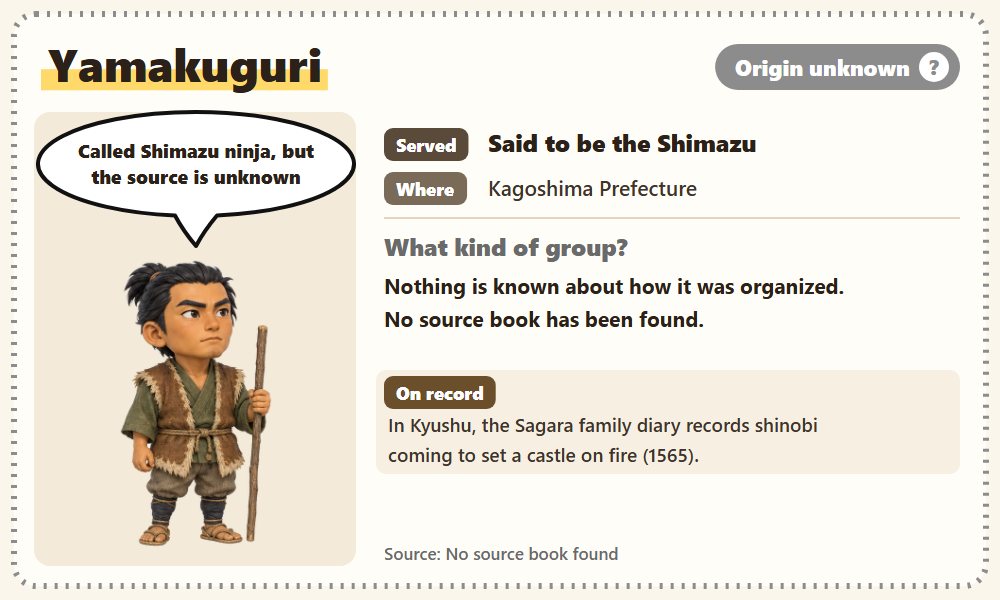
The Yamakuguri are sometimes introduced as the Shimazu clan's shinobi. But no source book has been found [Unknown].
Elsewhere in Kyushu, the Yatsushiro Nikki, a diary of the Sagara family in today's Kumamoto Prefecture, records that in 1565 shinobi came to set a castle on fire and were stopped [Widely accepted].
Famous Ninja: Was Hattori Hanzō a Ninja? Eight Figures Compared
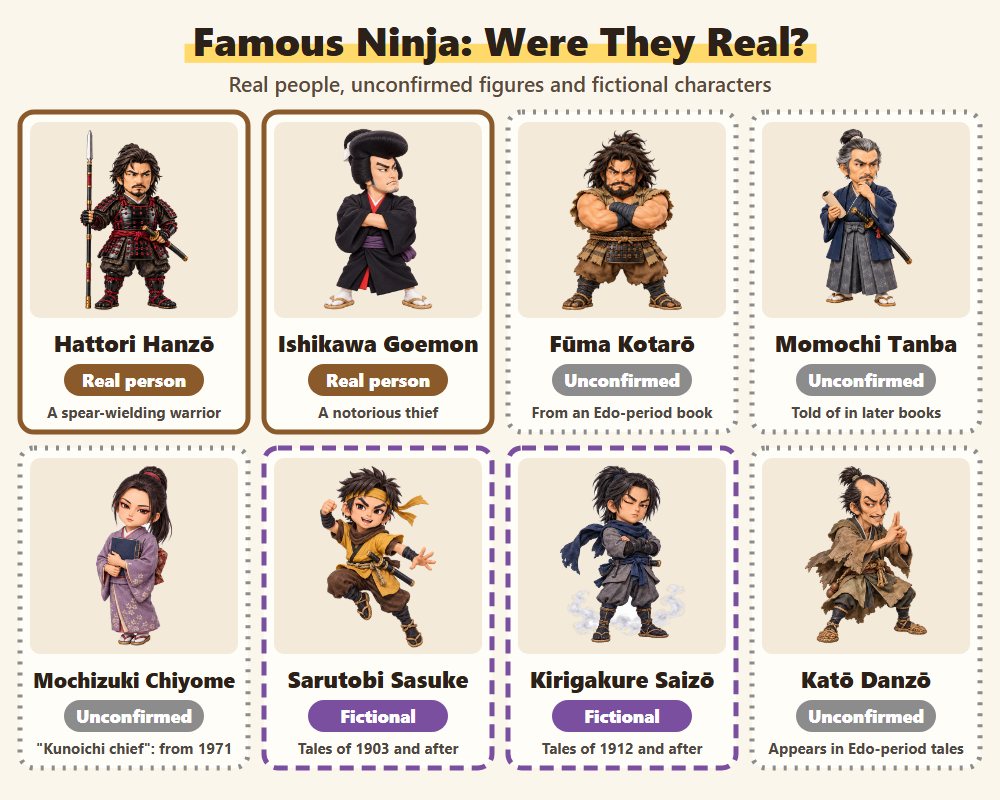
Hattori Hanzō and Ishikawa Goemon were real people. But Sarutobi Sasuke is a character in stories.
Separating real people from story characters makes it more fun!
Famous "ninja" include real people, people whose existence is unconfirmed, and fictional characters. On each card, "The person" covers records of the individual, and "The ninja story" shows where the ninja tales come from.
Was Hattori Hanzō a Ninja? A Spear Warrior Who Led Iga Men
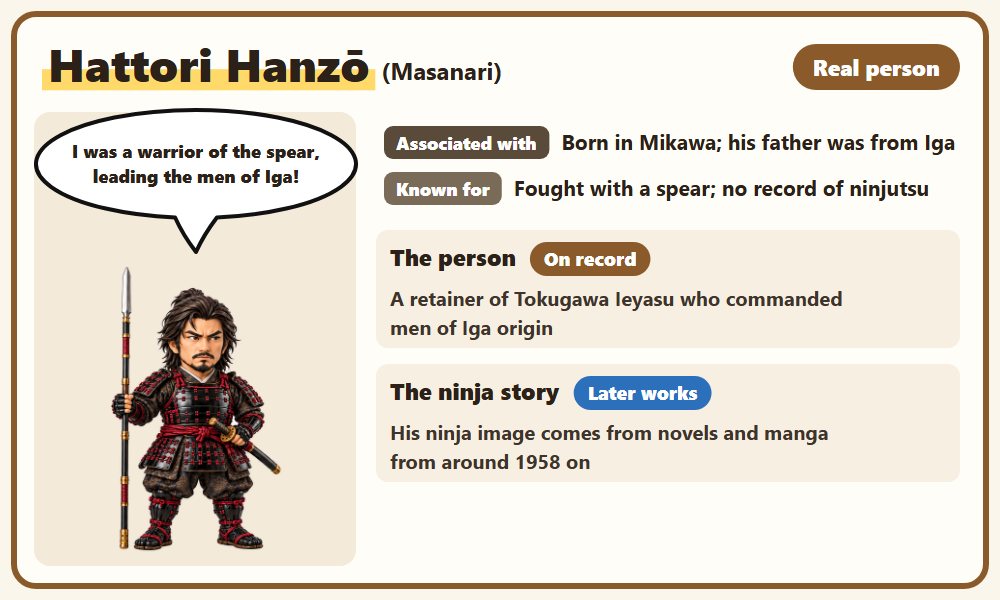
Hattori Hanzō (Masanari) was a real warrior who served Tokugawa Ieyasu [Widely accepted]. He fought with a spear and commanded men of Iga origin. No record confirms that he himself used ninjutsu [Widely accepted].
The image of "Hattori Hanzō the ninja" spread through novels and manga from around 1958 [Widely accepted]. See our article on Hattori Hanzō.
Was Fūma Kotarō Real? The Giant of the Hōjō Godaiki
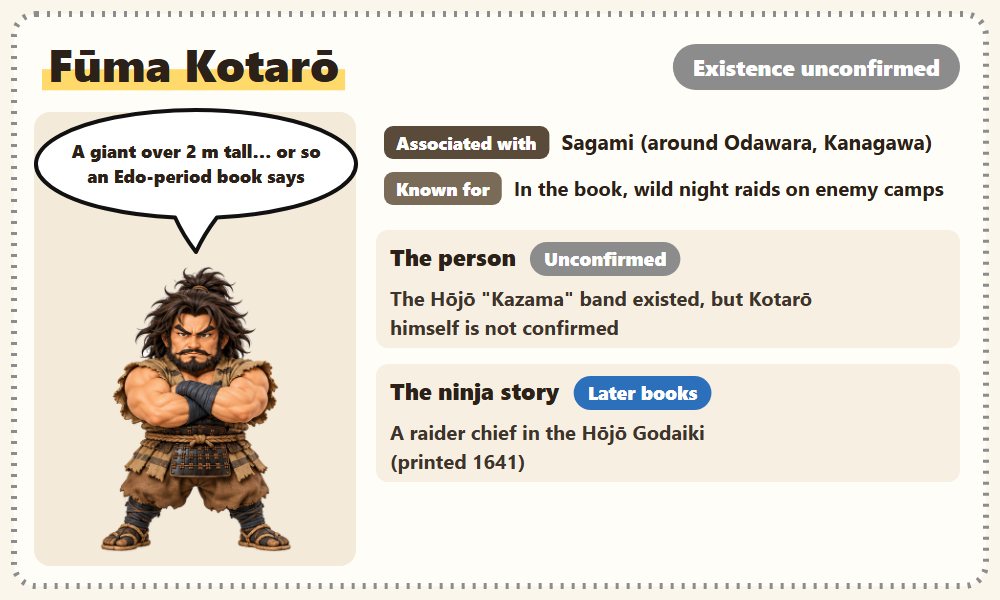
Fūma Kotarō appears in the Edo-period Hōjō Godaiki as the chief of the Hōjō clan's raiders (rappa) [Legend]. The book gives his height as 7 shaku 2 sun, about 2.2 m.
Hōjō documents mention the "Kazama" band, but Kotarō himself has not been confirmed in records of his time [Unknown]. Stories of a rivalry between Kotarō and Hattori Hanzō were created in 20th-century manga and other works [Fiction].
Was Momochi Tanba Real? An Iga Samurai in Later Books
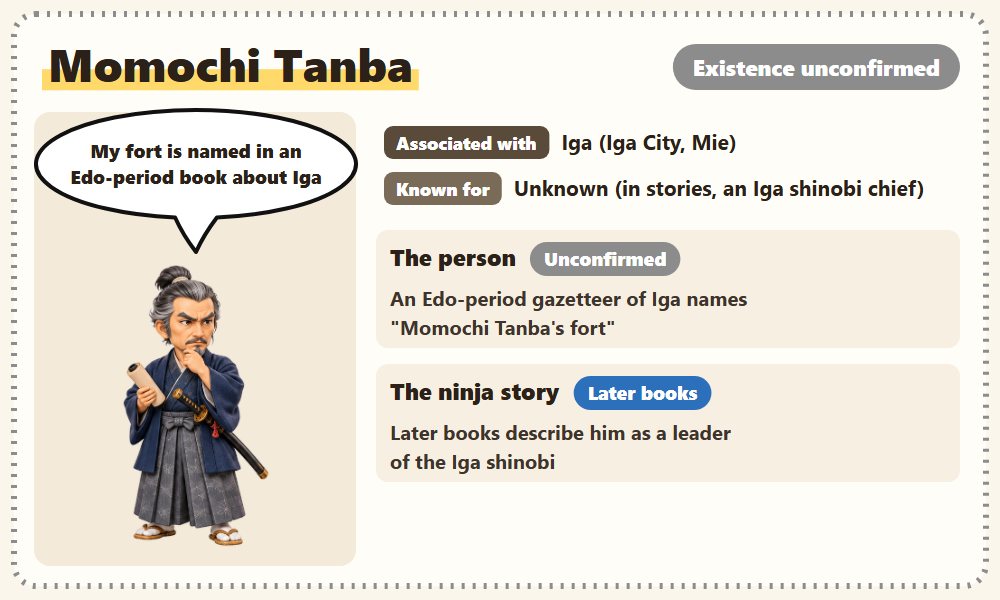
Momochi Tanba appears in later books and local traditions as a powerful samurai of Iga [Legend]. Reference works sometimes call the powerful families of Iga "jōnin."
The Sangoku Chishi, an Edo-period gazetteer of Iga, names "Momochi Tanba's fort," but the man himself has not been confirmed in records of his own time [Unknown]. Some identify him with "Momochi Sandayū" of later stories, but this is not certain [Debated].
Was Ishikawa Goemon a Ninja? A Thief on Record
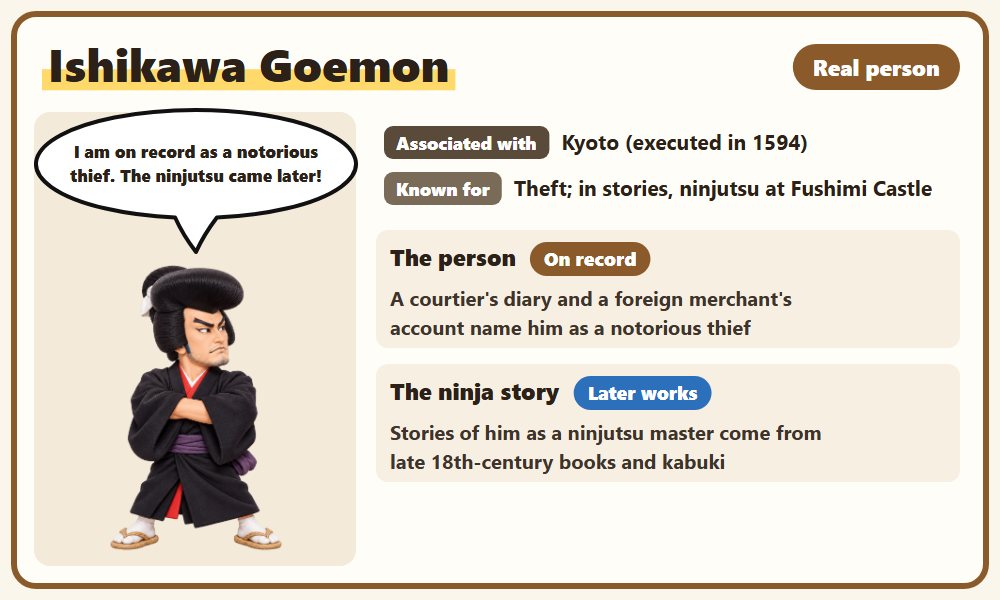
Ishikawa Goemon was a real and notorious thief, executed in Kyoto in 1594 [Fact]. He appears in the diary of the courtier Yamashina Tokitsune and in the account of a Spanish merchant.
Books and kabuki plays of the late 18th century turned Goemon into a master of ninjutsu [Widely accepted]. The story of him sneaking into Fushimi Castle spread from these works [Fiction].
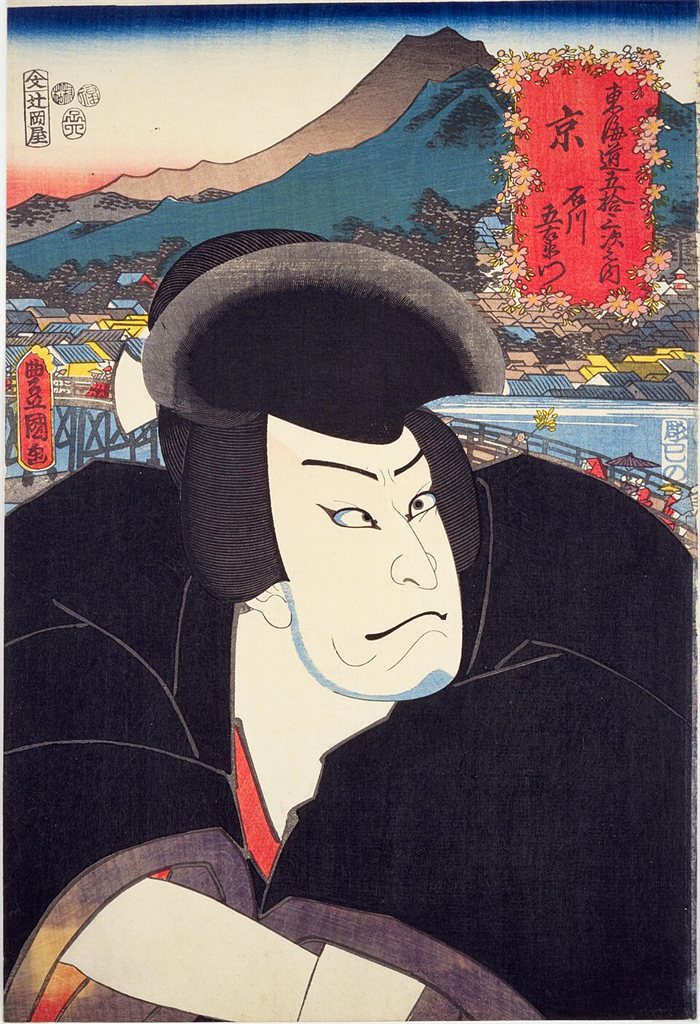
Image: Utagawa Kunisada, "Ishikawa Goemon," from the series Fifty-three Stations of the Tōkaidō (Kyoto). Public domain (National Diet Library / Wikimedia Commons)
Was Mochizuki Chiyome Real? The "Kunoichi Chief" of a 1971 Book
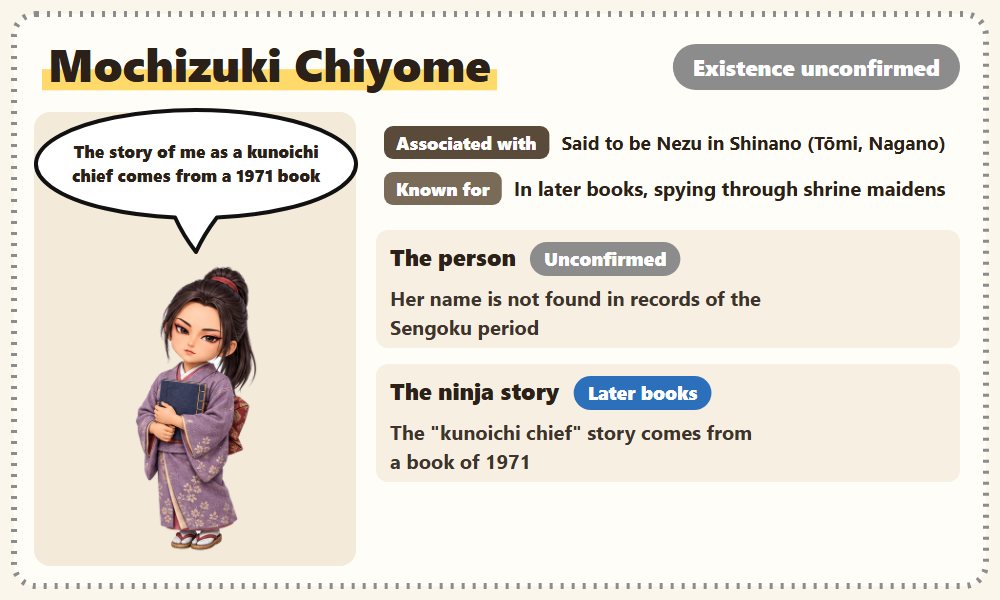
As we saw in the section on kunoichi, Chiyome's name is not found in records of the Sengoku period [Unknown]. Researchers trace the "kunoichi chief" story to a book of 1971 [Widely accepted].
Was Sarutobi Sasuke Real? A Hero of Meiji and Taishō Tales
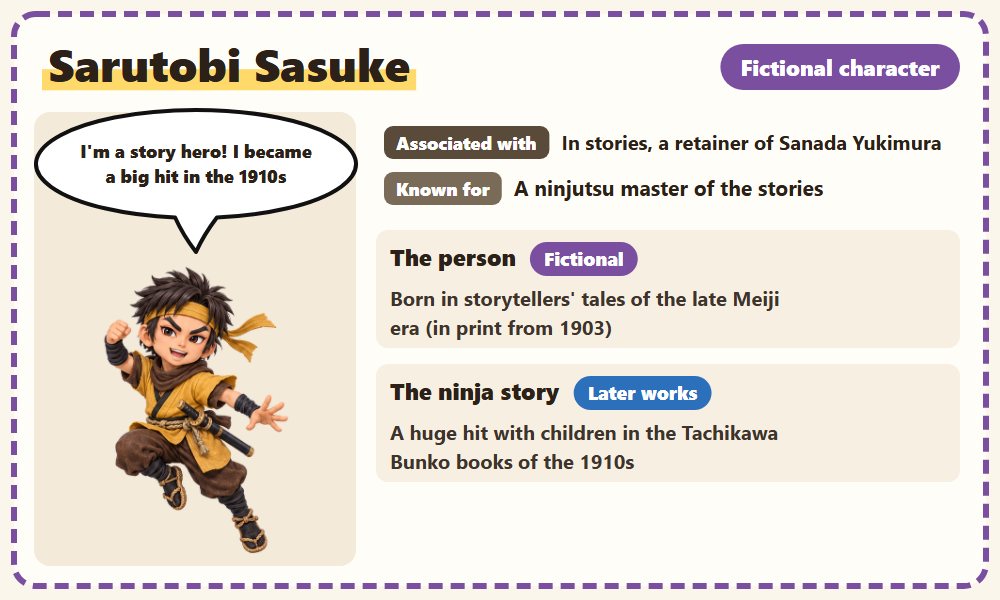
Sarutobi Sasuke is a fictional character born in the stories of professional storytellers (kōdan) at the end of the Meiji era. His name already appears in a printed storyteller's book of 1903 [Widely accepted].
He became hugely popular with children through the Tachikawa Bunko series of the 1910s [Widely accepted]. He is portrayed as a ninjutsu master serving Sanada Yukimura, and his name is said to echo the Monkey King of Chinese legend.
Was Kirigakure Saizō Real? One of the Ten Braves of Sanada
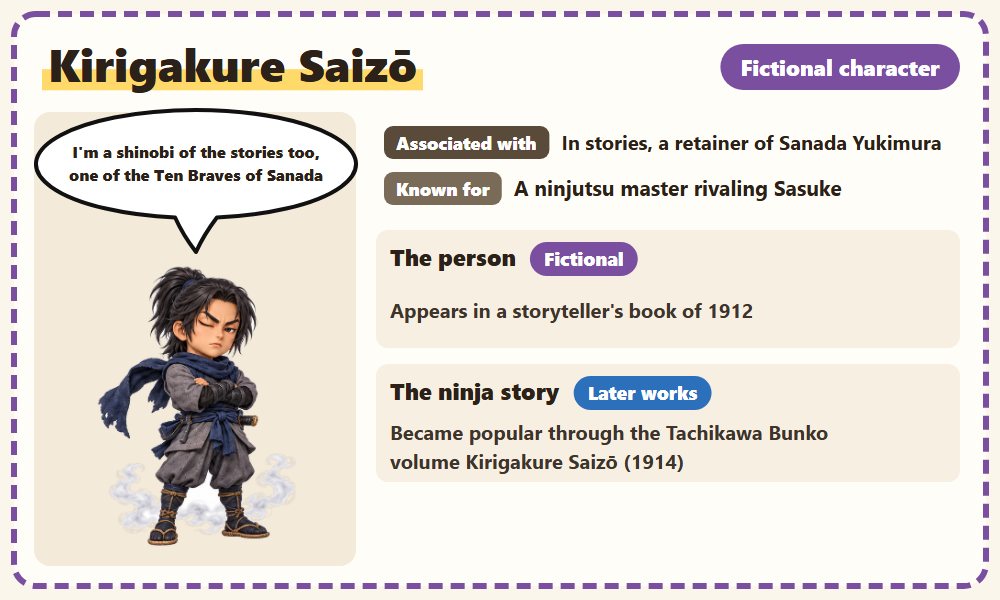
Kirigakure Saizō is also a fictional character. He appears in a printed storyteller's book of 1912 and became popular through the Tachikawa Bunko volume Kirigakure Saizō of 1914 [Widely accepted].
Was Katō Danzō Real? The Tale of "Flying Katō"
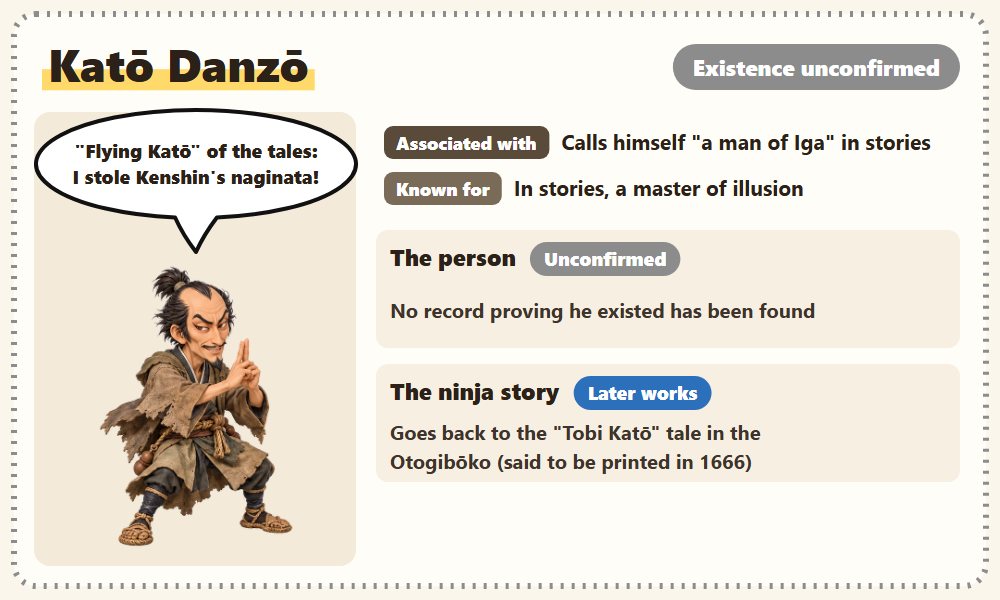
No record proving that Katō Danzō existed has been found [Unknown]. The stories told about him go back to Edo-period tales such as "Tobi Katō" ("Flying Katō") in the Otogibōko, said to have been printed in 1666. In it, he steals a naginata from Uesugi Kenshin's residence [Fiction].
The name "Katō Danzō" itself is said to come from books of the last years of the Edo period [Widely accepted].
Ninja Outfit: What Did Real Shinobi Wear?
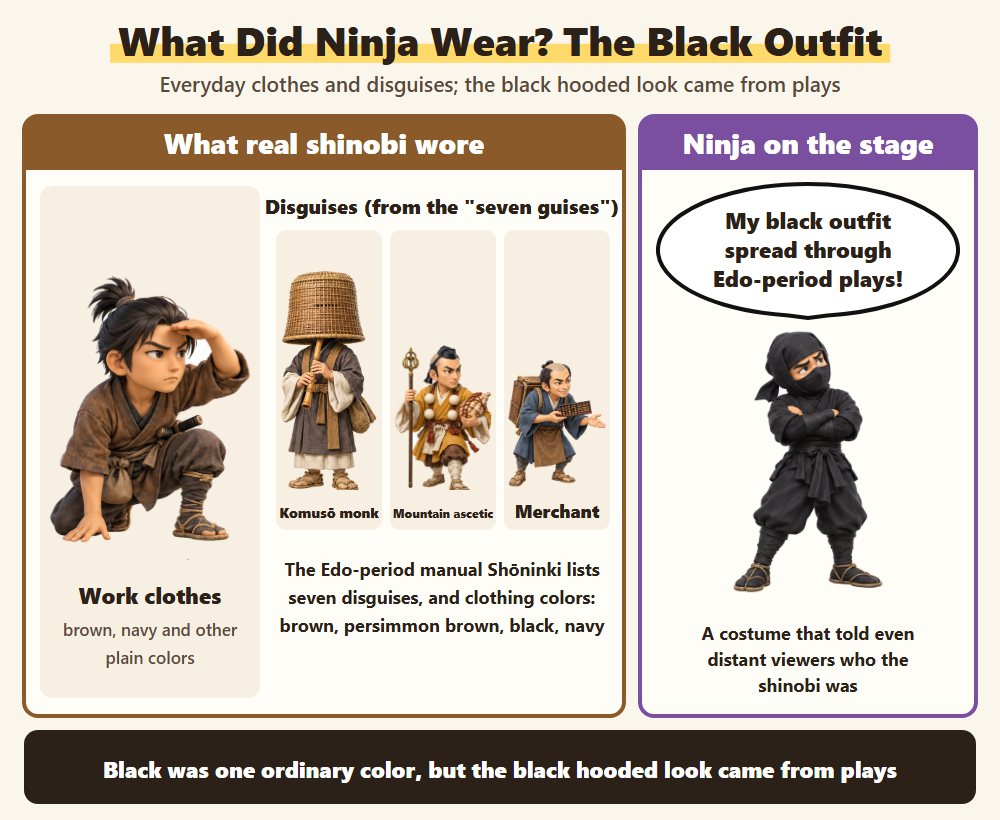
Black was one ordinary color at the time. But the black-hooded look spread through plays.
So even our black-clad guide is dressed like a stage ninja!
Real shinobi usually wore plain clothes that did not stand out. Yamada Yūji of Mie University explains that at night they wore navy or brown work clothes, and by day they disguised themselves as traveling performers or monks [Widely accepted].
The Shōninki (1681), an Edo-period manual, lists seven disguises (shichihōde): a komusō monk, a Buddhist priest, a yamabushi mountain ascetic, a merchant, a street performer, a sarugaku actor and one's everyday appearance [Widely accepted]. It gives clothing colors as brown, persimmon brown, black and navy, so black was just one ordinary color.
The black outfit with a hood is thought to have spread from a stage costume in kabuki and other Edo-period plays, designed so that even distant viewers could tell at a glance who was playing the shinobi [Widely accepted].
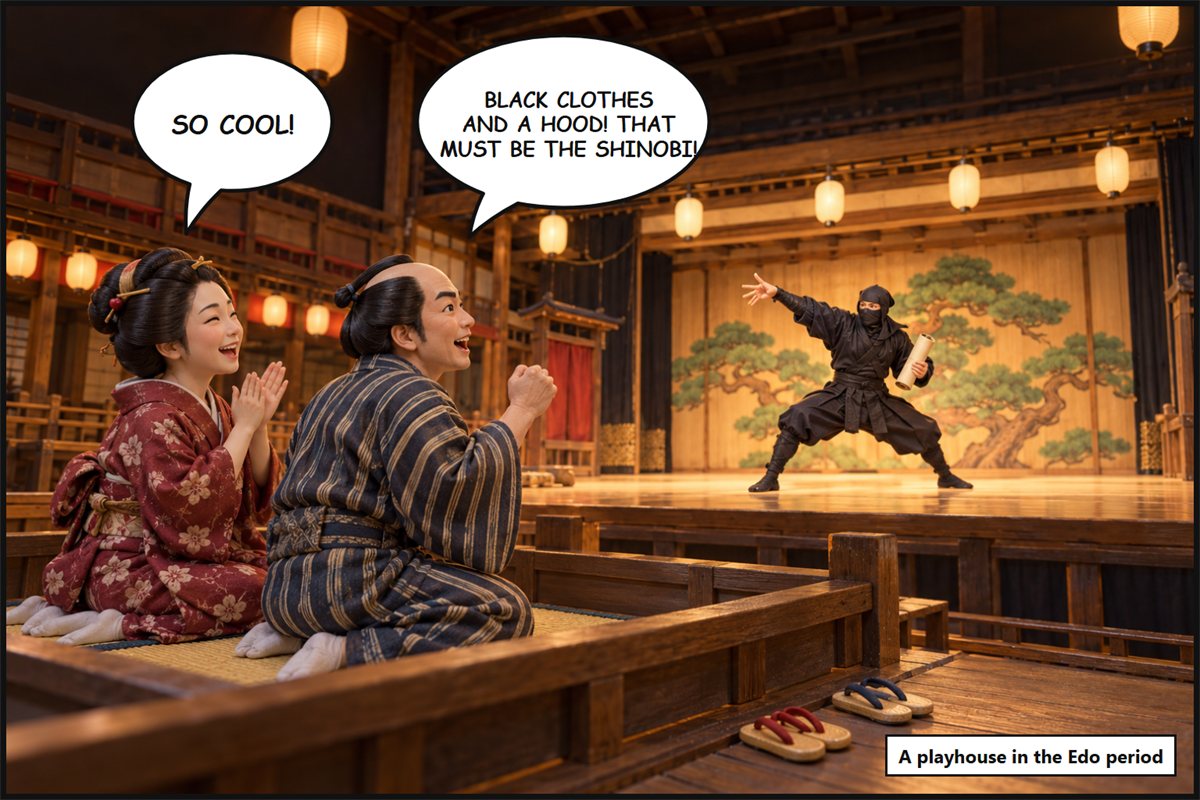
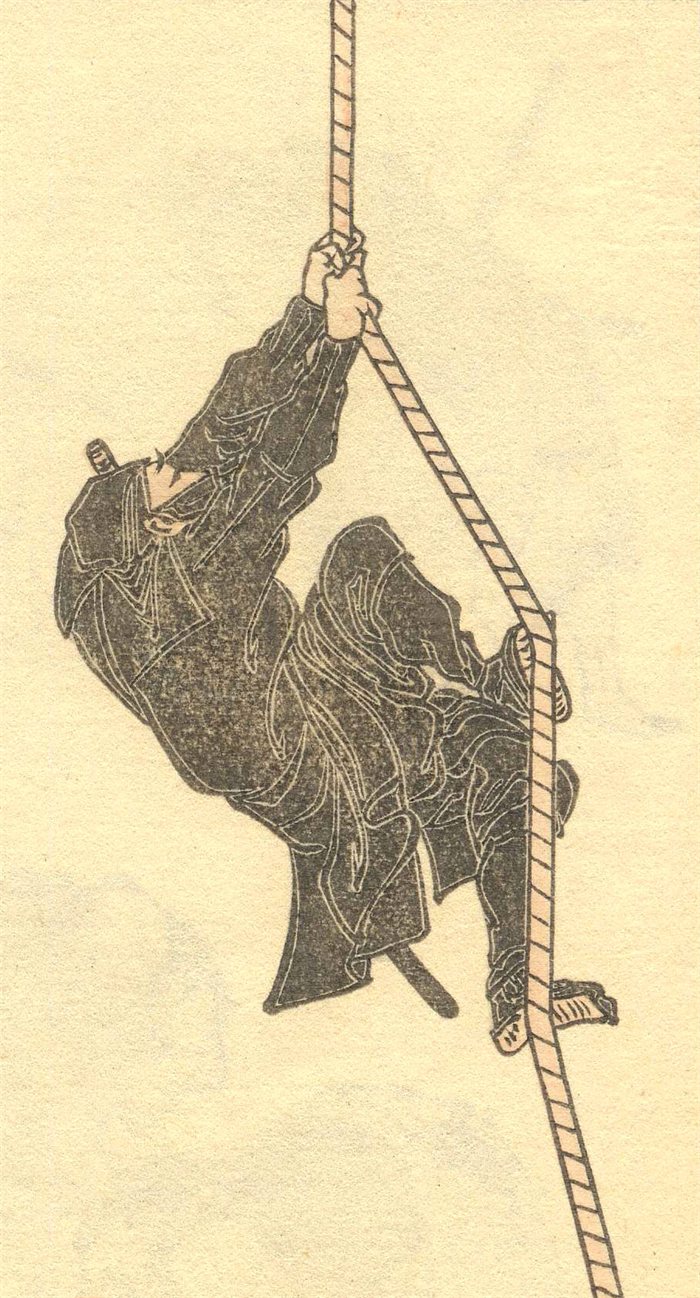
Image: A shinobi climbing a rope, from Katsushika Hokusai's Hokusai Manga, vol. 6 (1817). Public domain (Wikimedia Commons)
Ninja Weapons and Tools: What Is Documented?
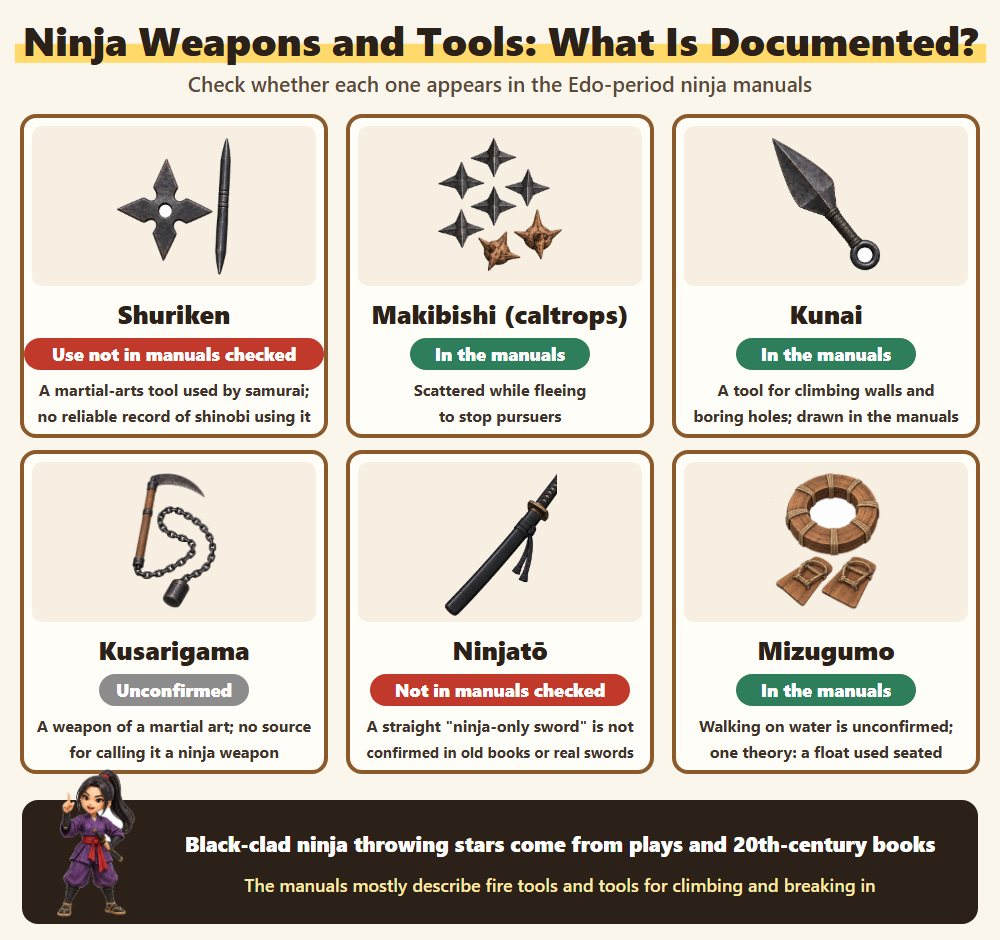
No reliable record shows shinobi using throwing stars. The manuals mostly describe fire tools and tools for climbing and opening.
And the mizugumo may have been a float!
The Bansenshūkai sorts tools into climbing tools, water tools, tools for opening doors and breaking in, and fire tools. The fire tools alone number more than 200 [Widely accepted].
The mizugumo ("water spider") has long been described as shoes for walking on water, but one line of research suggests it was a float used while seated [Debated]. A 20th-century drawing that added straps not found in the original manual helped spread the "walking on water" image [Widely accepted].
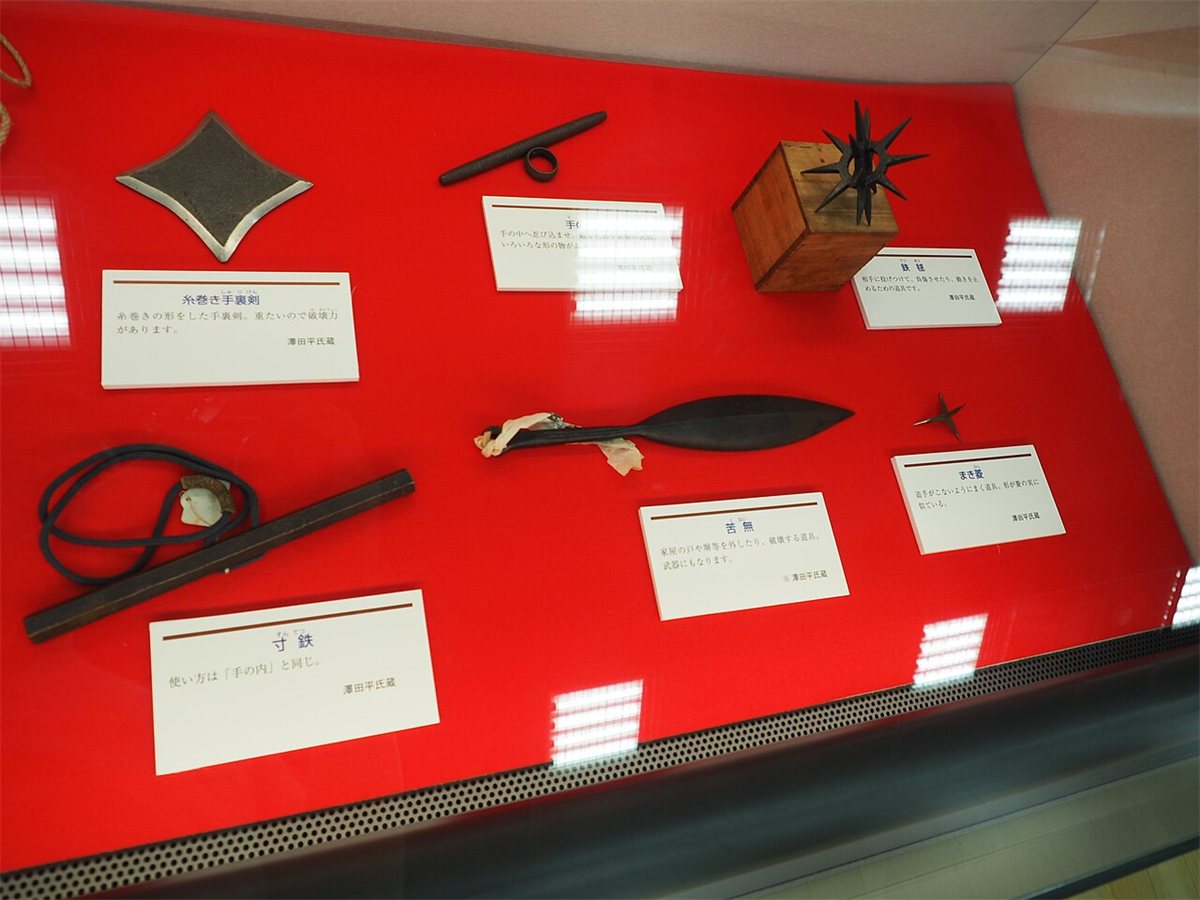
Image: Tetsumari, makibishi and kunai on display at the Kusuri Gakushūkan museum in Kōka City. Wikimedia Commons (photo: Motokoka, CC BY-SA 4.0)
Did Ninja Use Shuriken (Ninja Stars)?
Shuriken were real, and martial-arts schools taught their use, mainly to samurai. But no reliable record of shinobi using shuriken, or instructions for their use in the ninja manuals examined here, has been identified [Widely accepted].
The "ninja with throwing stars" image is thought to come from Edo-period kabuki, and the flat, star-shaped shuriken from 20th-century books [Widely accepted].
For how each tool was used, the original drawings from a ninja manual and a 1628 order list of real shinobi tools, see Ninja Weapons and Tools.
Ninja Ranks: Jōnin, Chūnin and Genin
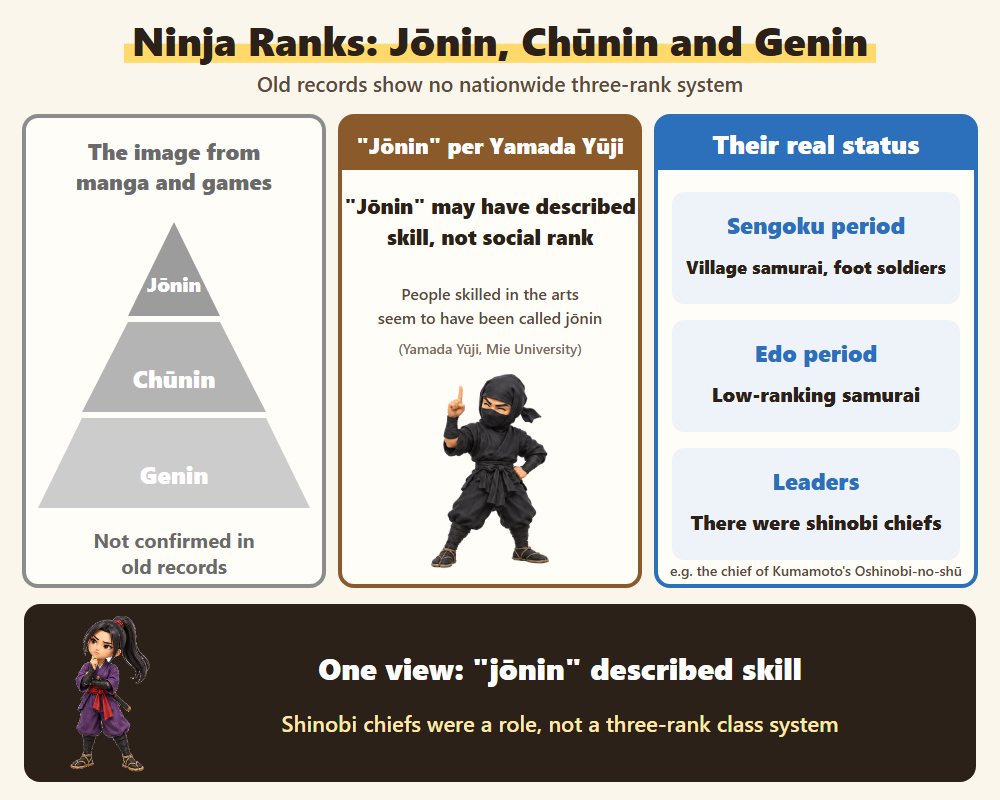
A nationwide three-rank system of jōnin, chūnin and genin cannot be found in the old records.
Wasn't the jōnin the highest-ranking ninja?
Yamada Yūji explains that "jōnin" seems to have meant a skilled shinobi. Keep that apart from social rank.
In today's manga and games, a three-rank system is familiar: jōnin make plans, chūnin lead in the field and genin carry out orders. But records of the time and the ninja manuals do not show these as social ranks [Widely accepted].
Yamada Yūji of Mie University says that "people skilled in the arts seem to have been called jōnin" [Widely accepted]. There were, however, shinobi chiefs who oversaw others; the Oshinobi-no-shū of Kumamoto had a chief, for example [Widely accepted].
In reality, shinobi were village samurai or foot soldiers in the Sengoku period, and low-ranking samurai of the shogunate or domains in the Edo period [Widely accepted].
Do Ninjas Still Exist? Where to See Ninja History in Japan
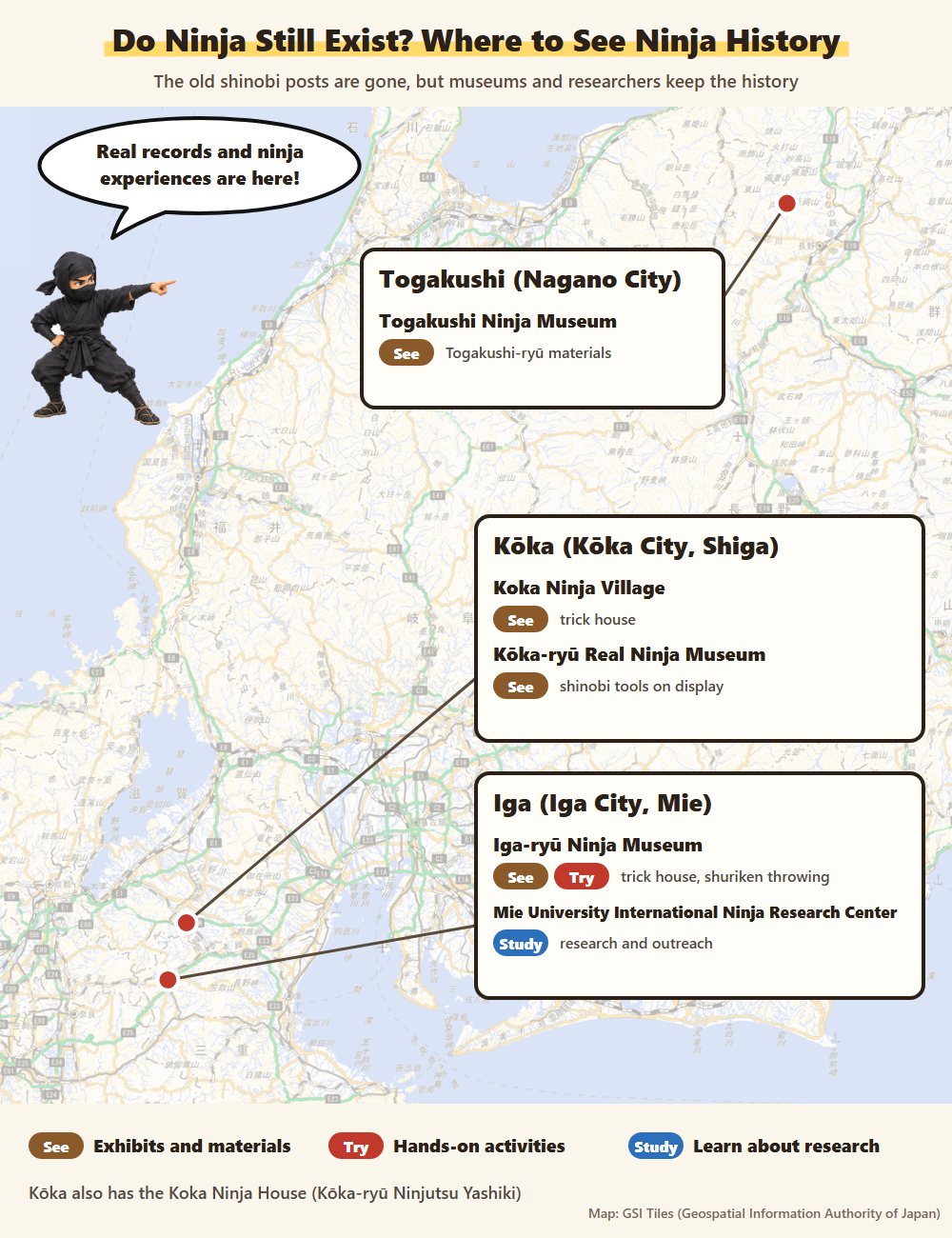
The shinobi posts of the shogunate and domains ended as Japan moved into the Meiji era. But museums still hold real records.
Now I want to visit Iga and Kōka!
Official shinobi posts disappeared during Japan's transition from the Edo period to the Meiji era [Widely accepted]. Hirosaki Domain's Hayamichi-no-mono is said to have continued until 1870 [Widely accepted].
Some modern practitioners are described as "the last ninja." Such claims do not, by themselves, establish a documented line of transmission from historical shinobi families [Unknown].
At the Iga-ryū Ninja Museum in Iga City, Mie Prefecture, you can see a trick house and ninjutsu demonstrations and try throwing shuriken (checked on the official website in October 2026). Mie University runs the International Ninja Research Center in Iga City.
Kōka City has the Koka Ninja House (Kōka-ryū Ninjutsu Yashiki) and Koka Ninja Village, among others. In 2017, the story of ninja culture in Iga and Kōka was recognized as Japan Heritage; the official English website calls it "Shinobi-no-Sato Iga and Koka."
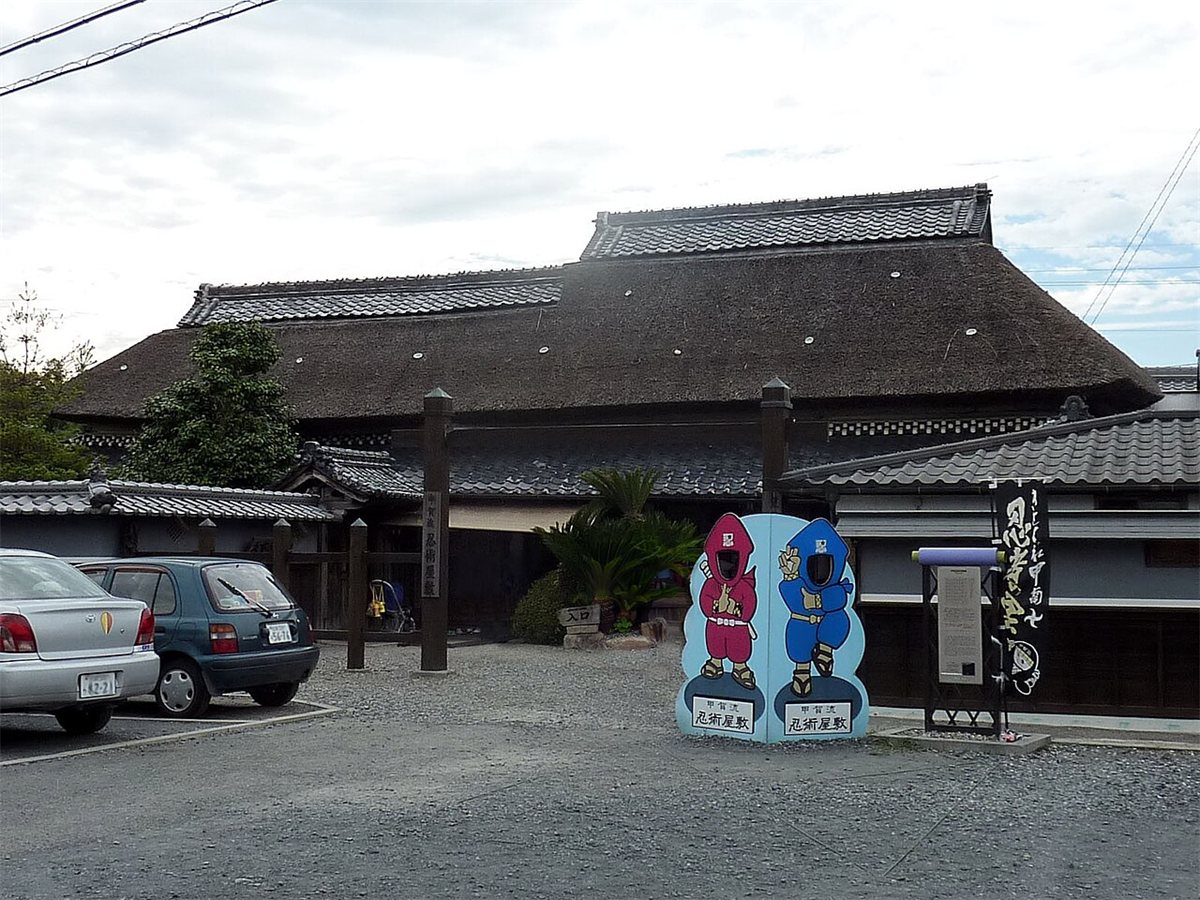
Image: The Koka Ninja House (Kōka-ryū Ninjutsu Yashiki), Kōka City, Shiga Prefecture. Wikimedia Commons (photo: Mocchy, public domain)
FAQ
Were ninja assassins?
The most important work of shinobi was gathering information about the enemy. Many researchers say there is little reliable evidence that shinobi carried out assassinations.
Did ninja and samurai fight each other?
People doing shinobi work sometimes fought samurai of the enemy side. But shinobi were not a separate class from samurai, and samurai themselves sometimes did shinobi work.
Was historical ninjutsu mainly a fighting system?
No. Historical ninjutsu covered intelligence gathering, infiltration, escape and other practical skills. It was broader than hand-to-hand combat.
Were Iga and Kōka enemies?
No. They were neighbors with close ties, and their leagues even met at the border. Yamada Yūji of Mie University says the idea of Iga and Kōka as rivals is an invention.
How much were ninja paid?
Yamada Yūji of Mie University thinks shinobi were not well paid and that in the Sengoku period they were paid according to results. The Iga-mono of the Edo period were low-ranking samurai of the shogunate.
Summary: Were Ninjas Real?
Summary
- Shinobi were real. A diary of 1541 records the Iga men slipping into a castle.
- Their work was scouting, slipping into castles, night raids and more. Samurai, foot soldiers and villagers did shinobi work.
- The black-hooded outfit, the "ninja with throwing stars," female ninja and the jōnin–chūnin–genin ranks are images that spread through later works.
- Some regional shinobi groups appear in records of their time; others appear only in later books.
The shinobi of the records and the ninja of the stories: tell them apart, and both become far more interesting.
Next I'll read about Hattori Hanzō and the escape through Iga!
For Ieyasu and the men of Iga and Kōka, see our article on the escape through Iga. For the warrior who led the Iga-mono, see our article on Hattori Hanzō.
Sources & How This Article Was Written
This article is based mainly on the following records and references:
- Records of the time: the Tamon'in Nikki (as quoted in the Buke Myōmokushō; printed edition ed. Tsuji Zennosuke, vol. 1, 1935), the Shinchō Kōki, the Nippo Jisho (Vocabulario da Lingoa de Iapam, 1603), Hōjō clan documents (as introduced in the Odawara Shishi), and the Yatsushiro Nikki and a letter of Kikkawa Motoharu (as quoted by Hirayama Yū)
- Later books: the Taiheiki, Kōyō Gunkan, Hōjō Godaiki (printed 1641), Bansenshūkai (1676), Shōninki (1681), Date Hikan and Buke Myōmokushō
- Studies (in Japanese; titles translated by us): interviews with Yamada Yūji, "Ninja Research at Mie University" (Mie University, 2021) and "The True Shinobi" (nippon.com, 2023); Hirayama Yū, "The Reality of Sengoku-Period Shinobi," Ninja Kenkyū 3 (2020) and Sengoku no Shinobi (Kadokawa Shinsho, 2020); Yoshimaru Katsuya, "The Falsehood of the Mochizuki Chiyome Story," in Ninja no Tanjō (Bensei Shuppan, 2017) and "On the Nokizaru" (International Ninja Research Center, 2021); Ueda Tetsuya, "The Shinobi of the Hosokawa of Kumamoto Domain," Ninja Kenkyū 3 (2020)
- Public sources: National Diet Library, "NINJA: In Fiction and in Reality" (Kaleidoscope of Books no. 33, 2023); the Iga-ryū Ninja Museum and the International Ninja Research Center, Mie University (checked in October 2026); Japan Tourism Agency multilingual commentary database (Kōka City entries)
- Images: Iga Ueno Castle (Asturio Cantabrio, CC BY-SA 4.0), the cloister of Aburahi Shrine, the makibishi and kunai, and the Bansenshūkai on display (Motokoka, CC BY-SA 4.0), the Koka Ninja House (Mocchy, public domain), and the prints by Katsushika Hokusai, Utagawa Kunisada and Utagawa Kuniyoshi (public domain) are from Wikimedia Commons. The maps are based on GSI Tiles from the Geospatial Information Authority of Japan.
What the Labels Mean
[Fact]Confirmed by sources from the time ([Fact: …]means the named record says so)[Widely accepted]A view widely accepted by researchers[Debated]Accounts or interpretations differ[Unknown]Not established from the sources we checked[Legend]Stories found in later records or local traditions[Fiction]Details created for novels, plays or manga
We keep "what a record says" separate from "what actually happened."
This article was written by the Samurai Lord editorial team and is revised as new research and reader feedback come in. If you spot an error, please let us know through our contact form (in Japanese) and we will check and correct it.
Read in Japanese
This article is also available in Japanese: 忍者は本当にいた?各地の忍びや有名な人物、くのいちの実在をたどる