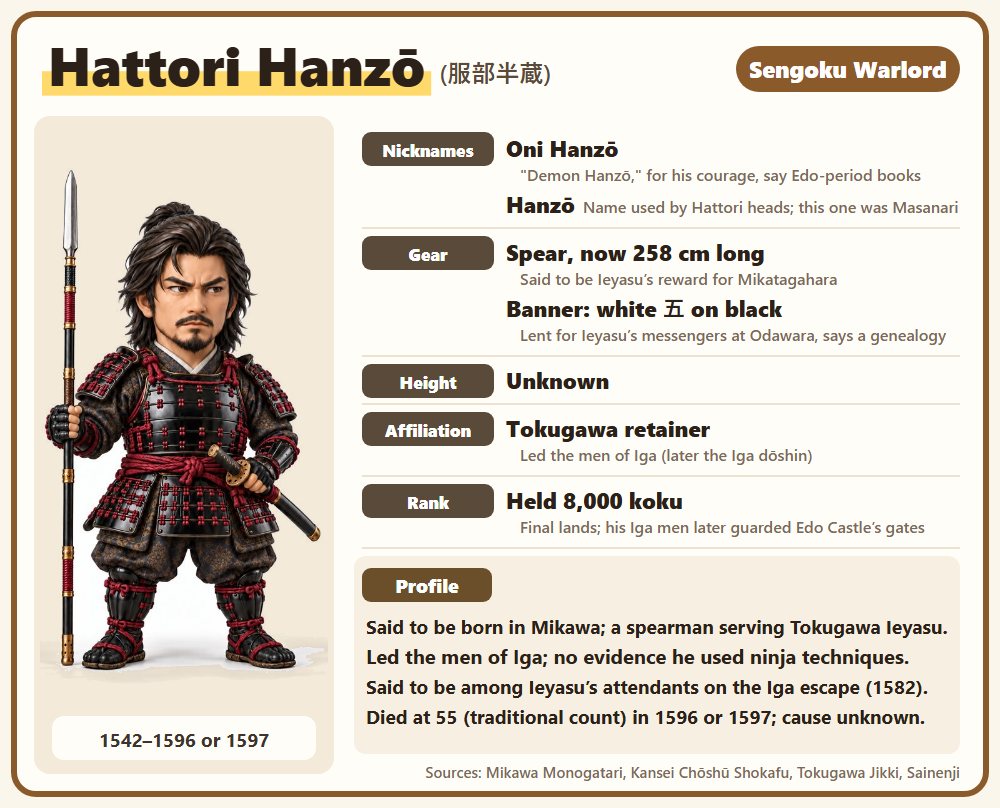
Hattori Hanzō was a samurai of Japan's Warring States period who served Tokugawa Ieyasu, the warlord who later founded the Tokugawa shogunate. "Hanzō" was a name passed down by the heads of the Hattori family, and when people say "Hattori Hanzō," they almost always mean Ieyasu's retainer Hattori Masanari (born 1542; died late 1596 or early 1597).
Today he is famous as a ninja master. Yet in the records, Masanari was a warrior who fought with a spear and a commander of men from Iga, the mountain province now remembered as the home of the ninja.
This article explains who Hattori Hanzō really was, whether he was a ninja, how and when he died, what happened to his descendants, where his grave and spear are, what he did during Ieyasu's famous escape through Iga, and how the image of "Hanzō the ninja" was born, keeping what the records say separate from later stories.
Key points are tagged: [Fact] confirmed by records from the time, [Widely accepted] a view widely accepted by researchers, [Debated] accounts, interpretations or ways of counting differ, [Unknown] not established from the sources we checked, [Legend] stories found in later records, [Folk belief] popular claims with little evidence, and [Drama fiction] invented for dramas and novels.

I am Uesugi Kenshin. Today's subject is the famous Hattori Hanzō.

I'm Date Masamune! Hanzō... the ninja in black who throws shuriken, right?

Heh. The records tell a rather different story. Let us look at them one by one.
The Short Answers
- Who was he? Hattori Masanari (born 1542; died late 1596 or early 1597), a retainer of Tokugawa Ieyasu. "Hanzō" was a name used by generation after generation of Hattori family heads (more)
- Was he a ninja? He was a commander known for his skill with a spear, who led men from Iga. The sources we checked do not establish that he himself used ninja techniques (more)
- Descendants? His sons' families served the Kuwana domain and others until the end of the Edo period. Who his descendants are today has not been confirmed (more)
- How did he die? The sources we checked do not say. He died in the 11th month of Keichō 1 (late 1596 or early 1597), aged 55 by the traditional count (more)
- Grave? At Sainenji temple in Shinjuku, Tokyo, which also keeps a spear said to have been a gift from Ieyasu (more)
Three Questions This Article Explores Through the Sources
- The escape through Iga, record by record: a table compares what seven records, from a diary written that very week to a 1961 city history, say about Hanzō's role (more)
- Two sons, two family lines: a family tree traces how his eldest and second sons' families continued in Kuwana, Matsuyama and Imabari (more)
- How "Hanzō the ninja" was born: a timeline based on Tamura Risa's 2020 study shows that the ninja Hanzō is mostly a creation of novels and manga from the late 1950s (more)
Jump to the part you want to read:
- Who was Hattori Hanzō? The real Masanari and the other Hanzōs
- Was Hattori Hanzō a ninja?
- Does Hattori Hanzō have descendants today?
- How and when did Hattori Hanzō die?
- Where is Hattori Hanzō's grave?
- What did he do during the escape through Iga?
- Why was he called "Demon Hanzō"?
- Was he ordered to assist at Nobuyasu's suicide?
- How did he become a famous ninja?
- FAQ
Who Was Hattori Hanzō? The Real Masanari and the Other Hanzōs
In a single sentence, Hattori Hanzō (Masanari) was "a warrior known for his skill with a spear, who served Tokugawa Ieyasu and led the men of Iga".
| Item | Details |
| Name | Hattori Hanzō. His personal name was Masanari (正成) |
| Born | 1542 (Tenbun 11), said to be in Mikawa Province, today's eastern Aichi Prefecture [Widely accepted] |
| Father | Hattori Yasunaga, from Iga Province (today's western Mie Prefecture), who is said to have served the Matsudaira family of Mikawa, later the Tokugawa [Widely accepted] |
| Lord | Tokugawa Ieyasu |
| Nickname | "Demon Hanzō" (Oni Hanzō) [Legend] |
| Role | A warrior who fought with a spear and commanded men from Iga, later the Iga dōshin [Widely accepted] |
| Lands | Eventually held lands assessed at 8,000 koku (a koku was a unit of volume used to express the assessed rice yield of land) [Widely accepted] |
| Died | 11th month of Keichō 1 (late 1596 or early 1597), aged 55 by the traditional count [Widely accepted] |
| Grave | Sainenji temple, Shinjuku, Tokyo |
"Hanzō" Was Not Just One Man
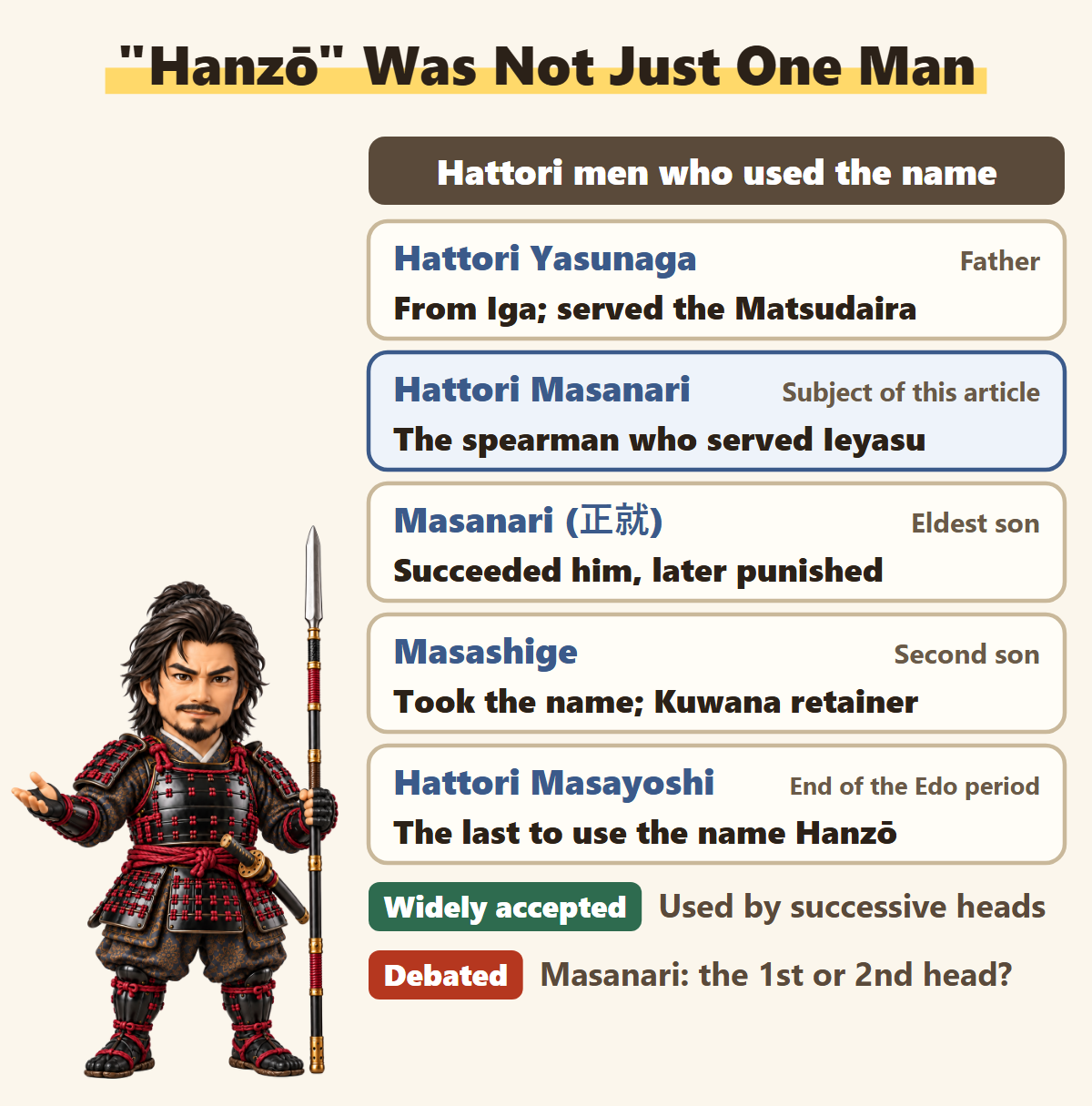
"Hanzō" (written 半蔵, or alternatively 半三) was the name used by successive heads of the Hattori family [Widely accepted]. Masanari's father Yasunaga used it, and so did both of Masanari's sons; the family's later heads kept the name "Hattori Hanzō" until the end of the Edo period.
Confusingly, his eldest son's name, 正就, is also pronounced "Masanari," although it is written with a different character from his father's name (正成). In this article, "Masanari" means the father unless we say otherwise.
Which "number" Masanari was depends on how you count. If his father Yasunaga is counted as the first, Masanari is the second (as in the National Diet Library's exhibition), while a local-history article by Kuwana City counts Masanari as the first [Debated].
| Person | Relation to Masanari | Who was he? |
| Hattori Yasunaga | Father | From Iga; said to have served the Matsudaira of Mikawa |
| Hattori Masanari | The subject of this article | The spearman who served Ieyasu, and the most famous "Hanzō" |
| Masanari (正就) | Eldest son | Succeeded his father but was later punished; died at the siege of Osaka |
| Masashige | Second son | Took the name Hanzō after his brother; later a senior retainer of the Kuwana domain (Mie Prefecture) |
| Hattori Masayoshi | Descendant at the end of the Edo period | Chief retainer of the Kuwana domain who fought in the Boshin War; the last man to use the name Hanzō |
Was Hattori Hanzō a Real Person?
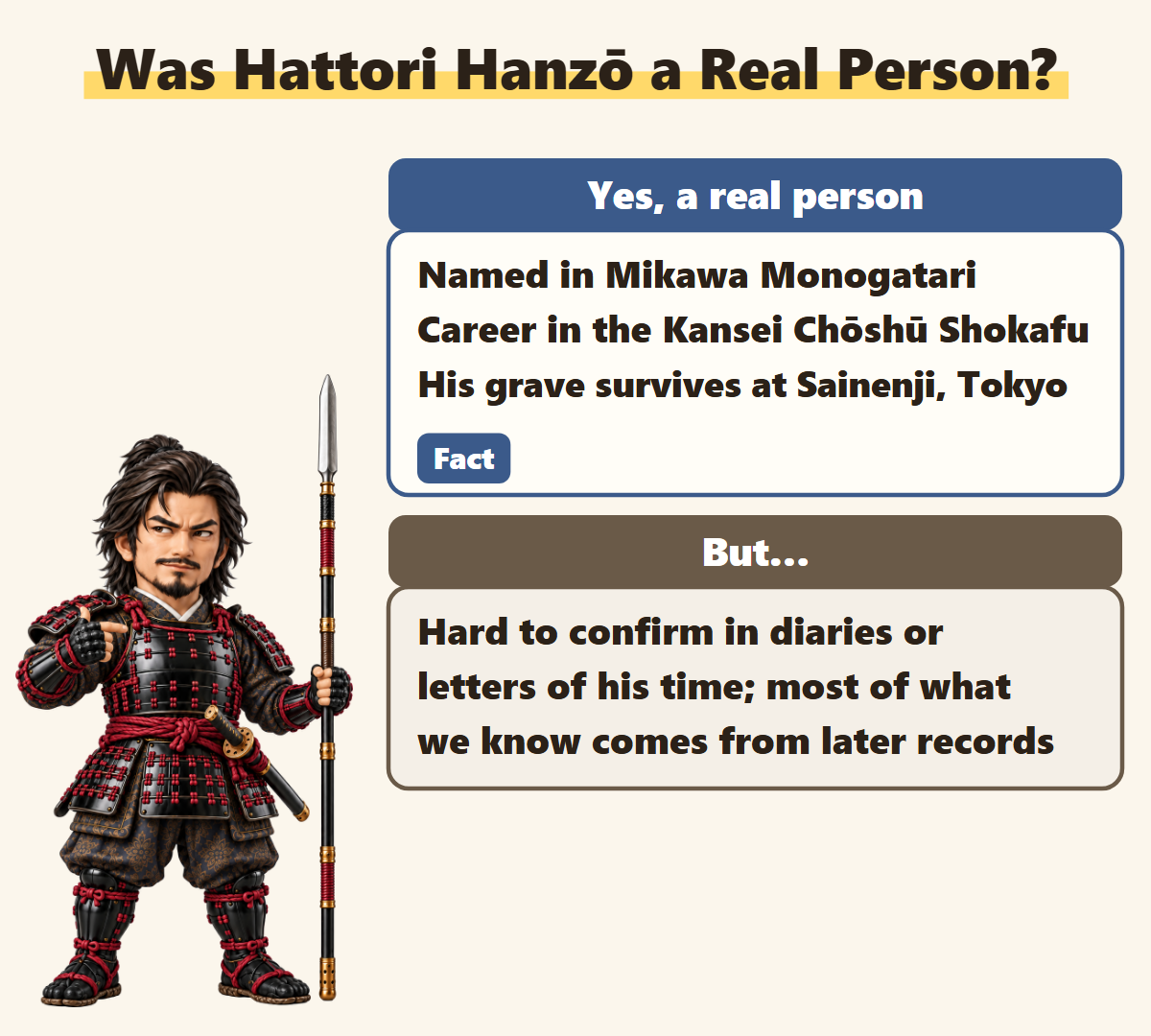
Yes. His name appears in Mikawa Monogatari, written in the early Edo period (1603–1868) by one of Ieyasu's retainers, and his career is described in the Kansei Chōshū Shokafu, a collection of family genealogies compiled by the Tokugawa shogunate. His grave also survives at Sainenji temple in Tokyo.
Even so, it is hard to confirm his name or deeds in diaries or letters from his own lifetime. Most of what we know about him comes from records written later.

So there were several Hanzōs!
Indeed. In this article, we will focus on Masanari, the most famous of them.
Was Hattori Hanzō a Ninja? The Commander of the Men of Iga
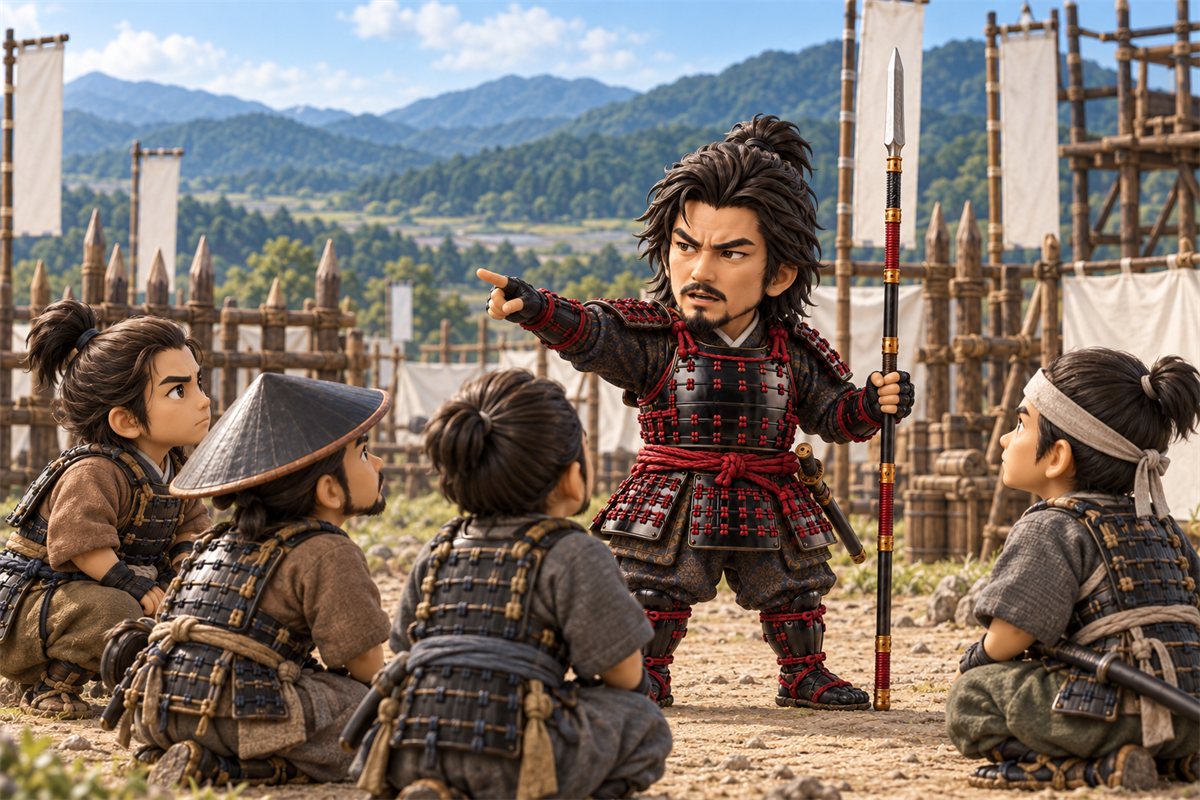
Image: Masanari giving orders to men of Iga, shown here dressed as ordinary local warriors rather than in the black outfits of fiction
The short answer: Masanari is known as a warrior who commanded men from Iga. The sources we checked do not support the idea that he himself used ninja techniques, as he does in stories.
Yamada Yūji of Mie University, a well-known ninja scholar, says that Masanari's name "always comes up as a leading soldier and master spearman," and that Masanari himself was probably not a shinobi (the period word for a ninja), but someone who commanded them (nippon.com).
Who Were the Iga-mono and Iga Dōshin?
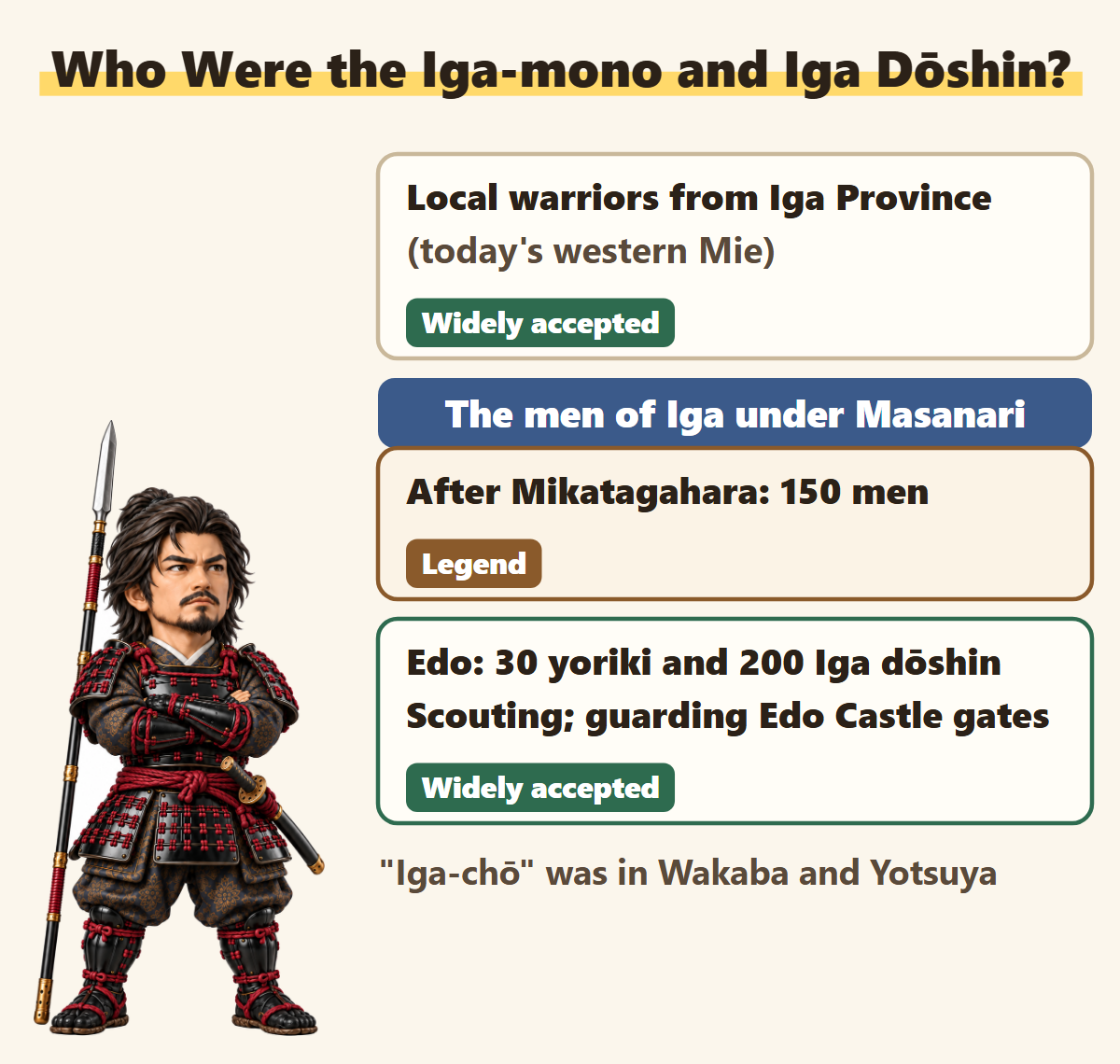
The Iga-mono (men of Iga) were local warriors from Iga Province, today's western Mie Prefecture. Their name later became the title of a post in the Tokugawa shogunate [Widely accepted].
The Kansei Chōshū Shokafu says that after the Battle of Mikatagahara (1573), 150 men of Iga were placed under Masanari [Legend]. It also says that after Ieyasu moved to Edo (today's Tokyo) in 1590, Masanari commanded 30 mounted officers (yoriki) and 200 Iga dōshin (lower-ranking retainers organized as an Iga unit). That he led the Iga dōshin is widely accepted in encyclopedias and similar references [Widely accepted]. In war, the men of Iga are said to have scouted the enemy, and in the Edo period they guarded the gates of Edo Castle.
In what is now Wakaba and Yotsuya in Shinjuku, Tokyo, there was once an "Iga-chō," a district where the men of Iga lived together. Sainenji temple, where Masanari's grave stands, is right next to it.
Iga or Kōka?
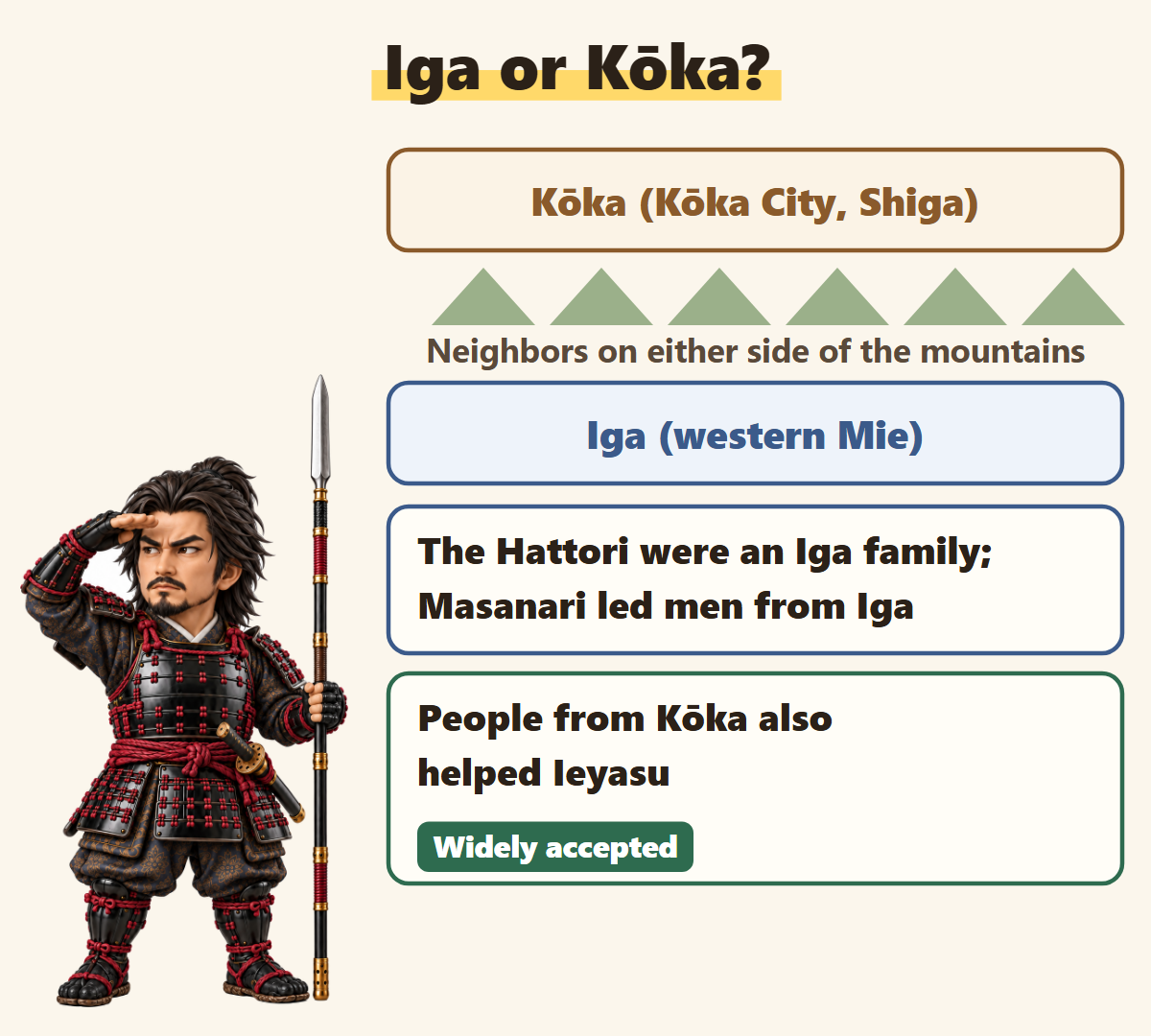
The Hattori were an Iga family, and the men Masanari led were from Iga. Among those who helped Ieyasu, however, there were also people from Kōka, the neighboring area in today's Kōka City, Shiga Prefecture [Widely accepted]. Iga and Kōka lie on either side of a range of mountains and are thought to have had close ties.
So he is better understood as a commander of shinobi than as a ninja himself!
Yes. He was a warrior who carried a spear and fought on the battlefield.
For shinobi groups across Japan beyond Iga and Kōka, such as the Hōjō clan's Fūma and the Takeda's suppa, and for whether female ninja existed, see our article "Were Ninjas Real?"
Does Hattori Hanzō Have Descendants Today?
The short answer: we could not find any source that confirms who his descendants are today [Unknown]. What we do know is that in the Edo period, the families of Masanari's sons continued as senior retainers of the Kuwana domain (Mie Prefecture) and other domains until the end of the Edo period [Widely accepted].
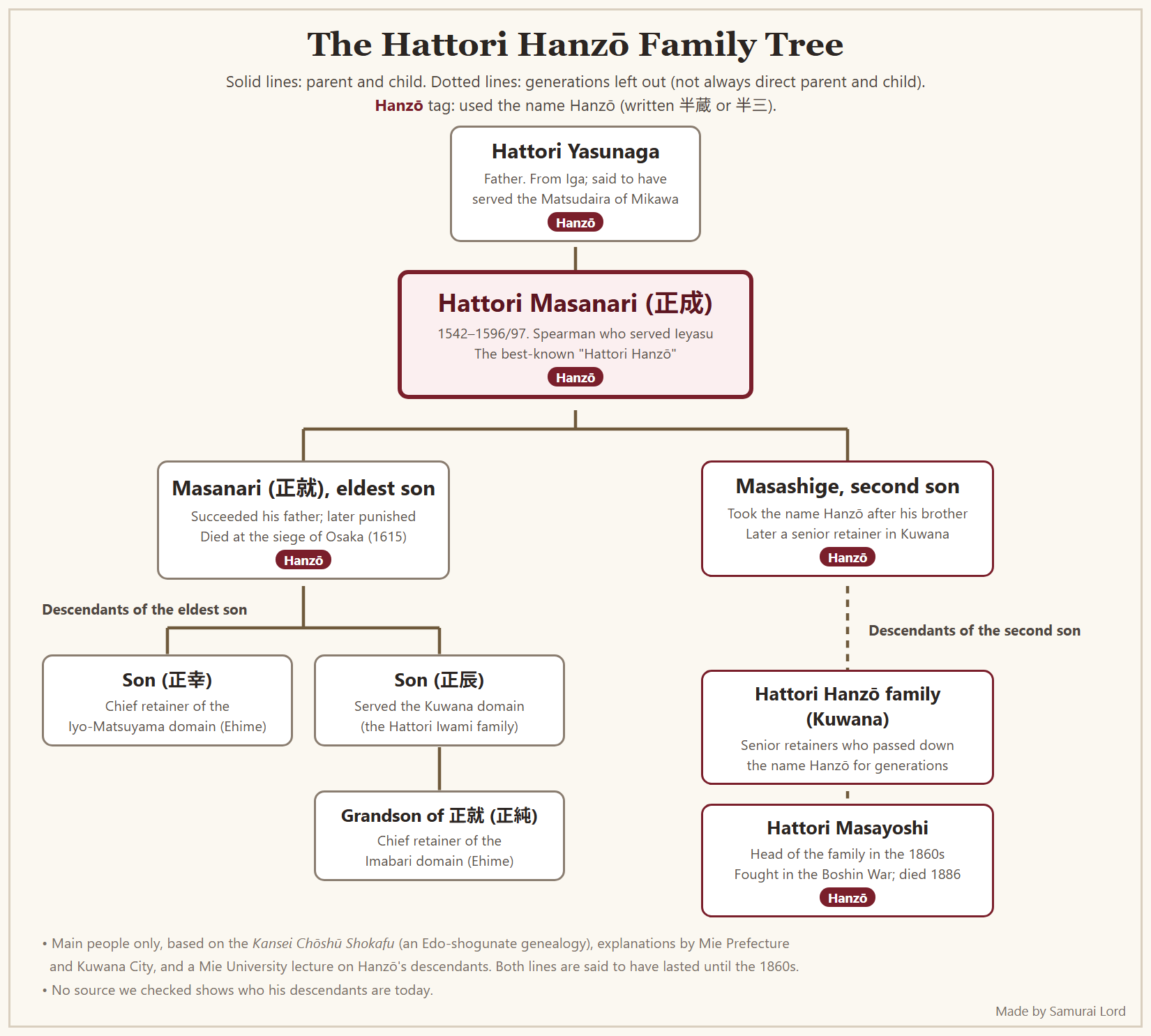
Image: The Hattori Hanzō family tree (made by Samurai Lord). Tap or click the image to enlarge it
The Line of His Eldest Son
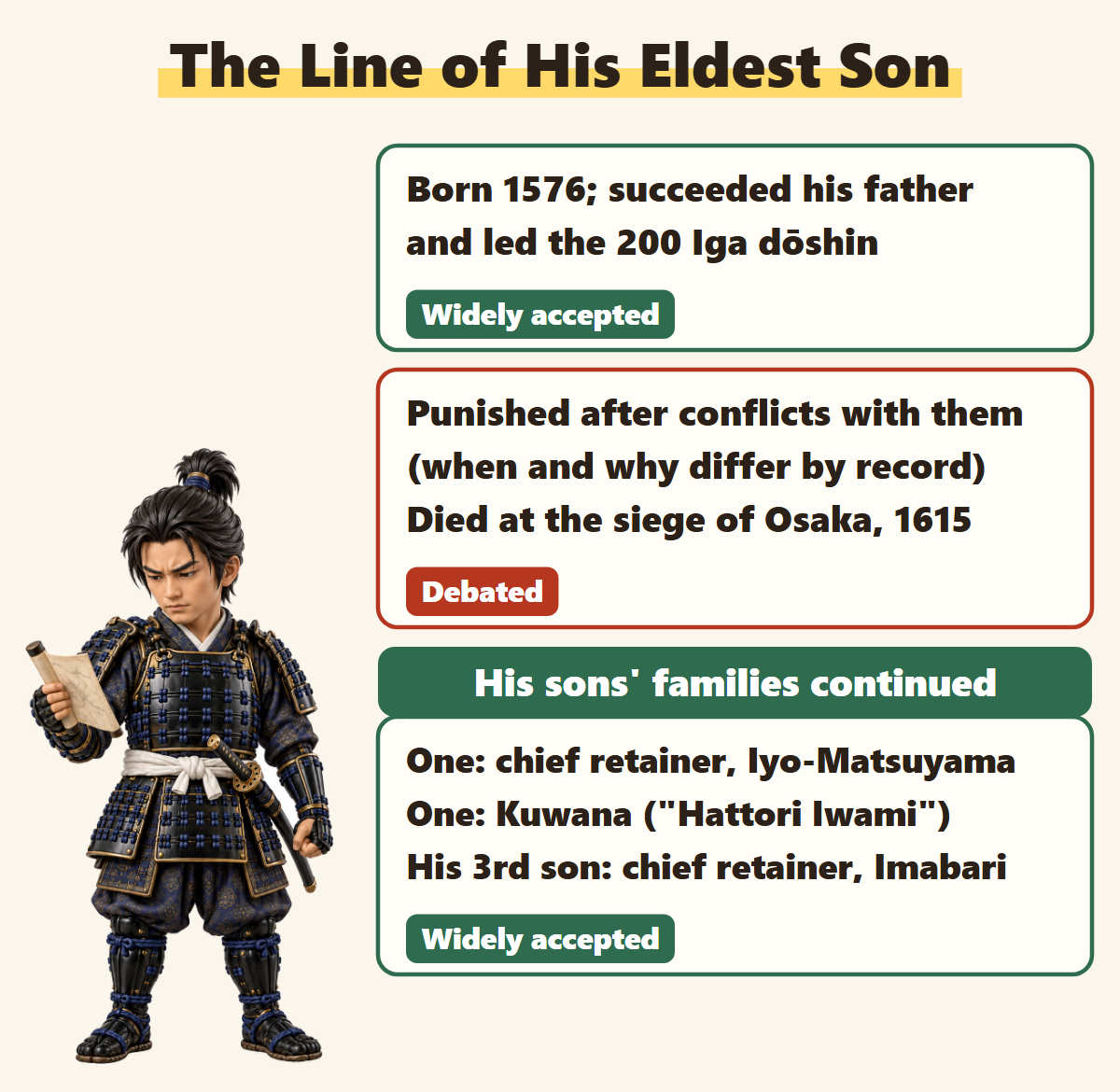
His eldest son, Masanari (正就), was born in 1576. After his father's death, he succeeded him and took charge of the 200 Iga dōshin [Widely accepted]. But conflicts with the Iga dōshin and other troubles are recorded, and he was later punished and lost his position. When and why exactly this happened differs from record to record [Debated]. He died in 1615 at the summer siege of Osaka [Widely accepted].
Even so, his line continued. According to a lecture summary from Mie University, one of his sons became a chief retainer of the Iyo-Matsuyama domain (Ehime Prefecture); another served the Kuwana domain as the head of the "Hattori Iwami" family; and that son's third son became a chief retainer of the Imabari domain (Ehime Prefecture). These families are said to have continued until the end of the Edo period [Widely accepted].
Masashige and the "Hattori Hanzō Family"
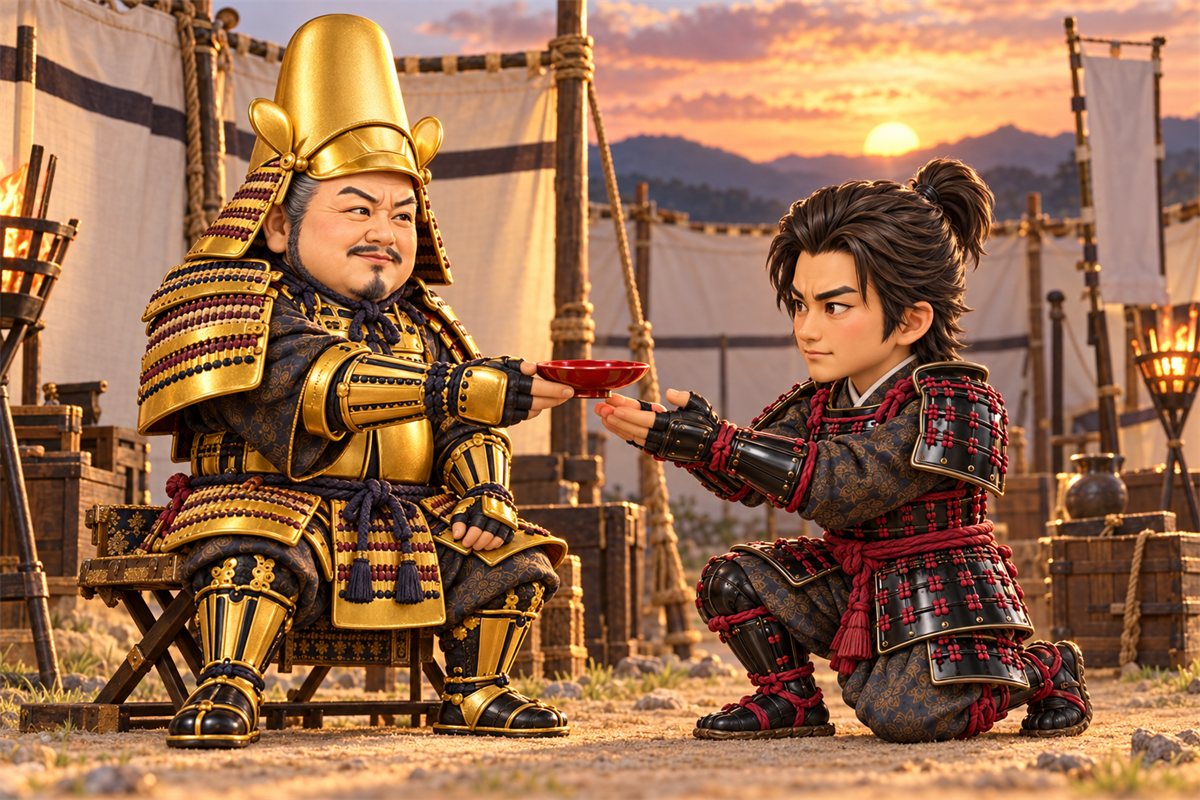
Image: Masashige receiving a cup from Ieyasu on the day before the Battle of Sekigahara (a story told in the shogunate's genealogy)
The second son, Masashige, was given 3,000 koku of his father's lands and served close to Ieyasu. The shogunate's genealogy tells a story that on the day before the Battle of Sekigahara (1600), Ieyasu said to him, in effect, "Your father and grandfather won honors many times. That you come with us to this battle at your young age is truly admirable," and gave him a cup of sake [Legend].
Masashige took the name Hanzō after his brother [Widely accepted]. He was later punished for his part in an incident, but he entered the service of Matsudaira Sadakatsu and later became a senior retainer of the Kuwana domain under Sadatsuna [Widely accepted]. This "Hattori Hanzō family" continued in Kuwana until the end of the Edo period. Its head at the end of the Edo period, Hattori Hanzō Masayoshi, fought in the Boshin War (the 1868–69 civil war between the new imperial government and forces supporting the former shogunate) as a chief retainer of Kuwana, and died in Kuwana in 1886 [Widely accepted].
Are There Descendants Today?
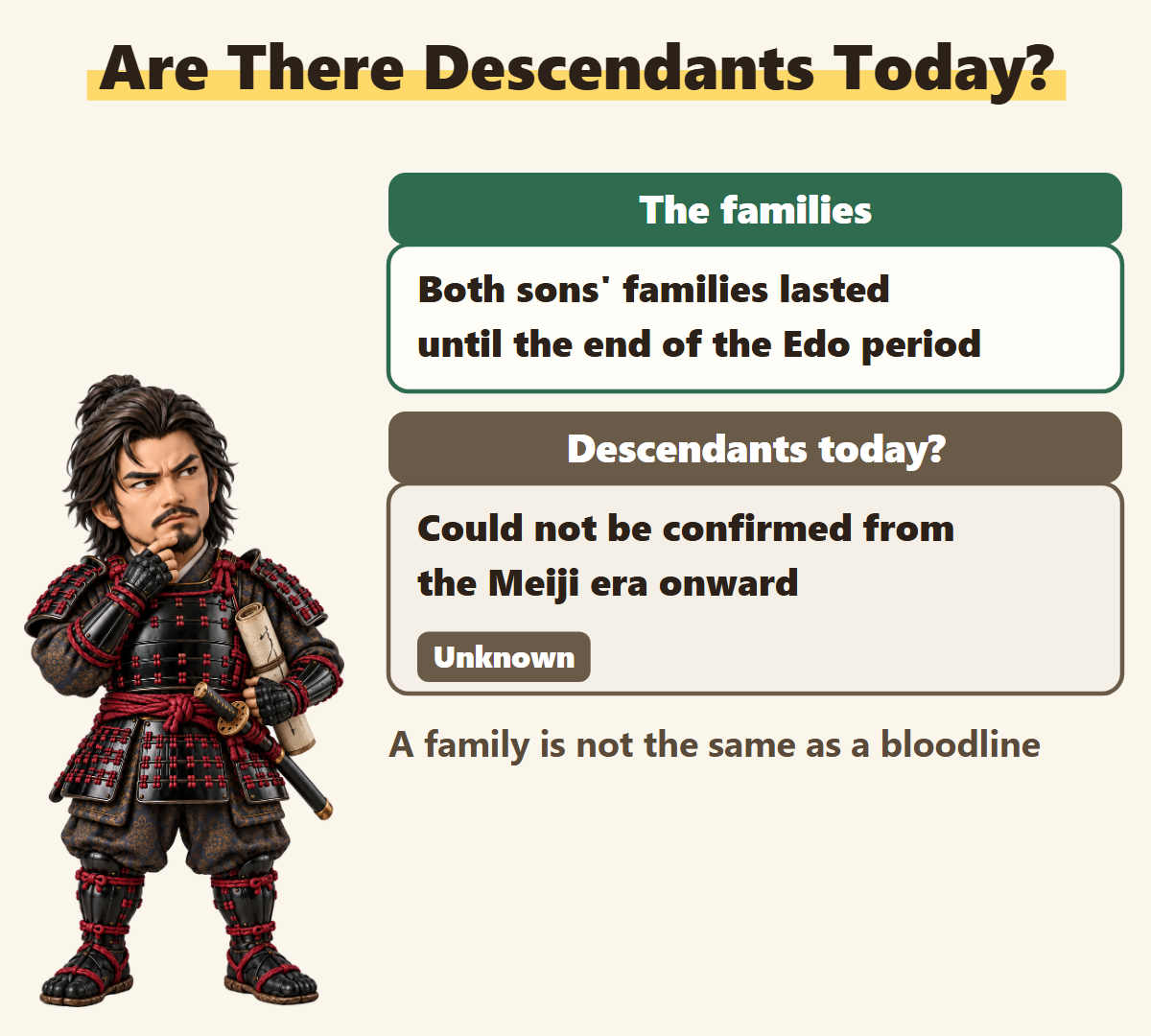
Explanations based on the domain's old documents show that families descended from Masanari's sons lasted until the end of the Edo period. But "a family continued" and "a bloodline continued" are two different things. We could not confirm who his descendants were from the Meiji era (1868–1912) onward, or who they are today [Unknown].
So the eldest son's family and the second son's family each carried on in their own way.
Just so. The family tree shows which families came from each son.
How and When Did Hattori Hanzō Die?
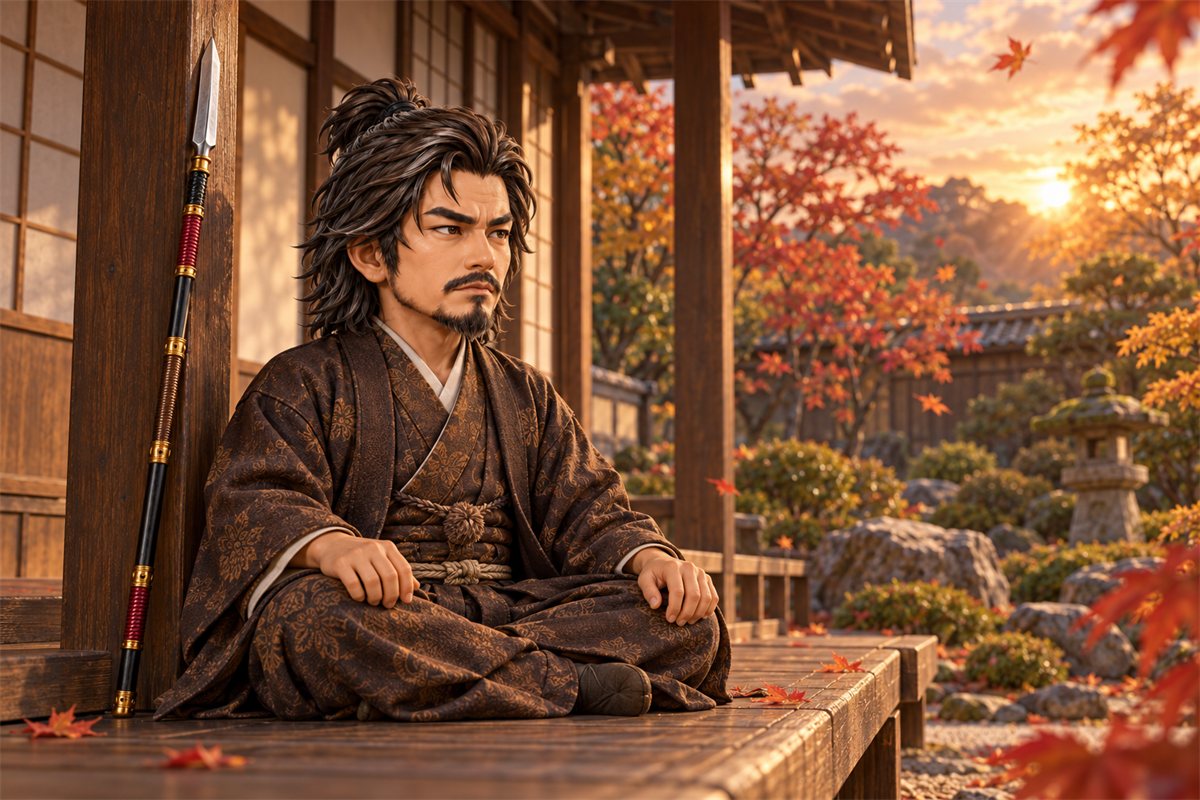
Image: Masanari in his last years
The short answer: the sources we checked do not tell us how Masanari died [Unknown]. He died in the 11th month of Keichō 1 (late 1596 or early 1597 in the Western calendar), aged 55 by the traditional Japanese count, in which a person was counted as one at birth and gained a year at the start of each new year in the Japanese calendar [Widely accepted].
| Item | What we know | Source |
| When | 11th month of Keichō 1 | The shogunate's genealogy; his gravestone and memorial tablet at Sainenji |
| Age | 55 by the traditional count | Same as above |
| Day | The 4th day in the Kansei Chōshū Shokafu; the 14th day on the back of the memorial tablet (as copied in the temple's report to the shogunate) and in a survey of the gravestone [Debated]. In the Gregorian calendar, the 4th day is December 23, 1596, and the 14th is January 2, 1597 | Materials in the National Diet Library |
| Cause | Not known from the sources we checked [Unknown] | — |
| Killed in battle? | No record we checked says he died in battle | — |
Some websites say he died of illness, but we could not confirm the record behind that claim. There is also a story that he was killed by Fūma Kotarō, said to be the leader of the shinobi who served the Hōjō family, but we found no source supporting this story in the materials we checked [Folk belief].
The death at the siege of Osaka, about nineteen years later, was that of his eldest son, not Masanari himself.
So when you don't know something, you say so!
Indeed. Making clear what we do not know is an important part of good research.
Where Is Hattori Hanzō's Grave? Sainenji and His Spear
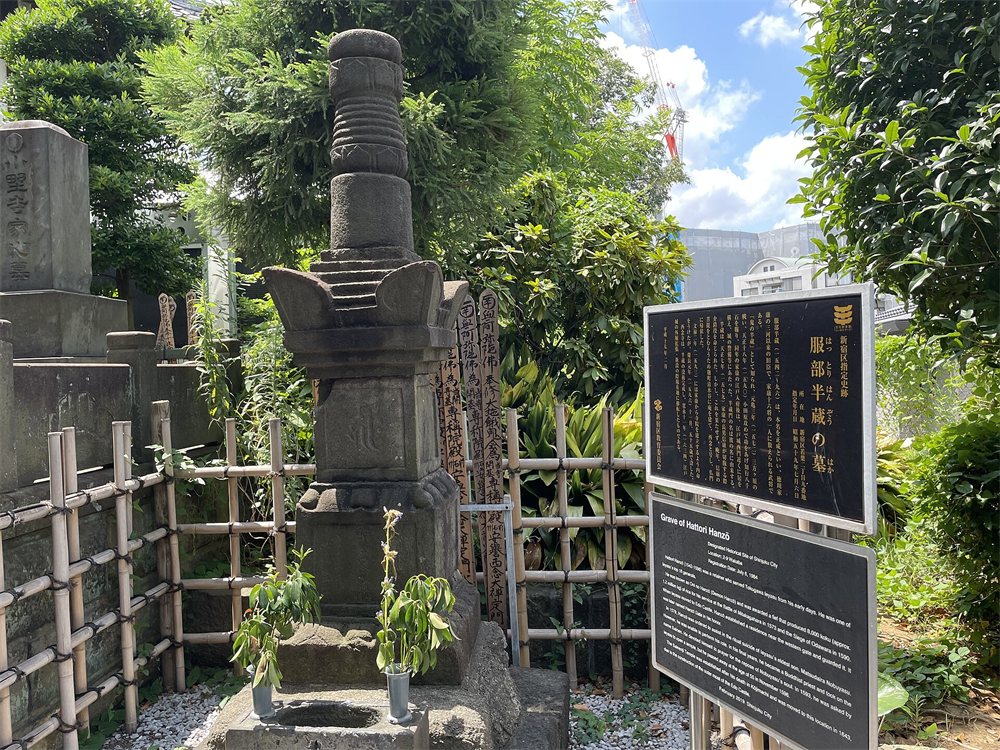
Image: The grave of Hattori Hanzō at Sainenji (Shinjuku, Tokyo). Wikimedia Commons (photo: Higa4, CC0)
The grave of Hattori Hanzō (Masanari) is at Sainenji temple in Wakaba, Shinjuku, Tokyo, about an 8-minute walk from Yotsuya Station. It is a stone pagoda of the type called hōkyōintō, designated a historic site by Shinjuku City. The temple grounds also hold a memorial pagoda for Matsudaira Nobuyasu, Ieyasu's eldest son (also a Shinjuku City historic site).
The Spear Said to Be a Gift from Ieyasu
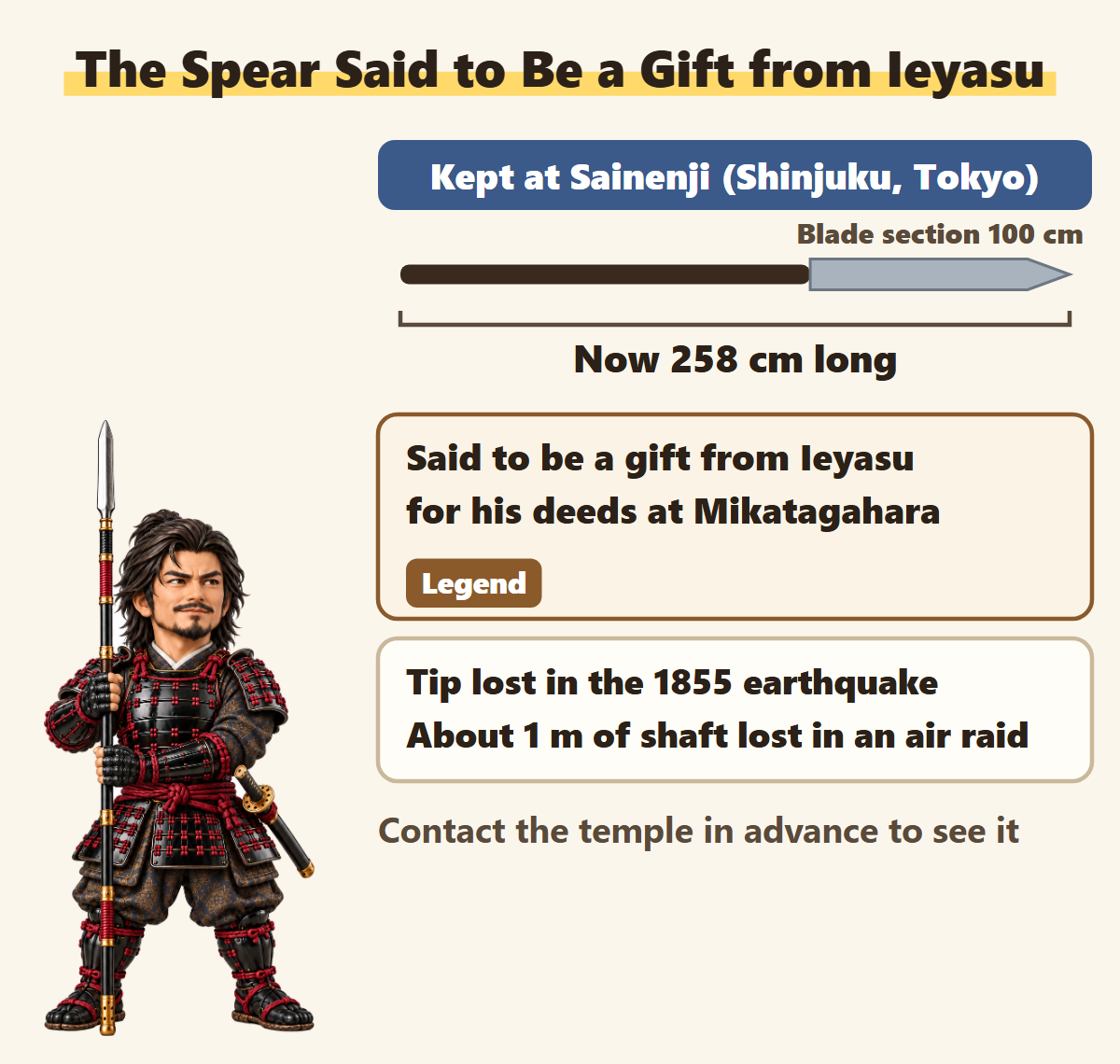
Sainenji keeps a "Spear of Hattori Hanzō," registered by Shinjuku City as a cultural property. According to the city's explanation, it is now 258 cm long, with a blade section of 100 cm. It is said to have been given to Masanari by Ieyasu for his deeds at the Battle of Mikatagahara [Legend], and his descendants are said to have donated it to the temple in the final years of the Edo period.
However, the tip of the blade broke off and was lost in the great Ansei earthquake of 1855, and about 1 m of the shaft was lost when it broke while being evacuated during an air raid in World War II. Its present length is not its original length. To see it, you need to contact the temple in advance.
Where Does the Name "Hanzōmon" Come From?
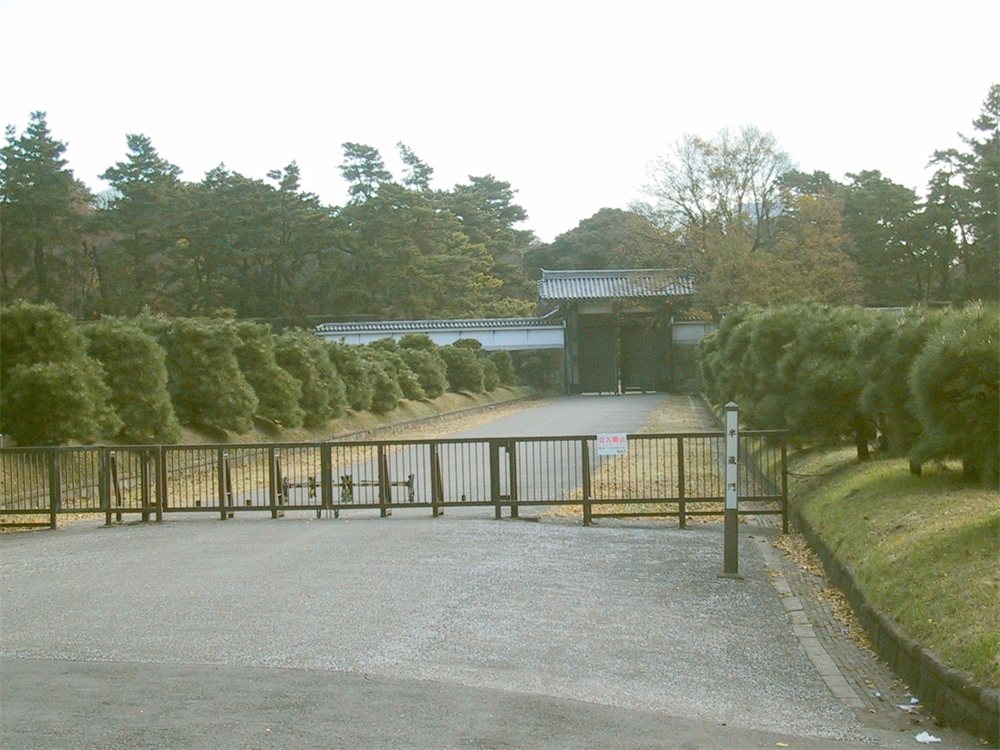
Image: The Hanzōmon gate of the Imperial Palace (Chiyoda, Tokyo). Wikimedia Commons (photo: Chris 73, CC BY-SA 3.0)
The Hanzōmon gate on the west side of the Imperial Palace (formerly Edo Castle) is said to be named after the residence of Hattori Hanzō and his men of Iga, which stood nearby [Widely accepted]. Sources differ, however, on which Hanzō the residence belonged to.
Places Connected to Hattori Hanzō
| Place | What is there? | Location |
| Sainenji | Hanzō's grave (Shinjuku City historic site), a memorial pagoda for Matsudaira Nobuyasu, and the spear said to have come from Ieyasu | Wakaba, Shinjuku, Tokyo |
| Hanzōmon | The gate of Edo Castle said to be named after him | Chiyoda, Tokyo |
| Chigachi Castle site | A castle site said to be the Hattori family's homeland, with a stone monument | Yono, Iga City, Mie |
| Kuwana | The castle town of the Kuwana domain, which his descendants served; Masayoshi's grave is here | Kuwana City, Mie |
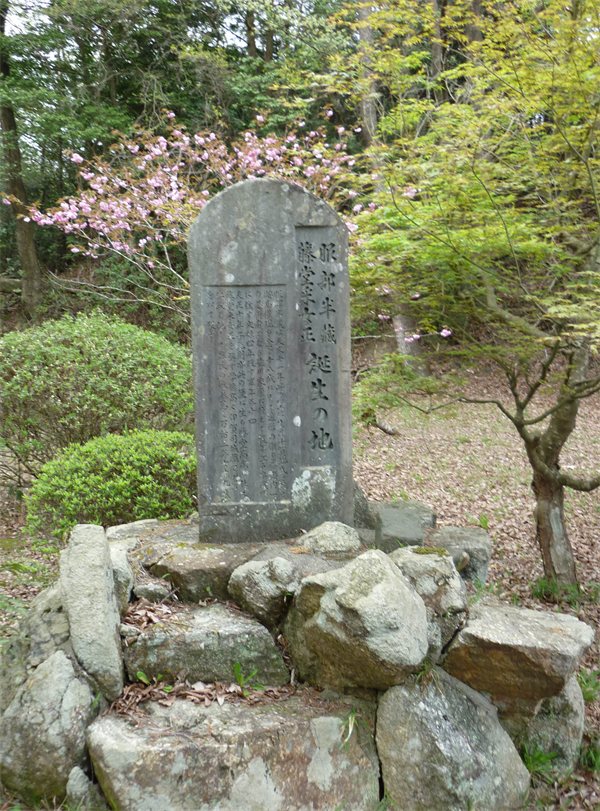
Image: The monument at the Chigachi Castle site (Iga City, Mie). Wikimedia Commons (photo: ブレイズマン, CC BY 3.0)
This monument is inscribed "Birthplace of Hattori Hanzō and Tōdō Uneme." The shogunate's genealogy, on the other hand, says Masanari was born in Mikawa. Iga is said to be the Hattori family's homeland, but on the question of where Masanari himself was born, the records and local tradition disagree.
What Did He Do During the Escape Through Iga? Comparing the Records
The escape through Iga (Iga-goe) took place in the 6th month of Tenshō 10 (June–July 1582). When Oda Nobunaga was killed at Honnō-ji temple in Kyoto on June 21, 1582, in the Julian calendar (July 1 in the Gregorian calendar), Ieyasu was in Sakai (today's Osaka Prefecture). He hurried home to Mikawa by way of Iga and Ise. That he returned through Iga and Ise is recorded in the Ietada Nikki, the diary of Matsudaira Ietada, written at the time [Fact: Ietada Nikki]. For the route and schedule of the whole journey, see our article on the escape through Iga.
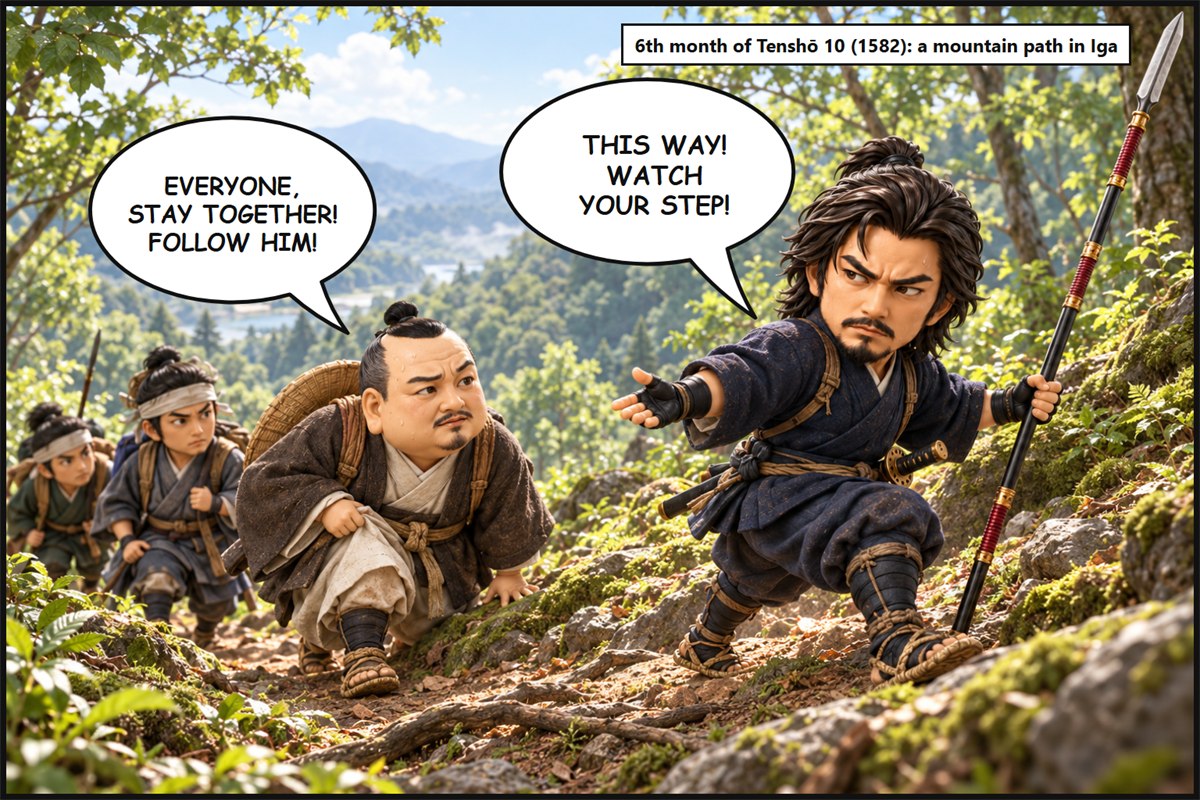
Image: Masanari guiding Ieyasu's party during the escape through Iga [Legend]
The story that "Hattori Hanzō gathered the men of Iga and protected Ieyasu" is famous, but when you compare the records, each one says something different.
| Record (when written) | What it says about Masanari | How we checked |
| Ietada Nikki (a diary from the time) | His name does not appear | The entry for the 4th day of the 6th month |
| Mikawa Monogatari (around 1626) | His name does not appear | The section on the escape through Iga |
| Ishikawa Tadafusa Tomegaki (notes by Ishikawa Tadafusa, son of Ōkubo Tadachika, who made the journey) | He was one of Ieyasu's attendants, with no mention of any special role | An explanation by Mie Prefecture |
| Kansei Chōshū Shokafu (around 1812; the shogunate's genealogy) | Since Iga was his family's homeland, he was ordered to act as guide | Materials in the National Diet Library |
| Family histories of the Iga-mono (written by Iga families about their own origins; several exist, one said to date from 1726) | The men of Iga guided Ieyasu, and Hanzō and his kinsmen joined them as guides | As introduced by researchers |
| Appendix to the Tokugawa Jikki (early 19th century) | 200 men of Iga who escorted Ieyasu over Kabuto Pass and then went home were later placed under Masanari | Materials in the National Diet Library |
| Ueno Shishi (1961 history of Ueno City) | Hanzō gathered and led more than 300 ninja of Iga and Kōka | An explanation by Mie Prefecture |
What the more reliable records confirm is that Masanari was among Ieyasu's attendants [Widely accepted]. The stories that he guided the party or gathered the men of Iga to protect Ieyasu come from later records [Legend]. The numbers need care too. One Iga family history is said to include a list of 190 men who escorted Ieyasu over Kabuto Pass; the appendix to the Tokugawa Jikki speaks of 200 men who turned back on the way; and the Ueno Shishi says Hanzō gathered more than 300. These figures may not be counting the same group of people [Debated].
Historians are divided. Yamada Yūji notes that no historical source records Masanari doing anything notable during the escape. Watanabe Daimon, while agreeing that most of the records are late, argues that the way Masanari was trusted and rewarded afterward suggests the story is not a complete invention.
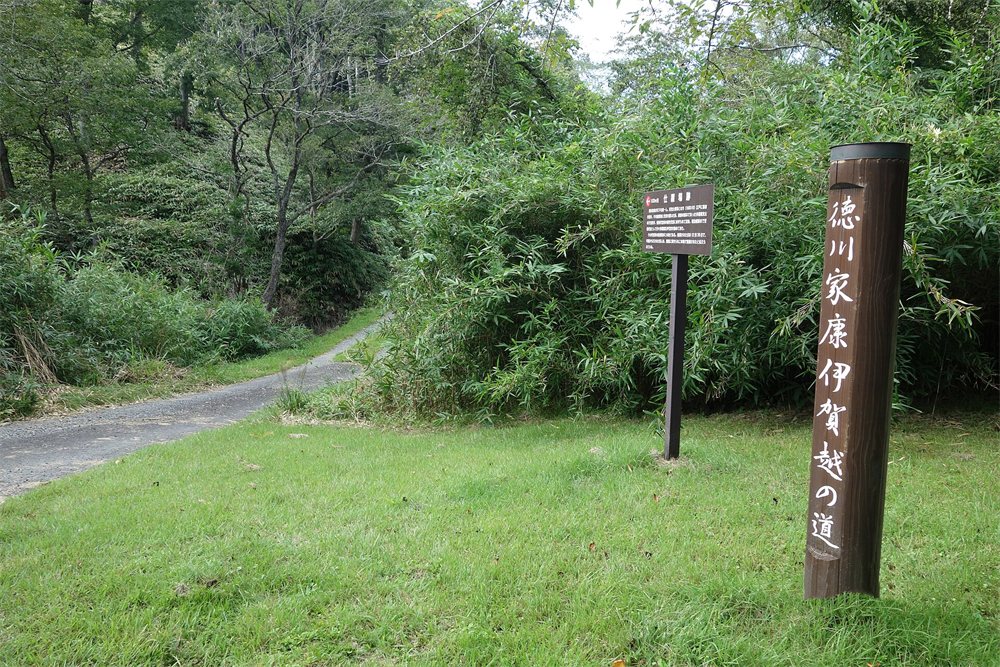
Image: A post marking "the route of Tokugawa Ieyasu's escape through Iga" in Shigaraki, Kōka City, Shiga Prefecture. Wikimedia Commons (photo: Motokoka, CC BY-SA 4.0)
Ieyasu went from Sakai through Iga and Ise, then sailed home to Mikawa. The exact route, and where he boarded and landed, differ from record to record [Debated].
The newer the book, the bigger Hanzō's role seems to get!
So it appears, but a later book may also have copied an older record. What matters is checking, one by one, what each book actually says.
Why Was He Called "Demon Hanzō"? His Battles and Spearmanship
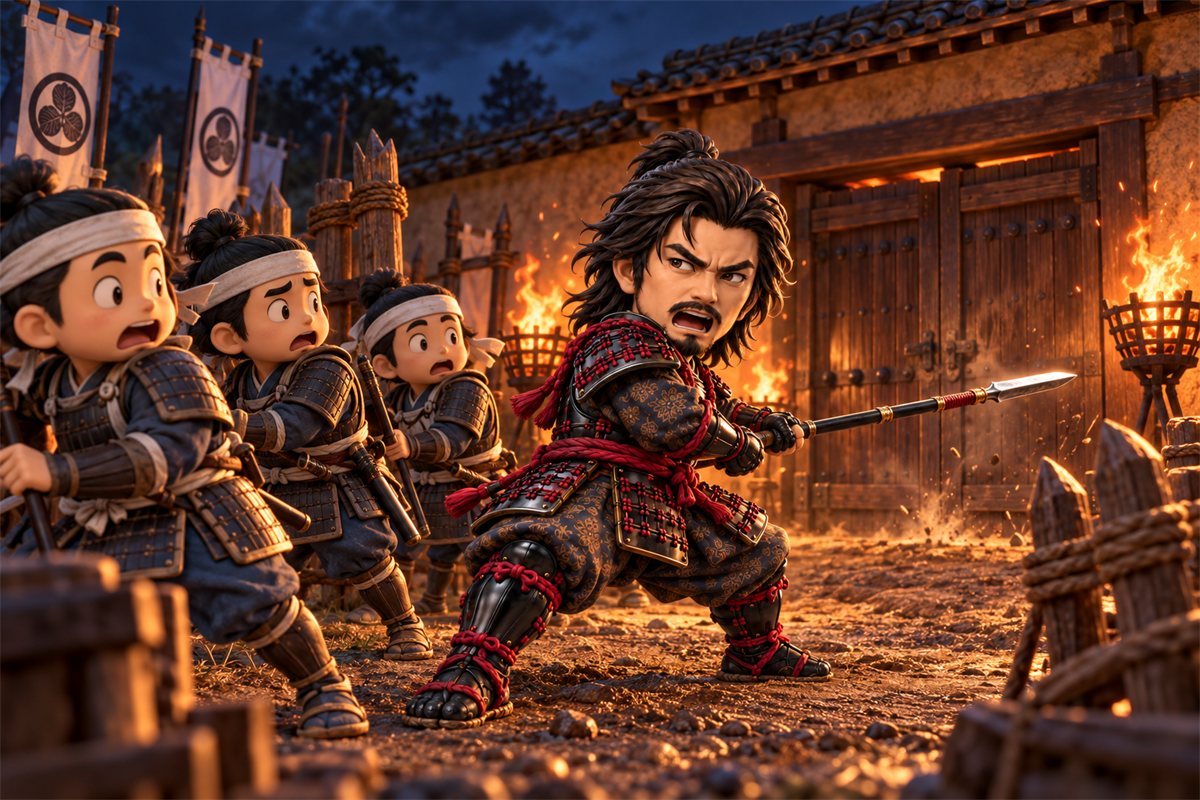
Image: Masanari standing his ground at the siege of Kakegawa Castle (a story told in the shogunate's genealogy)
Edo-period books say that Masanari was called "Demon Hanzō" (Oni Hanzō) for his courage [Legend]. The appendix to the Tokugawa Jikki quotes a song said to have been sung in Ieyasu's lands: "Hattori Hanzō is Demon Hanzō; Watanabe Hanzō is Spear Hanzō." Among Ieyasu's retainers there was another "Hanzō," Watanabe Moritsuna, who was known as "Spear Hanzō."
Masanari's deeds in battle are described mainly in the shogunate's genealogy, the Kansei Chōshū Shokafu.
| Year | Battle | What the genealogy says |
| 1569 (1st month of Eiroku 12) | Siege of Kakegawa Castle (Shizuoka Prefecture) | When the defenders tried to sally out and his own side began to flee, he held his ground with Watanabe Moritsuna and others |
| 1570 and other years | Battle of Anegawa and others | He fought in various battles (no details given) |
| 1573 (12th month of Genki 3) | Battle of Mikatagahara | He won honors, was given a spear by Ieyasu at Hamamatsu Castle, and had 150 men of Iga placed under him [Legend] |
| Autumn 1574 | Fighting against the Takeda in Tōtōmi | When Takeda troops tried to cross the flooded Tenryū River, he rode into the river to meet them |
| 1584 | Siege of Kanie Castle (Aichi Prefecture) | He surrounded one corner of the castle |
| 1590 | Siege of Odawara | He offered his own banner (white character "五", "five," on black) for use by Ieyasu's messengers |
These stories come from a genealogy compiled in the late Edo period, and their details cannot be confirmed [Legend]. The genealogy also says that at 16 (by the traditional count) he joined a night attack on Udo Castle (in today's Gamagōri, Aichi). But if Udo Castle was Kaminogō Castle, which fell in 1562, Masanari, born in 1542, would have been 21, so his age does not match.
Through such service, he ended up with lands of 8,000 koku, and after Ieyasu moved to Edo he commanded the Iga dōshin and played a part in guarding the city [Widely accepted].
"Demon Hanzō" and "Spear Hanzō": two Hanzōs!
Indeed. Both names come up again in the story of Nobuyasu.
Was He Ordered to Assist at Nobuyasu's Suicide?
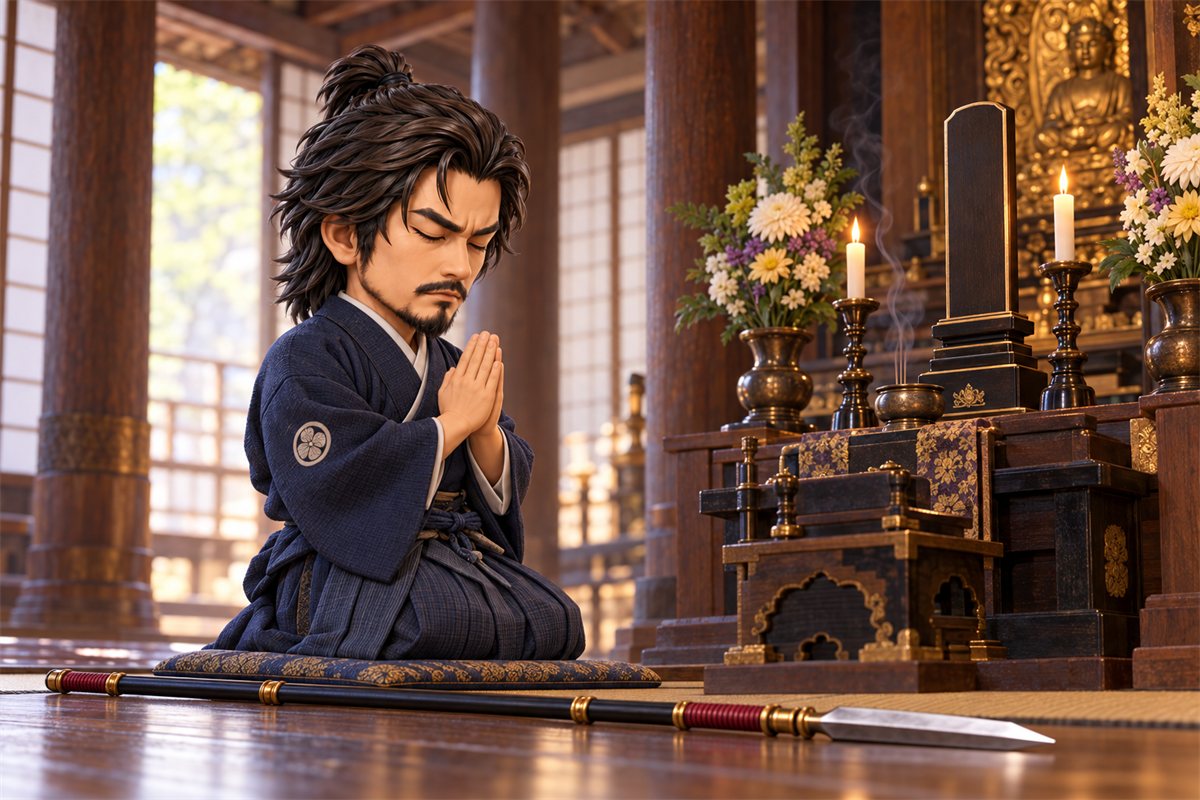
Image: Masanari praying at a temple for the soul of Nobuyasu
In 1579, Ieyasu's eldest son, Matsudaira Nobuyasu, is said to have taken his own life at Futamata Castle in Tōtōmi. According to Mikawa Monogatari, written in the early Edo period, two men were sent to him: Hattori Hanzō and a warrior written in the text as 天方山城 (we have not verified how this name is read).
A well-known story says that "Hanzō broke down in tears and could not perform kaishaku" (the final assistance given during seppuku, ritual suicide). But this story comes from later books, and the books even disagree about which "Hanzō" could not bring himself to do it: in some it is Watanabe Hanzō, in others Hattori Hanzō [Legend].
The Kansei Chōshū Shokafu says that Masanari built a temple called Anyōin in Kōjimachi, Edo, to pray for Nobuyasu, and that it was later renamed Sainenji after Masanari's Buddhist name, "Sainen." A report that the temple sent to the shogunate in the late Edo period, however, says it was founded in 1593 and named 専称山安養院西念寺 (the temple's full name). The temple's origins and the source of its name are known only from later records [Legend]. According to Shinjuku City, the temple moved to its present site in 1634.
He built a temple for Nobuyasu... I wonder if that means he was a kind man.
The temple is in the records. But how he felt at the time, the records cannot tell us.
How Did He Become a Famous Ninja? Hanzō in Fiction, and the Bashō Theory
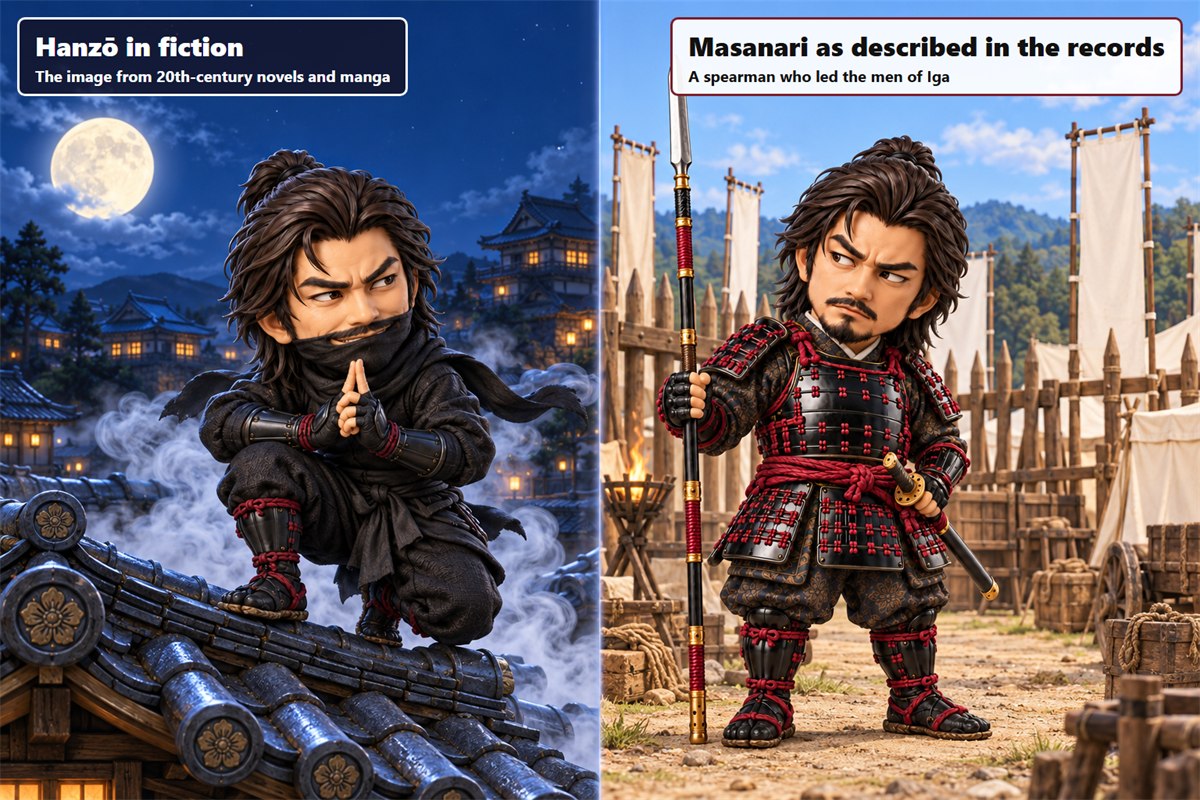
Image: A black-clad Hanzō on a rooftop (left) and an armored Masanari holding a spear (right)
The image of "Hattori Hanzō the ninja" spread mainly through novels, manga, films and TV in the late 1950s and early 1960s. The researcher Tamura Risa examined works up to 1964 and published her findings in a 2020 paper.
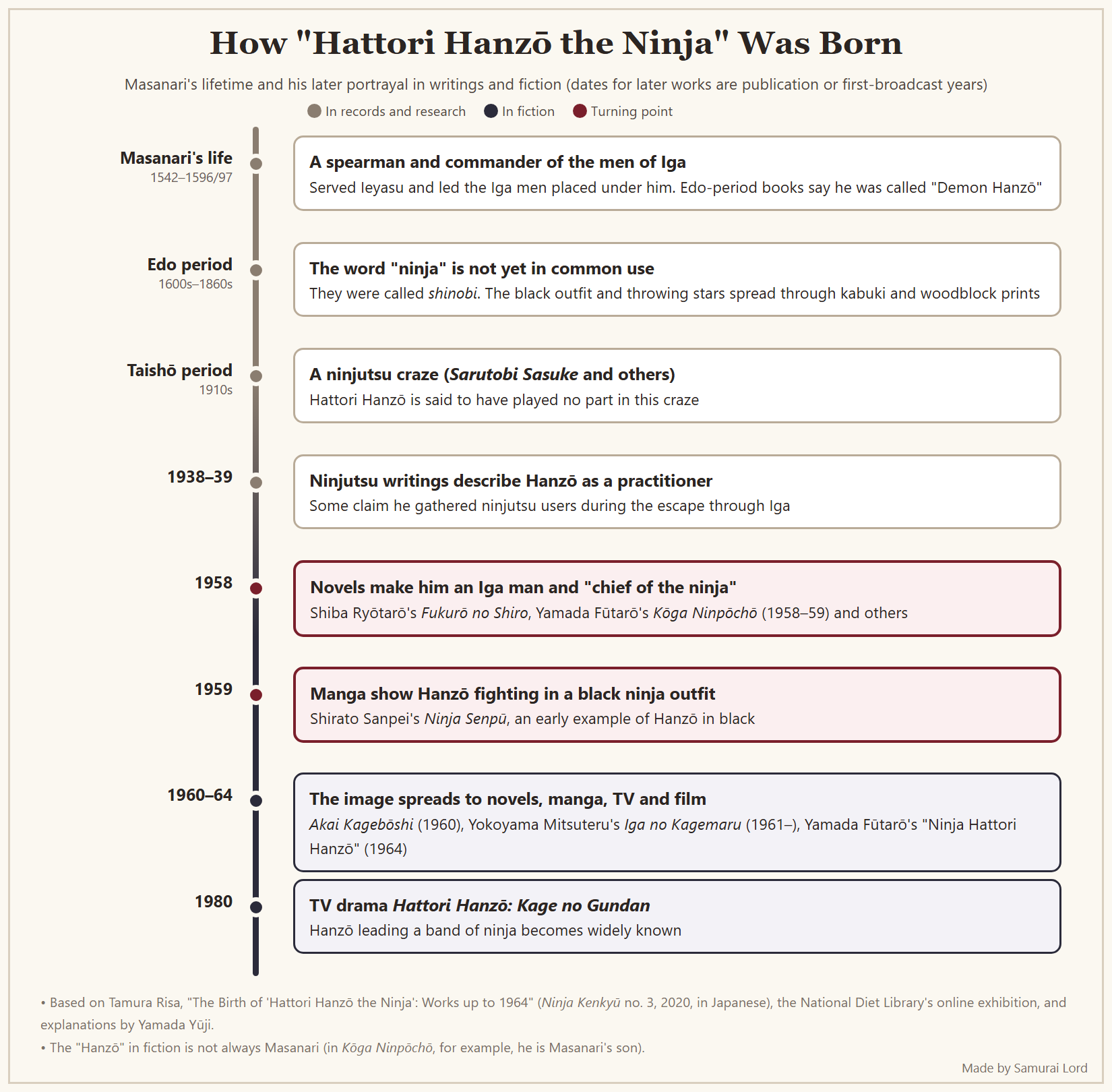
Image: How the image of "Hattori Hanzō the ninja" was formed (made by Samurai Lord, based on Tamura Risa's paper and other sources). Tap or click the image to enlarge it
According to Tamura, Hattori Hanzō played no part in the ninjutsu craze of the Taishō era (1912–1926) (the age of Sarutobi Sasuke). From around 1958, novels began to portray him as a man of Iga and "the chief of the ninja," and in 1959 a manga showed Hanzō fighting in a black ninja outfit.
The "Hanzō" in fiction is not always Masanari. In the novel Kōga Ninpōchō, for example, Hanzō is Masanari's eldest son.
Is the TV Drama Hattori Hanzō: Kage no Gundan Historical?
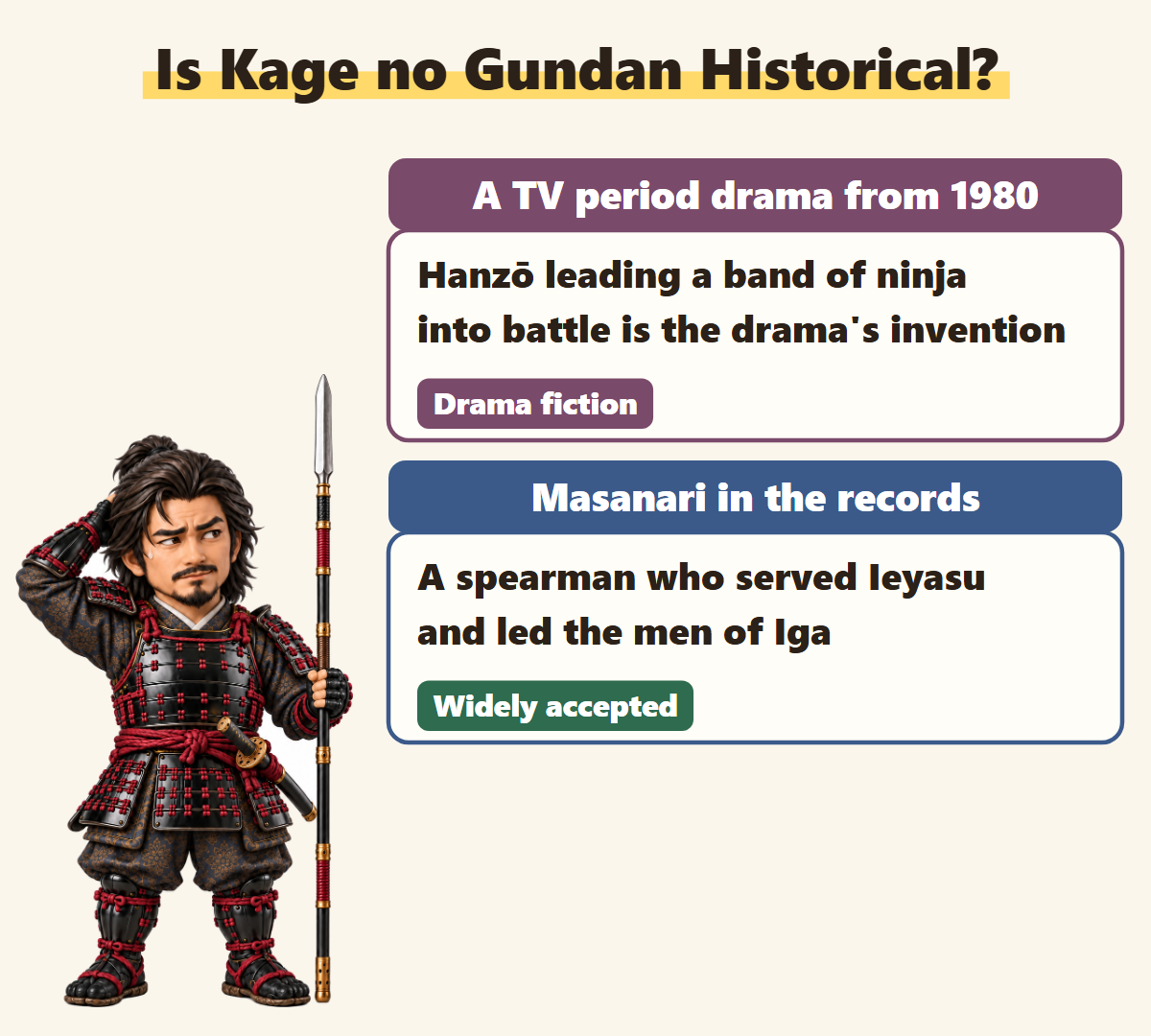
Hattori Hanzō: Kage no Gundan ("Hattori Hanzō: The Shadow Army") was a TV period drama first broadcast in 1980. Hanzō leading a band of ninja into battle is the drama's invention [Drama fiction].
Was the Poet Matsuo Bashō Really Hattori Hanzō?
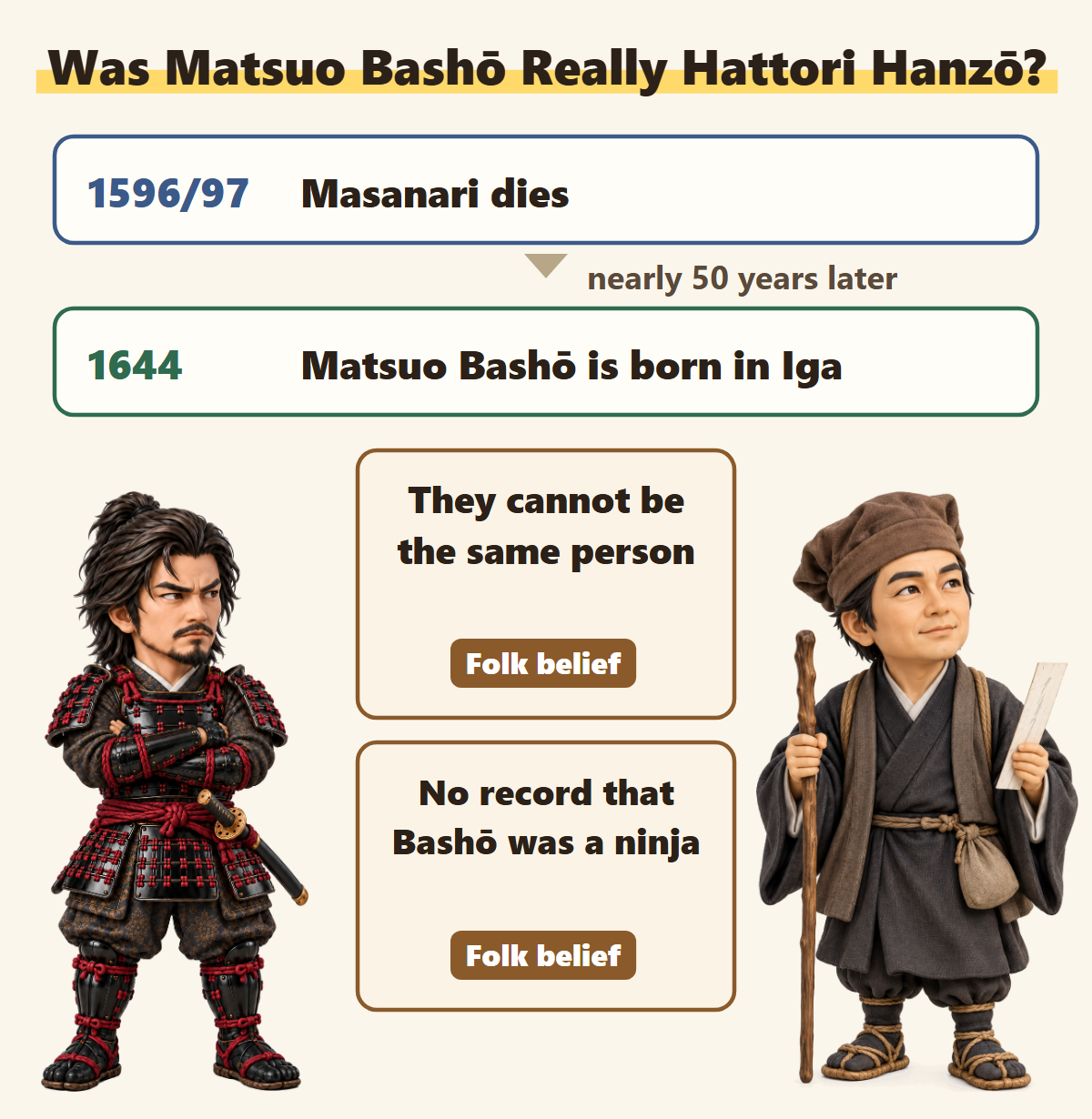
There is a claim that the haiku poet Matsuo Bashō was "really" Hattori Hanzō. But Masanari died in late 1596 or early 1597, while Bashō was born in Iga in 1644, nearly half a century later. Bashō and Masanari cannot have been the same person [Folk belief].
Because Bashō came from Iga, a story also arose that he was a ninja, but the sources we checked contain no record supporting it [Folk belief].
Were Hanzō and Fūma Kotarō Rivals?
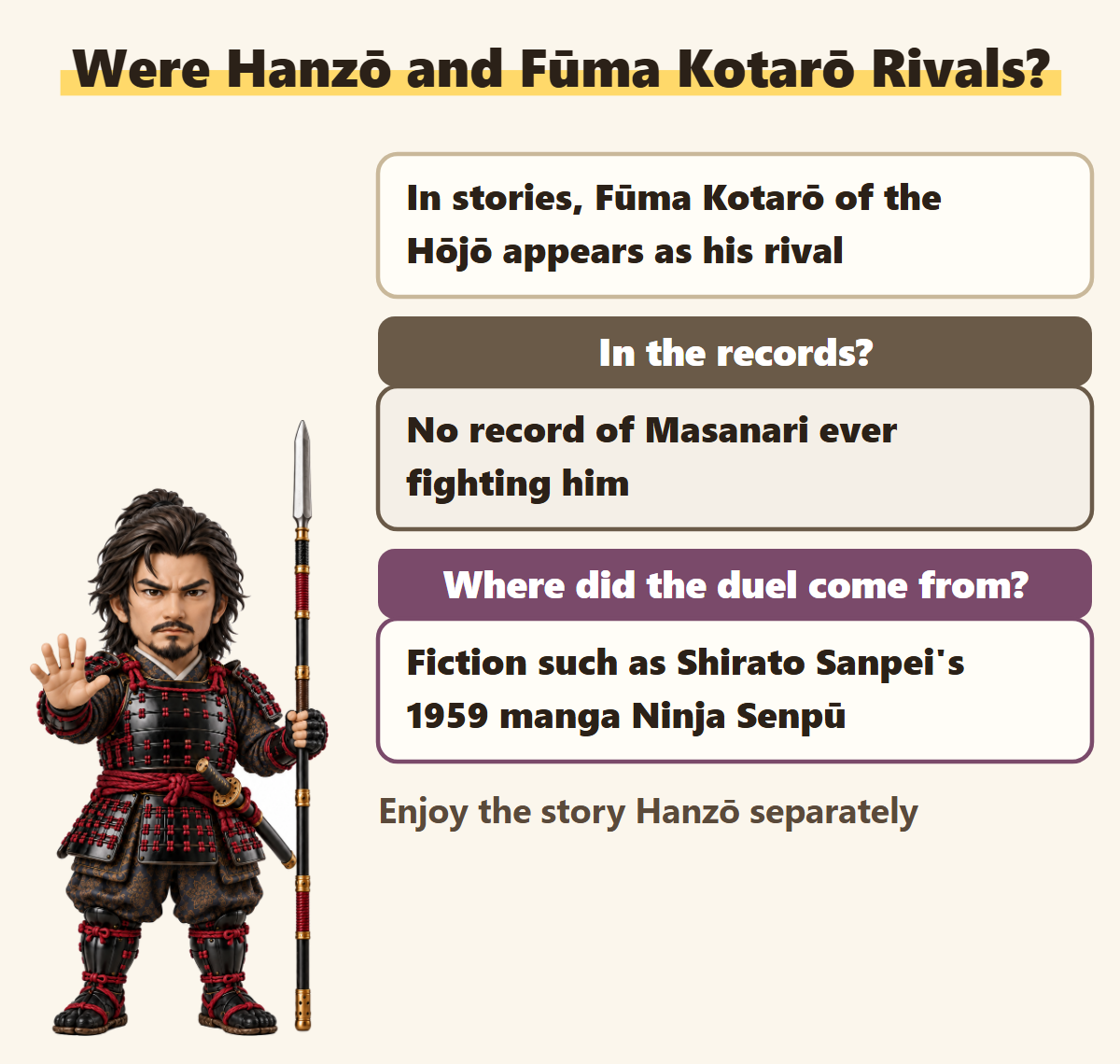
In stories, Fūma Kotarō, leader of the shinobi who served the Hōjō family, sometimes appears as Hanzō's rival. But the sources we checked contain no record of Masanari ever fighting him. Their duel is a fictional plot found in works such as Shirato Sanpei's 1959 manga Ninja Senpū.
So Hanzō the ninja was born from stories of the 1950s!
That is it. The Hanzō of stories is fun, but enjoy him separately from the Masanari of the records.
FAQ
What was Hattori Hanzō's real name?
Hattori Masanari. "Hanzō" was a name used by successive heads of the Hattori family. Masanari also used the title Iwami-no-kami (more).
Was Hattori Hanzō from Iga or Kōka?
The Hattori were an Iga family, and the men Masanari led were from Iga. Masanari himself is said to have been born in Mikawa (more).
Did Hattori Hanzō leave any famous words?
Some quotations are presented online as his words, but we could not find any record confirming that Masanari said them.
How old was Hattori Hanzō when he died?
55 by the traditional Japanese count. He died in the 11th month of Keichō 1 (late 1596 or early 1597); records give the day as either the 4th or the 14th (more).
Was Hattori Hanzō one of the "Sixteen Generals of the Tokugawa"?
Masanari appears in Edo-period paintings of the "Sixteen Generals of the Tokugawa." But these are later pictures of Ieyasu and his retainers, not a record of official posts or rankings at the time.
Are the Hattori Hanzō characters in Kill Bill and video games historically accurate?
In Quentin Tarantino's Kill Bill: Volume 1 (2003), Hattori Hanzō is a fictional swordsmith, not the sixteenth-century Masanari. In video games, the portrayal depends on the title: a character may draw on the historical Masanari, on later ninja stories, or on both. The name alone does not make a portrayal historically accurate (more).
Summary: Who Was Hattori Hanzō?
"Hattori Hanzō" was a name used by successive heads of the Hattori family, who served Tokugawa Ieyasu; the most famous of them was Hattori Masanari. Masanari was a warrior who fought with a spear and a commander of the men of Iga.
The image of "Hanzō the ninja" spread mainly through novels and manga of the 1950s and 60s. The Ishikawa Tadafusa Tomegaki, regarded as a relatively reliable later account, lists him among Ieyasu's attendants in the escape through Iga [Widely accepted], but the stories of him gathering the men of Iga to protect Ieyasu come from later records.
Masanari died in late 1596 or early 1597, aged 55 by the traditional count. The sources we checked do not tell us how he died. His grave is at Sainenji in Tokyo, and his sons' families continued in Kuwana and elsewhere until the end of the Edo period.
For the lord he served, see our article on Tokugawa Ieyasu; for the warlord whose death set off the escape through Iga, see our article on Oda Nobunaga.
Masanari of the records and Hanzō of the stories. Compare the two, and both become all the more interesting.
Now I want to visit Sainenji and see the real spear!
Sources & How This Article Was Written
This article is based mainly on the following records and references:
- A record from the time: Matsudaira Ietada, Ietada Nikki (the entry for the 4th day of the 6th month of Tenshō 10, as quoted in the Okazaki city history)
- Later records: Ōkubo Tadataka, Mikawa Monogatari; Kansei Chōshū Shokafu (the entries for Hattori Masanari and his sons; National Diet Library Digital Collections); Tōshōgū Gojikki Furoku (the appendix to the Tokugawa Jikki); Yotsuya Jisha Kakiage (Sainenji's report to the shogunate); Tōdaiki
- Studies (in Japanese unless noted): Tamura Risa, "The Birth of 'Hattori Hanzō the Ninja': Works up to 1964" (Ninja Kenkyū no. 3, 2020); "Espionage and Sabotage: The Truth About the Ninja" (interview with Yamada Yūji, nippon.com, in English); Watanabe Daimon, on the escape through Iga (Yahoo! News Expert, 2023); Mie University, "The Descendants of Hattori Hanzō" (Ninja and Ninjutsu lecture series, 2025); Kotobank (Nihon Daihyakka Zensho, Sekai Daihyakka Jiten and other encyclopedias)
- Public institutions: National Diet Library, "NINJA: In Fiction and in Reality" (online exhibition, in English); Mie Prefecture, "Hattori Hanzō and Ieyasu" and "Hanzō's Descendants, Well Treated"; Kuwana City, "People in Kuwana's History (5): Hattori Hanzō"; Shinjuku City, "The Grave of Hattori Hanzō" and "The Spear of Hattori Hanzō"
- Images: the photos of Hanzō's grave at Sainenji (Higa4, CC0), the Hanzōmon gate (Chris 73, CC BY-SA 3.0), the Chigachi Castle monument (ブレイズマン, CC BY 3.0) and the Iga escape route post (Motokoka, CC BY-SA 4.0) are from Wikimedia Commons. The family tree, timeline, manga panel and illustrations are original works by Samurai Lord
What the Labels Mean
[Fact]Confirmed by sources from the time ([Fact: …]names the source)[Widely accepted]A view widely accepted by researchers[Debated]Accounts, interpretations or ways of counting differ[Unknown]Not established from the sources we checked[Legend]Stories found in later records or traditions[Folk belief]Popular claims with little evidence[Drama fiction]Invented for dramas and novels
We keep "what a record says" separate from "whether it really happened."
This article was written by the Samurai Lord editorial team and is revised as new research and reader feedback come in. If you spot an error, please let us know through our contact form (in Japanese) and we will check and correct it.
Read in Japanese
This article is also available in Japanese: 服部半蔵とは何者?忍者だった?死因や現在の子孫・墓を解説!