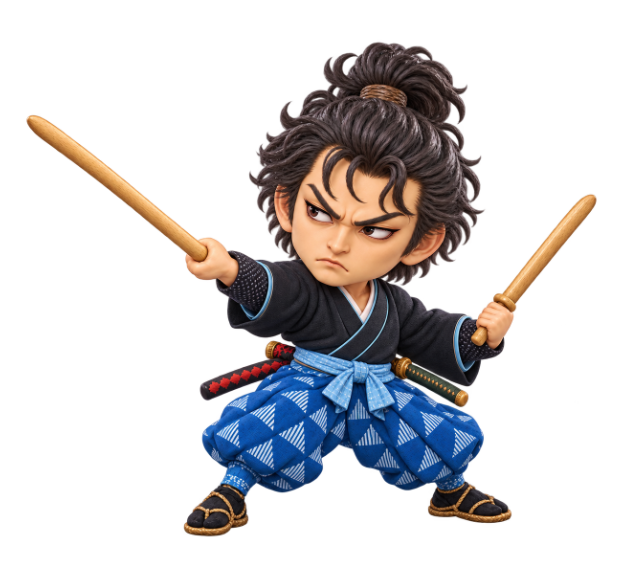
Image: An illustration of Miyamoto Musashi. All illustrations in this article are imaginative.
A swordsman famous for fighting with two swords at once, and the author of The Book of Five Rings—that is Miyamoto Musashi. His duel with Sasaki Kojirō on the island of Ganryūjima may be the most famous sword fight in Japanese history.
Yet much of the Musashi we think we know was shaped by biographies written more than 100 years after his death, and by a novel from the 1930s. Even the stories that he arrived late at Ganryūjima, that he cried "Kojirō, you have lost!", and that his opponent was named "Sasaki Kojirō" differ from record to record. This article covers the duel at Ganryūjima, Sasaki Kojirō, his two-sword style and how strong he really was, how he died, The Book of Five Rings, and his character—comparing what each record actually says.
Key points are tagged: [Fact] confirmed by Musashi's own writings or records from his time, [Widely accepted] supported by most historians, [Debated] competing theories, [Unknown] not known from any source, and [Legend], [Fiction], or [Folk belief] for later stories. A tag like [Legend: Bukōden] names the book where a story appears.
.jpg)
I am Uesugi Kenshin. Today's subject is a man who devoted his whole life to the sword. He was no warlord, but no account of the samurai world is complete without him.
.jpg)
I'm Date Masamune! Musashi is the one who fought Kojirō on Ganryūjima, right? Is it true he showed up late on purpose?
.jpg)
That is the interesting part. The old records and the newer ones tell rather different stories. Let us go through them one by one.
What We Know (Key Points)
- Who was he? A swordsman of the early Edo period who founded the Niten Ichi-ryū, a school of swordsmanship using two swords. In his last years, the Hosokawa lords of Kumamoto welcomed him as an honored guest, and there he wrote The Book of Five Rings
[Fact](more) - Who won at Ganryūjima? Musashi did
[Widely accepted]. But one record says his opponent came to, and was then beaten to death by Musashi's students, who had been hiding on the island[Debated](more) - What is The Book of Five Rings? A book on swordsmanship and strategy that Musashi began writing at about 60. It has five scrolls: Earth, Water, Fire, Wind, and Void
[Fact](more) - How did he die? He died of illness in Kumamoto in 1645. Records from his time do not name the disease; a later biography suggests it may have been stomach or esophageal cancer
[Debated](more)
Jump to the part you want to read:
- Who won the duel at Ganryūjima?
- Who was Sasaki Kojirō? Did he really exist?
- How strong was he? Why two swords, and how tall?
- How he died, and where his grave is
- The Book of Five Rings: summary and famous lines
- What was he like? A surprising side in the records
- How true are the novels and manga?
Who Was Miyamoto Musashi? When Did He Live, and What Did He Do?
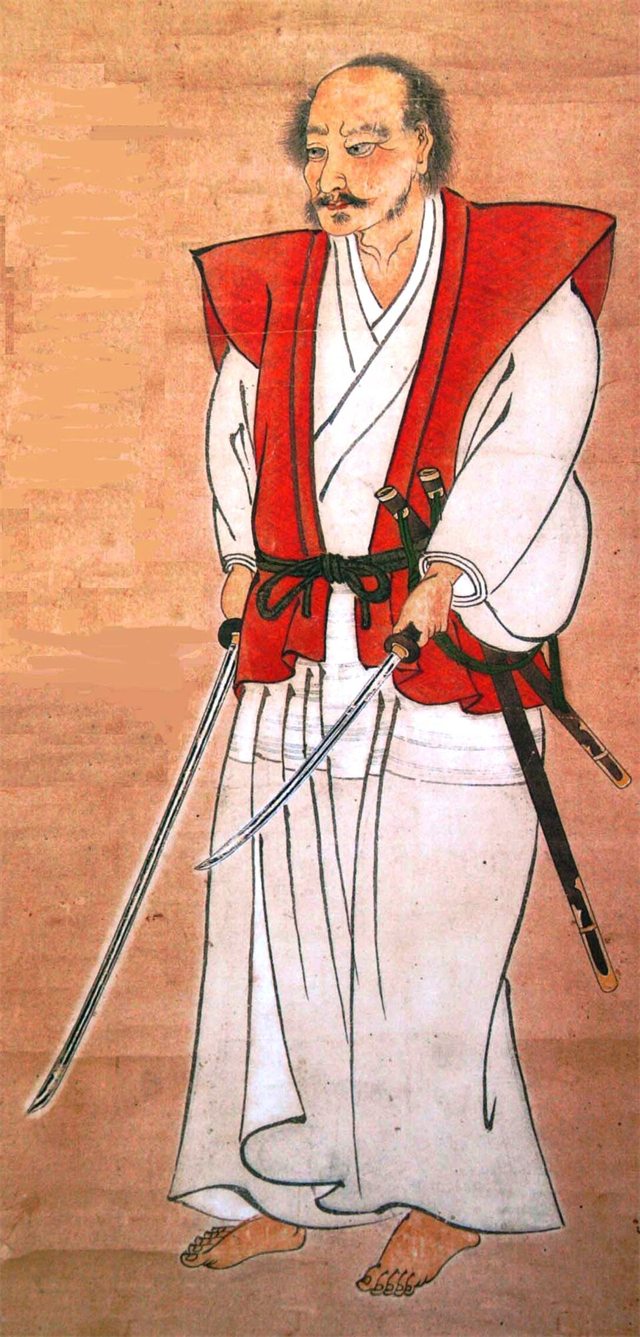
Image: Portrait of Miyamoto Musashi (Shimada Museum of Art, Kumamoto). The artist is unknown; it is thought to have been painted soon after his death, and some believe it is a self-portrait.
In a nutshell, Miyamoto Musashi was "a swordsman who wrote that he had fought more than 60 duels without a single loss, and who, late in life, set down his teachings in The Book of Five Rings." He was also a gifted artist, and some of his ink paintings are now designated Important Cultural Properties of Japan.
Three Things That Show His Character
- He raised two adopted sons and found them careers: both entered the service of daimyo (feudal lords), and his adopted son Iori later put up a large monument in his honor
[Fact] - He looked out for his students: just before he died, he asked a senior retainer of the Hosokawa family to take one of his students into service, and the request was granted
[Fact] - He loved the arts: in his last years he is said to have enjoyed painting, calligraphy, linked verse, and crafts, and fine ink paintings by him survive
[Fact]
Read more in the chapter on his character.
Quick Profile
| Item | Details | Reliability |
| Lived | 1584?–1645 (some say he was born in 1582) | [Debated] |
| Birthplace | Probably Harima Province (Hyōgo Prefecture); some say Mimasaka Province (Okayama Prefecture) | [Debated] |
| Name | Shinmen Musashi-no-kami Fujiwara no Genshin (his name in The Book of Five Rings); art name "Niten" | [Fact] |
| School | Enmei-ryū → Nitō Ichi-ryū → Niten Ichi-ryū | [Widely accepted] |
| Where he lived | Kyoto, Himeji, Akashi, Kokura; in his last years Kumamoto, as a guest of the Hosokawa family | [Fact] |
| Family | Adoptive father Shinmen Munisai. No record of a wife or children; two adopted sons, Mikinosuke and Iori | [Widely accepted] |
| Height | About 182 cm (6 ft), according to a biography written more than 80 years after his death | [Legend] |
| Writings | The Book of Five Rings (Gorin no Sho), Dokkōdō (The Way of Walking Alone), and others | [Fact] |
| Grave | Musashizuka, Kita Ward, Kumamoto | [Fact] |
| Cause of death | Illness (records from his time do not name it) | [Fact] |
When did he live?
Musashi was born around 1584—two years after Oda Nobunaga's death at Honnō-ji, if we follow the usual birth year. He was about 16 at the Battle of Sekigahara in 1600 and died in 1645, under the third Tokugawa shogun, Iemitsu. He was born at the end of the Sengoku ("Warring States") period and lived into the peaceful early Edo period [Widely accepted].
Unlike a warlord, he never ruled a domain of his own. He was a professional swordsman: he taught swordsmanship and strategy (heihō) and was taken in by daimyo as an honored guest.
His name: Is "Musashi" his real name?
"Musashi" was his everyday name; his formal personal name was Genshin (also read Harunobu). In The Book of Five Rings he calls himself Shinmen Musashi-no-kami Fujiwara no Genshin, and in later life he also used the art name "Niten" (Two Heavens) [Fact].
The name "Masana," which appears in some novels, comes from the Honchō Bugei Shōden, a collection of martial artists' biographies completed in 1714—nearly 70 years after his death. It is not found in the records of his own school or of the Miyamoto family [Folk belief]. The story that his childhood name was "Bennosuke" cannot be confirmed in reliable records either [Unknown].
When and where was he born? Two theories
The usual birth year, 1584, is worked out from the opening of The Book of Five Rings, where Musashi says he had "piled up sixty years" in 1643 (by the traditional Japanese count, in which a person is one year old at birth). A genealogy compiled by the descendants of his adopted son Iori gives 1582 instead [Debated].
Because The Book of Five Rings calls him "a warrior born in Harima," Harima Province (southwestern Hyōgo) is the more likely birthplace. Another theory, based on a local history from 1815 and similar sources, places it in Mimasaka Province (Mimasaka City, Okayama), where there is now a "Musashi no Sato" (Musashi's home village) and even a train station named Miyamoto Musashi [Debated].
Where do the stories about Musashi come from?
The key to separating fact from legend is to ask when, and by whom, each story was written. Apart from Musashi's own Book of Five Rings, most accounts were written after he died—and the later they are, the more detailed and dramatic they become.
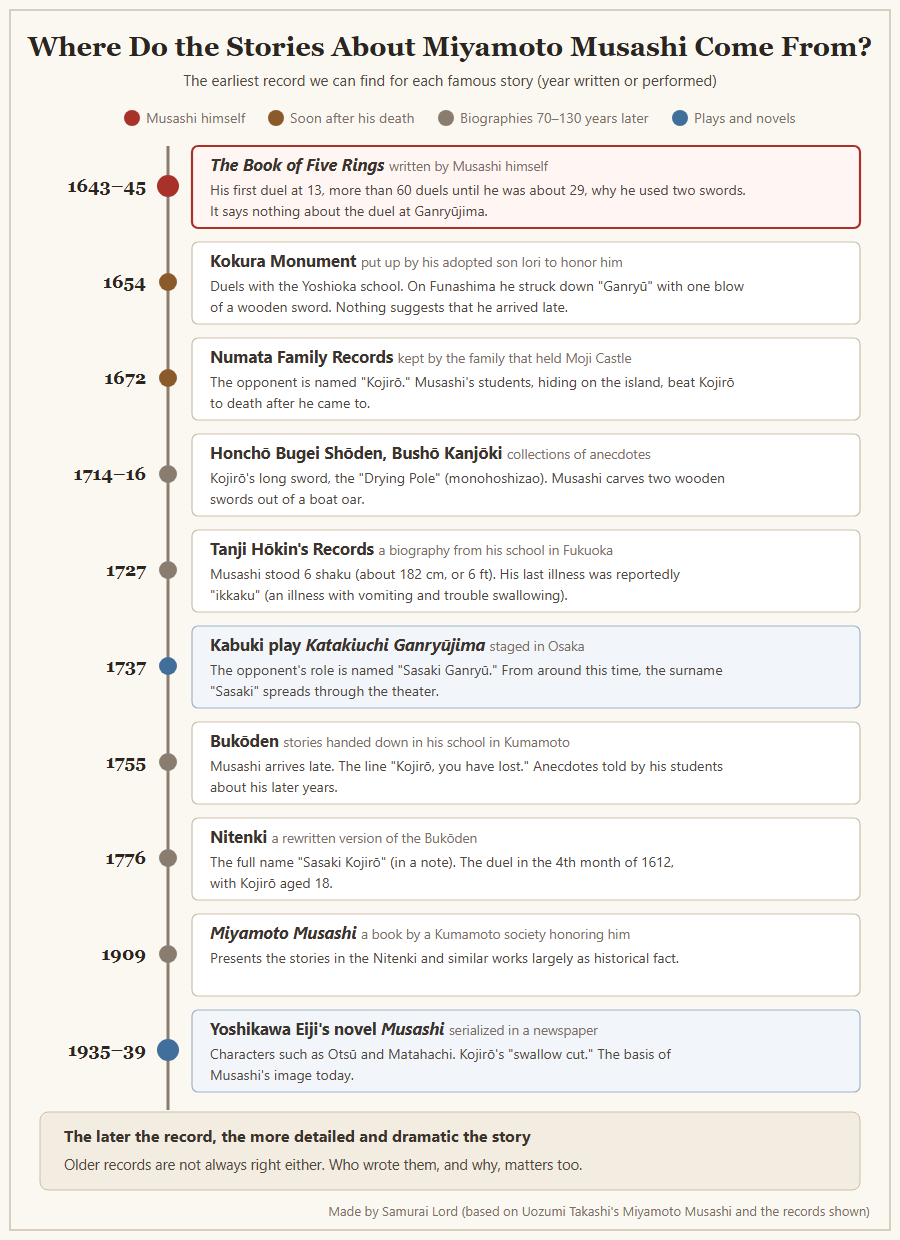
Image: Where the stories about Miyamoto Musashi come from (made by Samurai Lord). Tap or click to enlarge.
For example, the earliest records we can find of Musashi arriving late at Ganryūjima and of the line "Kojirō, you have lost" date from 1755—more than 140 years after the duel. The next chapter compares the records one by one.
Who Won the Duel at Ganryūjima? Did It Really Happen?
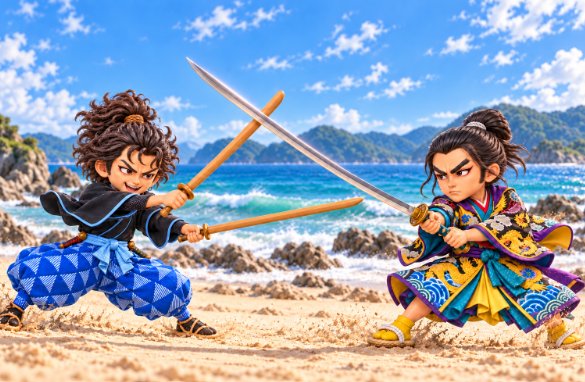
Image: An imaginative illustration of the duel at Ganryūjima. One record (the Bushō Kanjōki) does say Musashi used two wooden swords, but the weapons and clothing here are not historically accurate.
The Short Answer
- Musashi won. The monument that his adopted son Iori put up nine years after his death says that on the island of Funashima (today's Ganryūjima), Musashi fought a swordsman called "Ganryū" and struck him down with a wooden sword
[Widely accepted] - However, the records of the Numata family, who held nearby Moji Castle, say that Kojirō came to after the fight and was then beaten to death by Musashi's students, who had been hiding on the island
[Debated] - The stories of Musashi arriving late, of the line "Kojirō, you have lost," and of the surname "Sasaki" all appear in much later records, plays, and novels
[Legend]
Sources: the Kokura Monument (1654), the Numata Family Records (1672), Uozumi Takashi, Miyamoto Musashi (Iwanami Shoten, 2008; in Japanese)
When was the duel?
The duel is usually dated to the 13th day of the 4th month of 1612 (May 13 by the Western calendar). But that date comes from the Nitenki of 1776, written more than 130 years after Musashi died. Other biographies place it in 1601 or 1602, when Musashi was still in his teens, so the date is uncertain [Debated].
Surprisingly, Musashi himself never mentions the duel. In The Book of Five Rings he says he fought more than 60 duels by the age of 29, yet he says not a word about Ganryūjima.
Did Musashi arrive late? Did he really say "Kojirō, you have lost"?
In the famous scene, Musashi deliberately arrives late to unsettle Kojirō; when Kojirō throws away his scabbard, Musashi says, "Kojirō, you have lost—a man who meant to win would not throw away his scabbard." The earliest record we can find of this scene is the Bukōden of 1755, which presents it as the story of a man who said he had rowed Musashi to the island, told about 100 years after the duel [Legend: Bukōden].
The oldest record, the Kokura Monument, says the two men "met at the same time," and nothing in it suggests that Musashi was late [Fact: Kokura Monument]. Even so, this alone does not prove that he was on time. The monument was put up by his adopted son to honor him and was not meant to record every detail.
The idea that Musashi was late on purpose, as a tactic, owes much of its fame to Yoshikawa Eiji's novel of the 1930s [Fiction].
Did Musashi fight unfairly? The record that his students finished Kojirō off
The Numata Family Records, compiled in 1672—27 years after Musashi's death—tell a very different story [Debated: Numata Family Records]:
- A quarrel between the two men's students led to the duel, and both sides agreed not to bring any students
- Musashi won, but Kojirō had only been knocked unconscious and later came to
- Musashi's students, who had been hiding on the island, then beat Kojirō to death
- When Kojirō's angry students came after him, Musashi fled to Moji Castle (in today's Kitakyushu), where the commander, Numata Nobumoto, protected him and had him escorted to his father, Munisai
Numata Nobumoto was a retainer of the Hosokawa family, who ruled the area at the time, and he commanded Moji Castle near the site of the duel. But the Numata Family Records were also written to celebrate Nobumoto's deeds, so this version cannot be taken as the whole truth either. Whether Musashi fought "unfairly" depends on which record you read.
How the records differ—who wrote them, and why?
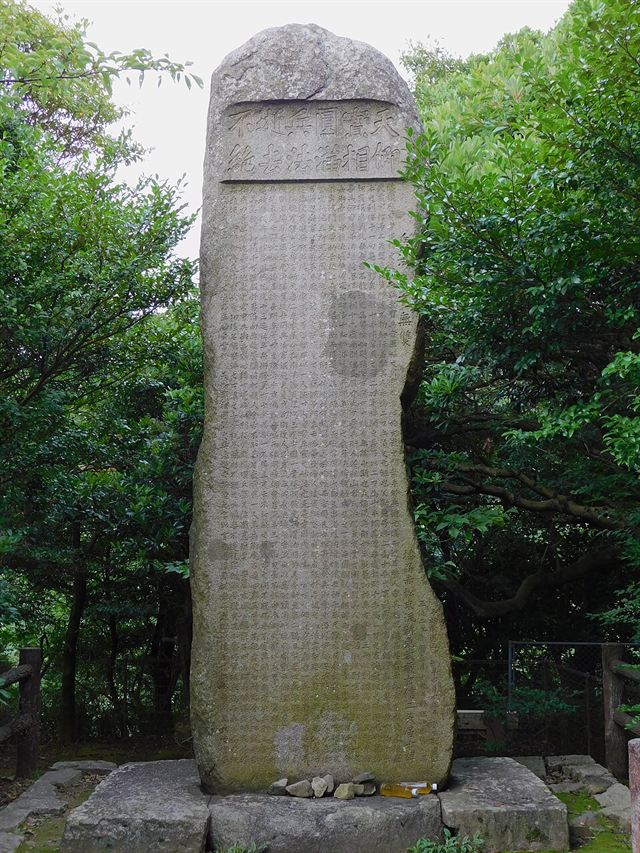
Image: The Kokura Monument (Tamukeyama Park, Kitakyushu), put up by Miyamoto Iori in 1654. It is the oldest record of the duel. Photo: 速日 (CC BY-SA 4.0 / Wikimedia Commons)
| Record (year) | Who wrote it, and why | How it tells the duel |
| Kokura Monument (1654) | Musashi's adopted son Iori, to honor him | The opponent is "Ganryū." Musashi strikes him down with one blow of a wooden sword. No helpers are mentioned |
| Numata Family Records (1672) | The family of Numata Nobumoto, commander of Moji Castle, to record his deeds | The opponent is "Kojirō." Musashi's hidden students finish him off |
| Honchō Bugei Shōden (1714) | Hinatsu Shigetaka, in a collection of martial artists' stories | Gives both versions: Musashi crossing alone, and Musashi bringing companions |
| Bukōden (1755) | Toyota Masanaga, a teacher of Musashi's school in Kumamoto, collecting its stories | The opponent is "Ganryū Kojirō." Musashi arrives late and wins with a wooden sword carved from a boat oar |
| Nitenki (1776) | Toyota Kagehide, rewriting the Bukōden | "Sasaki Kojirō" (in a note), aged 18. The duel in the 4th month of 1612. The basis of later novels |
Records written by people close to Musashi favor him, while a record from another family sees things differently. The lesson is not "older means true" or "newer means false," but to read each record with its author and purpose in mind.
It's the same duel, but the records tell it so differently!
When the writer's position changes, so does the story. Comparing them is the joy of history.
Where is Ganryūjima, and what is there today?
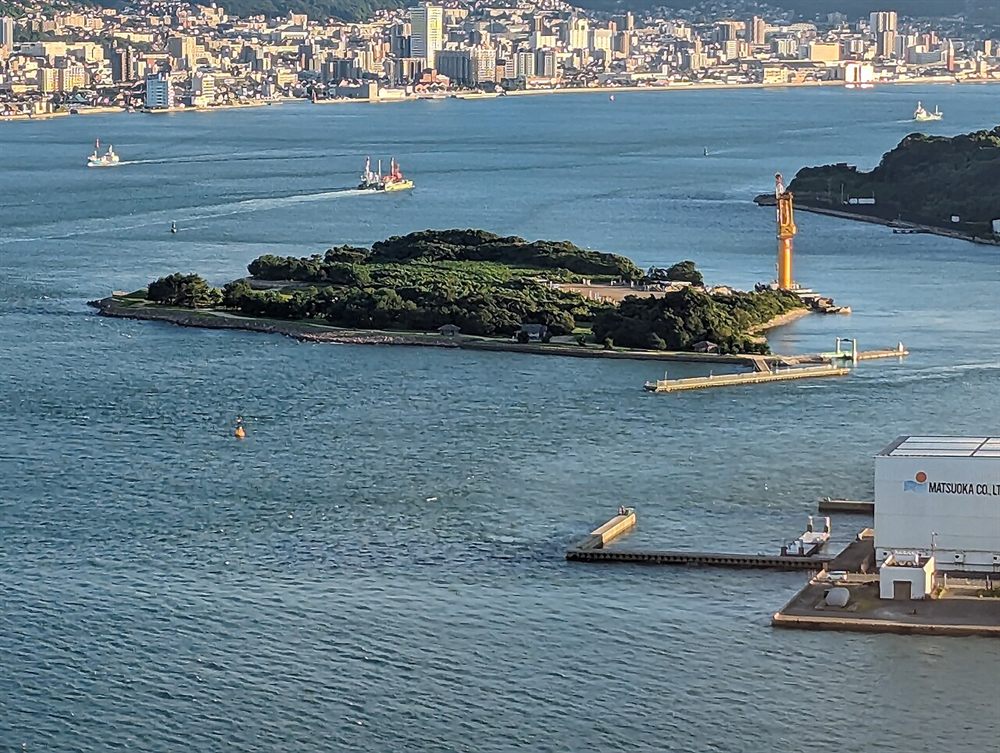
Image: Ganryūjima seen from Kaikyō Yume Tower in Shimonoseki, Yamaguchi. Photo: なしはな (CC BY-SA 4.0 / Wikimedia Commons)
Ganryūjima's official name is Funashima. It is an uninhabited island in the Kanmon Strait, part of the city of Shimonoseki in Yamaguchi Prefecture. At the time of the duel it belonged to the Kokura domain of the Hosokawa family, and the Kokura Monument describes it as an island in the sea between the provinces of Nagato and Buzen. After the duel, people are said to have started calling it "Ganryū Island" after the defeated swordsman [Widely accepted].
Land reclamation has since made the island several times larger than it was in Musashi's day (it now covers about 10 hectares). You can reach it by boat from Karato Pier in Shimonoseki and elsewhere (about 10 minutes from Karato), and statues of Musashi and Kojirō stand on the island.
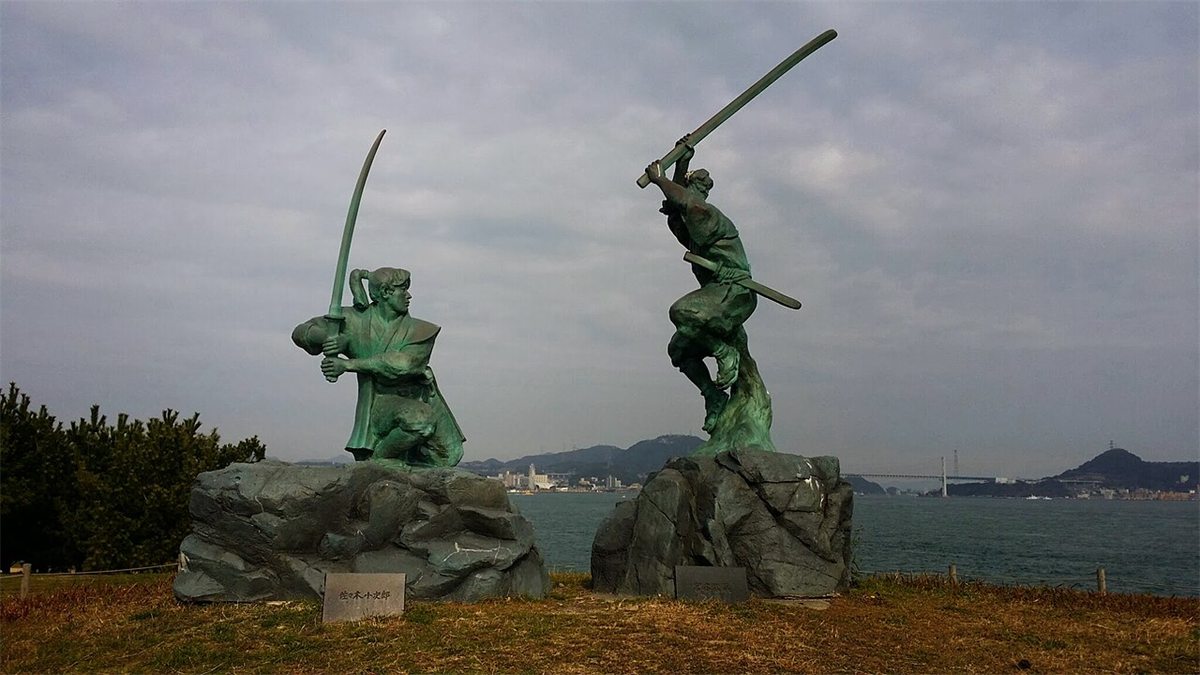
Image: Statues of Musashi and Kojirō on Ganryūjima. Photo: RoninjapanWiki (CC BY-SA 4.0 / Wikimedia Commons)
Who Was Sasaki Kojirō? Did He Really Exist?
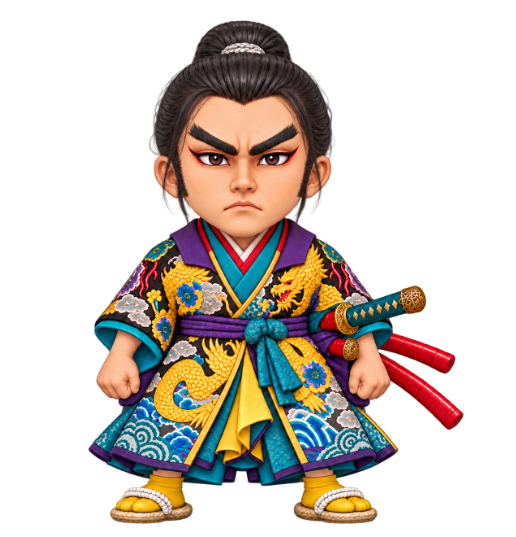
Image: An imaginative illustration of Sasaki Kojirō (no reliable record tells us what he looked like)
The Short Answer
- Old records show that a swordsman called "Ganryū" did fight Musashi
[Widely accepted] - But the full name "Sasaki Kojirō" first appears together in the Nitenki of 1776 (in a note)—more than 160 years after the duel. His age, origins, and teacher are all uncertain
[Unknown]
Sources: the Kokura Monument (1654), the Numata Family Records (1672), the Nitenki (1776)
Where does the name "Sasaki Kojirō" come from?
The oldest record, the Kokura Monument, calls him only "Ganryū," and the earliest record we can find of the name "Kojirō" is the Numata Family Records of 1672. The surname "Sasaki" spread through the theater from around 1737, when a kabuki play staged in Osaka, Katakiuchi Ganryūjima, gave him the role name "Sasaki Ganryū." The Nitenki of 1776 then called him "Sasaki Kojirō" in a note [Widely accepted].
Other records call him "Tsuda Kojirō" or even "Ueda Sōnyū," so no one knows his real name [Unknown].
The "swallow cut" and the "Drying Pole": are they real?
The name of Kojirō's long sword, the "Drying Pole" (monohoshizao, a pole for hanging laundry), appears in the Honchō Bugei Shōden, completed in 1714—about 100 years after the duel [Legend: Honchō Bugei Shōden].
The story that Kojirō invented his deadly "swallow cut" (tsubame gaeshi) beside the Kintai Bridge in Iwakuni, Yamaguchi, comes from Yoshikawa Eiji's novel. The bridge was first built in 1673, about 60 years after the duel [Fiction].
Kojirō's birthplace, age, and teacher
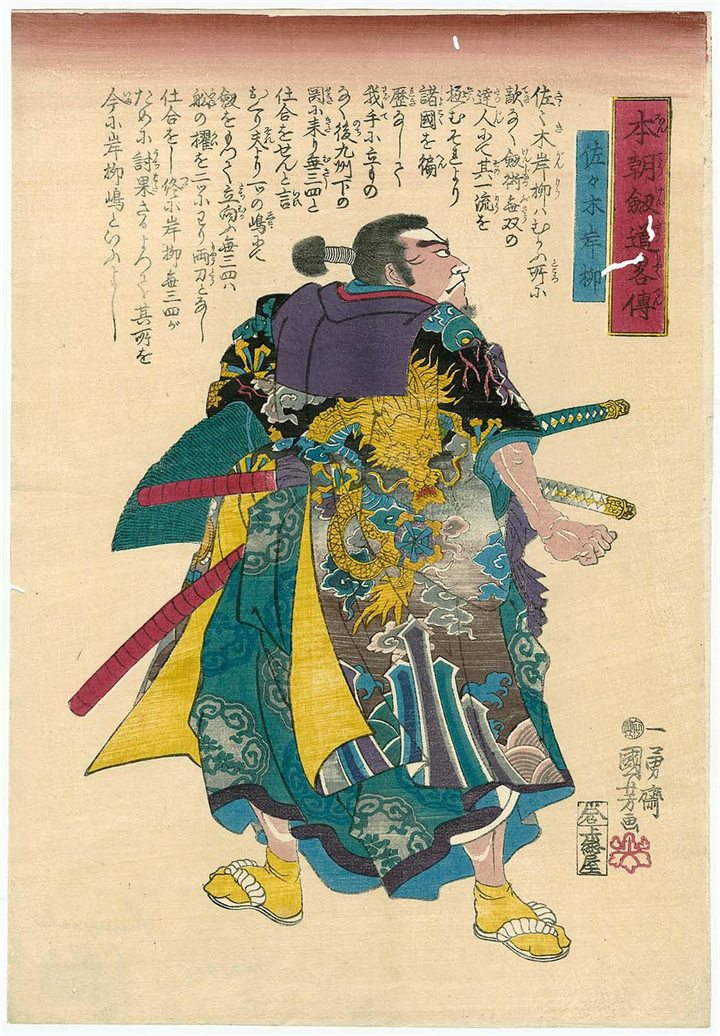
Image: Sasaki Ganryū by Utagawa Kuniyoshi, from the series Honchō Kendō Ryakuden (1845, Museum of Fine Arts, Boston). In this Edo-period print he is shown as a grown man, not a youth.
| Item | Main theories | Source |
| Birthplace | Echizen Province (Fukui Prefecture) | Nitenki (1776) |
| Birthplace | Buzen Province (Soeda, Fukuoka Prefecture) | Local tradition |
| Birthplace | Suō Province (Iwakuni, Yamaguchi Prefecture) | Yoshikawa Eiji's novel |
| Age at the duel | 18 | Nitenki; some suspect a copying error |
| Teacher | Toda Seigen, or Seigen's student Kanemaki Jisai | Bukōden, Nitenki, and others |
The Nitenki's "18" does not fit the dates of Toda Seigen, his supposed teacher, and some historians think Kojirō was actually much older than Musashi [Debated]. The image of Kojirō as a handsome young man took hold through later novels and films.
We plan to cover Kojirō's life and legends in more detail in a separate article.
.jpg)
Even the name "Sasaki Kojirō" was added later? I had no idea…
How Strong Was Musashi? Why Two Swords, and How Tall Was He?

Was he really undefeated in more than 60 duels?
At the start of The Book of Five Rings, Musashi describes his career like this (ages by the traditional Japanese count) [Fact: The Book of Five Rings]:
- At 13 he fought his first duel and defeated Arima Kihei, a swordsman of the Shintō-ryū
- At 16 he defeated a powerful swordsman named Akiyama from Tajima Province (northern Hyōgo)
- At 21 he went to Kyoto and fought several duels against the finest swordsmen in the land, never failing to win
- After that he traveled from province to province and fought more than 60 duels, from age 13 to 28 or 29, without a single loss
But these are Musashi's own words, and only the first two opponents are named. There is no way to check the details of all 60-plus duels in other records [Unknown]. It is worth remembering that "never defeated" is Musashi's own claim.
Why two swords? The reasons in The Book of Five Rings
Musashi's school, the Niten Ichi-ryū, is known for using two swords: the long sword (tachi) and the short sword. In the Earth Scroll of The Book of Five Rings, Musashi explains why [Fact: The Book of Five Rings]:
- Use every weapon you carry: "When you are about to give up your life, you want to make full use of all your weapons." To die with a sword still in its sheath is not what a warrior should want
- Learn to wield the long sword with one hand: holding a sword with both hands is awkward on horseback, while running, in swamps, on stony or steep paths, and in crowds. You may also have a bow or spear in your left hand, so train to swing the long sword with one hand
In other words, the two-sword style was less a flashy technique for fighting with two blades than training to handle the long sword freely with one hand. Musashi even writes that if you cannot strike down an opponent with one hand, you should use both—he was not stubborn about using two swords.
A story that he got the idea from watching a drummer beat a festival drum with two sticks is well known, but it is a local tradition [Legend].
Did he actually fight with two swords?
Surprisingly, the records of his famous duels hardly ever show him fighting with two swords. For Ganryūjima, the Kokura Monument mentions only "one blow of a wooden sword" and says nothing about how many he used [Fact: Kokura Monument].
| Record | What Musashi used at Ganryūjima |
| Kokura Monument (1654) | A wooden sword (the number is not given) |
| Bushō Kanjōki (1716) | Two wooden swords, long and short, made by splitting a boat oar |
| Bukōden (1755) and Nitenki (1776) | A wooden sword carved from a boat's oar |
In the duels with the Yoshioka school in Kyoto, too, the monument mentions wooden swords. In every duel described on the monument, Musashi fights with a wooden sword [Fact: Kokura Monument].
The name of his school: from Enmei-ryū to Niten Ichi-ryū
Musashi first called his school the Enmei-ryū, later the Nitō Ichi-ryū ("one school of two swords"), and in his last years the Niten Ichi-ryū ("one school of two heavens"). Both "Niten Ichi-ryū" and "Nitō Ichi-ryū" appear in The Book of Five Rings [Widely accepted]. His students carried the Niten Ichi-ryū on, and it is still practiced today.
Was he 182 cm (6 ft) tall? Did he stoop?
The claim that Musashi stood 6 shaku (about 182 cm, or 6 ft) comes from a biography written in 1727, more than 80 years after his death, by Tanji (Tachibana) Hōkin, a teacher of Musashi's school in the Fukuoka domain [Legend: Tanji Hōkin's Records]. That would have made him a very big man for his time, but there is no way to confirm it.
Some also say that Musashi stooped, judging from the posture in his portrait. Yet in the Water Scroll of The Book of Five Rings, he teaches that in your stance you should "lower both shoulders and keep your back straight" [Fact: The Book of Five Rings]. Perhaps his relaxed shoulders only make him look stooped.
So the two-sword style was no flashy trick—it was training to master the long sword with one hand.
"Never defeated" was his own claim too? Still, being confident enough to write it down is amazing!
How Did Miyamoto Musashi Die? His Last Days and His Grave
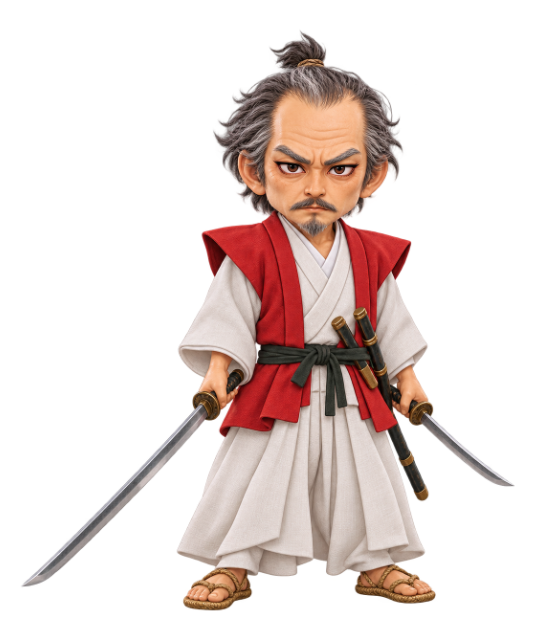
Image: An imaginative illustration of Musashi in his later years
The Short Answer
- Musashi died of illness at his house in Kumamoto on June 13, 1645 (the 19th day of the 5th month of Shōhō 2). He was 60 or 61 by Western reckoning (62 by the traditional count, if he was born in 1584)
[Fact] - Letters from the time show that he was seriously ill, but they do not name the disease
[Unknown] - A biography written more than 80 years after his death reports, as hearsay, that it was "ikkaku"—an illness with vomiting and trouble swallowing. This is why some think he had stomach or esophageal cancer
[Debated]
Sources: letters of Miyamoto Iori and Nagaoka Yoriyuki, Tanji Hōkin's Records (1727), Bukōden (1755)
His last days
Musashi began writing The Book of Five Rings in late 1643, and by the end of 1644 he was seriously ill. Letters between Nagaoka (Matsui) Yoriyuki, a senior retainer of the Hosokawa family, and Musashi's adopted son Iori show that the lord of Kumamoto, Hosokawa Mitsunao, sent doctors and was concerned for him [Fact].
According to the Bukōden, the sick Musashi withdrew to Reigandō, a cave outside Kumamoto, to meet his end in quiet, but Yoriyuki visited him on the pretext of a falcon hunt and persuaded him to return to his house in the castle town [Legend: Bukōden].
A week before he died, Musashi is said to have handed The Book of Five Rings to his student Terao Magonojō, and on the same day to have written the Dokkōdō, 21 short principles for living [Widely accepted]. However, The Book of Five Rings survives only in copies, and the date on the Dokkōdō is in a different hand from the main text, so some historians are cautious.
Where is his grave? Musashizuka
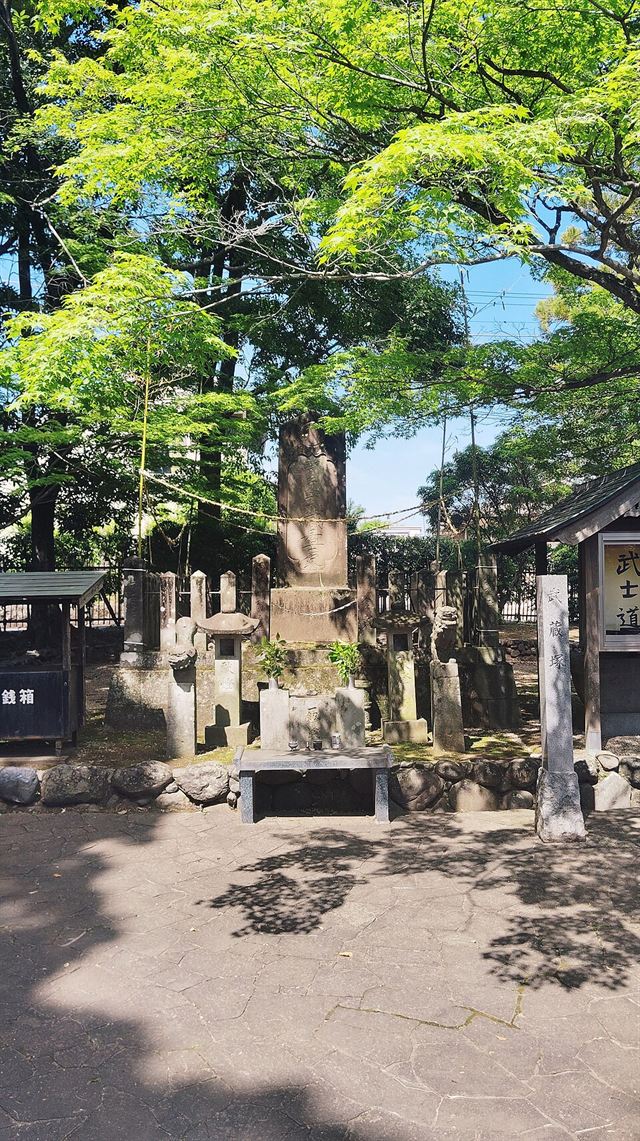
Image: Musashi's grave at Musashizuka Park, Kita Ward, Kumamoto. Photo: 水だらけのプール (CC0 / Wikimedia Commons)
Musashi's funeral was held at Taishō-ji Temple in Kumamoto, and his grave, known as Musashizuka (Musashi's Mound), is in Musashizuka Park in Tatsuda, Kita Ward, Kumamoto [Fact]. Legend says he was buried in full armor beside the road his lords took to Edo, so that he could watch over them even after death [Legend].
Places connected with Musashi
| Place | Location | Connection |
| Musashizuka | Kita Ward, Kumamoto | Musashi's grave |
| Reigandō | Nishi Ward, Kumamoto (Unganzen-ji Temple) | The cave where he is said to have written The Book of Five Rings |
| Kokura Monument | Kokura Kita Ward, Kitakyushu, Fukuoka (Tamukeyama Park) | The monument put up by his adopted son Iori; a memorial stone to Kojirō stands nearby |
| Ganryūjima | Shimonoseki, Yamaguchi | The site of the duel with Ganryū (Kojirō) |
| Ichijōji Sagarimatsu | Sakyō Ward, Kyoto | Said to be where he fought the Yoshioka school |
| Musashi no Sato | Mimasaka, Okayama | His birthplace according to the Mimasaka theory |
| Akashi | Akashi, Hyōgo | He is said to have helped lay out the town and design temple gardens |
What Is The Book of Five Rings? A Summary and Famous Lines
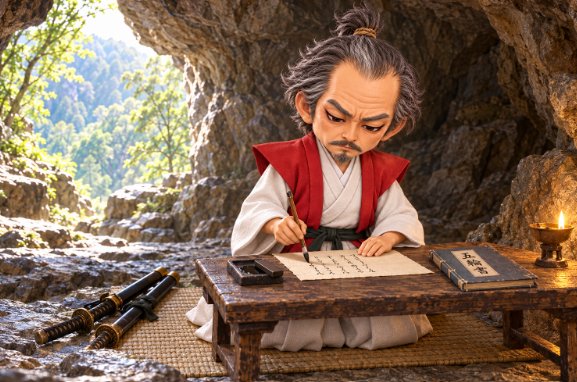
Image: An imaginative illustration of Musashi writing in the cave of Reigandō (the book on the desk is labeled Gorin no Sho, the Japanese title)
The Short Answer
- The Book of Five Rings (Gorin no Sho) is a book on heihō—swordsmanship and strategy—that Musashi began writing in Kumamoto in late 1643
[Fact] - It has five scrolls—Earth, Water, Fire, Wind, and Void—and covers not only sword technique but also how to see things and how to hold your mind
[Fact] - Musashi's handwritten original does not survive; the text has come down to us in copies made by his students
[Fact]
The five scrolls at a glance
| Scroll | Theme | What you learn |
| Earth | The big picture of strategy | Musashi's career, what heihō is, why he used two swords, how to choose weapons |
| Water | One-on-one swordsmanship | Mindset, posture, how to use your eyes, how to hold the sword and move your feet, guard positions |
| Fire | Tactics in a fight | Taking the initiative, timing and distance, moving your opponent's mind—lessons that also apply to battles between armies |
| Wind | Other schools | The weak points of schools obsessed with long swords, speed, and so on, and how the Niten Ichi-ryū differs |
| Void | The highest stage | The clear, unhesitating state of mind reached after mastering technique (the shortest scroll) |
The "five rings" are the five elements that make up the world in Buddhist thought: earth, water, fire, wind, and void (sky). The same idea appears in the five-tiered stone pagodas often seen at Japanese graves, and Musashi divided his teachings into these five parts.
Where did he write it? The cave of Reigandō
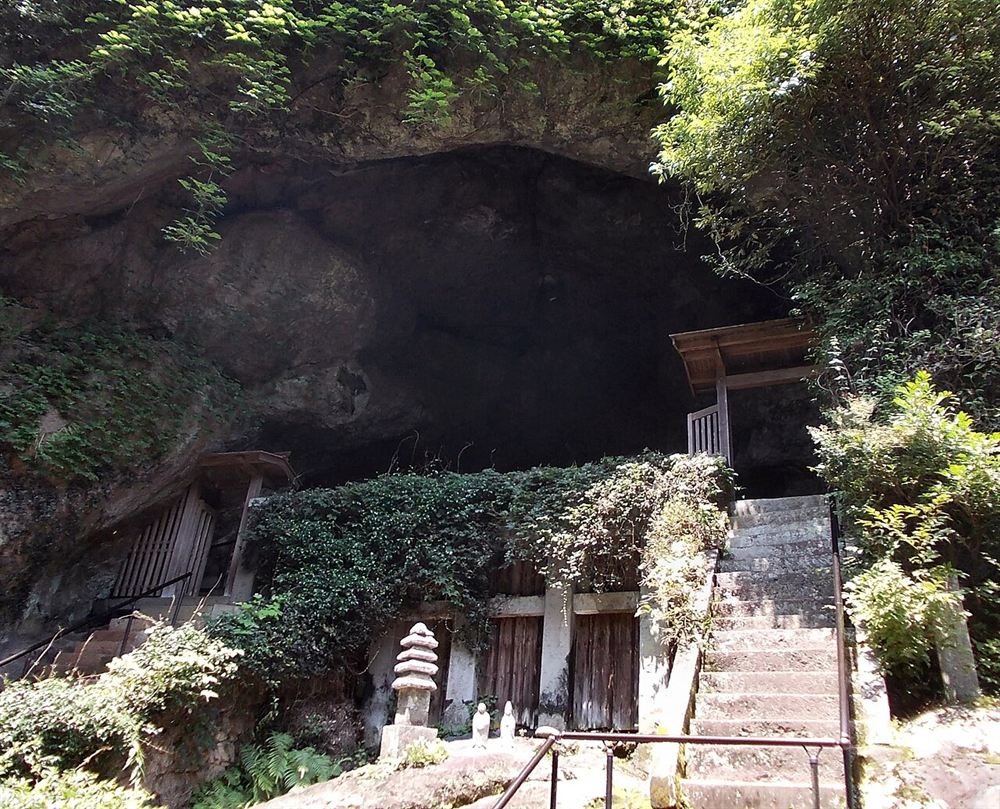
Image: Reigandō cave, Nishi Ward, Kumamoto. Photo: STA3816 (CC BY-SA 3.0 / Wikimedia Commons)
At the start of The Book of Five Rings, Musashi says that in the tenth month of 1643 he climbed Mount Iwato in Higo (Kumamoto), bowed to heaven, paid his respects to the bodhisattva Kannon, and began to write [Fact: The Book of Five Rings]. For this reason he is often said to have shut himself up in Reigandō, a cave at Unganzen-ji Temple on Mount Iwato, to write it [Legend]. Some historians, however, think he wrote it at a house in a nearby village [Debated].
Famous lines from The Book of Five Rings
- "A thousand days of training to forge, ten thousand days of training to polish." (Water Scroll): The Japanese word for "training," tanren, is made of these two characters—forging (tan) and polishing (ren)
- "Let your perceiving eye be strong and your seeing eye weak." (Water Scroll): Do not be caught by what the eye sees on the surface (ken); grasp the whole situation and your opponent's intent (kan)
- "Make your everyday posture your fighting posture, and your fighting posture your everyday posture." (Water Scroll): Be ready to fight as you are, and make the fighting stance part of daily life
- "When you are about to give up your life, you want to make full use of all your weapons." (Earth Scroll)
These are our own translations. The original wording differs slightly from copy to copy.
Words from the Dokkōdō (a separate work)
The Dokkōdō ("The Way of Walking Alone") is a separate work from The Book of Five Rings: 21 short principles for living that Musashi is said to have written just before his death [Widely accepted]. It is held at the Kumamoto Prefectural Museum of Art.
- "I do not regret what I have done."
- "Respect the gods and buddhas, but do not rely on them."
- "Think lightly of yourself and deeply of the world."
The Book of Five Rings around the world
The Book of Five Rings has been translated into many languages. Since English translations appeared in the 1970s, it has been read not only as a book on swordsmanship but also as a guide to strategy, competition, and mastery—by athletes, martial artists, and business readers alike.
When you read it, remember that Musashi wrote it for students of his own school. Many passages end with phrases like "you must study this well" or "this cannot be explained in writing," because he expected students to learn the techniques in person.
How to read it
Several English translations are available, so it is worth comparing them; some include the original Japanese and notes, and some also include the Dokkōdō. See the FAQ below for well-known translations.
What Was Miyamoto Musashi Like? A Surprising Side in the Records
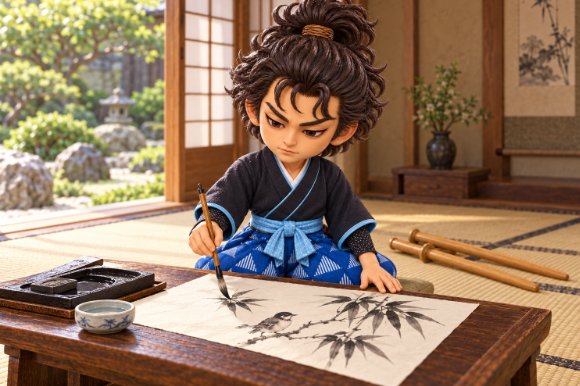
Image: An imaginative illustration of Musashi painting (his real works are shown in the chapter on his art)
"The lone master swordsman," "a fighter who would do anything to win"—that is Musashi's popular image. Here we look at the records in the order "what the record says → what we can read from it → what we cannot know."
Record 1: He raised two adopted sons and found them places with daimyo
- What the record says: Musashi adopted Mikinosuke, a son of a Mizuno family retainer, and placed him in the service of Honda Tadatoki of Himeji. Later he placed Iori in the service of Ogasawara Tadazane of Akashi (later Kokura). Iori rose to become a chief retainer of the Kokura domain, and in 1654, nine years after Musashi's death, he put up a large monument in Musashi's honor, the Kokura Monument
[Fact] - What we can read from it: Musashi himself never served one lord for long, yet he took care to secure his adopted sons' futures—and Iori clearly honored him as a father
- What we cannot know: almost no record shows what kind of father he was in daily life
Record 2: Just before he died, he asked for a job for his student
- What the record says: shortly before his death, Musashi asked Nagaoka Yoriyuki, a senior retainer of the Hosokawa family, to take his student Masuda Sōbei into service, and the request was granted
[Fact] - What we can read from it: he cared about how his students would live after he was gone
- What we cannot know: how he treated his other students is known mostly from later biographies such as the Bukōden, which are hard to verify
Record 3: The letter that says "I was hit by a stone and cannot stand"
- What the record says: in the Shimabara Rebellion of 1638, Musashi went to war with the Ogasawara family's forces. In a letter afterward to Arima Naozumi, lord of Nobeoka, he wrote that he too had been hit by a stone (thrown by the rebels) and his shin hurt so much that he could not stand, so he could not come to pay his respects
[Fact: letter to Arima Naozumi] - What we can read from it: the famously unbeaten swordsman admits, without any pretense, that he was laid up by a stone—a very human touch
- What we cannot know: how bad the injury was. His name does not appear on the Ogasawara (Nakatsu domain) list of the wounded, so some historians think it was minor
Record 4: The artist
The Bukōden says that in his last years Musashi spent his days enjoying linked verse, painting, calligraphy, and crafts, and that many saddles, wooden swords, paintings, and pieces of calligraphy made by him exist [Legend: Bukōden]. In fact, ink paintings by him that are designated Important Cultural Properties of Japan survive today, so there is no doubt that he was a serious painter [Fact]. See the chapter on his swords and art.
Another side: guns, and the story that he never bathed
In The Book of Five Rings, Musashi admits that when defending a castle, "nothing is better than guns," yet he also writes that the virtue of the bow is that you can see the arrow fly, while a bullet's flaw is that you cannot see it [Fact: The Book of Five Rings]. He was practical, but perhaps also a man who valued what he could check with his own eyes.
There is also a story that Musashi never took a bath in his life. It comes from the Watanabe Kōan Taiwa (1709), but that book contains many statements that do not fit the dates, and some historians doubt how reliable it is [Folk belief].
Hard in a duel, yet he cared about what became of his sons and students. That is the kind of man he was, I think.
Writing honestly that a stone knocked him off his feet—that makes me like him even more!
Miyamoto Musashi's Life: A Timeline of Duels and Service
Childhood and his first duel
Musashi was probably born in Harima and adopted by Shinmen Munisai of Mimasaka (Okayama). Munisai was a master of the jitte (a short iron truncheon used to catch and block swords), and Musashi learned martial arts from him [Widely accepted]. As we saw, he won his first duel at 13.
Which side was he on at Sekigahara?
Where Musashi was during the Battle of Sekigahara in 1600 is not clear. His adopted son Iori's monument says he took part in the war, but not under whom or what he did [Fact: Kokura Monument].
The view now widely accepted is that he and his father Munisai joined the army of Kuroda Josui (Kanbei), who fought on the Tokugawa (eastern) side, in Kyushu. A later biography (Tanji Hōkin's Records, 1727) describes him fighting at the Battle of Ishigakibaru in Bungo (Ōita) and elsewhere, and old records of the Kuroda family confirm that Munisai served the Kuroda before the battle [Widely accepted].
The old idea that he fought for the losing western side and became a rōnin (a masterless samurai) is now generally rejected [Folk belief]. For Kanbei's campaign in Kyushu, see our article on Kuroda Kanbei.
Sources: Uozumi Takashi, Miyamoto Musashi (Iwanami Shoten, 2008); Ōkura Ryūji, Miyamoto Musashi (Yoshikawa Kōbunkan, 2015)—both in Japanese
The duels with the Yoshioka school in Kyoto (Ichijōji Sagarimatsu)
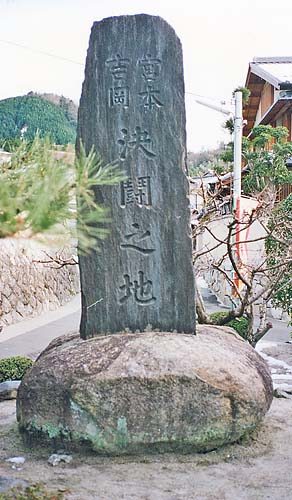
Image: The stone marking the site of the Miyamoto–Yoshioka duel at Ichijōji Sagarimatsu, Sakyō Ward, Kyoto. Photo: Fg2 (public domain / Wikimedia Commons)
The "finest swordsmen in the land" whom Musashi fought in Kyoto at 21 are thought to have been the Yoshioka family, said to have taught swordsmanship to the Ashikaga shoguns. According to the Kokura Monument, Musashi struck down the head of the family, Yoshioka Seijūrō, with one blow of a wooden sword, then defeated Yoshioka Denshichirō, and finally, at the pine tree of Ichijōji Sagarimatsu, beat off hundreds of the school's followers armed with bows and other weapons, all by himself [Legend: Kokura Monument].
However, other records say Musashi and the Yoshioka fought to a draw (the Honchō Bugei Shōden and others), and one, the Yoshioka side's own Yoshioka Den (1684), says Musashi lost. The outcome depends on the record [Debated]. And although the monument says the Yoshioka family died out after these fights, the family actually continued and became known for dyeing cloth [Widely accepted].
At the Siege of Osaka, on the Tokugawa side
In the Siege of Osaka (1614–15), Musashi joined the Tokugawa forces under Mizuno Katsunari as a mounted warrior attached to Katsunari's son Katsushige (Katsutoshi), as lists of the troops from the time confirm [Fact: Osaka campaign troop lists].
Himeji, Akashi, and Kokura
After the Siege of Osaka, Musashi was connected with the Honda lords of Himeji and the Ogasawara lords of Akashi, and he trained many students in Himeji [Widely accepted]. Records from Akashi in the Edo period say he helped lay out the castle town and design temple gardens there [Legend]. When the Ogasawara moved to Kokura (in today's Kitakyushu) in 1632, Musashi is thought to have moved there with Iori [Widely accepted].
Kumamoto and the Hosokawa family: his last five years
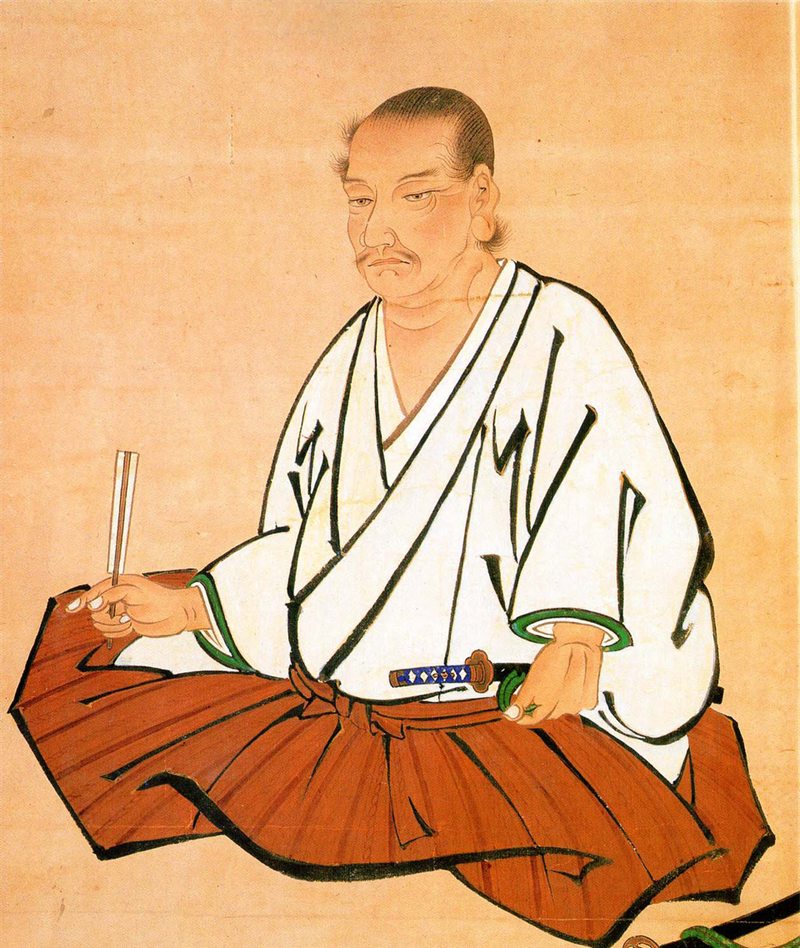
Image: Seated portrait of Miyamoto Musashi (Kumamoto Prefectural Museum of Art, mid-Edo period)
In 1640, Hosokawa Tadatoshi, lord of Kumamoto, invited Musashi to Kumamoto. He came not as a retainer but as an honored guest, and received 300 koku of rice a year (one koku is about the amount of rice one person eats in a year) [Fact]. He is said to have been given a house at Chibajō in the castle town as well [Legend: Bukōden]. Tadatoshi, a lord keen on swordsmanship, treated Musashi generously—inviting him to a hot spring, for example—but he died the following year, in 1641 [Widely accepted].
Under the next lord, Mitsunao, Musashi continued to be well treated, taught many students, and in 1643 began writing The Book of Five Rings.
Timeline of Musashi's life
| Year | Event | Note |
| 1584? | Born in Harima (some say 1582) | Worked out from The Book of Five Rings |
| c. 1596 | At 13, defeats Arima Kihei of the Shintō-ryū | His first duel |
| 1600 | Battle of Sekigahara; probably fights in Kyushu in Kuroda Josui's army | Tokugawa (eastern) side |
| c. 1604 | At 21, goes to Kyoto and fights the Yoshioka school | Outcome differs by record |
| 1612? | Fights Ganryū (Kojirō) on Ganryūjima (Funashima) | Year uncertain |
| 1614–15 | Fights for the Tokugawa (Mizuno Katsunari's army) at the Siege of Osaka | Confirmed by troop lists |
| c. 1617 on | Connected with the Honda of Himeji and the Ogasawara of Akashi | His adopted son Mikinosuke serves Honda Tadatoki |
| 1626 | Mikinosuke follows his lord in death; Iori enters Ogasawara service | | |
| 1632 | Moves to Kokura with the Ogasawara | | |
| 1638 | Fights in the Shimabara Rebellion and is hit by a stone | Letter to Arima Naozumi |
| 1640 | Welcomed by Hosokawa Tadatoshi of Kumamoto as an honored guest | 300 koku of rice |
| 1643 | Begins writing The Book of Five Rings | Aged 60 (traditional count) |
| 1645 | A week before his death, gives The Book of Five Rings to his student and writes the Dokkōdō | | |
| June 13, 1645 | Dies in Kumamoto | 60 or 61 (62 by the traditional count) |
| 1654 | Iori puts up the Kokura Monument | |
Did Musashi Have a Wife or Descendants? His Adopted Son Iori and the Miyamoto House
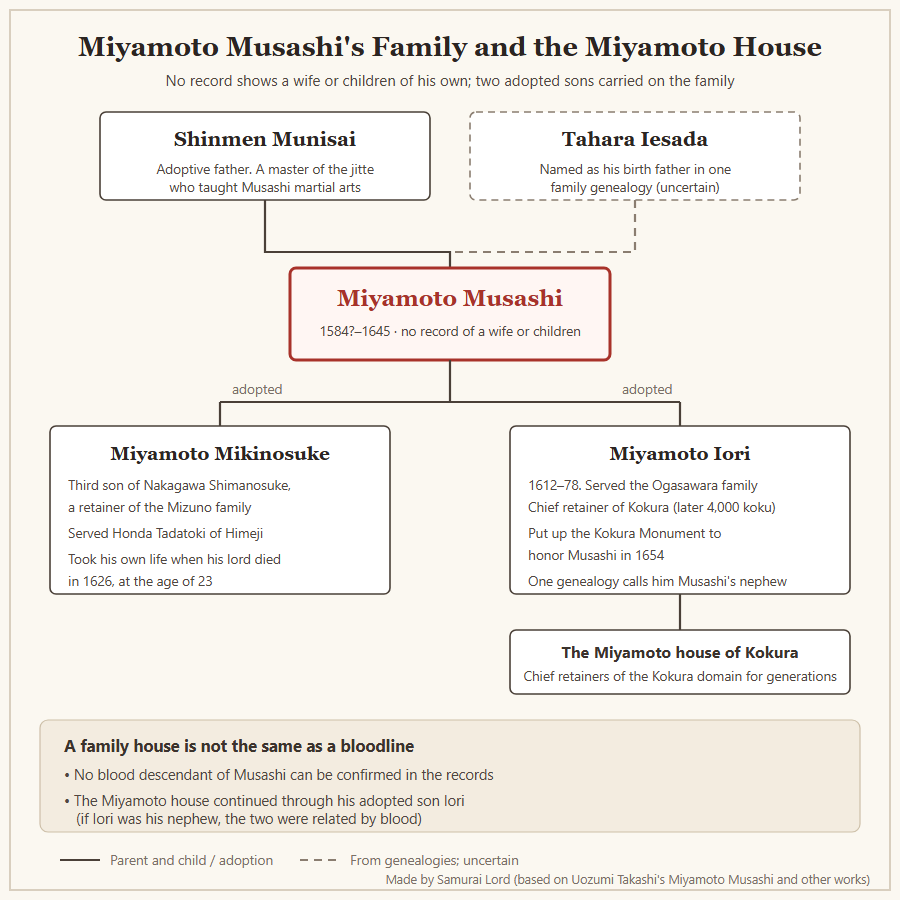
Image: Miyamoto Musashi's family and the Miyamoto house (made by Samurai Lord). Tap or click to enlarge.
The Short Answer
- There is no reliable record that Musashi had a wife or children of his own
[Unknown] - He had two adopted sons, and Iori's family—the Miyamoto house of Kokura—served as chief retainers of the Kokura domain for generations
[Fact] - So the Miyamoto house continued, but no blood descendant of Musashi can be confirmed
[Unknown]
Did he have a wife? Was Otsū real?
No record of a wife has been found. Otsū, the young woman who devotedly loves Musashi in novels and films, is a fictional character from Yoshikawa Eiji's novel [Fiction].
Edo-period writings about the pleasure quarters mention a courtesan who was close to Musashi, but these too come from later writings [Legend].
His father, Shinmen Munisai, and his two adopted sons
Musashi's adoptive father was Shinmen Munisai, known as a master of the jitte. One genealogy names Tahara Iesada of Harima as his birth father, but this is not certain [Debated].
- Miyamoto Mikinosuke: the third son of Nakagawa Shimanosuke, a Mizuno family retainer. As Musashi's adopted son he served Honda Tadatoki of Himeji, and when Tadatoki died in 1626, Mikinosuke followed his lord in death by ritual suicide (junshi) at the age of 23
[Fact] - Miyamoto Iori (1612–1678): served the Ogasawara family, became a chief retainer while still young, and was eventually granted 4,000 koku, partly for his service in the Shimabara Rebellion. His descendants served as chief retainers of the Kokura domain throughout the Edo period
[Widely accepted]
Are there descendants today? A family house is not a bloodline
Iori's family carried on the Miyamoto name, but since Iori was adopted, it is not certain that he and Musashi were related by blood. One genealogy calls Iori the son of Musashi's elder brother—his nephew—which would make them blood relatives, but the records Iori himself left say nothing about such a tie [Debated].
A family house continuing is not the same as a bloodline continuing. When people speak of "descendants of Miyamoto Musashi," they usually mean descendants of Iori's family.
So Otsū was a character in a novel…!
What carried his family on was not blood, but the bond with an adopted son. That too fits the way Musashi lived.
Musashi's Swords, Paintings, and Portraits: Musashi the Artist
What was Musashi's sword?
Swords such as "Izumi-no-kami Kaneshige" and "Hōki Yasutsuna" are often named as Musashi's favorite blades. But these come from later traditions and cannot be confirmed in records from his time [Legend].
The objects most clearly connected with Musashi are actually made of wood. The Matsui family of Kumamoto preserved a wooden sword said to be Musashi's copy of the one he used at Ganryūjima, a pair of long and short wooden practice swords, and a saddle said to be his work. A sword guard (tsuba) said to be made by Musashi is also designated a cultural property of Kumamoto Prefecture. Note, though, that while these objects' history of ownership is well documented, that does not prove Musashi made them himself [Widely accepted].
Musashi's ink paintings
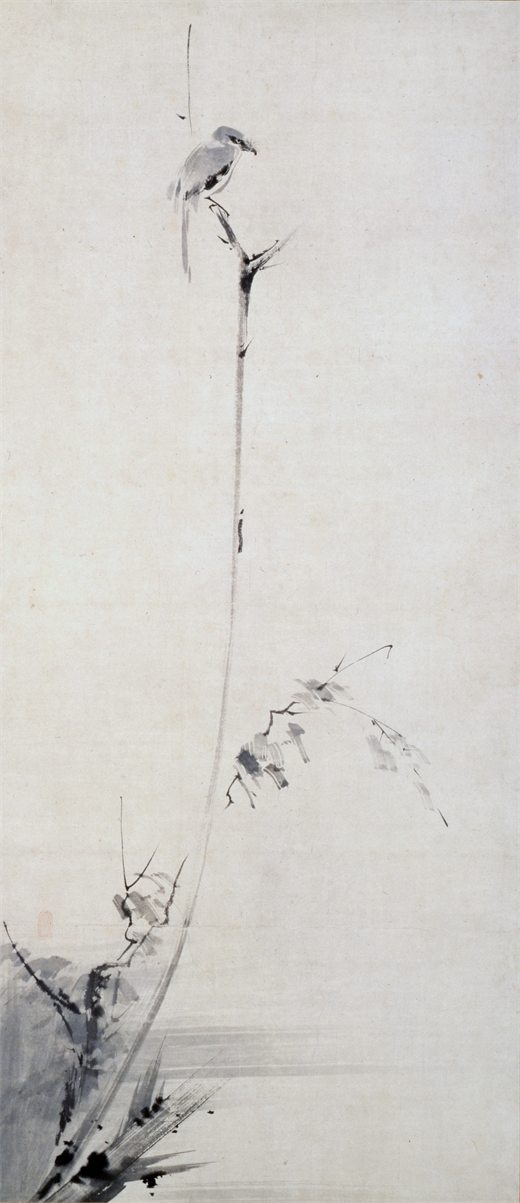
Image: Miyamoto Musashi, Shrike on a Withered Tree (Important Cultural Property, Kubosō Memorial Museum of Arts, Izumi)
Musashi left many ink paintings signed with his art name, "Niten." Shrike on a Withered Tree (Koboku Meigeki-zu), which shows a shrike perched at the tip of a dead branch, is famous for the long, thin branch drawn in a single stroke. Together with Cormorant and Doves and Red Plum Blossoms, it is designated an Important Cultural Property of Japan [Fact].
Many of his paintings show Daruma (Bodhidharma), the god Hotei, or birds, and works handed down in the Hosokawa family are held at the Eisei Bunko Museum in Tokyo and elsewhere. Not every work attributed to him is confirmed as genuine, however, and research continues [Widely accepted].
Is the famous portrait a self-portrait?
The portrait at the top of this article, showing Musashi standing with a sword lowered in each hand, belongs to the Shimada Museum of Art in Kumamoto and is a cultural property of Kumamoto Prefecture. It was handed down in the Terao family, whose members were Musashi's students, and the artist is unknown [Fact].
Because the relaxed stance matches the teachings of The Book of Five Rings, some believe it is a self-portrait, while others think a professional painter made it soon after Musashi's death [Debated].
How True Are the Novels and Manga? Fact vs. Fiction
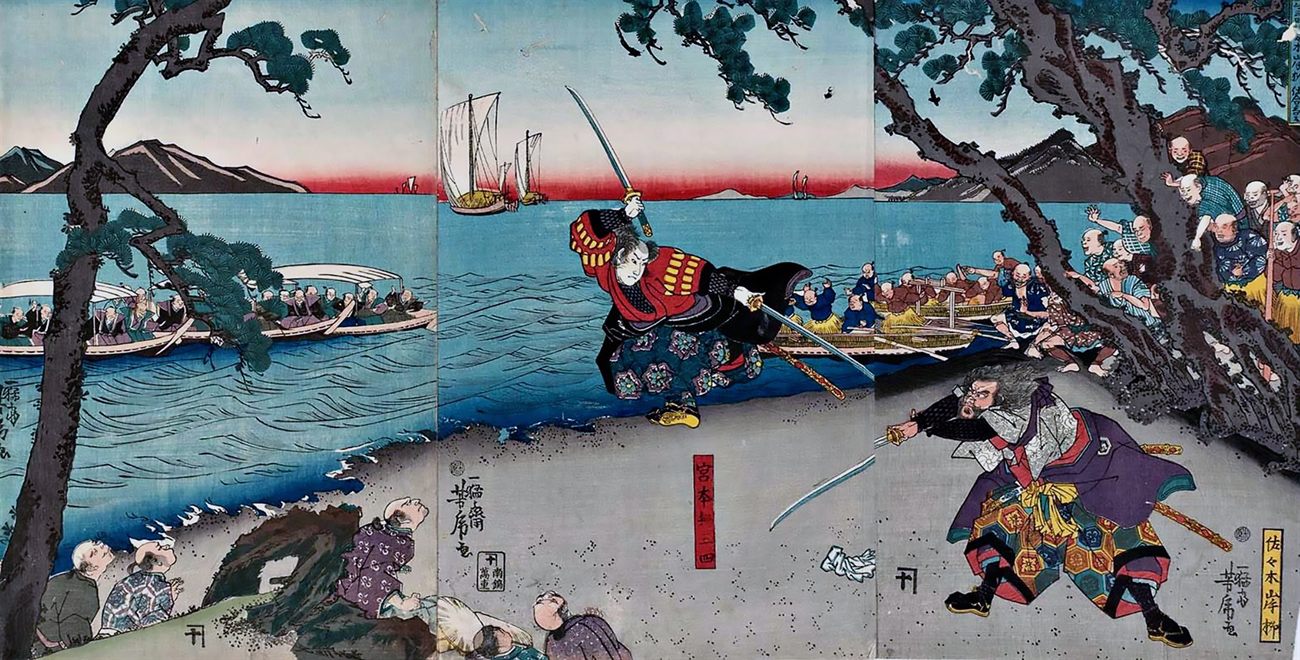
Image: The duel at Ganryūjima in a woodblock print by Utagawa Yoshifusa (about 1843–47). By the Edo period, the duel was already a favorite subject of plays and prints.
The novel that shaped today's image of Musashi is Yoshikawa Eiji's Musashi, serialized in the Asahi Shimbun newspaper from 1935 to 1939. Its story of a wild young man who grows as a person through the way of the sword became a huge bestseller. It inspired many films—including the "Samurai Trilogy" of the 1950s, the first part of which received an honorary Academy Award—and Inoue Takehiko's manga Vagabond, which is based on Yoshikawa's novel. The novel itself is available in English as Musashi.
But the novel is a story based on history, and many of its scenes and characters were invented by the author. Here are some scenes that often surprise readers, compared with the records:
| Famous scene | Earliest record we can find | What the records tell us |
| Musashi arrives late at Ganryūjima | Bukōden (1755) | The oldest record, the monument, has nothing suggesting he was late |
| The line "Kojirō, you have lost" | Bukōden (1755) | Hearsay recorded more than 100 years after the duel |
| The opponent's name was "Sasaki Kojirō" | A kabuki play (1737) and the Nitenki (1776) | Older records say only "Ganryū" or "Kojirō" |
| Kojirō was a handsome 18-year-old | Nitenki (1776) | Possibly a copying error; some historians think he was older than Musashi |
| Kojirō invents the "swallow cut" at the Kintai Bridge | Yoshikawa Eiji's novel | The bridge was built in 1673, about 60 years after the duel |
| Musashi's love Otsū and his friend Matahachi | Yoshikawa Eiji's novel | No record of them exists (fictional characters) |
| The monk Takuan guides the young Musashi | Yoshikawa Eiji's novel | Takuan was a real monk, but no record confirms that he knew Musashi |
| Musashi fights hundreds of men at Ichijōji Sagarimatsu | Kokura Monument (1654) | No other record mentions it, and some records say he drew or lost |
The Musashi who appears in manga such as Baki and in video games is a character based on the historical Musashi. This article focuses on the Musashi of history.
Frequently Asked Questions
Was Miyamoto Musashi a real person?
Yes. Letters in his own hand survive, and his name appears in the records of the Hosokawa family of Kumamoto and in troop lists from the Siege of Osaka. Many of the famous stories about him, however, were added by later biographies and novels.
When did Miyamoto Musashi live?
At the end of the Sengoku period and the start of the Edo period. He was born around 1584 (some say 1582) and died in Kumamoto in 1645.
Who won the duel, Musashi or Kojirō?
Musashi. Every record of the duel at Ganryūjima says Musashi won, but one record (the Numata Family Records) says Kojirō came to after the fight and was then beaten to death by Musashi's students, who had been hiding on the island.
How tall was Miyamoto Musashi?
A biography written in 1727 says he stood 6 shaku (about 182 cm, or 6 ft). It was written more than 80 years after his death, so it is not certain.
Where can I read The Book of Five Rings in English?
Several translations are available. Well-known ones include those by Victor Harris (1974, the first English translation), Thomas Cleary (1993), William Scott Wilson, and Alexander Bennett. Musashi's handwritten original does not survive; all versions are based on copies made by his students.
Is the Musashi in Vagabond or Yoshikawa's novel historically accurate?
Only partly. The basic outline—duels with the Yoshioka school, the fight with Ganryū, his later life in Kumamoto—follows the records, but many characters and scenes, such as Otsū, Matahachi, and the "swallow cut," were invented for the story.
Summary: Who Was Miyamoto Musashi?
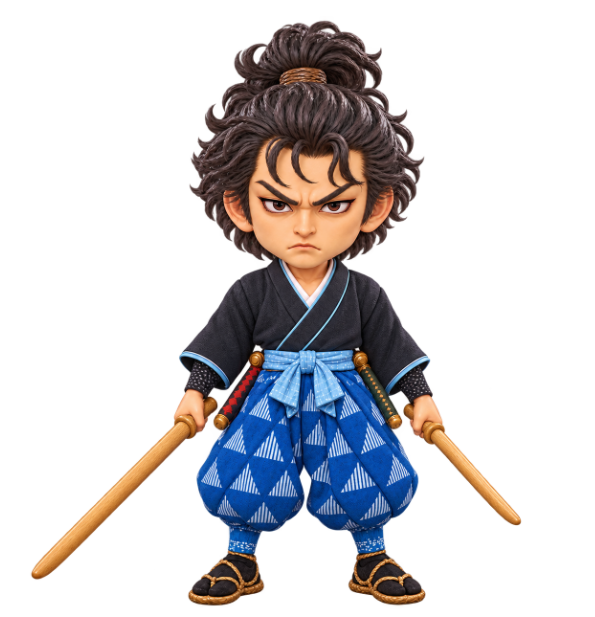
Miyamoto Musashi was a swordsman born at the end of the Sengoku period who wrote that he had fought more than 60 duels from age 13 without a single loss, and who, late in life in Kumamoto, set down his teachings in The Book of Five Rings.
Musashi won the duel at Ganryūjima, but the stories of his late arrival, the line "Kojirō, you have lost," and even the name "Sasaki Kojirō" were added as time went on. Meanwhile, records from his own time reveal another Musashi: a man who looked after the futures of his adopted sons and students, and who loved painting and calligraphy.
To learn more, read about Kuroda Josui (Kanbei), whose army Musashi probably joined around Sekigahara, in our article on Kuroda Kanbei, and about the era just before and after Musashi was born in Who Was Oda Nobunaga? and Who Was Toyotomi Hideyoshi?.
The man who won every duel with the sword ended by setting down his way with the brush. His was a life spent asking what true strength is.
The Musashi of the novels is cool, but the Musashi in the records is so human—I like him even more now!
Sources & How This Article Was Written
This article is based mainly on the following records and research:
- Musashi's own writings and letters: The Book of Five Rings (copies), the Dokkōdō, and his letter to Arima Naozumi
- Records from his own time: troop lists from the Siege of Osaka (Ōsaka Gojin no Otomo and others), letters of Miyamoto Iori, Nagaoka Yoriyuki, and others, and records of the Hosokawa family of Kumamoto
- Records written soon after his death: the Kokura Monument (1654, by Miyamoto Iori), the Numata Family Records (1672), and the Yoshioka Den (1684)
- Biographies and anecdote collections written 60 or more years after his death: the Watanabe Kōan Taiwa (1709), the Honchō Bugei Shōden (completed 1714, published 1716), the Bushō Kanjōki (1716), Tanji Hōkin's Records (Heihō Taiso Bushū Genshin-kō Denrai, 1727), the Bukōden (1755), the Nitenki (1776), and others—labeled
[Legend]or[Folk belief]in this article - Research and references: Uozumi Takashi, Miyamoto Musashi: "Heihō no Michi" o Ikiru (Iwanami Shoten, 2008); Ōkura Ryūji, Miyamoto Musashi (Yoshikawa Kōbunkan, 2015); the source texts and notes of the Miyamoto Musashi Research Project (Harima Musashi Kenkyūkai); tourism guides from Yamaguchi Prefecture, Shimonoseki, and Kumamoto—all in Japanese
- Images: the portrait of Musashi (Shimada Museum of Art), the seated portrait (Kumamoto Prefectural Museum of Art), Shrike on a Withered Tree, the woodblock prints by Utagawa Kuniyoshi and Utagawa Yoshifusa, and the photo of the Ichijōji Sagarimatsu marker (by Fg2) are public-domain images from Wikimedia Commons; the photo of Musashizuka (by 水だらけのプール) is CC0; the photos of the Kokura Monument (by 速日), Ganryūjima (by なしはな), and the Ganryūjima statues (by RoninjapanWiki) are under CC BY-SA 4.0; and the photo of Reigandō (by STA3816) is under CC BY-SA 3.0. The timeline, family chart, and illustrations are original to Samurai Lord
What the Labels Mean
[Fact]Confirmed by Musashi's own writings or by sources from his time ([Fact: …]names the source)[Widely accepted]The view held by most historians[Debated]Historians disagree[Unknown]No source tells us[Legend][Fiction][Folk belief]Stories created later, or claims with little evidence ([Legend: …]names the book where the story appears)
This article was written by the Samurai Lord editorial team and is revised as new research and reader feedback come in. If you spot an error, please let us know through our contact form (in Japanese) and we will check and correct it.
Read in Japanese
This article is also available in Japanese: 宮本武蔵とは?巌流島の決闘・五輪書・死因を史料で解説